
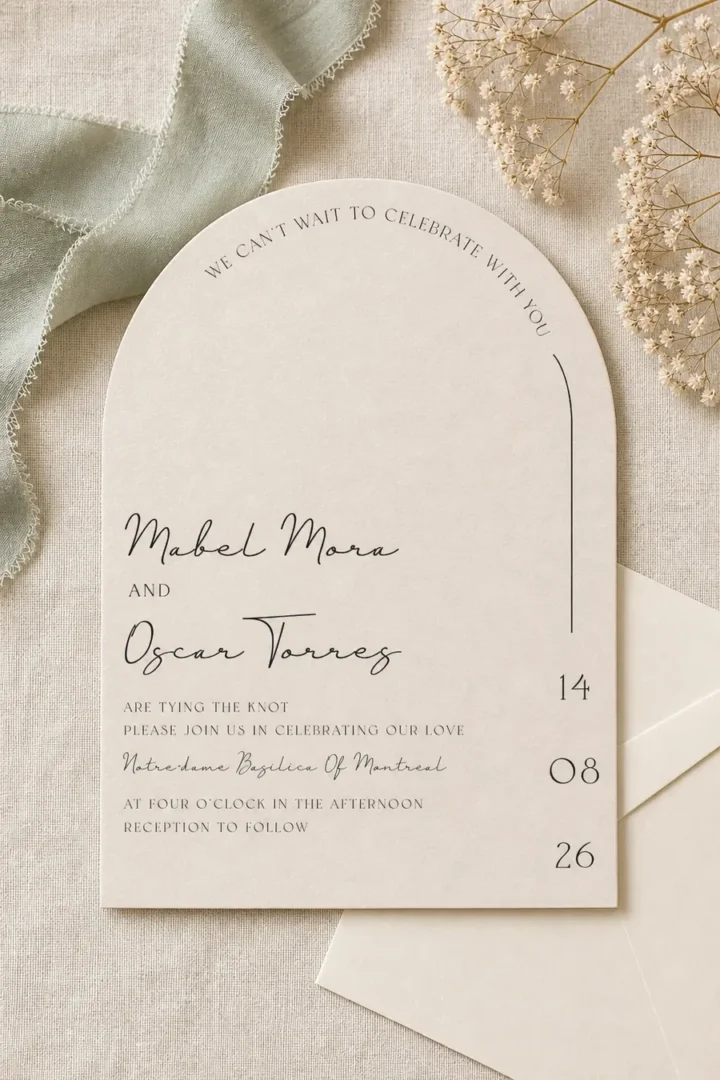
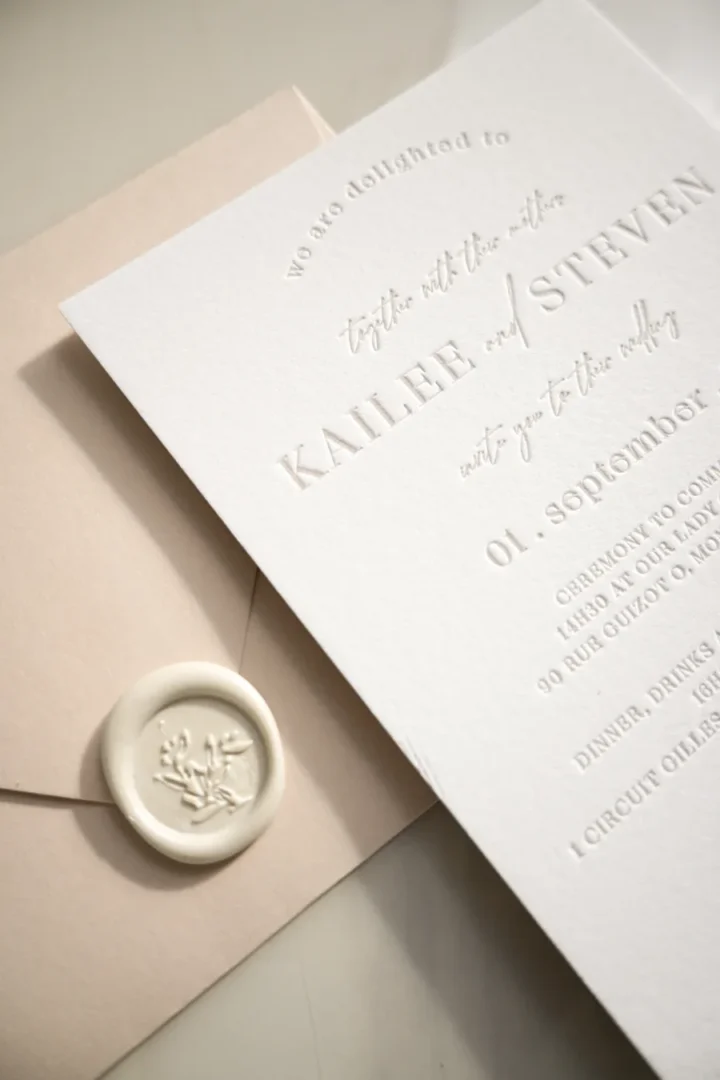
Pictured above: the Ivory wedding invitation in almond, on its envelope.
Addressing wedding invitations sounds simple until you are staring at a blank envelope wondering whether to write “Dr. and Mrs.” or “Mrs. and Dr.” Getting it right matters: the envelope is the first impression your guests receive, and proper addressing signals care and thoughtfulness before they even open the flap. Addressing is just one piece of the bigger picture, so if you are working through the common wedding invitation etiquette questions couples run into, start there first.
Shop wedding invitations at Paperlust
500+ exclusive wedding invitation designs, free white envelopes, and 1-2 day proofs.
Shop wedding invitations at Paperlust
Once you’ve nailed the wording, find a design to match. Designer suites, 1-2 day proofs, and 100+ styles to personalise.
The good news is that once you understand the core rules, most scenarios follow a predictable pattern. This guide walks through every situation you will likely encounter on your guest list, from married couples sharing a surname to military titles, widows, divorced guests, and families with grown children. Each section includes clear, copy-ready examples, and the comprehensive lookup table below covers all 31 common scenarios so you can reference it while you work through your stack.
Whether you are going fully traditional with double envelopes or keeping things modern with a single mailing envelope, the guidance below applies to both. And if you want help with what goes inside the envelope, our invitation wording guide covers everything from formal to casual phrasing.
Complete Addressing Reference: Every Guest Scenario
Use this table as your working reference while you address envelopes. Find your guest situation in the left column, then copy the exact wording for the outer and inner envelopes. Every scenario is covered in detail further down this page.
| Guest Situation | Outer Envelope | Inner Envelope |
|---|---|---|
| Married couple, same surname (traditional) | Mr. and Mrs. Daniel Smith | Daniel and Sarah |
| Married couple, same surname (both first names listed) | Mr. Daniel and Mrs. Sarah Smith | Daniel and Sarah |
| Married couple, different surnames (alphabetical) | Mr. Brian Barbee and Mrs. Emily Geyer | Brian and Emily |
| Married couple, different surnames (woman first) | Ms. Rachel Goldstein and Mr. David Chen | Rachel and David |
| Unmarried couple, same address | Ms. Sarah Anderson and Mr. Michael Taylor | Sarah and Michael |
| Same-sex couple, two men, same surname | Mr. James and Mr. David Wilson | James and David |
| Same-sex couple, Messrs. form (same surname) | Messrs. James and Alexander Hollis | James and Alexander |
| Same-sex couple, two women, same surname | Ms. Rachel and Ms. Claire Chen | Rachel and Claire |
| Same-sex couple, different surnames | Ms. Claire Foster and Ms. Maya Green | Claire and Maya |
| Non-binary guest (Mx. honorific) | Mx. Jordan Clarke | Jordan |
| Single woman (contemporary) | Ms. Rachel Kim | Rachel |
| Single woman (traditional, under 25) | Miss Claire Bennett | Claire |
| Single man | Mr. James Hollis | James |
| Single guest, unnamed plus one | Ms. Rachel Kim and Guest | Rachel and Guest |
| Single guest, named plus one | Ms. Rachel Kim and Mr. Daniel Perez | Rachel and Daniel |
| Family: parents listed on outer | Mr. and Mrs. James Wilson | James, Sarah, Emma, Oliver, and Henry |
| Family: “and Family” form | The Wilson Family | James, Sarah, and children |
| Adults-only invitation | Mr. and Mrs. James Wilson | James and Sarah |
| Adult child (18+), same address as parents | Ms. Emma Wilson [separate envelope] | Emma |
| Widow | Mrs. Margaret Collins | Margaret |
| Widower | Mr. Robert Collins | Robert |
| Divorced woman, reverted to maiden name | Ms. Rachel Goldstein | Rachel |
| Divorced woman, kept married surname | Mrs. Rachel Hollis | Rachel |
| One partner is a doctor (woman is doctor) | Dr. Emily Johnson and Mr. Michael Brown | Emily and Michael |
| One partner is a doctor (man is doctor) | Dr. David Chen and Ms. Rachel Chen | David and Rachel |
| Both partners are doctors, same surname | Drs. Emily and Michael Brown | Emily and Michael |
| Judge | The Honorable Sarah Chen and Mr. David Chen | Sarah and David |
| Clergy (Reverend or Pastor) | The Reverend John Williams and Mrs. Susan Williams | John and Susan |
| Military officer, single | Captain James Hollis, United States Army | James |
| Military officer with spouse | Captain James Lee and Mrs. Anna Lee | James and Anna |
| Military enlisted (below officer rank) | Mr. James Hollis, United States Army | James |
Custom address labels simplify your mailing. Print return address labels at Paperlust Print Shop, from $0.08 each.
How to Choose Your Wedding Invitation Addressing Style
Three factors shape every envelope: the formality of your wedding, whether you’re using outer + inner envelopes or just one, and how mixed your guest list is in titles and relationships.
1. Lock formality first
Formal weddings (black-tie, religious ceremony, heritage venue) require full titles, spelled-out words, and outer + inner envelope conventions. Casual weddings (backyard, brewery, destination) can drop titles, abbreviate, and use a single envelope. Pick one formality level and apply it to every guest, mixing formal and casual addressing across envelopes looks careless.
2. Decide single vs double envelope
Double envelopes (outer + inner) carry the formal weight and let you list children separately on the inner. Single envelopes are simpler and cheaper but require careful phrasing when the household has plus-ones or kids. If you’re sending more than 80 invitations, the double-envelope upgrade is worth the extra cost, addressing errors are easier to recover from when the inner envelope absorbs the personal phrasing.
3. Build a relationship-bucket sheet before you start writing
Every guest household falls into 6-7 buckets: married-same-surname, married-different-surnames, unmarried-cohabiting, same-sex-married, single, single-with-plus-one, family-with-children, professional-title-holder. Define your phrasing for each bucket once, then sort your guest list by bucket and address in batches. Browse wedding invitations with envelope printing options if you want the addressing done at the same time as the invite.

Outer Envelope vs. Inner Envelope
| Element | Outer envelope | Inner envelope |
|---|---|---|
| Purpose | Mailing; travels through the postal system | Personal; directly addresses guests at home |
| Formality | Most formal | More personal and casual |
| Name format | Mr. and Mrs. Thomas Hollis | Thomas and Margaret |
| Street address | Yes, full address required | No address, names only |
| Children listed? | No (outer shows head of household only) | Yes, children listed by first name if invited |
| Abbreviations | No, spell out Street, Avenue, etc. | More flexible |
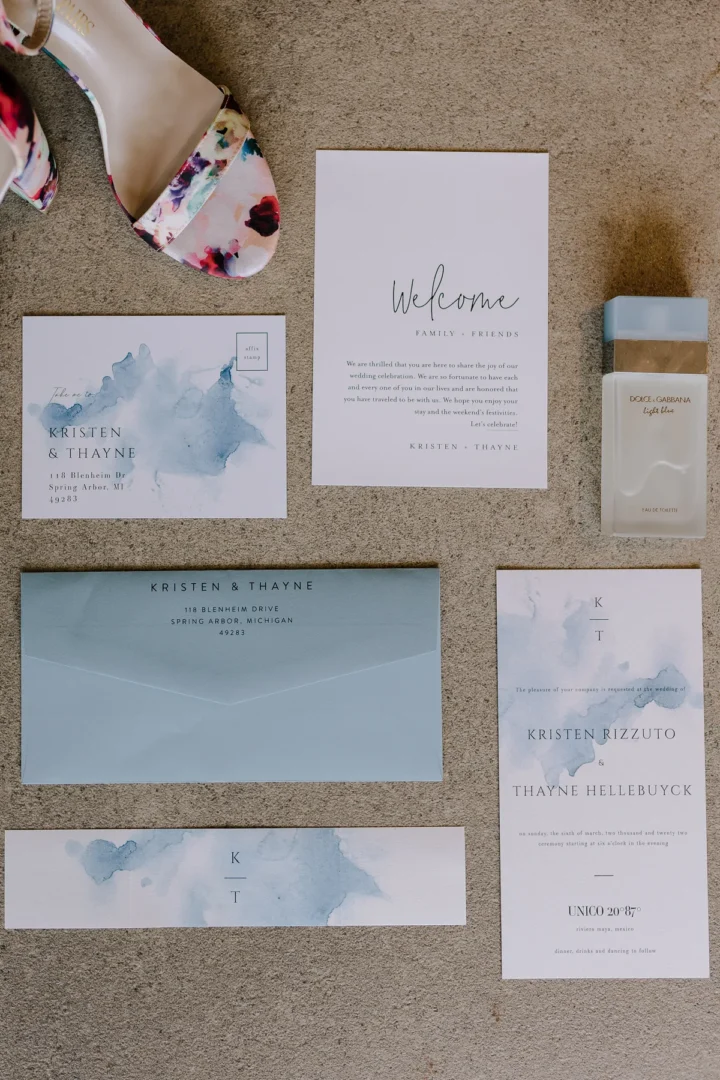
A coordinated wedding invitation suite with envelope addressing in matching typography.
Traditional formal weddings use two envelopes. The outer envelope is the mailing envelope: it carries full formal names, titles, and the complete postal address, and it travels through the mail system. The inner envelope sits inside and is what guests actually open at home. It is addressed more informally, using last names only or even first names, and it specifies precisely who is invited from that household.
For example, the outer envelope might read “Mr. and Mrs. James Wilson” while the inner reads “James and Sarah” or lists the children by first name if they are included. If children are not invited, you simply leave their names off the inner envelope, which removes any ambiguity.
Today, most couples use a single envelope. If that is your approach, treat it like the outer envelope: full formal names, correct titles, and the complete mailing address. To communicate who is (and is not) invited, use a separate enclosure card or note it clearly on your RSVP.
Shop classic wedding invitations
Timeless layouts and refined typography, ready to personalise.
Outer Envelope Rules: What Every Envelope Needs
Before getting into specific guest scenarios, here are the universal rules that apply to all outer envelopes:
- Spell out everything: “Street” not “St.”, “Avenue” not “Ave.”, “Apartment” not “Apt.” on formal outer envelopes.
- Spell out state names on the most formal invitations: “California” not “CA.” This is optional for semi-formal and casual weddings, the USPS preference is actually the abbreviated format for machine sorting, so many couples use abbreviations regardless of formality level.
- No nicknames: “Robert” not “Bob,” “William” not “Bill” on formal outer envelopes.
- Return address on the back flap is the traditional placement; top-left front is also widely accepted and more practical for USPS automated sorting.
- Guest address is centered on the front of the envelope.
- Omit punctuation after the street address line and city/state/zip line on formal invitations, traditional etiquette drops the comma after the city name on envelopes.
- Each invited guest should be named: write “and Family” only if you genuinely intend to invite the entire household, including children.
Married Couples: Same Surname
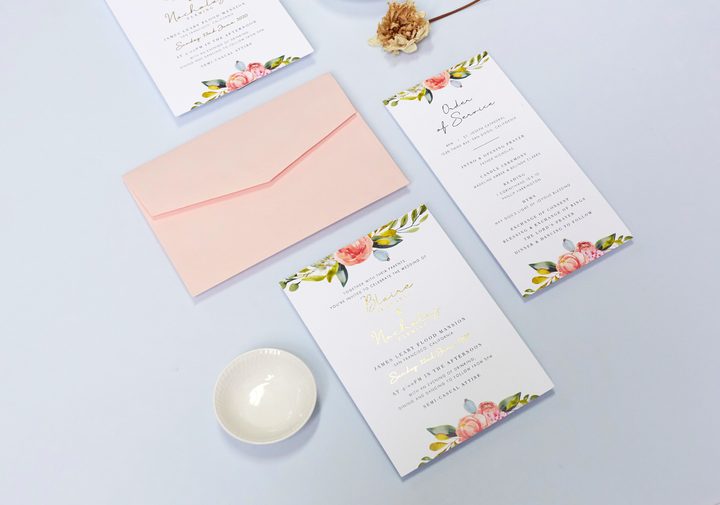
A formal wedding invitation envelope with hand-calligraphy addressing.
The classic format for a married couple who share a last name places both names on one line with the husband’s first name listed:
124 Elmwood Avenue
Charleston South Carolina 29401
If you prefer to include both first names, a popular modern option, list them together:
124 Elmwood Avenue
Charleston South Carolina 29401
Both are correct. The first is more formal and traditional; the second feels slightly warmer and more personal. For a casual or relaxed wedding, you can drop titles entirely and simply write “Daniel and Sarah Smith.”
Same-surname married couples: addressing checklist
- Outer envelope: Mr. and Mrs. James Carter
- Inner envelope: James and Sarah
- Modern variant: Mr. James Carter and Mrs. Sarah Carter
- Same-sex variant: Mr. James Carter and Mr. Liam Carter (alphabetise by first name)
- Avoid: “Mr. and Mrs. James Carter” if Sarah has retained her own first-name preference, drop the joint phrasing
Married Couples: Different Surnames
When a couple has kept different last names, list each person on their own line. The standard approach is alphabetical order by last name:
456 Magnolia Street
Atlanta Georgia 30301
Traditionally the woman’s name comes first when her name leads the line. For modern couples, either name can come first:
456 Magnolia Street
Atlanta Georgia 30301
Inner envelope (different surnames)
Alphabetical order by last name is the safest default, but if you are significantly closer to one partner, it is fine to list them first. What matters most is that both names appear and neither is treated as secondary by being omitted.
Unmarried Couples Living Together
For couples who share an address but are not married, list both names either on separate lines or joined on one line. Do not use “Mr. and Mrs.” for unmarried couples, even long-term partners:
789 Rosewood Drive
Savannah Georgia 31401
Inner envelope (unmarried couple)
Alphabetical order by last name works well as a neutral default. As with married couples with different surnames, you can list the person you know better first if that feels more natural.
Shop wedding invitations at Paperlust
500+ exclusive wedding invitation designs, free white envelopes, and 1-2 day proofs.
Unmarried cohabiting couples: addressing checklist
- List both names on the same line or separate lines, alphabetical by surname
- Both names get a courtesy title (Ms., Mr., or Mx.)
- Inner envelope uses first names only: Sarah and Michael
- If only one is invited: address to that person alone; do not add “and Guest” unless plus-ones are open
- Avoid: “Mr. and Mrs.”, they are not married, so the convention does not apply
Same-Sex Couples
The same rules apply for same-sex couples. For a married couple sharing a surname, use the appropriate shared title:
124 Elmwood Avenue
Charleston South Carolina 29401
An alternative for two men sharing a surname is the plural honorific “Messrs.” (pronounced “messers”), which is rare but entirely correct:
124 Elmwood Avenue
Charleston South Carolina 29401
For two women sharing a surname:
456 Magnolia Street
Atlanta Georgia 30301
For a couple with different surnames, list alphabetically:
789 Rosewood Drive
Savannah Georgia 31401
Non-binary guests
For guests who use gender-neutral titles, “Mx.” is the correct honorific. It is pronounced “mix” and functions the same way as Mr. or Ms.:
222 Birchwood Court
Portland Oregon 97201
If you are unsure of a guest’s preferred title, use their full name without any honorific: “Jordan Clarke” is completely acceptable on modern invitations and avoids any potential misgendering.
If both partners use the same title (both Mr., both Ms.), you can write “Mr. and Mr.” or “Ms. and Ms.” naturally before the names. The goal is that both partners feel equally acknowledged.
Single Guests
For a single guest who is not being offered a plus one, address the envelope to them alone. Two honorifics apply to women:
“Miss” is the traditional honorific for an unmarried woman, particularly under 25. “Ms.” is the contemporary neutral form that does not indicate marital status, and it is preferred by most adult women today:
1234 Oak Street
Brooklyn New York 11201
For a younger single woman where “Miss” is clearly appropriate:
789 Rosewood Drive
Savannah Georgia 31401
When in doubt, use “Ms.”, it is universally appropriate regardless of age or marital status. For single men:
101 Oak Lane
Nashville Tennessee 37201
Inner envelope (single guest)
Single Guest with a Plus One
If you are offering a plus one but do not know the partner’s name, add “and Guest” after the invited person’s name:
1234 Oak Street
Brooklyn New York 11201
Inner envelope (single guest with guest)
If you know the partner’s name, address them both properly:
1234 Oak Street
Brooklyn New York 11201
Important: only include “and Guest” if you genuinely intend to extend a plus one. Leaving it off the envelope is the clearest signal that the invitation is for that person alone. If a guest later asks about bringing someone and the envelope did not say “and Guest,” you are well within etiquette to politely explain your guest count.
Shop elegant wedding invitations
Elegant wedding invitations with refined typography and considered layouts.
Families with Children
When inviting an entire family, including the kids, you have several options depending on how formal you want to be:
Option 1: Parents only on outer (implies the whole household is invited)
124 Elmwood Avenue
Charleston South Carolina 29401
Option 2: “And Family” form
124 Elmwood Avenue
Charleston South Carolina 29401
Use “and Family” or “The [Surname] Family” only when you genuinely intend to invite everyone at that address, including children. If you want only the named adults, do not use this phrasing.
Inner envelope (children invited)
Emma, Oliver, and Henry
Inner envelope (adults only)
The absence of children’s names on the inner envelope is the clearest signal that it is an adults-only event. If you are using only a single envelope, address the outer envelope to the parents and include a brief note in your RSVP card clarifying that the event is adults-only. If it is an adults-only reception, do not reference children anywhere on either envelope.
Family-with-children addressing checklist
- Outer envelope: Mr. and Mrs. Carter (parents only, keeps the formal voice)
- Inner envelope: James, Sarah, Emma, and Noah (lists every invited guest by first name)
- Children under 18: only listed on the inner envelope, never the outer
- Children 18 and older: get their own separate invitation, even if they live at the same address
- “And Family” is acceptable on casual invites but not appropriate for formal black-tie weddings
Children 18 and Older at the Same Address
Adult children living at the same address as their parents should receive their own separate invitation. This applies even if the invitation would go to the exact same mailbox. Sending a separate envelope acknowledges that they are adults and deserve to be invited in their own right, not as an afterthought under their parents’ names.
Address the second invitation directly to them:
[Same address as parents]
If there are multiple adult children at the same address, you can address one envelope to all of them: “Ms. Emma Wilson and Mr. Oliver Wilson”, or send individual envelopes if they are being given separate guest allowances.
Widows and Widowers
A widow is traditionally addressed using her married name and the “Mrs.” title she has used throughout her marriage:
124 Elmwood Avenue
Charleston South Carolina 29401
Many widows prefer to retain this form, so it is usually the safest choice unless you know she has resumed using a maiden name or has a different preference. If she has remarried, address her according to her current name and marital status.
A widower follows the standard format:
124 Elmwood Avenue
Charleston South Carolina 29401
There is no change in addressing convention for men who have lost a spouse unless they have remarried.
Divorced Guests
Divorced guests require a small amount of research before you address the envelope, specifically, whether they have reverted to a maiden name or kept their married surname.
Divorced woman who has reverted to maiden name
789 Rosewood Drive
Savannah Georgia 31401
Divorced woman who has kept her married surname
789 Rosewood Drive
Savannah Georgia 31401
Use “Mrs.” for a divorced woman who has kept the married surname and “Ms.” for one who has reverted to her maiden name or simply prefers “Ms.” regardless. When in doubt, “Ms.” is always safe, it does not imply marital status and is universally appropriate.
If a divorced couple is attending separately but you know both, send each an individual invitation to their current address. Never send one envelope addressed to both a divorced couple.
Professional Titles: Dr., Judge, Clergy, Military
When a guest holds a professional title, use it in place of Mr. or Mrs./Ms. The person with the higher or more formal title typically goes first, regardless of gender.
Doctor (one partner is doctor, woman is doctor)
456 Magnolia Street
Atlanta Georgia 30301
The doctor goes first, even if that breaks traditional gender-based ordering. This is the modern standard and is universally accepted.
Doctor (one partner is doctor, man is doctor)
456 Magnolia Street
Atlanta Georgia 30301
Traditional form: “Dr. and Mrs. David Chen”, used when the wife does not use a distinct professional name and the couple prefers formal convention. Modern etiquette prefers the form above, which names both partners individually.
Note: If the wife’s name is professionally distinct from the husband’s, list both full names: “Dr. David Chen and Ms. Rachel Goldstein.”
Doctor (both partners are doctors, same surname)
456 Magnolia Street
Atlanta Georgia 30301
You can also write out both titles in full: “Dr. Emily Brown and Dr. Michael Brown.”
Doctor (different surnames)
456 Magnolia Street
Atlanta Georgia 30301
Judge
124 Elmwood Avenue
Charleston South Carolina 29401
Clergy (Reverend or Pastor)
Religious leaders receive their title in full before the name:
567 Church Street
Nashville Tennessee 37201
Military (active duty officer)
Active military personnel use their rank on formal envelopes. Army and Air Force officers list rank before the name on the same line. The branch appears on the line below:
United States Army
101 Oak Lane
Nashville Tennessee 37201
Military officer with spouse
If one partner is in the military and the other is not, the service member goes first:
101 Oak Lane
Nashville Tennessee 37201
Navy officer
United States Navy
124 Elmwood Avenue
Charleston South Carolina 29401
Military enlisted (below officer rank)
For enlisted personnel below officer rank, use “Mr.” or “Ms.” before the name and list the branch on the line below:
United States Army
101 Oak Lane
Nashville Tennessee 37201
For retired officers, it is generally fine to use the rank, most appreciate the acknowledgment. When in doubt, ask or use “Mr.” to be safe.
Shop wedding invitations at Paperlust
500+ exclusive wedding invitation designs, free white envelopes, and 1-2 day proofs.
Return Address Placement
For formal wedding invitations, the return address goes on the back flap of the outer envelope, centered on the flap. This is the traditional placement and keeps the front of the envelope clean and elegant.
A more casual alternative is the upper-left corner of the front, which is more compatible with USPS automated sorting since the return address must be visible from the front for machines to read it. For most wedding invitation suites, the back flap is the right choice visually, but either placement is correct.
Use the address where you want undelivered envelopes to be returned, typically your home address or wherever you are coordinating RSVPs. If a professional addressing or printing service is handling your envelopes, make sure the return address font and style matches the rest of your suite.
Assembling and Mailing Your Wedding Invitation Suite
Getting the addressing right is only part of the job. How you assemble and mail the suite affects both the presentation when guests open it and whether the post office handles it smoothly.
Stacking order inside the outer envelope
The traditional assembly order, from bottom (back of envelope) to top (closest to the flap), is:
- The invitation itself: face up so it is the first thing guests see
- Tissue paper (if included), laid over the invitation face. Tissue is a historic convention from an era when ink smudged easily; most modern couples omit it, but it looks elegant if your design warrants it
- Information cards: venue details, accommodation suggestions, travel directions, placed on top of the invitation
- RSVP card: tucked face-up under the flap of the pre-addressed RSVP envelope, then placed on top of the information card
- Inner envelope (if using double envelopes), the whole stack goes inside the inner envelope, which then goes inside the outer, with the inner’s flap visible when the outer is opened
If you are using a pocket-fold invitation (where the card opens to reveal inner pockets), insert the information card and RSVP card into the pockets in descending order of size.
Postage weight and hand-cancelling
A standard mailing envelope with one card inside typically falls under the 1-ounce first-class threshold. A full suite, invitation, RSVP card, RSVP envelope, information card, and wax seal, can easily hit 2-3 ounces. Weigh a stuffed, sealed sample at the post office before buying postage for the full run.
Oversize envelopes (anything wider than 6 1/8 inches or taller than 4 1/2 inches) and square envelopes incur a non-machinable surcharge regardless of weight. Most wedding invitation envelopes qualify.
Request hand-cancelling at the post office counter rather than running envelopes through the machine. Machine cancelling can damage wax seals, embossed finishes, and delicate paper stocks. Hand-cancelling adds a small per-piece fee at some locations (or none at others), but it is worth asking about for a luxury suite. Bring all your envelopes to a single counter window and ask the postal clerk directly.
Mailing timeline
Send wedding invitations 6-8 weeks before the wedding date for domestic guests, and 10-12 weeks for guests travelling internationally. If the week of your mailing includes a major US holiday (Thanksgiving, Christmas, July 4th), add another week to account for slower postal service. For destination weddings, 3-4 months out is not excessive when guests need to book flights and accommodation. Your save the dates should have gone out 6-12 months earlier to hold the date on everyone’s calendar.
Handwritten vs. Printed Labels vs. Envelope Printing
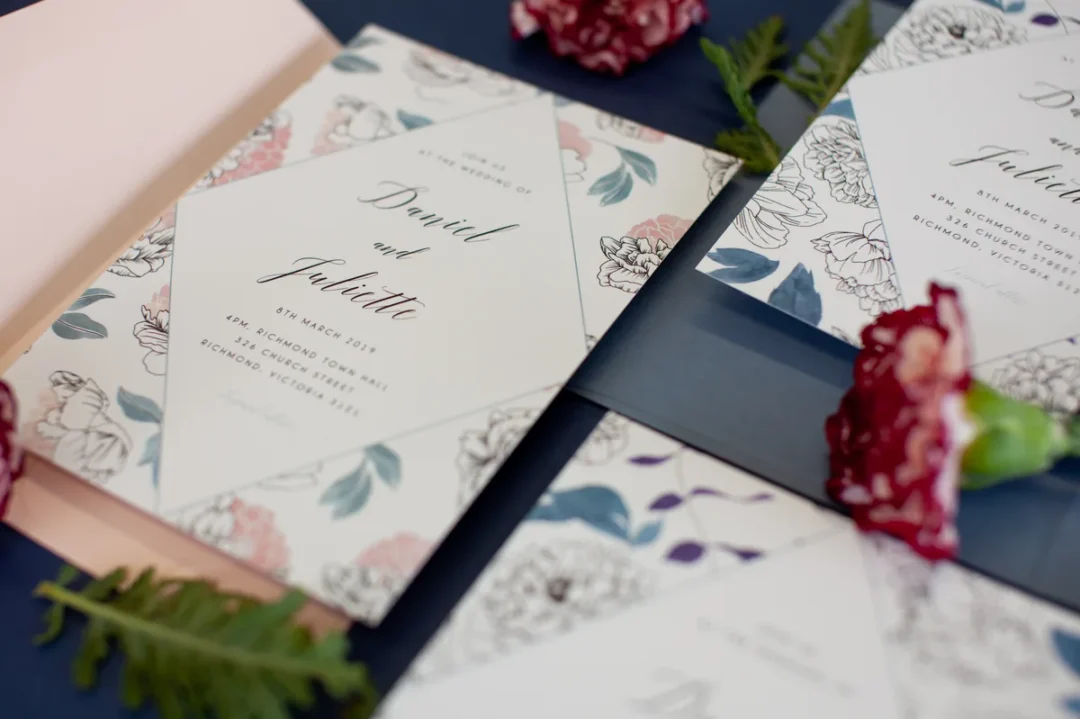
A pocket-fold wedding invitation with the inner envelope addressed to first names only.
You have three main ways to address your envelopes, each with different trade-offs:
Handwritten calligraphy
The most personal approach. Calligraphy looks beautiful and adds a layer of ceremony that printed addressing cannot replicate. However, it takes significant time, an experienced calligrapher addresses roughly 20-30 envelopes per hour, so 150 envelopes is a 5-8 hour job for a professional. Consistency across a large guest list is difficult without professional training. If calligraphy matters to you, budget for a professional calligrapher ($2-6 per envelope is typical) rather than attempting it yourself under deadline pressure. Send them a spreadsheet, not handwritten notes.
Printed labels
Fast and consistent, but labels on formal invitation envelopes tend to look out of place. Even high-quality laser labels rarely blend seamlessly with premium paper stock, the slight sheen and raised edge are visible on close inspection. Most stationery professionals advise against labels on wedding invitations above the casual tier. Labels are fine for casual or informal celebrations where they will not feel out of place.
Printed directly onto the envelope
The best balance of polish and practicality. Printing the address directly onto the envelope in a font that matches your invitation suite looks cohesive and professional, is far faster than handwriting, and produces consistent results for every guest. This is the method most professional stationers use and the approach Paperlust recommends for most couples. The key question to ask your printer: does the font match, and does the ink adhere cleanly to the envelope stock?
How to decide
- Formal black-tie wedding, 80+ guests: Envelope printing in a matched font, or a professional calligrapher for a smaller list
- Semi-formal or outdoor wedding: Envelope printing is the right call for any list over 50
- Casual celebration or micro wedding: Handwriting is manageable for under 40 guests; labels are acceptable
- Budget is tight: Printing is significantly cheaper per envelope than professional calligraphy once your list exceeds 60-70 guests
Addressing Envelopes Without Inner Envelopes
Many modern weddings skip the inner envelope entirely, it is an optional tradition, not a requirement. If you are not using inner envelopes, the outer envelope takes on the role of naming all invited guests. List everyone’s full name on the outer, or use “and Guest” or “and Family” as appropriate.
| Scenario | Single-envelope wording |
|---|---|
| Married couple, same surname | Mr. and Mrs. Thomas Hollis |
| Married couple plus children (all invited) | The Hollis Family |
| Married couple, adults only | Mr. and Mrs. Thomas Hollis |
| Single guest with unnamed plus one | Mr. James Hollis and Guest |
| Children named explicitly | Mr. and Mrs. Thomas Hollis, Lily and Jack |
| Non-binary guest | Mx. Jordan Clarke |
If there is no inner envelope and the guest list includes children, include a brief note in your RSVP or information card clarifying whether children are invited. Do not leave ambiguity in the envelope and expect the information card to resolve it, guests may not read enclosures carefully before calling to ask.
Paperlust Address Manager: The Easiest Way to Address Your Envelopes
If the thought of addressing 150 envelopes is making you anxious, the Paperlust Address Manager removes most of the work. You import your guest list directly via Excel, Facebook, or email contacts, and Paperlust prints each address directly onto the envelope at around $0.20 per address.
Every address is printed in a font that matches your invitation suite, so everything looks cohesive from the moment your guest picks up the envelope. No labels, no handwriting fatigue, no inconsistencies between the first envelope you address on a Tuesday morning and the last one you address on a tired Friday night.
The Address Manager works with any wedding invitations order from Paperlust. Before you commit, order a $5 sample pack to check the envelope quality and printing in person. And pair your invitations with matching RSVP cards for a complete, coordinated suite.
Shop wedding invitations at Paperlust
500+ exclusive wedding invitation designs, free white envelopes, and 1-2 day proofs.
Common Addressing Mistakes to Avoid
These are the errors that show up most often, easy to make when you are addressing 100+ envelopes under time pressure.
Using “Mr. and Mrs.” for unmarried couples
Even long-term partners who live together do not use “Mr. and Mrs.” unless they are legally married. Use both full names with individual titles instead.
Sending one invitation to a divorced couple
Even if you are inviting both people, each divorced individual gets their own separate invitation at their own address. Never address a single envelope to a divorced couple.
Listing children on the outer envelope
Children under 18 are listed on the inner envelope only. The outer envelope addresses the adult head of household. Listing children on the outer envelope looks informal and can confuse the postal service.
Adding “and Guest” when you are not offering a plus one
If you do not intend to offer a plus one, do not write “and Guest.” Guests will assume the invitation extends to a partner. The absence of “and Guest” is a clear, etiquette-approved signal.
Using nicknames on formal outer envelopes
Write “Robert,” not “Bob.” Write “Elizabeth,” not “Liz.” The outer envelope uses the guest’s full formal name. Nicknames are fine on the inner envelope where the tone is more personal.
Abbreviating street names and state names
On formal outer envelopes, “Street” not “St.”, “Avenue” not “Ave.”, and “California” not “CA.” Many couples also spell out “Apartment” instead of “Apt.” This is a formality signal, not a requirement, but if you are running a formal wedding, the abbreviations undercut the effort you have put into the rest of the suite.
Addressing to “The Smith Family” when you mean only the adults
“The Smith Family” implies the entire family is invited. If you want only the parents, address the outer to “Mr. and Mrs. Smith” and leave children off the inner envelope.
Forgetting to address the inner envelope separately
The outer envelope travels through the mail. The inner envelope is what guests pick up at home. If you are using double envelopes, both need to be addressed, but the inner uses a more casual format (first names only, or title and last name).
Addressing Timeline: When to Start and What to Do First
Addressing envelopes is one of the most time-consuming tasks in the invitation process. Getting the sequence right saves you from having to redo work.
Step 1: Collect addresses early (3-4 months before the wedding)
Guest list addresses tend to be the longest lead-time item. Send a digital address collector link with your save the dates so guests can submit their details at the same time they receive the date notification. Chase non-respondents at the 2-month mark. Export the final spreadsheet once your RSVP deadline has passed and spot-check for incomplete entries (missing apartment numbers, incorrect zip codes).
Step 2: Sort your guest list into buckets (2-3 months before the wedding)
Before you start writing, sort every household into the addressing categories covered in this guide: married-same-surname, married-different-surnames, unmarried-cohabiting, same-sex, single, single-with-plus-one, family-with-children, professional-title-holder. Define your phrasing for each category once, then address all guests in that category together. Batch addressing is far faster than decision-making envelope by envelope.
Step 3: Order envelopes and verify before printing (6-8 weeks before the wedding)
If you are having addresses printed, confirm the envelope stock, font, and ink colour with your printer before the full run. Request a proof with 3-4 test addresses that span different scenarios. Check that titles and long addresses fit on the envelope face without running into the edges. This is also the time to address any test envelopes for the stuffing and mailing tests.
Step 4: Stuff, seal, and weigh (1-2 weeks before mailing)
Assemble 5-10 complete suites in the correct stacking order and take them to the post office to be weighed. Purchase enough stamps for the full run at the correct rate. If any invitations are going internationally, purchase the correct international postage at the same time.
Step 5: Mail (6-8 weeks before the wedding for domestic, 10-12 weeks for international)
Hand-deliver the full stack to the post office counter and request hand-cancelling. Avoid dropping the stack into a collection box, it goes through the machine processing line and risks damage to wax seals and embossed stocks. Keep a record of which invitations were returned undelivered so you can follow up directly with those guests.
Frequently Asked Questions
Should I use “Ms.” or “Mrs.” for a married woman?
If you know she uses “Mrs.,” use that. If you are unsure, “Ms.” is always acceptable and does not make assumptions about marital status. Many married women today prefer “Ms.,” so it is a safe default when you are not certain of her preference.
Should I use “Miss” or “Ms.” for single women?
“Miss” is the traditional honorific for an unmarried woman, particularly one under 25. “Ms.” is the contemporary-neutral honorific that does not indicate marital status and is preferred by most adult women. When in doubt, use “Ms.”, it is universally appropriate regardless of age.
What if I do not know someone’s preferred honorific?
Use their first and last name with no honorific. “Jordan Clarke” with no title is completely acceptable on modern invitations and avoids any potential misgendering or incorrect title. Alternatively, ask a mutual friend or contact the guest directly.
What if I do not know whether a guest is married or single?
Address the envelope to their full name with the appropriate title and no reference to a partner. If you want to offer a plus one but do not know the partner’s name, add “and Guest.” When genuinely unsure, check with a mutual friend or reach out to the guest directly before mailing.
Do I have to use titles like Mr. and Mrs. at all?
No. Many modern couples drop titles entirely and write names only: “Daniel and Sarah Smith” or “Rachel Kim.” This works well for casual, relaxed, or non-traditional weddings. Titles are a convention, not a requirement, and skipping them is increasingly common.
Who goes first on the envelope when addressing two people?
For married couples with the same surname, traditional etiquette lists the husband first, but the modern preference is simply whoever you are closer to, or alphabetical order by last name for couples with different surnames. For same-sex couples, either order is fine. The person with a professional title (Dr., Captain, Judge) generally goes first regardless of gender.
Do I need inner and outer envelopes for a wedding invitation?
No. Inner envelopes are a traditional convention, not a requirement. Many modern couples skip them. If you use only one envelope, address it with the same formality you would use for the outer envelope, and include all invited guests’ names (or “and Guest,” “and Family”) on the single envelope.
Should I spell out state names or use two-letter abbreviations?
For the most formal invitations, spell out the state name: “South Carolina” rather than “SC.” For semi-formal and casual invitations, two-letter postal abbreviations are fine. The USPS preference is actually the abbreviated format for machine deliverability, so many couples use abbreviations regardless of formality.
Where does the return address go?
The traditional placement is centered on the back flap of the envelope. Top-left front is also widely used and more compatible with USPS automated sorting (return address must be visible on the front for machines to read it). Either is correct, choose based on your envelope design.
How do I address an invitation to a family when I only want to invite the parents?
Name only the parents on the outer envelope and on the inner envelope. Do not use “and Family.” The inner envelope convention is clear: only the names listed there are invited. If there is no inner envelope, include a brief note in your RSVP or information card clarifying the event is adults-only.
How do I collect guest addresses without it being awkward?
A digital address collector is the easiest method. You send a link (via text or email) and guests fill in their own details, which you can then export as a spreadsheet. Many couples include this with their save-the-dates. For guests who are less tech-savvy, a quick phone call or text asking for their current address works just as well. The Paperlust Address Manager accepts Excel imports, so however you collect addresses, you can upload them directly without any reformatting.
Can I print envelope addresses instead of handwriting them?
Yes, and for larger guest lists it is practically a necessity. Paperlust’s Address Manager tool allows you to import guest addresses from Excel or Google Sheets and prints addresses in a coordinated font. This is available as an add-on to your wedding invitation order for approximately $0.20 per address.
Shop Wedding Invitations at Paperlust
Hundreds of wedding invitation designs you can customize online, with an online proof before you print.