
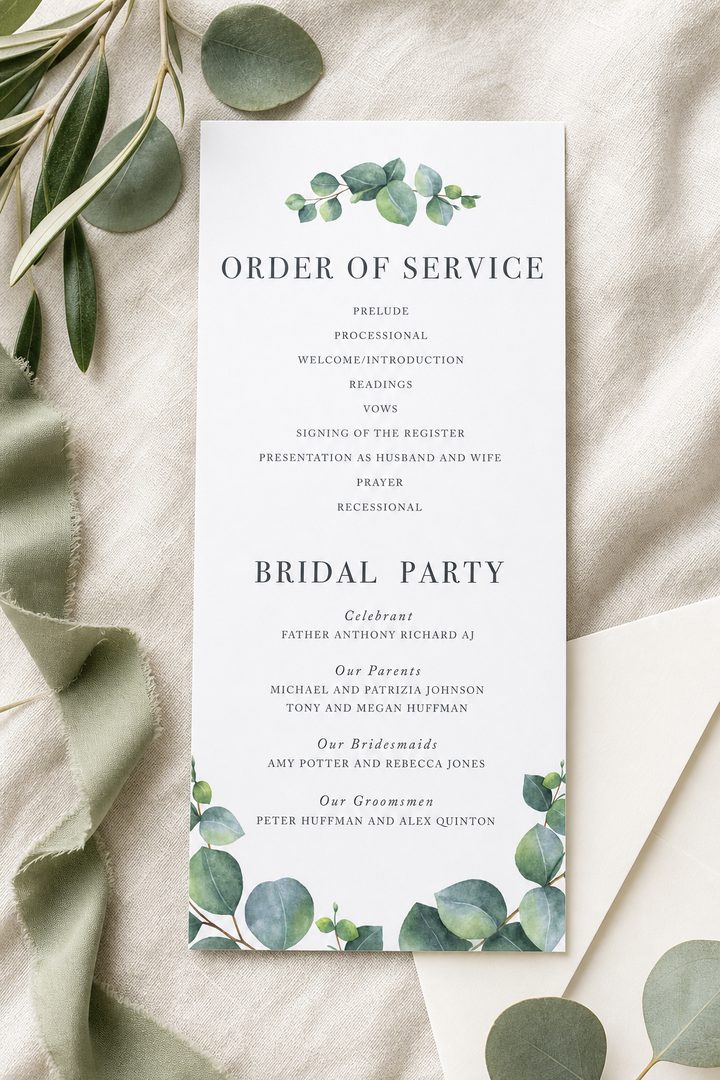
A wedding program does more than list the order of events, it sets the tone for your ceremony, helps guests follow along, and becomes a keepsake they actually hold onto. Whether you are planning an intimate civil ceremony or a full Catholic mass, these real wedding program examples will show you exactly what to include and how to lay it all out. And to keep every piece coordinated, browse Paperlust’s wedding invitations so your programs and invitations share one style.
Wedding Program Quick-Reference Cheat Sheet
- Must-haves: Couple’s names, date, venue, ceremony order, wedding party list
- Nice-to-haves: Song titles, reading citations, welcome note, memorial mention, thank-you message
- Formats: Single page, bi-fold, tri-fold, booklet, fan
- Ceremony types covered below: Civil, Catholic, Protestant, non-denominational, outdoor/beach, Jewish, Hindu, multicultural, elopement, micro-wedding, destination
- When to order: 6-8 weeks before the wedding; proof arrives within 1-2 business days
- How many: One per couple (not per guest) plus 10-15% extras
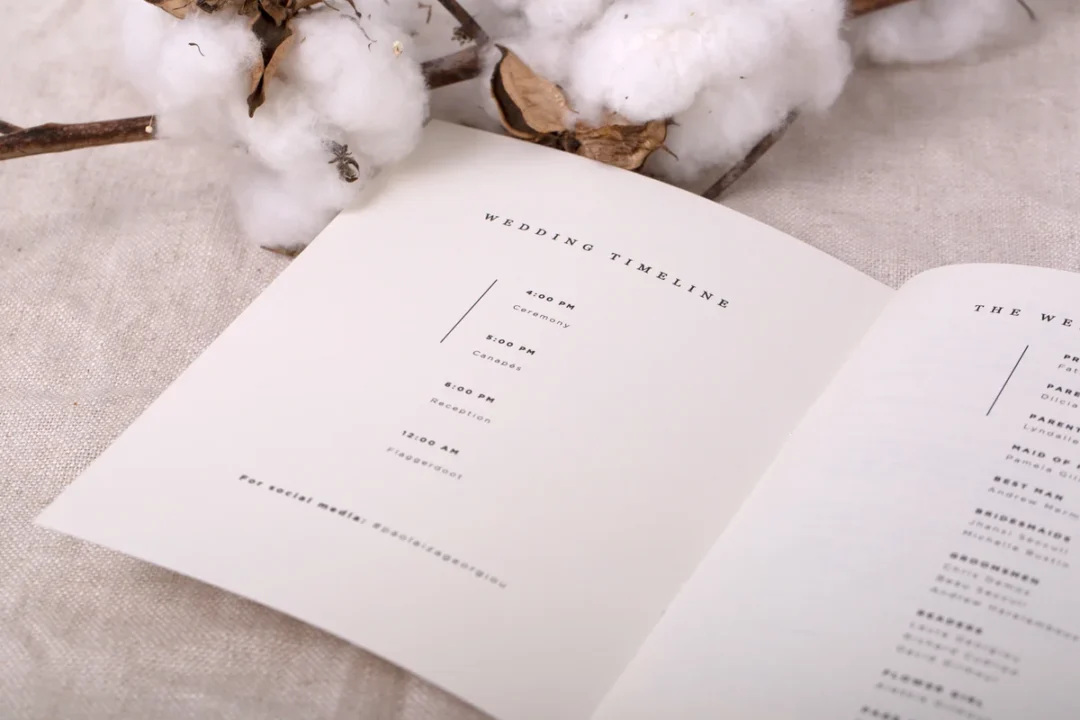

What to Include in a Wedding Program
Every wedding program has a few non-negotiables, and then a layer of personal touches that make it yours. Here is what goes in and what you can skip depending on your ceremony length and style.
The essentials (every program needs these)
| Element | What to include |
|---|---|
| Cover | Couple’s names, wedding date, venue name and city |
| Ceremony order | Each event in sequence with timing notes if helpful |
| Wedding party | Names and roles, officiant, maid of honor, best man, bridesmaids, groomsmen, flower girls, readers |
| Thank you | A brief line of gratitude to guests for traveling and celebrating with you |
Optional but appreciated
- Song titles and artists, guests love knowing what they are listening to during the processional and recessional
- Reading citations, note the source (poem, scripture, or prose) and who is reading it
- Welcome note, a short personal message from the couple, 2-4 sentences
- How we met, a fun snapshot of your love story works especially well in booklet format
- Memorial mention, a line honoring loved ones who could not be there in person
- Unplugged ceremony note, kindly ask guests to put phones away during the vows
- Reception details, venue address, timing, and any special instructions
- Cultural tradition explanations, a brief note explaining unity candle ceremonies, handfasting, or other rituals helps guests feel included
Complete Wedding Program Examples by Ceremony Type
Below are full, copy-ready program examples for the most common ceremony styles. Swap in your own names, songs, and details.
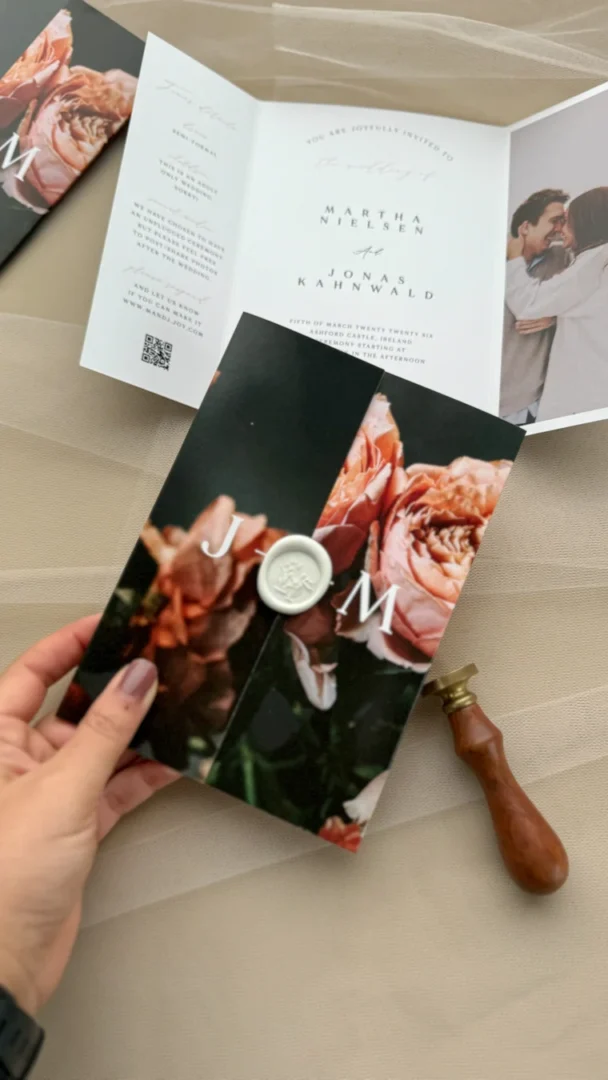
Civil ceremony program example
Civil ceremonies are typically 20-30 minutes and work perfectly on a single page or bi-fold.
Emma & Daniel
Saturday, October 4, 2026
The Botanical Gardens, San Francisco, California
Order of Ceremony
Prelude, “Can’t Help Falling in Love” by Elvis Presley
Processional, “A Thousand Years” by Christina Perri
Welcome and Opening Remarks
Reading, “i carry your heart with me” by E.E. Cummings, read by Sarah Chen
Exchange of Vows
Ring Exchange
Pronouncement of Marriage
Recessional, “You Are the Best Thing” by Ray LaMontagne
Wedding Party
Officiant: Michael Torres
Maid of Honor: Sarah Chen
Best Man: James Rivera
Bridesmaids: Lauren Park, Jessica Moore, Amanda Williams
Groomsmen: Tyler Brooks, Marcus Johnson, Kevin Lee
Thank you for celebrating this day with us. Your love and presence means everything.
Non-denominational ceremony program example
Non-denominational ceremonies have flexibility in structure. This example includes a unity ceremony and a second reading, both popular additions.
Olivia & James
Friday, June 12, 2026
The Vineyard Estate, Sonoma, California
Order of Ceremony
Prelude Music
Seating of Honored Guests
Processional, “Marry Me” by Train
Welcome
First Reading, “Union” by Robert Fulghum, read by Claire Davis
Address
Second Reading, “Love” by Roy Croft, read by Nathan Wells
Exchange of Vows
Ring Ceremony
Unity Sand Ceremony
Blessing and Pronouncement
Presentation of the Couple
Recessional, “Lucky” by Jason Mraz
Wedding Party
Officiant: Rev. Patricia Nguyen
Matron of Honor: Claire Davis
Best Man: Nathan Wells
Flower Girl: Lily Chen
A note on our unity ceremony
We will combine two separate vases of sand into one, one strand representing each of our families and the life we have built together.
Catholic wedding program example
A full Catholic wedding mass runs 60-90 minutes and has a detailed order of service. Guests who are not Catholic will appreciate the extra context a booklet provides.
The Sacrament of Holy Matrimony
Sofia & Anthony
Saturday, May 9, 2026
Saint Patrick’s Cathedral, New York
Introductory Rite
Prelude
Processional
Opening Prayer
Liturgy of the Word
First Reading, 1 Corinthians 13:4-8, read by Maria Russo
Responsorial Psalm
Gospel Acclamation
Gospel, John 15:9-12
Homily by Father Thomas Sullivan
Rite of Marriage
Statement of Intentions
Exchange of Vows
Blessing and Exchange of Rings
Liturgy of the Eucharist
Prayer of the Faithful
Offertory, “Ave Maria” by Franz Schubert
Nuptial Blessing
Holy Communion, “Panis Angelicus” by Cesar Franck
Prayer After Communion
Concluding Rite
Final Blessing
Recessional, “Ode to Joy” by Ludwig van Beethoven
All are welcome to observe Holy Communion. If you are not Catholic or not receiving, you are welcome to come forward for a blessing, simply cross your arms over your chest as a signal to Father Sullivan.
Protestant Wedding Program Example
Protestant ceremonies vary widely by denomination, but most are simpler than a Catholic Mass, no Eucharist, shorter liturgy, more flexibility for personal readings and music.
Front panel: “The Marriage of Ava & Noah | September 20, 2026 | First Baptist Church”
Inner left: Welcome, Prelude Music, Processional, Opening Prayer, Scripture Reading (John 15:12), Congregational Hymn (hymn number + first verse printed), Sermon: “A Covenant of Love”
Inner right: Exchange of Vows, Exchange of Rings, Lighting of the Unity Candle, Blessing and Pronouncement, Recessional
Back panel: Wedding party list, special acknowledgments, “Please join us for the reception at Riverside Manor following the service.”
Outdoor and beach ceremony program example
For outdoor weddings, a fan-style program serves double duty, program and cooling device. Keep the ceremony order concise and front-loaded so guests can hold the fan during the ceremony.
Maya & Noah
Sunday, August 16, 2026
Malibu Beach, California
Ceremony
Processional, “Wildest Dreams” by Taylor Swift (acoustic)
Welcome
Reading, “Somewhere I Have Never Travelled” by E.E. Cummings
Vows
Ring Exchange
The Kiss
Recessional, “Better Together” by Jack Johnson
Please feel free to use this as a fan!
Reception follows immediately at The Beach Club. Cocktails at 4:30 PM.
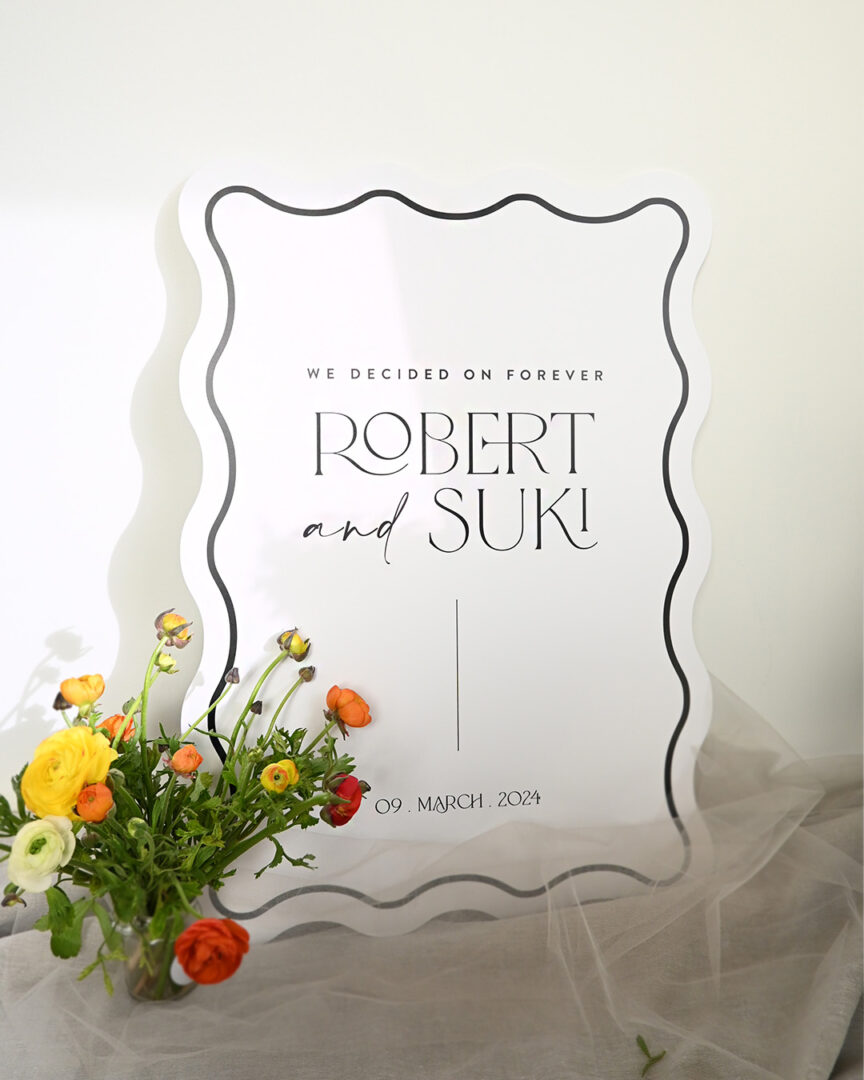
Cultural and Multicultural Ceremony Program Examples
Cultural ceremonies require programs that do more than list an order of events, they guide guests who may be unfamiliar with specific traditions. Well-crafted cultural programs create inclusion and allow everyone in the room to feel connected to the meaning of each moment.
A few principles apply to all cultural ceremony programs:
Describe Rituals With Respect and Accuracy
- Use the tradition’s own terminology (chuppah, not “canopy frame”; Saptapadi, not just “vows”).
- Include brief descriptions, one or two lines, that explain what each ritual represents without oversimplifying.
- If guests will be expected to respond or act at any point, make that clear in the text.
Jewish Wedding Program Example
Jewish weddings follow a structured order with rich ritual meaning at every stage. Programs often run 4-6 pages to accommodate the explanatory text guests need to follow along respectfully.
Cover: “The Marriage of Rachel & David | 14 Sivan 5786 | Temple Beth Shalom”
Bedeken (Veiling Ceremony), “David will lower Rachel’s veil, echoing the Biblical story of Rebecca covering herself before meeting Isaac.”
Kabbalat Panim (Welcoming the Bride and Groom), separate receptions described
Processional under the Chuppah, “The chuppah symbolizes the couple’s first home together, open on all sides to welcome family and community.”
Kiddushin (Betrothal), Ring ceremony with Hebrew blessing printed and transliterated
Ketubah Reading, “Our wedding contract, witnessed by two people who love us”
Sheva Brachot (Seven Blessings), all seven printed in Hebrew, transliteration, and English
Breaking of the Glass, “In remembrance of the destruction of the Temple in Jerusalem, and as a symbol that our joy is always coupled with awareness of the world’s pain. All: Mazel Tov!”
Yichud (Seclusion), brief description
Hindu Wedding Program Example
Hindu ceremonies are typically the most ritual-dense of any ceremony type, with multiple distinct stages that can span several hours. A program booklet, with each ritual named in Sanskrit, transliterated, and briefly explained in English, allows guests from all backgrounds to participate meaningfully.
Cover: “The Wedding of Priya & Arjun | June 28, 2026 | The Magnolia Estate”
Welcome note: “This ceremony follows the Vedic tradition. We have included descriptions of each ritual so that all our guests may share in the meaning of this day.”
Ganesh Puja, “We begin by honoring Ganesha, the remover of obstacles, asking for his blessings on this new beginning.”
Varan Ceremony, “The welcoming of the groom by the bride’s family. The bride’s mother anoints Arjun with turmeric and rice.”
Jaimala (Garland Exchange), “Priya and Arjun exchange floral garlands, symbolizing their acceptance of one another.”
Kanya Daan, “The father of the bride gives her hand to the groom in one of the most sacred moments of the ceremony.”
Saptapadi (Seven Steps), “Together, Priya and Arjun take seven steps around the sacred fire, each step representing one of seven vows: nourishment, strength, prosperity, wisdom, progeny, health, and friendship.”
Mangalsutra and Sindoor, “Arjun ties the mangalsutra (sacred necklace) and applies sindoor (vermilion) to Priya’s hair parting, completing the ceremony.”
Aashirvaad (Blessings), “Family elders offer their blessings to the couple.”
Multicultural Ceremony Program Example
For couples blending two or more traditions, the program acts as a bridge, explaining each element’s origin and meaning so both families feel honored and all guests feel included.
Cover: “Ji-Yeon & Benjamin | Married in Two Traditions | April 12, 2026”
Inner left, Korean Tradition:
Paebaek elements described: exchange of bows, sharing of jujubes and chestnuts (symbols of future children), parents’ blessing
Inner right, Jewish Tradition:
Chuppah, ring ceremony under the canopy, Sheva Brachot, Breaking of the Glass
Back panel: “We chose to celebrate both of our heritages today because they are both us. Thank you for witnessing all of who we are.”
Dual-language note: Korean text appears alongside English for the Paebaek section; Hebrew transliteration for the Sheva Brachot.
Intimate and Elopement Ceremony Program Examples
Micro-weddings and elopements present a unique question: do you even need a program? With fewer than 20 guests in a small and personal setting, the ceremony flows naturally without a printed guide. That said, many couples still choose to create a program because it gives the moment weight, serves as a keepsake, and thanks the few people who are there.
Elopement Program Example
Front: “Just Us | Olivia & Finn | January 19, 2026 | Blue Mountains, NSW”
Inside or back:
“Thank you for being one of the people we most wanted to witness this moment.”
Our ceremony:
A few words from our officiant
The vows (we wrote them ourselves)
The rings
Dinner at Cliffside, 5 PM
“Please take this card with you as a small token of our gratitude.”
Micro-Wedding Program Example (20-30 Guests)
Front: “Harper & Eli | Married surrounded by our people | March 7, 2026”
Inside:
Welcome by Officiant, “Julia Chen, dear friend and ordained minister”
Reading: “How Falling in Love Is Like Owning a Dog” by Taylor Mali
Personal Vows
Ring Exchange
Pronouncement
Dinner is served immediately following, please find your name card at the table.
Wedding Program Formats: Which One Is Right for You?
The format you choose depends on your ceremony length, guest count, and how much detail you want to include.
| Format | Best for | Typical size |
|---|---|---|
| Single page | Short civil ceremonies, minimal guest lists | 5×7″ or A5 |
| Bi-fold (4 panels) | Most ceremonies, enough space for full order + party list | 5×7″ folded |
| Tri-fold (6 panels) | Longer ceremonies with readings and extra details | 4×9″ folded |
| Booklet | Catholic mass, Jewish ceremonies, lengthy order of service | 5.5×8.5″ saddle-stitched |
| Fan | Outdoor summer weddings, beach ceremonies | 4×9″ paddle or teardrop |
If your ceremony includes multiple readings, a unity ritual, and a full wedding party of 16 people, go with a booklet. If it is a 20-minute civil ceremony in a garden, a single well-designed page is plenty. When in doubt, the bi-fold is the most versatile, four panels give you room to breathe without overwhelming guests.
Wedding Program Design Ideas by Style
Your program should feel like it belongs with the rest of your stationery suite. Here are the most popular styles for 2026 and what to look for.
Minimalist and modern
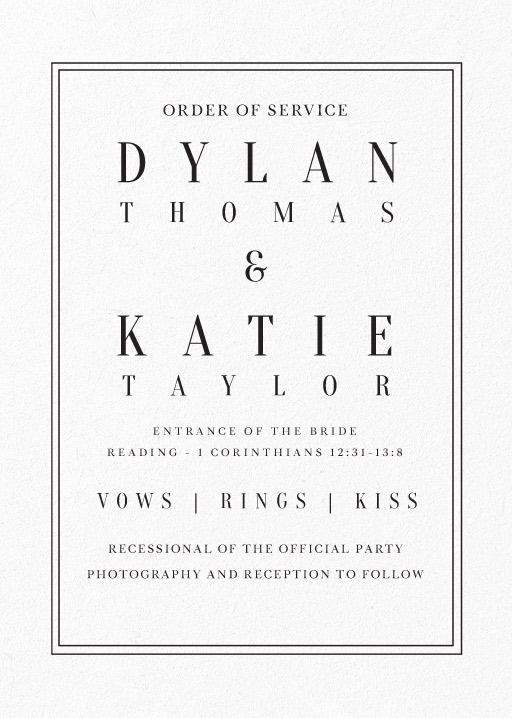
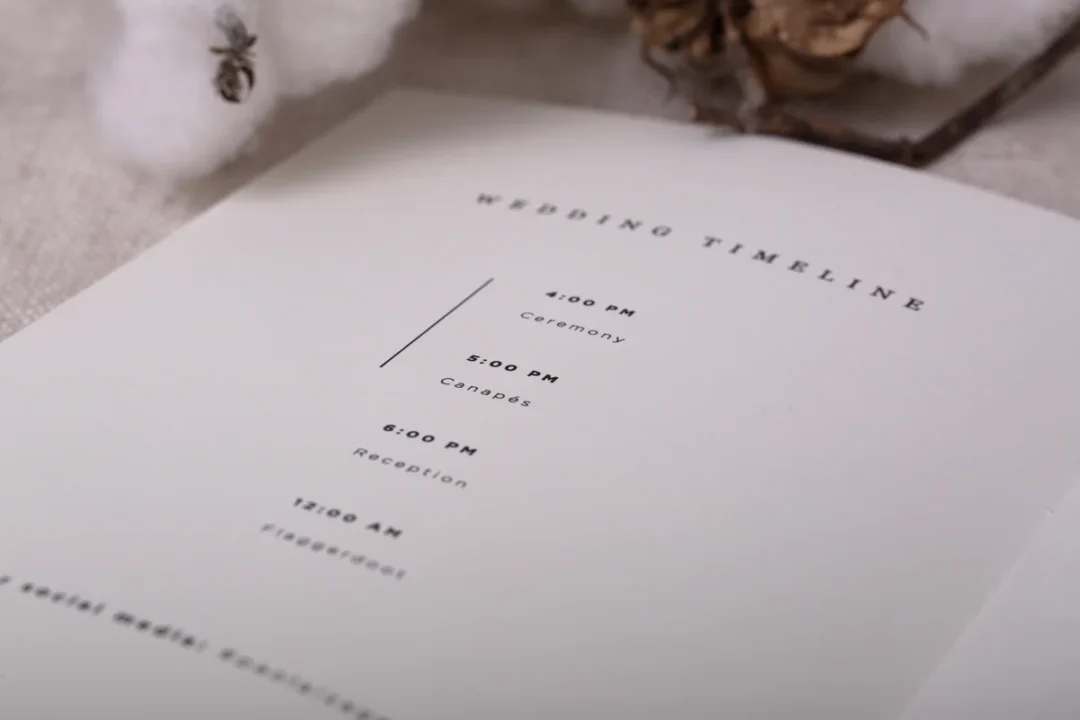
Clean typography, generous white space, and a single accent color or foil detail. These programs let the words do the work and look especially sharp in black ink on thick cotton or premium paper stock. A single line of flat gold foil on the couple’s names makes a strong impression without overdesigning.
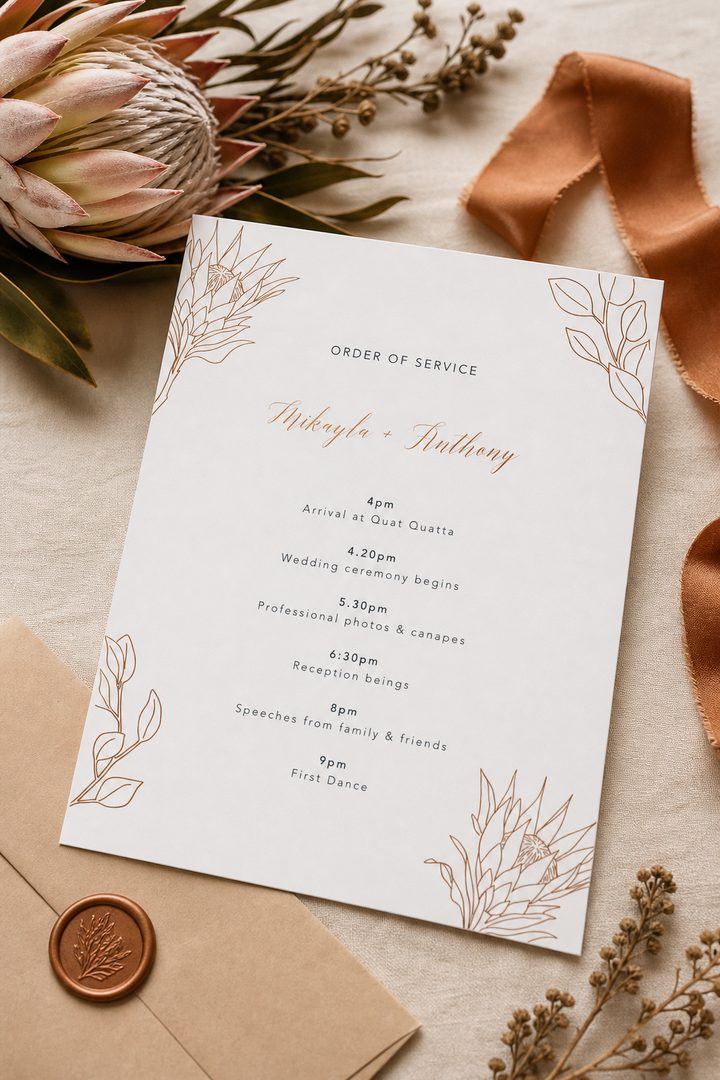
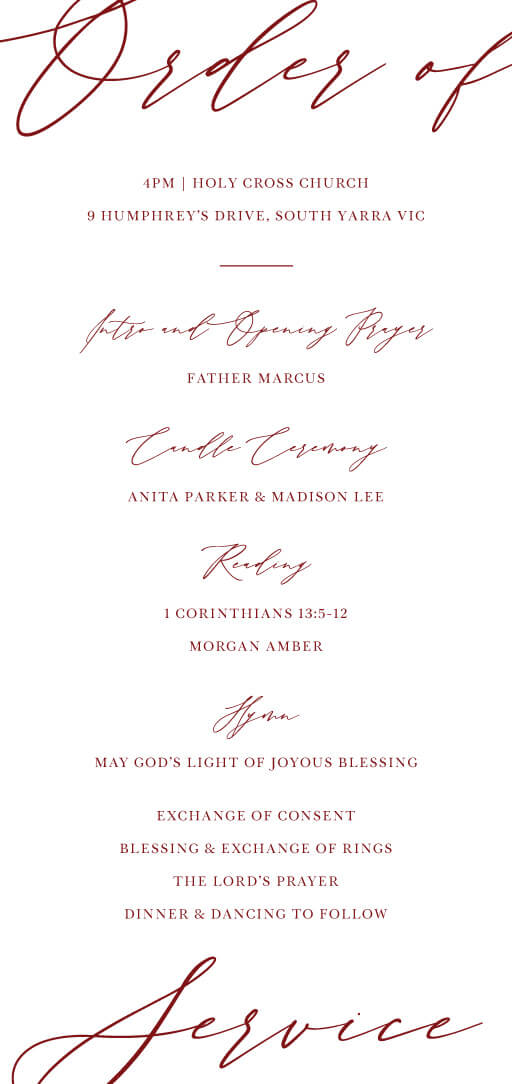
The LettersLetterpress
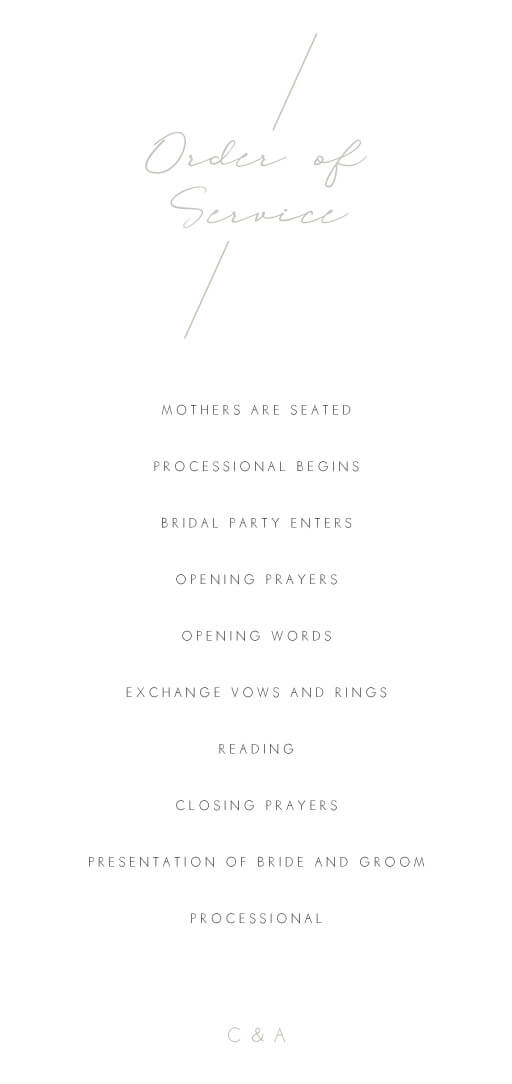
Blanc ModeDigital printing
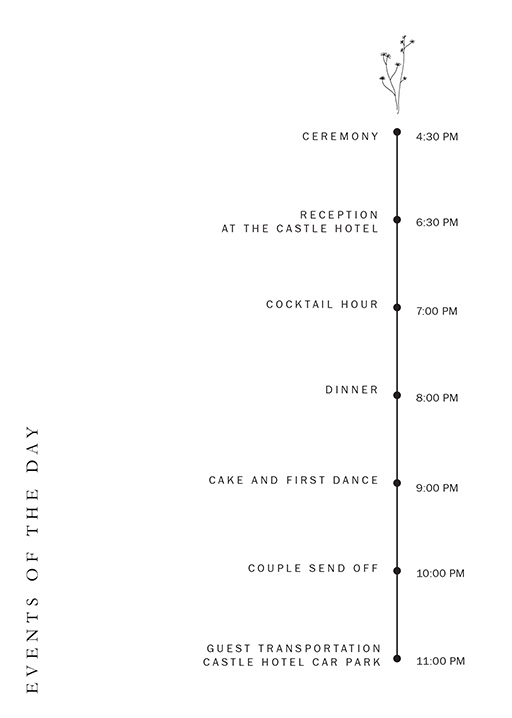
Ebb & FlowDigital printing
Classic DesignDigital printing
Romantic and botanical
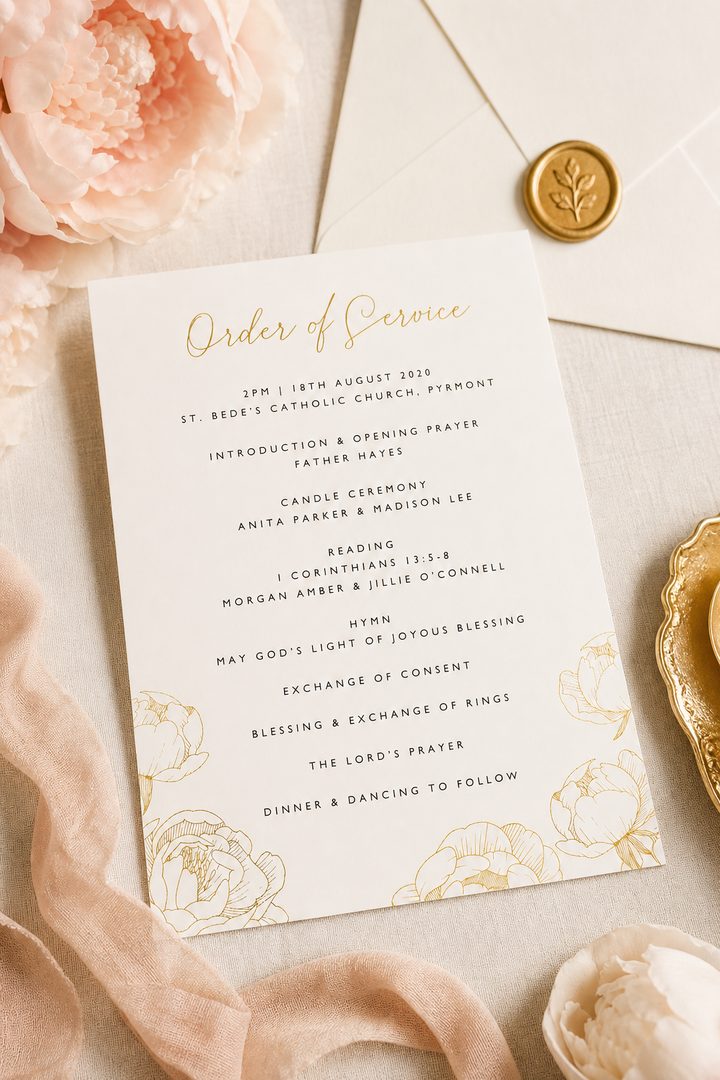
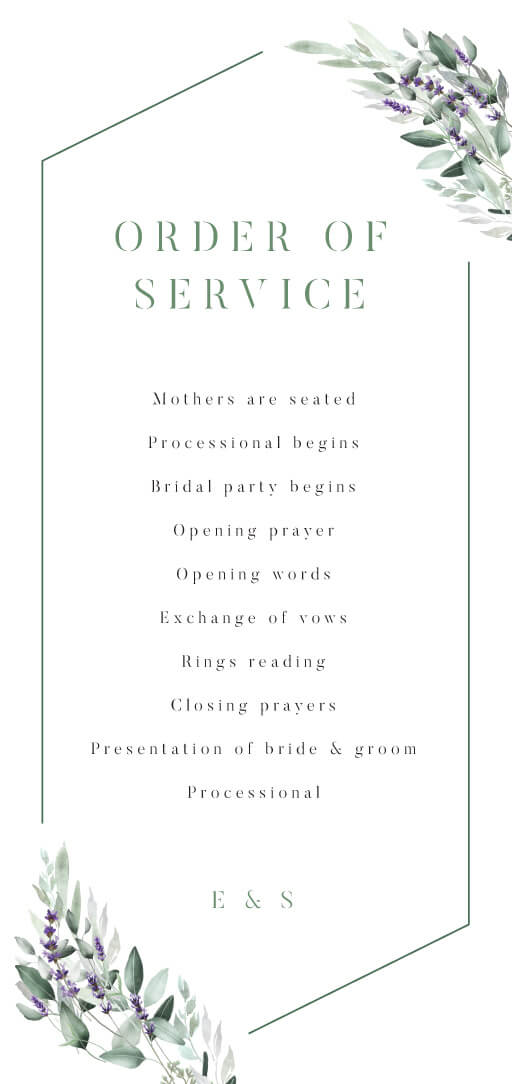
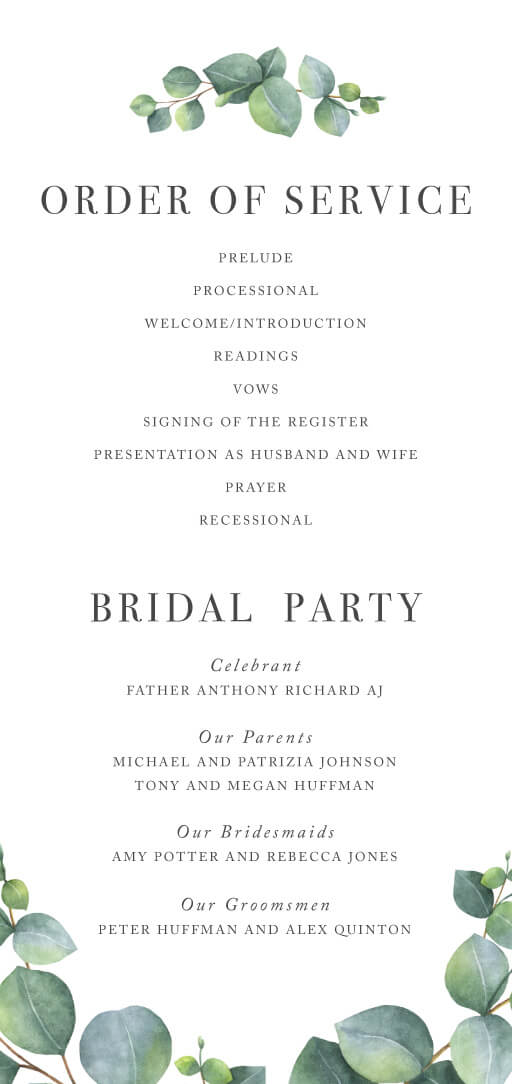
Watercolor florals, delicate line illustrations of greenery, and soft blush or sage color palettes. This style is consistently the most popular for spring and summer weddings. It pairs beautifully with letterpress printing, which gives the botanical illustrations a tactile depth that digital printing cannot replicate.
Lavender LeavesDigital printing

Stylistically GreenFlat foil
EucalyptusDigital printing

SaruleanFlat foil
Boho and earthy
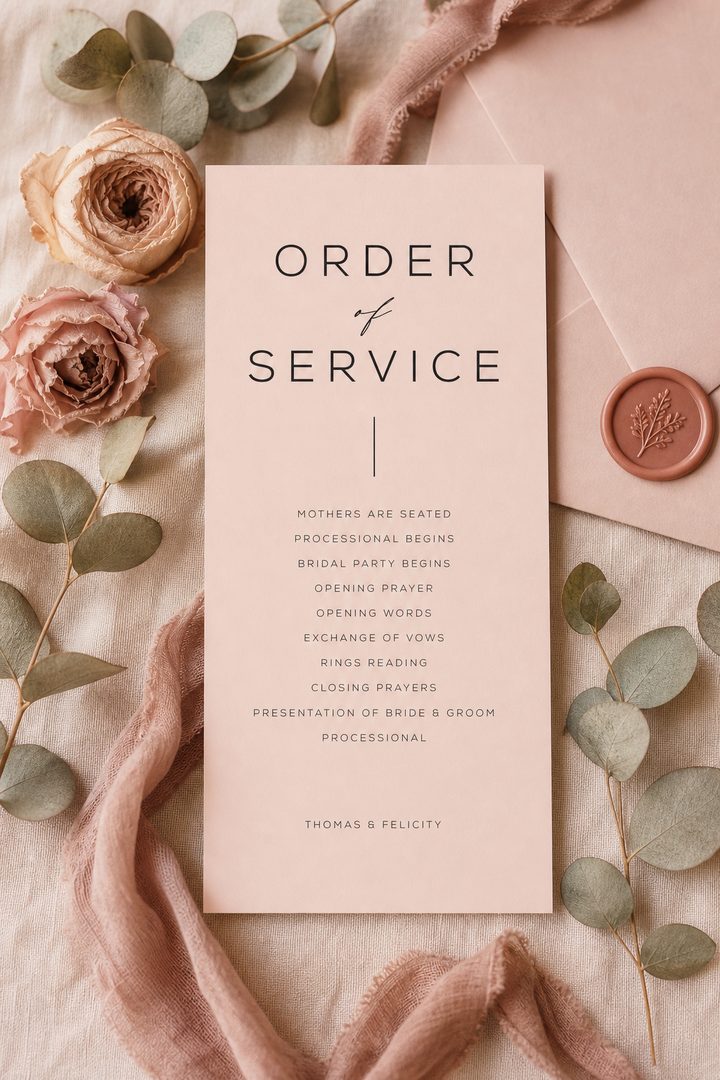
Terracotta, dusty rose, and warm ivory tones with pampas grass, dried palm leaf, or geometric line work. Fan programs work particularly well here, they can be designed to look like a natural pressed-leaf shape, which doubles as a takeaway piece guests keep.
Classic and formal
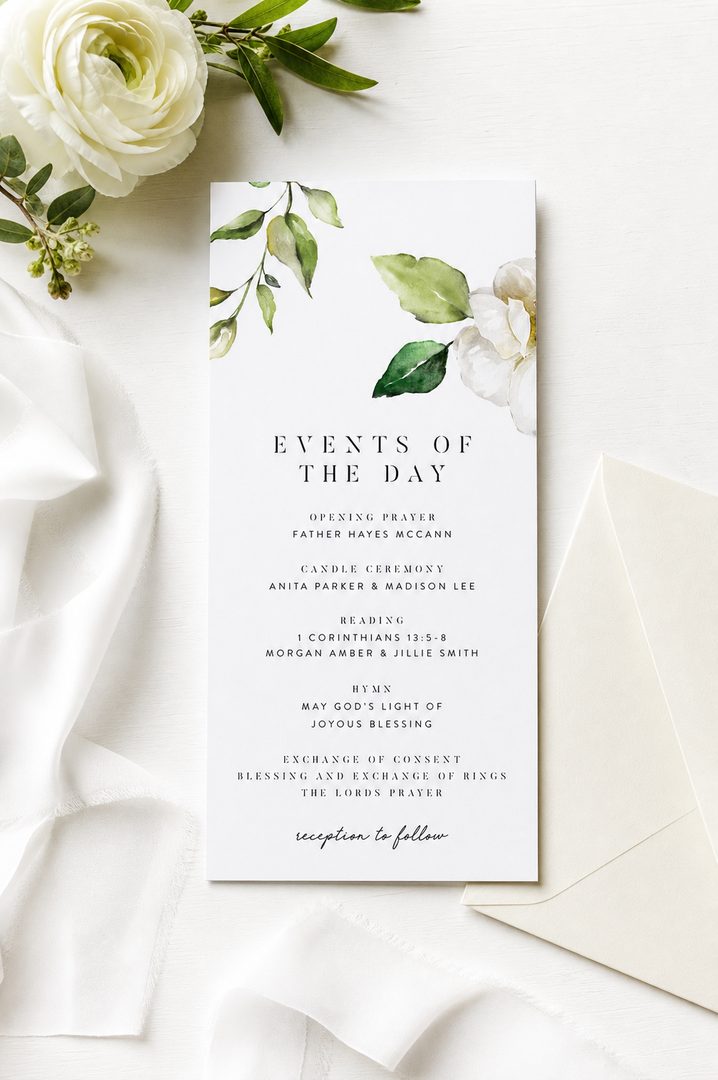
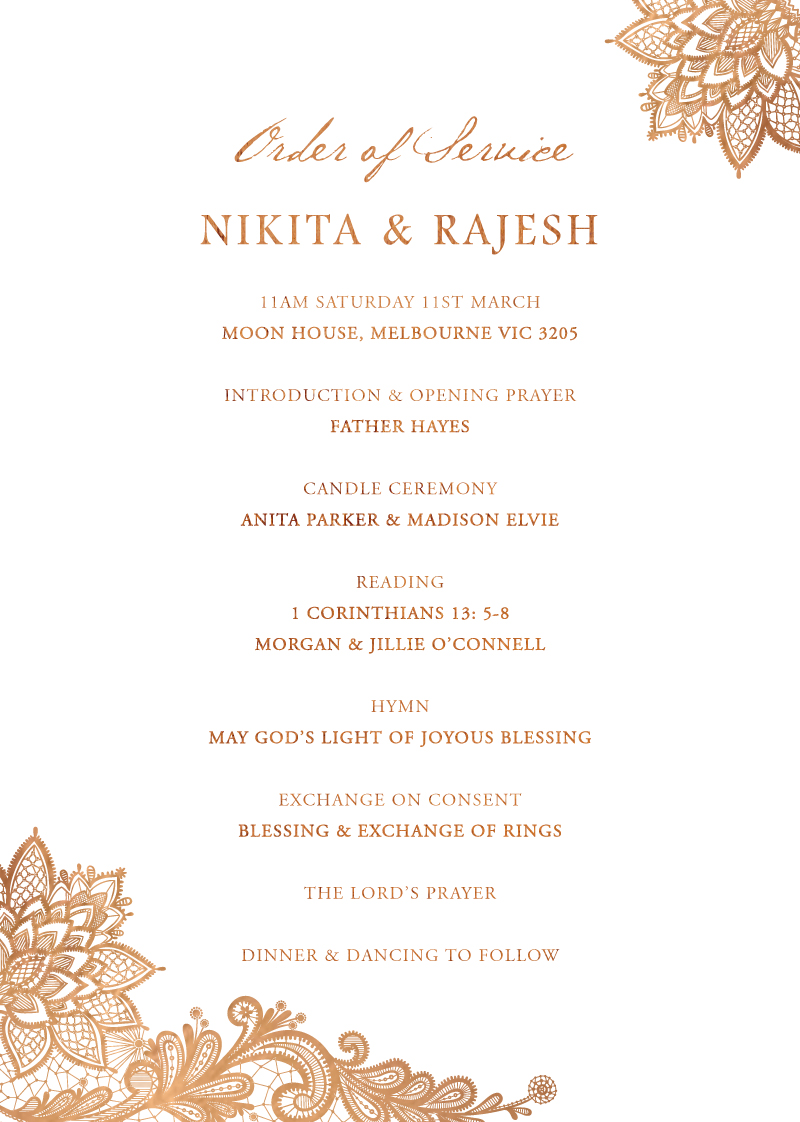
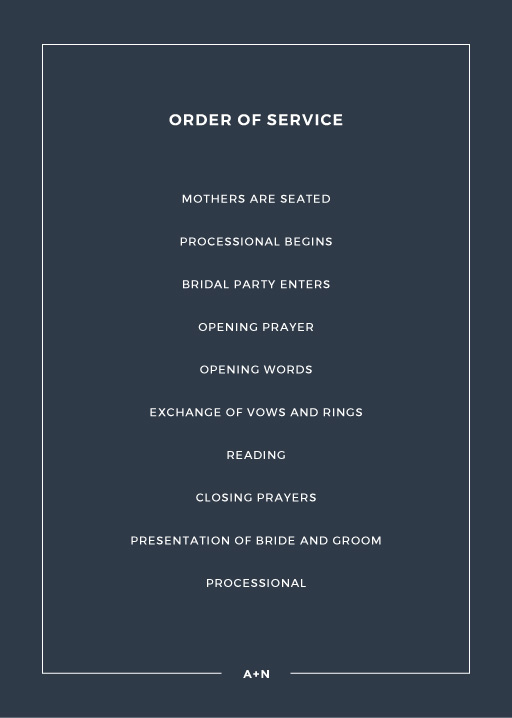
Navy or deep green with ivory and gold. Script headings, serif body text, and a formal layout with section dividers. This works for black-tie weddings, cathedral ceremonies, and any couple who wants their program to feel like a proper printed document rather than a casual card.


Fun and playful
Newspaper layout with fake headlines (“LOCAL WOMAN MARRIES DREAM MAN”), illustrated portraits of the couple, a word search with key wedding-related words, or a playbill format with the wedding party listed as “cast.” These make excellent keepsakes and are conversation starters during the ceremony wait.
What to Say on the Cover of Your Wedding Program
The cover sets the tone immediately. You have a few options depending on how formal or personal you want to feel.
Simple and elegant
“Emma & Daniel, October 4, 2026, San Francisco, California”
Just the essentials. Works for every style.
Warm and welcoming
“Welcome to our wedding, We are so glad you are here”
Emma & Daniel, October 4, 2026
A meaningful quote
“To love and be loved is to feel the sun from both sides”, David Viscott
Emma & Daniel
Ceremony title for religious weddings
“The Order of Service for the Marriage of Sofia and Anthony”
“A Celebration of Holy Matrimony”
How to Honor Loved Ones Who Have Passed
Many couples include a memorial line in their program, usually at the bottom of the back cover or inside back page. Keep it brief and warm.
- “We remember and honor those who are with us in spirit today, especially [Name] and [Name].”
- “Lighting a candle in memory of [Name], who we carry in our hearts.”
- “In loving memory of [Name]. Forever with us.”
- “Reserved seats in the front row honor the memories of those we have lost.”
Practical Tips: Printing and Ordering Your Programs
How many wedding programs do you need?
A general rule: one program per couple or adult guest (not per person), plus 10-15% extra for last-minute additions, vendors who want a copy, and keepsakes. For a 120-person wedding, 70-80 programs is usually plenty. If you want every single guest to have their own, order your full headcount plus 15%.
When should you order?
Order your programs 6-8 weeks before the wedding. This gives you time to receive your designer proof (which arrives within 1-2 business days of placing your order), review it with your partner, request any changes, and have programs in hand well before the day. Do not leave it until the week before, last-minute changes to the ceremony timeline have a habit of appearing right when you have least time to deal with them.
What if your ceremony is custom or non-standard?
If your ceremony does not fit a standard template, perhaps you are incorporating cultural rituals from two different backgrounds, having an outdoor ceremony with a detailed interactive element, or simply have more content than a standard booklet can hold, a custom order is the best option. With Paperlust’s custom design service, you reach out to the team with your ceremony details and style direction, receive a quote, and a designer creates your program from scratch. You will get a proof to review before anything is printed, so there are no surprises.
Browse our wedding programs collection to find designs that match your ceremony style, or explore our custom design service for something entirely your own. For specific wording ideas for each part of the ceremony, our wedding program wording guide has 30+ examples to draw from.
Frequently Asked Questions
What should be included in a wedding program?
The essentials are the couple’s names, wedding date, venue, ceremony order, and wedding party with roles. Add song titles, reading citations, a welcome note, and memorial mentions if you have space. If your ceremony includes cultural rituals that guests may not be familiar with, a brief explanation is always appreciated.
How many wedding programs do I need?
One program per couple (not per person), plus 10-15% extra. For a 120-guest wedding, 70-80 programs covers most situations. If you want everyone to have their own, match your full guest count and add 15%.
When should I order wedding programs?
Order 6-8 weeks before the wedding. Your designer proof will arrive within 1-2 business days. That gives you time to review, request changes, and receive your finished programs with at least a few weeks to spare, enough buffer if anything needs adjusting after a final run-through with your officiant.
What is the best wedding program format?
The bi-fold is the most versatile, four panels cover the order of service, full wedding party, and a thank-you note without feeling cramped. For longer ceremonies (Catholic mass, full Jewish service), a booklet gives you more room. For summer outdoor weddings, a fan-style program doubles as a cooling aid.
Do I need a wedding program for a short ceremony?
For a 20-30 minute civil ceremony, a single-page program is sufficient, or skip it entirely if the ceremony is very intimate and informal. Printed programs matter most when the ceremony is longer than 40 minutes, includes multiple readings, or has religious elements that guests may not be familiar with.
How do you write a multicultural wedding program?
Briefly explain each tradition and its meaning before describing the ritual. Use the tradition’s own terminology. Consider dual-language formatting for families who speak different languages. A bifold or booklet gives enough room to honor both traditions.
Do elopements need wedding programs?
No, but a simple single card makes a lovely keepsake for the guests who are there. Many couples use the back for a personal thank you note.
Shop Wedding Invitations at Paperlust
Hundreds of wedding invitation designs you can customize online, with an online proof before you print.
Love how these wedding programs can be customized to reflect the couple’s unique style. It really adds that personal touch and makes the ceremony feel even more special!
Excellent breakdown straightforward and super useful.
Really appreciate the effort you put into this. It’s super helpful.
Such a helpful collection of wedding program templates — the variety in ceremony styles and paper finishes is really well-represented. The visual comparison between traditional formal layouts and modern minimal designs makes it easy to find the right direction for a specific wedding aesthetic.
What a beautifully curated collection of wedding program examples! The variety of styles from classic to modern shows how much creativity goes into this often-overlooked detail. For creating custom wedding visual concepts, Nano Banana 2 generates gorgeous 4K imagery perfect for stationery design.
Wedding programs really do set the tone before the ceremony even begins — the template variety you’ve covered here makes it easy to match the formality and aesthetic of any event. For couples designing their own printed materials, using GPT Image 2 to visualize layout options and decorative motifs before committing to print can save a lot of costly revisions.
Lovely collection of examples. The detail on font pairings and spacing is exactly the kind of guidance that’s hard to find elsewhere. Really appreciate the thoroughness.
The ‘quick-reference cheat sheet’ format is such a practical addition — most wedding program guides just show pretty templates without explaining what actually needs to be on there for a Catholic mass versus a civil ceremony. We made a short mockup video walking through a program layout using HappyHorse before finalizing the print design, and it helped catch a missing section before it went to print. Saving this for the order-of-events checklist alone.
The point about a wedding program becoming a keepsake rather than just a logistics sheet is a good reminder – we almost skipped ours to save money and now I’m glad we didn’t, since it’s one of the few physical things from the day guests actually take home. Do the templates here account for blended family orders of service, where you need to credit multiple sets of parents without it looking cluttered?
The point about the program doubling as a keepsake is easy to overlook when you’re deep in ceremony-order logistics — most couples only think about function until months later when it’s the one physical memento from the day. The civil versus Catholic mass distinction in the templates is a nice touch too since the running orders really do differ.
The quick-reference cheat sheet is such a smart addition — most couples underestimate how much decision fatigue goes into the wording alone. We transcribed our officiant’s draft reading with Whisper Web before sending the program to print, which caught a wording mistake we’d have otherwise missed.
The keepsake angle is what a lot of program templates miss — guests genuinely do hold onto these longer than almost any other piece of wedding stationery. Nice to see options here for both intimate civil ceremonies and full Catholic mass structures, since the flow differs quite a bit.
The point about a program doubling as a keepsake is so true — years later it’s often the one piece from the whole day people actually keep in a drawer. We went with a simple folded card for our civil ceremony because the full Catholic mass templates felt like overkill for a twenty-minute service. Good to see examples split by ceremony style rather than one generic template trying to cover everything.
The layout examples here are really helpful — it’s one of those stationery pieces couples often underestimate until they’re scrambling the week before. A clear ceremony rundown saves guests so much confusion, especially for mixed-tradition or interfaith ceremonies.
The template variety here is impressive — having examples organised by ceremony style rather than just aesthetic makes it genuinely useful for couples who are still finalising the format. The detail on typical running order for both Christian and non-denominational services is particularly helpful. Bookmarking this for a friend who’s just started planning.
Comprehensive guide to wedding programs — the ceremony order breakdowns are really helpful for couples planning every detail. Music planning is equally important; Lyria 4 is a creative option for couples who want a completely unique first dance song generated from their own love story.
This is a really thorough look at Wedding Program Examples: Complete Templates for Every Cerem. I’m always looking for good resources on this kind of thing — bookmarking this one for sure.
This is a wonderfully thorough guide to wedding programs—I especially appreciated the breakdown by ceremony type and the cheat sheet of must-have elements. For couples who like to add a bit of personalized symbolism to their big day, exploring how your palms might hint at future compatibility can be a fun twist. I recently tried an [AI palm reading for wedding insights](https://palmreading.pro/) that analyzes a photo of your hand to reveal personality traits and future tendencies, which could be a lighthearted way to complement your program ideas or even spark conversation during the reception.
These wedding program examples are exactly what I needed for my upcoming ceremony. The detailed breakdown of must-haves and optional elements makes it easy to customize. I’ve been particularly interested in how AI tools can analyze guest preferences and suggest design layouts—something I learned about from [AI for research insights](https://aiforsciencehub.org/). Their coverage of AI applications in event planning and design optimization is quite insightful for anyone wanting to blend tradition with technology.
I really appreciated the detailed breakdown of what to include in a wedding program, especially the tip about explaining cultural rituals so guests feel included.
The tip about listing the wedding party with a short line on how each person knows the couple is such a nice touch. At a friend’s wedding last spring the program did exactly that, and it gave guests something to talk about while waiting for the ceremony to start. We also printed a QR code on the back that linked to a short video of the couple’s story, which older relatives loved. Saving this for our own planning.
The point about a program doubling as a keepsake is so true — years later, it’s often the one thing from the whole day that people actually hold onto in a drawer. We chose a simple folded card for our civil ceremony, since the full Catholic mass templates felt like too much for a twenty-minute service. It’s great to see examples organized by ceremony style instead of a single generic template trying to cover every situation.
An exceptionally practical guide to wedding programs. It breaks down essential elements versus nice-to-haves, offers ready-to-copy text templates for various ceremony styles (civil, Catholic, outdoor, etc.), and details how to match program formats—from bi-folds to fan designs—with your overall wedding stationery style.
I love that including song titles for the processional and recessional made the nice-to-haves list — guests really do appreciate knowing what they’re hearing. It makes me wonder whether couples would also want rough timing notes per song so the program actually doubles as a mini playlist guide.