
Whether you are planning your ceremony from scratch or trying to understand what actually happens and in what order, this guide covers everything, from who walks down the aisle first to how long each moment lasts. Use it to plan your own ceremony structure, then print it as a wedding program so your guests can follow along on the day. Pair it with your matching wedding invitations so your ceremony stationery feels like one suite.
In this guide
What Is a Wedding Ceremony?
A wedding ceremony is the formal event during which two people exchange vows, make their commitment to each other official, and are declared married. It is the act of getting married itself, not the party afterward. Most ceremonies include an officiant authorized to solemnize marriages, the couple, witnesses, and usually a wedding party. The ceremony is distinct from the reception: the ceremony runs 15 to 90 minutes with a structured, sequential format; the reception runs 4 to 6 hours and is primarily social.
How the ceremony differs from the reception: The ceremony is the marriage. It has a defined legal and symbolic purpose, a formal running order, and limited guest participation. The reception is the celebration. It has dinner, speeches, dancing, and open socializing. Most couples hold both on the same day at the same venue or a short drive apart, but they are distinct events and require separate planning. See the full reception running order in the Wedding Reception Timeline section below.
Who is involved in a wedding ceremony:
- The couple
- An officiant: a civil registrar, judge, religious leader, secular celebrant, or ordained friend, depending on the ceremony type
- Witnesses: usually two are required for legal purposes, though requirements vary by jurisdiction
- A wedding party (optional but traditional): bridesmaids, groomsmen, maid of honor, best man, flower girl, ring bearer
- Readers, musicians, or other participants the couple chooses to include
Legal requirements: What legally constitutes a valid marriage varies by country, state, and in some cases by religious authority. Most jurisdictions require a licensed or ordained officiant, verbal consent from both parties (vows), at least one witness, and registration of the marriage with a civil authority. Where the ceremony can legally take place, who is authorized to officiate, and what paperwork is required all differ. If you are marrying in a country where you do not live, check the requirements in both places. Your officiant should be familiar with what is needed in your location.
Wedding Ceremony Order, Quick Reference
- Processional, guests seated, wedding party walks in, bride/couple enters (5-10 min)
- Opening remarks, officiant welcomes guests (2-3 min)
- Readings, optional, 1-3 readers (3-10 min)
- Address/homily, officiant speaks about the couple (2-5 min)
- Exchange of vows, the main event (3-8 min)
- Ring exchange, rings placed, words spoken (2-4 min)
- Unity ceremony, optional (candle, sand, handfasting) (3-5 min)
- Pronouncement and first kiss, you are married (1-2 min)
- Recessional, exit as newlyweds (3-5 min)
Total duration: Civil ceremonies: 15-25 min | Non-denominational: 25-45 min | Catholic mass: 60-90 min
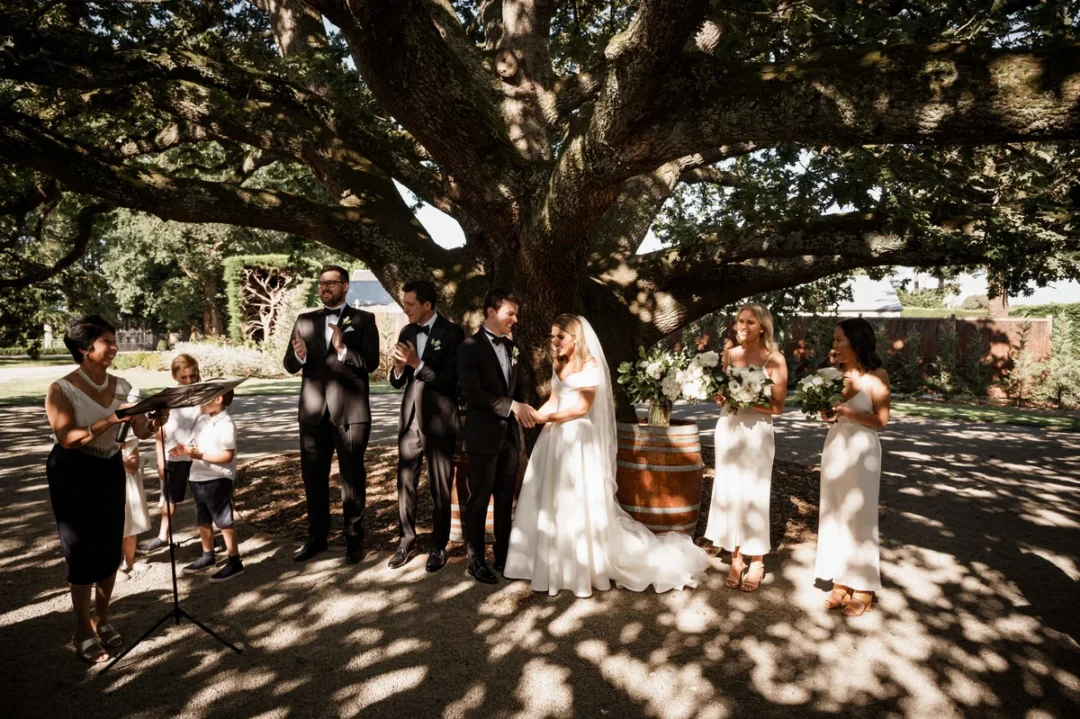

Hand your guests the running order
Wedding programs print the ceremony order guests follow along with. 500+ designs, single page, bifold, booklet and fan.
The Standard Wedding Ceremony Order, Step by Step
Most Western weddings, civil, non-denominational, or lightly religious, follow the same basic arc. Here is what each moment involves and approximately how long to allow for it.
1. Pre-ceremony: seating guests (15-30 minutes before)
This is not technically part of the ceremony order, but it shapes the entire experience. Ushers or designated family members guide guests to their seats while prelude music plays in the background. Traditionally, the groom’s family sits on the right and the bride’s on the left, but most modern couples drop this entirely and let guests sit wherever they like. If you have an unplugged ceremony, have your officiant or an usher mention it during seating rather than waiting until the processional. This is also where signage earns its keep. A welcome sign at the entrance tells guests they are in the right place, and a small notice near the aisle can carry the unplugged request so your officiant does not have to. Our wedding signs come in designs that match your invitation suite.
2. Processional
The processional is the formal entrance of the wedding party and couple. Music typically changes for each entrance, often something instrumental or classical during the wedding party’s walk and switching to a more meaningful or dramatic piece for the bride or couple’s entrance.
Traditional processional order (adapt freely, this is not a rule):
- Officiant takes their place at the altar
- Groom enters (with parents, alone, or with groomsmen)
- Groomsmen and bridesmaids walk in paired
- Maid of honor (last bridesmaid to enter)
- Best man (positioned with groom at altar)
- Flower girl and ring bearer
- Bride enters (escorted by parent, partner, alone, or with both parents)
For same-sex couples, both partners often choose to walk down the aisle simultaneously or one after the other based on personal preference. There is no required order, what matters is that it feels right to you.
3. Opening remarks
The officiant welcomes guests, introduces the purpose of the gathering, and sets the emotional tone for the ceremony. This is typically 2-4 minutes. A great officiant will say something that feels personal to the couple rather than reciting a generic script, if yours has not asked you questions about your relationship, prompt them to do so in advance.
4. Readings
Readings are optional but widely used. Most ceremonies include one or two, a mix of a love poem and a piece of scripture works well for couples with some religious background. Purely secular ceremonies often use well-known poems or prose passages. Keep each reading to 2-3 minutes maximum; anything longer loses the audience. Popular choices include:
- “i carry your heart with me” by E.E. Cummings
- “Union” by Robert Fulghum
- 1 Corinthians 13:4-8 (“Love is patient, love is kind…”)
- “How Do I Love Thee?” by Elizabeth Barrett Browning
- Excerpts from Captain Corelli’s Mandolin by Louis de Bernieres
In your wedding program, list each reading by title, author, and reader name. Guests who are not familiar with the text will appreciate the context.
5. Address or homily
The officiant speaks directly about the couple, how they met, what makes their relationship special, and what marriage means. In religious ceremonies this is called a homily and typically draws on the scripture reading. In civil or non-denominational ceremonies it is more conversational and personal. This is usually 3-8 minutes and is the moment when guests learn something about the couple they may not have known.
6. Declaration of intent
Before the vows, the officiant formally asks each partner if they freely choose to marry the other. This is the legal backbone of the ceremony and takes about 60 seconds. In its simplest form: “Do you take [name] to be your lawfully wedded spouse?” “I do.”
7. Exchange of vows
This is the emotional heart of the ceremony. Couples either repeat traditional vows prompted by the officiant or read personal vows they have written themselves. Personal vows typically run 2-4 minutes per person; traditional vows are shorter. If you are writing your own, aim for 200-350 words each, enough to be meaningful, short enough that you will not lose your guests (or your composure).
8. Ring exchange
The rings are presented, usually by the best man or ring bearer, and placed on each other’s fingers with a short phrase: “With this ring, I thee wed” or something more personal. The officiant may say a blessing over the rings first. This takes 2-4 minutes and follows immediately after vows.
9. Unity ceremony (optional)
A unity ceremony is a symbolic ritual that represents two lives joining as one. It is entirely optional and works best when it has genuine meaning to the couple rather than being included because it seems expected. Common choices include:
- Unity candle, two individual candles light one central candle together
- Sand ceremony, two colors of sand are poured into one vessel, creating a mixed pattern that cannot be separated
- Handfasting, the couple’s hands are loosely bound together with ribbon or cord (the origin of “tying the knot”)
- Wine or whiskey tasting, a bottle blended from two separate bottles, shared by the couple
- Tree planting, each partner pours soil into a shared planter
- Ring warming, the rings are passed through the hands of every guest before the exchange, gathering their well-wishes
If you include a unity ritual, explain what it represents in your wedding program. Guests who have not encountered it before will be more emotionally engaged if they understand the symbolism.
10. Pronouncement and first kiss
The officiant formally declares the couple married and introduces them to the room for the first time as a married couple. This is 1-2 minutes and is the moment every guest is waiting for. The phrasing can be traditional (“I now pronounce you husband and wife”) or modern (“You are now married!” or the couple’s names announced directly).
11. Recessional
The newlyweds lead the exit, typically to a joyful or celebratory piece of music. The wedding party follows in reverse processional order. Guests are then guided out by ushers or dismissed row by row. This takes 3-5 minutes and signals the start of the cocktail hour or reception.
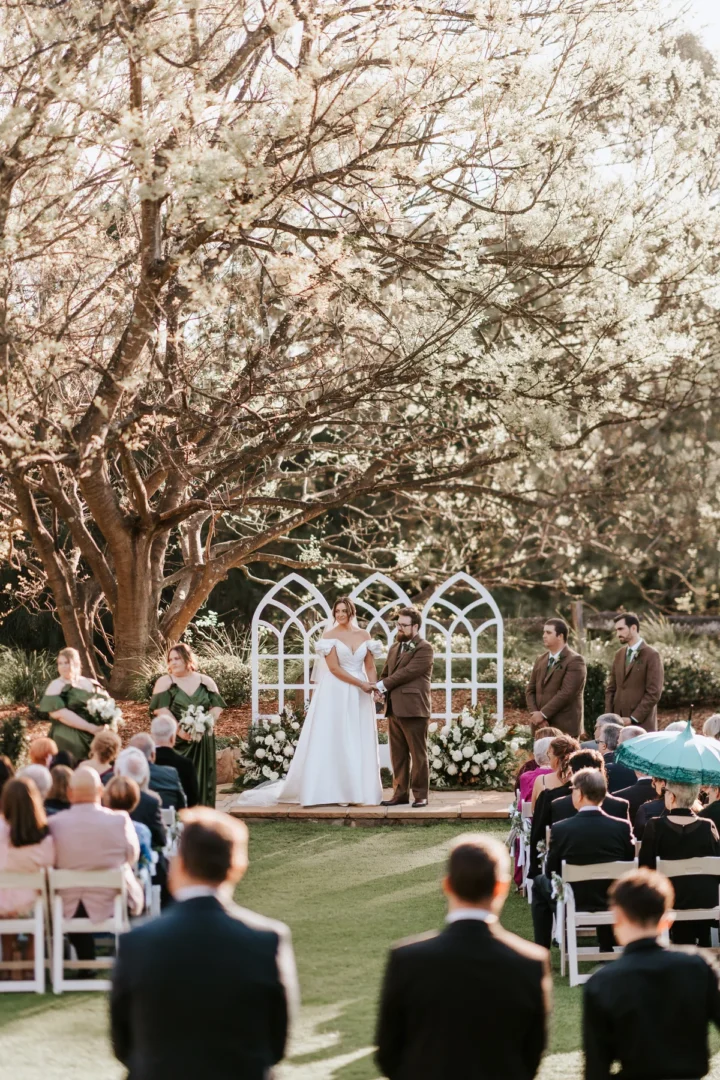
Wedding Ceremony Order by Ceremony Type
The core arc stays the same, but the details shift significantly depending on whether your ceremony is civil, religious, or cultural. The table below compares eleven ceremony types across the dimensions that matter most for planning.
| Ceremony type | Typical length | Officiant | Legal paperwork | Typical readings / music | What goes on the program |
|---|---|---|---|---|---|
| Civil | 15-25 min | Civil registrar or judge | Marriage license; register signed at the ceremony | None required; optional secular readings | Names, date, order of service; register signing note |
| Non-denominational / secular | 25-45 min | Ordained celebrant or licensed friend | Marriage license | Secular poetry, personal vows, any music | Full running order, wedding party names, reading credits |
| Catholic (no mass) | 30-45 min | Catholic priest | Marriage license; pre-marriage preparation required | Scripture readings, traditional hymns | Rite structure; brief notes for non-Catholic guests |
| Catholic (with mass) | 60-90 min | Catholic priest | Marriage license; pre-marriage preparation required | Full liturgy, multiple readings, Kyrie, Gloria | Full Mass order with responses; essential for non-Catholics |
| Protestant / Anglican | 30-50 min | Minister or pastor | Marriage license | Hymns, scripture readings, congregational responses | Hymn lyrics, order of service, spoken responses |
| Jewish (Reform / Conservative) | 30-60 min | Rabbi | Marriage license; ketubah signed pre-ceremony | Sheva brachot, Psalms, Hebrew and English readings | Hebrew text with transliteration and translation; ritual explanations |
| Hindu | 1-4 hours | Pandit | Marriage license (civil registration may be separate) | Sanskrit mantras, devotional music | Guide to each ritual with its meaning; essential for non-Hindu guests |
| Humanist / celebrant-led | 30-50 min | Humanist celebrant (legal status varies by jurisdiction) | Marriage license; separate civil registration may be required | Personal choice: poetry, prose, secular music | Fully personal running order; narrative and warm in tone |
| Elopement | 10-20 min | Civil registrar or ordained friend | Marriage license | Minimal or none | Rarely used; a simple keepsake card if anything |
| Micro-wedding (under 20 guests) | 20-35 min | Civil or celebrant | Marriage license | Optional readings and couple’s chosen music | Simple single-page program; personal in tone |
| Destination | 20-40 min | Licensed local officiant in destination country | Marriage license in destination country; home-country registration may also be required | Personal and flexible; officiant guides local requirements | Running order plus travel logistics or local customs notes |
Civil ceremony order
Civil ceremonies are legally binding without any religious element. They must include a declaration of intent but are otherwise flexible. Most civil ceremonies run 15-25 minutes and are held at a courthouse, city hall, venue, or outdoors. A register or marriage license signing typically happens at the end, witnessed by two people. If guests will wait during the signing, background music helps fill the pause gracefully.
Non-denominational ceremony order
Non-denominational ceremonies are the most common format for modern weddings in the US. They have no prescribed structure, which is both a freedom and a challenge. Start with the processional, build through the readings and address, peak at vows and rings, and close with the pronouncement and recessional. Add a unity ceremony in the middle if it suits you. The key is pacing, you want emotional builds and releases, not a flat run through a checklist.
Catholic ceremony order (with mass)
A full Catholic wedding mass follows a specific liturgical structure set by the Church. The priest has limited room to personalize certain elements, so talk to yours early about what flexibility exists. The order follows the Nuptial Mass: introductory rite, Liturgy of the Word (readings, Gospel, homily), Rite of Marriage (vows, rings), Liturgy of the Eucharist, and concluding rite. For guests who are not Catholic, a printed program with brief explanatory notes for each section is genuinely useful.
Jewish ceremony order
Jewish ceremonies center on the chuppah (canopy) as a symbol of the home the couple will build. The order includes kabbalat panim (welcome reception), processional to the chuppah, betrothal blessings and first cup of wine, ring exchange, ketubah reading (marriage contract), seven blessings (sheva brachot) over a second cup of wine, and finally the breaking of the glass. The glass breaking is celebrated loudly by guests with a shout of “Mazel tov!”, worth noting in the program for guests unfamiliar with the tradition.
Hindu ceremony order
Hindu wedding ceremonies are rich, multi-ritual events that typically run one to four hours, with some traditions extending across multiple days of pre-wedding celebrations. The core ceremony centers on the fire altar (havan), where the couple performs rituals guided by a pandit reciting Sanskrit mantras. The most significant moment is the saptapadi, the seven steps taken together around the fire, each representing a vow. Other central rituals include the exchange of garlands (jaimala), the application of sindoor, and the tying of the mangalsutra. A printed program with translations and explanations of each ritual is more valuable here than at almost any other ceremony type, since many guests will not be familiar with the Sanskrit prayers or their symbolic meaning.
Protestant and Anglican ceremony order
Protestant ceremonies range from the structured liturgy of Anglican services, which follow the Book of Common Prayer or Common Worship, to the more open format of evangelical gatherings with contemporary worship music and extended preaching. Most Protestant ceremonies follow this order: opening hymn, welcome, scripture readings, sermon, declaration of intent, vows, ring exchange, prayers, blessing, and recessional hymn. Congregational participation through spoken responses is common, and the program is especially useful here because it includes the text of those responses so guests can participate rather than observe.
Humanist and celebrant-led ceremony order
Humanist ceremonies are fully personalized and non-religious. There is no prescribed structure: the celebrant works closely with the couple in advance to create a ceremony built around their actual story. A typical format includes a welcome and introduction, personal readings the couple has chosen, declaration of intent, vows, ring exchange, and a closing address. The legal status of humanist ceremonies varies by jurisdiction. In many US states, a humanist celebrant is a fully licensed officiant and the ceremony itself is the legal marriage. In some other countries, a separate civil registration is required in addition to the ceremony. Your celebrant will confirm what is required in your location. Because every element of the ceremony reflects choices the couple made together, the program tends to be the most personal and readable of any format.
Elopement ceremony order
An elopement is a marriage with a minimal or no audience, typically just the couple, an officiant, and the required witnesses. There is no formal processional, no wedding party, and no traditional reception. The ceremony follows the same legal structure as any other wedding: a licensed officiant, verbal vows, witnesses, and a signed marriage license. Duration is typically 10 to 20 minutes. Couples often choose a location with personal meaning, such as a mountaintop, a courthouse, or a beach at sunrise, over a formal venue. A printed program is rarely used.
Micro-wedding ceremony order
A micro-wedding is a full ceremony scaled to a guest list of roughly 20 people or fewer. It includes the same core structure as any ceremony (processional, vows, pronouncement) but the smaller audience changes the feel considerably. There is often no formal seating arrangement, guests can see and hear everything without amplification, and the processional is sometimes simplified to the couple entering together. Length: 20 to 35 minutes. Programs are often simpler and more personal, sometimes handwritten or printed on a single card as a keepsake.
Destination wedding ceremony order
Destination weddings follow whatever ceremony format the couple chooses, officiated by a local licensed officiant in the destination country. The ceremony structure itself is standard; the added complexity is legal. Most couples need to satisfy the marriage requirements of the destination country and register the marriage in their home country as well. Requirements change frequently, so consulting the relevant embassy or a local wedding coordinator in the destination is essential. Programs at destination weddings often serve an added function: welcoming guests who have traveled far and noting any local customs or venue logistics they should be aware of.
Shop wedding programs
List the wedding party and the order they walk in, printed on premium stock.
Processional Order: Who Walks in First?
The processional is one of the most frequently asked-about elements of ceremony planning. Here is the most common traditional order, followed by common modern variations.
Traditional processional order
| Order | Who | Music |
|---|---|---|
| 1 | Officiant takes position at altar | Prelude continues |
| 2 | Grandparents of the couple (seated by usher) | Prelude |
| 3 | Parents of groom (seated) | Prelude |
| 4 | Mother of bride (seated last, signals ceremony start) | Prelude ends |
| 5 | Groom enters with best man | Processional music begins |
| 6 | Groomsmen and bridesmaids (paired) | Processional |
| 7 | Maid of honor | Processional |
| 8 | Ring bearer | Processional |
| 9 | Flower girl | Processional |
| 10 | Bride (escorted or alone) | Music changes, bridal entrance song |
Modern variations
- Groom waits at altar from the start, increasingly common; removes the “entrance” for one partner and focuses the full processional on the wedding party and bride
- Both partners enter together, particularly popular for couples who feel strongly about equal representation
- Both partners each walk with their own parents, a warm option that involves the families without any gender-specific roles
- Small weddings skip the wedding party processional, the couple simply enters together to their chosen music
- Children walk with parents, rather than as flower girls or ring bearers in isolation
How Long Does a Wedding Ceremony Last?
Ceremony length is one of the most practical questions couples and guests have, and it varies more than most people expect.
- Civil ceremony at a registry office: 10-20 minutes
- Intimate civil ceremony at a venue: 15-25 minutes
- Non-denominational with 1-2 readings: 25-40 minutes
- Non-denominational with unity ceremony: 35-50 minutes
- Catholic Rite of Marriage (no mass): 30-45 minutes
- Catholic Nuptial Mass (full): 60-90 minutes
- Jewish ceremony: 30-60 minutes
- Hindu ceremony (core rituals): 1-4 hours
For most couples, a ceremony in the 25-40 minute range hits the sweet spot, meaningful without guests beginning to shift in their seats. If your ceremony is going over 45 minutes, look at trimming readings rather than rushing the vows or removing the unity ritual. The vows are the point; readings are supporting content.
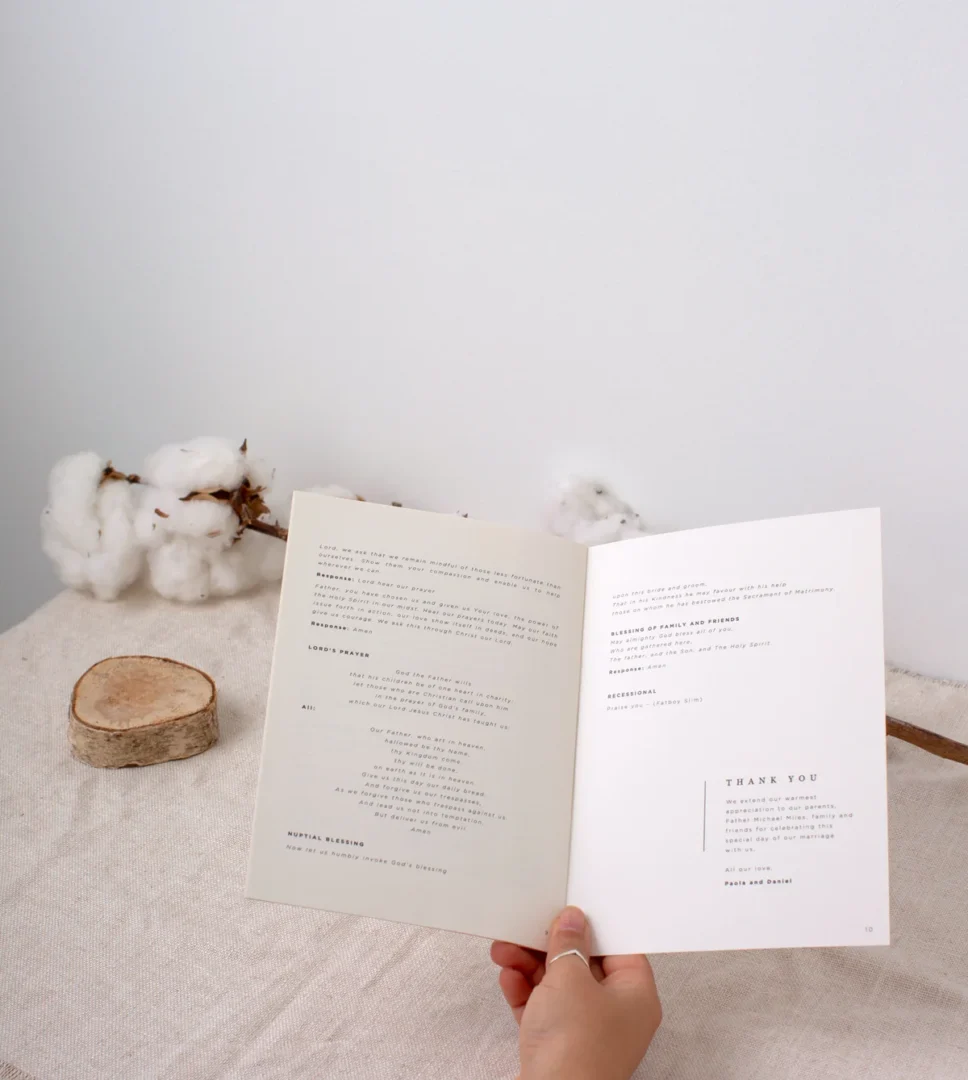
Wedding Reception Timeline and Running Order
The reception is a separate event from the ceremony, typically held at the same venue or a short drive away and running four to six hours. The ceremony ends and the celebration begins. Here is the standard running order for an evening reception, with approximate timings counted from when guests arrive at the reception space.
| Segment | Approximate timing | What happens |
|---|---|---|
| Cocktail hour | 0:00 to 1:00 | Guests arrive at the reception venue or outdoor area. Welcome drinks and canapes are served. The couple is typically finishing photos. |
| Guests seated | 1:00 | MC or venue coordinator invites guests to take their seats. Seating charts or place cards guide larger groups to their tables. |
| Grand entrance | 1:05 to 1:20 | Wedding party is announced and enters, followed by the couple. The first dance often happens immediately at this point. |
| Welcome and first course | 1:20 to 2:00 | Entrees are served. The MC welcomes guests and the couple or a parent gives a brief thank-you. |
| Speeches | 1:45 to 2:30 | Typically: parent of the bride or groom, best man or maid of honor, then the couple. Allow 4 to 5 minutes per speaker. Brief is better. |
| Main course | 2:00 to 3:00 | Dinner service. In most formats this overlaps with later speeches. |
| First dance (if not at entrance) | 3:00 to 3:15 | The couple’s first dance. Parent dances often follow immediately. |
| Cake cutting | 3:15 to 3:30 | The MC announces the cutting ceremony. Dessert or cake service begins. |
| Open dancing | 3:30 onward | The DJ or band opens the floor. This is the longest and most unstructured segment of the evening. |
| Optional traditions | 4:00 to 4:30 | Bouquet toss, anniversary dance, shoe game. Include what fits your crowd and skip what does not. |
| Last dance and send-off | 5:30 to 6:00 | Final song, sparkler exit, confetti, or ribbon wands. The MC closes the evening and thanks guests. |
The timings above are hours from the start of cocktail hour, not fixed clock times, since every wedding schedule is different. If your reception starts at 5 PM, simply shift all segments forward accordingly. Your venue will usually have their own preferred run sheet; the table above gives you a baseline to work from in conversations with your coordinator, MC, and DJ or band.
Printed table menus are one detail that pays dividends at the reception. They set the tone for the meal, help guests with dietary questions before service begins, and double as a keepsake. Browse our wedding menus for designs that coordinate with your ceremony programs and invitation suite.
Planning Your Ceremony Order: Timeline
Decisions about your ceremony structure should not be left until the week before. Here is a practical planning timeline.
| Timeframe | What to finalize |
|---|---|
| 9-12 months out | Book officiant; discuss ceremony format, length, and any non-negotiables (religious requirements, legal considerations) |
| 6-9 months out | Select readings and readers; decide if you want a unity ceremony and which type; choose ceremony music direction |
| 3-6 months out | Finalize processional order; confirm specific songs and playlists with musicians or DJ; start drafting personal vows if writing your own |
| 6-8 weeks out | Order your wedding programs, proof arrives within 1-2 business days; review and approve; allow time for adjustments |
| 2-4 weeks out | Finalize and lock ceremony script with officiant; share order of events with wedding party |
| 1-2 days before | Wedding rehearsal, walk through processional, positions, cues, and recessional at the venue with wedding party and officiant |
How a Wedding Program Supports Your Ceremony Order
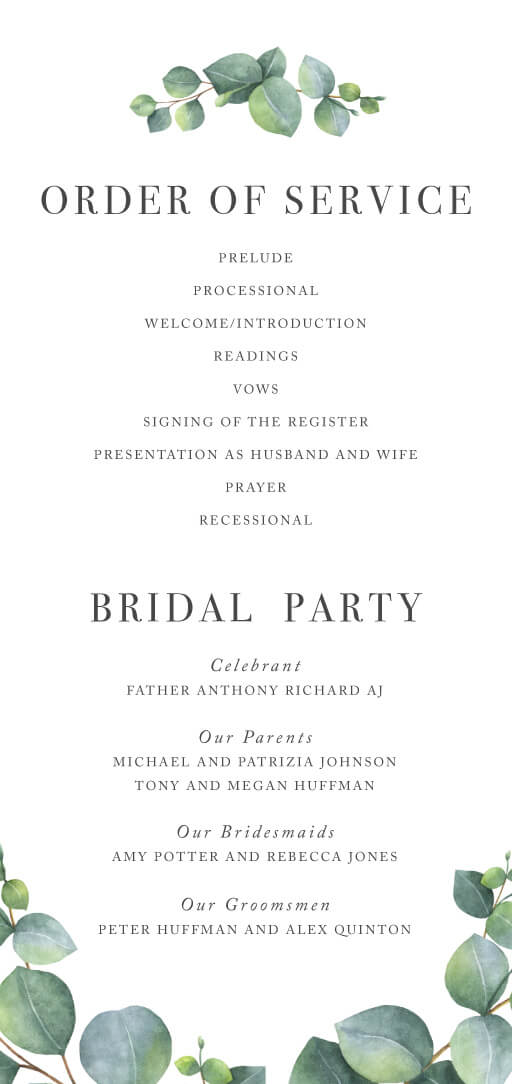
A printed wedding program transforms your ceremony order from an internal planning document into something guests can hold and follow. It tells them what is coming next, who is speaking, what song is playing, and, most importantly for longer or more complex ceremonies, helps them understand unfamiliar traditions.
The format you choose should match your ceremony length. A single-page or bi-fold program works for most civil and non-denominational ceremonies. A booklet-style program makes sense for a full Catholic mass or Hindu ceremony where guests need the detail. Fan-style programs serve double duty for outdoor summer weddings.
For longer or more complex ceremonies where a standard template does not fit your exact order of service, Paperlust’s custom design service can build your program from scratch. Simply reach out to the team with your ceremony details and style direction, receive a quote, and a designer creates your program to match. You will receive a proof to approve before anything is printed.
Browse our wedding programs collection to find designs that suit your ceremony style. For wording help, our wedding program wording guide has 30+ examples for every section.
Ready to print your wedding programs?
Browse Paperlust’s full wedding programs collection, bi-fold, flat, and fan formats in letterpress, foil, and digital print. Order a $5 sample pack to feel the stocks and finishes before committing.
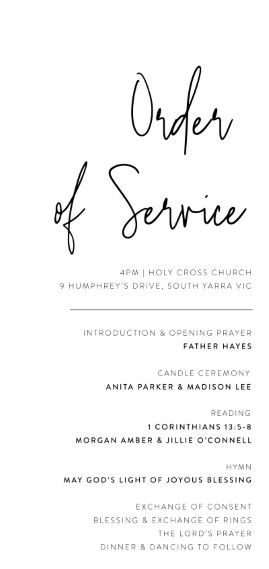


Frequently Asked Questions
What is a wedding ceremony?
A wedding ceremony is the formal event during which two people exchange vows, make their commitment to each other official, and are declared married by a licensed officiant. It is distinct from the reception that follows: the ceremony is the legal and symbolic act of getting married, typically running 15 to 90 minutes depending on format. Most ceremonies require a licensed or ordained officiant, the couple’s verbal consent (vows), at least one witness, and registration of the marriage with a civil authority. Requirements vary by country and jurisdiction.
What is the difference between a wedding ceremony and a reception?
The ceremony is the marriage itself: a structured, formal event where vows are exchanged, the couple is declared married, and the union is legally recorded. It typically runs 15 to 90 minutes. The reception is the celebration that follows: a social event with dinner, speeches, dancing, and toasts that typically runs 4 to 6 hours. The ceremony has limited guest participation; the reception is fully social. Some couples hold both at the same venue with only a cocktail hour between them; others use entirely separate locations.
What is a typical wedding reception running order?
A typical evening reception runs in this order: cocktail hour (guests arrive, welcome drinks served), grand entrance of the couple and wedding party, entrees and welcome speeches, main speeches (parent, best man or maid of honor, couple), main course, first dance, cake cutting, and open dancing. Optional traditions (bouquet toss, anniversary dance) fit into the dancing portion. The reception typically runs 4 to 6 hours and closes with a final song and send-off. Your MC and venue coordinator will help you adapt this to your specific schedule.
What is the order of a wedding ceremony?
A standard wedding ceremony follows this order: processional (wedding party and couple enter), opening remarks by the officiant, readings, address or homily, declaration of intent, exchange of vows, ring exchange, optional unity ceremony, pronouncement and first kiss, and recessional. Total duration ranges from 15 minutes for a civil ceremony to 90 minutes for a full Catholic mass.
Who walks down the aisle first at a wedding?
In a traditional processional, the officiant takes position first, followed by grandparents and parents being seated, then the groom (with best man or alone), groomsmen and bridesmaids paired together, maid of honor, ring bearer and flower girl, and finally the bride. Modern ceremonies vary this freely, some couples enter together, others each walk with both parents.
How long does a wedding ceremony last?
A civil ceremony typically lasts 15-25 minutes. A non-denominational ceremony with readings runs 25-45 minutes. A Catholic Rite of Marriage (without mass) is 30-45 minutes, and a full Catholic Nuptial Mass is 60-90 minutes. Jewish ceremonies average 30-60 minutes, and Hindu ceremonies can run 1-4 hours.
Do you need a wedding program for your ceremony?
A wedding program is not required, but it is especially valuable for ceremonies longer than 30 minutes, ceremonies with readings or unity rituals, religious ceremonies with elements guests may not be familiar with, and large weddings where guests cannot easily see or hear every detail. For a brief civil ceremony of 15-20 minutes, it is optional.
What should go in a wedding ceremony program?
A wedding ceremony program should include the couple’s names, date, and venue on the cover; the full ceremony order with song titles and reading citations inside; and a wedding party list with names and roles. Optional additions include a welcome message, memorial mentions, explanations of cultural rituals, and reception details on the back.