

The last four weeks before a wedding contain the most specific, time-sensitive tasks on the entire planning timeline. The big decisions are made. Now it is about execution, handoff, and making sure every vendor, every piece of printed stationery, and every person running something on the day has exactly the information they need.
This checklist moves week by week from four weeks out to the final 48 hours. Each window has a clear job. Do the four-week tasks at four weeks, not earlier and not later, because the sequence matters: you cannot finalize place cards before the seating chart is locked, and you cannot lock the seating chart before the caterer has the final headcount.
If you still have broad planning to finish, a full wedding planning timeline covers the earlier windows. This article covers only the final month.
- 4 weeks out: Lock headcount, start seating chart, book vendor confirmation calls, check marriage paperwork
- 3 weeks out: Confirm all vendors, send day-of timeline, order place cards, menus, and seating chart signage
- 2 weeks out: Submit final guest count, receive and check printed stationery, collect rings, confirm witnesses
- 1 week out: Final venue walk-through, build handover list, prepare payment envelopes
- 48 hours out: Pack, brief your day runner, get out of the logistics
Place cards, menus and charts all need final numbers, which is what this week is for.
Four Weeks Out: Lock the Numbers
The RSVP deadline has passed, or close enough. Your first task is to get a definitive headcount, because almost everything else in the next four weeks depends on it: the seating chart, the caterer’s order, the number of printed place cards, the table count, and the venue minimum.
Contact every guest who has not responded. Be direct, give a two-day deadline, then close the list. Assign “no response” guests a status you can work with: either a seat or off the list.
Once you have a number, work through these four things before the end of week one.
Confirm the caterer’s deadline for final numbers. Most venues require a final headcount somewhere between 10 and 14 days before the event, written into the contract. Locate that date now. If your count is still shifting at four weeks, communicate that to the venue rather than waiting.
Check your marriage paperwork status. Licensing requirements differ by country and by state or county within each country. The important question at four weeks out is whether you have what you need and whether it is still valid. In the US, most county clerk offices issue licenses with an expiration window, so confirm that your license will still be valid on your wedding date. In Australia, confirm your Notice of Intended Marriage is lodged with your celebrant and that the one-calendar-month minimum period will have elapsed before your ceremony date. Do not leave this check for the final week.
Draft your seating chart. At this stage, “draft” is the right word: you will not have a final version until the last RSVP is confirmed. Place the easy decisions first, head table, immediate family, close friends, then work outward. Use a spreadsheet or a dedicated planning app rather than paper, because you will move people more than once.
Book vendor confirmation calls. Schedule a 10-minute call with each major vendor for the following week: photographer, caterer and venue coordinator, celebrant or officiant, florist, transportation, band or DJ. Your day-of timeline is the agenda.


Three Weeks Out: Confirm Every Vendor and Order the Printed Pieces
Run your vendor confirmation calls this week. The goal of each call is the same: confirm arrival time, confirm what the vendor needs from you on the day, confirm any outstanding payments or details, and exchange personal cell numbers. By the end of the week, you should have one vendor call sheet with every person’s name, role, arrival time, personal cell number, and a note about what they need when they arrive.
Payment schedule check. Review which vendors still have balances owing and what triggers each payment. Some require full payment before the event; others accept it on the day or after. For vendors who expect a tip, prepare labeled envelopes now, not the night before. Assign one person, your day coordinator or a trusted friend, to hold and distribute the envelopes at the right moments.
Order your stationery pieces now, not later. Place cards, menus, seating chart signage, and any remaining day-of printed items need to be ordered at three weeks out. Here is the reason: printing involves a proof approval step, then production, then shipping. If a name is misspelled on a proof or a guest is accidentally left off a card, you need days to correct and reprint. Order at three weeks and you have that buffer. Order at two weeks and you are at the edge. Order at one week and you are almost certainly using a same-day local printer or going without.
If you are finalizing your place card and menu design, the Paperlust wedding stationery collection shows the print methods, paper weights, and design styles available, which helps if you want your day-of pieces to match the invitation suite you already sent.
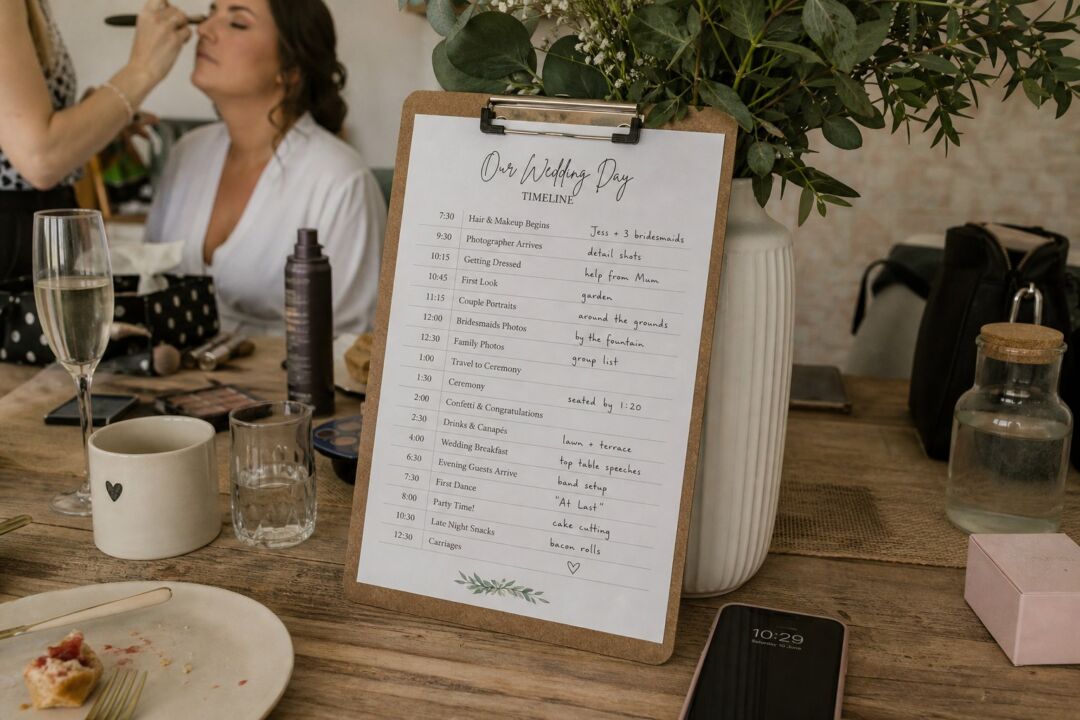
Finalize your day-of timeline. This document is what your vendors, wedding party, and family coordinators will use on the day. It should include: getting-ready start time, transportation departures, ceremony start time and estimated duration, cocktail hour, reception arrival, first dance, speeches, meal service, cake cutting, and end time. Share it with your photographer and videographer this week so they can flag any gaps in the photo schedule.
Order it once RSVPs close, not before.
Two Weeks Out: Receive, Confirm, and Check the Legal Pieces
This is the logistics-dense week.
Submit your final guest count to the caterer. Once you submit this number, in writing, it is generally locked for billing purposes, even if a guest cancels after. Confirm the number via email so there is a record.
Receive and check your printed stationery. When place cards, menus, and seating chart signage arrive, check every name against your seating list. One by one. Misspellings matter to guests, and they are common. Sort place cards into table groups in labeled envelopes or small boxes so whoever sets up on the day can move through the room quickly.
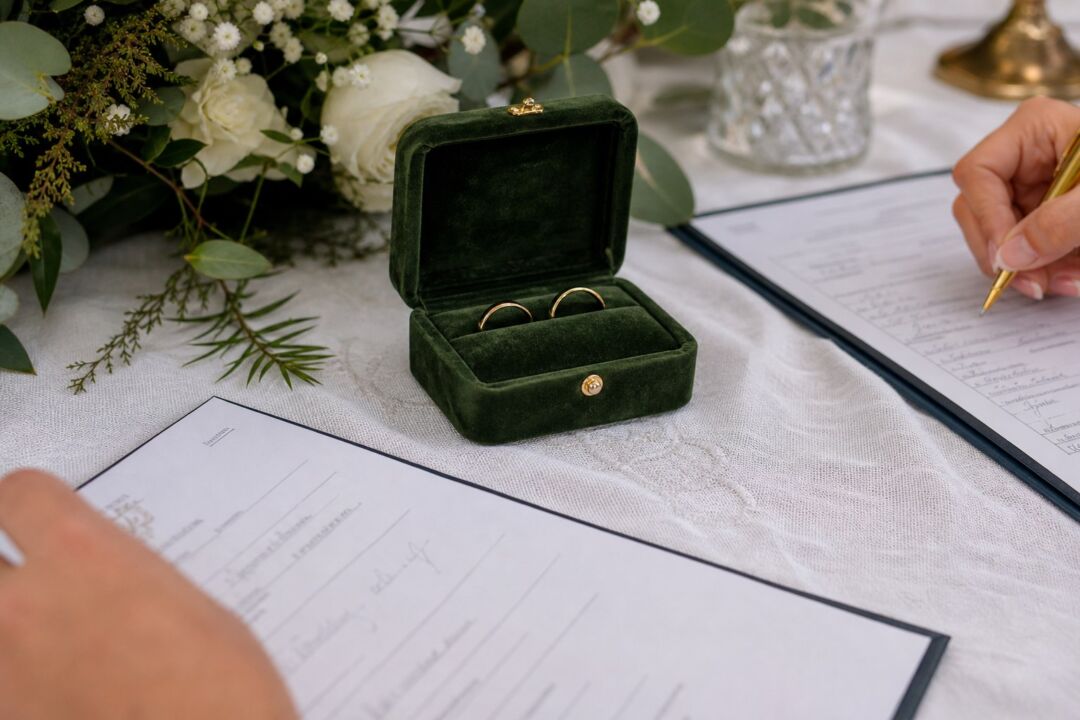
Collect your rings. If you ordered custom rings or had them resized, confirm they are ready and pick them up this week. Try them on. Check engraving if applicable. Designate one person, not you, to hold both rings until the ceremony.
Confirm marriage paperwork details. Know who holds the license or certificate on the day, when and where it gets signed (typically immediately after the ceremony), and who the two witnesses are. Brief your witnesses now. This takes five minutes and removes a scramble from the day.
Final attire check. Pick up altered garments and do a complete try-on before you take everything home: dress or suit, shoes, accessories, undergarments. The same applies to your partner. Do not assume alterations are right until you have confirmed them on your body.
Distribute the finalized day-of timeline. Send it to every vendor, your wedding party, and the family members involved in readings or photos.
One Week Out: Build the Handover List
The handover list is the most underrated item on this checklist. It is a document, or a labeled folder of documents, that tells every person running something on the day exactly what they are responsible for, without needing to contact you.
A complete handover list covers:
- The vendor call sheet (names, roles, arrival times, cell numbers)
- Who holds the payment and tip envelopes and when to distribute them
- Where the ceremony and reception setup boxes are and what is in each
- Who manages the card and gift table and takes gifts home safely after the reception
- Who collects the cake topper, toasting flutes, and any family heirlooms when the reception ends
- Who handles décor teardown and what is being returned versus kept
- Who is the day runner: the one person that guests and vendors contact with questions, so neither of you gets pulled into logistics once the ceremony starts
Print two copies. Give one to your planner or coordinator and one to the most organized person in your group.
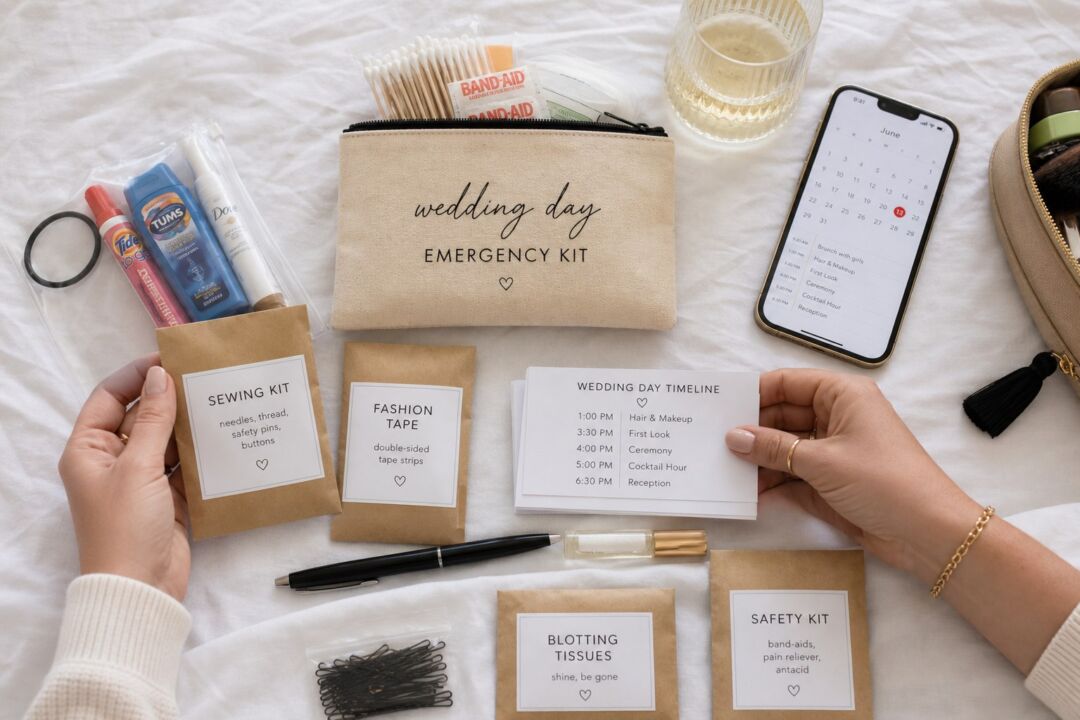
This week also: do your final venue walk-through if you have not already, confirm any décor setup restrictions, and pack your wedding-day kit. The kit should include rings, vows, emergency supplies (pain relief, fashion tape, a basic sewing kit, tissues, mints), and printed copies of the timeline and vendor call sheet.
The Last 48 Hours: Hand It Off and Stop
Your job in the final 48 hours is to get out of the logistics. Everything that can be delegated should already be delegated.
Brief your day runner in person or on a call. Walk through the handover list together and answer any questions now. Do not leave ambiguities for the morning of the event.
Pack for what comes immediately after. If you are leaving for a honeymoon within 24 hours of the wedding, confirm passports, travel documents, and bags are packed before the morning of the event. Not on the morning of the event.
Rest, eat, and drink water. These are not soft suggestions. Dehydration and poor sleep cause low-level confusion that makes a simple thing feel complicated. Your one job in the final 48 hours is to be present.
Place cards, table numbers and seating charts personalized online. The $5 sample pack puts seven designs and an envelope in your hands, including real foil and letterpress, so you judge paper and finish off a screen.
Frequently Asked Questions
When exactly do I give the caterer my final headcount?
Most venues write the deadline into the contract, typically 10 to 14 days before the event. Check your contract for the specific date, then confirm your number in writing (email is sufficient) before that deadline. Once submitted, the number is generally locked for billing, so chase any outstanding RSVPs before the cutoff, not after.
How far in advance do I need to order place cards and menus?
Three weeks out is the safe window for most printed stationery. Production takes several business days, and shipping adds more time on top. If a name is wrong on a proof and you need a reprint, three weeks gives you the buffer to fix it. Two weeks is workable but leaves almost no margin. One week before the wedding is too late for most professional printers.
What is a vendor call sheet and what goes on it?
A vendor call sheet is a single-page document listing every person working your wedding: their name, their role, their personal cell number, their expected arrival time, and any logistical note relevant to the day (“confirm with venue coordinator on arrival” or “enter via side gate”). It lives inside your handover list so whoever is running your day can answer vendor questions without interrupting you.
Do I need to brief my witnesses before the day?
Yes, briefly. Tell each witness they will need to sign the marriage register or certificate immediately after the ceremony, that they should arrive a few minutes before the ceremony begins, and that they may need to show photo ID depending on the jurisdiction. Your celebrant or officiant will guide them through the signature process on the day, but they should not be surprised by the request.
What is the handover list and who should have it?
The handover list is a printed document that tells every person managing something on the day what their specific job is: who holds vendor payments, who manages the gift table, who is the day runner for questions. Give a copy to your planner or coordinator and to the most organized and reliable person in your group. Its purpose is to keep you out of logistics from the moment the ceremony starts.
Can I still change the seating chart at one week out?
In principle, yes, but expect knock-on effects: reprinting or handwriting replacement place cards, updating the chart signage, and renotifying the caterer if table counts change. The seating chart is commonly stable by two weeks out, with only one or two late adjustments after that. If a last-minute change is unavoidable, handwrite a replacement card in matching ink rather than reprinting the full set.