
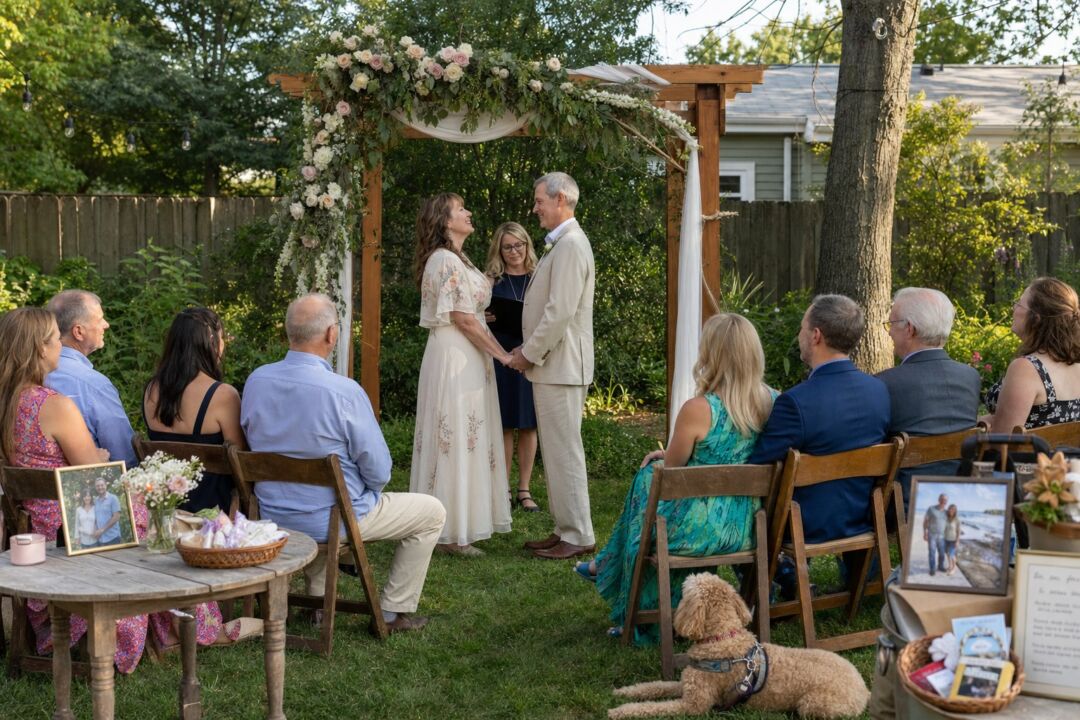
You already had the wedding. A vow renewal is something different: a deliberate choice, made with full knowledge of what marriage costs, to say the same thing again. There is no paperwork, no license, no legal steps. Nobody signs anything. A vow renewal has no legal effect on your marriage status, and that is precisely the point. The meaning comes entirely from the act itself.
This article covers the ceremony: what order it runs in, what is said, who should be there, and how to write vows that actually reflect the years you have lived rather than pretending this is a first wedding. For invitation wording and etiquette, see our vow renewal invitation guide. For the broader planning picture, timelines, venue options, and gift etiquette, see our complete vow renewals guide.
Vow Renewal Ceremony: Quick Guide
- No marriage license needed. No legal witnesses required. No legal effect.
- An officiant is optional. Anyone you trust can lead the ceremony.
- Typical ceremony length: 15 to 30 minutes
- Guest list is smaller and more personal than most weddings
- Children often participate. The original bridal party does not have to.
- Vows should acknowledge the years passed, not repeat first-wedding language
- Dress code is flexible. Formal, cocktail, or casual all work.
- Invitations go out 6 to 10 weeks in advance
People need a date, a place and a dress code, exactly like the first time.
What a Vow Renewal Is (and What It Is Not)
A vow renewal does not require a marriage license. It does not require a Notice of Intended Marriage, legal witnesses, or a registered celebrant. It carries no legal weight. If you are already legally married, a vow renewal does nothing to change that status. If for some reason your original marriage was not legally recorded and you now want it to be, that is a civil ceremony, not a renewal, and the process is entirely different.
None of this makes a renewal less meaningful. The absence of legal machinery is what makes the ceremony entirely yours to design.
You also do not need an ordained or licensed officiant, though many couples want one. A friend, a family member, or anyone the couple chooses can lead the ceremony. There are no requirements to satisfy, only the ones you set for yourselves.
Why Couples Choose to Renew Their Vows
The most common milestones are round-number anniversaries: the 10th, 25th, and 50th. But there is no rule about timing. Couples also renew vows after one partner’s serious illness, after a period of estrangement and reconciliation, after a major life transition such as relocation or retirement, after a second marriage ceremony for family or friends who could not attend the original, or simply because they want to mark publicly what they have built together.
One situation that generates a great deal of searching but less coverage: renewing vows after a genuinely difficult period. If your marriage survived something that almost ended it, a renewal can mark that turning point. The wording for this situation is covered in detail below.
Who to Invite
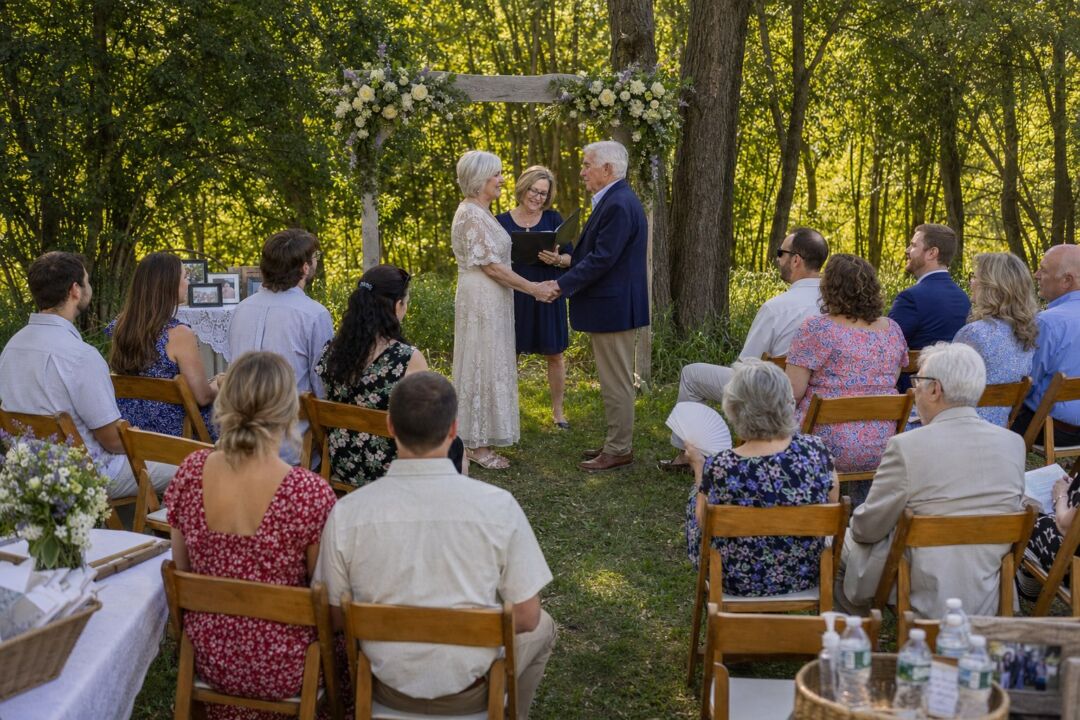

Because a vow renewal has no legal requirements, there is no formal guest list structure to follow. Commonly, couples keep it significantly smaller than their original wedding. The natural core group is immediate family, closest friends, and the people who have been genuinely present in your marriage over the years.
Children. Including your children is very common and often the most emotionally resonant element of the day. They can walk with you during the processional, stand beside you at the altar, hold the rings, or receive a spoken acknowledgment in the vows. This works at any age.
The original bridal party. No obligation. If you want to recognize the people who stood with you on your wedding day, you can include them. But many couples at a 25th or 50th anniversary are more interested in a small, personal ceremony than in reassembling a formal party.
A practical size guide:
- Under 20 guests: immediate family and closest friends only, very intimate
- 20 to 50 guests: close friends, extended family, and people who have shared your life
- 50 or more: treat it closer to a reception-style celebration, where the ceremony itself is brief
The Ceremony Order, Step by Step
Most vow renewals run 15 to 30 minutes. A short ceremony with a welcome, vows, ring exchange, and pronouncement can be under 20 minutes. Having a loose running order helps guests and the person leading the ceremony.
| Step | Description | Typical length |
|---|---|---|
| 1. Processional | Couple enters together, or one partner walks to meet the other. Music plays. | 2 to 3 minutes |
| 2. Welcome | Officiant greets guests and states the purpose of the gathering. | 1 to 2 minutes |
| 3. Reflection | Brief remarks on the marriage: where it started, what it has been through, why everyone is gathered here today. | 2 to 4 minutes |
| 4. Reading (optional) | A poem, scripture passage, or prose read by a guest or the officiant. | 2 to 3 minutes |
| 5. Vow renewal | Each partner speaks or recites their vows. | 3 to 6 minutes |
| 6. Ring exchange (optional) | Re-exchange original rings or present new ones with a short spoken line. | 2 minutes |
| 7. Family recognition (optional) | Spoken acknowledgment of children or other family members present. | 1 to 2 minutes |
| 8. Closing words | Blessing, prayer, or final remarks from the officiant. | 1 to 2 minutes |
| 9. Pronouncement | Officiant declares the renewal complete. Applause. | Under 1 minute |
| 10. Recessional | Couple exits together. Music plays. | 1 to 2 minutes |
What the Officiant Says
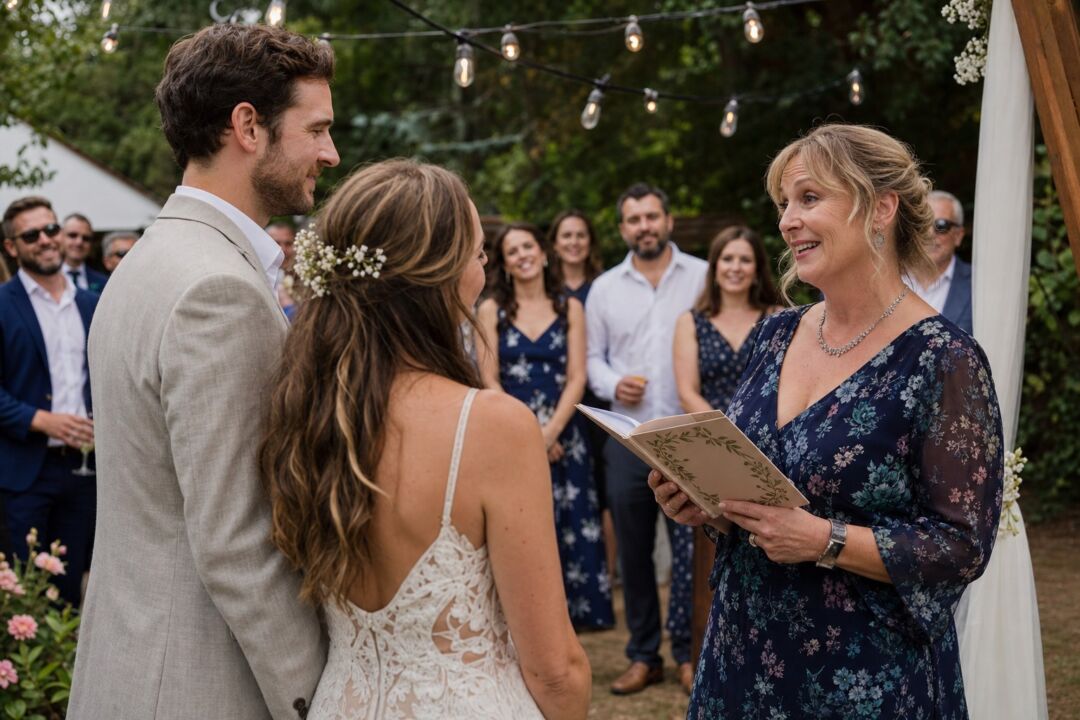
You do not need a licensed officiant for a vow renewal. A trusted friend, a family member, or anyone the couple chooses can lead the ceremony. Most people doing this for the first time find it easier to have a loose script to follow. Below are two welcome scripts: one non-religious and one faith-based. Closing remarks and pronouncements follow the same tone; keep them brief and specific to the couple.
Non-religious welcome:
“Family and friends, thank you for being here today as [Name] and [Name] renew the vows they made [X] years ago. We are not here because the law requires it or because a ceremony was scheduled on a calendar. We are here because these two people chose to stand in front of the people they love most and say again what they already know to be true.”
Christian or religious welcome:
“Dearly beloved, we are gathered here in the sight of God and in the presence of these witnesses to celebrate a renewal of marriage vows. [Name] and [Name] come today to reaffirm the promises they made when they were first joined in holy matrimony, and to give thanks for the years they have shared.”
A program keeps readings, vows and speeches in the order you actually planned.
Vow Renewal Wording: 8 Examples
The single most important rule: do not write vows that sound like a first wedding. You already know what the marriage costs. You know what held and what broke. The best renewal vows acknowledge the years directly rather than reaching for the fresh-start language of a first ceremony.
Milestone anniversary vows
Short and honest (suitable for any milestone):
“[X] years ago, I made you a promise. I kept it through things I hadn’t imagined, with a person I know better now than I did then. Today I make it again, not because I have to, but because I want to.”
Warm and reflective (25th or silver anniversary):
“Twenty-five years ago I married the person I thought I knew. Every year since, I have learned more. I have learned your patience and your stubbornness, your humor in hard moments, and the way you take care of people you love. I would choose all of it again. I renew my vows to you today with a gratitude I did not yet have on our wedding day.”
Simple “I do” style (officiant leads):
Officiant: “[Name], having spent [X] years building a life with [Name], do you choose to renew your promise of love and commitment?” Partner: “I do.”
With children or family
Acknowledging children in the vows:
“I renew my vow to you, and I renew it in front of [children’s names], who are the clearest evidence of what we have made together. I promise to keep building the kind of marriage our children can trust.”
After a difficult period
These examples are for the couples who need them. They generate a great deal of searching and are less often written well. Vows that acknowledge the hard seasons directly tend to carry more weight than generic renewal language.
Honest and hopeful:
“I stand here today knowing what we have walked through. There were seasons I wasn’t sure we would make it. But we chose to keep working. Today I renew my vows with open eyes: I promise to keep doing the hard work, to listen more than I speak, and to remember that we are on the same team.”
Acknowledging the repair:
“We have had to rebuild things I once thought were permanent. I do not pretend that has been easy. What I can say is that the marriage we have now is one I know, not one I imagined. I vow to protect it. I vow to keep being honest, even when it costs me. I choose you again, knowing exactly what that means.”
Other tones and situations
Religious or faith-based:
“Before God and these witnesses, I renew my vow to you. I promise to love you, to honor you, and to cherish you all the days of my life. I am grateful for every year we have shared, and I trust what God has joined will continue to hold us.”
Lighthearted and casual:
“The original terms still apply. I still choose you. Still glad you put up with me. Still think you’re the right person. Let’s keep going.”
Readings for a Vow Renewal
Most wedding readings were written about new love, anticipation, or the beginning of things. Renewal readings work better when they acknowledge time, continuity, or the quality of love that deepens rather than fades.
Good choices:
- Pablo Neruda’s “Love Sonnet XVII” (“I do not love you as if you were salt-rose or topaz…”) works at renewals because it is about a love that has already grown into something bone-deep
- Rainer Maria Rilke’s letters on love and patience, particularly Letter Seven from “Letters to a Young Poet,” suit couples who want something about the discipline of loving someone over time
- Mary Oliver’s “The Summer Day” or “When Death Comes,” for couples who want a reading about choosing a full and conscious life
- 1 Corinthians 13 works well at renewals because it is explicitly about love that endures (“love never fails”), not love that begins
- A short passage from a book, film, or piece of writing that was significant in your relationship, read by someone who knew you when
One reading is usually enough. Two short readings work. More than two tends to stretch a ceremony that should stay tight and personal.
How a Vow Renewal Differs from a Wedding
| Factor | Wedding | Vow renewal |
|---|---|---|
| Marriage license | Required | Not required or applicable |
| Legal witnesses | Required in most states | Not required |
| Officiant | Must be legally authorized | Anyone can lead the ceremony |
| Legal effect | Creates legal marriage | None |
| Dress code | Often formal | Flexible. Couple’s preference. |
| Guest list | Often large, includes social obligations | Smaller and more personal |
| Bridal party | Traditional structure | Optional and informal |
| Gift expectations | Expected | Not expected. State this on the invitation. |
Your Vow Renewal Invitations
Vow renewal invitations use different language from wedding invitations: they name the anniversary milestone, avoid “wedding” wording, and typically set clear expectations about gifts and formality. The stationery itself can draw from the same range of designs used for wedding invitations, with the wording adapted to fit the occasion. Our guide to vow renewal and elopement reception invitations covers specific wording templates, etiquette, and timing in detail. For renewals tied to a milestone year, anniversary invitations carry wording built around the anniversary rather than a first wedding.
Anniversary and renewal designs you personalize online. The $5 sample pack puts seven designs and an envelope in your hands, including real foil and letterpress, so you judge paper and finish off a screen.
Frequently Asked Questions
Do you need an officiant to renew your vows?
No. Because a vow renewal carries no legal standing, no licensed or ordained officiant is required. You can ask a trusted friend, a family member, or anyone who knows you well to lead the ceremony. Many couples write their own scripts and have someone simply read them. Officiant services that specialize in renewals exist if you want a professional, but there is no requirement to use one.
What should renewal vows not say?
Avoid language that sounds like a first wedding: phrases like “as we begin this journey together” or “for all the years to come” used as if the marriage has not already accumulated years. The best renewal vows acknowledge that this is a continuation, not a beginning. Say what you have learned, what you have survived, and what you are choosing again.
Do children have to be included?
No, but including them often makes the ceremony more meaningful, especially if the renewal is partly about the family you have built. Common ways to involve children: walking in the processional, holding the rings, receiving a spoken acknowledgment in the vows, or standing at the altar. There is no obligation either way.
How long should a vow renewal ceremony be?
Most run 15 to 30 minutes. A short ceremony with a welcome, vows, ring exchange, and pronouncement can be under 20 minutes. Adding readings, family acknowledgments, and a longer reflection brings it to around 30 minutes. Much longer than that and the ceremony starts to need elements it probably does not need.
Can you renew vows after a very difficult period in your marriage?
Yes, and for many couples this is exactly what a renewal is for. The wording examples in the “after a difficult period” section above are written specifically for this situation. Vows that acknowledge the hard seasons honestly rather than pretending they did not happen tend to be more powerful than generic renewal language.
Who pays for a vow renewal?
There are no traditional rules. Couples commonly pay for the renewal themselves. Guests are not typically expected to bring gifts. If you want to be explicit about this, the invitation can note “your presence is the only gift we need” or similar wording.