
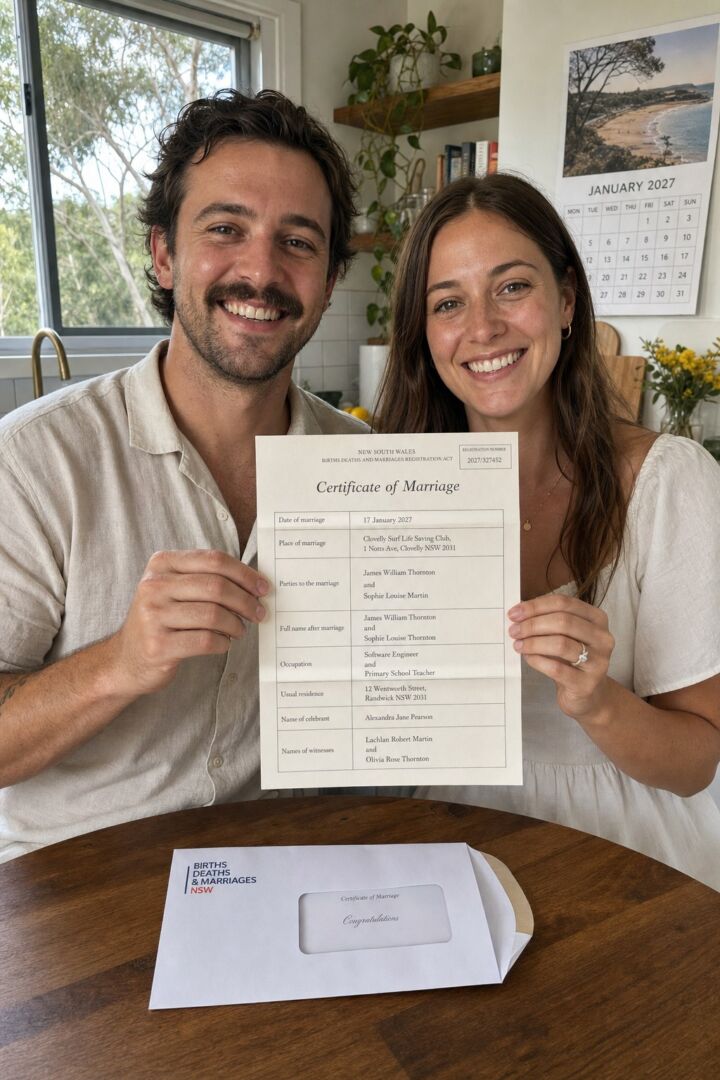
Two pieces of paper come out of an Australian wedding, and they are not interchangeable.
The first is the certificate your celebrant hands you at the ceremony. It carries your names, the date, and the location, and it means a great deal personally. But it is a commemorative keepsake. Government agencies, passport offices, banks, and superannuation funds will not accept it.
The second is the official marriage certificate issued by the Registry of Births, Deaths and Marriages in the state or territory where you married. That is the document that unlocks every name change, visa application, mortgage update, and passport renewal. This guide explains why the two certificates exist, how your marriage gets registered, and exactly where to apply depending on where you said your vows.
Quick guide: Getting your official Australian marriage certificate
- Apply to the Registry of Births, Deaths and Marriages in the state or territory where the ceremony took place, not a national office.
- You can apply only after your marriage is registered. Your celebrant is legally required to lodge the paperwork with the Registry within 14 days of the ceremony.
- Applications are typically available online, by post, or in person depending on the state.
- Have ready: full names of both parties, date and place of marriage, proof of identity, and your payment method.
- The decorative certificate from your ceremony day cannot be used for name changes, passports, visas, or any other official purpose.
- Fees and processing times are set by each state or territory registry and change periodically. Check the registry website for current figures.
The same is true of your invitation suite, which is why couples frame one and file the other.
The Certificate You Sign on the Day Is Not the Legal One
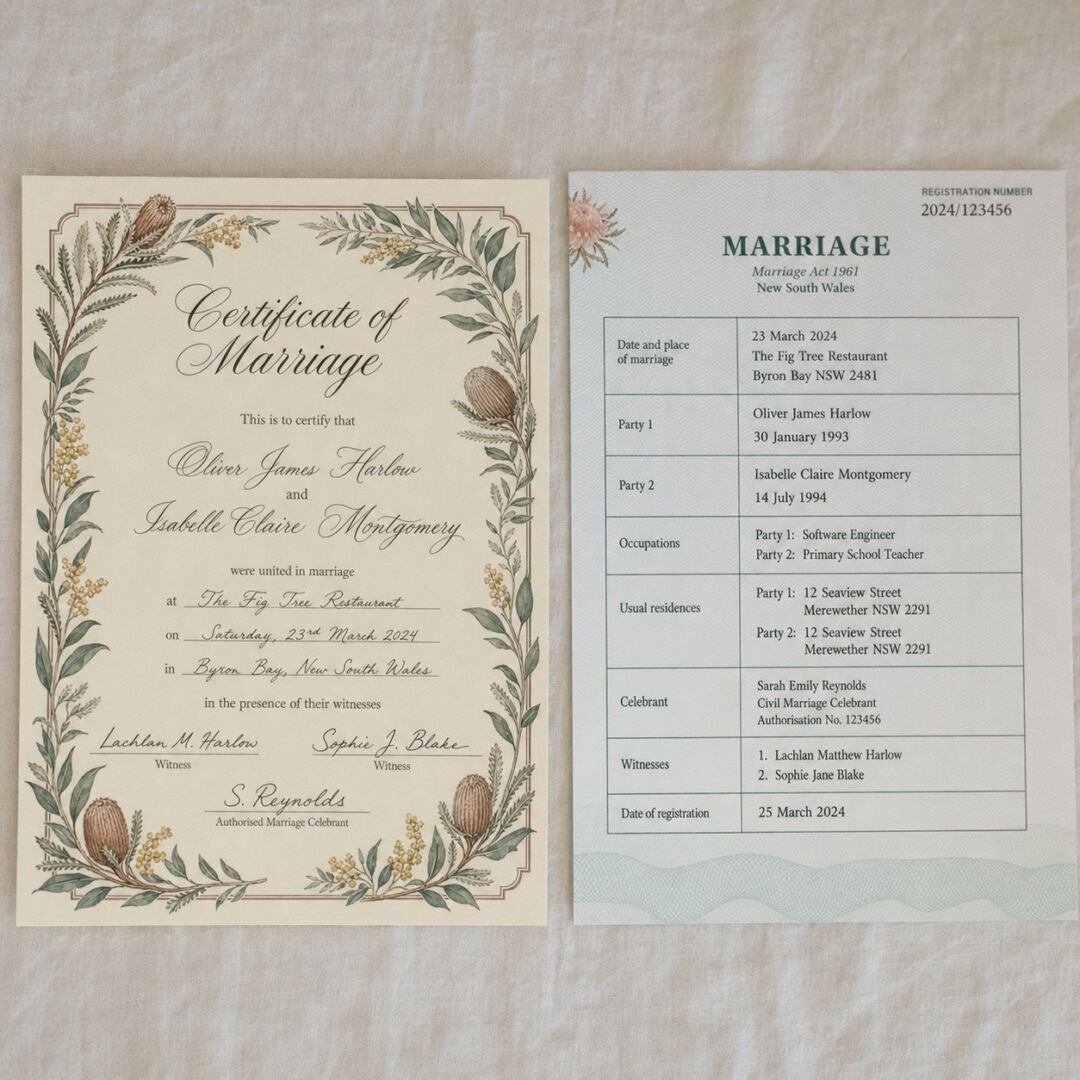
When your celebrant hands you a certificate at the ceremony, that is a commemorative document. It records your names, the date, and the location of the ceremony, and it is designed to be kept as a keepsake, not used as proof of identity.
Every state and territory Births, Deaths and Marriages registry is explicit on this point. The NSW Registry describes the commemorative certificate as an elegant keepsake that is “not official proof of identity or marriage.” Queensland’s registry states that commemorative certificates “cannot be used to prove your relationship.” Consumer and Business Services in South Australia notes they “may not be accepted as proof of identity.”
The reason is practical: official marriage certificates are printed on security paper with anti-fraud features to prevent copying or tampering. Commemorative certificates are not. Any institution with identity verification requirements will reject a document that cannot be checked for fraud.
The official certificate looks plainer. That is intentional. Its value is legal, not decorative.

How Your Marriage Gets Registered
Responsibility for lodging the registration documents sits with your celebrant, not with you. Under the Marriage Act 1961 (Commonwealth), your celebrant must lodge the official paperwork with the Registry of Births, Deaths and Marriages in the state or territory where the ceremony took place within 14 days of the marriage.
The Registry processes the lodgment and adds the marriage to the official register. Only once registration is complete can you apply for the official certificate.
If you want to apply soon after the wedding, confirm with your celebrant that the documents have been lodged, then allow a short window for the Registry to process the registration before submitting your application. Applying before registration is complete will simply result in a delay.
Why You Need the Official Certificate
The official marriage certificate is the primary document used to prove that a marriage took place in Australia. Institutions across every sector require it, not the commemorative version.
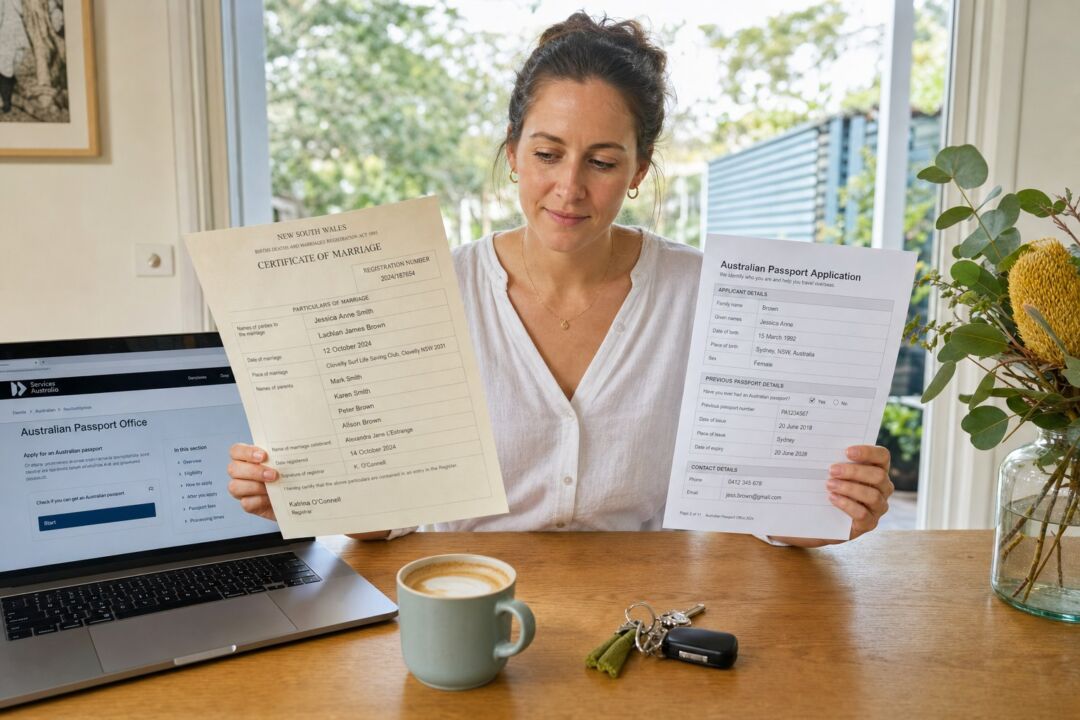
Name change after marriage. In most cases, Australians changing their surname after marriage do not need to formally register a change of name with BDM. The official marriage certificate is sufficient for most purposes. The standard sequence is to update your driver license first, then Medicare, then your passport, then banks and other accounts. None of these authorities accept the ceremonial document.
Australian passport. The Australian Passports Act 2005 specifically requires a marriage certificate issued by an Australian state or territory Registry for a surname change on a passport. A certificate from an overseas marriage generally cannot be used for this purpose; a formal Change of Name certificate from BDM is required instead.
Visa and immigration records. The Department of Home Affairs requires official evidence of name change for immigration record updates. If you hold a visa in your previous name, you will need to notify the relevant immigration authority. The commemorative certificate is not accepted.
Mortgage and financial accounts. Banks, lenders, credit card providers, and insurance companies require the official BDM certificate when updating account records after a name change. Most also want updated photo identification alongside it.
Superannuation. Each fund has its own process, but all require the official certificate and updated identification. Keeping your super records, ATO details, and bank accounts aligned with your current legal name is particularly important for beneficiary nominations.
Applying for Your Certificate: State-by-State Guide
Apply to the Registry in the state or territory where the marriage took place, regardless of where you currently live. There is no single national registry for Australian marriages.
The table below lists the official name of each registry and how to apply. Fees and processing times vary by jurisdiction and are updated periodically; confirmed figures are noted where they could be verified from the issuing registry, and a pointer to the registry website is given where they could not. Most registries offer both standard and priority processing options. Priority processing reduces turnaround times significantly for an additional fee and is worth considering if you need the certificate for a visa or passport application.
| State/Territory | Registry name | How to apply |
|---|---|---|
| NSW | NSW Registry of Births, Deaths and Marriages (via Service NSW) | Online via the Service NSW website; paper form by post; in person at any Service NSW centre. The NSW Registry of Births, Deaths and Marriages charges $70 for a standard certificate and $105 for priority processing, both including postage and handling (NSW Government fee schedule, effective 1 July 2026). This is the registry fee for the official certificate, payable to the registry whether you were married by a private celebrant or in a registry ceremony. |
| VIC | BDM Victoria (Victorian Registry of Births, Deaths and Marriages) | Online via the BDM Victoria website; paper form by mail or in person at the Registry. BDM Victoria charges $59.10 for a marriage certificate (BDM Victoria fee schedule, effective 1 July 2026). This is the registry fee for the official certificate, payable to the registry whether you were married by a private celebrant or in a registry ceremony. Priority processing is available at an additional fee. |
| QLD | Queensland Registry of Births, Deaths and Marriages | Online; by post to PO Box 15188, City East QLD 4002; in person at a Magistrates Court, QGAP office, or the Brisbane Registry customer service centre (Level 32, 180 Ann Street). Current fees at the Queensland BDM website. |
| WA | WA Registry of Births, Deaths and Marriages | Online via the Registry website; in person at the Perth Registry or statewide court locations; by post to PO Box 7720, Cloisters Square, Perth WA 6850. Do not send original identity documents by mail. Current fees at the WA Registry website. |
| SA | Consumer and Business Services, Births, Deaths and Marriages | By post to Consumer and Business Services, GPO Box 1351, Adelaide SA 5001; in person at a Gawler Service SA centre or any regional Service SA location. Phone applications are not accepted. Current fees at the CBS website. |
| TAS | Births, Deaths and Marriages Tasmania (Department of Justice) | Online via the BDM Tasmania website; paper form by post; in person at any Service Tasmania centre. Current fees at BDM Tasmania. |
| ACT | Births, Deaths and Marriages, Access Canberra | Complete the Application for a Certificate form, pay the fee, and receive the certificate by registered post (you provide identity on delivery). In-person appointments also available. Fee waivers possible in limited circumstances; contact Access Canberra. Current fees at Access Canberra. |
| NT | NT Births, Deaths and Marriages | Online, by post, or in person. Same general process applies as other registries. Current fees at the NT BDM website. |
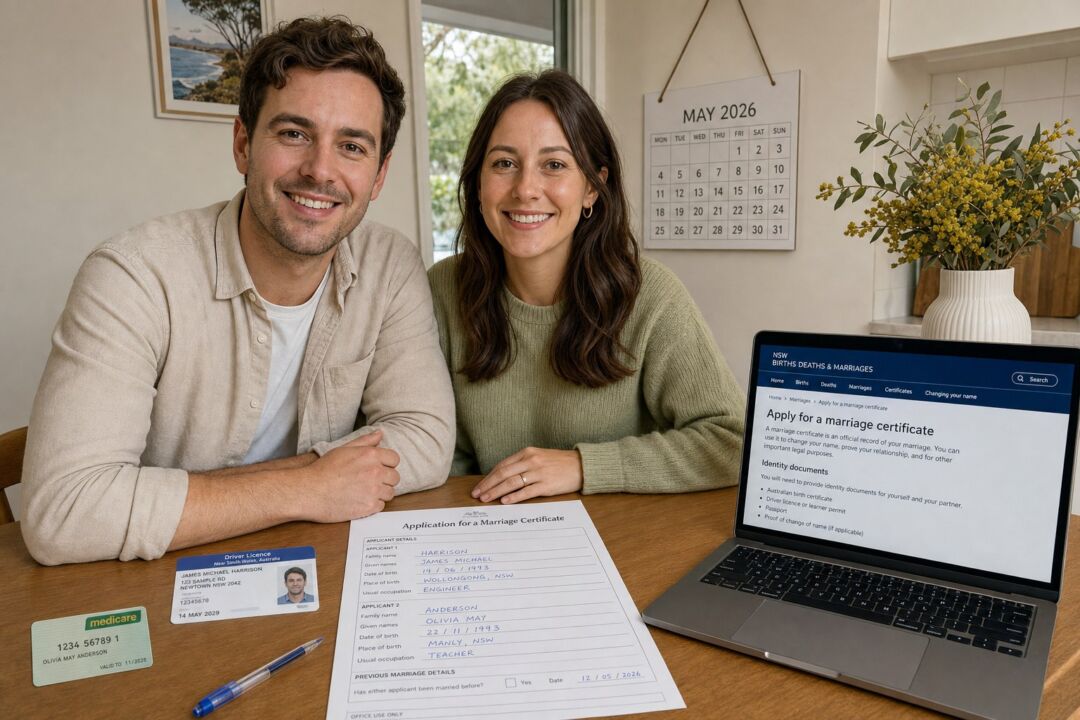
What every state requires: full names of both parties as they appear on the registration, the date and place of marriage, proof of your own identity (driver license, passport, or equivalent), and your payment. Postal applications typically require certified copies of identity documents, signed by a justice of the peace, solicitor, or police officer.
Thank you cards that match the invitation suite close the loop on the whole set.
After the Certificate Arrives
When the official certificate arrives, that is the practical starting point for the name change process. Starting with your driver license is the practical approach, since many other institutions accept a new driver license plus the marriage certificate as sufficient. Medicare and passport follow, then the longer list of banks, superannuation funds, employers, and electoral roll.
The same window is typically when wedding thank you cards go out. Many couples prefer to send them under their new married name, which means the two timelines often run in parallel. Cards sent within eight weeks of the wedding are well within what etiquette guides recommend. Couples who marry legally first and celebrate later often send wedding invitations for that second event once the certificate is in hand.
For a full guide to the legal requirements for getting married in Australia, including the Notice of Intended Marriage and your celebrant’s obligations, see How to Legally Get Married in Australia.
Thank you card designs you personalize online and print on the same stock as your invitations. The $5 sample pack puts seven designs and an envelope in your hands, including real foil and letterpress, so you judge paper and finish off a screen.
Frequently Asked Questions
How long does it take to get a marriage certificate in Australia?
Processing times vary by state and the service level you choose. Most registries offer standard processing (typically several weeks) and priority or express processing (several days for an additional fee). If you need the certificate for a visa or passport application, use the priority option and confirm current turnaround times on your state registry’s website before applying.
What is the difference between a commemorative and an official marriage certificate?
The commemorative certificate is a decorative document given to you at the ceremony. It is a keepsake only and has no legal standing. The official certificate is issued by the state or territory Registry of Births, Deaths and Marriages and is printed on security paper with anti-fraud features. Only the official certificate is accepted for name changes, passports, visas, banking, and superannuation.
Can I use my marriage certificate to change my name in Australia?
Yes, for a surname change. The official BDM marriage certificate is accepted by most Australian government agencies and financial institutions as proof of a name change following marriage. You do not typically need to register a separate change of name. For first or middle name changes, or for marriages that took place overseas, a formal Change of Name certificate from BDM is usually required.
When can I apply for my official marriage certificate?
You can apply after your marriage has been registered. Your celebrant is legally required to lodge the marriage documents with the Registry within 14 days of the ceremony. Allow a few days after lodgment for the Registry to process the registration, then submit your application.
Do I apply to a national office or to my state’s registry?
There is no national registry for Australian marriages. You apply to the Registry of Births, Deaths and Marriages in the state or territory where the ceremony took place, regardless of where you currently live. Each state and territory operates its own registry independently.
What if I lose my official marriage certificate?
You can apply for a replacement at any time through the same registry that issued the original. There is a fee for replacement certificates. The process is the same as the initial application: provide your personal details, proof of identity, and payment. Most registries process replacement orders within the same standard and priority timeframes as new applications.