
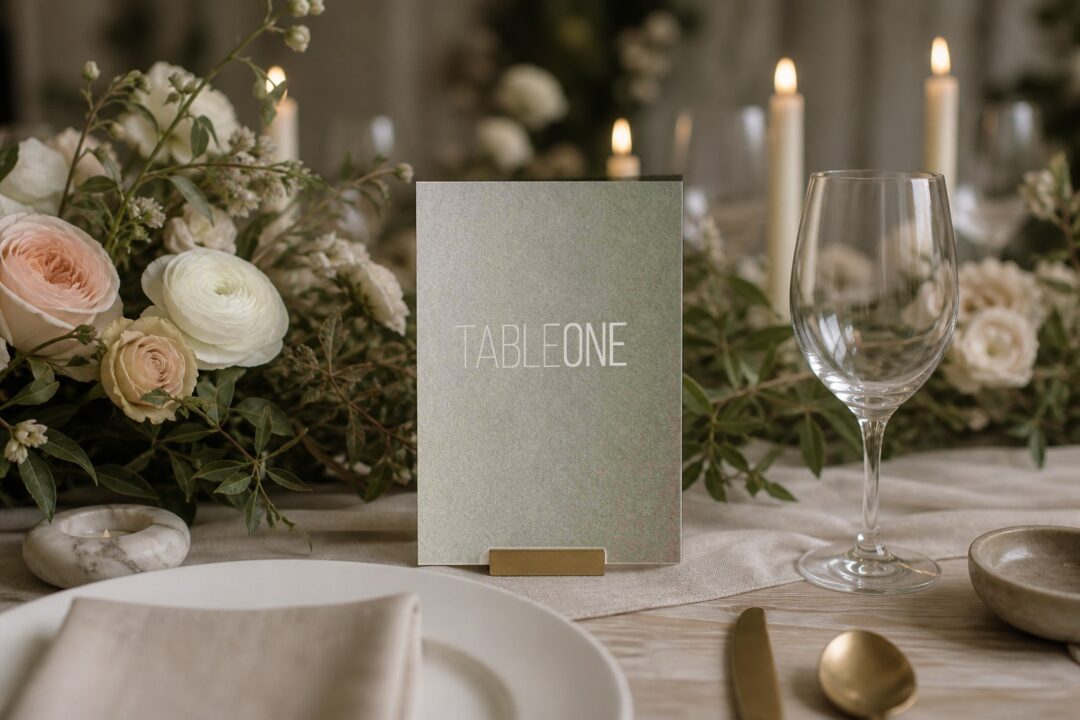
Table numbers sit at the center of every guest table from the moment doors open until the last song plays. They are small in size but visible in almost every reception photo. Whether to make them yourself or order a professionally printed set is a practical question with a real cost-effort trade-off, and this guide walks through both paths with honest numbers.
- DIY total cost (10-20 tables): $15-$95 depending on frames and paper quality. Print-at-home adds roughly $0.25-$0.70 per card in cardstock and ink.
- Professionally printed (10-20 tables): $40-$160 for a coordinated set. Foil and letterpress finishes cost more but are the only way to truly match specialty invitation suites.
- The consistency gap is real: home printers drift in color output across 15+ cards, especially with dark backgrounds, rich colors, or metallic-look designs.
- Matching your suite is simplest when table numbers come from the same printer on the same paper as your invitations, same proof process, same press run.
- Quantity breakpoint: under 10 tables, DIY almost always wins on cost. Over 20 tables with a coordinated look, professional printing typically saves time and stress.
- Foil table numbers are a DIY dead end, flat foil and foil stamp finishes require industrial equipment. Professional printing is the only route for true metallic numbers.
- Time budget: designing, printing, cutting, and framing 20 table numbers takes 4-8 hours. Professional printing hands that time back to you.
The Real Costs of DIY Wedding Table Numbers
DIY covers a wide range of effort levels. The lowest-cost approach is downloading a free printable template, printing on standard cardstock at home, and slipping it into a dollar-store frame. The most hands-on version involves designing from scratch, printing on specialty paper, and hand-lettering numbers over a digital base. Here is what each path actually costs.
Print-at-Home Using Canva or an Etsy Template
The most popular DIY route is designing in Canva (the free plan is sufficient for table numbers) or buying a matching Etsy template ($5-$15), then printing on 90-110 lb cardstock at home or at a local print shop.
At-home printing costs per table:
- Cardstock: $0.10-$0.30 per sheet (90-110 lb weight)
- Ink: roughly $0.15-$0.40 for a full-color 5×7 card
- Total per table: $0.25-$0.70
Local print shop costs per table:
- Walmart or Walgreens 5×7 photo card: $1.25-$1.75
- Staples cardstock print: $0.80-$1.50
- Total for 20 tables: $16-$35
Add frames or display holders ($0.50-$3 each from craft stores or Amazon) and your all-in cost for 20 tables lands at $25-$95.
The catch with at-home printing: consumer inkjet printers drift in color output as ink runs low. Table number 1 and table number 20 may not look identical. Dark backgrounds and rich colors, such as navy, black, or emerald, are especially prone to banding or inconsistency across a large print run. Always print a single test card on your actual cardstock before committing to the full set.
Craft-Store Frames and Stands
If you want the framed look without investing in a specialty printer, craft stores like Michaels and Hobby Lobby carry 4×6 and 5×7 acrylic stands and frames year-round. Budget $1-$4 per frame for basics, $5-$12 for styled options such as arched, black metal, or ornate gold. For 20 tables, frames alone run $20-$240 depending on the style.
Some couples skip frames entirely and use folded tent cards on thick cardstock. Tent cards stand on their own, require no additional materials, and can be scored and folded from a single printed sheet. This is the fastest, lowest-material DIY option.
Hand-Lettered Calligraphy Numbers
Hand calligraphy table numbers have a warmth that printed versions cannot replicate. If you or a friend have calligraphy skills, hand-lettering numbers onto pre-cut cardstock or wood rounds is genuinely achievable.
Budget: $30-$90 for cardstock, calligraphy pens, and practice sheets for a 20-table wedding. Add $80-$200 or more if you hire a professional calligrapher.
The limitation: calligraphy numbers vary slightly between cards by nature, which some couples love and others find inconsistent. If your stationery suite has a clean, modern, type-based design, hand-lettered numbers may read as a mismatch in the final reception photos.
Professional Wedding Table Numbers: What You Actually Get
Professionally printed table numbers from a stationery printer are not simply a better version of print-at-home. The difference is in the paper stock, the ink process, and the ability to match your existing invitation suite exactly.
Paper weight: Professionally printed table numbers typically start at 300-380gsm (about 110-140 lb), compared to 90-110 lb (240-300gsm) cardstock sold at office supply stores. That extra weight means cards hold their shape in frames without buckling and feel substantial in your guests’ hands.
Print methods available professionally but not at home:
- Flat foil: Mirror-bright metallic gold, silver, rose gold, or copper numbers. No home printer can produce this finish.
- Foil stamp: A custom die presses foil into the paper, leaving a subtle debossed impression alongside the shine. Tactile and distinctive.
- Letterpress: Numbers and text are physically pressed into cotton paper, creating a debossed indent with hand-mixed ink. Requires a letterpress studio.
- White ink on dark stock: Crisp white type on navy, black, or emerald cardstock, requiring a dedicated white ink imaging station.
Consistency: Every card comes off the same press with the same paper and the same ink batch. Table number 1 and table number 30 are identical.
DIY vs Printed: Side-by-Side Comparison
| Factor | DIY at Home | DIY via Print Shop | Professionally Printed |
|---|---|---|---|
| Cost per table (materials only) | $0.25-$0.70 | $1.25-$2.50 | $2-$8+ |
| Total cost (20 tables + frames) | $30-$95 | $45-$130 | $60-$200+ |
| Time investment | 4-8 hours | 2-4 hours | 30 min to order |
| Color consistency | Variable | Good | Excellent |
| Paper weight | 90-110 lb | 90-120 lb | 300-380gsm |
| Foil or metallic finish | Not possible | Not possible | Available |
| Matches invitation suite | With effort | With effort | Exact match possible |
| Rush-reprint flexibility | Immediate | Same day | 3-7 day lead time |
| Best for | Under 10 tables, simple designs | 10-20 tables, clean print look | 20+ tables, coordinated suite, foil finishes |
When Professionally Printed Table Numbers Are Worth It
The decision usually comes down to one of three factors: the design calls for a finish you cannot replicate at home, you want everything to match precisely, or you do not have the time to invest in the production process.
Go professional when:
Your invitations have foil, letterpress, or metallic ink. Table numbers should match, and those finishes are only available from a professional stationery printer. Using digital inkjet numbers alongside foil-stamped invitations creates a visible mismatch that reads in photos.
You have more than 20 tables. Printing, cutting, and framing 25+ cards can take a full weekend when factored in alongside everything else on the pre-wedding schedule.
Your reception space has good lighting on the tables. Under uplighting or candlelight, professionally printed foil numbers read from across the room in a way that inkjet prints simply do not.
You are ordering other printed items alongside the table numbers. Bundling menus, place cards, escort cards, and programs into a single order means everything comes from the same paper batch and the same press run. See the full collection of coordinated pieces at wedding place cards and coordinate with your wedding seating chart to create a complete reception-stationery system.
You want a long-term keepsake. Cotton paper letterpress or foil table numbers are the kind of item couples frame after the wedding.
DIY is the better choice when:
You have under 10 tables. The time and effort involved is minimal, and the cost savings are real.
Your theme is rustic, boho, or intentionally handmade. Slight variation between cards adds character rather than inconsistency.
Your total table number budget is under $50. DIY is the only path that stays in that range.
You enjoy the creative process and already have a good home printer, paper trimmer, and basic craft supplies.

Matching Table Numbers to Your Invitation Suite
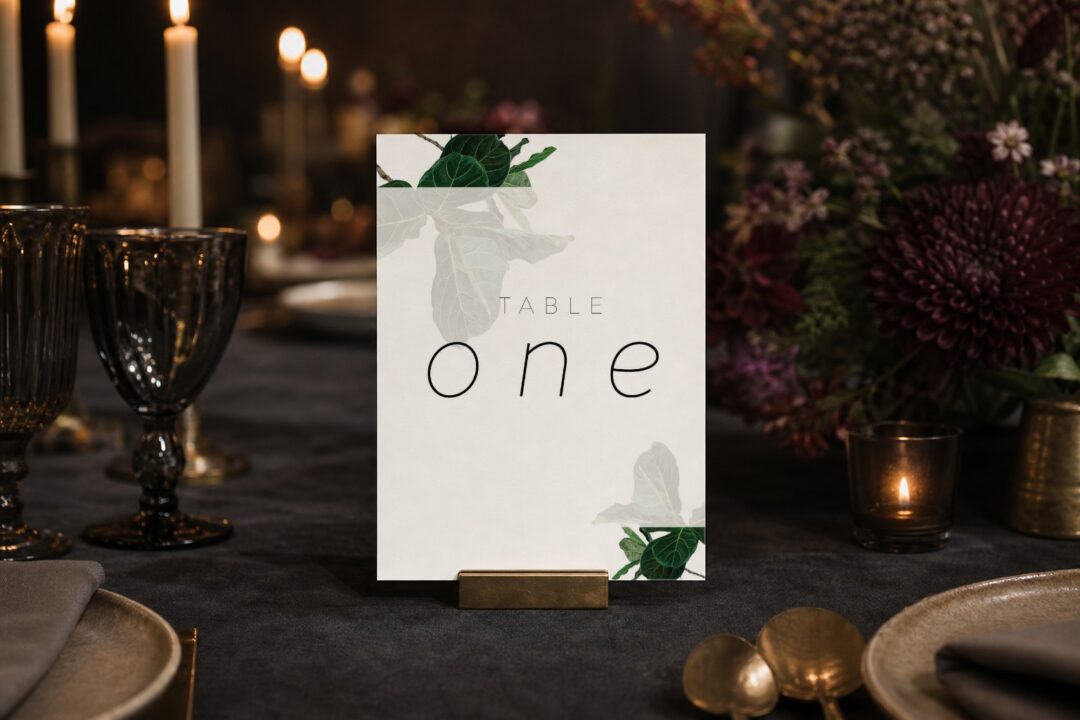
The strongest argument for professional printing is suite cohesion. When table numbers come from the same designer, on the same paper, and from the same press as your invitations, save-the-dates, and menus, the whole reception reads as a coordinated, intentional design.
For a true suite match, the key variables are:
Paper stock: Your invitations specify a paper weight and surface finish, whether matte, cotton, textured, or linen. Table numbers on the same stock feel like part of one design system rather than a separate project.
Print method: If your invitations are flat foil on 380gsm premium paper, table numbers in digital print on 110 lb office cardstock will look like an afterthought next to them. Matching the print method is as important as matching the font.
Font and color: Canva templates can match fonts and approximate colors, but exact color matching depends on your home printer’s calibration and the cardstock surface. Professional printers work from your original design file and match CMYK values across the full set.
Proof process: When you order through Paperlust, a designer proof is delivered within 1-2 business days of placing your order, so you can verify the numbers look right alongside your suite before anything goes to print. Two rounds of edits are included at no extra charge.
Browse coordinated table numbers at Paperlust wedding table numbers, including options that match designs across the wedding invitations collection. For couples building a complete reception stationery set, the sibling post “Wedding Table Number Display Ideas” covers display options and styling ideas for once your numbers arrive. The pillar “Wedding Table Numbers: Ideas, Etiquette and Wording” covers format decisions, numbering systems, and wording conventions in full.
Printable Table Number Templates: A Practical Middle Path
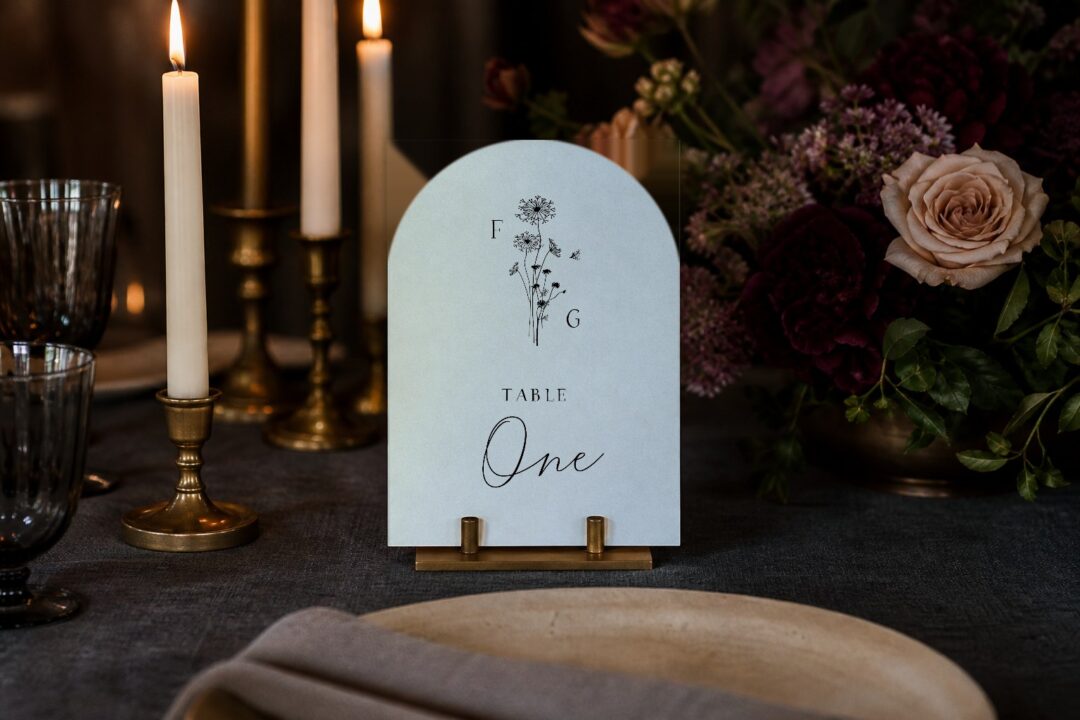
If budget is the primary concern but you want something that looks more polished than a generic word-processor layout, printable templates offer a real middle path between from-scratch DIY and a full professional order.
What to look for in a printable table number template:
- Sold as an editable PDF or a Canva template link, not a locked image file
- Matches your invitation style in fonts, color palette, and border treatment
- Includes bleed and crop marks if you plan to cut at home
- Available in 5×7 inches (127x178mm), the most versatile size for framed display, or 4×6 inches (102x152mm) for a smaller footprint
Where to find templates:
- Canva’s free library includes dozens of wedding table number templates, many styled to match popular invitation themes
- Etsy has thousands of paid options ($5-$15), often sold by the same designers who create the invitation templates, which helps with font and color consistency
- Creative Market and Design Bundles carry designer-level template sets with full suites
After downloading any template, print a single test card on your actual cardstock before running the full set. Colors on screen never exactly match what a home printer outputs. Catching a shade difference before printing 25 cards saves both materials and frustration.
How Quantity Shapes the Decision
The math changes significantly as table count rises. Here is a simple breakpoint guide:
Under 8 tables: DIY almost always wins on cost and effort. At 8 cards, even the time to design in Canva and print at home is modest. Download a template, print, frame, done.
8-15 tables: The choice is genuinely close. If your theme calls for a clean printed look without specialty finishes, a local print shop run is fast and affordable. If your invitations have any foil, letterpress, or metallic finish, order professionally.
15-25 tables: The consistency argument starts to favor professional printing. Printing 20+ cards at home means multiple ink cartridges and a real risk of color drift between the first and last card. Local print shops remain viable for simple designs but cannot match the paper weight or finish of a stationery printer.
25+ tables: Order professionally. The time investment of DIY at this scale is significant, and the consistency of a single press run is worth the cost difference for most couples.
Frequently Asked Questions
What size should DIY wedding table numbers be
The most common sizes are 5×7 inches (127x178mm) for framed numbers and 4×6 inches (102x152mm) for tent-card style. If your tables are large or your centerpieces are tall, a 5×7 frame reads more easily from a distance. Tent cards can use the same 5×7 size scored in half to create a 5×3.5 inch standing card.
Can I match DIY table numbers to my printed invitations
You can get close using the same fonts and a Canva color match, but exact replication is difficult without ordering from the same printer. The paper weight, surface finish, and ink process all differ between home printing and professional stationery printing. If suite cohesion is important, ordering the table numbers at the same time as your invitations is the most reliable approach.
What paper weight should I use for DIY table numbers
Use 90 lb (240gsm) cardstock as your minimum. 110 lb (300gsm) is better for framed numbers because it holds its shape without buckling under the weight of the frame glass. Avoid standard copy paper, which curls, flops in frames, and shows printer banding at heavier ink coverage.
How many table numbers do I need
One per guest table plus two or three spares for last-minute changes or mishaps. If you have an escort card display or a seating chart directing guests to their tables, every table still needs a number they can confirm on arrival.
Are foil table numbers possible as a DIY project
No. Flat foil and foil stamp finishes require industrial heat and pressure equipment not available for home use. Foil-tipped pens exist for calligraphy purposes, but they produce a different look, more like metallic paint than true reflective foil. If foil is part of your invitation suite, matching table numbers need to be professionally printed.
How far in advance should I order professionally printed table numbers
If ordering alongside your invitations, order everything together during the invitation production window. If ordering table numbers separately, allow 2-3 weeks minimum for production and delivery. For international orders, Paperlust offers DHL Express delivery on orders over $350 USD, which typically arrives in 2-4 business days after dispatch.
Can I order a sample of professionally printed table numbers before placing a full order
Yes. A custom sample is available for most Paperlust print methods for $15, so you can check paper weight, color accuracy, and print finish before committing to a full set. Note that the $15 custom sample is not available for letterpress orders. A $5 sample pack covering multiple print methods and paper types is also available.
Do professionally printed table numbers need frames
Not necessarily. Numbers printed on 300-380gsm stock can stand in acrylic risers, lean against candlesticks, or sit in purpose-built table number holders without any frame at all. Frames work well for a formal or gallery-style look but add cost and the logistics of sourcing 20+ matching frames. Tent-fold cards on thick stock are the frameless alternative.
What fonts work best for DIY table number templates
Serif fonts such as Cormorant Garamond or Playfair Display read well in formal and classic settings. Script fonts suit romantic themes but should be large enough to read at a glance, typically at least 120pt for the numeral itself. Sans-serif fonts such as Montserrat or Lato suit modern and minimalist receptions. Matching the font family from your invitation suite is the fastest way to achieve visual cohesion.
Is it cheaper to DIY table numbers or order them professionally
For under 10 tables with a simple design, DIY is cheaper. Once you factor in frames, specialty cardstock, and the time involved in printing and cutting 15+ cards, professional printing often costs the same or less per finished number while delivering better consistency, heavier paper, and a proof process that catches errors before the full run.
What is the difference between flat foil and foil stamp on table numbers
Flat foil uses heat to bond metallic foil to the card surface with no debossed impression. It sits on top of the paper for a mirror-bright, reflective finish. Foil stamp uses a custom die that simultaneously applies the foil and presses it into the paper, leaving a subtle debossed indent alongside the shine. Foil stamp has a more tactile, high-end feel. Flat foil is more affordable and available at lower minimum quantities. Both are only available through professional printing.
Can table numbers be ordered as standalone cards without frames
Yes. Paperlust prints table numbers as standalone cards on your chosen paper stock. Frames, stands, and holders are sourced separately by the couple, giving you full control over the display style that fits your venue and centerpiece design.