

It is easy to spend twenty minutes picking a registry site and then live with that choice for the next year. The decision shapes what your guests see, how easy it is to return duplicates, and how much of a cash gift actually reaches you. It is worth thinking through properly.
This is a comparison of the major US registry platforms: what each one does well, how cash fund fees actually work, who handles returns, and how to pair platforms. For advice on what to add to your list, that territory belongs to the companion piece on how to build a wedding registry.
Quick guide
- Want everything in one place, including cash funds: Zola or Joy
- Widest product selection and best returns logistics: Amazon (add alongside a cash-fund platform)
- Strong kitchen and tabletop brands with in-store help: Crate and Barrel
- Targeting department-store shoppers: Macy’s or Target
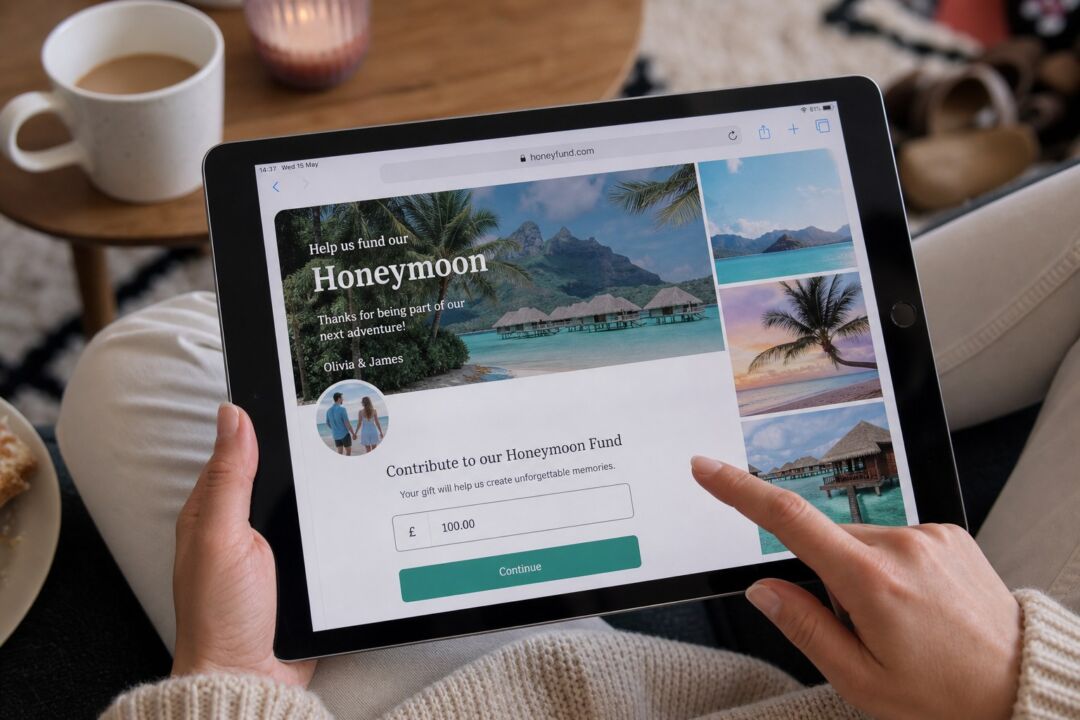
- Honeymoon or experience funding only: Honeyfund
- Common combination: one universal platform plus one store registry
Cash fund fees change. Check each platform’s current help page before you decide.
Registry details belong on a details card with the invitation, never printed on the invitation itself.
Universal Platforms vs. Store Registries
The first question is not which site to use. It is which type.
Universal platforms (Zola, Joy, The Knot Registry, MyRegistry) let you add items from any store, build cash funds, and share a single link. They earn through affiliate commissions, so most fees are invisible to you except on cash funds.
Store registries (Amazon, Target, Crate and Barrel, Macy’s) are tied to one retailer. They offer completion discounts on unpurchased items after the wedding, and returns go directly to a store rather than through a platform intermediary.
The two types are not competitors. Running one universal platform alongside one or two store registries is the common approach.


The All-in-One Platforms
Zola
Zola is the dominant universal registry. It has a large catalog, a good browser extension for adding items from external sites, and a wedding website builder included at no charge. Planning tools covering guest list management and a wedding timeline are built in.
Zola advertises cash funds with zero Zola fees, and the charge you will actually see is the card processor’s, not Zola’s markup. Zola lets you choose whether the guest covers it at checkout or you absorb it out of what you receive. Check the current processing rate on Zola’s help pages, because it is set by the processor and moves. Contributions via Venmo from a bank account or debit card carry no Zola fee. The registry page at zola.com, fetched 2026-07-31, describes cash funds as having “zero fees,” meaning no fee above what the card processor charges. Check Zola’s current cash fund FAQ for the precise rate, since Zola updates terms periodically.
Zola’s Newlywed Discount is 20% off anything still sitting on your registry after the wedding, which is stated on its registry page. Check the window it stays open in your account.
Joy
Joy markets its cash funds as zero-fee. The page at withjoy.com/cash-fund-registry/, fetched 2026-07-31, states: “Joy has zero fees on cash gifts.” It integrates with Venmo, PayPal, and Cash App, so guests contribute through peer-to-peer apps without entering card details. When guests use those apps with a bank-funded source, there is no platform fee and no card processing charge. Card payments may carry standard processing fees; check Joy’s current help center for the structure.
Joy includes a wedding website, planning tools, and a post-wedding completion discount; its published cash-gift position is the headline, so confirm the discount rate in your account.
The Knot Registry
Worth considering if you are already using The Knot’s website and planning suite, since everything shares one login. The registry is universal and The Knot runs a post-wedding completion discount on its own registry store. The catalog is narrower than Zola’s. Cash fund fees follow a card-processing model; check theknot.com for current rates.
The Store Registries
Amazon
Amazon’s strength is breadth and logistics. Registry gifts get an extended return window, considerably longer than Amazon’s standard policy, which matters when a gift arrives months before the wedding. The completion discount is structured as a single use, at a higher rate for Prime members than for everyone else, on eligible items sold by Amazon rather than third-party sellers. Amazon does not publish these terms on a page that can be read without signing in, and it changes both the rate and the eligible-purchase cap, so read the current numbers in your own registry account rather than from any article, including this one.
Amazon has no native cash fund. Run Honeyfund or Joy alongside it if you want one.
Target
Target works well for everyday items, small appliances, and home goods that guests can pick up in-store. The completion discount is limited to one online use and one in-store use, and both the rate and the window it stays open have moved in recent years, so check the current terms in your Target registry account. Stacking with a Target RedCard (5% off) and Target Circle rewards can push the effective discount higher than any other store registry on this list.
Crate and Barrel
The right choice if kitchen, tabletop, and home brands matter and you want guests to browse with in-store help. Its completion discount is the multi-use kind, spendable across several separate purchases rather than burned on one coupon, and the registry stays open well past the wedding. Confirm the current rate and window on the Crate and Barrel registry page before you count on it. That multi-use structure makes Crate and Barrel’s completion benefit among the most flexible of any store registry.
Macy’s
Macy’s covers bedding, towels, cookware, small appliances, and fine china in one place, with in-store pickup for local guests. The completion discount applies to remaining and newly added registry items for a set window after the event; check the current length in your registry account. Registry discounts cannot be combined with other savings passes or coupons, and no adjustment is available on prior purchases or returned-and-repurchased items.

A wishing well card asks the question politely and keeps the fees conversation off your registry page.
Cash Funds: What the Fees Actually Look Like
Fee language on cash registries is designed to sound better than it is. Here is the plain version.
Every platform that accepts cash gifts processes a payment. The rate is set by the card processor, not the platform, and moves with processor pricing; check each platform’s current help page for the figure. Platforms handle this one of three ways: the guest pays it at checkout, you absorb it from what you receive, or the platform eats it (which only happens when guests use bank-funded peer-to-peer transfers, not cards).
Zola and Joy both offer genuinely zero-fee routes through Venmo, PayPal, or Cash App when guests fund from a bank account or debit. The moment a guest pays by credit card, a processing fee appears somewhere.
Honeyfund specializes in honeymoon and experience funds. Redeeming as a Honeyfund prepaid Mastercard or retailer gift cards carries no fee; withdrawing directly to a bank account does. The specific rates change; check Honeyfund’s current help page for the active numbers.
The reliable rule: if zero fees matter to you, look for platforms accepting bank-funded peer-to-peer payments, not just cards. And verify from the platform directly, not from a comparison article, because these figures change regularly.
Returns and Exchanges: Who Handles Them
Store registries have a structural advantage here. Gifts from Amazon, Target, Crate and Barrel, or Macy’s are returned directly to that store. Most offer an extended gift return window, and the process is the same as any return.
With a universal platform, returns depend on where the item was purchased. Items from the platform’s own catalog go through the platform’s support team. Items added from an external store via the browser button go back to that store directly, with the platform uninvolved.
Practical takeaway: for high-value items where you might need to exchange for a different size or color, list them on the store registry rather than a universal platform linking to that same store.
Telling Guests Where to Find You
Once you have chosen your platforms, guests need to know where to look. A wedding website with direct links to each registry is the cleanest approach. If you are sending physical invitations, an information card in the envelope is the standard way to share registry links and any other logistics your guests need. A card designed to match your invitation suite keeps the stationery cohesive and makes it easier for guests to find your list when they are ready to shop. If you are asking for contributions rather than gifts, wishing well cards handle that request in the envelope, where a registry link cannot.
Details and wishing well card designs that match your invitation suite. The $5 sample pack puts seven designs and an envelope in your hands, including real foil and letterpress, so you judge paper and finish off a screen.
Frequently Asked Questions
How many wedding registry websites should we use?
Two or three. One universal platform covers cash funds and the cross-store list; one store registry covers items where that retailer’s returns or shopping experience is an advantage. A third makes sense if you want a dedicated honeymoon fund separate from your main list. More than three is harder for guests to navigate.
Can guests use a registry finder to look us up?
Yes. All major platforms, including Zola, Joy, The Knot, Amazon, and Target, have a search tool where guests enter your name or event date. Universal platforms show the full list in one place; store registries show only what you added at that store. Put your registry links on your wedding website so guests have a direct path.
Is it rude to ask for cash gifts?
No. Cash and experience funds are mainstream for couples who already share a home or are prioritizing a goal like a honeymoon or down payment. Present the fund with a specific purpose rather than a generic “cash welcome” entry and guests will feel like they are contributing to something meaningful.
Does it matter which site a guest buys from?
It matters for returns. A guest buying through a universal platform’s catalog means any return goes through that platform. A guest buying from a store using your store registry link means the return goes to the store. For high-value or large items, directing guests to the store registry makes exchanges cleaner.
Do any registry websites charge couples to sign up?
No major US platform charges a setup fee. Revenue comes from affiliate commissions on purchases and, in some cases, cash fund processing fees. Check for any premium tiers before opting into paid features.