

Both systems have real failure modes, and using only one of them is how couples end up chasing a significant portion of their guest list in the final two weeks before the deadline. The smarter approach is running both in parallel from the start, with a single tracked list that catches every response regardless of which channel it comes through.
This article is about how to do that: the real differences between online and paper RSVPs, which guests will use one but never the other, how to run the hybrid system so neither channel creates a dead end, and the exact timeline that gets you to a complete headcount before your caterer asks for it.
For setting up the wedding website itself, Wedding Website: What to Include covers everything that should be on the page. This article picks up from there, at the question of whether a paper RSVP card is still worth including alongside it.
Online RSVP vs. paper RSVP card: quick comparison
| Paper RSVP card | Online RSVP | Hybrid | |
|---|---|---|---|
| Response speed | Slow, days to weeks in transit | Fast, often same day | Fast, with paper as backup |
| Why responses stall | Fill, address, stamp, and post: each step loses some guests | Requires a device and internet connection; some guests won’t complete the form | Each guest takes the path that suits them |
| Main failure mode | Card gets lost, guest forgets to post | Older guests can’t engage, form breaks | Two incomplete lists if not merged |
| Hidden work | Manual data entry, lots of chasing | Building the form, QR logistics | Maintaining one master list |
| Best for | Formal weddings, older guest mix | Tech-comfortable guest list | Most weddings |
Bottom line: For most Australian weddings, send a paper invitation with a QR code and short URL on an insert card, both routes feeding one tracked list. Paper-only leaves too many responses outstanding. Online-only leaves older guests with no graceful way in.
Online RSVP alone loses the guests who will never fill in a form.
The Real Difference Between the Two Systems
The difference between online and paper RSVP is not aesthetic. It is friction.
With a paper card, your guest needs to fill it in, find an envelope, find a stamp, remember where a letterbox is, and post it before the deadline. Each of those steps loses a few people. Each extra step between intent and a returned card loses some guests. Fill it in, find an envelope, find a stamp, get to a letterbox before the deadline: some guests fully intend to reply and simply never get all four done. With paper only, you have no visibility into who is in that group until you start calling.
With an online RSVP, the guest opens their phone, taps a link, and is done in under two minutes. Responses arrive faster, and you can see in real time who has and hasn’t replied. Wedding website platforms let you send a reminder to everyone on the outstanding list at once rather than calling them individually.
The failure mode for online-only is different: not late responses, but missing responses from guests who don’t feel confident enough with technology to complete a form. These guests exist at almost every Australian wedding, and they tend to go quiet rather than tell you they couldn’t get it to work.
Which Guests Will Never RSVP Online
Before invitations go out, go through your guest list and flag anyone who fits one or more of these:
- Over 70, or over 65 if they are not comfortable on a smartphone
- No email address you have on file
- Someone who has asked for help with any technology in the past two years
- A relative from a rural area with unreliable internet access
For Australian weddings with a mix of family generations, this group is often larger than couples expect. They are also the guests least likely to tell you they couldn’t figure out the website. They will simply not respond, and you will spend the final week before your deadline calling each of them individually.
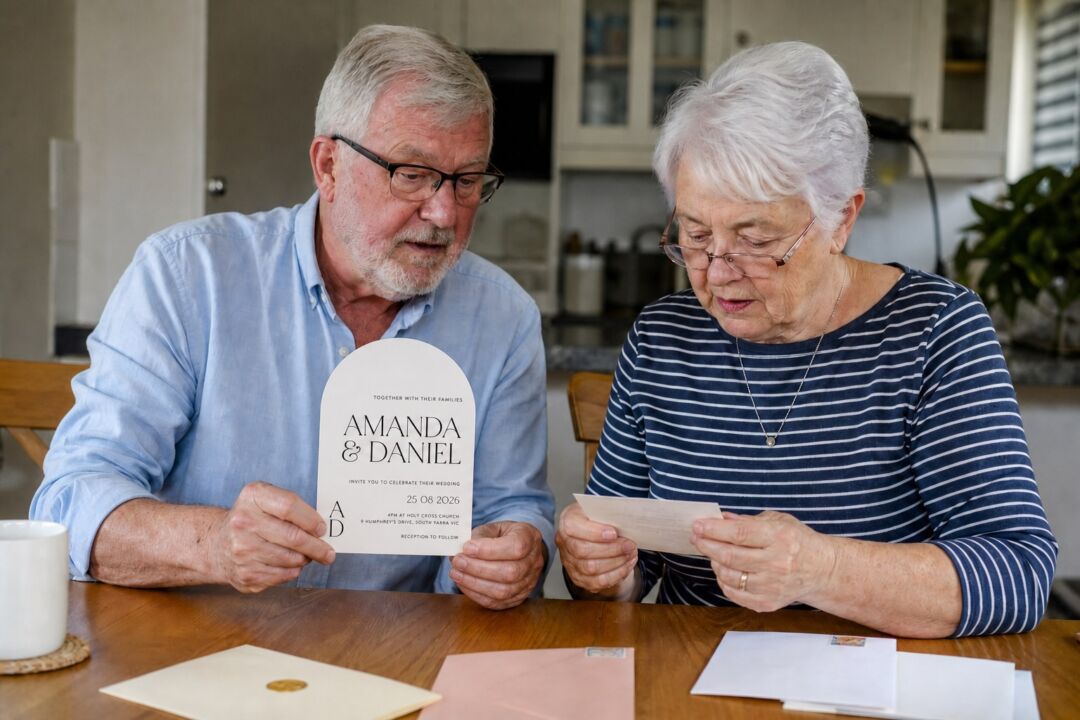
The fix is not to send them a separate mailing. Include a physical RSVP card in every invitation, and make clear that the website is the preferred method but the card is there for anyone who wants it. Guests who prefer online will go online. Guests who need the card will use it. You lose nothing either way.

What Paper RSVPs Really Cost
Including a physical RSVP card in each invitation adds to your per-invitation cost: the card, an envelope, and the return stamp your guest uses to post it back. At a hundred guests that is noticeable but not prohibitive.
The larger cost of paper-only is not in the printing. It is in the time spent manually entering responses into a spreadsheet, following up with the guests who never post their card back, and making calls about whether silence means “attending and forgot to reply” or “not coming and assumed someone else responded.” That work scales with your guest count in a way online responses do not.
Online RSVPs shift that work earlier, when you are building the form, and reduce it overall because the system tracks responses automatically and reminders go to the full outstanding list in one click. The trade-off is that setup takes a few hours before invitations go out.
One genuine advantage paper still holds over online is persistence. A card sitting on a kitchen counter is a more tangible reminder than an email that gets buried. Some couples include a paper card specifically because of this, regardless of whether they expect most guests to use it.
The Paper RSVP Problem That Is Easy To Miss
Australia Post’s standard delivery is two to five business days within metro areas, and up to a week or more for regional addresses. A card posted from Sydney to rural Queensland can take that full week in each direction.
This creates a timing problem that couples often discover too late. If your invitations go out ten weeks before the wedding and your RSVP deadline is six weeks out, guests in regional areas have a narrower window than you realize once postal time is accounted for. And when a card does get lost in the mail, the guest typically assumes it arrived and is sitting in your pile. They won’t follow up unless you do.
The hybrid system solves this by giving guests the option to respond online the moment the invitation lands in their hands, without waiting for postage in either direction. The paper card stays in the suite as a fallback, but most of your responses arrive online well before the physical cards would have found their way back.
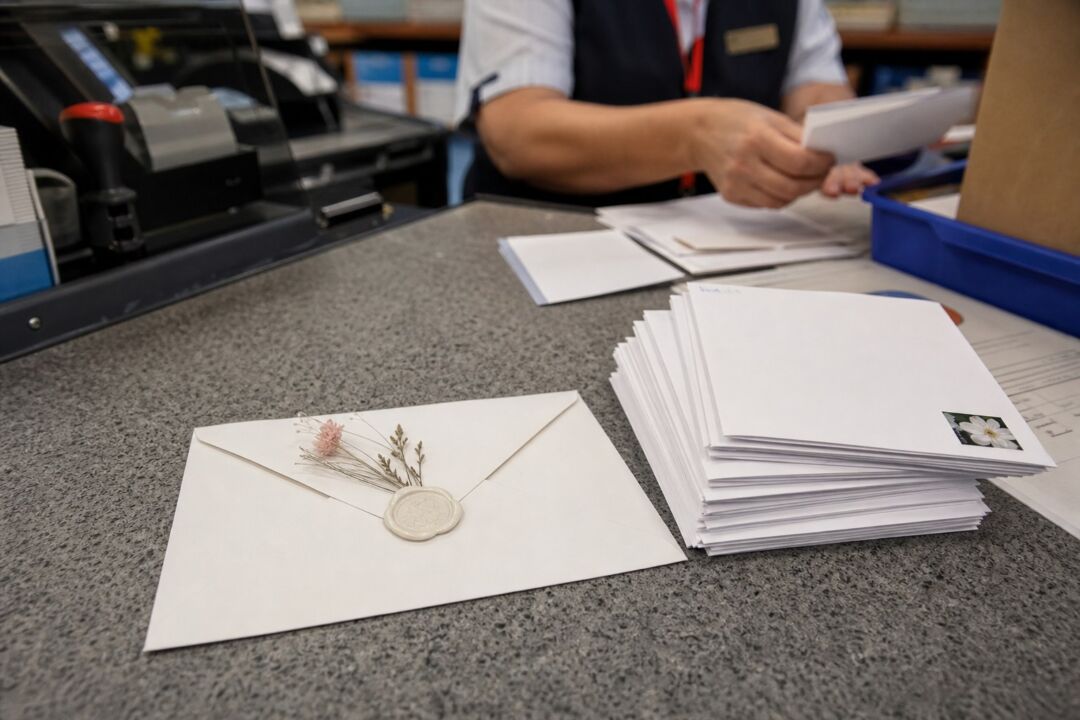
A reply card with a stamped envelope is what closes the gap on your slowest responders.
How to Run the Hybrid System Properly
The hybrid system has three parts: the paper card in the invitation, the online RSVP form on the wedding website, and a single master list that receives input from both.
How to word the card so it gives a clear choice, not a confusing one
The most common mistake is printing two competing sets of instructions. If the paper card says “RSVP by [date]” and the invitation separately says “visit our website to RSVP,” some guests don’t know which one to use and do neither.
The cleaner approach is to make the website the primary option and treat the paper card as a backup. Something like:
“The easiest way to RSVP is online at [yourweddingwebsite.com.au] by [date]. A card is also included if you prefer to post your reply.”
That tells every guest what to do, in what order of preference, and when. The guests who want online will go online. The guests who prefer the card will fill it in. Nobody is confused about whether they need to do both.
For the wedding invitations themselves, this wording typically lives on a small insert card rather than on the main invitation panel. That keeps the main card visually clean and lets you adjust RSVP details independently if anything changes. Local post also shapes the reply window, and Australian RSVP cards are printed and mailed domestically rather than arriving from overseas.
Who gets pointed online, who gets paper
Every invitation should include both the URL and the physical card. The segmentation happens naturally: guests who are comfortable online will choose the website; guests who are not will use the card. You do not need to decide in advance who falls into which group, and you avoid the awkwardness of sending a different invitation to your grandmother than to your friends from work.
The one exception is guests overseas. Posting a card back from London or Auckland adds postage cost for the guest and is unreliable in both directions. For international invitations, note the website URL prominently and make clear the card is optional.
Keeping one master list
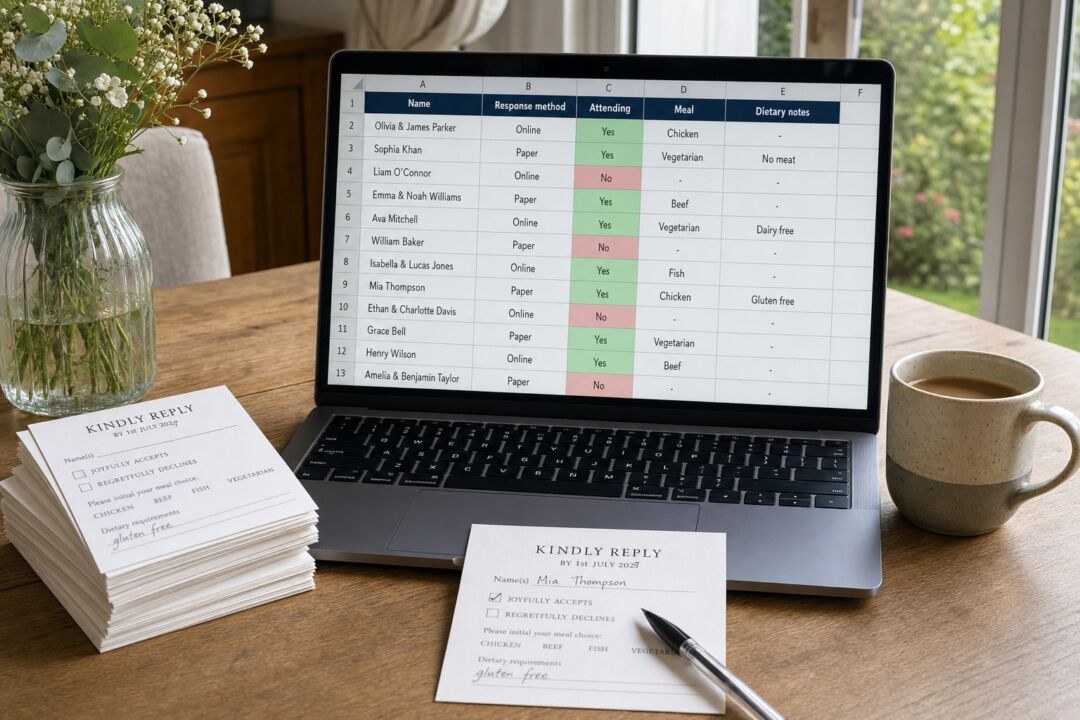
The hybrid system breaks down if you end up with two half-complete lists: one on the wedding website platform and one in a pile of returned cards on the table. Before invitations go out, set up a single spreadsheet with one row per household and columns for: response method, attending yes or no, meal choice if applicable, dietary notes, and date received. When a paper card arrives, you enter it. When someone responds online, you note it. Your live count is always accurate regardless of how each response came in.
The RSVP Timeline
Two to three weeks before the wedding is a common RSVP deadline. It is usually too late.
Your caterer will ask for final numbers two to four weeks before the event, sometimes more for larger venues. Your RSVP deadline needs to be at least a week before that, and ideally two, so you have time to chase non-responders and confirm the ambiguous cases before you submit a binding headcount.
A practical timeline for most Australian weddings:
- Six to eight months out: Send save the dates with the wedding website URL. Guests can register intent even before the formal RSVP form opens.
- Ten to twelve weeks out: Post invitations, including the paper RSVP card and the insert with the QR code and URL. Allow for two to five business days delivery in metro areas, up to a week for regional.
- RSVP deadline: Set this six weeks after invitations are posted. That gives most guests four to five weeks to respond after the invitation arrives.
- Two weeks after the deadline: Send a group reminder to everyone who has not responded, via the wedding website platform or a group message.
- One week after the reminder: Personal message or call to anyone still outstanding.
- Two weeks before the catering deadline: Final headcount confirmed and submitted.
Chasing Non-Responders
Two weeks after your RSVP deadline, you will have a group of guests who still haven’t replied. This is normal regardless of which system you use. The goal is to keep that group small enough to contact individually.
Send a group reminder first. Frame it as practical rather than a chaser: you are finalizing seating and catering numbers, and you want to make sure their spot is confirmed. Include the direct link to the RSVP form. Keep the tone easy.
Anyone who still hasn’t responded after that gets a personal text or call. With a well-run hybrid system, this list should be small: ideally under ten percent of your total guest count. In most cases, silence at this stage means the guest assumed someone else in their household already responded, or they intended to do it and kept forgetting. A direct message from you resolves it quickly.
Start chasing no later than two weeks before your caterer’s final deadline, not the day before.
RSVP card designs that match your invitation, personalized online. The $5 sample pack puts seven designs and an envelope in your hands, including real foil and letterpress, so you judge paper and finish off a screen.
Frequently Asked Questions
Should I include a paper RSVP card if I already have a wedding website?
For most Australian weddings, yes. The website handles the majority of guests faster and with less manual work, but a physical card ensures that older guests or anyone without reliable internet access can still reply without having to ask you for help. The cost of including the card is small compared to the effort of tracking down missing responses in the final weeks.
How long does it take for a posted RSVP card to get back to me in Australia?
Standard Australia Post delivery is two to five business days within metro areas, and up to a week or more for regional and rural addresses. For guests interstate, allow up to a week in each direction. This is why paper-only systems require a much longer window than online ones, and why hybrid with online as the primary option tends to produce faster, more complete responses.
What should I do about overseas guests and paper RSVP cards?
Make the website URL prominent and note the paper card is optional for them. Posting from overseas adds cost for the guest and is unreliable. If an overseas guest is not comfortable with the online form, a direct email or phone call is simpler than asking them to mail a card back from another country.
When should I set my RSVP deadline?
Set your deadline at least seven to ten days before your caterer’s final headcount date, and ideally two weeks before, to leave time for chasing non-responders. For most Australian weddings, a deadline set six weeks after invitations are posted gives guests enough time to receive and reply, while leaving you enough runway to follow up before numbers are due.
How do I word the RSVP on the invitation when using both methods?
Nominate the website as the primary option and describe the paper card as a backup, in that order. One clear sentence works well: “Please RSVP online at [yourwebsite.com.au] by [date], or use the enclosed card.” Avoid giving both options equal weight or listing them separately in a way that suggests guests need to do both.
Can I use a QR code instead of printing the full URL?
Yes. The more practical approach is to include both: print the QR code alongside the short URL so that guests who prefer to scan can do so, and guests who prefer to type can also manage. Test the QR code on at least three different devices before the invitations are sent to print.