
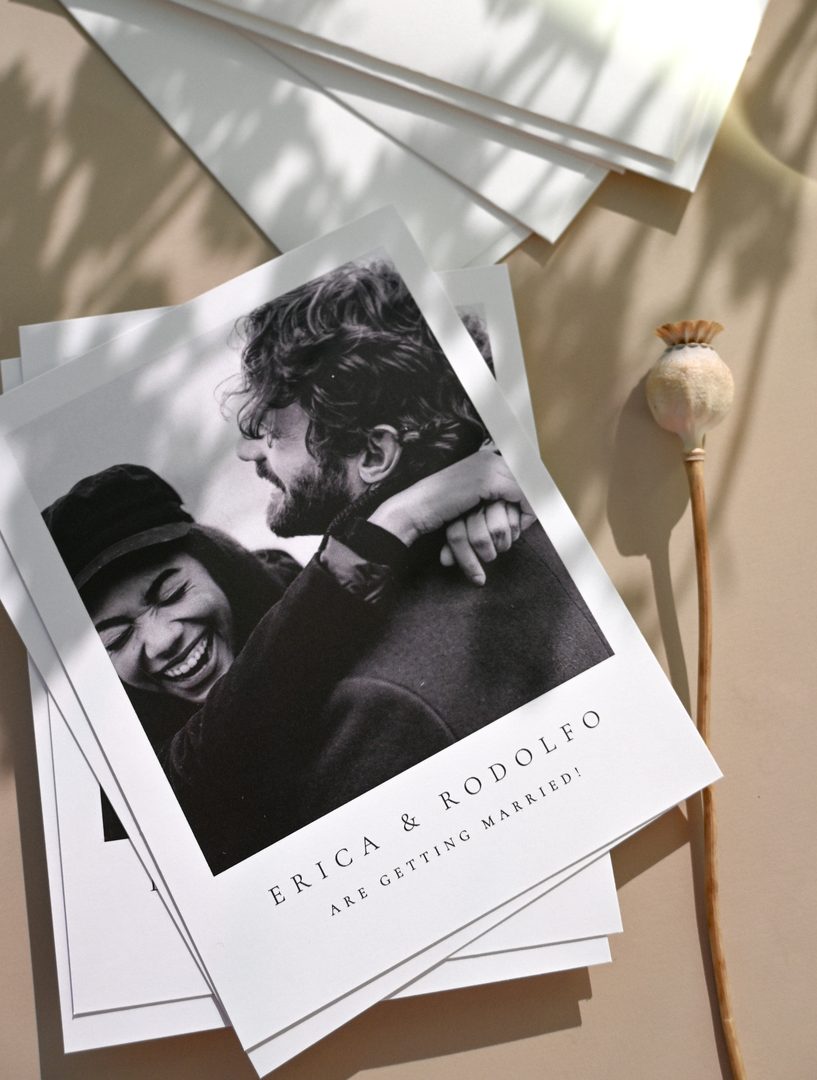
Married life is officially underway, and now you get to tell the world. Just-married cards and “at-home” cards are two of the oldest post-wedding traditions in stationery, and for good reason: a printed card carries a warmth that a social post simply cannot match. This guide walks through what each card is, when to send it, and exactly how to word it, whether you kept your name, hyphenated, or are announcing a new shared address across town or across the country.
- Just-married card: A formal announcement mailed after the wedding, typically to guests who did not attend.
- At-home card: A small card (often enclosed with the announcement) that states the couple’s married name and new shared address.
- When to send: Within two to three months of the wedding date.
- Who receives them: Extended family, colleagues, friends not on the guest list, and anyone who needs your new address.
- Size: Typically A2 (4.25″ x 5.5″) or a smaller enclosure card at around 3.5″ x 5″.
- Cost: From $2.04 per card at Paperlust; free DHL Express shipping on orders over $350 USD.
What Is a Just-Married Card?
A just-married card is a printed announcement mailed after the wedding to people who were not present at the ceremony. It formally communicates that the couple has married, giving the date and often the location. The tone can range from classic and formal to warm and personal.
Just-married cards are not the same as wedding invitations, and they serve a different purpose than save-the-dates. They look back rather than forward: they are a moment of shared joy sent to the broader circle of people who matter to the couple but could not join the celebration.
They are particularly useful after:
- Elopements or micro-weddings where the guest list was very small
- Destination weddings that limited attendance
- Courthouse ceremonies or civil celebrations
- Second marriages conducted with close family only
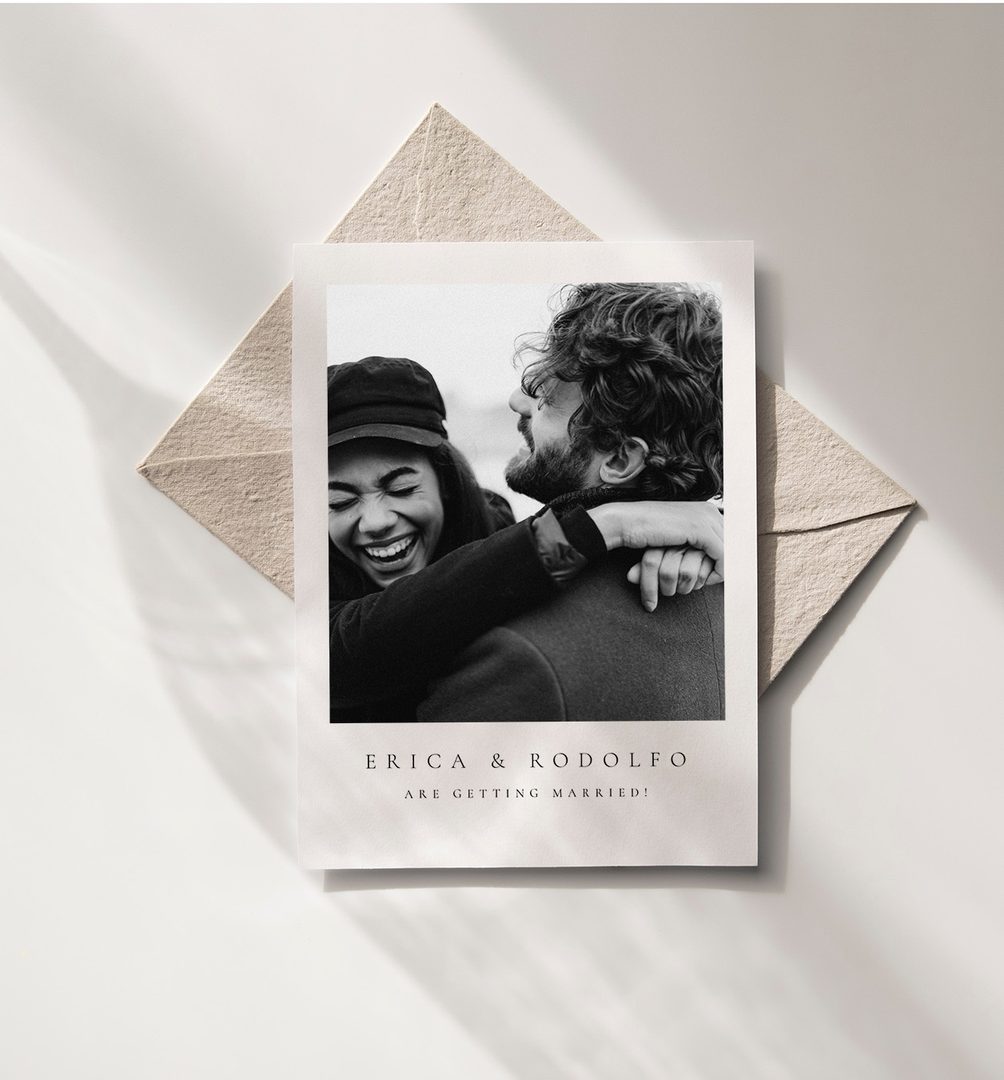
The format is typically a simple printed card or postcard. Some couples include a photo; others keep it text-only with a clean typographic design.
How Just-Married Cards Differ from Wedding Announcements
The terms are often used interchangeably, but there is a traditional distinction worth knowing.
A wedding announcement is a broader statement sent to anyone the couple wants to inform, regardless of whether they would ever have been invited. A just-married card is more personal in tone and is usually directed at people already within the couple’s circle.
In practice, most couples use one card to do both jobs. See our dedicated guide on Wedding Announcement Cards: For Guests Not Invited to the Day for a deeper look at formal announcement wording and who typically receives them.
What Is an At-Home Card?
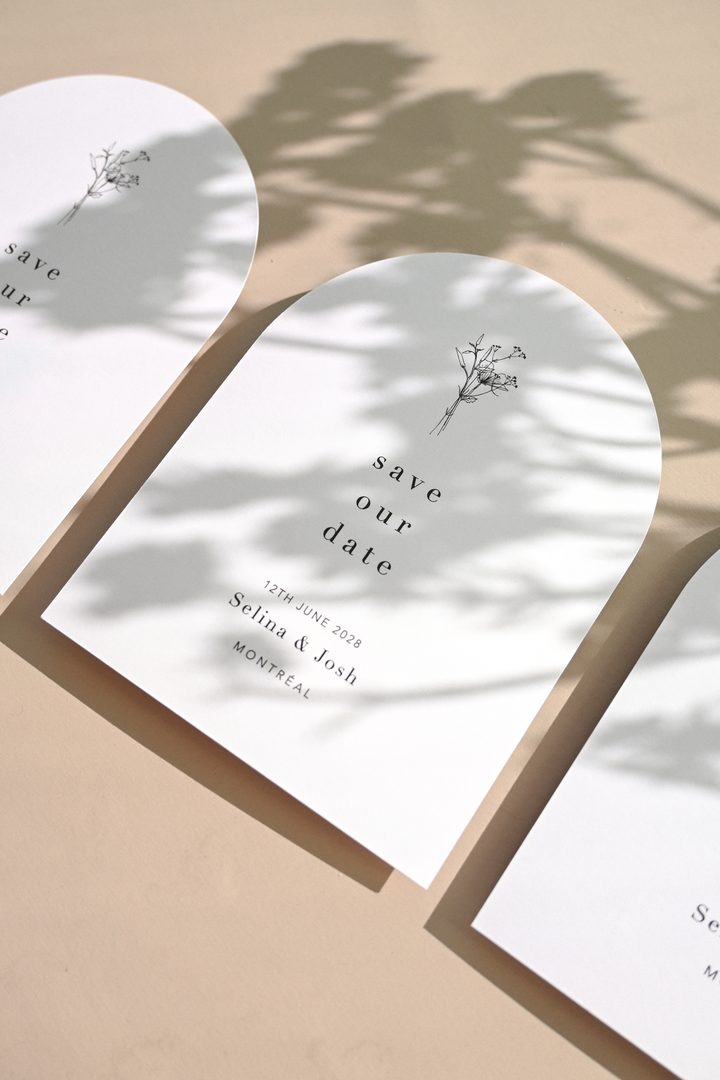
An at-home card is a small enclosure card that tells recipients how to address the couple going forward, and where to reach them. The phrase “at home” is Victorian in origin, referring to the times when a couple would be “at home” to receive visitors at their new shared address.
Modern at-home cards serve three practical purposes:
- Name update – Announcing the married name or any hyphenation choice so that friends and family address future correspondence correctly.
- Address announcement – Sharing the couple’s new shared home if either or both partners have moved.
- Combined identity – Giving the couple’s chosen household identity in one clear printed line, particularly useful when one partner has kept their name, one has changed, or both have hyphenated.
At-home cards are typically 3.5″ x 5″ [89mm x 127mm] or smaller. They are usually enclosed inside the just-married announcement card envelope rather than mailed separately.

When to Send Just-Married and At-Home Cards
The general rule is within two to three months of the wedding date. If you eloped, that window starts from your actual wedding day. If you had a ceremony followed by a delayed celebration, send the cards after the wedding date itself, not after the party.
Mailing a card four to six months post-wedding is still meaningful, but by that point many people will have already updated their records or sent gifts to your old address. Earlier is always better.
A practical mailing timeline:
- Order cards: Two to four weeks after the wedding
- Designer proof: Returned to you within 1-2 business days
- Production and shipping: Varies by print method, typically 8-15 business days after proof approval
- Cards in the mail: Aim for within six weeks of the wedding
If you are also working through the legal name-change process, you do not need to wait until every document is updated. The cards state your social name and new address, not a legal certificate. For the full name-change checklist by agency, see Changing Your Name After Marriage: The Complete Checklist.
At-Home Card Wording Examples
Each example below handles a slightly different naming situation. Choose the format that matches your own.
Classic At-Home (Both Partners Take One Surname)
are at home at
312 Maple Street
Portland, Oregon 97201
As of July 15, 2026
Modern (Couple Uses First Names, Shared Surname)
312 Maple Street
Portland, Oregon 97201
Married July 15, 2026
Name-Keep or Hyphenation (One Partner Retains Their Name)
are at home at
312 Maple Street
Portland, Oregon 97201
Both Partners Hyphenate
312 Maple Street
Portland, Oregon 97201
July 15, 2026
Casual (No Formal Titles, New City Move)
New home! Find us at:
312 Maple Street, Apt 4B
Portland, OR 97201
Just-Married Card Wording Examples
The announcement itself usually includes a brief line confirming the marriage, the couple’s names, the date, and sometimes the location.
Formal
were united in marriage
on Tuesday, the fifteenth of July
two thousand and twenty-six
at The Rosewood Garden, Portland, Oregon
Modern
Julia Whitmore and Jonathan Hall
July 15, 2026 | Portland, Oregon
We can’t wait to celebrate with you soon.
Elopement Announcement
just the two of us, exactly as we always imagined.
Julia and Jonathan Hall
Eloped July 15, 2026
With New Address (Combined Card)
are newly married
and can be found at their new home:
312 Maple Street
Portland, Oregon 97201
July 15, 2026
At-Home Cards and the Name-Change Process
One of the most useful things an at-home card does is tell your social network how to address you before the legal paperwork catches up. Name changes at the Social Security Administration, DMV, and passport office can take weeks to months, but your friends and family only need to know your chosen name now.
A few points of etiquette around names:
- Professional names: If one partner is keeping their professional name for career purposes, you can include a note (“Julia Whitmore professionally; Julia Hall socially”) though most couples simply choose one version for the card.
- Academic or professional titles: Include them if they are part of how you want to be addressed. “Dr. Julia Hall and Mr. Jonathan Hall” is perfectly correct on an at-home card.
- Non-binary and gender-neutral options: “Sam and Jordan Rivera are at home at…” works cleanly without any title line.
- No address change: If neither partner is moving, you can simply omit the address line and use the card to announce the name only.
Do People Still Send Just-Married and At-Home Cards?
Yes, and the trend toward them has increased in the years since pandemic-era micro-weddings became common. Many couples who married with fewer than twenty guests have found that a printed announcement card is the most gracious way to share the news with the wider family and friend group.
The card also serves a practical function that a social media post does not: it puts your new name and address into the hands of older relatives, colleagues, and anyone who does not follow you online. It is especially valued by grandparents, older aunts and uncles, and anyone from your parents’ generation who keeps a physical address book.
That said, at-home cards in the strictly Victorian sense (a separate enclosure card with no wording beyond the name and address) are less common today. Most couples fold the name and address information into a single announcement card or combine it with their thank-you card mailing if timing works out.
Etiquette Do’s and Don’ts
| Do | Don’t |
|---|---|
| Send within two to three months of the wedding | Wait so long that people hear the news elsewhere first |
| Use the name format you actually want to go by | Use a name for social purposes that differs from what you tell people in person |
| Address envelopes to the recipient’s household (not just one person) | Reuse your wedding guest list without checking for address updates |
| Include a new return address on the envelope as a subtle update | Leave recipients guessing about how to address you going forward |
| Keep the card simple and warm in tone | Imply that gifts are expected (the card is a courtesy, not a gift solicitation) |
| Match your card’s design to your invitation suite for a cohesive look | Use a font or style that makes the card hard to read |
Design and Printing Options at Paperlust
Just-married and at-home cards follow the same design and print method options as the rest of the Paperlust wedding stationery suite. If you ordered your invitations through us, it is straightforward to match the aesthetic by working with the same design template or color palette.
Print methods available:
- Digital print – Full-color, clean, and affordable. Ideal for photo-led cards or detailed illustrations. From $2.04 per card.
- Flat foil – A mirror-bright metallic accent in gold, rose gold, silver, or copper with no die required. Great for adding shine to a name or a monogram.
- Foil stamp – A custom die presses the foil into the paper for a tactile impression, a beautiful option if your suite already uses foil.
- Letterpress – Debossed ink on 300gsm or 600gsm Wild Cotton, the most textural and heirloom-quality choice.
- Metallic print – Subtle gold pigment at a 5th imaging station for a softer shimmer than foil.
- White ink – Works on kraft, deep-colored stocks, or vellum for moody, tonal cards.
Paper to consider: For an at-home card, the 300gsm Wild Cotton used for letterpress has a softness and weight that feels special in the hand. For a photo-led just-married card, the 380gsm Premium stock used for Flat Foil provides excellent print quality.
Every order includes a designer proof within 1-2 business days, two free rounds of edits, and free DHL Express shipping to the US on orders over $350 USD.
Browse the full wedding invitations collection to find designs that work as announcement and at-home cards, or explore enclosure cards and information cards for smaller at-home card formats.
If you are weighing finishes, the $5 sample pack sets digital, letterpress, flat foil, and foil stamp side by side so the decision is simple.
Frequently Asked Questions
What is an at-home card?
An at-home card is a small printed card traditionally enclosed with a wedding announcement. It tells recipients the couple’s married name and new shared address. The name comes from the Victorian custom of indicating when a newly married couple would be “at home” to receive callers. Today, couples use them primarily to communicate name changes and address updates.
Do people still send at-home cards?
Yes, though the format has evolved. The strictly traditional at-home card (a tiny card with only the name and address, no other copy) is less common now. Most couples fold the same information into a combined just-married announcement card, or add a name and address note to their thank-you card. The underlying purpose, letting people know how to address you and where to reach you, is as relevant as ever.
When should I mail just-married cards?
Within two to three months of the wedding is the standard window. If you eloped, the clock starts on your wedding day. If you had a large reception after a courthouse ceremony, you may want to send the cards after the official wedding date rather than waiting for the celebration.
Who receives just-married and at-home cards?
Anyone in your life who would benefit from knowing: extended family, older relatives who keep physical address books, close friends not on the guest list, colleagues, and professional contacts who have your old address. The mailing list is typically broader than the wedding guest list.
Can I combine a just-married card with my thank-you cards?
Timing-wise it can work if your thank-you cards go out quickly. However, the tone is different: a thank-you card is specific to the recipient’s gift or presence, while a just-married card is a general announcement. Combining them can feel transactional. Most etiquette advisors suggest sending them separately, but if circumstances make one mailing more practical, a combined card is perfectly acceptable.
Do just-married cards replace wedding announcements?
They are closely related and often the same card in practice. Traditionally, a “wedding announcement” was a more formal document sent to the wider public, while a just-married card was more personal. Today most couples use a single printed card that accomplishes both. If you want a deeper look at the formal announcement format, see our guide on Wedding Announcement Cards: For Guests Not Invited to the Day.