

- Bar mitzvah is for a boy and bat mitzvah is for a girl; b’nai mitzvah covers two or more children.
- Send save the dates 6 to 12 months before the date and invitations 6 to 8 weeks out.
- Put the Hebrew name, Hebrew date and Torah portion in front of the rabbi or cantor before printing.
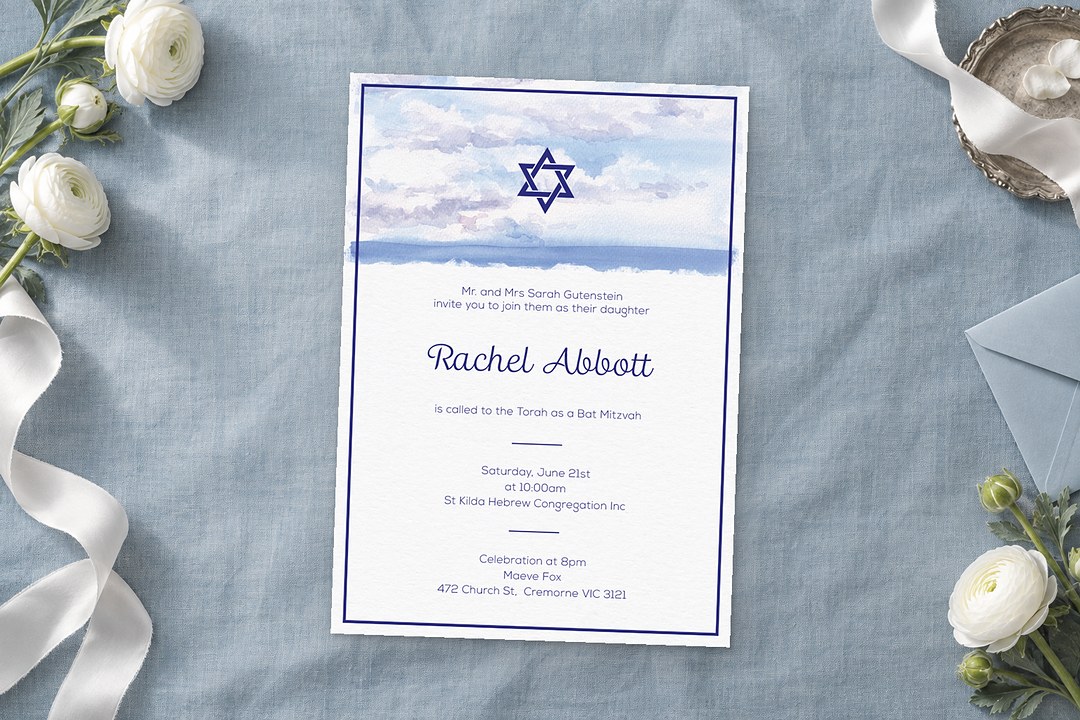
- A formal card lists hosts, child, milestone phrase, weekday, date, time, synagogue and celebration.
- For an evening dance party or a classmates-only event, use a party only invitation or insert.
- Money gifts in multiples of 18 reflect chai, the Hebrew word for life.
You are checking the invitation draft late at night, comparing “called to the Torah” with the simpler “becomes a Bat Mitzvah.” Your friend’s card used one; the template used another. Beside the date and the synagogue name, the words have to be right.
This bar and bat mitzvah invitation wording guide is for parents, stepparents and grandparents planning a service, a luncheon or an evening party. It explains each Hebrew term, arranges wording by family situation, and gives copyable samples for formal, modern and celebration-only cards.
You will also find save the date wording, reply card lines and a proofing checklist so the rabbi or cantor can confirm every Hebrew line before it goes to print.
The terms that appear on the invitation
A boy becomes a bar mitzvah, a girl becomes a bat mitzvah, two or more boys or a mixed group become b’nai mitzvah, two or more girls become b’not mitzvah, and some congregations use b-mitzvah for a nonbinary child or for everyone.
| Term | Who it is for | Typical phrase on the invitation |
|---|---|---|
| bar mitzvah | A boy, age 13 | called to the Torah as a Bar Mitzvah |
| bat mitzvah | A girl, age 12 or 13 depending on the community | becomes a Bat Mitzvah |
| b’nai mitzvah | Two or more children, boys or a mixed group | are called to the Torah as B’nai Mitzvah |
| b’not mitzvah | Two or more girls | become B’not Mitzvah |
| b-mitzvah | A nonbinary child, or everyone, in some congregations | celebrates becoming a B-Mitzvah |
The word mitzvah means commandment, and bar and bat mean son and daughter. The status arrives with the age, with or without a ceremony, so the service and party celebrate it. That is why an invitation can say a child becomes a Bar Mitzvah, or that he is called to the Torah as one.
At the service many children take an aliyah, saying blessings both before and after the Torah reading. Some also chant a section from the Torah, read from the Prophets, lead parts of the prayers, or offer a short talk on the weekly portion, which is the d’var Torah. Practice differs by movement and by synagogue, so the child’s own rabbi or cantor is the best check on the service line. In Orthodox communities, for example, a girl becomes a bat mitzvah at 12 and is usually not called to the Torah; her invitation speaks of celebrating her bat mitzvah.
What every invitation needs
Start any bar or bat mitzvah invitation wording with the same practical core: the child’s name, the hosts, the milestone phrase, the weekday, date and time of the service, the synagogue or venue with its address, and what follows the service and where.
- Child’s name: use the name the child uses socially. If the Hebrew name differs, it can go on its own optional line.
- Hosts: name the people inviting, in a voice that fits the household. Family shape changes only this line.
- Milestone phrase: choose “is called to the Torah as a Bar Mitzvah,” “is called to the Torah as a Bat Mitzvah” or “becomes a Bat Mitzvah,” whichever your synagogue uses.
- Weekday, date and time: lead with the service day, then the civil date and the start time.
- Synagogue or venue: print the common name and street address so guests can find it without a second email.
- What follows the service: say whether the invitation includes a luncheon, dinner, Havdalah reception or evening party, and where.
- Reply date and method: put the RSVP deadline and contact on the reply card when the set includes one; if there is no reply card, print a single RSVP line on the main card.
- Optional lines: add attire, Hebrew name, Hebrew date, Torah portion, donation or livestream notes only when they help guests or honor tradition.
Separate cards carry details that would crowd the main invitation: a celebration card with its own time and place, a reply card, and an insert with directions, hotels and a short guide for guests who have not been to a synagogue service. On most bar mitzvah invitations, the service and the meal directly after it share the main card, while an evening party with a separate venue gets its own card.

When to send save the dates and invitations
Send save the dates 6 to 12 months before the date, and mail invitations 6 to 8 weeks before the service. When many guests travel, move the invitation mailing to 10 to 12 weeks before. Set the reply date 3 to 4 weeks out, and order printed invitations 3 to 4 months ahead so the proof and printing schedule stay relaxed.
| When | What to send or do |
|---|---|
| 6 to 12 months before | Send save the dates |
| 3 to 4 months before | Order printed invitations |
| 6 to 8 weeks before | Mail invitations; use 10 to 12 weeks for many traveling guests |
| 3 to 4 weeks before | RSVP deadline falls |
| Week of the service | Confirm the service time with the synagogue office |
| After the celebration | The child writes thank-you notes |
A bat mitzvah save the date needs far less than the invitation: the child’s name, the date, the city and a note that a formal invitation will follow. Here are two short forms.
for Maya Rosen’s Bat Mitzvah
Saturday, September 14
Chicago
Invitation to follow
for Max Gold becoming a Bar Mitzvah
Saturday, November 9
Los Angeles
Invitation to follow
A save the date is not the place for the Hebrew name, the Hebrew date or the Torah portion; those details belong on the invitation, after the rabbi or cantor has confirmed them.
Traditional and formal wording
For formal bar mitzvah invitation wording, the traditional order is hosts, request line, child’s name, milestone phrase, weekday and date, time, synagogue, and what follows. A bat mitzvah invitation uses the same structure, and the voice can stay third person throughout.
Formal wording often includes a request line such as “request the honor of your presence” because this is a religious milestone. Keep the service details exact; the celebration card can carry a more relaxed voice later if the party is separate.
request the honor of your presence
as their son, Jacob Samuel Halpern,
Yaakov Shmuel ben Daniel v’Rivka,
is called to the Torah as a Bar Mitzvah
Saturday, October 12
at nine thirty in the morning
Temple Emanuel
Kiddush luncheon to follow
invite you to share in their joy
as their daughter, Hannah Rose Feld,
becomes a Bat Mitzvah
Saturday, June 8, at ten in the morning
Congregation Beth Am
Kiddush luncheon to follow
RSVP by May 18
request the pleasure of your company
as their son, Ethan David Berk,
will chant from the Torah and become a Bar Mitzvah
Saturday, January 23
15 Shevat
Parashat Beshalach
at nine o’clock in the morning
Beth Shalom
Lunch to follow
invite you to the Bat Mitzvah of
Lila Miriam Adler
granddaughter of Ruth and Joseph Sacks
and of Shirley Katz of blessed memory
Saturday, May 4, at ten thirty
Temple Sinai
Kiddush to follow
For the stationery itself, browse Paperlust bar and bat mitzvah invitations, which are personalized online. The designer sends a free digital proof, and you approve it before printing starts; methods include digital, flat foil, letterpress, foil stamp and white ink, so the card can match the formality of this wording.


Modern and casual wording
Casual bat mitzvah invitation wording still names the same details: the child, the milestone, the service time, the place and what comes next. The voice simply sounds warmer and closer to how your family talks. A child’s voice still needs a complete set of details, so even a short card must give the day, time, place and celebration. A very short card works when a separate reply card and celebration card carry the rest, or when the guest list is small and everyone already knows the schedule. For a late Saturday afternoon Havdalah service, name the Havdalah moment and the party that follows it.
invite you to celebrate as their daughter,
Ava Brennan,
becomes a Bat Mitzvah
Saturday, September 21, at ten thirty
Temple Beth Or
Brunch and dancing to follow
and I get to become a Bar Mitzvah!
Come cheer me on:
Saturday, March 9, at nine
Congregation B’nai Israel
Tacos and music after
Saturday, November 16, ten in the morning
Shaarei Shalom
Party to follow
and to celebrate Ruby Kessler becoming a Bat Mitzvah
Saturday evening, February 8, at five thirty
Temple Beth El
Dinner and dancing to follow

Wording for different families
For blended, interfaith, LGBTQ+ and other family shapes, only the host line usually changes. The milestone phrase, service details and celebration line stay the same. Choose the wording that names your child’s real family, and let the rest follow the invitation format you already like.
Divorced parents hosting together
When divorced parents share the day, put each parent’s name on a separate line without a connecting “and.” Check that both names appear as the child knows them.
Michael Hale
invite you to celebrate as their son,
Eli Jonah Winter,
will be called to the Torah as a Bar Mitzvah
Saturday, April 6, at ten
Ohr Shalom
Kiddush luncheon to follow
A remarried parent with a stepparent named
When one parent has remarried, list each household on its own line: the parent and stepparent together, then the child’s other parent alone. That keeps the relationships clear without a block of names.
with Emma’s father, David Shore
invite you to the Bat Mitzvah of
Emma Rose Shore
Saturday, August 10, at ten thirty
Temple Beth Israel
Lunch and celebration to follow
A single parent
A single parent can host under one name, or add a warm line about the whole family’s joy.
invites you to celebrate her son,
Gabriel Andres Torres,
as he becomes a Bar Mitzvah
Saturday, May 11, at nine thirty
Congregation Sinai
Luncheon to follow
Two moms or two dads
Use both parents’ names exactly as the family does, with no special explanation needed.
ask you to share their joy
as their daughter, Sadie Rae Quinn,
becomes a Bat Mitzvah
Saturday, June 22, at ten
Temple Shir Hadash
Celebration to follow
An interfaith family or guests new to the synagogue
Keep the wording warm and clear for guests who may not know service customs. The card can offer a guide insert rather than explaining everything on the card, and a welcoming line can help every guest feel included.
request the pleasure of your company
as their son, Sam Whitfield,
celebrates becoming a Bar Mitzvah
Saturday, October 5, at ten thirty
Temple Beth Emeth
A short guide to the service is enclosed
Lunch and celebration to follow
Twins, siblings or friends sharing the day
For two or more children, b’nai mitzvah fits boys or a mixed group, and b’not mitzvah fits two or more girls.
invite you to celebrate as their children,
Zoe and Levi Rosenfeld,
become B’nai Mitzvah
Saturday, November 23, at nine thirty
Congregation Rodef Sholom
Kiddush lunch and party to follow
A nonbinary child
Some congregations use b-mitzvah, b’mitzvah or bet mitzvah, and they and them in the wording. Ask your rabbi or cantor which form your synagogue uses.
invites you to celebrate as their child,
Sol Rivera,
becomes a B-Mitzvah
They are preparing their Torah portion
and hope you will be there
Saturday, January 11, at ten
Beth Chayim
Kiddush luncheon to follow
An adult bar or bat mitzvah, self-hosted
An adult can host the invitation themselves, using the same milestone language and adding a line about the study or service.
and I invite you to celebrate my becoming a Bar Mitzvah
Saturday, March 15, at ten
Kehillat Lev Shalem
Study, service and lunch to follow
Service and celebration: one card or two
Use one card when every guest is invited to the service and everything after it. Use a separate celebration card when the party has its own time, place or guest list, such as a party only invitation for the child’s classmates after a morning service.
The celebration card travels in the same envelope as the main invitation. That way each household sees which events their group is invited to without receiving two mailings. If classmates are invited to the party, they are welcome at the service too; a sentence on the insert can tell parents that the ceremony is open to all.
A morning service often leads to a luncheon line like “Kiddush luncheon to follow” on the same card. For a party after Shabbat ends, list the celebration on its own card with a start time after Havdalah. Guests need to know whether they should arrive for the close of Shabbat or only for the meal and dancing. If the family marks Shabbat more observantly, music and dancing wait until Shabbat has ended, so the card should give the evening start time as the moment guests may arrive.
For an Orthodox bat mitzvah, practice differs: the girl is usually not called to the Torah, so the wording speaks of celebrating her bat mitzvah, often at a festive meal or a party where she may give a d’var Torah.
will become a Bar Mitzvah at morning services.
Please join us for dinner and dancing in his honor
Saturday evening, October 26, at seven
The Lakeview Room
the service comes first, and afterward it is time to party with Sophie.
Sunday, September 22, from noon to three
Riverside Gymnasium
Pizza, games and a sundae bar
RSVP by September 8
Sasha Rubin
Sunday, May 19, from four to seven
The Maple Room
Dessert, dancing and an art project
Optional lines and the reply card
Optional lines earn their place when they carry tradition or make the day easier for guests. Add only what your guests need, and let the reply card handle names, the number attending and any meal choice.
Hebrew name and Hebrew date lines
A Hebrew name line uses the format child’s Hebrew name, ben or bat, then the parents’ Hebrew names joined by v’. A non-gendered option is mibeit, from the house of. The Hebrew date line sits beside the civil date and uses a day and month, not the year.
Torah portion line
The portion, or parashah, is fixed by the service date. On the card it appears as “Parashat” plus the portion name. Confirm the Hebrew spelling and the portion name with the rabbi or cantor before you approve the proof.
Attire and kippot
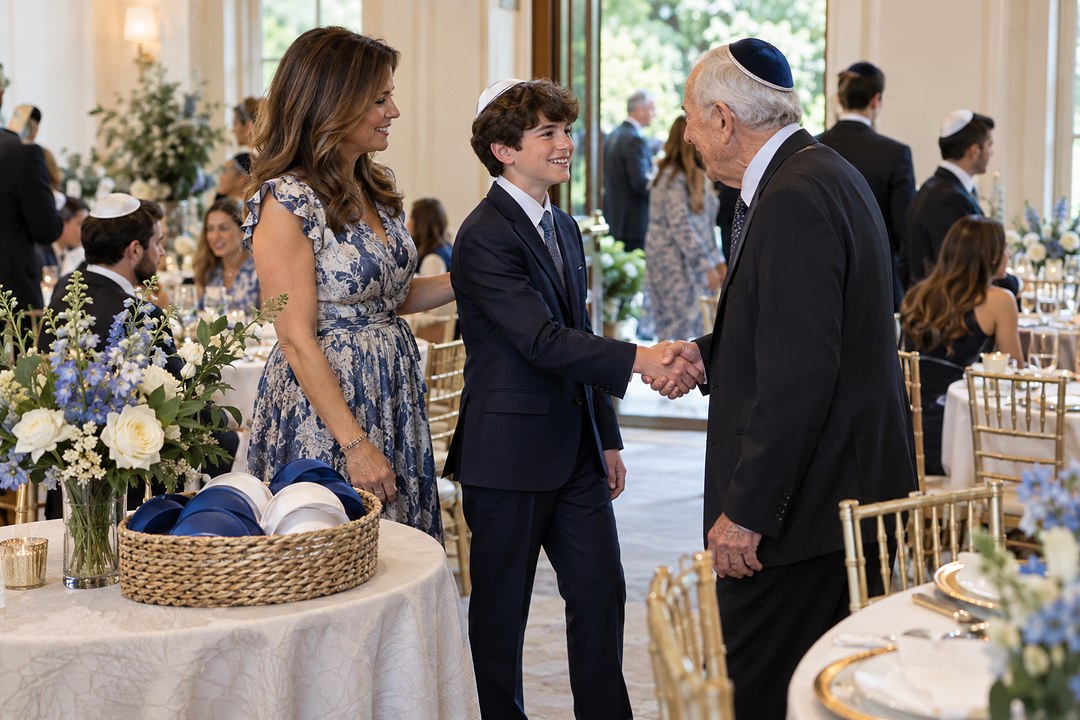
A line such as “Kippot will be provided” or “Dress for comfort and respect” helps guests. In the sanctuary, many guests wear a kippah as a head covering, and hosts often supply personalized ones as keepsakes.
A note for guests new to a Shabbat service
If the service is on Shabbat, a short insert can mention that phones, photos and writing are not used in the sanctuary. In observant communities, the music and party may wait until Shabbat has ended.
Donation and mitzvah project line
A gift to a cause in the child’s honor is customary, and many children choose a cause or a mitzvah project. In Jewish communities, money gifts are often given in multiples of 18 because 18 corresponds to the numerical value of chai, the Hebrew word for life. If you prefer a donation, a gentle line can point guests toward the cause your child has chosen.
The reply card
A reply card asks for names, the number attending, and a meal choice where there is one. For a kids’ party, give a parent as the contact and print a pick-up time so families know when the celebration ends. If you want more samples, this RSVP card wording examples guide uses the same card format and adapts easily to a bar or bat mitzvah.
_____ accepts with pleasure
_____ declines with regret
Name(s) ____________________
Number attending the luncheon ____
Text Talia’s mom
Number of kids attending ____
Pick-up at 4:30 p.m.
Proofing, printing and mailing
Before you approve the proof, ask your rabbi or cantor to check every Hebrew word, the portion name and the service time. This is the step that catches a transliteration error, a weekday that does not match the date, or a portion name that is not the one read on that date.
Your proofreading list should cover the child’s name as it will be printed, all parent and stepparent names, the synagogue name and address, the weekday matching the date, service start time, celebration start time, and reply date. For Hebrew lines, confirm the child’s Hebrew name, the Hebrew date on the card, and the Torah portion exactly as the clergy gives them. Ask a detail-oriented friend to read the proof aloud too; a typo often hides in times and names.
Order one invitation per household, plus spares for mistakes, last-minute guests and keepsakes. If you print through Paperlust, the cards are printed in Melbourne and delivered internationally, and the designer sends a free digital proof before printing starts. For the envelopes, follow this addressing invitation envelopes guide; the same etiquette applies to bar and bat mitzvah mailings, so double-check titles, street names and zip codes.
After the celebration, the child writes the thank-you notes. A short line in their own voice, naming the gift or the guest’s presence, means more than an unsigned printed card.
Frequently asked questions
What do you write on a bar or bat mitzvah invitation?
Start with the hosts and the day, time and place of the service. Then name the child, state that they are becoming a Bar or Bat Mitzvah, and say what follows. Add the reply date on the reply card, with optional lines such as the Hebrew name or dress note. Keep the card clear and let an insert carry directions or a guide for guests.
When should bar and bat mitzvah invitations be sent?
Mail invitations 6 to 8 weeks before the service. If many guests are traveling, send them 10 to 12 weeks out. Set the reply date 3 to 4 weeks before. Send save the dates 6 to 12 months ahead, and order printed invitations 3 to 4 months ahead.
Should the card say “bar mitzvah of” or “becomes a bar mitzvah”?
A card can say “becomes a Bar Mitzvah.” Many invitations also use “called to the Torah.” The title is tied to age rather than to the ceremony, so “becomes” is accurate. Use “the Bar Mitzvah of” when the invitation names the child as the honoree.
Does Hebrew have to appear on the invitation?
No. Hebrew lines are optional. Many families add a Hebrew name, a Hebrew date or the Torah portion, but you can print an entirely English invitation. If you do include Hebrew, confirm every transliteration and the portion name with your rabbi or cantor before proofing.
What does b’nai mitzvah mean and when should I use it?
B’nai mitzvah is the plural form used for two or more children, usually boys or a mixed group such as twins or siblings sharing a date. Use b’not mitzvah for two or more girls. Some congregations also use b’nai mitzvah as a gender-neutral term.
Can the invitation mention gifts or a donation?
You may mention a gift that benefits a cause the child chose, especially when there is a mitzvah project. Many families do not mention gifts at all. In Jewish communities, money is often given in multiples of 18 because 18 represents chai, the Hebrew word for life.
What should we tell guests who have never been to a synagogue service?
Include a short insert rather than crowding the invitation. Tell guests when to arrive, that phones and photos are not used on Shabbat, that a kippah will be available, and what follows the service. Explain whether the party includes music and dancing that evening or the next day.