

Good celebrants book out fast in Australia. In the major capitals, a Saturday slot in the spring and summer season can be gone twelve months or more before the date. Commonly, couples start looking when it feels too early and discover it is already late.
This guide is about the decision: how to shortlist, what to ask, how to tell a good celebrant from one who will phone it in, and what is actually in your control once you have signed the contract. For background on costs, the Notice of Intended Marriage, and how the three celebrant types differ, see our wedding celebrant guide for Australia. This article picks up where that one stops.
The clearest signal that you have found the right person is simple: you leave the first meeting feeling more settled than when you arrived.
At a glance: how to choose a marriage celebrant in Australia
- Verify first: search the Attorney-General’s Department register before any first meeting
- Book 12 months out for a peak-season Saturday in Sydney, Melbourne, Brisbane, or Perth
- October is the crunch point: searches and bookings spike, available dates shrink, deposits lock in
- Ask for a sample script or ceremony video before committing, not after
- The legally required words are fixed (monitum and vows under the Marriage Act 1961); everything else is yours to write
- One red flag overrides five-star reviews: no backup plan if they cannot make it on the day
Guests follow readings, music and the legal wording far better with it in hand.
Civil, Religious, or Registry: Which One Actually Suits You?
Australia allows four categories of person to legally solemnize a marriage: a Commonwealth-registered civil celebrant, a registered religious celebrant, a minister of religion from a recognized denomination, and a state or territory registry officer.
In practice, the real choice for most readers is between civil and registry: the Easy Weddings 2026 Australian Wedding Industry Report finds 83% of Australian couples choose a civil celebrant for their wedding. Religious ministers typically require existing faith membership or pre-marriage counseling through their denomination, so they self-select out of the pool early.
Civil celebrants write a fully personalized ceremony around you: your story, your vows, your structure. You control the tone, the length, the readings, and any rituals you want to include. The celebrant manages all legal paperwork, lodges the Notice of Intended Marriage, and registers the marriage with the relevant state or territory Births, Deaths and Marriages office after the ceremony.
Registry officers conduct legal ceremonies at a government office. The ceremony is short, structured, and not personalized. This is the right choice if you want the marriage on paper without a ceremony event, or if you are planning a separate celebration later.
The decision is simple: if the ceremony itself matters to you, book a civil celebrant. If you only need the legal document, use the registry. If you are still weighing a civil ceremony against a registry office ceremony, our companion guide covers costs, what the experience looks like, and who each option suits best.

How to Verify a Celebrant in Three Minutes
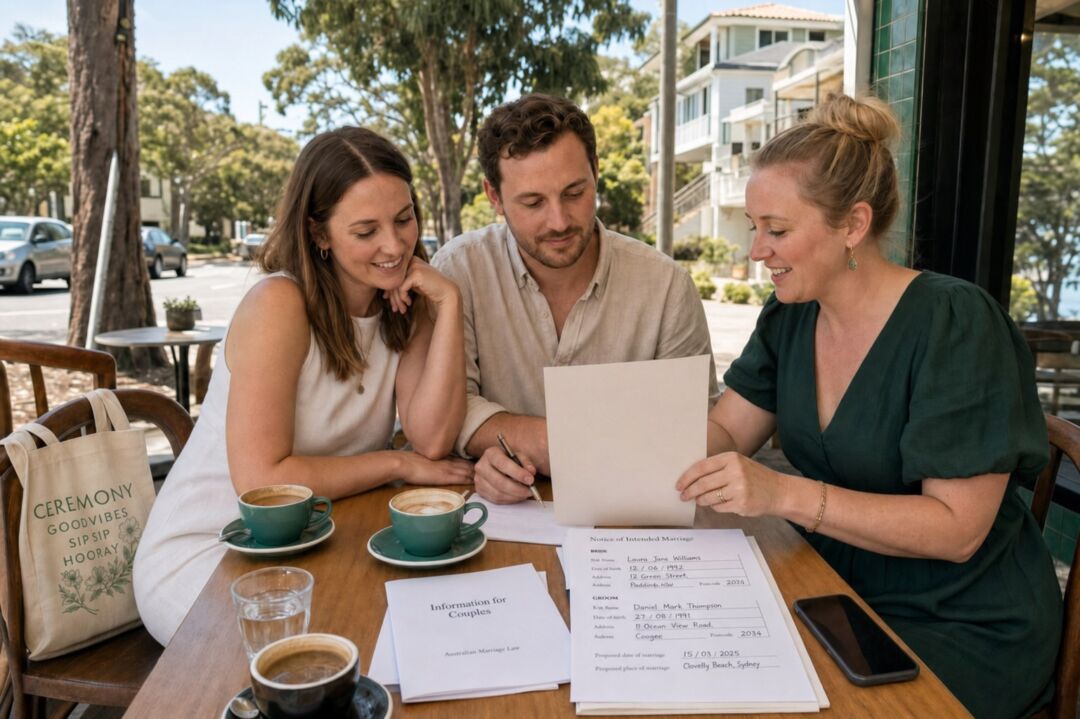
Every Commonwealth-registered civil celebrant must appear on the Attorney-General’s Department register of authorized marriage celebrants. Search it at the AG’s Department website by name, location, or postcode before you contact anyone.
This check matters: a marriage in Australia is only legally valid if it is performed by an authorized person. A celebrant’s website, Instagram account, or listing on a wedding directory does not confirm they are currently authorized. The register does.
Do this before your first meeting, not after you have paid the deposit.
Book Earlier Than You Think
October is when Australian wedding planning demand peaks. Couples who got engaged over the Christmas and New Year period start booking vendors in earnest, Saturday dates in spring and summer fill quickly, and experienced civil celebrants in Sydney, Melbourne, Brisbane, and Perth can have no availability left for any Saturday in the following twelve months.
A realistic booking timeline:
- 12 to 18 months before your date: start shortlisting if you want a prime Saturday in a capital city between September and April
- 9 to 12 months before: the normal booking window for most metro dates; confirm style fit and pay the deposit
- 6 months before: absolute minimum for most celebrants, with fewer options available
- 3 to 4 months before: lodge the Notice of Intended Marriage (legally, no earlier than 18 months and no later than one calendar month before the ceremony)
If your date falls in October, November, or December, add two to three months to each of those windows.
The Questions to Ask at Your First Meeting
A first meeting with a celebrant is usually free. Treat it as a brief audition. You want to understand three things: whether they are a legal fit, whether they are a personality fit, and whether they are organized enough to handle the paperwork without you managing them.
Legal and professional basics
- Are you currently listed on the Attorney-General’s Department register of authorized marriage celebrants?
- How many weddings have you performed, and have you done ceremonies similar to ours in size and setting?
- How many weddings do you take on per day or per weekend?
- What is your backup plan if you are sick or have an emergency on our wedding day?
Style and personalization
- How would you describe your ceremony style, and can you show us a sample script or a video of a ceremony you have conducted?
- How do you gather our story and turn it into a script? How many meetings does that involve?
- Can we write our own vows, and are there any constraints?
- How many rounds of revisions can we request, and when would we see the final script?
Logistics and paperwork
- How do you handle the Notice of Intended Marriage, and what documents will we need to provide?
- What happens after the ceremony to register the marriage with Births, Deaths and Marriages?
- Do you have your own PA system suitable for our venue?
- Is a rehearsal included, or is it an additional cost?
Contract and fees
- What is your total fee and what does it include?
- Are there additional costs for travel, extra meetings, public holidays, or ceremony overtime?
- What is your deposit and payment schedule?
- What is your cancellation or postponement policy, and do you offer a written service agreement?
The Easy Weddings 2026 Australian Wedding Industry Report puts the national average celebrant fee at $1,031. The range is wide depending on location, experience, and ceremony complexity, so treat that figure as a benchmark when reviewing quotes, not a target price.
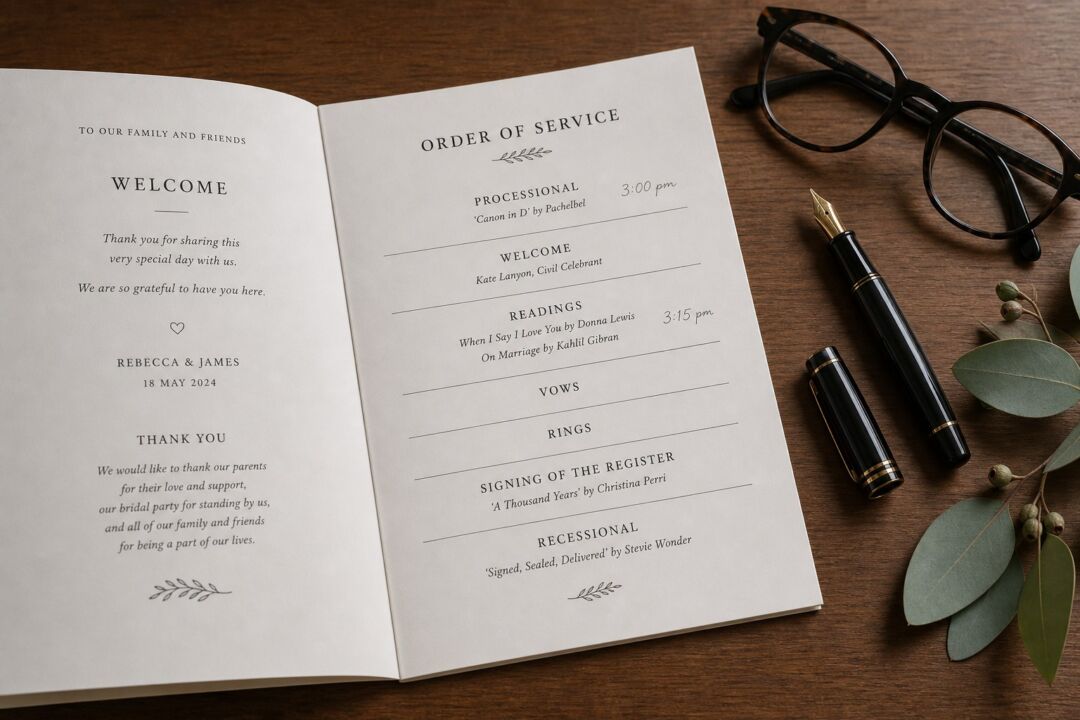
Print them in the program and your guests can follow the ceremony instead of guessing at it.
The Legally Required Words
Australian civil marriages are governed by the Marriage Act 1961 (Cth). Two sets of words are mandatory by law.
The monitum (s 46(1)) is spoken by the celebrant before the vows. The current form, as set out in the Attorney-General’s Guidelines on the Marriage Act 1961 for Authorised Celebrants, is:
> “I am duly authorised by law to solemnise marriages according to law. Before you are joined in marriage in my presence and in the presence of these witnesses, I am to remind you of the solemn and binding nature of the relationship into which you are now about to enter. Marriage, according to law in Australia, is the union of 2 people to the exclusion of all others, voluntarily entered into for life.”
The act permits “words to that effect,” meaning minor variations are allowed, but the core meaning must remain.
The legal vows (s 45(2)) are spoken by each party to the other, in the presence of the celebrant and two witnesses:
> “I call upon the persons here present to witness that I, [name], take thee/you, [name], to be my lawful wedded wife (or husband, or spouse)”
or words to that effect. Since marriage equality, “spouse” and “partner in marriage” are both accepted variations. The legal vows must be a present declaration (“I take you,” not “I will take you”) and must not contradict the definition of marriage in the monitum.
These two elements cannot be removed. Everything else in the ceremony is optional.
What You Actually Control
More than you might expect.
Beyond the monitum and the legal vows, there is no prescribed ceremony structure in Australian law. You can write as much or as little of the rest as you want, and personal vows can be any length or style, provided they do not contradict the legal vows.
What is yours to define:
- Personal vows: any wording, any length, any tone
- Readings: poetry, literature, religious texts, song lyrics, letters
- Rituals: unity candle, sand ceremony, ring warming, handfasting, cultural elements
- Ceremony order: when readings happen, whether vows are exchanged before or after rings, whether the celebrant tells your story
- Length: personalized civil ceremonies typically run 20 to 35 minutes, but this is entirely your call
Where stationery connects:
The celebrant’s running sheet documents the ceremony in sequence: monitum, welcome, story, readings, vows, ring exchange, pronouncement, and any rituals between them. That running sheet is the direct source for your wedding programs and orders of service: each section of the ceremony becomes a line in the printed program, in order. The ceremony order is commonly finalized with the celebrant six to eight weeks before the wedding, with programs ordered shortly after. The more settled your ceremony structure, the simpler the programs are to finalize. Foil is the method most worth ordering early, since foil wedding invitations and matching programs both add a pass on press.
The Red Flags
A good celebrant is easy to miss without knowing what to look for. A bad one is easy to book by mistake when you are moving quickly.
Walk away from any celebrant who:
- Cannot confirm their registration on the AG’s Department register, or is evasive about their authorization status
- Refuses to show any past work before you commit: no sample scripts, no ceremony videos, no recent references
- Has no backup plan for illness or an emergency on the day
- Gives incorrect information about the Notice of Intended Marriage: if they say the NOIM does not need to be lodged at least one calendar month before the ceremony, or they are unclear about the identity documents required, this signals they will mishandle the rest of the legal process
- Dismisses your ideas without engaging: “I always do it this way” is not a customization service
- Does not offer a written service agreement: the contract should document date, time, venue, agreed services, total fee, and cancellation terms before you pay a deposit
- Has reviews that mention lateness, paperwork errors, or communication failures: one mention might be an outlier, but two or three is a pattern
One additional signal that is harder to quantify: if you leave the first meeting feeling more uncertain than when you arrived, that is information. A good celebrant makes the process feel manageable.
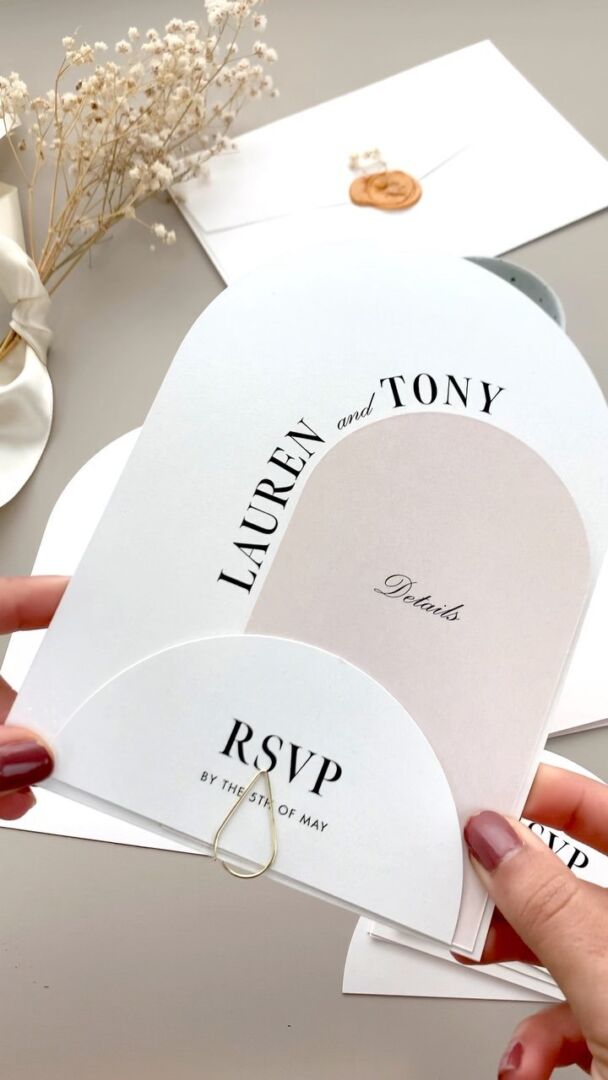
Foil invitation designs and matching programs, personalized online. The $5 sample pack puts seven designs and an envelope in your hands, including real foil and letterpress, so you judge paper and finish off a screen.
Frequently Asked Questions
Can a friend legally marry us in Australia?
No. In Australia, only an authorized person can legally solemnize a marriage: a Commonwealth-registered civil or religious celebrant, a minister of religion from a recognized denomination, or a state or territory registry officer. A friend can speak, read, or perform music at your ceremony, but they cannot legally perform it.
How do I verify that a celebrant is authorized?
Search the Attorney-General’s Department register of authorized marriage celebrants online. You can search by name, postcode, or suburb. This is a public register maintained by the AG’s Department and it is the only authoritative source. Wedding directories and review platforms do not confirm current authorization status.
What is the Notice of Intended Marriage and when do we lodge it?
The Notice of Intended Marriage (NOIM) is a legal form completed by you and witnessed by your celebrant before the wedding. Under the Marriage Act 1961, it must be lodged at least one calendar month before the ceremony and no more than 18 months before. Lodging with a private celebrant carries no government fee. You will need identification documents including birth certificates or passports and, if previously married, evidence of how that marriage ended (a divorce order or a death certificate).
How much of the ceremony can we actually write ourselves?
Almost all of it. The legally required sections are the monitum (around three sentences spoken by the celebrant) and the legal vows (one sentence each party says to the other). Personal vows of any length, readings, rituals, and the overall ceremony order are entirely yours to define. Most civil celebrants provide prompts, templates, and multiple meetings to guide you through the process.
How long before the ceremony should we finalize our order of service?
Lock the ceremony running order with your celebrant six to eight weeks before the wedding, then print programs shortly after. Print production for wedding ceremony programs typically takes one to two business days from proof approval. Order earlier if you have a large guest count or are using a premium print method such as foil or letterpress.
What should we do if a celebrant we like is already booked?
Ask if they have a waiting list, ask for referrals to colleagues whose work they respect, and check whether they know of cancellations. Most experienced civil celebrants know others who work in a similar style. This is a better path than settling for someone whose manner does not fit your ceremony because they were the first available option.