
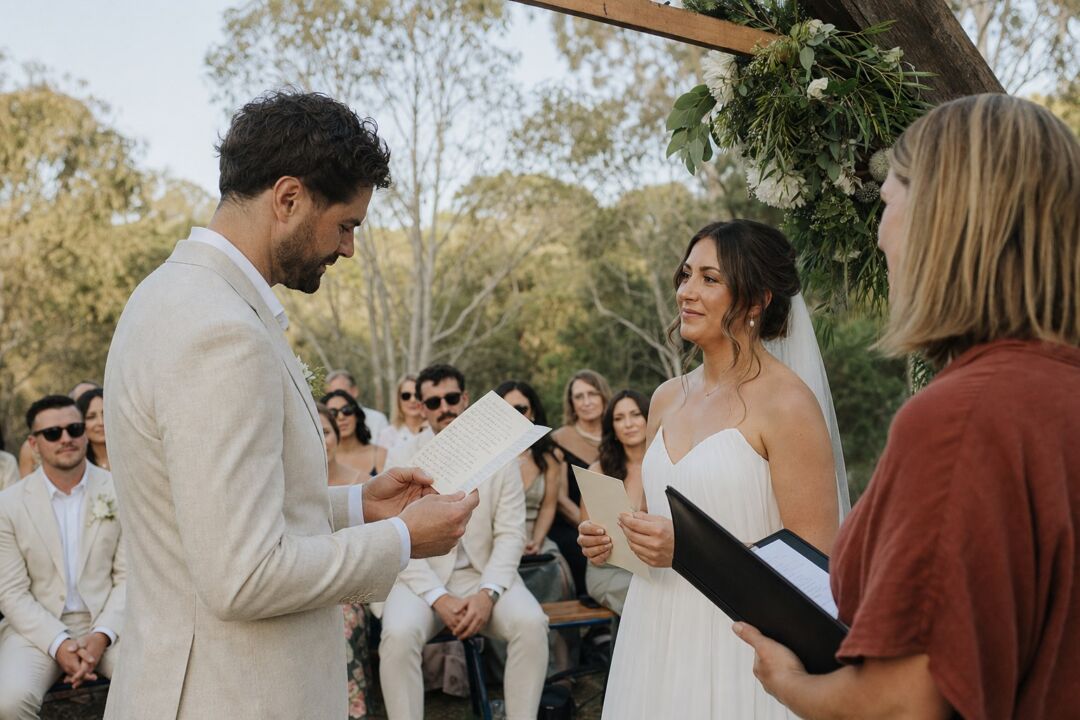
If the thought of standing in front of everyone and saying something heartfelt out loud makes you want to elope, this is for you. Public speaking is one of the most common fears people carry into their wedding day, and nobody talks about it enough. The good news is that short vows are not a fallback. They are often the most affecting thing in the room.
This article gives you more than twenty-five ready-to-use sample wedding vows, all of them short enough to say without losing your place or your nerve. It also covers the practical stuff nobody else writes about: what to do with the card in your hands, what to do if you freeze, and how to ask your officiant to carry some of the weight for you.
If you want to explore longer personal vows or understand how to write your own from scratch, our complete guide to wedding vows covers the full picture. And if you want sixty-plus examples across every tone and format, our wedding vow examples collection has them. Come back here when you want the ones built for people who just want to get through the ceremony with their dignity intact.
Short Vow Quick Reference
- Target length: 40 to 90 words (20 to 40 seconds spoken aloud)
- Minimum structure: one sentence about who they are to you + two promises for the future
- Reading from a card: completely fine; it looks better than forgetting
- Memorizing: optional; a card is the backup, not the fallback
- If you cry or freeze: pause, breathe, look at your partner, keep going from where you stopped
- Ask your officiant: to break vows into short phrases you repeat, if that helps
- Best format for nervous speakers: repeat-after-me, or reading from a flat vow card held at chest height
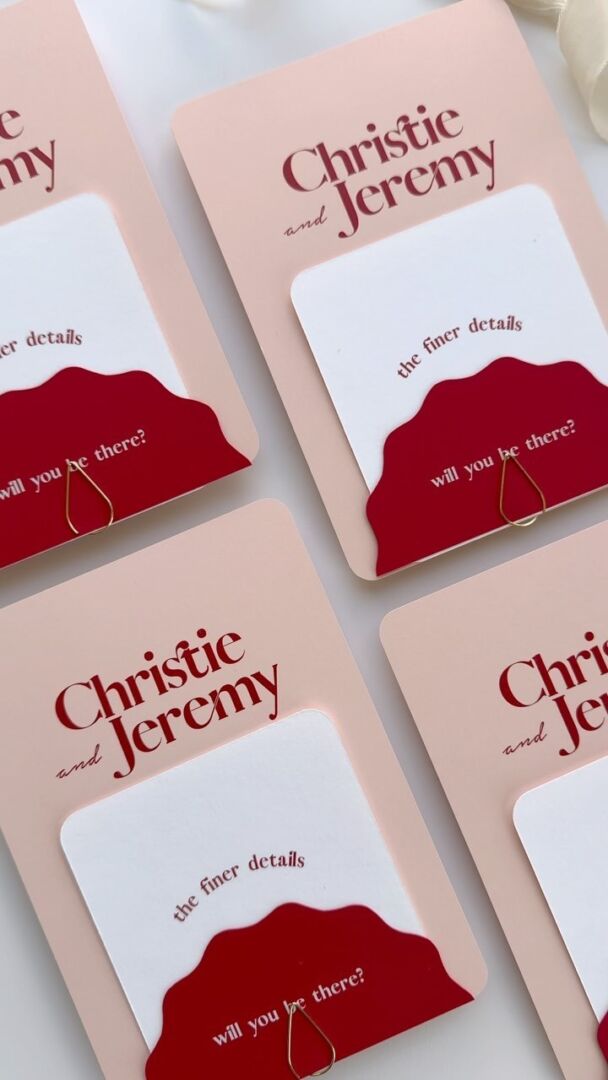
A printed program carries the readings and music so the spoken part can stay brief.
Why Short Vows Are Not a Compromise
The couples who write the shortest vows often have the most to say. They just already know how to say it without a preamble.
A long vow is not a sign of deeper love. In practice, long personal vows written under pressure often become a list of inside jokes the guests cannot follow, a summary of the couple’s dating history nobody asked for, or a string of promises so vague they disappear the moment they are spoken. Short vows force you to find the one thing that is actually true, and then say it clearly.
There is also something to be said for the experience of the people in the room. Guests at a ceremony are already emotionally charged. A single honest sentence delivered clearly lands harder than three minutes of heartfelt meandering. Brevity is a gift to your partner, too: they have to stand there absorbing everything you say, in front of everyone they know, without being able to look away.
The best vows are the ones you can actually say. If the version you write in your notes app is too long to get through without unraveling, it is not the right version for this moment. That version lives in a letter you leave somewhere they will find it later.

How Long Is a Short Vow? The 20-to-40 Second Rule
Speaking pace varies, but as a rough guide: forty words takes about twenty seconds to say out loud at a slightly slower-than-normal pace, and ninety words takes about forty seconds. That is the window this article targets.
Forty to ninety words is enough room to say something real. It is short enough to memorize if you want to, long enough to hold a full thought, and brief enough that a moment of emotion in the middle does not derail the whole thing.
The hub article in our vow guide series recommends two hundred to three hundred words as a standard personal vow length. That is roughly a minute to a minute and a half, and it is right for many couples. But if reading that length out loud in front of people feels genuinely impossible, there is no rule that says you have to do it. Forty to ninety words is enough.
The Minimum Viable Vow: What Every Short Vow Needs
A short vow that holds together needs three things:
1. One honest statement about your partner or your relationship
Not a list. One thing. Who they are to you, what you feel, or what they have given you. This is the anchor.
2. At least one real promise
Promises are the legal and emotional point of the ceremony. Even the shortest vow should include at least one clear commitment. “I will love you” counts, but a specific promise (“I will always come home to you”) tends to land harder.
3. A clean ending
Vows end, and then silence lands. Know your last line, and let it be the last thing you say. Do not trail off. Do not add “and that’s it” or “I think that’s everything.” Say the last line, and stop.
Everything else, the backstory, the inside references, the gratitude, the future plans, is optional. The three elements above are not.
25 Sample Wedding Vows, by Tone
None of these appear in our broader vow examples article. Use them as-is or change a word or two to make them yours.
Plain and Sincere
These are for the person who wants to say something honest without it feeling performed.
[Name], I will love you on the ordinary days and the hard ones. I choose you today, and I will choose you again tomorrow. I promise to stand with you, and to build a life with you, for as long as I live.
I take you as my partner in everything that matters. I promise to show up for you honestly, to listen without judgment, and to love you without conditions, from today until I cannot.
[Name], I love you. I want to be with you. I promise to be loyal to you, to take care of you, and to keep this promise every day of our lives together.
You have made my life better. I cannot say it any other way. I promise to work hard for us, to be here for you, and to never stop being grateful that you are mine.
I came here today to make one promise: to love you. Everything else we will figure out together. I promise to face whatever comes with you, and to never let you face it alone.
Warm
For the person who wants something that feels like a hug.
[Name], you are the first thing I want to see in the morning and the last thing I think about at night. I promise to love you with patience, to hold you when things fall apart, and to celebrate every good thing with you, always.
You feel like home. Since the moment I met you, I have been moving toward you. I promise to keep moving toward you, to stay close, and to love you for exactly who you are.
You make me want to be better. Not because you ask me to be, but because you deserve it. I promise to grow alongside you, to be proud of what we build, and to love you more each year.
I am thinking right now about growing old with you. About slow mornings and shared routines and all the ordinary days ahead. I promise to love you through all of them, and to mean it more each time I say so.
With you I feel like myself, fully. I promise to always give you that back: a place that is safe, a love that is steady, and a life that is genuinely ours.
Slightly Funny
These land well with guests and release the tension in the room. Make sure your partner knows the tone you are going for.
[Name], I promise to love you unconditionally, to be your partner in all things, and to always ask before I eat the leftovers you were clearly saving. I am yours, completely and permanently.
I promise to love you on the good days and the bad ones, to be the person who tells you when you have something in your teeth, and to never pretend I do not need your help. I am lucky to have you, and I will spend our whole lives making sure you know it.
I have tested my theory that you are the best person I know, and the evidence is overwhelming. I promise to honor this finding by loving you properly, annoying you only sometimes, and choosing you every single day.
Fair warning: I am not a perfect person. I lose things, I overthink, and I have opinions about how to load the dishwasher. But I promise to love you as well as I possibly can, to always come home to you, and to listen, even when I think I already know.
My life before you was fine. My life with you is better in every measurable way. I promise to take care of what we have, to make you laugh as often as I can, and to be here, permanently and enthusiastically, for whatever comes next.
Faith-Adjacent, Without Being Religious
For couples who want vows that feel weighty and meaningful without invoking a specific tradition.
I believe we are meant for this. Not because anything ordained it, but because every choice that brought us here was pointing in this direction. I promise to honor that, to love you deliberately, and to keep arriving at you, every day.
You are the person I want beside me for everything that matters. I promise to witness your life with attention and love, to be grateful for the grace of knowing you, and to stay close to you for as long as we have.
There is something in loving you that feels worth protecting, something I want to be careful with. I promise to treat what we have with the seriousness it deserves, to love you with my whole heart, and to keep this promise as the most important one I will ever make.
You are enough. I am enough. Together we are something I did not know I was looking for until I found it. I promise to nurture this, to show up for you with everything I have, and to love you as the extraordinary thing you are.
I make this promise to you alone, in front of everyone who matters to both of us. I will love you in the way you need, protect what we build together, and return to you, always, no matter what the day brings.
Second Marriage and Blended Families
These acknowledge real history without dwelling on it. Several can work as part of a ceremony that includes children.
I have learned what it means to start over, and I have learned that it takes courage. You are worth every bit of that courage. I promise to love you with what I know now, to choose you every day, and to build something that lasts.
I am not here to undo the past. I am here because you showed me what love can look like when it is right. I promise to honor what we have, to take care of you, and to face whatever comes with you beside me.
You did not just take me on. You took on all of us. I see that, and I am grateful for it every day. I promise to love you for the person you are and the family you have chosen, and to build a home with you that belongs to all of us.
We are each bringing our histories into this day. Our children, our memories, the people we have been. I promise to honor all of it, yours and mine. I will love you in a way that makes room for everything we have carried here.
Choosing to love again took more out of me than I expected. You were patient with that, and you deserve to know how much that patience means. I promise to bring my whole heart to this marriage, to give you everything I have, and to love you the way you have always deserved to be loved.
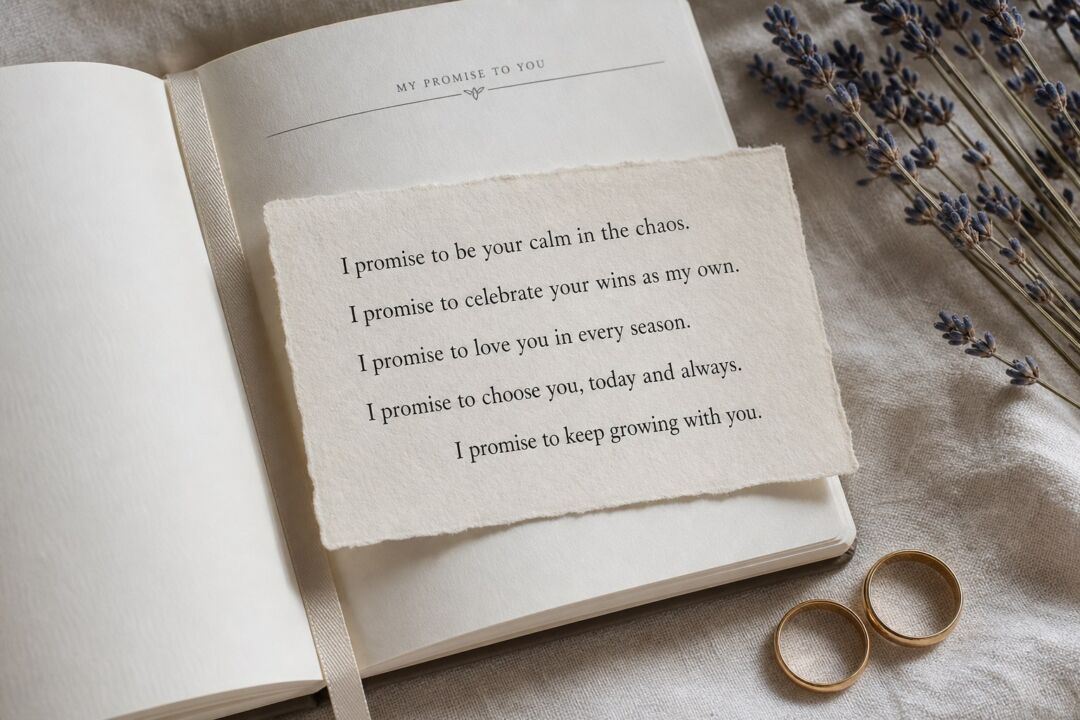
A program in every hand takes the pressure off the two people at the front.
How to Deliver Your Vows Without Panicking
This is the section nobody else writes. The advice below comes from what actually happens in ceremonies, not from what looks good in a wedding planning listicle.
Should You Memorize?
Probably not, if the idea of memorizing makes you more anxious. The risk of a blank mind in a high-stress moment is real, and the recovery from forgetting mid-vow is more disruptive than reading from a card ever was. A few light read-throughs so the words feel familiar is the right preparation for most people. Memorization is for actors and performers; this is a ceremony, not a performance.
If you do want to memorize, use a card anyway. Hold it, have it in your hand, and know exactly where you left off if you need to look down. The card being there makes forgetting impossible, which means you can relax enough to actually remember.
Reading from a Card Is Completely Fine
This is the thing people feel most awkward about, and it deserves a direct answer: reading your vows from a card is not a sign that you are unprepared, unromantic, or less committed. It is a sign that you thought about what you wanted to say and wrote it down so you could say it clearly. Every court reporter, every judge, every person who has ever signed a legal document in front of witnesses has read something aloud from a page. It is the normal way that words get exchanged formally between people.
Guests do not notice the card. They are watching your faces and trying not to cry themselves.
How to Hold the Card
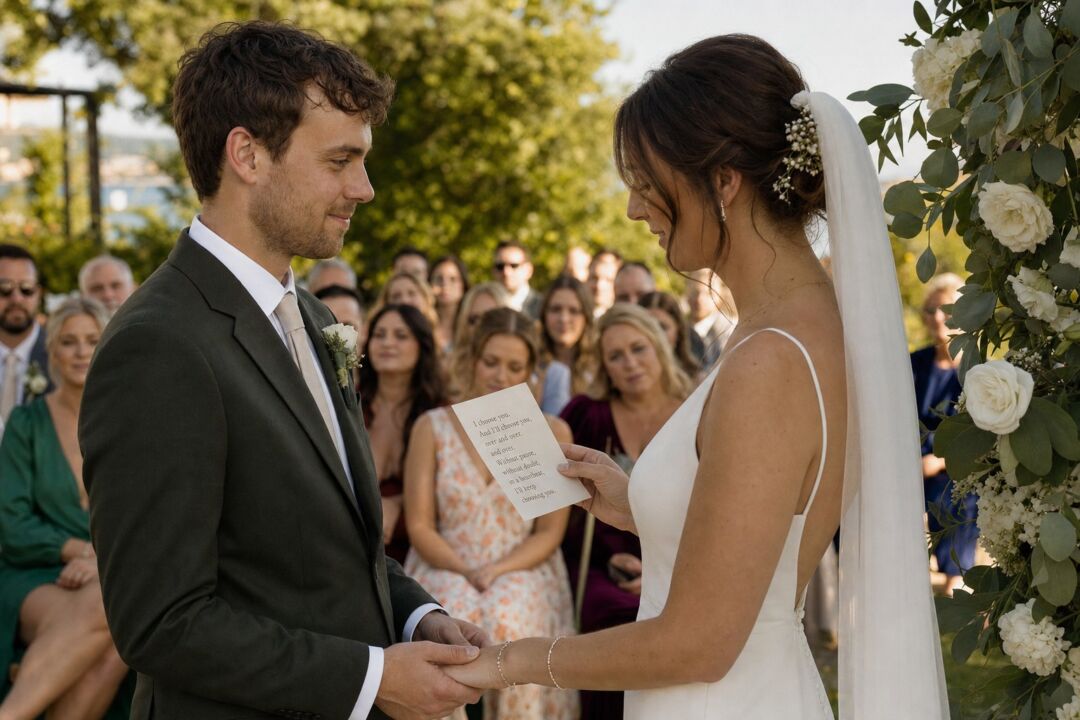
Hold it at chest height, not down by your waist. When the card is low, you have to drop your head to look at it, and your voice gets directed at the floor. At chest height, your eyes can travel between the card and your partner’s face without your head moving much.
A folded card or vow booklet holds its shape better than a loose sheet. If you are nervous and your hands might shake, a booklet is more forgiving than a single sheet that can flutter. A heavier card stock helps too.
Mark any word or phrase you tend to stumble on. A subtle circle or underline in pencil gives your eye something to land on if your brain goes blank for a second.
What to Do If You Cry or Freeze
Both are completely fine and happen commonly at ceremonies. Here is what to do when either one hits:
Stop. Do not try to push through before you are ready. One breath is faster than you think it will be, and guests will wait. They want you to get there.
Look at your partner, not at the crowd. The crowd is the source of the anxiety; your partner is the antidote.
Pick up from the last line you finished, not from the beginning. You do not need to restart. Find your place on the card and continue. If you have lost your place, pause, find it, and keep going.
If you cannot continue at all, your officiant can read the rest of your vow back to you in short phrases for you to repeat. Tell them in advance that this might happen. Any good officiant has done it before.
Tell Your Officiant You Are Nervous
Do this before the ceremony, not during it. A celebrant who knows you are anxious about speaking can:
- Break your vow into shorter call-and-response phrases instead of having you read a full paragraph
- Give you a short pause after each ring exchange to steady yourself
- Keep their own voice calm and slow, which tends to calm the person repeating after them
- Have a backup plan ready if you need to stop
Ask for this in your final pre-ceremony meeting. There is nothing unusual about the request. Officiants are used to managing nervous speakers.
Vow Books and Cards: The Honest Solution
The anxiety that brings most people to this article has a physical solution: something in your hand that tells you exactly what to say next.
A wedding ceremony program is the version your guests hold during the ceremony, but a separate vow card or vow booklet is what you hold. It is small, flat, and light enough to hold without it being noticeable. The most useful formats are:
- A folded card, roughly 3 x 4 inches, printed in a large clear font on one side with breathing marks built into the line breaks
- A small sewn booklet with a ribbon marker, which lies flat and will not flip closed in the wind
If you are having a ceremony with printed programs for guests, it is worth ordering them from the same collection so the look is consistent. Programs designed to match your invitations tend to feel intentional rather than an afterthought.
Paperlust’s wedding ceremony program designs are available across print methods including digital and foil stamp, and can be customized to match your invitation suite. Browse the full range of wedding programs.
Ceremony stationery you personalize online and print on premium stock. The $5 sample pack puts seven designs and an envelope in your hands, including real foil and letterpress, so you judge paper and finish off a screen.
Frequently Asked Questions
How short can wedding vows be?
There is no minimum length for personal vows. The exchange of rings and the legal declaration handled by the officiant are the elements required by law; anything you say is in addition to that. Vows of three or four sentences are common and entirely appropriate. Some couples say one sentence each. The measure is whether the words are genuine, not how many of them there are.
Is it rude to read vows from a card?
No. Reading from a card means you prepared what you wanted to say and took the moment seriously enough to write it down. Many officiants consider it better practice than improvising or trying to recall from memory under stress. The card does not pull attention from the moment. Your face does.
What if I completely forget my vows mid-ceremony?
Look down at your card. If you do not have a card, ask your officiant to read the vow in phrases for you to repeat. Either of these is a faster recovery than most people expect. Every officiant has handled this, and your guests will not notice or mind. What they remember is how you looked at your partner, not whether you glanced at a piece of paper.
What is the best format for a nervous speaker?
The repeat-after-me format, where your officiant says a short phrase and you repeat it, is the lowest-pressure option. You are never holding a thought in your head or scanning ahead; you are just repeating what you just heard. If full personal vows feel impossible, using a traditional vow set with the officiant prompting each line removes almost all the public-speaking element entirely.
How do I make a short vow feel meaningful?
Specificity. One specific truth about your partner or your relationship is worth more than ten general declarations of love. “You are the person I want beside me when things go wrong” lands harder than “I love you with all my heart” because it describes something real. Short vows work best when they say one specific thing and then make one or two clear promises. That combination gives guests and your partner something concrete to hold onto.
Can my partner and I say different-length vows?
Yes. There is no rule that vows must be the same length or even the same format. If one of you wants two sentences and the other wants a full paragraph, both are valid. Checking with your officiant first is sensible, since they may want to pace the ceremony accordingly, but different-length vows are not unusual.