

Chinese weddings are among the most layered and visually striking celebrations in the world. Whether you are a couple planning a ceremony that honors both heritage and modern life, or a guest stepping into a banquet for the first time, knowing the traditions behind each ritual makes the experience richer for everyone present.
This guide covers the full arc of Chinese wedding customs, from the ancient Three Letters and Six Etiquettes to the tea ceremony, door games, and wedding banquet, with practical sections on Chinese wedding invitations, bilingual stationery design, and red envelope etiquette. Han, Cantonese, and Northern Chinese variations are flagged throughout where they genuinely differ.
Quick reference
Chinese wedding traditions in 30 seconds
- Red and gold dominate: red symbolizes joy and protection; gold symbolizes prosperity
- The tea ceremony is the single most-practiced tradition at modern Chinese and Chinese-American weddings
- Door games (chuangmen) are a lighthearted tradition where the groom earns entry to the bride’s home before pickup
- Wedding banquets typically feature 8 to 9 auspicious courses; whole fish and longevity noodles carry specific symbolism
- Hongbao (red envelopes with cash) are the standard wedding gift; registry culture is less common in traditional Chinese settings
- The double happiness character (囍) appears on nearly every element of the traditional ceremony
- Most Chinese-American couples hold a Western ceremony first, followed by a separate tea ceremony with family
- Stationery matters: invitations, red envelopes, and table cards all carry cultural signals that guests notice immediately
Browse wedding stationery by region: United States | Australia | United Kingdom | Canada | New Zealand
Chinese Wedding Traditions: An Overview for Couples and Guests
Chinese wedding traditions span more than two thousand years and draw from Confucian values, folk customs, regional dialects, and Buddhist and Taoist influences. The result is a celebration that operates on multiple layers simultaneously: the ceremony happening in the room, the symbolic meaning embedded in each gesture, and the family relationships being publicly acknowledged.
It is worth noting upfront that “Chinese wedding traditions” is not a single uniform set of customs. Han Chinese traditions, which form the most widely recognized framework, differ from Cantonese customs common among families with roots in Guangdong Province and Hong Kong, which in turn differ from the customs of Northern Chinese families (particularly those from Shandong, Hebei, and Shanxi provinces). Regional variations in attire, foods served, and the specific games or rituals performed are real and significant. Where this guide describes variations, it flags them clearly.
For Chinese-American couples, the picture is often a deliberate hybrid: a Western ceremony with white dress and vows, followed by a tea ceremony later in the day or at a separate family gathering, all set against invitations and table cards that incorporate red, gold, and the double happiness symbol.
The connective thread across all these variations is family. Chinese weddings are fundamentally family events, not just a union of two individuals but a formal merging of two households. This shapes everything from who speaks during the ceremony, to who is served tea first, to who receives a red envelope at the banquet.
Traditional vs. Modern Chinese Weddings
Traditional and modern Chinese weddings share the same cultural foundation but differ significantly in execution, scale, and format. Most contemporary Chinese-American weddings occupy the middle ground, drawing on traditional rituals while adapting venue, catering, and attire to a bicultural audience.
| Aspect | Traditional Chinese Wedding | Modern Chinese-American Wedding |
|---|---|---|
| Attire | Bride in red qipao or cheongsam; groom in changshan or Tang suit | Bride in white gown for ceremony, changes into red dress for tea ceremony and reception |
| Tea ceremony | Held separately at each family’s home; two full ceremonies | Often held in one combined session at the reception venue or a private room |
| Venue | Family home, traditional banquet hall | Luxury hotel, outdoor garden, modern event space |
| Invitations | Red and gold designs with traditional calligraphy and double happiness motif | Modern minimalist or fusion styles; bilingual English and Chinese increasingly standard |
| Wedding banquet | 8 to 9 auspicious courses in strict symbolic order | May blend Chinese banquet courses with Western-style catering or cocktail reception |
| Gift giving | Guests give red envelopes (hongbao) with cash | Red envelopes remain standard; gift registries gaining acceptance alongside them |
The Shape of a Modern Chinese Wedding Day
Most Chinese weddings in Australia and the US today compress the historical multi-day timeline into 18 to 24 hours, often split between the bride’s family home, a tea-ceremony venue, and an evening banquet at a Chinese restaurant or hotel ballroom.
The order of events on a typical fusion day: hair combing the night before; door games at sunrise; tea ceremony for the bride’s family mid-morning; church or civil ceremony around noon; portrait session and a second tea ceremony for the groom’s family in the afternoon; banquet from early evening with multiple outfit changes and toasts. What rarely gets dropped is the tea ceremony, the door games, and the banquet itself, and these are the moments that most need to be communicated clearly on your stationery suite.
The Three Letters and Six Etiquettes: Historical Framework
The formal structure behind traditional Chinese marriage is known as the Three Letters (三书, San Shu) and the Six Etiquettes (六礼, Liu Li). These rites were codified during the Zhou dynasty and elaborated in the Han dynasty Book of Rites, though their influence runs through Chinese wedding planning to this day, even when families follow only the spirit rather than the full letter of each step.
The Three Letters
- The Betrothal Letter (胜书, pin shu): The formal engagement contract binding the two families. Today this is largely ceremonial, but the act of families formally agreeing to a union, often over dinner, echoes this tradition.
- The Gift Letter (礼书, li shu): A written inventory of all betrothal gifts presented by the groom’s family to the bride’s family. Modern equivalents include jewelry (often gold), red envelopes, and symbolic foods.
- The Wedding Letter (迎仴书, ying qin shu): Presented on the wedding day when the groom formally receives the bride from her family home. This letter welcomes her into the groom’s family.
The Six Etiquettes
These steps map the full courtship-to-wedding arc:
1. Proposal and Matchmaking (纳采, Na Cai)
Originally facilitated by a professional matchmaker (媚人, mei ren), this step involved the groom’s family formally expressing interest in the bride’s family. Today it functions as the parents’ first meeting or the formal introduction of partners.
2. Requesting the Birth Information (问名, Wen Ming)
The bride’s date and hour of birth, known as her “Eight Characters” (八字, ba zi), would be shared with the groom’s family to check astrological compatibility. Many families today still consult a fortune teller or Chinese almanac when selecting the wedding date.
3. Astrological Compatibility Check (纳吉, Na Ji)
A fortune teller would compare the couple’s ba zi charts. A favorable reading moved the process forward; an unfavorable one would end the match. Modern couples rarely cancel a wedding based on this, but date selection remains genuinely important to many families.
4. Betrothal Gift Exchange (纳征, Na Zheng), the Guo Da Li ceremony
The Guo Da Li (过大礼) ceremony is the formal betrothal gift exchange and remains widely practiced today, particularly in Cantonese communities. The groom’s family presents gifts to the bride’s family: traditionally including tea, lotus seeds, longan, red dates, gold jewelry, and cash in red envelopes (with amounts chosen for auspicious numbers, especially multiples of 8 and 9). The bride’s family returns a portion as a gesture of goodwill.
5. Selecting the Wedding Date (请期, Qing Qi)
The Chinese almanac (通胜, tung sheng) assigns auspicious and inauspicious days based on a combination of lunar calendar, elemental cycles, and other factors. Choosing the right date is taken seriously even in secular Chinese families; a fortune teller or respected elder typically advises. Many couples pick dates with numerological significance: 8/8 (August 8) is particularly popular for its double-eight auspiciousness.
6. The Wedding Ceremony (亱迎, Qin Ying)
The formal wedding day, when the groom receives the bride. This culminates in the ceremonies described in the sections below.
The Tea Ceremony: Step-by-Step Modern Guide
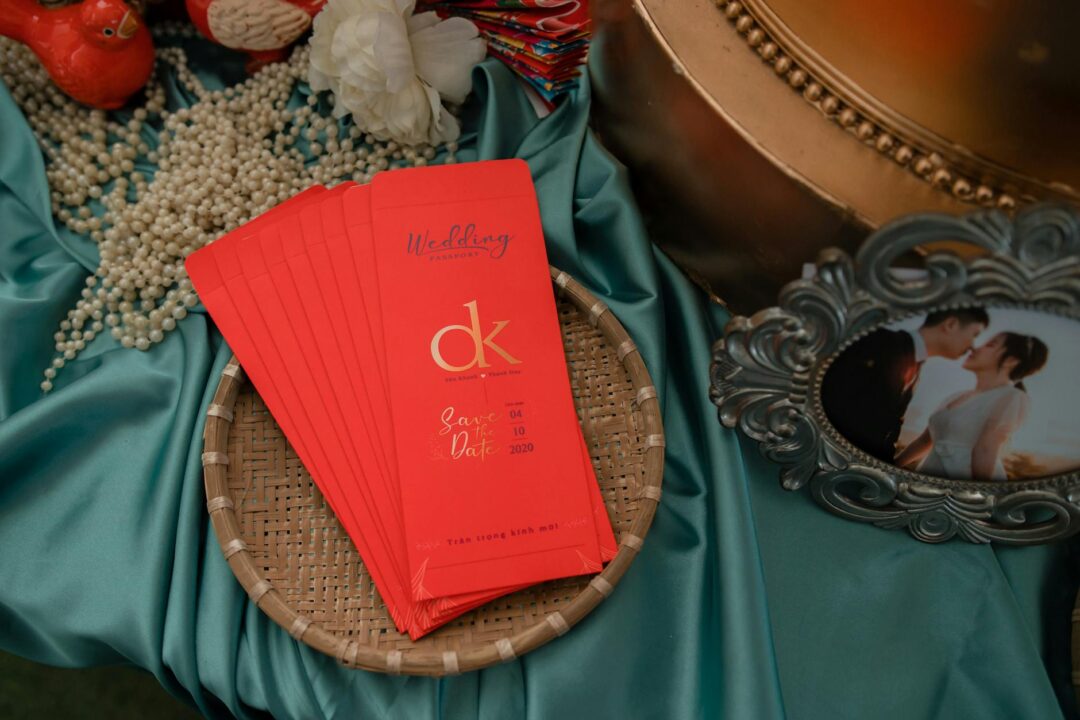
The tea ceremony (振茶, jing cha) is the single most widely retained Chinese wedding tradition today. For many Chinese-American families, it is the only traditional element in an otherwise Western wedding, and it carries enormous weight precisely because of that.
The ceremony’s purpose is direct: the newlyweds formally pay respect to their parents, in-laws, and elders by kneeling and serving them tea. In return, elders offer blessings and typically present red envelopes (hongbao) or jewelry.
What you need
- Tea set: Traditionally red, decorated with the double happiness symbol. Common teas include oolong, tie guan yin (iron goddess), or red date tea (hong zao cha). Green tea symbolizes purity; oolong symbolizes harmony. Avoid bitter teas: bitterness is inauspicious.
- Seating arrangement: Two chairs or a bench for the parents and elders being served. A low table or tray to hold the teapot and cups. Kneeling cushions for the couple.
- Red envelopes: Elders prepare these in advance to give the couple as a blessing after receiving tea.
- Attire: The bride typically wears a red qipao or cheongsam for the tea ceremony, even if she wore white for the Western ceremony. The groom wears a dark suit or matching changshan (traditional men’s jacket).
The serving order
Order matters significantly and is one area where regional variation appears. The most common sequence:
- Groom’s parents first (traditionally, the bride was entering the groom’s family)
- Groom’s grandparents
- Groom’s uncles and aunts (by seniority)
- Groom’s elder siblings and their spouses
- Bride’s parents
- Bride’s grandparents and extended family, following the same seniority pattern
Modern adaptation: Many Chinese-American couples conduct a combined ceremony, serving both families simultaneously rather than hosting two separate ceremonies (one at each family’s home as in the traditional format). The bride’s family is served first in some modern interpretations to acknowledge that the couple is building a new equal partnership.
How to perform the ceremony
Step 1: Prepare the tea space
Set up a dedicated area with chairs for elders and cushions for the couple to kneel. Have all cups filled and the tray ready. The groom stands on the right; the bride stands on the left.
Step 2: Call elders forward by name and title
Address each elder by their correct family title, not by name. “Dad, please drink some tea” (父父,请协茶) uses the term “baba” for the father-in-law. “Mom, please drink some tea” (围围,请协茶) uses “mama.” Using correct titles is culturally important.
Step 3: Present the tea with both hands
Offer the cup held in both hands at chest height. Offering with one hand is considered disrespectful. The couple kneels together as they present.
Step 4: The elder accepts, blesses, and gives
Elders sip the tea, offer verbal blessings (often in Cantonese or Mandarin), and present a red envelope or piece of jewelry. Common blessings: “Bai Tou Xie Lao” (may you grow old together), “Zao Sheng Gui Zi” (may you have children soon; note: optional to say in modern settings), and “Xin Hun Kuai Le” (happy new marriage).
Step 5: Move through the full order
Proceed through the full seniority sequence. Each elder or couple receives their own individually poured cup.
What to skip or adapt in modern ceremonies
The “Zao Sheng Gui Zi” blessing (quickly bear a precious child) is traditional but some couples prefer to quietly signal to elders not to say it if children are not in the near-term plan. Most respectful elders will follow the couple’s lead.
Younger siblings do not receive tea in the traditional ceremony: the direction flows from younger (the couple) to older (elders). Cousins and close family friends sometimes receive tea at the couple’s discretion in modern ceremonies.
The tea ceremony order card: the practical detail most couples skip
If the tea ceremony has more than 12 elders being served, a printed order card avoids the awkwardness of pausing mid-ceremony to confirm who is next, and it gives the photographer a cue sheet. A working order card includes the full name of each elder in service order, their relationship to the couple in both English and (where appropriate) the Chinese kinship term, the family side marked clearly, and a service number. A small 5×7 inch (127 x 178 mm) printed card in matching red and gold reads as both functional and ceremonial.
Saturday, the Fourteenth of June
The Family Home of Mr. and Mrs. Lee
1. Yeh Yeh and Mah Mah Lee
2. Gung Gung and Po Po Wong
3. Mr. and Mrs. David Lee
4. Mr. and Mrs. Henry Wong
5. Uncle Peter and Auntie Susan Lee
A custom seating chart can be designed to mirror the invitation suite, giving the order card a ceremonial feel rather than a functional-only one.
Wedding Colors and Symbolism: Red, Gold, and Double Happiness (囍)
Color carries meaning in Chinese wedding culture in ways that go well beyond decoration. Understanding the symbolism helps guests and couples make intentional choices.
Red (红, hong)
Red is the dominant color of traditional Chinese weddings because it represents joy (喜, xi), good fortune, vitality, and protection against negative energy. Red appears on the dress, the invitations, the tea set, the red envelopes, the table decorations, and the double happiness character. Guests should not wear red to a Chinese wedding: it competes with the bride’s color and is considered impolite.
Gold (金, jin)
Gold represents wealth, prosperity, and longevity. It appears as accents throughout the ceremony: gold jewelry presented at the Guo Da Li, gold embroidery on the qipao, gold lettering on invitations, and gold-rimmed tableware at the banquet. For stationery, flat foil detailing in gold on red or cream stock captures this pairing authentically.
Double Happiness (囍)
The double happiness character is formed from two identical characters for happiness (喜, xi) placed side by side. It appears on virtually every element of a traditional wedding: the bride’s dress, the tea set cups, the cake, the wedding favors, and the invitations. It represents the union of two joys and two families. When you see 囍 on any wedding element, it is an explicit signal that the event is a Chinese celebration.
Other symbolic colors
- Pink: A modern softening of red; widely used in Chinese-American weddings as a compromise between traditional red and Western white.
- White: In traditional Chinese culture, white is associated with mourning and funerals. Guests should avoid all-white outfits. However, brides wearing white gowns in modern Chinese-American weddings is fully normalized; the Western ceremony context shifts the color reading.
- Black: Traditionally also associated with mourning; avoid in traditional settings. More acceptable at modernized ceremonies.
- Green: Wearing a green hat specifically is considered deeply offensive in Chinese culture (associated with infidelity). Guests should avoid green hats; green clothing in other forms is generally fine.
Chinese Wedding Invitations: Design, Motifs, and Print Methods
Your wedding invitation is the first touchpoint where guests read the cultural register of your celebration. For Chinese and Chinese-American weddings, stationery choices carry genuine weight: the right motifs, palette, and print method signal fluency with tradition; the wrong ones can feel generic or off-key.
Motifs and symbols on Chinese wedding stationery
- Double happiness (囍): The most universally recognized Chinese wedding symbol. Gold foil stamping of the character on a red card is the classic execution. Works as the sole ornament on a minimalist design or as a centerpiece in an elaborately decorated suite.
- Dragons and phoenixes: The dragon (龙, long) represents the groom; the phoenix (骻, feng) represents the bride. Together they symbolize balanced strength and grace. Common in embroidery and card borders.
- Mandarin ducks: A symbol of lifelong fidelity because mandarin ducks mate for life. Particularly meaningful on cards for couples with a shared emphasis on partnership.
- Peonies: Represent prosperity, honor, and feminine beauty. A common floral motif in both traditional and contemporary Chinese wedding designs.
- Pomegranates: Symbolize fertility; the many seeds represent many children. Common in traditional invitation borders and fabric embroidery.
- Jianzhi (paper-cut) borders: The traditional Chinese paper-cutting art form. A jianzhi-style frame around the invitation text reads as distinctly Chinese and pairs well with both red-and-gold and modern minimalist aesthetics.
Print methods for a red-and-gold palette
Three print methods carry the red-and-gold aesthetic most authentically. Foil stamp uses a custom die to press real gold foil into the paper with a tactile debossed impression; it is the closest contemporary equivalent to traditional gold-leaf Chinese wedding cards and pairs beautifully with deep red 380gsm premium stock. Browse foil wedding invitations to see the range of gold-on-red designs available. Flat foil applies metallic foil without a die at a lower minimum order, with faster lead time, and works well for a full paper-cut design where debossing the entire border would be prohibitively expensive. Letterpress creates a debossed impression on 600gsm Wild Cotton (the heaviest paper available) and works for a minimalist modern design with 囍 as the only ornament. Digital print starts at $2.04 per card and can reproduce a full paper-cut design photographically, but lacks the tactile feel of foil or letterpress.
Key elements of a traditional Chinese wedding invitation
- Red and gold colors: The palette that signals the cultural register of the celebration. Red stock with gold foil lettering is the most traditional execution.
- Double happiness symbol (囍): Included on virtually every traditional Chinese invitation, either as a centerpiece or as a border motif.
- Elegant calligraphy or brushstroke typography: Brush-style fonts or hand-lettered elements are common for the couple’s names and wedding date. Gold foil adds a luxurious finish.
- Bilingual wording: English on the front, Chinese on the reverse, or a bilingual layout on a single card. Traditional Chinese characters (used in Hong Kong, Taiwan, and among older mainland Chinese families) versus simplified Chinese (mainland China) is a detail worth confirming with family.
Bilingual Chinese wedding invitation: sample wording
and
Mr. and Mrs. Henry Wong
request the honor of your presence
at the marriage of their children
Michelle Lee & Andrew Wong
李美瑙 & 黄安秘
Saturday, the Fourteenth of June
Two Thousand and Twenty Six
at four o’clock in the afternoon
Tea Ceremony to follow
Banquet at six o’clock
Browse our full wedding invitation collection to find designs in red, gold, and bilingual layouts. Customization in both English and Chinese is available as standard.
RSVP cards and the full stationery suite
A Chinese wedding with a banquet and tea ceremony generates more stationery touchpoints than a Western-only wedding. Beyond the main invitation, most couples order a suite that includes RSVP cards (critical when confirming final banquet seat counts), an information card with tea ceremony timing and attire guidance for Western guests, and a day-of envelope for the red envelope collection at the reception entrance.
Save the date and stationery timeline
For a Chinese wedding with a banquet and multiple ceremonies, save the dates should go out earlier than for a Western-only wedding. Elderly relatives often need to travel internationally, and the tea ceremony cannot proceed without the senior generation present.
| Stationery piece | When to send |
|---|---|
| Save the date (international guests) | 10 to 12 months before |
| Save the date (local guests) | 8 months before |
| Formal invitation | 3 to 4 months before |
| Tea ceremony invitation (close family only) | 2 months before |
| RSVP deadline | 6 weeks before |
| Banquet seating chart finalized | 2 weeks before |
Chinese Wedding Attire: Qipao, Cheongsam, and Western Hybrid
Wedding attire in Chinese weddings has evolved significantly, with most modern ceremonies featuring multiple outfit changes that honor both heritage and personal style.
The qipao and cheongsam
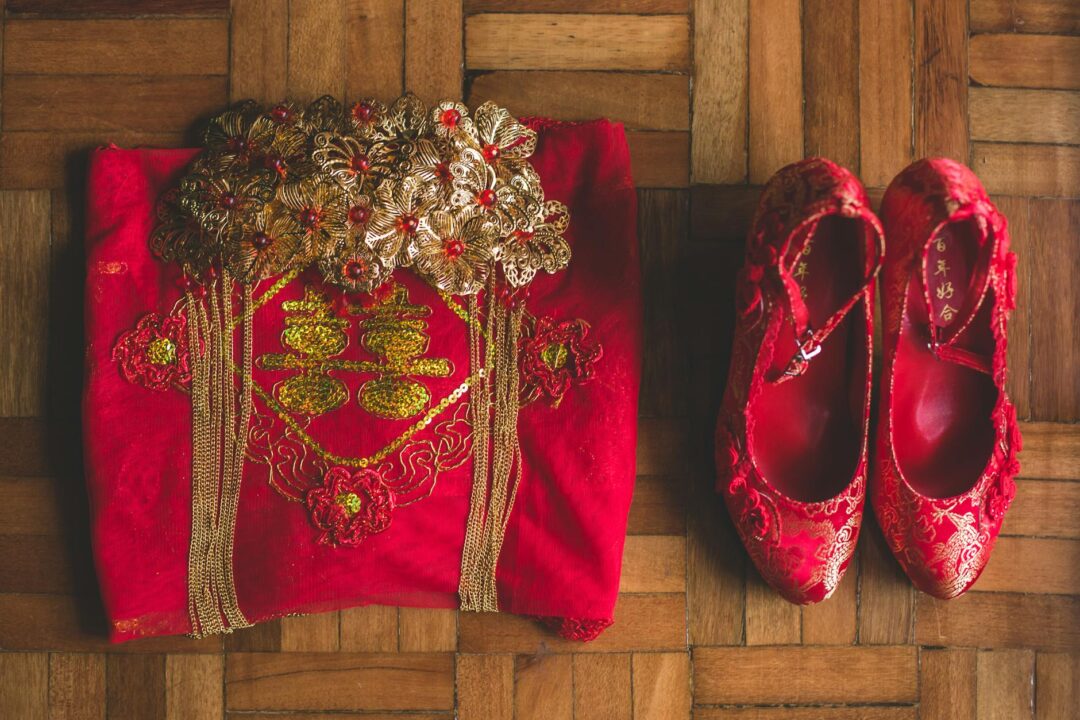
The qipao (施虽) and cheongsam are often used interchangeably in English, though strictly speaking the qipao refers to the Manchu-origin garment adapted during the Republican era (1912-1949), while “cheongsam” is the Cantonese pronunciation of the same garment. The modern fitted silhouette (mandarin collar, side slits, form-fitting cut) became fashionable in 1920s Shanghai and remains the iconic Chinese bridal dress today.
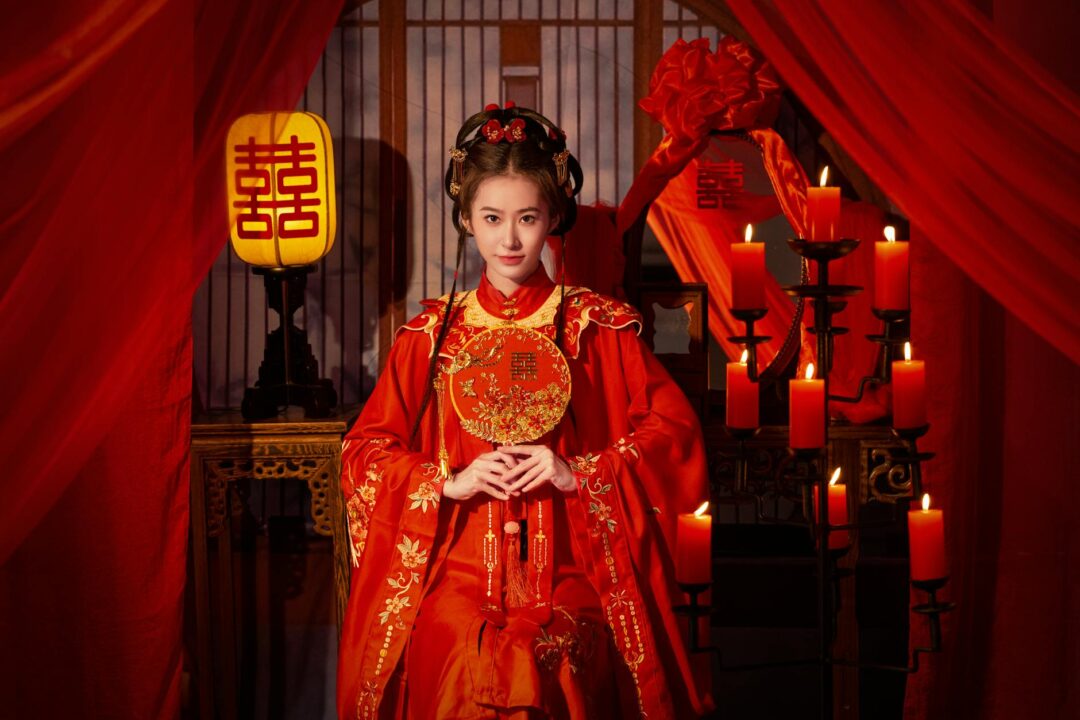
For weddings, the bridal qipao is almost always red, often with gold embroidery featuring phoenixes, peonies, or dragons. The phoenix (骻, feng) and dragon (龙, long) pair represents the bride and groom respectively and appears frequently in embroidery and decor.
The qun kwa (Cantonese traditional bridal garment)
The traditional Cantonese bridal garment is the qun kwa (襪襭), a two-piece red and gold embroidered jacket and skirt. Heavier and more covered than the qipao, with large embroidered panels featuring dragons, phoenixes, and peonies, the qun kwa is the formal choice for Cantonese families with roots in Guangdong Province and Hong Kong.
The xiu he fu (秘竹服)
A style gaining significant popularity among younger brides is the xiu he fu, a two-piece traditional Han Chinese outfit with flowing robes and large sleeves, more coverage than the qipao, and often softer embroidery in red, pink, or wine tones. It is frequently chosen by couples wanting a more classical Han aesthetic rather than the Shanghainese qipao look.
The changshan for grooms
The traditional groom’s garment is the changshan (长螛), a long brocade jacket typically in red, dark navy, or black with gold embroidery. Many grooms wear a Western tuxedo for the main ceremony and change into the changshan for the tea ceremony.
The Western-hybrid pattern for modern Chinese-American weddings
The most common attire sequence at Chinese-American weddings:
- Western ceremony: Bride in white gown; groom in tuxedo or dark suit
- Tea ceremony: Bride changes into red qipao or cheongsam; groom changes into changshan or remains in suit
- Reception/banquet: Bride changes into a second Western dress (often a shorter cocktail or evening gown); further outfit changes for photo sessions
Two to four outfit changes across the wedding day are entirely normal at Chinese-American celebrations. Each change is a significant moment photographically.
Guests: what to wear
Guests at a Chinese wedding should aim for celebratory colors: red, pink, jewel tones, and rich neutrals are all appropriate. Avoid white (too close to mourning), black if the event is traditional, and avoid wearing red if you are not close to the bride (it risks upstaging her). For banquets, smart casual to semi-formal is standard. Consider adding a brief note to your wedding website if you have a mixed Western and Chinese guest list: “We welcome you in celebratory colors; reds, blues, purples, and rich neutrals are all wonderful. We ask that guests avoid all-white and all-black outfits out of respect for Chinese tradition.”
The Hair Combing Ceremony (Shang Tou)
The hair-combing ritual (上首, shang tou) happens the night before the wedding, traditionally at a midnight hour chosen from the Chinese almanac. Both the bride and the groom undergo it separately at their own family homes, performed by a “good-fortune woman” (a relative or family friend who is married, has children, and whose own marriage is considered happy).
She combs the hair four times, each stroke accompanied by a spoken blessing:
- First stroke: From beginning to end; a marriage that lasts a lifetime
- Second stroke: From harmony to old age; love and respect through the years
- Third stroke: A house full of children and grandchildren
- Fourth stroke: Longevity and prosperity
After the combing, the bride or groom eats a small bowl of glutinous rice balls (tang yuan) for sweetness and unity.
Modern couples often incorporate this as a private family moment the morning of the wedding rather than the night before, and the “midnight hour” requirement is frequently set aside. If you are inviting a small circle of women to attend the bride’s ceremony, a coordinating insert card in the invitation suite is a thoughtful touch, giving the time, dress code, and whether gifts are expected.
The Door Games (Chuangmen) and Bride Pickup Tradition
One of the most entertaining elements of a traditional Chinese wedding is the chuangmen (闻门), literally “charging the door.” This tradition plays out in the morning before the wedding, when the groom and his groomsmen arrive at the bride’s home to receive her.
The premise
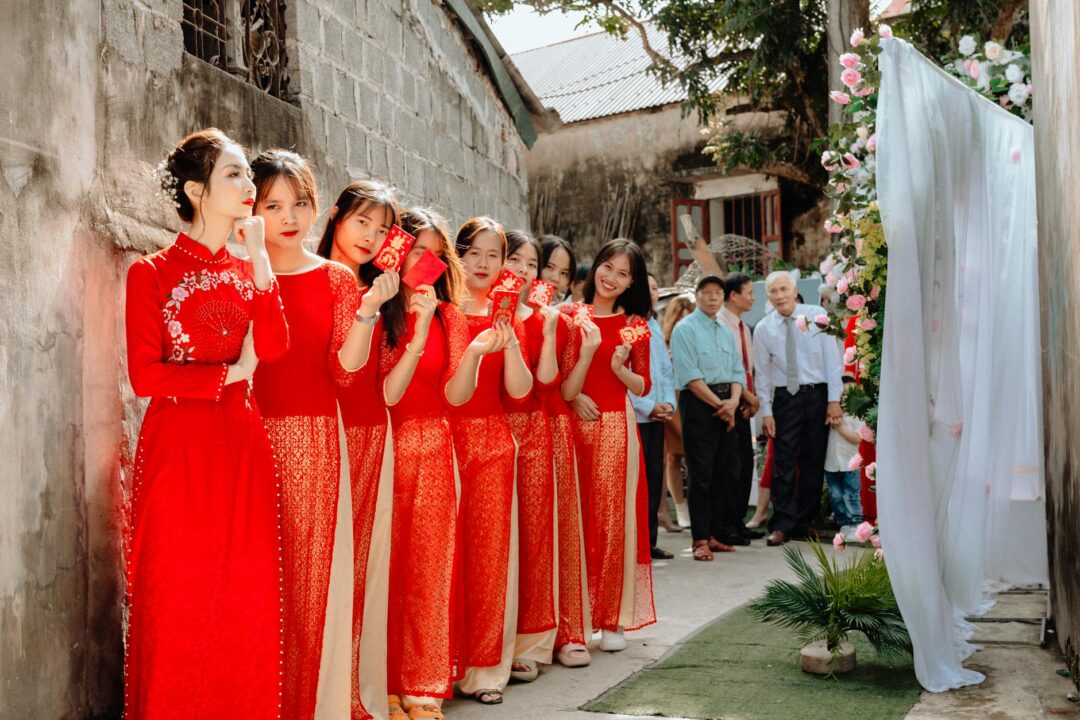
The bride’s bridesmaids guard the door to the bride’s room and refuse to let the groom in until he completes a series of challenges. The underlying idea is that the bride is her family’s most precious person; she should not be given up without the groom proving his worthiness, love, and resourcefulness.
Common challenges
- The four flavors test: The groom must eat or drink four things in sequence: sour (usually lemon juice), sweet (honey), bitter (bitter melon juice or coffee), and spicy (chili sauce). The sequence symbolizes his willingness to endure all of life’s flavors alongside his bride.
- Trivia about the bride: Bridesmaids ask rapid-fire questions about the bride’s preferences, habits, childhood details, and relationship history. Wrong answers earn forfeits.
- Physical challenges: Push-up challenges, singing a love song, reciting a poem or marriage vow, dancing.
- Red envelope negotiations: The groom and groomsmen slide red envelopes with cash under the door to negotiate entry. Bridesmaids may reject insufficient amounts and demand more.
Red envelope amounts for door games in 2026
Amounts are anchored on the lucky number 8 (the Mandarin word for eight, ba, sounds like the word for prosperity, fa) and avoid the unlucky number 4 (which sounds like the word for death). The following amounts represent what Chinese-Australian and Chinese-American couples use in practice:
| Recipient | Per envelope (AUD/USD) | Count |
|---|---|---|
| Lead bridesmaid (sister of bride or maid of honor) | $288 to $688 | 1 |
| Each bridesmaid | $88 to $188 | 1 per bridesmaid |
| Group challenge envelopes (passed through door during games) | $8.80, $18.80, $28.80 | 4 to 8 small envelopes |
| Tea ceremony elder gift (from couple to elder) | Symbolic only; often empty or a small token | The elders are giving, not receiving, so the couple’s envelope is a gesture, not a significant amount |
The lead bridesmaid envelope is intentionally generous, since she typically distributes portions to the rest of the bridal party. Challenge envelopes are kept small in value but plentiful in count; the energy comes from the back-and-forth, not the dollar figure. Avoid round numbers like $100 or $200, which read as flat; the doubled-eight ($88, $188, $288) reads as both generous and culturally fluent.
Modern and regional variations
Cantonese families often run more elaborate multi-stage games with more complex challenges. Northern Chinese families may skip the games entirely and focus on the formal procession. Many Chinese-American families adapt the tradition to a shorter, more lighthearted version suited to a morning timeline: 20-30 minutes of fun rather than a 90-minute ordeal.
The games are meant to be joyful, not punishing. Grooms who show genuine humor, preparation (know your bride’s answers), and generosity (well-stuffed red envelopes) get through quickly and with goodwill.
The bride pickup procession
After the groom successfully completes the games and reaches the bride, he leads her out of her family home. Traditionally, her feet should not touch the ground as she leaves the threshold; she may be carried, or a red carpet or satin cloth is laid. In Cantonese tradition, a red umbrella is held over her head as she exits to ward off bad luck from open skies.
The procession to the wedding venue is accompanied by firecrackers (in regions where permitted), festive music, and in some communities, a lion dance to ward off negative energy and attract good fortune.
Wedding Banquet: Auspicious Dishes, Toasting, and Seating
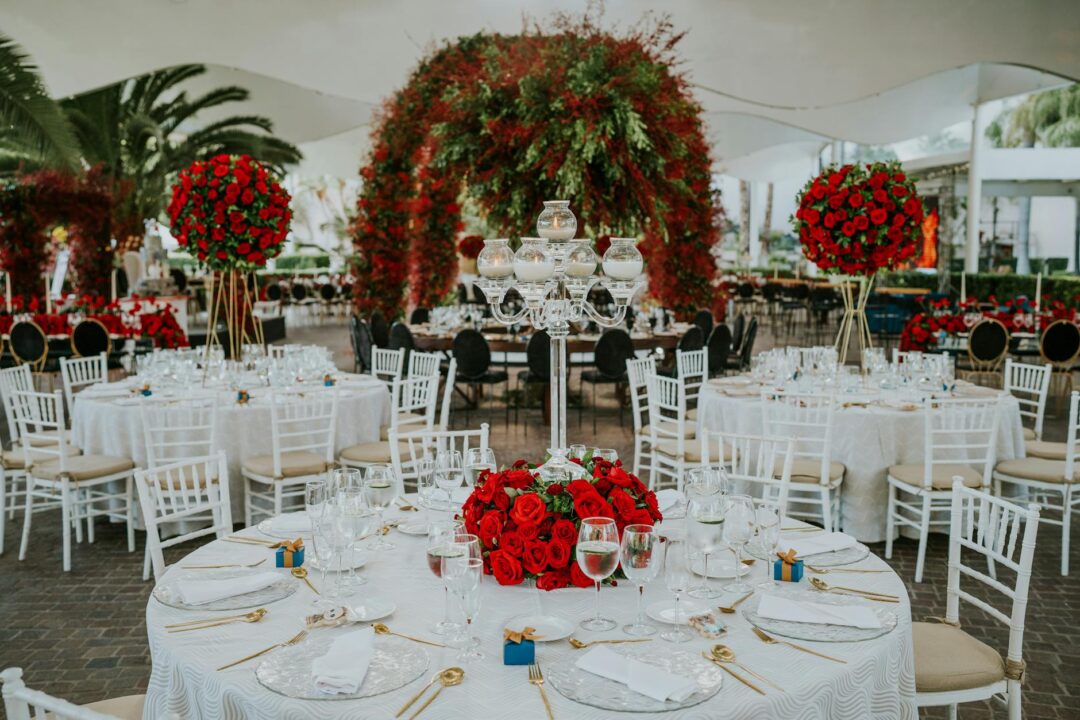
The wedding banquet (婚婷, hun yan) is the central event of a Chinese wedding. It is typically held in the evening, at a Chinese restaurant or hotel ballroom, and can range from intimate family gatherings of 30 to large banquets of 300 or more tables.
The number 8 and banquet structure
Traditional Chinese wedding banquets serve 8 to 9 auspicious courses (not including the Western-style dessert course many modern banquets add): 8 for prosperity (ba sounds like fa, wealth) and 9 for longevity (jiu sounds like long-lasting). Full Cantonese celebrations sometimes extend to 10 savory and sweet courses. Northern Chinese banquets may extend to 12. The number 4 is always avoided; never plan a 4-course or 14-course menu for a Chinese wedding event. Each course arrives at the table served family style, and the sequence carries symbolic weight.
Auspicious dishes and their meanings
| Course | Typical dish | Symbolism |
|---|---|---|
| 1 | Cold platter (roast duck, suckling pig, jellyfish) | Joy, abundance, purity |
| 2 | Shark fin soup or sustainable substitute | Wealth and status; many venues now offer a seafood broth alternative |
| 3 | Lobster or whole prawns | Happiness; the red color signals good fortune after cooking |
| 4 | Roast suckling pig | Purity, fidelity, and family completeness; particularly significant in Cantonese tradition |
| 5 | Whole roasted duck or chicken | Phoenix symbolism; fidelity and good marriage. Whole preparation is important: chopped or partial birds are avoided in Cantonese tradition. |
| 6 | Abalone with sea cucumber | Wealth and good fortune; sea cucumber symbolizes fertility and vitality. A premium dish whose presence on the menu signals the generosity of the host family. |
| 7 | Whole steamed fish | Abundance; fish (魚, yu) sounds like “surplus.” Served intact with some left on the plate to signify ongoing surplus |
| 8 | Longevity noodles or fried rice | Long life; noodles must not be cut or broken, their length symbolizes the length of the marriage |
| 9 | Sweet red bean soup or tong yuan (glutinous rice balls) | Sweetness in marriage and togetherness; the round shape of tong yuan symbolizes completeness and reunion. Lotus seeds (with red dates, peanuts, and longan as classic additions) sound like “successive births” in Cantonese. Often served as the penultimate dessert course before the final sweet. |
| 10 | Wedding cake or sweet pastries | Celebration; the Western-fusion gesture in modern Chinese-American banquets |
A printed wedding menu card in red and gold matching the invitation suite is one of the highest-leverage stationery pieces at a Chinese banquet. Many Western guests will not recognize the dishes; a menu that lists each course in English with the Chinese name and the symbolic meaning underneath turns the meal into cultural storytelling.
Toasting culture at Chinese banquets
The toast sequence at a Chinese wedding banquet differs from Western weddings. Instead of formal speeches at a microphone, the couple and their parents move table to table throughout the evening, toasting each table personally. This is called the yam seng toast (鰼勒, literally “drink to victory” in Cantonese). The host calls “yam seng” three times in increasingly drawn-out cheers as everyone stands; the table responds and drinks together each time.
Guests at tables are expected to toast actively with those around them throughout the meal, not only when the couple visits. Baijiu (Chinese spirit, typically 50%+ alcohol) is traditional; beer and Chinese wine (mijiu, huangjiu) are also common. Non-drinkers may use tea or soft drinks for toasts: it is the gesture of togetherness that matters, not the alcohol.
The couple’s toast circuit
The bride and groom visit every table during the banquet, typically with the couple’s parents. This is physically and socially demanding at a large banquet; some couples change outfits partway through. The toast circuit is when guests have their best opportunity to photograph and speak with the couple, so make it meaningful and brief.
Banquet seating and family hierarchy
Seating at a Chinese wedding banquet is more politically sensitive than at a Western reception. Table 1 is reserved for the most senior members of both families: paternal grandparents, parents, and honored elders. Table 2 is the second tier: maternal grandparents and the couple’s siblings. The bridal party often sits together at table 3 or at a head table near the stage.
Mistakes in seating placement (seating a maternal grandparent at table 3 instead of table 1, or seating divorced parents at the same table without checking) cause real tension. Confirm seating with a parent or trusted family member before printing any materials. Consider printing two seating displays: one in English for younger guests and Western friends, and one in traditional Chinese characters for older relatives. A bilingual seating chart in red and gold signals respect to the senior generation.
Hongbao (Red Envelopes): Etiquette for Giving and Receiving
Hongbao (红包, literally “red packet”) are the standard wedding gift in Chinese culture. While Western weddings increasingly use gift registries, traditional Chinese wedding guests give cash in red envelopes rather than physical gifts. This practice is rooted in practicality (the couple gets what they actually need) and in cultural symbolism (the red envelope itself carries good fortune).
How much to give
The amount should cover your cost as a guest at the banquet; Chinese wedding banquets are expensive to host. For context:
| Relationship to couple | Typical US range | Notes |
|---|---|---|
| Acquaintance or distant relative | $100-$150 | Minimum to cover your plate at a mid-range banquet |
| Friend or colleague | $150-$200 | Per person attending; multiply for couples |
| Close friend or cousin | $200-$300 | Reflects closeness and generosity |
| Immediate family (uncle, aunt, sibling) | $300-$500+ | Some families have established expectations; ask a parent if unsure |
| Parents of the couple | $1,000-$8,888+ | Pin Jin (bride price) or parental gift; highly variable by family |
For a single guest attending a hotel banquet in Sydney, Melbourne, San Francisco, or New York, $168 to $288 AUD or USD is the standard range in 2026. Couples typically give $288 to $588. Close family and business connections give $688 or more.
Auspicious numbers for envelope amounts
Choose amounts ending in auspicious numbers. Eight (8) is the luckiest number in Chinese culture because it sounds like prosperity (发, fa) in Cantonese. Nine (9) represents longevity. Even numbers are preferred. Amounts ending in 4 should be avoided: four (四, si) sounds like death (死, si) in Mandarin. $168, $188, $200, $288, $300, $388, $500, $688, $888 are all common amounts.
Odd numbers and amounts associated with funerals ($4, $40, $400) should be strictly avoided.
When and how to give
Place the envelope in the designated collection box at the reception; most venues have a decorated box or table at the entrance managed by a trusted family member. Do not hand it directly to the couple during the banquet.
Use a red envelope with the couple’s names written on the outside, or a dedicated wedding hongbao with the double happiness symbol. Regular red envelopes (used for Lunar New Year) are acceptable but wedding-specific ones are preferable. Cash in clean new bills is expected.
The couple’s side: special hongbao given during the ceremony
Beyond guest gifts, there are specific red envelopes within the ceremony itself:
- Elders to the couple during tea ceremony: The primary moment when elders give the couple hongbao or jewelry as blessings in exchange for tea.
- Groom to bridesmaids (during chuangmen): Negotiating envelopes to gain entry to the bride’s room.
- Couple to service staff: Tips for the banquet hall staff are often given in red envelopes.
- Couple to children at the banquet: It is traditional for the newlyweds to give small red envelopes to children present at the banquet.
Blending Chinese and Western Wedding Traditions
The Chinese-American wedding is its own evolved form. Not a lesser version of either tradition, but a genuine hybrid that reflects the experience of families navigating two cultures simultaneously. Most couples approach this not as a compromise but as an expansion: doing more, not less.
Common patterns in Chinese-American weddings
The two-ceremony structure
The most common pattern: a Western ceremony with officiant, vows, and ring exchange in the morning or early afternoon, followed by the tea ceremony with family before or at the start of the reception. The Western ceremony handles the emotional public declaration; the tea ceremony handles the family relationship acknowledgment that Chinese culture reserves for that ritual.
Bilingual programs and signage
Ceremony programs, table cards, and escort cards in both English and Chinese (traditional or simplified, depending on the family’s heritage) are increasingly common and deeply appreciated by older family members. This is one area where stationery choices carry real cultural weight.
Managing color expectations across two guest groups
Western guests often arrive in all-white or all-black without knowing the cultural significance. A brief note on the wedding website or in the invitation is both practical and considerate: “We welcome you in celebratory colors: reds, blues, purples, and rich neutrals are all wonderful. We ask that guests avoid all-white and all-black outfits out of respect for Chinese tradition.”
Reception elements that bridge both cultures
- Western-style first dance and parent dances alongside table toasting rounds
- Western wedding cake alongside Chinese dessert table (egg tarts, sesame balls, mooncakes if seasonal)
- Western DJ or band set alongside lion dance during cocktail hour
- Gift registry offered alongside red envelope collection (with clear signage explaining both options)
- Wedding favors that reflect both cultures: custom red envelopes with a small amount inside, or Chinese tea packets as favors
Stationery as the first cultural signal
Your invitations are the first touchpoint where you communicate the cultural register of your wedding. Chinese-Western couples increasingly use stationery that incorporates red and gold alongside the invitation wording, double happiness symbols, or Chinese calligraphy for names and dates. Flat foil in gold on cream or red stock captures the traditional pairing authentically. The envelope liner and any inserts are opportunities to layer in bilingual elements without overwhelming the main card.
If you are navigating this design balance, a browse through our wedding invitation collection is a good starting point; you can filter by color and style to find designs that feel right for your specific blend of traditions.
Planning resources for multicultural weddings
If you are exploring traditions from other cultures alongside your own, our related guides may help: Indian wedding traditions and Jewish wedding traditions cover similar ground on ceremony structure, attire, and blending heritage with modern life. For the broader planning arc, the wedding planning checklist and wedding ceremony script guide both have sections on customizing structure for non-Western ceremonies. For theme inspiration that aligns with Chinese aesthetic preferences, wedding themes 2026 has a rich section on maximalist and heritage-inspired directions.
Ready to Begin?
Find stationery that honors both worlds
Paperlust’s wedding invitation collection includes designs that pair beautifully with red, gold, and traditional Chinese motifs. Available in flat foil, letterpress, and digital print.
Frequently Asked Questions
What is the most important Chinese wedding tradition?
The tea ceremony is widely considered the most important. It is the moment when the couple is formally introduced to one another’s families and the marriage is recognized within the family hierarchy. Even couples who skip every other tradition usually keep the tea ceremony.
Do you have to follow all Chinese wedding traditions?
No. Chinese wedding traditions exist on a spectrum, and most modern couples (especially Chinese-American couples) select the rituals that are meaningful to their families and skip those that do not resonate. The tea ceremony is the most universally retained element because it directly serves the family relationship purpose. Door games are popular because they are fun. The six etiquettes are rarely followed in full but often honored in spirit. Follow what feels genuine, consult your parents about which elements matter most to them, and build from there.
How much money should I put in a red envelope as a wedding guest in 2026?
For a single guest attending a hotel banquet in Sydney, Melbourne, San Francisco, or New York, $168 to $288 AUD or USD is the standard range in 2026. Couples typically give $288 to $588. Close family and business connections give $688 or more. Use even amounts that include the number 8, and avoid the number 4. Cash in clean new bills is preferred.
Is it rude to wear red to a Chinese wedding as a non-Chinese guest?
In a traditional Chinese setting, wearing red as a guest risks appearing to compete with the bride, whose primary color is red. For a modern Chinese-American wedding, the rule softens considerably, particularly if the bride is wearing white. When in doubt, opt for another celebratory color and reserve red for settings where you know the bride has worn another color.
Do I need to wear traditional Chinese dress to a Chinese wedding?
No. Western-style dresses and suits are appropriate for guests. Avoid white and black as primary colors and choose red, pink, gold, or warm jewel tones instead. The bride and groom and their immediate family will wear traditional dress for the tea ceremony; guests are not expected to match.
Can a Chinese wedding invitation be printed in English only?
Yes, but a bilingual invitation in English and Chinese is the more thoughtful choice if the couple has older relatives who read primarily in Chinese characters. The Chinese version is usually printed on the reverse side or as a second card in the suite. Traditional Chinese characters (used in Hong Kong, Taiwan, and among older mainland families) versus simplified Chinese (mainland China) is a detail worth confirming with family before going to print.
Do Chinese weddings have bridesmaids and groomsmen?
Yes. Modern Chinese weddings in Australia and the US almost always have a bridal party. The bridesmaids play a particularly active role on the day, leading the door games and collecting red envelopes from the groom and his groomsmen. The bridal party typically does not wear matching dresses in the Western sense; coordinated colors or individual dresses in the same palette are more common.
What is the double happiness symbol (囍) and is it okay for non-Chinese guests to give gifts with it?
The double happiness character (囍) is a combination of two joy characters (喜) placed side by side. It is a universally recognized Chinese wedding symbol and is entirely appropriate for any guest, Chinese or non-Chinese, to include on a card or gift. It is a celebratory symbol, not a culturally restricted one.
What should I put in a red envelope for a Chinese wedding?
Cash in an amount that at minimum covers your cost as a banquet guest, plus a margin based on your relationship to the couple. For a mid-range banquet in a US city, $150-$200 per person attending is a reasonable baseline. Use an amount with auspicious significance: multiples of 8 (like $168, $188, $288, $888) are ideal. Avoid amounts containing the number 4.
Can the tea ceremony be performed outside of a Chinese home?
Yes. Many Chinese-American couples hold the tea ceremony in a private room at the reception venue, a hotel suite, or even in a dedicated space at the ceremony venue. The tea ceremony does not require a specific setting; it requires the people (elders), the tea, and the couple. The setting matters far less than the gesture.
What is the difference between a qipao and a cheongsam?
The terms are often used interchangeably in English. Technically, qipao is the Mandarin term and cheongsam is the Cantonese pronunciation of the same garment (literally “long shirt” in Cantonese). Both refer to the fitted, mandarin-collar dress that originated in 1920s Shanghai. For weddings, the garment is almost always red with gold embroidery. Either term is acceptable in conversation.
Is a lion dance at a wedding required?
A lion dance is traditional at Chinese banquets to bring good luck and ward off negative energy, but it is an addition, not a requirement. Many couples include a lion dance during cocktail hour or at the start of the reception. It is a spectacular visual element for guests unfamiliar with the tradition and a meaningful one for family members who grew up with it. Cost typically ranges from $300-$800 for a professional troupe, depending on the location and length of the performance.
What happens if a guest cannot attend a Chinese wedding they were invited to?
Send a red envelope with an appropriate cash amount to the couple even if you cannot attend; the invitation was extended and the banquet was planned around your attendance. A written note of congratulations alongside the envelope is appropriate. In many Chinese families, sending nothing when invited (even if you decline) is considered inconsiderate.