
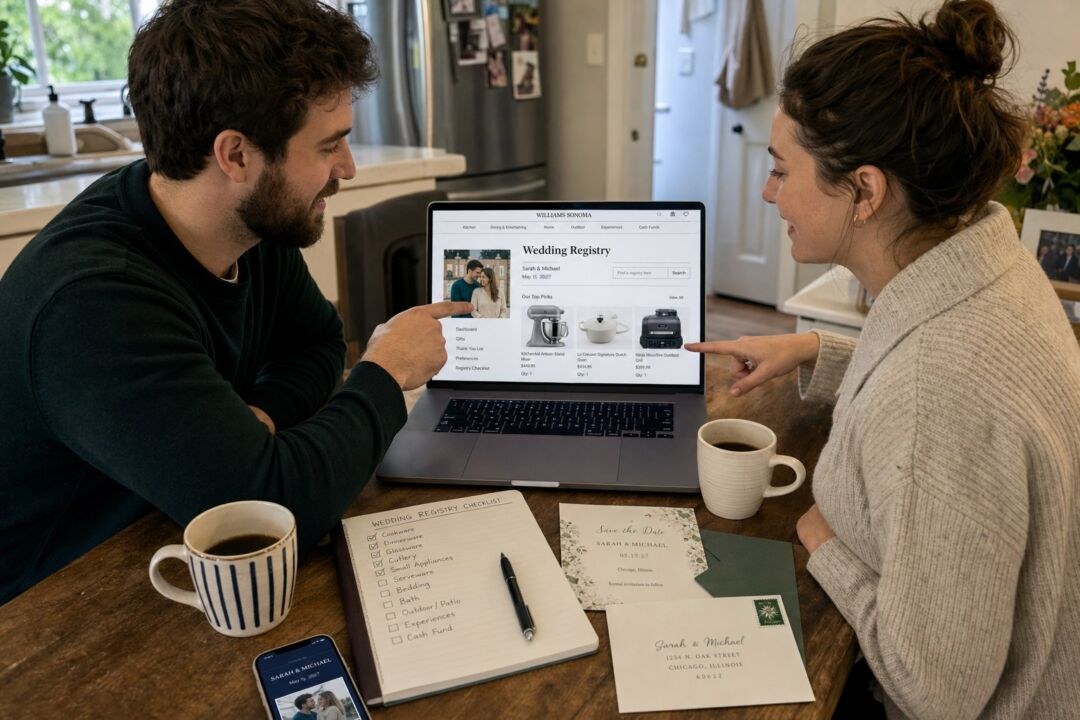
We don’t sell registries. We sell wedding stationery, so we have no commercial interest in which platform you choose or what you put on it. That turns out to be an advantage when the most useful registry questions are the ones that feel awkward to ask: how many items is too many, why does half your list go unbought, and what are you actually supposed to tell guests about where to send gifts?
This guide answers those questions with specific numbers rather than vague encouragement.
Registry at a glance
| Decision | Short answer |
|---|---|
| When to open | 4-6 months before the wedding; before shower invitations go out |
| How many items | Roughly 2 per invited guest; keep restocking as items sell |
| Price mix | 40% under $50, 30% $50-$100, 20% $100-$200, 10% over $200 |
| Shipping address | Your current address; update it in your registry account if you move |
| What goes unbought | Formal china, ultra-specific gadgets, high-ticket items without group-gift labels |
| Where to share | Your wedding website and shower invitations, not the wedding invitation itself |
Guests who never open your website still need the registry details in the envelope.
When Should You Open a Registry?
Four to six months before the wedding is the practical window. The main reason for this timing is the bridal shower: shower invitations go out 6-8 weeks before the shower itself, and guests expect a registry link in them. If you do not have one ready, they call your mother.
If you are not having a shower, 4 months out still works as a starting point. Opening it at engagement is fine and gives family a useful answer when they immediately ask “where are you registered?” after hearing the news. The downside to opening very early is that you spend more months updating the list as things sell down.
How Many Items Do You Actually Need?
The working formula: roughly two items per invited guest.
- 75 guests: start with about 150 items
- 125 guests: start with about 250 items
- 175 guests: start with about 350 items
This sounds like a lot until you consider the timeline. An engagement party in October, a bridal shower in March, and a June wedding means guests are looking at your registry across 8 months. Popular items sell early. If your list thins out, later guests find little choice and default to cash or gift cards, which is fine, but only if that is what you wanted.
Keep restocking. When a $45 item sells, add a different $45 item. The goal is a fresh, stocked list at every point in the engagement, not a fixed list you set once and forget.
How to Spread Price Points
“Include a range of price points” is advice that sounds useful and isn’t. Here is a more specific breakdown:
| Price range | Share of registry | Example: 200-item list |
|---|---|---|
| Under $50 | 40% | 80 items |
| $50-$100 | 30% | 60 items |
| $100-$200 | 20% | 40 items |
| Over $200 | 10% | 20 items |
The under-$50 tier gets the most traffic. Guests shopping for a shower gift or a small contribution often start here. Keep it stocked with real items you want, not filler.
Any item over $200 needs one of two things: either it is a popular, gift-friendly product that people actually buy solo (a KitchenAid stand mixer at $400 regularly gets purchased; a $400 abstract wall print rarely does), or it is set up as a group gift with a contribution option. Without a group-gift label, most single items over $300 go unbought.

What to Actually Put on It
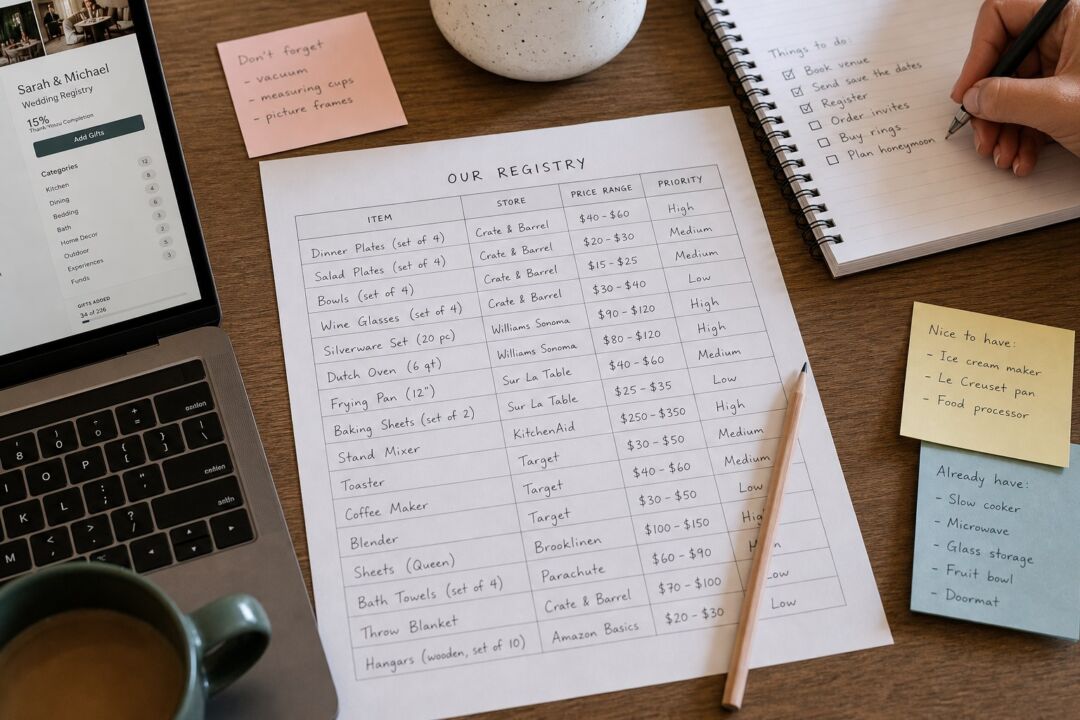
Start by walking your home room by room and noting what you already own and love versus what needs replacing. Then build from that reality, not from a template.
Kitchen and cooking: Cookware set (4-8 pieces), a knife set with a wood cutting board, baking sheets, a cast-iron skillet or Dutch oven, food storage containers, and the small appliances you actually use. Be honest. If you order takeout four nights a week, a pasta maker is aspirational. A blender, an air fryer, and quality pans are not.
Bed and bath: Three sheet sets per bed (one on, one in the wash, one spare) is a functional standard, not generous padding. Towels: 6 bath towels, 6 hand towels, and 6 washcloths per bathroom gives you a rotation. These categories get purchased readily and wear out faster than most people expect.
The items that get forgotten: Trash cans for every room, a vacuum, a mop, hampers, and cleaning organizers. Guests buy these. A $40 trash can from your registry is a gift someone uses every day for a decade.
Cash funds and group gifts: These belong on a modern registry and are not a cop-out. A honeymoon fund or a home renovation contribution is a legitimate gift. Set up high-ticket items (luggage, a premium vacuum, a coffee machine over $300) as group gifts so guests can contribute $50 toward them without buying the whole thing.
If your invitation suite includes an information card, that is the natural place to point guests toward your registry website. A well-designed information card handles registry, accommodation, and RSVP details together in a format guests expect to find in the envelope. It keeps the main invitation clean while giving guests the practical logistics they need.
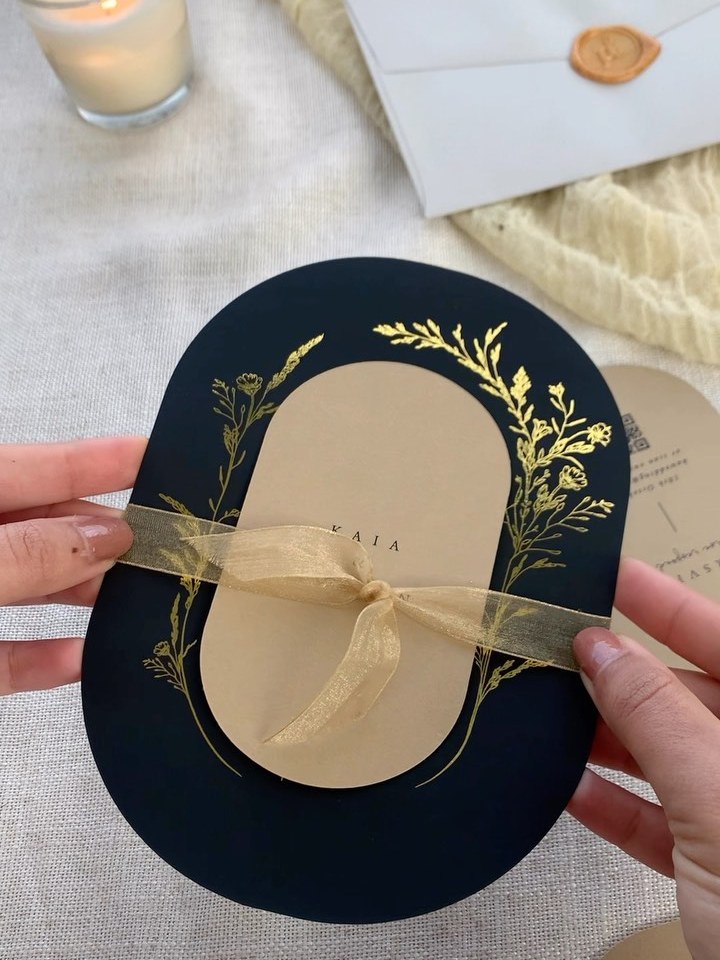
A wishing well card gives the guests who skip the registry somewhere to go.
What Almost Always Goes Unbought
Formal china. Many couples register for it because it seems like something a registry should have. Guests see a 12-piece formal dinner service and skip it, even when they would have contributed $75 toward it as a group gift. If you genuinely entertain formally, add it as a group gift and set a contribution option. If you don’t, remove it.
Ultra-specific gadgets. A pasta roller attachment for a stand mixer you do not own yet, a fondue pot, a waffle maker for people who have never made waffles. These items stay on the list until the couple uses their post-wedding completion discount to buy them for themselves, then they sit in a cabinet. Ask yourself: did we use something like this in the past year? Not: do we want to be people who use this?
High-ticket items without group-gift labels. A $450 piece of luggage listed as a standard item almost never gets purchased. The same item, labeled as a group gift, regularly does. If your registry platform supports group gifting, use it for anything over $200.
Duplicates. Two versions of a knife set in the same price range, multiple blenders. Guests interpret this as uncertainty and choose something else. Decide which one you want and remove the other.
The Shipping Address Question
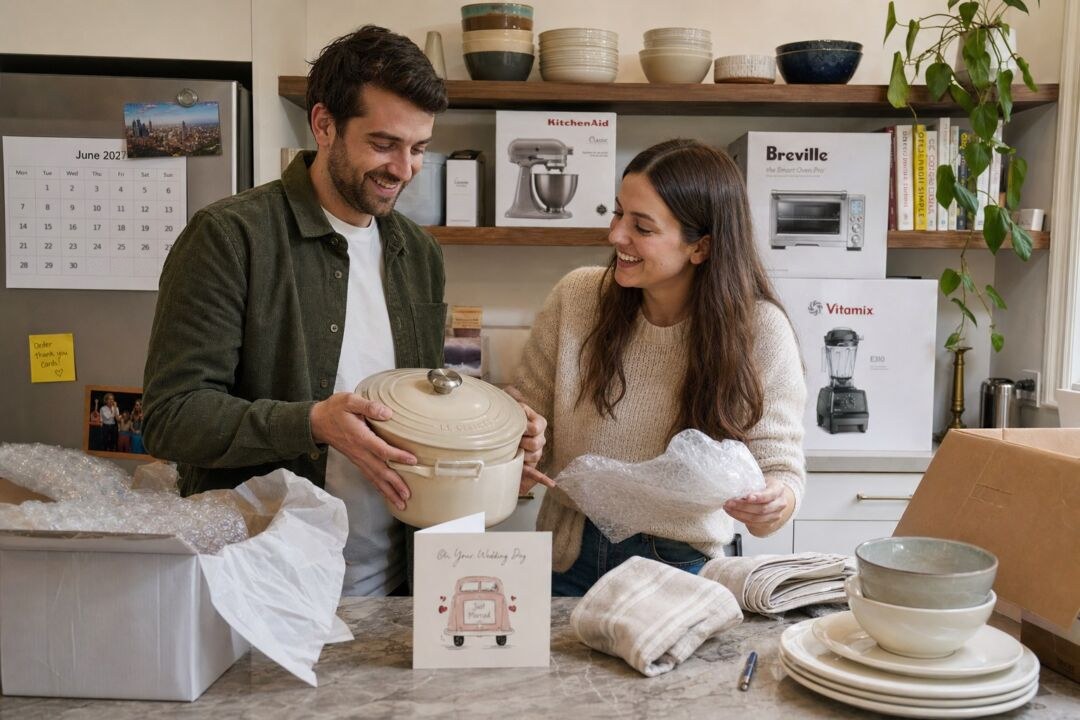
Use your current address: the one where you reliably receive packages today.
Most registry platforms store one shipping address that gets applied at checkout automatically. Guests type nothing; they click purchase and the item ships to where you told the platform to send it. Update the address inside your registry account if you move. Guests do not need to be notified, and most platforms allow mid-order rerouting if you contact the retailer quickly.
On your wedding website, you do not need to publish your street address. “Gifts can be shipped directly through our registry” is clear and sufficient. For the small number of guests who prefer bringing a physical gift to the wedding, a card or envelope at the reception table handles that gracefully.
Do not list a future address you plan to move into. Packages arrive across an 8-month span and timelines shift.
When and Where to Share Your Registry
Your wedding website is the right primary home. It is where guests look, and it is where they can click directly to your registry.
Bridal shower invitations include registry information as a firm expectation. Guests receiving a shower invitation without registry access have to make phone calls, which creates work for your family and uncertainty for guests.
Wedding invitations do not include registry information. This is a long-standing rule with a practical basis: an invitation is an invitation, not a gift solicitation. The information card in your invitation suite handles the logistics, including your registry link, so the main invitation stays uncluttered. If contributions are part of the plan, wishing well cards handle that request directly rather than leaving guests to interpret a registry page.
Tell your immediate family where you are registered and share a direct link. They will field a large share of questions and should have the answer ready.
Information and wishing well cards personalized online. The $5 sample pack puts seven designs and an envelope in your hands, including real foil and letterpress, so you judge paper and finish off a screen.
Frequently Asked Questions
How many items should be on a wedding registry?
A working formula: two items per invited guest, kept restocked as items sell. For a 100-person wedding, start with around 200 items. This gives guests real choice at every stage of the engagement, from the early announcement through the final weeks before the wedding. Popular items sell fast; when they do, add new ones at the same price range rather than letting the list thin out.
When should I start a wedding registry?
Open it before your bridal shower invitations go out, which typically means 4-6 months before the wedding. If you are not having a shower, 4 months before the wedding is a reasonable floor. Opening it at engagement is fine; family will ask within days of the announcement, and having an answer ready saves everyone a follow-up conversation.
What price range should most registry items be?
Aim for 40% of items under $50, 30% between $50 and $100, 20% between $100 and $200, and 10% above $200. The under-$50 tier gets the most purchases, so keep it stocked. Any item over $200 should either be a genuinely popular product or set up as a group gift so guests can contribute partial amounts.
What items usually go unbought on a wedding registry?
Formal china sets, specialized gadgets like pasta makers and fondue pots, and single items over $300 that are not set up as group gifts. These items stay on registries until the couple uses their post-wedding completion discount. If you want to include them, label them as group gifts and set a contribution minimum so guests can participate without buying the whole thing at once.
Do I need to publish my home address for registry shipping?
No. Registry platforms handle the shipping address at checkout automatically. Store your current, stable address inside your registry account and update it there if you move. On your wedding website, “gifts can be shipped directly through our registry” is sufficient. You do not need to make your address public.
Can I include a honeymoon fund or cash contributions on my registry?
Yes. Honeymoon funds, home renovation contributions, and down payment funds are standard practice in the US. Some guests prefer a physical gift; keep enough physical items on the list to give them that option. Others will appreciate the flexibility of contributing to an experience or a future goal. Offer both and let guests choose.