
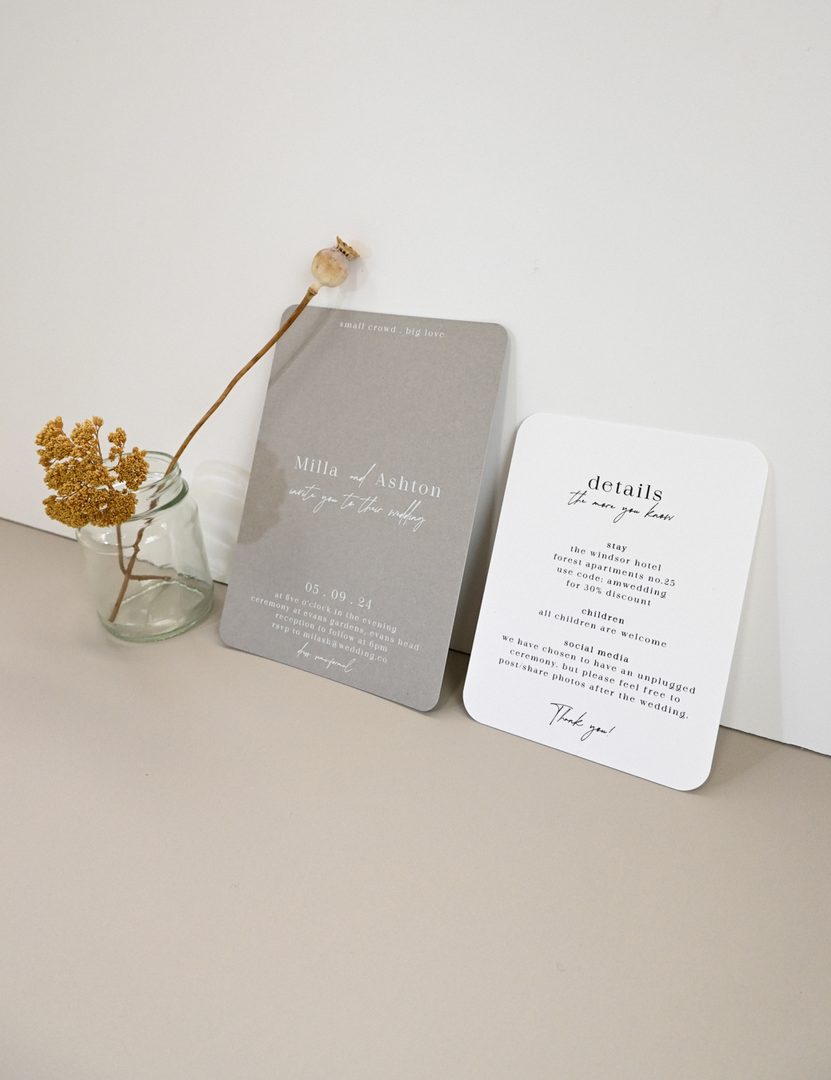
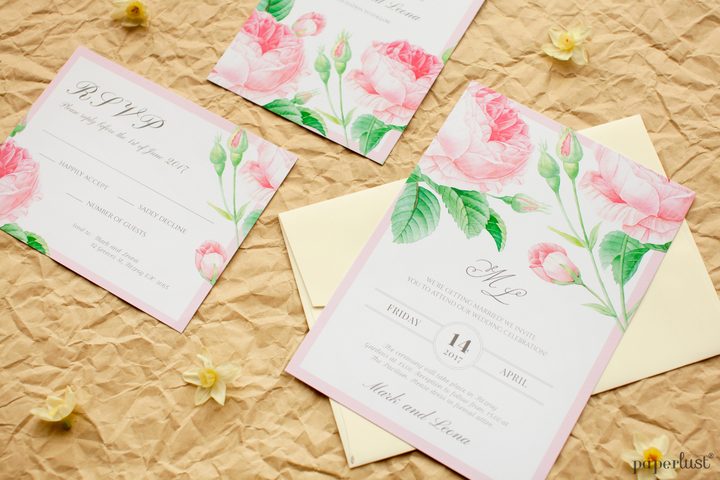

Shopping for wedding stationery? Browse Paperlust by region:
Opening a wedding envelope should feel like a gift, not a puzzle. But without knowing which insert cards to include, and what to say on each one, couples often either overstuff the envelope with cards their guests won’t read, or under-prepare and leave guests scrambling for parking details two days before the wedding. This guide walks you through every type of wedding invitation insert card, shows you how to word each one, and helps you decide which ones your suite actually needs. If you want the full picture on building your stationery suite from scratch, this wedding stationery suite guide covers every piece from invitation to day-of signage.
- The only truly essential inserts are the RSVP card and a details/information card, everything else is optional based on your guest needs.
- A details card (also called an information card or enclosure card) handles venue directions, parking, accommodation, and website links in one place.
- A QR code or website card can replace the details card if your wedding website covers all logistics information.
- Dress code, accommodation, and registry cards only need to be included if that information isn’t already on your details card or website.
- The stuffing order matters: main invitation on the bottom, then inserts largest to smallest, RSVP card and envelope on top.
- All-in-one invitations combine invitation, info, and perforated RSVP in one card, eliminating multiple loose inserts entirely.
What Are Wedding Invitation Insert Cards? (and Which Are Truly Necessary)
Wedding invitation insert cards, sometimes called enclosure cards, are the smaller supplementary cards that travel inside the main invitation envelope. Each one serves a specific function: confirming attendance, sharing logistics, pointing guests toward your wedding website, or communicating dress code. The challenge is that etiquette has evolved considerably, and most couples today are working with a mix of printed cards and a digital wedding website.
Here is the honest breakdown of which cards earn their spot in the envelope:
| Insert Card | Must-Have or Optional | When to Include |
|---|---|---|
| RSVP card + return envelope | Must-have (if no online RSVP only) | Always, unless your website RSVP is the sole method and all guests are comfortable using it |
| Details / information card | Must-have for most couples | Venue is hard to find, parking is limited, accommodation blocks are reserved, or you have multi-day events |
| Wedding website / QR code card | Optional (strong replacement for details card) | Your website covers all logistics and most guests will use it; include for older guests who may not |
| Dress code card | Optional | Dress code is non-standard or guests may be confused (e.g., “tropical formal,” “cocktail garden party”) |
| Accommodation card | Optional | You have a hotel room block or many guests are traveling from out of town |
| Registry card | Use with caution | Most etiquette guides suggest keeping registry info on your website, not in the envelope. A brief mention (“Registry information at [website]”) on the details card is more appropriate. |
| Rehearsal dinner / events insert | For invited guests only | Only in envelopes addressed to those specific guests. Do not include in all suites. |
The cleaner your insert count, the better the guest experience. Most couples get the best result with two inserts: an RSVP card and a details card. Everything else goes on the wedding website.
RSVP Card Wording and Format Guide
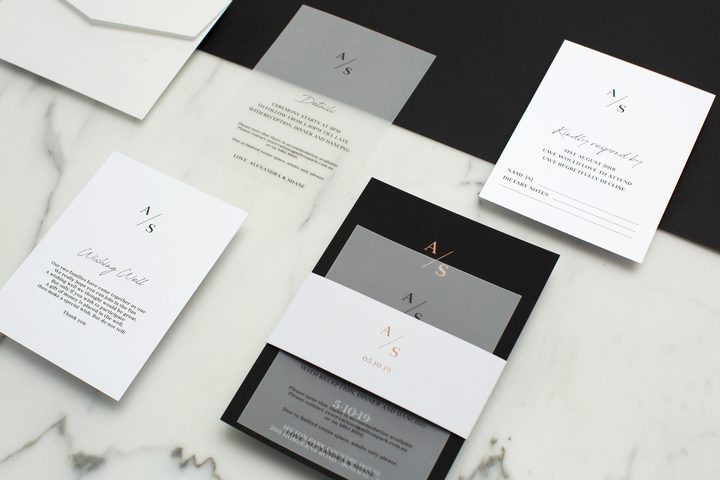
The RSVP card is the one insert nearly every couple needs in printed form. Even if you have an online RSVP on your wedding website, many guests, particularly older relatives, will expect a physical card. For a deep dive into RSVP card etiquette, deadline timing, and handling non-responses, see our complete wedding RSVP guide. Here, we cover the wording fundamentals.
The core RSVP card elements
- A response deadline (usually 3-4 weeks before the wedding)
- An accepts / declines field
- Name line(s), so you know who is responding
- Meal choice, if applicable
- Song request, dietary note, or other optional fields
Standard RSVP wording examples
M ___________________________
__ Accepts with pleasure
__ Declines with regrets
Meal choice: __ Chicken __ Fish __ Vegetarian
Name(s): _________________________
___ Will attend ___ Cannot attend
Dietary requirements: ________________
Modern RSVP wording (online + printed hybrid)
If your primary RSVP method is online but you want to include a physical card for guests less comfortable with technology, keep the card brief:
RSVP at [yourweddingwebsite.com] or return this card
M ___________________________
__ Joyfully accepts __ Regretfully declines
RSVP formatting tips
- Print “M” at the start of the name line as a classic convention (guests fill in “Mr.”, “Ms.”, or their first name)
- Pre-stamp the return envelope, guests are more likely to return the card promptly
- Set your RSVP deadline at least 3 weeks before the wedding date to give your caterer time to finalize headcount
- Standard RSVP card size matches a 4-bar or A2 envelope for easy mailing
Details Card: Directions, Accommodation, and Parking Wording
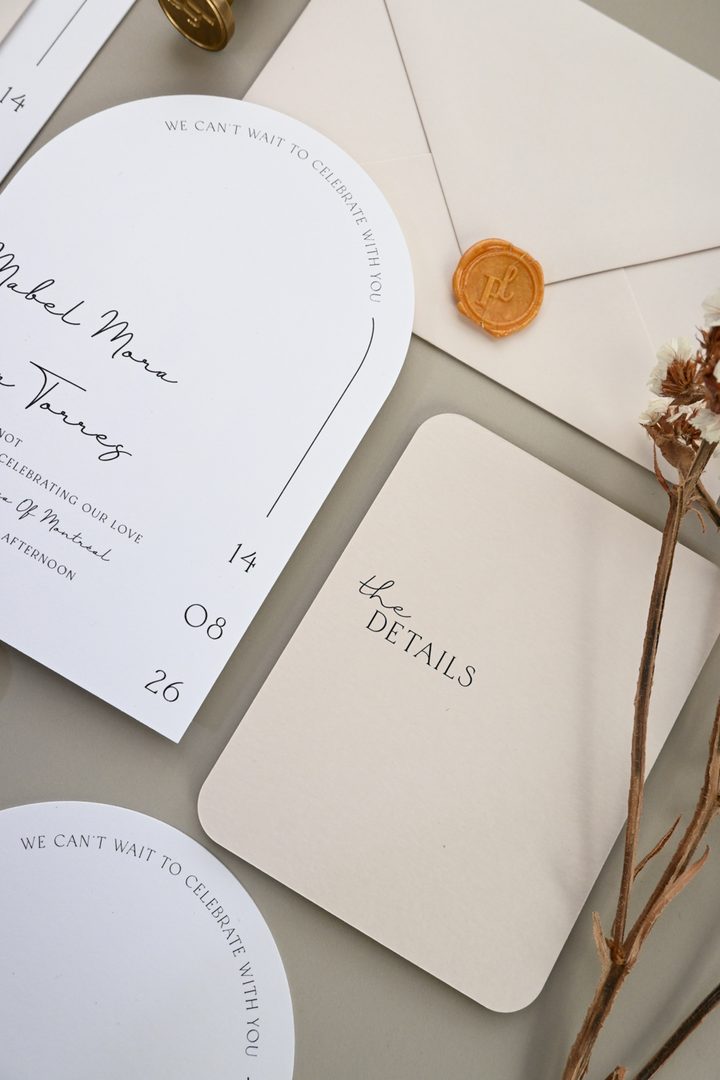
The details card, also called an information card or enclosure card, is the workhorse of the invitation suite. It handles every logistical question so that information doesn’t clutter the main invitation. Paperlust’s wedding information cards are designed to complement your invitation suite and can be ordered to match your chosen design exactly.
What to put on a details card
- Ceremony venue details: full address, parking instructions, accessibility notes
- Reception venue details: full address if different from ceremony, distance/travel time, parking
- Accommodation block: hotel name, room block booking code, and deadline for the group rate
- Transportation: shuttle times, recommended rideshare drop-off points
- Wedding website: URL for full event information and online RSVP
Details card wording examples
[Venue Name]
[Street Address, City, State, ZIP]
Parking available at [lot/street]
Reception
[Venue Name]
[Street Address, City, State, ZIP]
Accommodation
A room block has been reserved at [Hotel Name].
Book by [Date] using code [CODE] at [hotel website or phone].
More details at [yourweddingwebsite.com]
[Venue Name] · [Address]
Valet parking available. Street parking on [Street Name].
Stay With Us
We have reserved a block of rooms at the [Hotel Name], [City].
Book at [hotelsite.com] with the code [WEDDINGCODE] by [Date].
Shuttle service departs [Pickup Location] at [Time].
Keep the details card concise. If the information starts running longer than two sides of a standard 4.25″ x 5.5″ (108 x 140mm) card, move overflow details to your wedding website and use a website card or QR code insert instead.
Wedding Website and QR Code Cards: How to Word Them
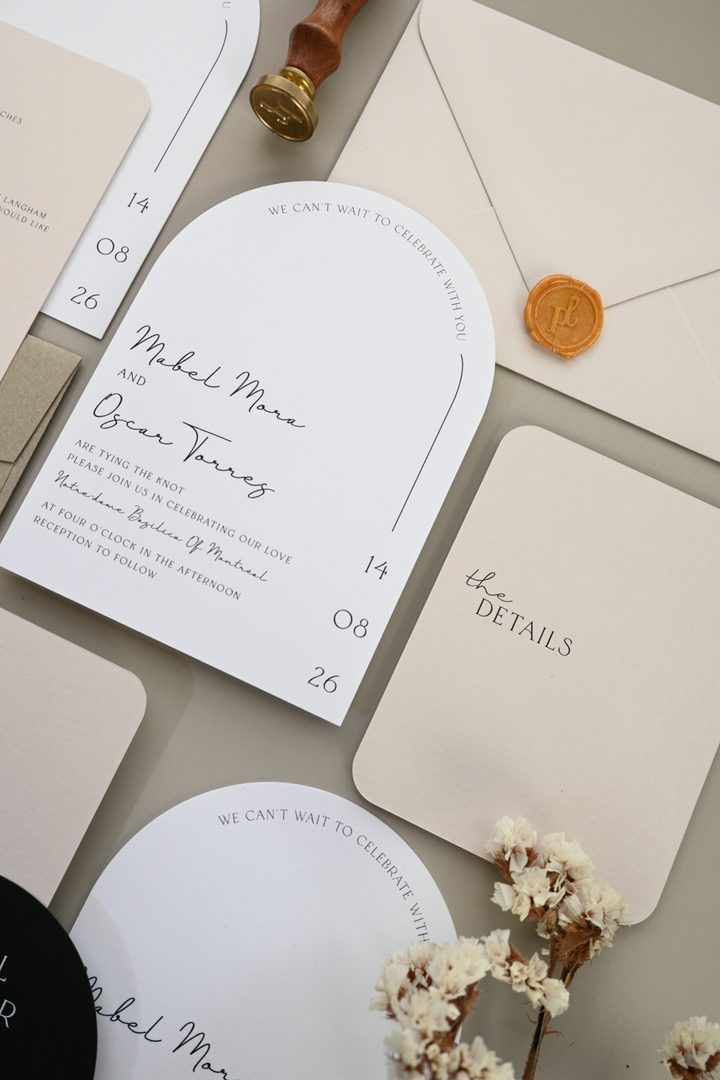
A dedicated wedding website card is one of the most practical inserts for modern couples. It directs guests to a single source of truth for all event information, online RSVP, accommodation links, registry, and real-time updates. A QR code printed on the card makes it even easier for guests to navigate straight to your site.
Website card wording examples
[yourweddingwebsite.com]
RSVP, accommodation, registry, and more.
Scan or visit [yourweddingwebsite.com]
for venue maps, accommodation links, and RSVP.
QR code card tips
- Always include the URL in addition to the QR code, some guests will prefer to type it manually
- Test your QR code on multiple devices before printing
- Size the QR code to at least 1″ x 1″ (25mm x 25mm) for reliable scanning
- Use a URL shortener or custom domain to keep the link clean and memorable
Can a website card replace the details card?
Yes, for most couples it can. If your website covers all venue information, accommodation, and directions, a single website card with a QR code is a clean, modern alternative to a full details card. The exception: always include printed directions for guests who are not comfortable with technology, even if it’s just a brief note on the back of the RSVP card.
Dress Code, Accommodation, and Registry Insert Card Wording
Dress code card wording
A separate dress code card is only necessary when the dress code is non-standard or likely to confuse guests. If your invitation already includes a dress code line (“Black tie optional” or “Cocktail attire”), a separate card is redundant. Use a dedicated card for vibe-based dress codes or themed weddings where guests need more guidance.
Think flowy dresses, linen suits, floral prints.
Please avoid heavy blacks and dark navy.
Bright colors and bold prints encouraged.
Heels at your discretion, the ceremony is held on grass.
Accommodation card wording
If you have a hotel room block, an accommodation card saves guests from having to hunt for booking details. Keep it to one card with the hotel name, code, and booking deadline.
A block of rooms has been reserved at
[Hotel Name] · [City, State]
Book by [Date] using group code [CODE]
at [hotel website] or call [phone number].
Rate: $[XXX]/night. Limited rooms available.
Registry card wording
Most etiquette advisors recommend keeping registry details off the printed invitation suite entirely, since it can read as expecting a gift. The better approach: mention the registry on your details card or website card (“Registry and gift information at [yourweddingwebsite.com]”) and let guests find it naturally. If you do include a registry card, keep the wording understated:
For those who wish to give, our registry can be found at
[yourweddingwebsite.com/registry]
How to Stuff a Wedding Invitation Envelope (Order and Etiquette)
The order in which you insert cards into the envelope has a traditional logic behind it: the main invitation sits at the back (against the envelope), and each successive insert is placed face-up on top, with the smallest items closest to the flap. Here is the standard order from bottom to top:
Standard stuffing order
- Main invitation (largest card, face-up, against the back of the envelope)
- Details card / information card (if included, face-up on top of invitation)
- Dress code, accommodation, or website cards (in order from largest to smallest)
- RSVP envelope (tucked flap-side up so guests can easily remove it)
- RSVP card (face-up, inside or on top of the RSVP envelope)
Inner and outer envelope etiquette
Formal invitations traditionally use an inner and outer envelope. The outer envelope carries the mailing address; the inner envelope lists the names of the specific guests invited (and signals whether children or plus-ones are included). If you are using the traditional two-envelope setup, the stuffed inner envelope slides into the outer envelope with the guests’ names facing the flap.
Practical stuffing tips
- Turn all cards so they face the same direction before inserting, guests should be able to remove the stack and read everything without flipping cards
- For letterpress or flat foil printing, handle cards with clean dry hands to avoid fingerprints on the metallic or debossed surfaces
- Pre-stamp RSVP return envelopes before assembling, it is much harder to add stamps once the suite is stuffed
- Do a single test assembly before sitting down to do all envelopes; confirm everything fits comfortably without bulging
How Many Insert Cards Is Too Many?
There is no hard rule, but most envelope etiquette points toward a simple test: if a guest has to unfold or shuffle more than three pieces of paper to find what they need, the suite is overcrowded. The sweet spot is typically the main invitation, one insert card (details or website), and the RSVP card with its return envelope.
When multiple inserts make sense
- Destination weddings with multiple events across several days
- Weddings where a significant proportion of guests are traveling from out of town
- Non-standard venues where directions really do need their own card
- Events with strict or unusual dress codes requiring a full explanation
The all-in-one alternative
If you want to reduce insert count entirely, Paperlust’s all-in-one tri-fold wedding invitation combines the main invitation, information panel, and a perforated tear-off RSVP card into a single piece. It can be mailed without an envelope (seal-and-send style), which simplifies assembly significantly. For couples who want a cohesive suite without multiple loose insert cards, it is worth considering before committing to individual pieces.
What you can cut
| Insert | Cut if… |
|---|---|
| Separate accommodation card | Hotel block info fits on your details card |
| Separate website card | URL is already printed on the details card |
| Separate dress code card | Dress code line fits on main invitation |
| Rehearsal dinner insert | You are sending separate rehearsal dinner invitations (recommended for formal events) |
| Registry card | Registry is listed on your wedding website (almost always the better option) |
When in doubt, consolidate. A single well-designed details card that covers venue, accommodation, and website is cleaner and more impressive than a stack of five thin cards, and it photographs better when guests share their invitation unboxing online.
Ready to build your complete suite? Browse Paperlust wedding invitations and information cards to find designs that work together as a cohesive set. Every Paperlust order comes with a dedicated designer and a proof delivered within 1-2 business days so you can see exactly how your suite looks before it goes to print.
Frequently Asked Questions
Do you need an RSVP card if you have a wedding website?
It depends on your guest list. If all of your guests are comfortable using online forms, a website RSVP alone works well. However, for mixed age groups or formal weddings, including a physical RSVP card ensures that every guest has a convenient way to respond regardless of their comfort with technology. Many couples include both, a website RSVP as the primary method with a physical card as a backup.
What order do you put inserts in the envelope?
The traditional order from bottom to top: main invitation face-up at the back, then inserts from largest to smallest (details card, then any smaller cards), and the RSVP envelope with the RSVP card on top, closest to the envelope flap. All cards should face the same direction so guests can remove and read the stack without having to flip anything.
What is the difference between a details card and an information card?
They are the same thing. The terms are used interchangeably. An information card (sometimes called a details card, enclosure card, or directions card) is the insert that carries venue addresses, parking instructions, accommodation details, and your wedding website URL. It supplements the main invitation with practical logistics.
How big should insert cards be?
Most insert cards are sized to fit inside the main invitation envelope without folding. Common sizes are 4″ x 6″ (102 x 152mm) or 4.25″ x 5.5″ (108 x 140mm). RSVP cards are typically smaller, around 3.5″ x 5″ (89 x 127mm), so they can fit into their own A2 or 4-bar return envelope. Paperlust information cards can be ordered to match your invitation design at a coordinating size.
Should you include the dress code on the main invitation or a separate card?
For standard dress codes (black tie, cocktail attire, smart casual), a single line at the bottom of the main invitation is sufficient. A separate dress code card is only worth including when your dress code is vibe-based, theme-specific, or has unusual requirements, such as garden party formal, tropical cocktail, or all-white, where guests need more detail to feel confident.
Can you include registry information in the invitation suite?
Technically yes, but most etiquette advisors recommend against it, since it can feel like the invitation is focused on gifts. The cleaner approach is to mention your registry on your wedding website and either include the website URL on your details card or send a separate card pointing guests there. If you do want to include registry information, keep the wording gracious and understated, something like “Your presence is the greatest gift; registry information available at [website].”
How far in advance should insert cards be ordered?
Order your full invitation suite, including all inserts, at the same time. Digital print invitations typically take around 8-10 business days for production after your designer proof is approved, while specialty methods like flat foil take approximately 12-15 business days. Most couples send their wedding invitations 6-8 weeks before the wedding, so working backward, you should place your order at least 12-16 weeks before the event to allow time for design, production, delivery, and assembly.
What is the all-in-one wedding invitation and how does it reduce inserts?
An all-in-one wedding invitation is a tri-fold card that combines the main invitation, an information panel, and a perforated tear-off RSVP section into a single piece. Because all three elements are integrated, there are no loose insert cards to manage, guests simply tear off the RSVP section and mail it back (or respond online). It can be mailed without an envelope in a seal-and-send format. Paperlust offers an all-in-one invitation at paperlust.co/all-in-one-wedding-invitations/.
What is a rehearsal dinner insert and who should receive it?
A rehearsal dinner insert is a small card that includes the time, location, and any details for the rehearsal dinner the night before the wedding. It should only be placed in envelopes addressed to guests who are invited to the rehearsal dinner, typically the wedding party, immediate family, and out-of-town guests. Do not include it in the full guest list mailing.
How do you word an insert card for a second venue (reception only)?
If your ceremony and reception are at different locations, include the reception venue information on your details card under a clear heading such as “Reception” or “Following the ceremony.” Include the full address, any parking notes, and the start time so guests know when to arrive. If the gap between ceremony end and reception start is significant, note it explicitly so guests know they have time to travel.
Build your complete invitation suite
Browse 500+ exclusive designs with matching insert cards, coordinated paper stocks, and a dedicated designer on every order.