
Australia |
United Kingdom |
Canada |
New Zealand
Your RSVP card is a small piece of paper doing serious logistical work. It determines your final headcount, confirms meal preferences, flags dietary needs, and gives your caterer and venue the numbers they need to run a smooth event. Getting every element right from the card design through to the follow-up strategy makes the whole process less stressful for you and easier for your guests. This guide covers every stage of the RSVP process, from what goes on the card to how to chase the stragglers who never replied.
RSVP quick-reference cheat sheet
- Send invitations: 8-10 weeks before the wedding (12 weeks for destination)
- RSVP deadline: 3-4 weeks before the wedding, giving you a 2-week buffer before vendor cutoffs
- Card must-haves: guest name line, accept/decline, deadline date, meal choice (if plated)
- Paper vs digital: paper = higher response rates; digital = easier data management
- Follow-up window: start chasing non-respondents 3 days after the deadline
- Suite discount: order RSVP cards with your invitation and details card for a 15% discount at Paperlust
- Production time: designer proof within 1-2 business days; allow extra time for letterpress or flat foil
What Is an RSVP Card and Why You Need One
RSVP stands for “repondez s’il vous plait,” a French phrase meaning “please respond.” On a wedding RSVP card (also called a response card), you are asking guests to confirm whether they will attend and, often, to select a meal or note any dietary needs.
Couples sometimes question whether a printed RSVP card is necessary in the age of wedding websites and email. The answer depends on your guest list demographics and how formal your event is. Here is why many couples still choose a printed card, even when they also run a digital RSVP system alongside it.
Why printed RSVP cards still work
- Guests receive a physical reminder they can pin to their refrigerator or calendar
- Older guests and family members who are less comfortable with technology respond at higher rates via mail
- A stamped return envelope eliminates almost all friction, resulting in faster responses
- A coordinating card adds polish to the invitation suite, signaling the formality level of the event
- Physical cards are harder to accidentally miss in a spam folder or a busy inbox
Paperlust RSVP cards can be ordered as part of a coordinating suite with your invitations, seating cards, menus, and programs. Ordering three or more card types together triggers a 15% suite discount automatically at checkout. Browse Paperlust RSVP card designs to see how each print method looks alongside matching invitation suites.
For a deeper look at the digital alternative, including tools, costs, and hybrid setups, see our guide: Deep dive: Online RSVP for Weddings: Tools, Wording, and How It Works
Paper RSVP Cards vs Online RSVPs: How to Choose
The choice between paper and digital RSVPs is rarely either/or. Most couples use one primary method and offer the other as a backup. The right primary method depends on your guest list, formality level, and logistical preferences.
| Factor | Printed RSVP Card | Online / Digital RSVP |
|---|---|---|
| Response rate | Higher (physical reminder, pre-stamped envelope) | Lower (easy to forget, lands in inbox) |
| Data management | Manual data entry required | Auto-collects into spreadsheet or tool |
| Guest experience | Tactile, felt thoughtful especially for formal events | Convenient for tech-comfortable guests |
| Cost | Printing + postage for return envelope | Free to low-cost (most wedding website tools) |
| Best for | Formal weddings, older guest lists, full invitation suites | Casual events, tech-savvy guests, large guest lists |
| Hybrid option | Add QR code to printed card linking to online form | Include fallback email for non-digital guests |
The hybrid approach
Many couples now print a card with a QR code or short URL that routes guests to their wedding website RSVP form. This means tech-comfortable guests can scan and respond in 30 seconds, while guests who prefer to mail the card back still have that option. This hybrid method captures the higher response rates of physical cards while reducing the manual data entry burden.
Deep dive: Online RSVP for Weddings: Tools, Wording, and How It Works covers the top platforms, QR code setup, and wording for your invitation card when you go digital.

What to Put on a Wedding RSVP Card
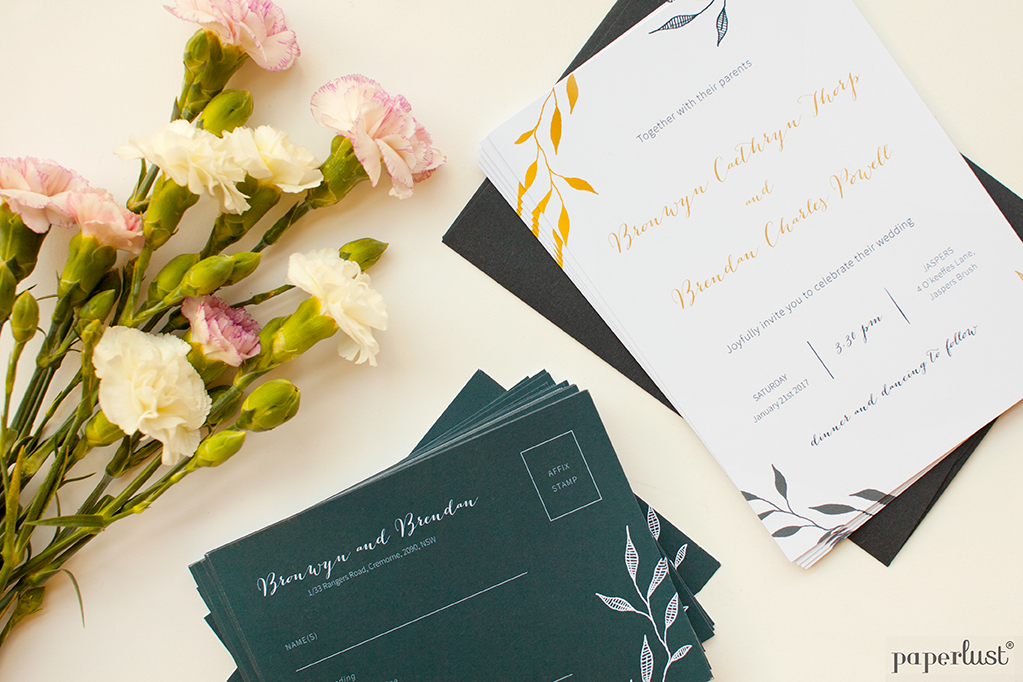
Every RSVP card needs a few core elements to function. Additional optional fields depend on your reception format, how much information you need to collect, and how much white space your design has to work with.
Must-have elements
- Guest name line: either “M_______” (traditional, guests add Mr./Mrs./Ms.) or “Name(s): _______” (modern, more inclusive). Pre-fill names if you have the guest list in a spreadsheet and your designer can personalize each card.
- Accept / decline options: checkboxes or lines work equally well. Classic wording is “accepts with pleasure” and “declines with regret,” but any clear yes/no works.
- RSVP deadline date: always a specific date, never “as soon as possible.” Guests treat vague deadlines as optional.
- Reply method: mailing back in the enclosed stamped envelope, or a URL/QR code if going digital, or both.
Optional but common additions
- Number attending: “Number of guests attending: ___” helps you catch uninvited plus-ones before you have to deal with the awkward conversation at the door.
- Meal choices: for plated dinners, list each option with a checkbox or initial line. Include a dietary restrictions line regardless of whether you have meal choice options.
- Song request: “Song that will get you on the dance floor: _______” adds personality and gives your DJ a ready-made crowd-pleaser list.
- Advice or well-wishes: “Words of wisdom for the couple: _______” works well for casual and backyard weddings.
Wording examples for each element
“accepts with pleasure” / “declines with regret”
“Can’t wait to celebrate!” / “So sorry, can’t make it”
“Kindly reply by the fifteenth of September”
“Please reply by September 15, 2026”
“We have reserved ___ seat(s) in your honor. ___ guests will attend.”
For 50+ wording templates across formal, casual, fun, and meal-choice variations, see our dedicated wording guide: Wedding RSVP Wording: 50+ Examples and Templates.
If your wedding is destination or semi-destination, see also: Destination Wedding RSVP Etiquette: What to Include and When to Send for destination-specific wording and longer lead times.
RSVP Deadline: When to Set It
Your RSVP deadline should be set by working backward from your vendor cutoff dates, not forward from when you feel like asking. Caterers and venues typically need a final headcount 10-14 days before the wedding. Set your RSVP deadline 2-3 weeks before that cutoff so you have time to chase non-respondents.
Standard timeline (local and regional weddings)
- Send invitations: 8-10 weeks before the wedding
- Set RSVP deadline: 3-4 weeks before the wedding
- Confirm final numbers with caterer: 10-14 days before the wedding
- Chase non-respondents: starting 3 days after your RSVP deadline
Destination weddings
Destination wedding timelines run 3-4 months longer than standard at every stage. Send invitations 4-6 months before the wedding. Set your RSVP deadline 10-12 weeks before the event. Your guests need to book flights and hotels, and you need those headcounts before travel prices rise. For a full destination stationery timeline, see the destination wedding RSVP etiquette guide.
Deep dive: Wedding RSVP Deadline: How to Set It and Why It Matters covers the exact calculation method, how to phrase the date on the card (including formal number-written-out conventions), and what to do if your vendor cutoffs leave you with an unusually tight window.
Meal Choice and Dietary Options on RSVP Cards
If your reception includes a plated dinner, your caterer will need individual meal choices per guest before the event. The RSVP card is where you collect this information. Getting the format right on the card saves you from a chaotic spreadsheet reconciliation later.
How to format meal choices on the card
List each option on a separate line with a checkbox. If you have couples attending together on one card, use an “initial next to your choice” format rather than checkboxes, so each person’s selection is identifiable.
☐ Beef tenderloin
☐ Roasted salmon
☐ Mushroom risotto (vegetarian)
Dietary restrictions: _______________
Please initial next to your entree choice:
___ Beef tenderloin ___ Roasted salmon ___ Mushroom risotto
Dietary restrictions or allergies: _______________
Children’s meals
If you are offering a children’s menu, add a separate line: “Children attending: ___ (ages ___). Children’s meal: ☐ Yes ☐ No.” This prevents a surprise 12-plate overage at service.
For a full guide to meal choice wording with templates for beef, fish, vegan, and kids options, the spoke post in this cluster will cover exactly this topic when it publishes: Meal Choice Wording for Wedding RSVP Cards (coming soon in batch 5).

How to Follow Up With Non-Respondents
No matter how clear your deadline is, a percentage of guests will not respond on time. The industry norm for late RSVPs is roughly 10-20% of your guest list, and the etiquette around following up is less fraught than most couples fear. Three days past the deadline is an acceptable window to begin outreach. Waiting longer just compresses your timeline with the caterer.
Who to contact first
Start with the guests you are least worried about offending: friends and colleagues whose contact details you have. Then move to more sensitive names: elderly relatives, distant acquaintances, anyone who might be dealing with something personal. Lead with warmth and a practical framing rather than pressure.
Message templates
“Hey [Name]! We’re finalizing numbers with our caterer and want to make sure we have you counted. Are you able to make it on [date]? No stress either way, just need to know by [new soft deadline]. Can’t wait either way!”
“Dear [Name], We are finalizing our guest numbers for [date] and noticed we haven’t received your RSVP yet. We would love to know whether you are able to join us. Please let us know by [soft deadline] so we can include you in our final count. We hope to see you there!”
When to make a decision for them
If a guest does not respond after two follow-up attempts, it is reasonable to mark them as not attending for planning purposes. If they contact you later, you can attempt to accommodate them depending on your venue capacity, but you are not obligated to do so. Your seating chart and catering order are based on confirmed headcounts.
Deep dive: How to Follow Up With Wedding Guests Who Haven’t RSVP’d covers the full playbook including scripts for awkward conversations, how to handle plus-one situations diplomatically, and what to do if a large family group goes silent.
Tracking RSVPs: Spreadsheets and Tools
Whether you are managing 60 responses or 300, you need a consistent system from day one. Waiting until a pile of response cards accumulates on your kitchen counter and then trying to enter everything at once is how mistakes happen.
What to track for each guest
| Field | Why It Matters | Notes |
|---|---|---|
| Full name(s) | Seating chart and escort cards | Spell exactly as you want it on escort/place cards |
| Attending (Y/N) | Headcount for venue and catering | Track per individual, not per household |
| Meal choice | Caterer’s per-table order | Match to place card or escort card before printing |
| Dietary restrictions | Catering and kitchen brief | Pass full list to caterer at least 1 week before |
| Table assignment | Seating chart and escort cards | Add once seating chart is finalized |
| RSVP method | Auditing who responded via mail vs digital | Useful if you run a hybrid system |
Tool options
- Google Sheets: free, shareable, works for most guest lists. Build columns for the fields above and use color coding for attended/declined/pending status.
- Wedding website RSVP tools: platforms like Joy and WithJoy auto-collect responses into a built-in guest list tool. Works best when you run a digital or hybrid RSVP system.
- RSVPify: purpose-built for event RSVPs; handles meal choices, plus-one tracking, and dietary restrictions in a structured form. Free plan for smaller guest lists.
- Paperlust Address Manager: if you used the Paperlust address import tool to print envelope addresses, the address list exports as a CSV that you can repurpose as your starting guest list spreadsheet.
RSVP Etiquette for Guests: What Couples Wish You Knew
If you are reading this as a wedding guest trying to understand the expectations around RSVPs, this section is for you. (Couples: feel free to share the link with anyone on your list who seems to be treating the deadline as a suggestion.)
Why the deadline actually matters
Your RSVP deadline is not arbitrary. It exists because the couple’s caterer has a headcount cutoff that is often contractually binding. Responding late can mean the couple pays for a seat you do not occupy, or scrambles to add a plate after the order is placed. One late response is manageable. Fifteen are not.
Do not assume you have a plus-one
If the invitation is addressed to you and your name only, or says “and guest” with a blank, respond for exactly the number of people invited. Writing in additional names is not polite and puts the couple in an uncomfortable position of having to call and uninvite someone they already know.
Respond even if you cannot attend
A “no” response is far more useful than silence. It allows the couple to finalize their count, potentially add a guest from their B list, and feel settled rather than anxious about an unresolved RSVP. Declining graciously with a short note is always the right move.
Do not assume you can change your response
Life happens, and legitimate emergencies do occur. But if you RSVP yes and then cannot attend, contact the couple as soon as possible and understand that last-minute cancellations after the catering order is placed may not result in a meal credit. Similarly, if you declined and your situation changes, check with the couple before assuming there is room for you.
Design your RSVP cards with Paperlust
500+ designs in digital, flat foil, letterpress, and metallic print. Order with your invitation suite for a 15% discount. Designer proof in 1-2 business days.
Browse RSVP card designs
Order a $5 sample pack to feel the paper quality
Frequently Asked Questions
What does RSVP mean on a wedding invitation?
RSVP stands for “repondez s’il vous plait,” a French phrase meaning “please respond.” On a wedding invitation, it indicates that the couple needs a formal response confirming whether you will attend. Most invitations include a separate response card with a return envelope, a wedding website URL, or a QR code to make the process as easy as possible.
What is the standard RSVP deadline for a wedding?
The standard RSVP deadline is 3-4 weeks before the wedding date. This gives the couple enough time to follow up with non-respondents before submitting a final headcount to the caterer and venue, which is typically required 10-14 days before the event. Destination weddings often set the deadline 10-12 weeks before the wedding because of the longer planning lead times involved. For more detail, see our wedding RSVP deadline guide.
What should I include on my wedding RSVP card?
Every RSVP card should include a guest name line, an accept/decline response field, the RSVP deadline date, and the reply method (mail-back, website, or QR code). If your reception includes a plated dinner, add meal choice options and a dietary restrictions field. Optional additions include a guest count line to prevent uninvited plus-ones, a song request line, and a well-wishes space for casual events.
Should I include a stamped return envelope with my RSVP cards?
Yes, for printed RSVP cards, a pre-addressed and pre-stamped return envelope is standard etiquette. Requiring guests to find their own envelope and postage is a friction point that reliably delays responses. The small cost of pre-stamped envelopes typically improves your response rate enough to be worth it, especially for formal weddings with older guests on the list.
How do I handle guests who do not respond by the RSVP deadline?
Wait 3 days past the deadline, then reach out by text, phone, or email with a warm message explaining that you are finalizing catering numbers. Give them a new soft deadline of 2-3 days. If they still do not respond after two attempts, it is reasonable to mark them as not attending for planning purposes. Our full playbook for this situation: How to Follow Up With Wedding Guests Who Haven’t RSVP’d.
Can I use online RSVPs instead of printed cards?
Yes, many couples opt for online RSVPs through wedding website platforms or purpose-built tools like RSVPify. Online RSVPs are easier to manage in a spreadsheet, collect dietary and meal data cleanly, and cost less than printed response cards with postage. The trade-off is a typically lower response rate, especially among older guests who are less comfortable with technology. A hybrid approach, printing a card with a QR code that routes to your online form, captures the best of both options. Full guide: Online RSVP for Weddings: Tools, Wording, and How It Works.
What print methods are available for Paperlust RSVP cards?
Paperlust RSVP cards are available in digital print, flat foil (gold, rose gold, silver, copper, and more), letterpress on Wild Cotton paper (300gsm or 600gsm), metallic print, and white ink on dark stock. When ordered as part of a coordinating suite with your invitation and detail cards, you receive a 15% discount across the entire order. Designer proofs are delivered within 1-2 business days of placing your order.
How far in advance should I order RSVP cards?
Order your RSVP cards at the same time as your wedding invitations, typically 10-14 weeks before your planned mail date. For digital print, production runs 8-10 business days after proof approval. Letterpress and flat foil orders take approximately 20 business days. Ordering your full stationery suite together not only triggers the 15% discount but also ensures every card coordinates in paper stock, color, and finish.