


The average US wedding costs around $30,000 – and the gap between what couples plan to spend and what they actually spend is one of the most consistent stories in wedding planning. The good news is that real savings exist in every budget category, and couples who plan thoughtfully end up with a wedding that feels just as special as a big-budget blowout. This guide covers 60+ practical, tested strategies for a wedding on a budget – cutting real cost without cutting joy.
- Guest list is the single highest-impact lever – cutting 25 guests from a 150-person list can save $5,000-$8,000 across catering, venue, stationery, and florals simultaneously.
- Booking an off-peak date (November-April, Friday or Sunday) typically saves 15-30% on venue fees alone – often $1,500-$4,000 on mid-tier venues.
- Switching from a seated dinner to a brunch or cocktail-style reception can cut food and beverage costs by 30-40% per guest.
- The 80/20 rule applies to wedding budgets: venue, catering, and photography account for roughly 70% of most budgets – optimize these three categories first before touching anything else.
- Never cut photography quality, food standards, or licensed vendor coverage below a quality floor – these are the elements guests remember and that cannot be redone.
The Cost-Cutting Hierarchy: Where the Real Savings Come From
Before you start collecting cheap wedding ideas on Pinterest, it helps to understand where wedding money actually goes. The average US wedding budget breaks down approximately like this: venue (28-31%), catering and bar (25-28%), photography and videography (10-12%), florals and decor (8-12%), attire (8-10%), music (5-8%), stationery and paper goods (2-3%), and everything else (10-15%).
The math is straightforward: if you want to make a meaningful dent in your total, you need to attack the big three – venue, catering, and photography – which together represent around 65-70% of most wedding budgets. Saving $200 on centerpieces while spending $8,000 more than you need to on a venue is the wrong sequencing. Work top-down, not bottom-up.
| Category | Typical % of Budget | Savings Potential | Optimize Priority |
|---|---|---|---|
| Venue | 28-31% | 15-50% with date/type flexibility | First |
| Catering & Bar | 25-28% | 20-40% with format swap | First |
| Photography/Video | 10-12% | 20-35% with coverage scope trim | Second |
| Florals & Decor | 8-12% | 20-50% with seasonal/DIY choices | Second |
| Attire | 8-10% | 30-70% with sample/rental | Third |
| Music | 5-8% | 30-60% with DJ vs band swap | Third |
| Stationery & Paper | 2-3% | 30-60% with format simplification | Third |
Start with a firm total budget locked before you speak to any vendor. Then check the full 2026 average wedding cost breakdown by region and guest count to benchmark your target against national averages. Once you know your numbers, work through each category using the strategies below.
Guest List and Invitation Savings
Here is the uncomfortable truth about wedding budgets: every single person you add multiplies your costs across six or more categories simultaneously. More guests means a bigger venue, more catering covers, more table centerpieces, more save-the-dates, more invitations, more thank-you cards, and often a larger wedding party with associated downstream costs. The guest list is not just one line item – it is the multiplier that determines almost every other line item.
The per-guest multiplier effect
The typical cost per guest at an American wedding runs between $200 and $300 when you factor in catering, venue per-capita allocation, florals, and stationery. That means a guest list of 150 can generate $30,000-$45,000 in per-head costs, while trimming to 100 guests saves $10,000-$15,000 before you change a single other decision.
- Cut the automatic plus-one: The traditional rule of giving every adult guest a plus-one adds roughly $250-$350 per couple-slot you fill. Reserve plus-ones for guests in committed relationships only and save $1,500-$3,000 on a 150-guest list.
- Children’s policy: Some venues charge 60-70% of the adult rate for children. A “no children except immediate family” policy is now widely accepted and saves both headcount and coordination complexity.
- The obligation guest category: Coworkers you rarely speak to, your parents’ neighbors, distant cousins you’ve met twice – this is the easiest list trim available. Be honest about who you genuinely want celebrating with you versus who is on the list out of social obligation.
- The micro-wedding path: A guest list of 30-50 people opens up entirely different and far less expensive venue types – private dining rooms, backyard celebrations, intimate restaurant buyouts – and reduces every downstream cost proportionally. A well-executed micro-wedding at $12,000 is often more meaningful than a stretched traditional wedding at $35,000.
Invitation suite savings once your list is locked
Once your guest count is set, your stationery naturally scales. A smaller list means fewer pieces to print, fewer envelopes to address, and lower postage spend. Beyond guest count, format choices make a significant additional difference.
- Digital RSVPs: Including your wedding website URL instead of a physical response card and return envelope eliminates 2-4 pieces per invitation and associated postage. On a 100-guest list, that is $100-$200 saved before you factor in stamps – and most guests under 60 actively prefer digital response.
- Postcard save-the-dates: Postcards require less postage than standard first-class mail and skip the envelope entirely. They are a widely used, completely legitimate format that guests appreciate for its simplicity.
- Single-card invitations: The traditional 6-piece suite (outer envelope, inner envelope, invitation card, RSVP card, RSVP envelope, details card) has given way to streamlined formats. A single card with the core details and a website URL for everything else costs 50-60% less to print and mail.
- Order your suite together: Ordering save-the-dates, invitations, and thank-you cards as one combined order unlocks multi-product discounts. At Paperlust, ordering three or more card types saves 15% across the full order – and new customers receive 10% off their first order.
Paperlust’s wedding invitations start from $2.04 per card in digital print, with 500+ exclusive designs and free white envelopes included. Save-the-dates start from $1 per card. A 100-guest digital print invitation suite (invitation card only, digital RSVP) can be produced for under $300 in cards before postage. For wording help, see the complete guide to save-the-date wording.
Venue Savings
Venue is the single largest line item in most wedding budgets, and it is also the category with the most flexibility – if you are willing to adjust the date, day of the week, or venue type. These three levers operate independently and stack: a Sunday wedding at an off-peak month in a non-traditional venue can save 40-60% versus a Saturday peak-season ballroom booking.
Date and timing strategies
- Off-peak season: Peak wedding season in the US runs from May through October, with June and September as the most competitive months. Booking a November through April wedding – with the exception of the two weeks around Christmas – typically saves 20-30% on venue rental fees. Off-peak bookings also often come with upgraded inclusions: additional hours, complimentary furniture packages, or preferred vendor flexibility that costs extra in peak season.
- Friday and Sunday weddings: Saturday is the most expensive day of the week at almost every venue in the country. Friday evenings and Sunday afternoons typically rent at 20-30% less. Sunday morning brunch weddings come in at the lowest end of the scale and have a distinctly relaxed, intimate feel that many couples and guests prefer.
- Weekday weddings: Venues can discount Monday-Thursday events by 30-50%. Not suitable for every couple or guest list, but for couples with guests who are retirees, freelancers, or remote workers, a midweek wedding can be an excellent option.
- Morning and midday receptions: An 11am ceremony with a midday reception that ends by 3pm uses a venue’s less-competed daytime slot. Venues charge significantly less for daytime windows, and catering for a brunch or lunch service costs substantially less than an evening dinner service.
Non-traditional venue types
| Venue Type | Typical Rental Cost | Key Savings | Key Considerations |
|---|---|---|---|
| Traditional ballroom or estate | $3,000-$15,000+ | Often all-inclusive: tables, chairs, staff | Caterer exclusivity, minimum spend requirements |
| Restaurant private buyout | $1,500-$6,000 | Catering built in; no separate venue + caterer cost | Limited capacity, menu flexibility varies |
| Public park or botanical garden | $200-$2,000 (permit) | Beautiful natural backdrops, minimal decor needed | Weather contingency, equipment rentals required, permit lead time |
| Family backyard | $0 rental | Maximum flexibility, no vendor exclusivity | Tent, restrooms, parking, power, event insurance required |
| Vacation rental property | $1,000-$5,000/weekend | Accommodation for wedding party included in cost | Events policy must be confirmed with property owner; small guest count |
| Brewery, winery, or distillery | $1,500-$5,000 | Built-in bar service often lower; atmosphere is the decor | Minimum beverage spend required, capacity limits |
For the complete checklist of what to ask before signing any venue contract, including hidden fee red flags and contract clauses that can cost thousands, see our guide on how to choose a wedding venue.
Catering Savings
Food and beverage is the second-largest cost center at most American weddings. The format you choose – more than the specific menu or caterer – drives the majority of the price difference. Switching formats is the highest-leverage catering decision available.
Reception format cost comparison
| Format | Per-Guest Cost (food only) | Feel | Staff Ratio |
|---|---|---|---|
| Plated seated dinner | $90-$160 | Formal, traditional | High (1 server per 8-10 guests) |
| Buffet or family-style | $60-$100 | Relaxed, social | Moderate |
| Cocktail reception (heavy appetizers) | $50-$85 | Social, modern | Moderate |
| Brunch or lunch reception | $40-$75 | Daytime, casual-elegant | Moderate |
| Dessert reception | $25-$50 | Festive, alternative | Lower |
| Food truck(s) | $35-$65 | Casual, memorable | Low |
Bar cost strategies
The bar typically adds $25-$90 per guest on top of food costs. Here are the most effective ways to reduce it without leaving guests feeling shortchanged:
- Beer and wine only: Eliminating a full open bar and serving beer, wine, and one or two signature cocktails cuts bar costs by 30-40%. A well-curated selection is all most guests need, and it feels considered rather than restricted.
- BYO at licensed venues: Some venues permit you to source your own alcohol (BYO), which cuts bar costs significantly versus caterer-supplied packages. Always confirm the venue’s specific policy and local licensing requirements before planning around this.
- Shorter bar hours: Opening the bar at dinner service rather than through cocktail hour, and closing 30-45 minutes before the event ends, both reduce consumption and cost without anyone noticing at the time.
- Consumption bar vs. flat open bar: A consumption bar charges for what guests actually drink rather than a flat per-head rate. For daytime weddings or older guest demographics, this consistently comes in under the flat-rate estimate.
- Skip the cocktail hour as a standalone event: One of the most underused savings strategies available. Transitioning directly from ceremony to reception – opening with appetizers on guest tables – eliminates a dedicated cocktail-hour venue setup, cocktail-hour florals, and a separate music budget for that window.

Photography and Video Savings
Photography is one category where blanket cost-cutting advice is genuinely bad. Your wedding photos are the only permanent artifact of the day – they outlast the flowers, the food, the venue, and eventually even the guests. That said, there are meaningful savings available within photography that do not compromise the quality of what you get back.
Where you can trim photography costs without compromising quality
- Shorter coverage hours: Most photographers offer packages from 4 to 10 hours. If your timeline is tight – ceremony plus cocktail hour plus dinner – 6 hours of coverage captures everything that matters at $400-$800 less than an 8-hour package.
- Photo only, no video: Videography adds $2,000-$5,000+ to the average wedding budget. If you are genuinely indifferent to video, this is a clean cut. If you want some video, a 60-90 second highlight reel from a videographer who specializes in reels costs significantly less than full documentary coverage.
- Associate photographers from established studios: Most quality photography studios have associate or junior photographers who shoot with the same equipment and editing style at 30-50% less than the lead photographer’s rate. Ask studios directly whether they offer associate bookings before assuming the listed price is the only option.
- Album outside the package: Don’t lock in a print album at booking time. Get digital files first, then order an album 6-12 months after the wedding through a third-party service once you’ve had time to select favorites. Albums ordered this way cost 40-60% less than in-package albums.
- Guest photo-share supplement: A shared album (Google Photos or a similar service) announced at the reception provides candid coverage from multiple angles at no cost. It does not replace professional photography, but it meaningfully supplements it.
Where you should not compromise
Never hire a photographer based solely on price without reviewing a complete wedding portfolio – not just styled shoots or portraits, but a real wedding shot beginning to end. A photographer who primarily shoots headshots or newborns and “does weddings sometimes” will struggle with ceremony timing, low-light reception environments, and the physical stamina an 8-hour wedding day demands. This is the one category where the quality floor is non-negotiable.
Flower Savings
Wedding flowers are one of the most emotionally loaded line items in the budget conversation. There is typically a gap between what couples plan to spend on florals and what they actually spend. The strategies below close that gap without leaving the ceremony or reception looking sparse.
The highest-impact floral cost strategies
- Book in-season blooms: In-season flowers cost 30-50% less than out-of-season imports. A peony wedding in June is far more affordable than one in January when peonies are being shipped from South America. Ask your florist what is at peak in your month and build your palette around those varieties.
- Single-variety bouquets: A tightly wrapped single-variety bouquet – garden roses, ranunculus, or anemones – is as elegant as a complex mixed arrangement and significantly cheaper to construct. Some of the most beautifully photographed bridal bouquets in recent years are single-variety.
- Greenery-heavy arrangements: Eucalyptus, fern, and rich foliage cost a fraction of focal blooms and create full, lush arrangements. Greenery garland table runners cost less than elevated floral centerpieces and photograph beautifully under reception lighting.
- Strategic placement over full coverage: Instead of floral centerpieces on every table, invest in two or three focal arrangements – the ceremony arch, sweetheart table, and welcome table – and use candles, lanterns, or greenery for remaining tables. Guests notice and remember the spaces they stand near, not the tables they walked past.
- Repurpose ceremony florals: Coordinate with your florist to move ceremony arch blooms, aisle arrangements, and cocktail-hour centerpieces to the reception. This requires 30-45 minutes during the venue changeover but eliminates the need to budget for two separate sets of arrangements.
- Wholesale bulk sourcing: Wholesale clubs sell fresh flowers by the stem or bunch and are a genuine option for simple arrangements assembled by willing hands. Best suited to ceremonies with a relaxed aesthetic and a wedding party available to help the day or evening before.
- High-quality faux mixed in: Premium silk flowers blended into real arrangements, or used exclusively for bridesmaid bouquets, can reduce floral costs by 20-30% while being visually indistinguishable in photographs.
Attire Savings
Bridal attire – the dress, veil, accessories, alterations, and shoes – typically accounts for 8-10% of the wedding budget when all components are added up. The same optimization applies to the groom, groomsmen, and bridesmaids.
Wedding dress savings strategies
- Sample sales: Bridal boutiques hold sample sales 1-3 times per year to clear floor models. Sample sale dresses sell for 40-70% off retail. The trade-off is limited size availability (most samples are size 8-12) and minor wear from try-ons. If you find your size, the value is extraordinary.
- Online bridal retailers: Direct-to-consumer bridal brands that bypass the boutique markup sell comparable silhouettes at 40-60% less than designer retail. Read reviews carefully and understand return policies before purchasing.
- Pre-owned and consignment: Bridal resale platforms offer dresses worn once or not at all at significant discounts. Many sellers had alterations done, which can be a bonus if the measurements align. Verify sizing carefully against your own measurements – not dress tags.
- Rental: Wedding dress rental services exist in most major US markets. The savings are 50-70% versus retail and are particularly logical for destination weddings where traveling with a full gown is complex.
- Non-bridal formal white: A formal white dress from a regular formalwear line can photograph identically to a designer bridal gown at a fraction of the price. This approach is increasingly common and completely accepted.
Wedding party attire savings
- Mismatched bridesmaids: Give bridesmaids a color palette and let them choose their own dress within it. They get something flattering and more likely to be worn again; you save coordination overhead and eliminate pressure on bridesmaids to purchase unflattering styles.
- Suit rental for groomsmen: Groomsmen are expected to coordinate, not match exactly. Directing groomsmen to a national rental chain they can each book independently eliminates the purchase cost entirely. Men’s suit rental typically runs $100-$200 for the complete outfit.
- Skip the specialty flower girl dress: Flower girls can wear a simple white or neutral dress they already own, or an inexpensive white sundress from any children’s retailer. There is no requirement for a custom flower girl gown.

Stationery Savings
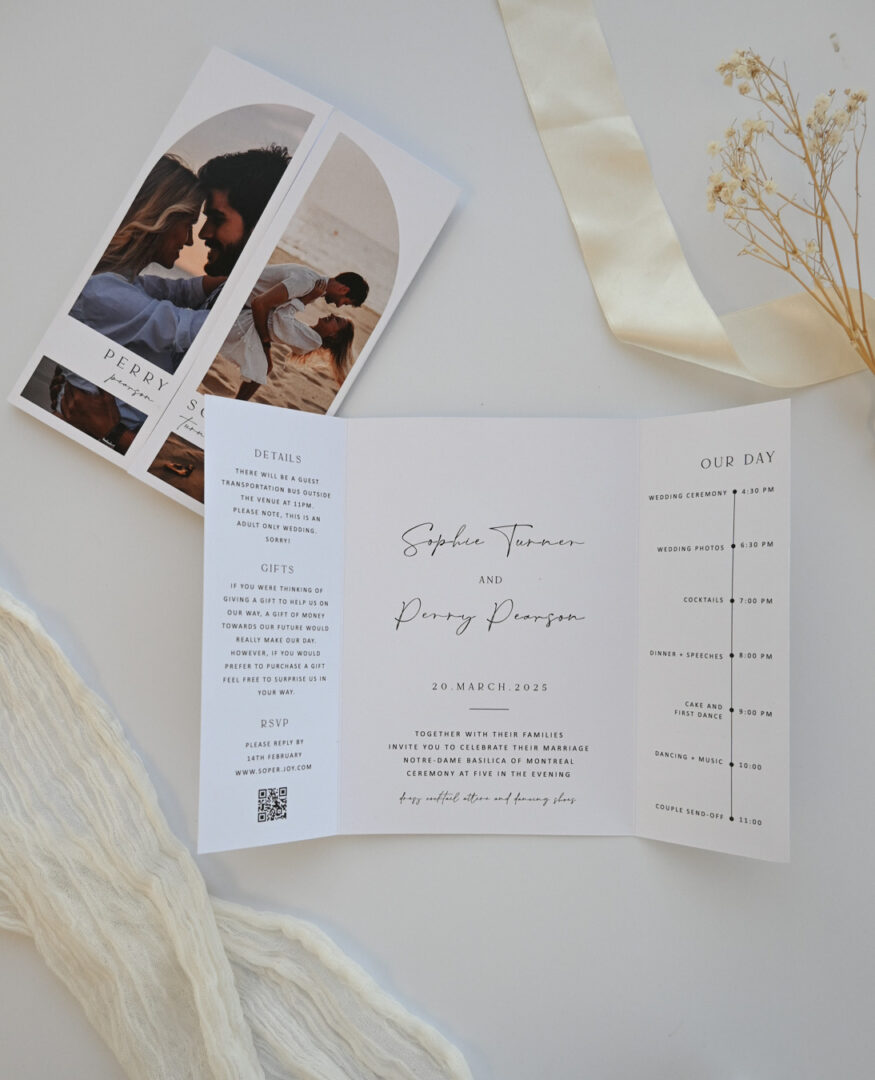
Wedding stationery – save-the-dates, invitations, RSVPs, programs, menus, place cards, and thank-you cards – adds up faster than most couples expect, especially once postage is included. But stationery is also one of the categories where thoughtful format choices yield real savings without any visible compromise in quality.
Format and print method decisions
- Digital RSVPs: The single biggest stationery saving available. Including your wedding website URL instead of a physical RSVP card and return envelope eliminates 2-4 pieces per invitation and the associated postage. On a 100-guest list, that is $100-$200 saved before you buy a single stamp. Most guests under 60 actively prefer digital response.
- Digital print over specialty methods: Letterpress and foil-stamped invitations are beautiful, but they cost significantly more than digital print. Well-designed digital print invitations on quality paper look clean, sharp, and modern. You are paying for design quality and paper weight – not necessarily the print method.
- Postcard save-the-dates: Postcards cost less per piece to print and qualify for lower postage rates than standard first-class letters. They require no envelope, no stuffing, no sealing. On a 100-guest list, switching from an enveloped save-the-date to a postcard saves $30-$60 in postage alone.
- Streamline your enclosures: The traditional 6-piece suite (outer envelope, inner envelope, invitation, details card, RSVP card, RSVP envelope) has been replaced in most modern weddings by a single invitation card plus a wedding website URL for all details. This costs 50-60% less to produce and mail.
- Digital ceremony programs: A QR code on a small signage card at the ceremony entrance leads guests to your online program. Zero per-item printing cost, and guests are not left holding paper through cocktail hour.
- Combine your full suite order: Ordering save-the-dates, invitations, and thank-you cards together in one session unlocks multi-product discounts. At Paperlust, ordering three or more card types saves 15% across the full order.
Beautiful invitations don’t have to break the budget
Paperlust wedding invitations start from $2.04 per card in digital print – with 500+ exclusive designs, free white envelopes included, 15% off when you order three or more card types together, and 10% off your first order as a new customer.
For wording inspiration across your full suite, see the guides to wedding invitation wording for 2026 and RSVP card wording. For design trends shaping what couples are ordering right now, see wedding invitation trends 2026.
Music Savings
Live bands are one of the most beloved reception elements – and one of the most expensive. A live band of four to six musicians typically costs $3,500-$10,000 or more for an evening. A professional DJ typically runs $1,000-$2,500 for the same hours. The entertainment experience is different, but the savings are substantial and the dance floor energy is equivalent when the DJ is skilled.
Music format options by cost
- Professional DJ for the reception: The standard cost-effective choice. A good DJ reads the room, takes requests, handles all audio, and maintains energy through the night. Budget $1,000-$2,500 for a professional with a genuine wedding portfolio and verified references.
- Curated playlist for the ceremony: For the processional, signing, and recessional, a carefully curated Spotify or Apple Music playlist through quality speakers is entirely adequate. Ceremony music is ambient and brief – this is a clean $400-$800 saving compared to hiring a musician for the ceremony window only.
- Acoustic friend for ceremony: If someone in your circle plays acoustic guitar or sings confidently, a 20-30 minute ceremony performance is a genuinely personal contribution. Confirm they can handle the technical setup (outdoor amplification, timing, managing nerves under pressure) before committing.
- No live cocktail-hour music: A thoughtfully curated playlist through quality Bluetooth speakers is indistinguishable from a solo acoustic performer during cocktail hour, where ambient background music is standard. This is a clean $400-$800 saving.
- Duo or trio format: Some acts offer a stripped-back version – a singer plus one or two musicians – that delivers a live music feel at 50-60% of a full band’s cost. A well-rehearsed duo can cover a reception beautifully if you are not expecting an extended extended danceable set.
Decor Savings
Wedding decor is where DIY energy is most commonly applied – and where the DIY trap is most common (more on that below). The most impactful decor savings come not from doing everything yourself, but from being strategic about where you focus decor investment and where you deprioritize it.
High-impact decor strategies
- Candles over florals at the table level: A cluster of pillar candles, votives, and tapers at varied heights creates warmth and atmosphere on a table at $15-$25 per table versus $60-$150 for a florist centerpiece. With some eucalyptus or greenery tucked in, the effect is elegant and photographs beautifully under warm reception lighting.
- Fewer, larger focal arrangements: Three impressive arrangements placed strategically cost more impact per dollar than fifteen modest arrangements scattered throughout the venue. Focus decor intensity on the ceremony backdrop, sweetheart table, and welcome or bar area.
- Ceremony-to-reception transfers: Plan with your florist to move ceremony arch blooms, aisle arrangements, and cocktail-hour florals to the reception. This requires 30-45 minutes of transition time but eliminates a full duplicate florals budget.
- Rent, don’t buy: Candle holders, lanterns, vases, charger plates, and decorative elements are available from event rental companies at a fraction of their retail price. For decor items used exactly once, rental always wins economically over purchasing and disposing of.
- Choose a venue that does the work for you: A vineyard, botanical garden, historic building, or architecturally interesting restaurant requires almost no additional decor investment. The venue itself is the visual backdrop. Spending $500 on candles at a venue with character beats spending $3,000 trying to transform a blank-canvas industrial hall.
- String lights as atmosphere: Warm string lights, uplighting, and LED candles do more for evening ambiance than almost any other element at a fraction of the cost of elaborate florals. A few hundred dollars in warm bulb string lights transforms any reception space.
For wedding signage that ties your decor together – welcome signs, seating charts, directional signs, and bar menus – browse Paperlust’s wedding signs collection, which includes professionally printed fabric and PVC board options that replace what would otherwise be expensive handmade pieces.

What NOT to Cheap Out On
Budget optimization and across-the-board cost-cutting are fundamentally different strategies. There are specific categories where saving money creates problems that cost more than the original saving – in stress, in regret, or literally in dollars spent to fix the outcome after the fact. Knowing where the floor is matters as much as knowing where the ceiling is.
Non-negotiable investment areas
- Photography, to a quality floor: There is a minimum quality threshold below which wedding photography becomes permanently regrettable. The $400 photographer advertising on social media with no complete wedding portfolio is almost never the exception. Your photos will be in frames in your home in 30 years. Optimize for quality within your budget – not for the lowest possible number.
- Food quality: Wedding guests talk about the food. A genuinely well-executed meal – even a casual buffet or brunch – is the most reliably positive memory guests carry from a wedding. Cutting food costs to the point of obvious mediocrity (cold plated chicken, thin grainy beef, wilted salad greens) registers with everyone at the table and lingers in the story told afterward for years.
- Licensed and insured vendors: The $800 catering quote that looks too good to be true often comes without liability insurance, proper food handling certification, or a contract that would protect you if the vendor cancels. Licensed vendors with written contracts cost more because the protection they provide is real and consequential.
- Marriage license: Typically $35-$100 depending on your state, and requires advance processing time (often 3-5 business days minimum) with specific county-level requirements. Confirm your state’s requirements well in advance. This is not a category to optimize or leave until the last minute.
- Vendor contracts: Never book any vendor without a contract specifying date, hours, deliverables, cancellation policy, and payment schedule. A vendor who will not provide a written contract is a vendor who should not be booked regardless of price.
- Food allergy accommodations: If guests have documented food allergies or serious dietary restrictions, proper accommodation is non-negotiable both as a hospitality standard and a liability issue. Communicate all dietary needs to your caterer in advance and confirm their handling protocol in writing.
The DIY Trap: When DIY Costs You More
DIY wedding culture has produced genuinely beautiful weddings and genuinely miserable final weeks. The difference is usually whether the couple accurately estimated the time, skill, and coordination required before committing. DIY is a legitimate and often excellent strategy in specific applications – but it has a failure mode that most budget guides underemphasize.
When DIY genuinely saves money
- You or someone close to you has professional or near-professional skill in the specific craft.
- The items can be made well in advance – weeks before the wedding – without time pressure as the date approaches.
- The total materials cost, including waste and mistakes, is genuinely lower than professional alternatives at equivalent quality.
- You have consistent, reliable help across multiple sessions. The production burden does not fall entirely on you and your partner in the two weeks before the wedding.
When DIY does not save money
- Wedding cake: A homemade wedding cake requires professional-level technical skill to stack safely, travel to a venue without sliding, and hold structural integrity at room temperature for 3-4 hours. If the cake collapses on the morning of the wedding, you need a bakery cake the same day. That risk has a real cost.
- Same-day floral assembly: Ordering bulk wholesale flowers and assembling all arrangements on the morning of your wedding adds 4-6 hours of high-stress production work on the single day with zero margin for error or delay. Many couples who attempt this describe it as the single biggest regret of their wedding planning.
- DIY catering: Even with the most capable and willing family members, cooking food for 80-150 people in the hours before a ceremony is a reliable path to exhausted helpers, uneven food quality, and a wedding party that missed the ceremony because they were in the kitchen.
- Items requiring specialized professional equipment: Any project that actually requires equipment you do not own is not truly DIY – it is production sourced elsewhere with more coordination overhead. If the “DIY” project involves renting equipment you do not know how to operate, the economics rarely work out.
- Anything under time pressure: The correct DIY projects for budget weddings are things that can be done in relaxed sessions months in advance: assembled favor bags, hand-addressed envelopes, simple greenery bundles tied with ribbon, escort card calligraphy. These are genuinely achievable. Multi-tier cake construction and full floral production on the wedding morning are not.
The honest DIY cost accounting includes your own time at a fair hourly rate plus all materials, waste, and contingency. When you run that calculation, the savings often evaporate – and that is before accounting for the stress cost in the final days before your wedding. DIY is not inherently budget-friendly; it is budget-friendly in specific, well-chosen applications.
Professional quality, budget-friendly pricing
Your wedding invitations are one category where professional quality and budget-conscious planning genuinely coexist. Browse Paperlust’s full 2026 invitation collection – from $2.04 per card in digital print, with 500+ designs by independent artists and your full stationery suite at 15% off when ordered together.
Frequently Asked Questions
What is the most effective single way to save money on a wedding?
Reducing your guest count is the highest-impact lever available. Every guest you remove saves money across catering, venue per-capita allocation, stationery, florals, and favors simultaneously. Cutting 25 guests from a 150-person list can save $5,000-$8,000 across categories before you change a single other decision. After guest count, venue date flexibility – off-peak season, Friday, or Sunday – is the next biggest single lever.
How much should a budget wedding cost?
A carefully planned wedding for 50-75 guests can be done well in the $10,000-$18,000 range in most US markets outside New York, Los Angeles, and San Francisco. This requires flexibility on venue type (public park, restaurant, backyard), catering format (brunch, buffet, or cocktail-style), and photographer tier. A micro-wedding of 20-30 guests can be beautifully executed for $6,000-$10,000 in many markets.
What is the cheapest type of wedding venue?
Public parks and botanical gardens with event permits are typically the least expensive formal venue option, often in the $200-$2,000 range depending on location and size. Backyard weddings have zero rental cost but require rented tents, restrooms, tables, chairs, and power – factoring those in, the effective cost is often $3,000-$6,000 in rental equipment. Restaurant private buyouts combine venue and catering in a single $1,500-$6,000 package and are often the most cost-effective all-inclusive option.
Can you have a good wedding for under $10,000?
Yes. A micro-wedding of 20-30 guests in a restaurant private room or a family backyard, with a photographer booked for 4-5 hours, brunch or buffet-style catering, a DJ or curated playlist, and streamlined stationery can be achieved for $8,000-$12,000 in mid-cost US markets. Many couples find micro-weddings more intimate and meaningful than large traditional events – and the budget goes further on quality rather than quantity.
Is it cheaper to have a Friday or Sunday wedding?
Both are meaningfully cheaper than Saturday. Friday evenings and Sunday afternoons typically save 20-25% on venue rental compared to Saturday. Sunday brunch weddings offer the maximum savings and naturally limit bar costs with an earlier end time. The trade-off for Friday is that guests may need to take half a day off work; Sunday events typically wrap by early evening.
What is the average cost of wedding invitations?
A complete wedding stationery suite – save-the-dates, invitations, and thank-you cards for 100 guests – typically ranges from $300 to $1,500 depending on print method, number of enclosures, and postage. Digital print invitations start around $2-$3 per card from quality printers, while letterpress and foil-stamped designs run $5-$12 per card. Eliminating the physical RSVP card in favor of a digital RSVP removes 2-3 pieces per envelope and associated postage, which adds up to $100-$200 on larger guest lists. For addressing guidance, see the complete guide to how to address wedding invitations.
Should I hire a wedding planner or skip it to save money?
Consider a day-of coordinator ($800-$1,500) instead of a full-service planner ($2,000-$6,000+). A day-of coordinator takes over vendor management in the 4-6 weeks before the wedding and runs all logistics on the day itself. This prevents the most costly problems (vendor no-shows, timeline emergencies, family disputes) without paying for 12 months of planning support. Skipping all coordination entirely typically means a family member absorbs that role – which usually means someone who should be celebrating the day is instead managing vendors.
Is a buffet reception tacky?
No. This is a persistent myth that bears no relation to how modern guests actually experience a wedding. Buffet and family-style service are now standard across all budget and formality levels, from casual outdoor events to upscale hotel ballrooms. Many guests prefer buffet because they can eat at their own pace and return for more of what they enjoyed. A well-executed buffet with quality food is consistently more memorable than a mediocre plated dinner.
What wedding costs do couples most often forget to budget for?
The most consistently underestimated costs are: vendor gratuities ($20-$100 per vendor, totaling $300-$800 for a typical vendor team); vendor meals (caterers typically require a hot meal for staff working 8+ hours, billed at $30-$50 per vendor); marriage license fees ($35-$100 depending on state, with advance processing time); dress alterations ($150-$800 for bridal gowns, rarely included in the purchase price); day-of wedding party transportation ($300-$800 for a sprinter van or car service); and the wedding-day emergency kit (safety pins, stain remover, headache medicine, fashion tape – small costs that add up). See the full breakdown in our 2026 average wedding cost guide.
Does booking vendors early actually save money?
Early booking saves money indirectly by giving you access to better options at your budget level before the best vendors are booked. It does not typically lower vendor rates, but it prevents the last-minute premium that comes when 0-3 month availability forces you toward whoever is still available. The exception is off-peak season venues, where last-minute availability can occasionally yield meaningful discounts on unsold dates.
What is the easiest budget cut that couples rarely consider?
Eliminating the cocktail hour as a separate standalone event. Instead of paying for a dedicated cocktail-hour venue setup, a second set of florals, passed appetizers, and cocktail-hour music, transition directly from ceremony into a reception that opens with appetizers on guest tables. This saves the venue setup cost for a second space, eliminates cocktail-hour-specific decor, and simplifies the catering logistics – all without guests feeling like anything was missing.
How do I stay on budget once planning starts?
Build a 10-15% contingency buffer into your total from day one – unexpected costs are guaranteed, not optional. Track every quote and confirmed cost in a single spreadsheet updated regularly. Resist mid-planning scope additions: the photo booth, the upgraded linens, the late-night taco station each look small in isolation but collectively represent 15-25% of typical budget overruns. Lock your guest list early and do not reopen it. Confirm final headcount with your caterer at the contractual deadline (typically 2-3 weeks before) rather than earlier, so you are not paying for no-shows.
Does the time of year really affect wedding costs significantly?
Yes, substantially. The most expensive months for US weddings are June, September, and October when vendor demand is highest. The least expensive months are January, February, March, and November (excluding Thanksgiving week). An identical wedding planned for a February Saturday versus a June Saturday will cost 15-30% less primarily through lower venue fees and florist pricing, with secondary effects on photographer and caterer rates.
Are budget-friendly wedding invitations worth it?
The relationship between price and quality is not linear in wedding stationery. A well-designed digital print invitation on quality paper stock is genuinely beautiful and costs a fraction of specialty print methods. The invitation sets the first impression of your wedding – invest in good design rather than expensive print technique. Clear, elegant digital print at $2-$3 per card from a quality printer is the right approach for most budget-conscious couples. For the latest design directions, see wedding invitation trends for 2026.
Paperlust has been featured in Vogue Australia, Marie Claire Australia, The Sydney Morning Herald, and Harper’s Bazaar Bride as a destination for beautifully designed wedding stationery.