
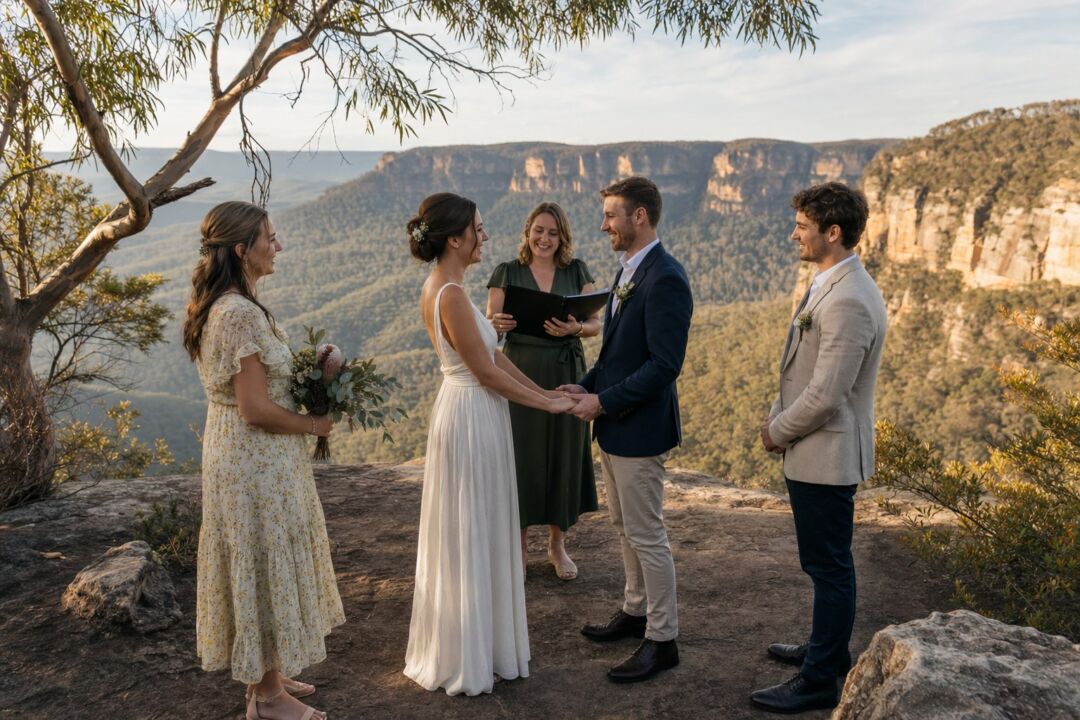
Eloping in Australia is entirely legal. You can marry at sunrise on a beach, in a national park, on a private vineyard, or anywhere else in the country. What you cannot do is decide on Thursday and be married by Saturday. Australian law requires couples to lodge a Notice of Intended Marriage at least one full calendar month before the ceremony. That single rule shapes everything about how you plan.
This guide covers the legal requirements, the paperwork sequence, how to find two witnesses when you have no guests, permits for popular outdoor venues, what the whole thing costs, and how to tell people afterward. For deeper detail on the legalities, see our guides to how to legally get married in Australia and when to lodge your NOIM.
Both of those posts sit alongside two inspiration-focused articles on elopement ideas already on this site. This one is different. If you want to know the legal process step by step and the practical problems couples actually run into, this is the one to read.
Australian elopement: quick facts
- NOIM deadline: Lodge with your celebrant at least 1 calendar month before the ceremony (valid for up to 18 months in advance)
- Celebrant: Must be listed on the Commonwealth Register of Marriage Celebrants (search at ag.gov.au)
- Witnesses: Exactly 2, both aged 18+, present for the full ceremony
- Who can witness: Family, friends, photographer, videographer, venue staff, or strangers. No qualification required.
- Location: Anywhere in Australia or its territorial waters is legally valid. Permits may still be required from parks or councils.
- Fees: Celebrant fees are not set by government; contact celebrants directly via the Commonwealth Register at ag.gov.au. The official marriage certificate after the ceremony is a fixed government fee that varies by state (in NSW: $70 standard / $105 priority as at 1 July 2026, per the NSW Government fee schedule; check your own state registry for the current amount).
- Official certificate: Apply through your state or territory Births, Deaths and Marriages registry after the ceremony.
The NOIM window is dead time. A save the date turns it into notice for the people you are telling.
The one-month rule: why you cannot elope on a whim in Australia
Under the Marriage Act 1961 (Cth), a couple must lodge a Notice of Intended Marriage with an authorized marriage celebrant at least one calendar month before the ceremony date, and no more than 18 months before. There is no exception for spontaneous elopements. A court can shorten the notice period in genuine emergency circumstances, but this requires a formal application and is rare.
The practical implication: you need to find a celebrant and sign the NOIM before you lock in your elopement date. One partner can sign the form first; the other can sign later. But the NOIM itself must be signed in front of an approved witness, which is a separate requirement from your two ceremony witnesses. For the NOIM, an approved witness means a Justice of the Peace, solicitor, doctor, dentist, pharmacist, nurse, or police officer, among others. If you are overseas when signing, an embassy or consulate official or a notary public qualifies.
Your celebrant handles the paperwork from there. Once lodged, you can choose your ceremony date anywhere within the 18-month window.
The Attorney-General’s Department publishes the full Marriage Act requirements and the NOIM form at ag.gov.au. Your celebrant should walk you through all of this at the initial booking, but verify the current approved-witness list directly with the department, as it has been updated in recent years.
Finding an authorized marriage celebrant
Your celebrant must be listed on the Commonwealth Register of Marriage Celebrants, which the Attorney-General’s Department maintains. You can search it at ag.gov.au. Not everyone who performs ceremonies is registered, so confirm before you book.
For an elopement, look specifically for a celebrant who advertises travel ceremonies or elopement packages. Most are comfortable driving to national parks, clifftops, or remote beaches and will carry a portable PA system. Celebrant fees are not regulated by government and vary by location, experience, and what is included in the package. Contact registered celebrants directly for quotes via the search function at ag.gov.au.
Ask any celebrant upfront whether their fee includes the NOIM preparation, travel to your location, and the lodging of the official certificate with the Births, Deaths and Marriages registry after the ceremony. Some charge separately for each.


The two-witness requirement and how to solve it
Every legal marriage in Australia requires exactly two witnesses. Both must be aged 18 or over, present throughout the entire ceremony, able to understand English (or the language used in the ceremony), and sober enough to sign the certificates. There is no requirement that witnesses know the couple personally, hold any qualification, or be Australian citizens.
This is where elopements get practical. If you want genuinely no guests at all, you still need two adults standing with you.
The most workable solutions:
- Your photographer and second shooter. Most elopement photographers are comfortable acting as a witness. Many work with a second shooter or assistant who can serve as the other. Ask before booking.
- The celebrant’s partner or assistant. Many celebrant businesses routinely bring a second person, partly because this situation comes up constantly with eloping couples.
- Venue or location staff. A national park ranger, a winery employee, a hotel concierge. The law asks only that they meet the age and comprehension criteria.
- Strangers at the location. Legally fine and practically straightforward at popular scenic spots where other visitors are present. Most people say yes when asked.
- Dedicated witness services. Some elopement packages include witnesses; ask whether witnesses are included when you request a quote from your celebrant.
Witnesses sign all three marriage certificates. One stays with the couple as the presentation certificate. One goes to the celebrant. The third is lodged by the celebrant with the state Births, Deaths and Marriages registry, and that lodgment is what legally registers the marriage.
Permits for national parks, beaches, and council land
Australian law places no restrictions on where you marry. A ceremony can happen anywhere in the country or its territorial waters. The land itself, however, may impose requirements regardless of what the Marriage Act says.
The practical rule: assume you need permission for any public land until you confirm otherwise.
National parks: Requirements vary by state. Parks Victoria requires a wedding permit for any ceremony on Parks Victoria estate, with applications lodged at least 8 weeks in advance. NSW National Parks allows small private events below 40 people at certain locations without a permit, but requires 15 days’ notice for sites not on their listed wedding venue list. Queensland parks require permits for groups over 40 in day-use areas or over 15 in remote zones. A genuine two-witness elopement with no additional guests may fall under the threshold in QLD, but check with the specific park before assuming.
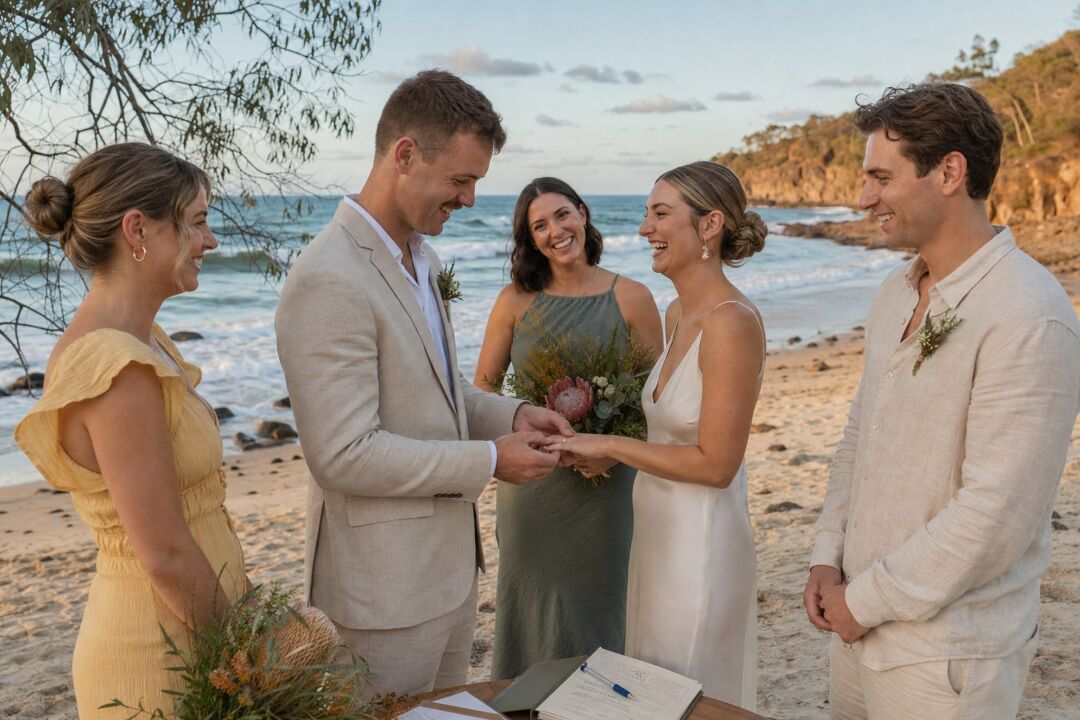
Beaches: If the beach is managed by a local council, that council may require a booking or permit for a ceremony even with very small numbers. If it sits within a national park boundary, the parks permit rules apply. Popular elopement beaches in NSW, QLD, and WA have had permit requirements tighten in recent years as micro-wedding demand has grown.
Council parks, lookouts, and gardens: Contact the relevant council directly for current fees and application requirements. Many allow small ceremonies with an informal email permission; others charge a site booking fee.
Your celebrant is often a useful first contact here. One who regularly works in a particular area will know which locations need permits and what the process involves.
An elopement invitation is small, personal and usually the only printed piece.
Season, weather, and location in Australia
Australia’s geography means there is no single best season to elope. The answer depends on where you are going.
Spring (September-November): Wildflower season in WA and SA, mild temperatures across most southern states. Peak demand for elopement services in Victoria and NSW, so book celebrants and photographers early.
Summer (December-February): Excellent in Tasmania and in elevated parts of the Victorian High Country. Hot and dry in most of the south and interior. December and January suit couples who want to elope and then host family for a summer celebration.
Autumn (March-May): Widely considered the best all-round season. Stable weather across every state, photogenic light, and national park crowds at their lowest since school is back in session. March is the peak booking month for autumn elopements.
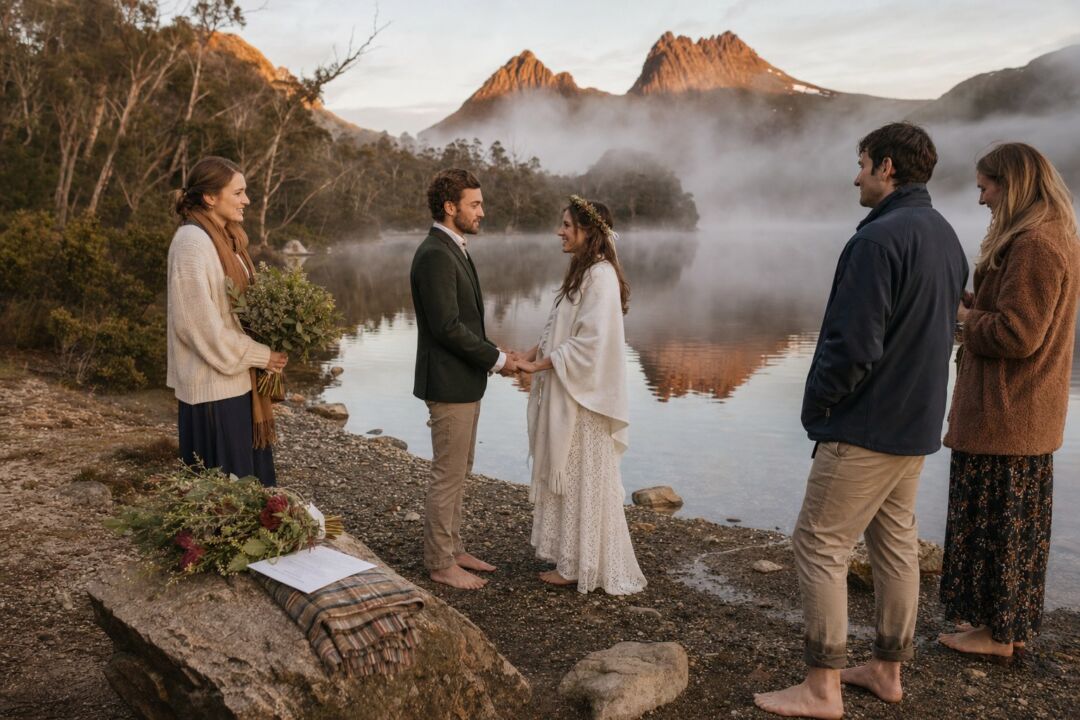
Winter (June-August): The tropical north, including the Daintree rainforest, the Kimberley, and Broome, is at its absolute best: no humidity, no cyclone risk, clear skies. This is genuinely one of the most underused windows for Australian elopements.
What an elopement costs in Australia
An elopement has three cost categories: the celebrant, the official marriage certificate, and any location permit or site fee.
Celebrant: Fees are not regulated by government and are set by individual celebrants. Contact registered celebrants directly for quotes via the Commonwealth Register at ag.gov.au. Ask what is included: NOIM preparation, travel, the ceremony itself, and post-ceremony certificate lodgment may be priced separately or together depending on the celebrant.
Official marriage certificate: This is the government-issued certificate you use for passport applications, name changes, and other legal purposes. It is separate from the presentation certificate you receive on the day and must be ordered from your state or territory Births, Deaths and Marriages registry after the marriage is registered. In NSW, the current fee is $70 for standard processing or $105 for priority processing, both including postage, per the NSW Government fee schedule current as at 1 July 2026. Fees in other states differ; check your state BDM registry’s website for the current schedule before budgeting.
Location permit or site fee: Contact the relevant managing authority directly (Parks Victoria, NSW National Parks, Queensland Parks, or your local council) for current fees and application requirements. Some locations charge nothing for very small ceremonies; others require a formal permit application with a fee.
Photography, florals, styling, and accommodation are discretionary and will make up the largest part of the total if you include them. Elopement photography packages vary widely; ask for quotes from photographers who specialize in elopements and outdoor locations in your chosen area.
Telling people: before, after, and the paper that does it
Some couples tell immediate family in advance and ask them to keep it quiet. Others prefer the ceremony first and the announcement afterward. Both approaches are legally and socially fine. Neither requires the other.
The stationery piece for an elopement is different from a wedding invitation. You are not asking people to attend; you are announcing something that has already happened. An elopement announcement card typically goes out within a few weeks of the ceremony. It reads more like a birth announcement than an invitation: who, when, where, a brief line about the choice to elope, and often a photograph from the day.
If you plan to host a celebration for family and friends after the fact, a second set of cards serves as the event invitation. These pair well as a coordinated suite with your announcement card so that everything reads as deliberate rather than assembled from separate orders.
Browse wedding stationery designs at Paperlust to see what works for a post-elopement announcement or celebration invitation. Paperlust designers can also customize a design around your ceremony location or a photograph from the day. If a celebration follows the elopement, save the date cards give interstate guests the lead time that a late invitation cannot.
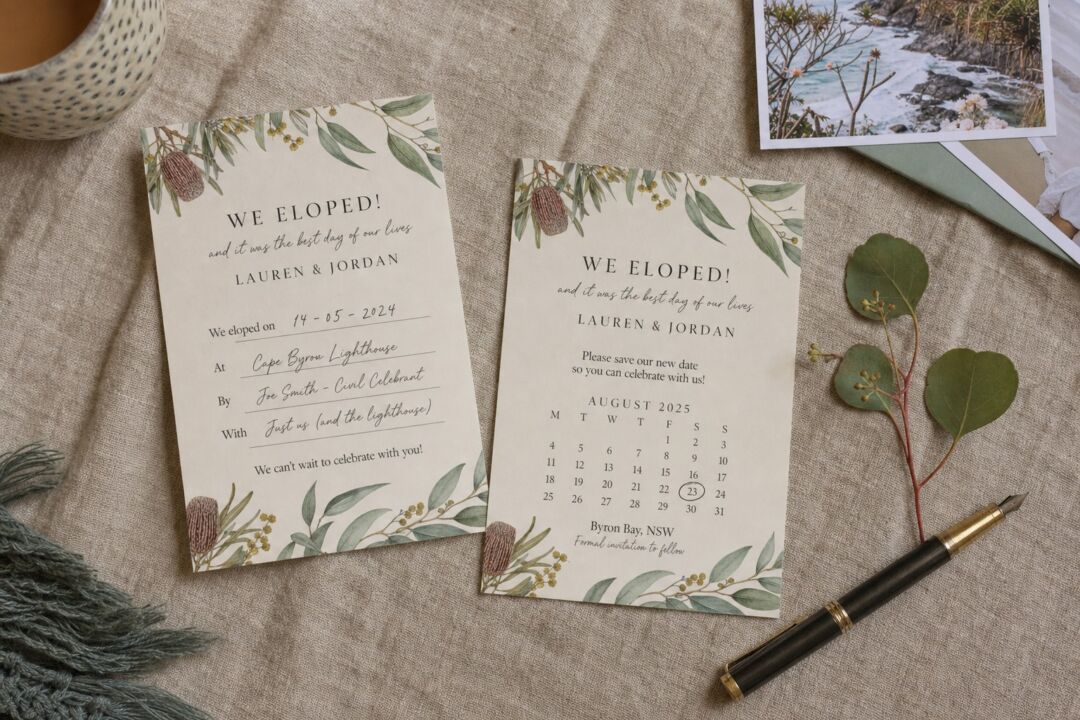
Announcement cards you personalize online and post the week after. The $5 sample pack puts seven designs and an envelope in your hands, including real foil and letterpress, so you judge paper and finish off a screen.
Frequently asked questions
Can you elope in Australia without telling anyone beforehand?
Yes. The Notice of Intended Marriage is a private document held by your celebrant and is not publicly listed or announced. Your ceremony does not need to be publicly advertised. The marriage is registered with the state BDM registry by the celebrant after the ceremony, but there is no public announcement requirement. You can elope with no guests and tell people at any point you choose.
Who can legally perform an elopement ceremony in Australia?
Only an authorized marriage celebrant or a registered minister of religion can legally solemnize a marriage in Australia. Your celebrant must be listed on the Commonwealth Register of Marriage Celebrants. You can search the register at ag.gov.au. Civil celebrants conduct the majority of Australian elopements.
Do the two witnesses need to be Australian citizens or residents?
No. Witnesses can hold any nationality. The legal requirements are that they are aged 18 or over, present for the full ceremony, able to understand English or the language used in the ceremony, and sober enough to sign the certificates. They do not need to know the couple personally.
Can you elope in a national park without a permit?
In most cases, no. Most national parks and state parks require a permit or notification for any wedding or elopement ceremony, even for very small groups. Rules vary significantly by state and by individual park. Contact the managing authority well before your planned date. Parks Victoria, NSW National Parks, and Queensland Parks each have different thresholds and timelines. Your celebrant may already be familiar with the rules for your chosen location.
How long does the NOIM need to be lodged before an elopement in Australia?
At least one full calendar month before the ceremony date, under the Marriage Act 1961 (Cth). The NOIM can be lodged up to 18 months in advance, which gives you flexibility to plan your elopement date after the paperwork is done. A court can shorten the notice period in genuine emergency circumstances, but this requires a formal application and is not a standard option.