
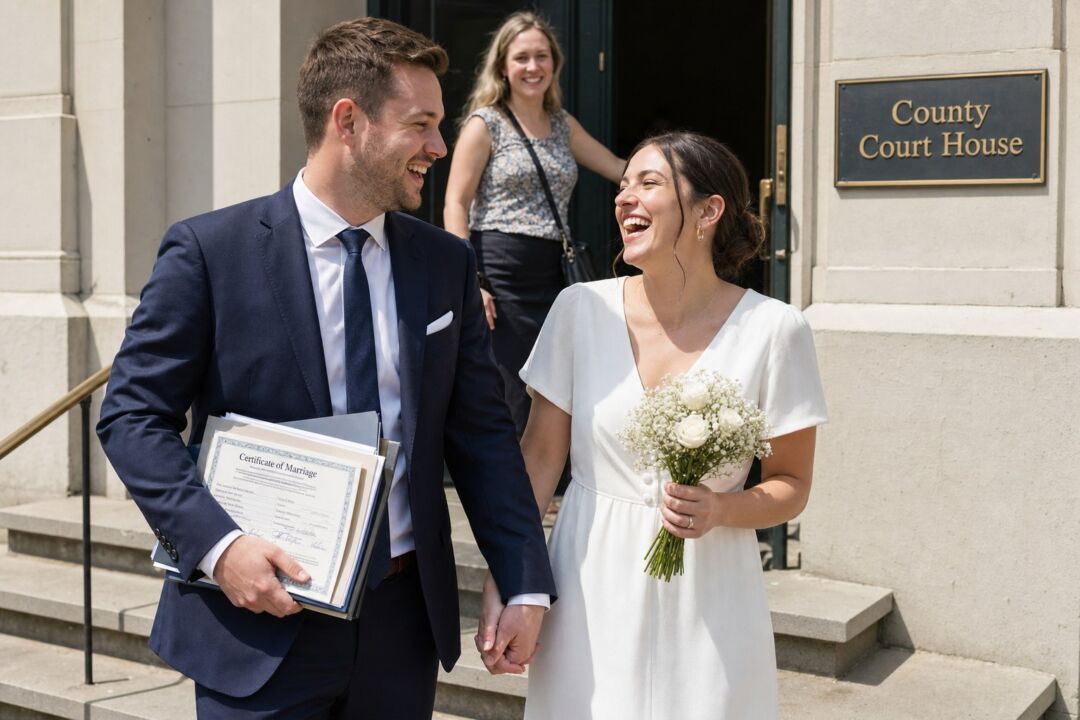
It is easy to look up the marriage license fee for a courthouse wedding, see a number well below what a traditional wedding venue quotes, and feel relieved. That figure is accurate. It covers the paperwork. What it does not cover is everything else you end up spending on the day you get married.
The official courthouse costs are genuinely low. The gap between that figure and what you actually spend comes from a category of expenses that does not feel like a “wedding cost” until you are in the middle of it: the outfit that is not quite casual, the photographer you decide you need after all, the dinner for twelve that becomes a proper celebration. And then, for some couples, there is a party weeks or months later that also belongs in the true cost of choosing this path.
This article is about that full number. If you want the official breakdown of what the courthouse charges by state and county, see How to Get Married at the Courthouse: A Complete Guide.
| Marriage license | Varies by county. Check your county clerk’s website. (Reference: Los Angeles County, CA charges $91 for a public marriage license as of July 2026.) |
| Civil ceremony fee | Varies by county; some include it in the license fee, others charge separately. Weekday slots are almost always cheaper than weekend. |
| Certified copies | Usually a few dollars each; order at least two to three copies at the courthouse window. |
| Legal total | Verify on your county clerk’s website before you budget. |
| Outfit (per person) | Depends on what feels right; a sale-rack find to a tailored piece covers a wide range |
| Hair and makeup | Optional; professional styling typically adds low-to-mid hundreds of dollars |
| Photography (1 to 2 hours) | Your largest single variable; courthouse mini-sessions in most US cities run several hundred to over $1,000 |
| Small bouquet | Optional; grocery store flowers work well and the photos are just as good |
| Celebration meal | Depends on group size and restaurant; dinner for two differs significantly from dinner for twelve |
| Realistic all-in for the day | A photographed, celebrated courthouse wedding typically runs several hundred to a few thousand dollars for most US couples |
| If you add a party later | Add significantly more; depends entirely on guest count and venue type |
Government fees vary by county and change periodically. Your county clerk’s website publishes current license and ceremony fees; check it before you budget. All other rows are general planning orientation that varies by location and supplier.
Stationery is one of the few remaining costs you can set yourself.
What the Courthouse Actually Charges
The legal costs of a courthouse wedding have three parts, all published on county clerk websites.
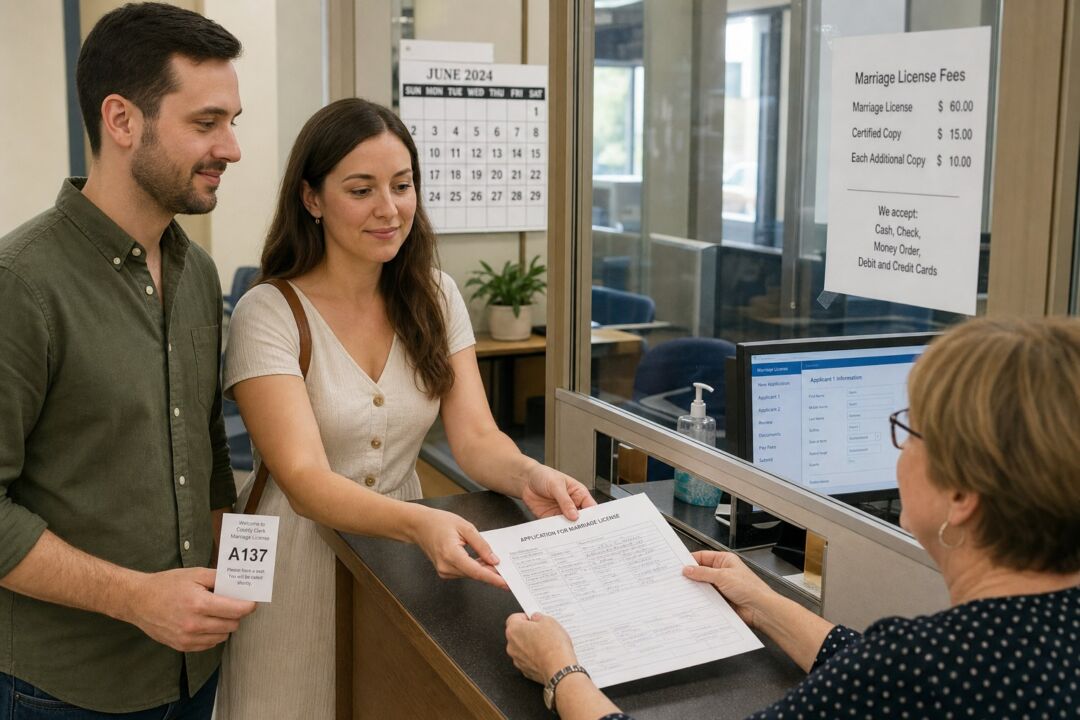
Marriage license. Both partners appear in person at the county clerk’s office and pay the fee at the time of application. Fees vary by county and are updated periodically; your county clerk’s website is the only reliable source for what you will actually owe. As a reference point: Los Angeles County, California charges $91 for a public marriage license, as listed on the LA County Registrar-Recorder/County Clerk fee schedule (lavote.gov/home/county-clerk/marriage-licenses-ceremonies/fees/fees, read July 31, 2026). Counties in other states may be considerably lower or higher. Many states also require a waiting period between when you receive the license and when you can use it, commonly one to five days. Some states reduce the fee if you complete a premarital education course, and it is worth checking whether your state offers this.
Civil ceremony fee. Some courthouses fold the ceremony into the license fee. Others charge separately. In Los Angeles County, the civil ceremony fee is $35 (lavote.gov/home/county-clerk/marriage-licenses-ceremonies/fees/fees, read July 31, 2026). Your county may charge more, charge less, or bundle the ceremony into the license fee entirely. Weekday business-hours slots are almost always cheaper than weekend ceremonies, which commonly carry a surcharge.
Certified copies. The certificate you receive at the courthouse is one certified copy. One is rarely enough. Social Security, your state DMV, mortgage lenders, and employers each need their own original. Order at least two or three copies while you are already at the window. The per-copy fee varies by county; check your county clerk’s website.
These three items combined can total very little or considerably more, depending entirely on your county. County clerk websites are the only reliable source for exact figures: fees change from year to year and vary enough between counties that general averages mislead.

The Costs That Catch Couples Off Guard
The courthouse fees are not where the budget slips. The gap opens in the hours surrounding the ceremony.
Outfit. A courthouse wedding does not require formal attire, but most people want to wear something that feels appropriate for the day. A simple dress, suit, or smart-casual set can come from a sale rack or a boutique; the range is wide. Professional hair and makeup, if you choose it, adds on top.
Photography. This is the single biggest variable. A courthouse ceremony takes five to fifteen minutes; couples who want professional photos typically book a photographer for one to two hours to cover the arrival, the ceremony, portraits, and a short session outside. Courthouse mini-sessions are a recognized format with their own pricing. Get quotes from three or four photographers in your area: prices vary significantly between smaller markets and major cities, and booking early almost always helps. If you want professional photos of your wedding day, plan for photography as your largest expense before you set everything else.
Flowers. Many courthouse couples pick up flowers from a grocery store on the way; the photos are just as good. A florist bouquet costs more; skipping florals entirely is also common.
The meal afterward. Unless you are heading straight home, this is the next line item. Dinner for two costs meaningfully less than dinner for eight to twelve, which scales up with every additional person and bottle of wine. This does not feel like a wedding expense. It is one.
Add these up and a thoughtful, photographed, nicely dressed courthouse wedding with dinner for a small group lands in the several-hundred-to-a-few-thousand-dollar range for most US couples. That is well below a conventional wedding, but it is a different number than the courthouse fee alone.
The party still needs an invitation, and it is usually the only printed piece of the whole wedding.
The Party Many Couples End Up Throwing Later
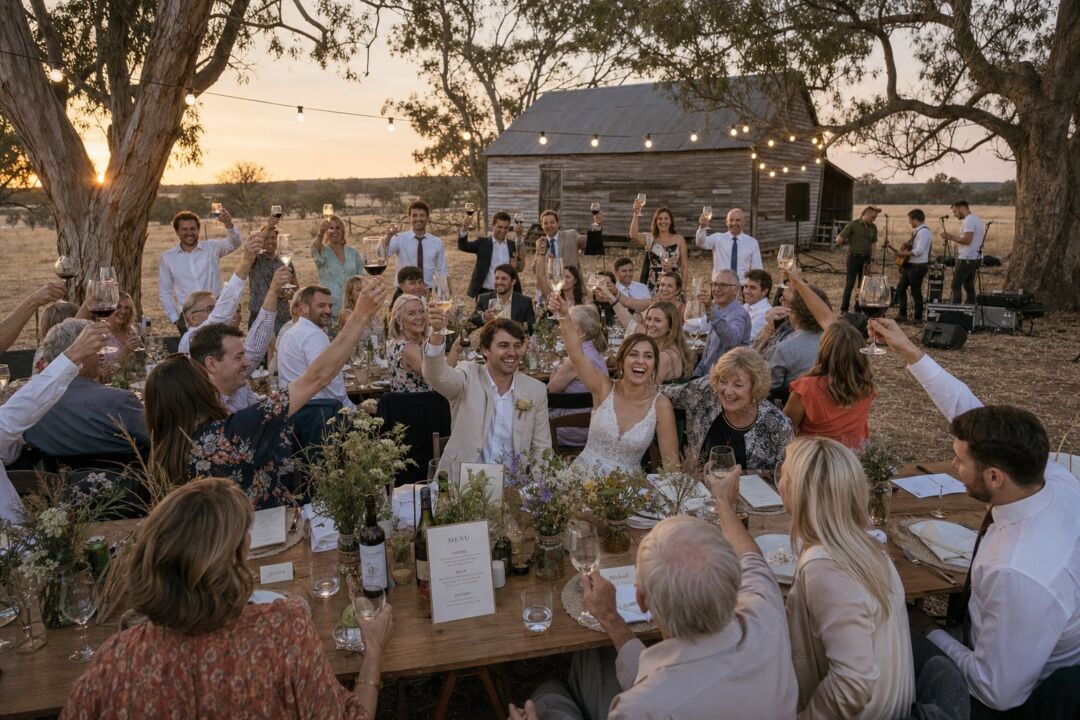
Some couples who have a courthouse wedding find themselves planning a second event weeks or months later. The reasons vary: family members who could not attend on short notice, friends who expected to celebrate with them, or simply the feeling that a private ceremony deserves a public moment too.
This celebration might be a backyard dinner, a restaurant buyout for thirty people, or something closer to a traditional reception. The cost depends entirely on scale: a home-hosted gathering for thirty and a rented venue with catering and an open bar are very different budgets.
This matters because a two-event strategy changes the math. A courthouse ceremony plus a proper celebration party for thirty guests can total several times the courthouse-ceremony-alone figure, depending on your choices. That combined spend is still commonly below the US average for a traditional wedding, but it is significantly different from the bare courthouse fee figure that often appears in quick-search results.
Think through the second event before committing to the courthouse ceremony. Some couples find it genuinely suits them: a private legal moment followed by a celebration on their own timeline. Others find that by the time they have spent on the party, they would have preferred planning a single event from the start.
If you do go the two-event route and need to invite people to a post-ceremony celebration, a set of wedding invitations keeps costs low without sacrificing the design quality the day deserves. A courthouse budget rarely justifies a full letterpress suite, and cheap wedding invitations cover the celebration mailing without reopening the number you set.
Courthouse vs. Elopement vs. Small Traditional Wedding: The Real Trade-offs
If you are weighing your options, here is how the formats compare on cost structure:
| Format | Typical guest count | What drives cost |
|---|---|---|
| Courthouse, legal fees only | 0 to 2 witnesses | License + ceremony + certified copies: see your county clerk’s website for the exact amounts |
| Courthouse + photos + dinner | 2 to 10 | Photography and the restaurant bill are the main variables; typically several hundred to a few thousand dollars all-in |
| Local elopement (outdoor, hired officiant) | 0 to 10 | Officiant fee and photography; similar cost range to a photographed courthouse wedding |
| Destination or adventure elopement | 0 to 10 | Travel and accommodation add significantly; can rival the cost of small traditional weddings |
| Small traditional wedding, 30 guests | ~30 | Venue, catering, and vendor stack; typically pushes well into five figures at this guest count |
| Small traditional wedding, 75 guests | ~75 | Same categories as above, scaled; national wedding industry surveys put the US average well above $30,000 |
Government fees from county clerk websites. All other estimates are general planning orientation; your actual costs depend on your location, choices, and suppliers. Ranges exclude rings.
A local elopement with a hired officiant and a photographer often costs roughly the same as a properly photographed courthouse wedding. The courthouse format is most distinct financially when you keep it to the legal minimum.
The biggest cost driver across every format is guest count. Two witnesses to thirty guests is what shifts you from four figures to five.
How to Keep Your All-In Under $2,000
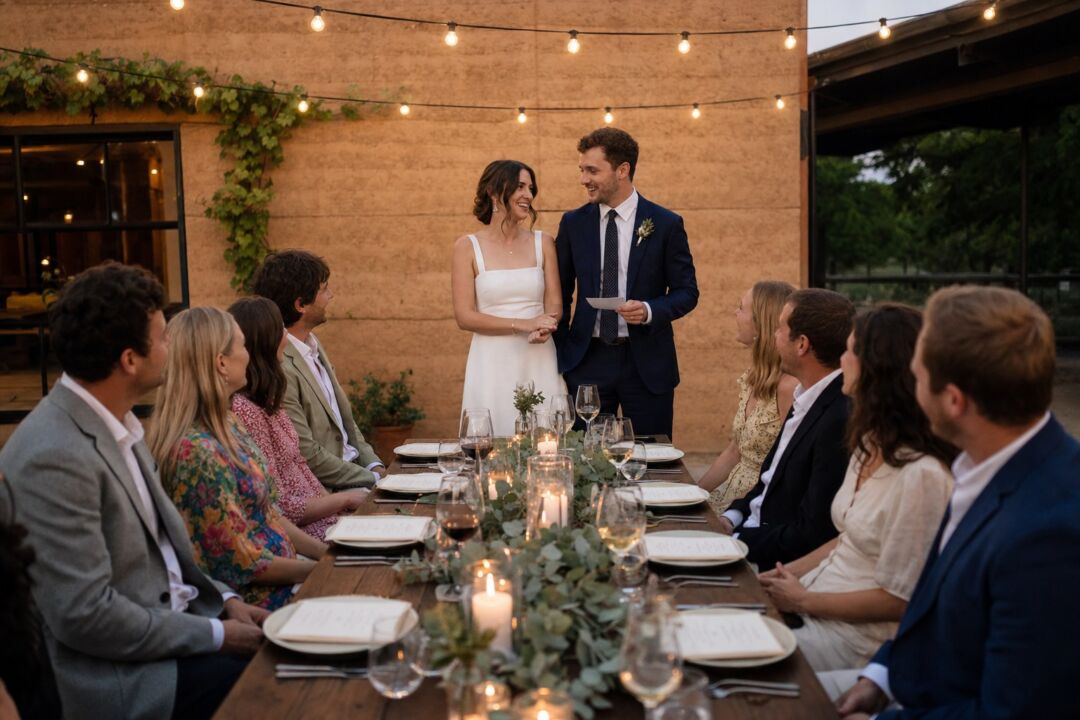
A courthouse wedding with professional photos, nice outfits, and dinner for a small group can fit under $2,000 in most US cities with some planning. Here is a realistic guide to where the money goes:
| Item | How to keep costs down |
|---|---|
| License + ceremony fee + 3 certified copies | Check your county clerk’s website for exact amounts; there is no way to reduce government fees |
| Outfits for two people | Sale racks and off-season shopping; courthouse attire is a fraction of formal wedding-dress spend |
| Photography, 1-hour mini session | Get three to four quotes; booking early and choosing a weekday often unlocks lower rates |
| Small bouquet | Grocery store flowers are a legitimate option; the photos are just as good |
| Dinner for two to six people | Keeping the group small is the biggest lever in this category |
| Staying under $2,000 | Realistic with a small dinner group, a photographer booked early, and off-the-rack attire |
The key levers: keep the dinner group small, book your photographer early, and choose a weekday ceremony slot to avoid weekend surcharges. Most of the budget flexibility sits in photography and attire. The license and ceremony fees are fixed by your county.

Budget-friendly invitation designs printed on real stock. The $5 sample pack puts seven designs and an envelope in your hands, including real foil and letterpress, so you judge paper and finish off a screen.
Frequently Asked Questions
How much is a courthouse wedding?
The courthouse fees (license, ceremony, and two to three certified copies) depend on your county; check your county clerk’s website for exact amounts before you budget. When you add outfit, one to two hours of professional photography, and dinner for a small group, the realistic all-in cost for the day typically runs several hundred to a few thousand dollars for most US couples in 2026, depending on your market and choices.
How much does it cost to have a courthouse wedding compared to a regular wedding?
A photographed, celebrated courthouse wedding can be done in the low thousands of dollars. A small traditional wedding for 30 guests typically involves a venue, catering, and vendor stack that pushes into the tens of thousands. National wedding industry surveys consistently put the US average well above $30,000. Even when you factor in a celebration party thrown weeks later, the courthouse-plus-party approach usually costs significantly less than a traditional wedding for an equivalent guest count.
How long does a courthouse wedding take?
The ceremony itself takes five to fifteen minutes. The full courthouse visit, including waiting, signing documents, and a short session outside for photos, typically takes one to two hours. You will usually also have a separate appointment to apply for the marriage license in advance (check your state’s waiting period). Plan for two to three courthouse visits total if your state requires the license and ceremony on different days.
Is a courthouse wedding legally valid?
Yes. A marriage performed by a civil officiant at a courthouse is fully legally recognized in all US states. You need a valid marriage license, a licensed officiant provided by the courthouse, and two adult witnesses in most states. After the ceremony, you receive a certified copy of your marriage certificate, which is the official legal proof of your marriage.
Is a courthouse wedding cheaper than eloping?
A bare-minimum courthouse wedding (legal fees only) is the cheapest legal path to marriage; your county clerk’s website has the current fee for your county. A fully photographed and celebrated courthouse wedding costs roughly the same as a local elopement with a hired officiant. Destination elopements, which involve travel and accommodation, are typically more expensive than courthouse weddings with a modest celebration, because of what you spend to get there.
What is not included in a courthouse wedding cost?
Courthouse fees cover the license, the officiated ceremony, and certified copies. Everything outside that is separate: outfit, professional hair and makeup, a photographer, flowers, rings, and any celebration meal or party. The fees also do not cover the name-change process, which requires additional steps at the Social Security Administration and your state DMV after the wedding, with separate fees for replacement documents.