

The legal window for your Notice of Intended Marriage is narrow at one end and generous at the other. Under section 42 of the Marriage Act 1961 (Cth), your celebrant cannot solemnise your marriage until they have held your NOIM for at least one calendar month. That same notice expires if eighteen months pass without a ceremony. The one-month minimum is widely known. What catches couples out is the detail: exactly when the clock starts, what to do if they are inside that window, and whether they can move the date after lodging.
This article covers those questions precisely. At the end is a combined legal and stationery timeline, because the NOIM milestones and the paper milestones interact in ways worth knowing before you book anything.
- Minimum notice: One calendar month before the ceremony. A calendar month means a full calendar month: if your wedding is on 15 November, the NOIM must be in your celebrant’s hands by 14 October at the latest.
- Maximum lead time: 18 months before the ceremony
- Clock starts: when your celebrant RECEIVES the form, not when you sign it
- Who you lodge with: your chosen authorised celebrant, not a BDM registry
- Inside one month? Only a prescribed authority can approve a shortening, on five specific grounds
- NOIM expired at 18 months? Lodge a new one; a fresh one-month minimum applies
- Changing date or venue? The NOIM stays valid if the new date is within the 18-month window and gives at least one month’s notice
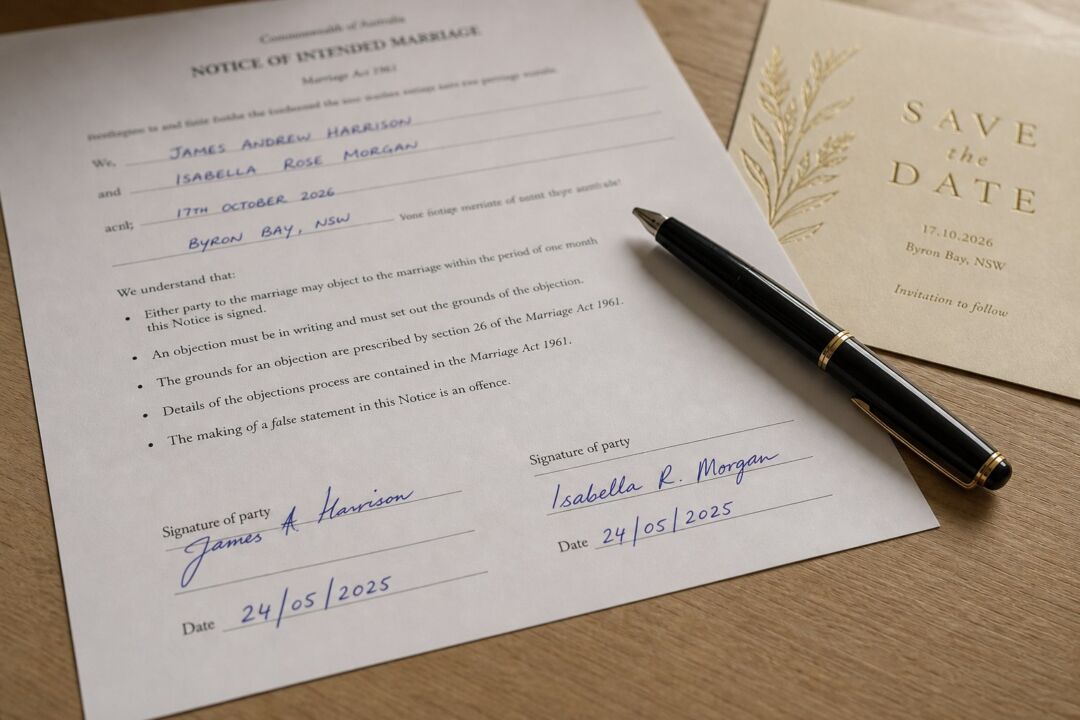
Your NOIM window is exactly when a save the date does its job, before invitations are anywhere near ready.
When Does the One-Month Clock Actually Start?
The clock does not start when you sign the form. It does not start when you scan and email it. It starts on the date your authorised celebrant actually receives a completed, signed, and correctly witnessed NOIM.
This distinction matters in practice. If you sign today and post the form, the one-month minimum does not begin until the document arrives with your celebrant. If you send a scanned copy by email, ask your celebrant to confirm receipt in writing and note the date, because that date determines when your marriage can legally take place. Nothing else starts the clock: not the booking date, not the deposit, not the first conversation.
The form must also be witnessed correctly at the moment of signing. If you sign it in Australia, an authorised marriage celebrant can witness it. If you are outside Australia when you sign, the witnessing rules are stricter (see the overseas section below).

What Happens If You Are Inside One Month?
Your celebrant cannot waive the one-month rule. Only a prescribed authority (a magistrate, court officer, or state BDM Registrar) can approve a shorter notice period, and only on one of five specific grounds. Your celebrant has no authority to grant the shortening themselves, but they can provide the supporting letter you need and direct you to the right authority for your location.
The practical process involves four steps:
Step 1: Lodge the NOIM with your celebrant immediately
You cannot apply for a shortening without a lodged NOIM already in place.
Step 2: Obtain a supporting letter from your celebrant
The letter confirms receipt of the NOIM and their willingness to perform the ceremony on the proposed date, subject to the shortening being granted.
Step 3: Gather evidence for one of the five permitted grounds
Your situation must fall into one of the categories listed in Schedule 3 of the Marriage Regulations. See the next section for what those are.
Step 4: Apply to a prescribed authority
Submit the NOIM, the celebrant’s letter, and your evidence to the appropriate authority. A non-refundable assessment fee applies; confirm the current amount directly with your prescribed authority before submitting. Approval is assessed on the evidence and is not guaranteed. Even if your circumstances fit a category, the authority may find the grounds insufficient.
The Five Grounds for Shortening – and One That Does Not Qualify
Schedule 3 of the Marriage Regulations lists exactly five grounds on which a prescribed authority may shorten the one-month notice period. These five are exhaustive. There is no discretion to grant a shortening outside them.
1. Employment-related or other travel commitments. An imminent overseas transfer or urgent travel situation that makes postponing the wedding impractical.
2. Wedding or celebration arrangements, or religious considerations. Significant arrangements already in place (venue contracts, catering bookings) that cannot reasonably be changed, or a relevant religious calendar consideration.
3. Medical reasons. Serious illness or incapacity affecting one of the parties or a close relative, where an early marriage is important.
4. Legal proceedings. Impending court hearings, incarceration, or legal deadlines affecting either party.
5. Error in giving notice. An administrative error, a genuine misunderstanding of the one-month rule, or a mistake by a third party that caused the late lodgement.
Ground five is the closest to “we ran late,” and it is often misread. It applies to genuine administrative errors, not to having simply left it too late through ordinary circumstances. “We did not organize it in time” is not one of the five grounds. A prescribed authority has no legal authority to approve a shortening on that basis, regardless of how sympathetic the situation is.
What Happens When Your NOIM Expires?
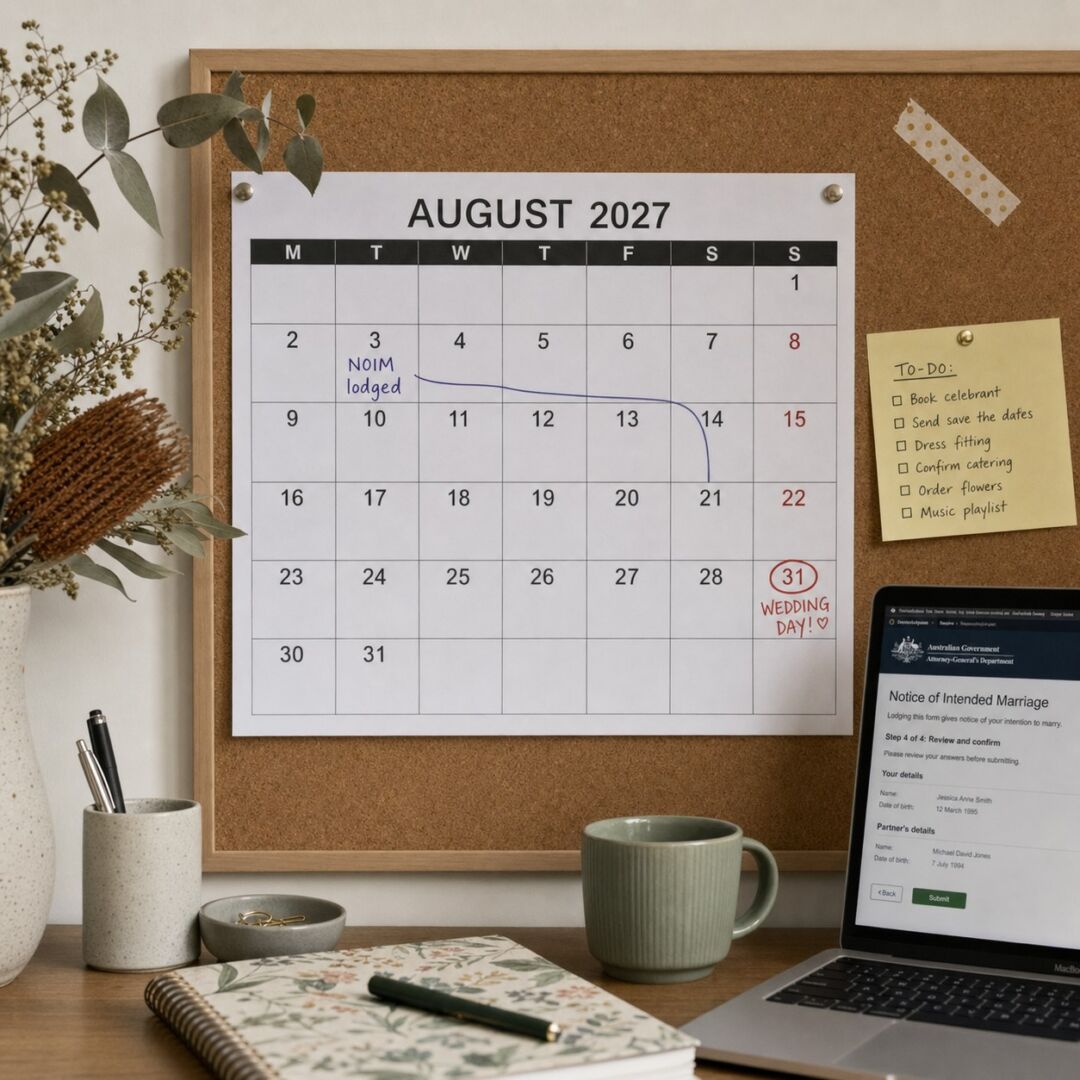
If eighteen months pass after your celebrant received the NOIM and the marriage has not taken place, the notice expires. There is no extension process. You cannot use the original NOIM to solemnise the marriage.
The practical consequence: lodge a new NOIM. That restarts the whole process, including the one-month minimum. If your new ceremony date is less than a month away when you lodge the replacement notice, you will need to apply for a shortening of time from a prescribed authority.
This is most common when couples postpone a wedding by more than six months. If you initially lodged your NOIM in early 2026 for a mid-2026 wedding and then pushed the ceremony to late 2027, the original NOIM will have expired long before the new date. Build a check into your planning calendar. Your celebrant should flag it too, but the obligation sits with the couple.
Wait until the venue and the NOIM agree before you print, then personalize and order in one sitting.
Can You Change the Date or Venue After Lodging?
Yes, you can change the wedding date after lodging your NOIM. The notice remains valid, provided two conditions are met: the new date must fall within the original eighteen-month window counted from when your celebrant received the form, and the new date must still give your celebrant at least one month’s notice. Tell your celebrant as soon as a date change is confirmed.
Venue changes are handled more loosely. The NOIM does not fix you to a specific location, and your celebrant can solemnise under the same NOIM at a different venue provided all legal requirements are otherwise met. Confirm any unusual venue with your celebrant before finalising.
Lodging from Overseas
You can lodge your NOIM while outside Australia. The timing rules are unchanged: the form must be received by your celebrant not earlier than eighteen months and not later than one month before the ceremony.
The key difference is who can witness the form. If you are outside Australia when you sign, an Australian authorised celebrant cannot witness it. Authorised overseas witnesses include Australian diplomatic or consular officers, a notary public, and authorised Commonwealth or Austrade employees. Your celebrant can direct you to the appropriate category for your location.
If only one party is overseas, there is a provision allowing the NOIM to be lodged with one signature, with the second party signing in the physical presence of the celebrant before the wedding. Confirm this arrangement with your celebrant before relying on it.
The Combined Timeline: Legal and Paper Milestones Together
The NOIM deadline and the stationery deadlines converge at the same point in your calendar. This table puts both on one axis. The save-the-date link in the twelve-to-eighteen-month row is the first paper decision that follows from having a confirmed date, which is the same thing that unlocks your ability to lodge the NOIM.
| When | Legal milestone | Paper milestone |
|---|---|---|
| 12-18 months out | Book your authorised celebrant and lodge the NOIM. This is the ideal window: well within the 18-month limit, and the one-month minimum is not a concern. | Confirm your date and venue, then order save the dates. Having a confirmed date and celebrant is what makes these possible. |
| 6-12 months out | NOIM is active and valid. No further legal action required unless your date or venue changes. | Send save the dates if not already done. Start finalizing your invitation design. Letterpress and foil orders need 20 or more business days of production time, so order early. |
| 6-8 weeks out | NOIM must already be received and valid. If it is not, you are inside the one-month window and a shortening application is urgent. | Send wedding invitations. Six to eight weeks is the standard; guests traveling from interstate or overseas need closer to twelve weeks. |
| 4-5 weeks out | Absolute lodgement deadline without a shortening. Your celebrant must have the NOIM in hand with at least one month to spare. | Set your RSVP deadline around now so you have final numbers with enough time to finalize on-the-day stationery. |
| 2 weeks out | Confirm any last-minute date or venue changes with your celebrant directly. | Finalize place cards, menu cards, seating charts, and ceremony programs. These go to print last and need accurate final numbers. |
| Ceremony day | Marriage solemnised. Your celebrant holds the signed NOIM as part of the legal record. | All stationery in place: ceremony programs, order-of-service cards, reception menus, and signage. |
For a full walkthrough of the legal process, including the documents you need, the difference between civil and religious ceremonies, and the steps from engagement to registry, see our guide to how to legally get married in Australia.
Place cards, menus and signage are the last pieces, ordered once numbers are final. The $5 sample pack puts seven designs and an envelope in your hands, including real foil and letterpress, so you judge paper and finish off a screen.
Frequently Asked Questions
How long before a wedding does a NOIM need to be lodged?
Your authorised celebrant must receive the completed NOIM at least one calendar month before the ceremony. There is no grace period below that threshold. The notice is also invalid if lodged more than eighteen months before the ceremony. Celebrants commonly ask for the NOIM when you book them, which is typically twelve to eighteen months out, well within both limits.
Does the one-month NOIM notice period start when I sign it or when my celebrant receives it?
When your celebrant receives it. If you sign today and post the form, the one-month period does not begin until the document arrives in their hands. If you scan and email it, ask for written confirmation of the receipt date, because that date determines when the marriage can legally take place.
Can a celebrant waive the one-month NOIM rule?
No. Only a prescribed authority (a magistrate or a state and territory BDM registrar) can approve a shortening of the notice period, and only on one of five specific grounds listed in Schedule 3 of the Marriage Regulations. Your celebrant has no authority to reduce or waive the one-month requirement, regardless of your circumstances.
What are the grounds for shortening the NOIM notice period?
There are five: employment-related or other travel commitments, wedding or celebration arrangements or religious considerations, medical reasons, legal proceedings, and error in giving notice. These are exhaustive. “We did not organize it in time” does not qualify as a standalone reason. The fifth ground (error in giving notice) requires a genuine administrative error, not ordinary late planning.
What happens if my NOIM expires before the wedding?
If eighteen months pass after your celebrant received the NOIM and no marriage has taken place, the notice expires and cannot be used. Lodge a new NOIM. The one-month minimum applies again from the date your celebrant receives the replacement form.
Can I lodge a NOIM from overseas?
Yes. The form must be signed in the presence of an authorised overseas witness: an Australian diplomatic or consular officer, a notary public, or an authorised Commonwealth or Austrade employee. Your Australian celebrant cannot witness the NOIM if you are outside Australia when you sign it. Send the witnessed form by post or email; the notice period starts when your celebrant receives it, not when you signed it.