
Australia |
United States |
United Kingdom |
Canada |
New Zealand
Your guest list is finalized. The venue has confirmed the floor plan. Now comes the part every couple quietly dreads: figuring out where 120 people sit for the next several hours. A well-done seating chart makes your reception run smoothly and keeps family dynamics from becoming the day’s biggest drama. This guide walks you through the entire process, from the moment RSVPs close through to display and day-of presentation.
- Start your seating chart 6-8 weeks before the wedding, once RSVPs are finalized.
- A seating chart assigns guests to tables; escort cards assign them to a seat; place cards mark the individual seat at the table.
- Strategic table assignment groups guests by relationship tier, age range, and comfort level, not just household proximity.
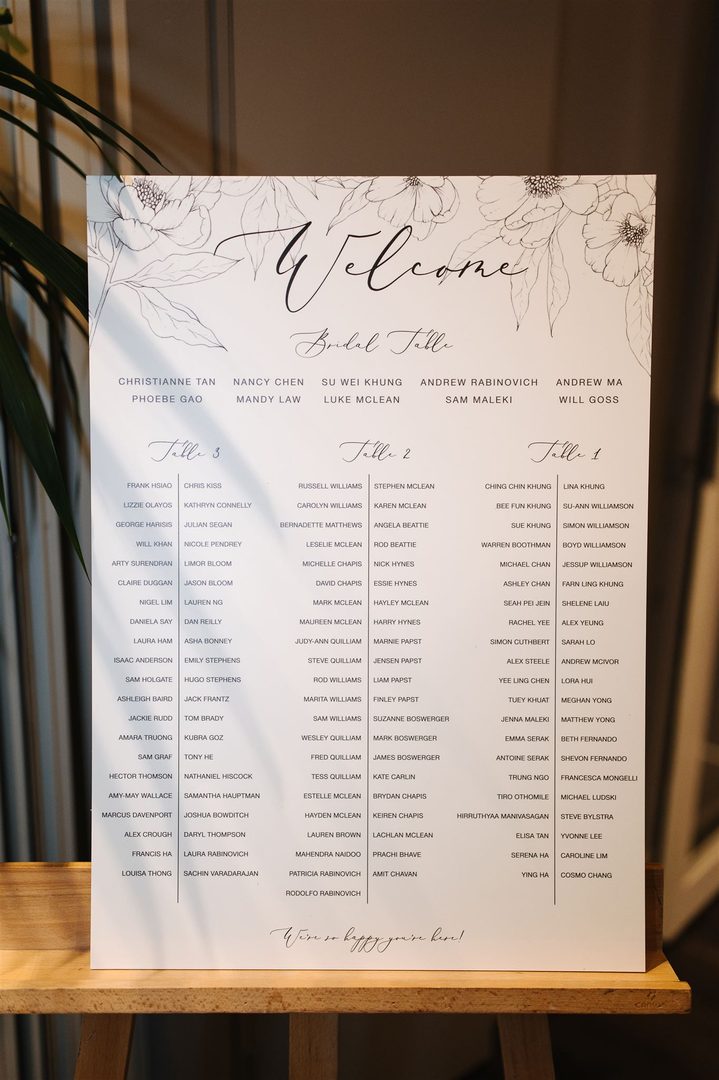
- Printed seating charts come in two main display formats: rigid PVC board (easel-mounted) and fabric (hanging or framed).
- Order your printed display 3-4 weeks before the wedding to allow proof, print, and delivery time.
- A digital backup (PDF on your phone + venue coordinator copy) prevents day-of panic if a guest can’t find their name.
What Is a Wedding Seating Chart and Do You Need One?
A wedding seating chart is a display at the venue entrance that lists every guest alongside their assigned table. Guests check the chart as they arrive and then find their seat independently. It is distinct from two related items that often appear alongside it.
| Item | What It Does | Where Guests See It |
|---|---|---|
| Seating Chart | Lists every guest with their table assignment | Displayed near the reception entrance on an easel or hanging frame |
| Escort Card | Individual card per guest naming their table (and sometimes seat number) | On a table, ledge, or display near the entrance, guests pick up their own |
| Place Card | Marks a specific seat at the table, typically with the guest’s name | Already positioned at the individual place setting on the table |
Many couples use all three. A printed seating chart near the entrance gives guests a big-picture overview; escort cards help them navigate; place cards confirm the exact seat. Some couples skip escort cards and rely solely on the seating chart plus place cards. Others skip place cards entirely and let guests within each table choose their own seats once they know which table they’re at.
Do you need a seating chart at all? For receptions with 40 guests or fewer, open seating often works fine. Above 60 guests, most planners recommend some form of assigned seating. A printed chart prevents clustering, awkward milling, and the bottleneck that happens when 150 people try to find seats at the same time. You can choose from more than 150 seating chart designs and add your guest names and table assignments.
For guidance on place cards specifically, see our wedding place cards guide, which covers wording, formats, and display ideas.


Moody TropicsVinyl foil

Burnt Butter CakesDigital printing
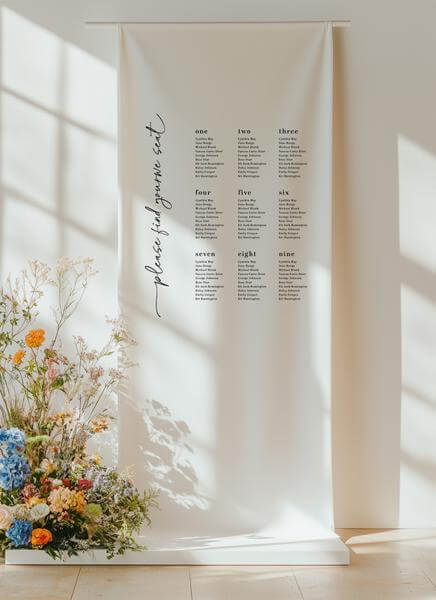
AlignDigital printing
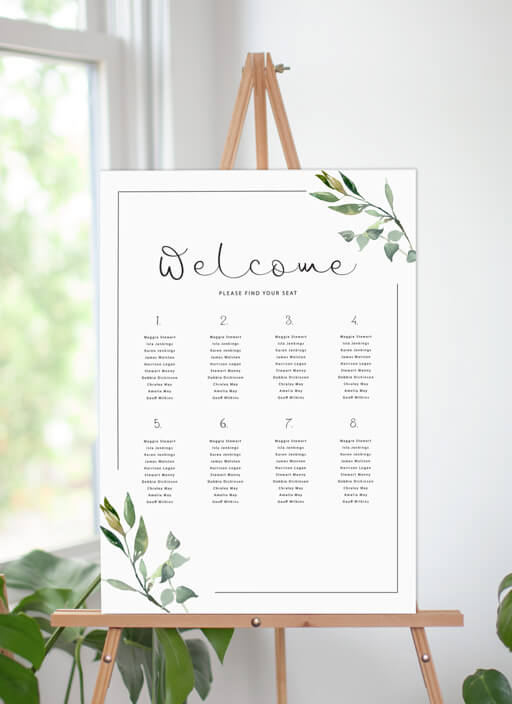
Garden WindowDigital printing
When to Start Your Seating Chart (Timeline After RSVPs Close)
The seating chart is one of the last major wedding planning tasks because it depends on your final guest count. Starting it too early means reworking everything when late RSVPs trickle in. Starting it too late means rushing a decision with real family dynamics at stake.
| Weeks Before Wedding | Action |
|---|---|
| 8-10 weeks out | Set your RSVP deadline. Confirm final capacity with the venue. Get the floor plan with table numbers and positions. |
| 6-8 weeks out | RSVPs close. Compile the final list. Begin draft seating assignments in your planning tool of choice. |
| 4-6 weeks out | Finalize table assignments. Resolve any placement challenges (divorced parents, estranged relatives, guest plus-ones you haven’t met). Share with partner and key family members for a sanity check. |
| 3-4 weeks out | Submit your seating chart for printing. Paperlust delivers designer proofs within 1-2 business days, so you have time to review and request adjustments before production begins. |
| 1-2 weeks out | Printed display arrives. Handle any last-minute guest changes on place cards (cheaper and faster to reprint one or two cards than the full chart). Prepare a digital backup PDF. |
One common delay: couples wait until the week before the wedding to chase stragglers. Plan for this. If your RSVP deadline is 8 weeks out, expect to spend a week following up on non-respondents before your list is actually final.
For a deeper walkthrough of the mechanics, see our guide on how to make a wedding seating chart, covering tools, spreadsheet templates, and the actual step-by-step assignment process.
Tools for Building Your Seating Chart: Apps, Spreadsheets, and More
You have three broad options for building the working version of your seating chart before it gets formatted for print.
Spreadsheet (Google Sheets or Excel)
The simplest option. Create one column for guest names, one for table number, and one for any notes (dietary needs, plus-one relationship, mobility requirements). Sort by table number once assignments are finalized to generate the display list in alphabetical order per table. Works well for couples who want full control and have a smaller guest list.
Seating Chart Apps
Apps like AllSeated, WedSites, and similar tools let you drag guests onto a visual floor plan, which makes it easier to visualize family clusters and traffic flow. Most sync with guest list imports. The limitation: they can get expensive for larger guest counts, and the floor plan visuals are sometimes less accurate than the actual venue layout.
Paperlust Address Manager
If you’re using Paperlust for your stationery suite, the address manager tool lets you import guest names from Excel, Facebook, or email, which significantly reduces manual data entry when submitting your seating chart design for print. You can upload a formatted guest list and the design team works from that to populate your display.
Which to Use
For most couples: start in a spreadsheet (it’s always available, easy to share with a partner or planner, and exports cleanly to CSV for print). Use an app if you want visual drag-and-drop for complex floor plans. Export your finalized list to whatever format your print vendor requires.
For free template downloads and a breakdown of the best apps by use case, see our companion guide: Wedding Seating Chart Templates: Free Options and How to Use Them.
How to Assign Tables Strategically
The assignment stage is where most of the real work happens. There is no universally “correct” approach, but the following framework applies to most receptions.
Start with the Must-Haves
Place these groups first, before you touch anyone else:
- Immediate family of both partners (parents, siblings, and their partners) near the front or in positions of honor, unless your family culture specifically calls for something else.
- Guests with mobility needs at easily accessible tables, near an aisle and close to restrooms if possible.
- Young children and their parents at a table where children can move a little without disrupting the whole room.
- Solo guests intentionally placed with people who share at least one connection, whether shared profession, mutual friends, or similar life stage.
Group by Relationship Tier
Once the must-haves are placed, work outward by relationship tier:
- Close friends together (people who already know each other tend to have better nights)
- Extended family together unless specific dynamics make that unwise
- Work colleagues together if they don’t overlap with the social friend groups
- “How do we know these people” guests together, which often works better than it sounds
Avoid the Common Mistakes
- Splitting up couples is rarely a good idea unless they specifically prefer it.
- Seating divorced or separated parents at the same table needs a conversation first, not an assumption.
- Putting all the “random” guests at one table is noticeable and unkind. Distribute solo or loosely-connected guests thoughtfully.
- Mixing age groups works best when there’s a real connection. A 25-year-old friend of the bride and a 70-year-old great-aunt may not have much to talk about over three courses.
The Final Check
Once every guest has been assigned, do one pass asking: “Is there anyone here who will be genuinely uncomfortable at this table?” Fix those before you finalize. A five-minute review now saves a potentially awkward conversation on the day.
For a full breakdown of etiquette considerations including divorced families, plus-ones, and children’s tables, see Wedding Seating Chart Etiquette: Who Sits Where and Why.
Seating Chart Display Options: Board, Fabric, Framed Poster
Once your assignments are finalized, you need a physical display at the venue. The format you choose affects the visual impact, venue logistics, and how easy the chart is to read at a distance.
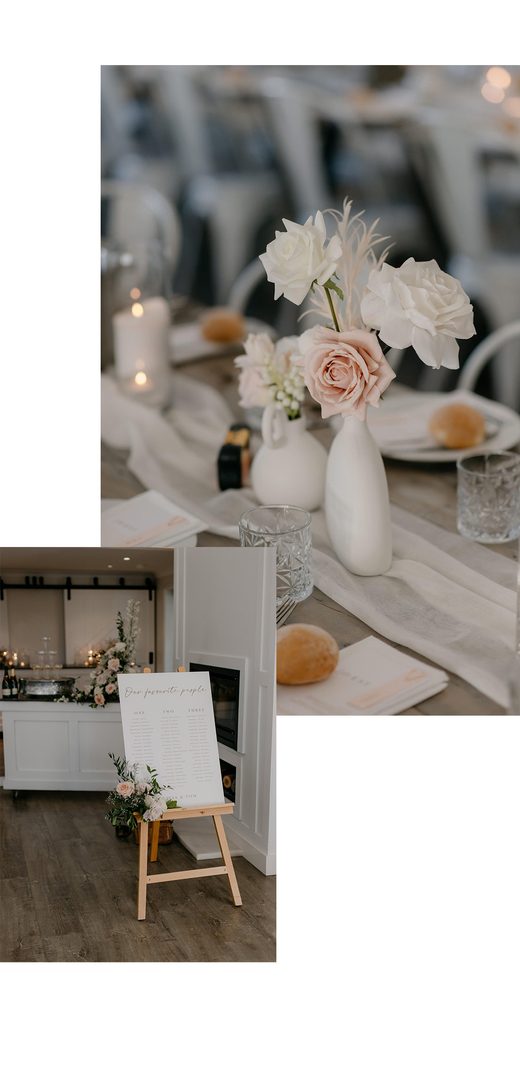
Printed PVC Board (Rigid)
A PVC board is a rigid flat panel, typically mounted on a wooden easel or leaned against a decorative frame. The print sits flush on the surface with no glare from glass. PVC is durable, doesn’t curl in humidity or outdoor settings, and holds up well for the entire reception. It’s a good choice for both indoor and outdoor venues, and works across styles from modern to rustic.
Fabric Display (Soft, Hanging)
A fabric seating chart is printed on a soft textile designed to hang from a frame or rod, or drape from a decorative mount. The fabric finish gives a softer, more tactile aesthetic, and is a popular choice for garden weddings, barn venues, and couples who prefer a warm, textured look over the clean precision of a flat board. Fabric also rolls rather than folds, so it travels and stores more easily.
Framed Poster
Some couples print on paper stock and mount it in a frame. This is a lower-cost option but requires a heavyweight paper stock to avoid visible creasing or buckling, and the reflective glass can make reading difficult in direct sun or strong event lighting. If you go this route, use non-glare glass and ensure the frame size accommodates all your guests at a legible font size.
Digital Display
A tablet or small screen displaying the chart is occasionally used at very modern or tech-forward weddings. It’s functional but lacks the visual presence and photo-ready quality of a printed display. Most couples who try it end up wishing they’d printed one for the photos.
For a detailed side-by-side comparison of all display formats with size guidance and venue matching, see our deep-dive companion post: Large-Format Wedding Seating Chart Displays: Board, Fabric, and Frame Options.
Printed Seating Chart Materials: PVC Board vs Fabric
Paperlust prints seating charts on printed PVC board, fabric, acrylic, and mirror acrylic, and this section compares printed PVC board and fabric. Both go through the same personalization and proofing process. The choice comes down to your venue setting, aesthetic, and practical transport needs.
| Factor | Printed PVC Board | Fabric |
|---|---|---|
| Finish | Flat, clean, precision-printed surface | Soft textile, warm and draped |
| Display method | Easel, stand, or leaned against a wall | Hanging rod, frame, or fabric mount |
| Best for | Indoor and outdoor, all styles, easy readability | Garden, barn, boho, rustic, warm-aesthetic venues |
| Humidity/outdoors | Excellent, won’t warp or curl | Good, doesn’t curl, slight texture movement in breeze can add to the look |
| Transport | Rigid, requires a flat surface in your car or delivery | Rolls for easy packing and transport |
| Vinyl foil accents | Available in gold, silver, or rose gold for headers and decorative elements | Not applicable |
| Keepsake potential | Frame it after the wedding; makes a striking display piece | Can be rolled and stored or reframed as a textile art piece |
If your venue provides easels, PVC board is the simpler logistical choice. If you’re handling your own setup and want something that packs flat in a carry-on or small car, fabric is worth considering. Either material is available in a range of Paperlust’s seating chart designs.
Browse the full collection: wedding seating charts at Paperlust.

Ordering and Printing Timeline for Your Display
Once your guest list and assignments are finalized, you need to allow enough time for design proofing, production, and delivery.
Standard Production Timeline
Step 1: Submit Your Order
- Upload your finalized guest list and table assignments
- Choose your design, material (PVC board or fabric), and size
- Select any extras like vinyl foil headers (gold, silver, or rose gold)
Step 2: Designer Proof
- A Paperlust designer sends your first proof within 1-2 business days
- Two rounds of revisions are included at no extra charge
- Check every name, spelling, and table number carefully at this stage
Step 3: Production
- Digital print orders: approximately 8-10 business days after proof approval
- Plan for any back-and-forth on proof revisions when building your timeline
Step 4: Delivery
- International orders via DHL Express: 2-4 business days transit after dispatch
- Free DHL Express shipping on orders over $350 USD
- Orders under $350 USD ship at a flat rate
Recommended Order Window
Place your order at least 3-4 weeks before the wedding. This gives you time for the full proof cycle and a buffer if revisions are needed. Ordering 5-6 weeks out is ideal if you have a complex guest list or a venue with unusual sizing requirements.
If a guest cancels or adds a plus-one in the final two weeks, handle that change on the individual place card level rather than reprinting the full chart. A simple handwritten addition to a place card is always acceptable, and no one at your reception is examining your seating chart for corrections.
How to Present Your Seating Chart on the Day
The logistics of displaying your seating chart on the day deserve more thought than most couples give them. A beautiful printed chart that guests can’t easily read or find creates the exact bottleneck you were trying to avoid.
Placement
Position the chart where guests naturally flow after entering the reception space, before they reach the tables. Near the entrance, beside a cocktail bar, or at the transition point from ceremony to reception all work well. Avoid placing it in a corner that requires guests to double back after seeing the chart.
Legibility at Scale
- Font size matters more than design at this stage. Guest names need to be readable from 3-4 feet away without squinting.
- Alphabetical order (by first name or last name, your call) is faster to navigate than by-table order for most guests.
- A brief sign next to the chart (“Find your name, then head to your table”) reduces questions if it’s a mixed crowd.
Staffing the Chart
For receptions over 80 guests, have one person (a friend, a coordinator, or a groomsman) standing near the chart during the first 20 minutes of cocktail hour. Their job is to answer “I can’t find my name” questions quickly rather than letting a queue form. Most seating chart issues trace back to name spelling discrepancies between what was submitted and what guests expect to see.
Day-of Digital Backup
Keep a PDF of the final seating chart on your phone and give a copy to your venue coordinator. If the physical display gets damaged, displaced, or if a guest absolutely cannot locate their name, the digital version resolves it in 30 seconds. This is the single most practical insurance step for the day.
Photography
Ask your photographer to get a detail shot of the seating chart early in cocktail hour, before guests have gathered around it. A clean shot of the display with the floral styling and lighting is a nice editorial image for the album.
Wedding Seating Chart FAQs
When should I finalize the seating chart?
Aim to finalize assignments 4-6 weeks before the wedding. This gives you time to handle any tricky placement decisions without rushing, and enough lead time to order a printed display and receive it before the day.
Do I need a seating chart if I’m having a small wedding?
For receptions under 40 guests, open seating works well. For 40-60 guests, it depends on your venue layout and guest mix. Above 60 guests, some form of assigned seating prevents confusion and bottlenecks at the entrance.
What is the difference between a seating chart, escort cards, and place cards?
A seating chart is a single display showing all guests and their table assignments. Escort cards are individual cards that guests pick up, each naming their table. Place cards are positioned at the actual seat at the table. Many couples use all three; some use just one or two depending on how formal and how large the reception is.
How do I list names on a seating chart?
Alphabetical by first or last name is the most common format. List both members of a couple on the same line with a slash (“Sarah / Tom Wilson”) or on consecutive lines. For children, include them under their parents’ line or list them separately depending on your chart layout.
What size should my printed seating chart be?
A1 (approximately 23 x 33 inches) works for most receptions up to 100 guests. For 100-200 guests, A0 or a split two-board layout is more legible. Paperlust’s design team will recommend the right format based on your guest count and table arrangement when you submit your order.
Can I add vinyl foil to my seating chart?
Yes. Vinyl foil in gold, silver, or rose gold can be added to headers and decorative elements on Printed PVC Board seating charts. This is a popular upgrade for couples who have a foil treatment on their invitation suite and want a consistent look across their day-of stationery.
What if a guest cancels last-minute after the chart is printed?
Leave the name on the chart and remove the place card from that seat. Guests won’t notice one missing name, and redoing the entire chart for a late cancellation is never worth it. For a last-minute addition, a handwritten place card is always acceptable.
How early do guests check the seating chart?
Most guests look at the chart in the first 5-10 minutes after entering the reception space, typically during cocktail hour. Having it in a clear, well-lit position near the entrance means the majority of guests are seated within 15 minutes, which keeps service timing on track.
Can I match my seating chart to my invitation suite design?
Yes. Paperlust offers matching design suites across seating charts, table numbers, place cards, menus, and ceremony programs. Ordering everything from the same suite ensures consistent typography, colors, and style across all your paper stationery.
Is it okay to seat divorced parents at the same table?
There is no universal rule here. It depends entirely on the relationship and what both parties are comfortable with. The safest approach is to ask both parents directly rather than assume. Positioning them at separate family tables with their respective partners or close friends is often the easiest solution for all involved.
Browse Wedding Seating Charts
500+ designs in printed PVC board and fabric. Matched suites available.