
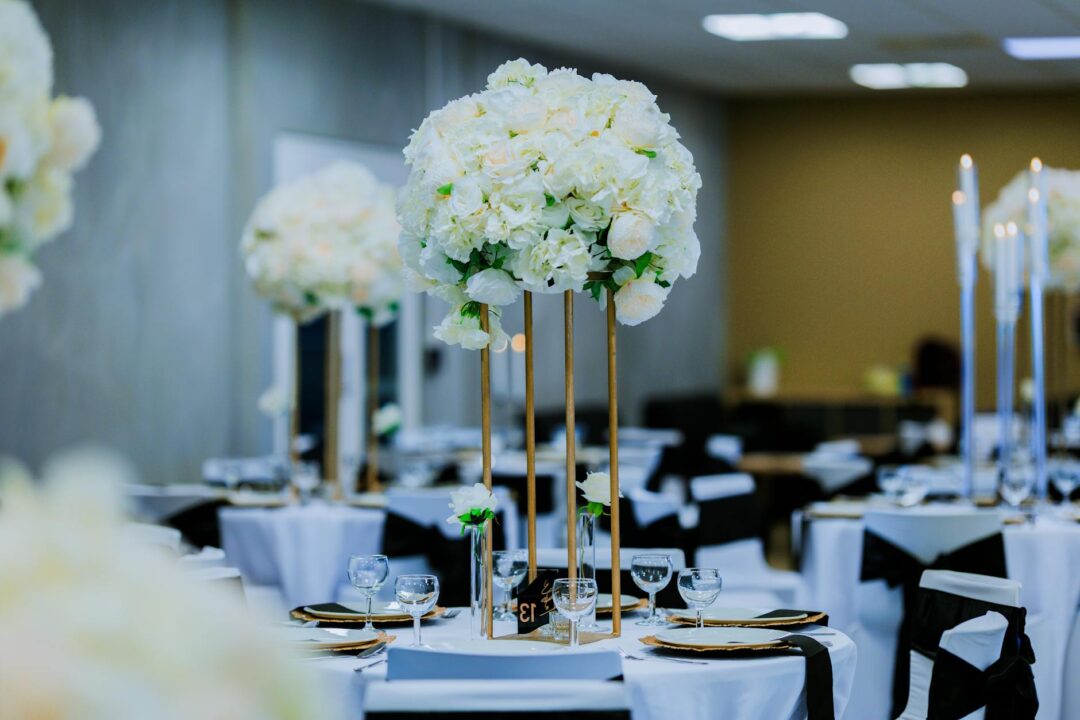


Your wedding centerpieces do more work than almost any other decor element in the room. They anchor each guest table, set the mood, reinforce your theme, and – when done right – become the backdrop for every table photo your guests take and share. Whether you are drawn to towering garden-style florals, low clusters of candlelight, or something non-floral entirely, this guide covers 50+ ideas across every style and budget, a realistic cost breakdown, a step-by-step DIY tutorial, and everything else you need to make confident decisions for your day.
- Centerpiece costs range from $20-50 per table (DIY) to $75-300 (professional florist) and $500+ for luxury installations.
- Estimate your table count by dividing your guest count by 9, most reception tables seat 8-10 guests, then add 2-3 extra for sweetheart, cocktail, and cake tables.
- Tall centerpieces (24 in / 60 cm+) require ceilings above 12 ft; low arrangements suit any venue and keep conversation flowing naturally.
- DIY florals save 40-60% but need 2-3 full days of prep, hiring a florist buys you time and guarantees professional conditioning of stems.
- Candles combined with flowers is the most requested look for 2026 and suits nearly every theme and price point.
- Non-floral centerpieces (lanterns, greenery-only, terrariums, book stacks) trend strongly in 2026 and typically cost 30-50% less than fresh-flower arrangements.
How to Choose Wedding Centerpieces
Before you commit to any centerpiece style, work through five practical filters. Skipping even one of them is how couples end up with arrangements that look beautiful on Pinterest but wrong in the actual room. These filters apply whether you are hiring a florist, going fully DIY, or doing a hybrid where a florist handles ceremony flowers and you handle reception centerpieces yourself.
Table size and shape
Round tables (typically 60 in / 152 cm diameter) are the most common and suit both tall pedestal arrangements and clusters of low bud vases. Rectangular farmhouse or banquet tables are a different challenge, one centerpiece per table looks lonely on an 8-foot run, so plan for either a row of low bud vases, a long garland “runner” of greenery and blooms, or multiple arrangements spaced along the length. Square tables work well with four-quadrant low arrangements or a single statement piece centered precisely.
Ceiling height and venue rules
Tall arrangements (anything above 24 in / 60 cm from the tabletop) only read as “tall” in venues with ceilings above 12 ft. In a lower-ceilinged barn, restaurant, or tent, the same arrangement will feel cramped. Ask your venue coordinator for the ceiling height in writing, many couples are surprised. Also ask whether open-flame candles are permitted; some venues restrict naked flames entirely and require LED alternatives. Balloon and floral arches sometimes require approval too, and outdoor venues have wind to contend with (top-heavy tall centerpieces need weighted bases).
Theme and aesthetic
Your centerpieces should feel like a natural continuation of the rest of your decor, from your wedding stationery to your linens. A romantic garden wedding with soft blush invitations calls for lush, loose arrangements of garden roses and peonies, not structured formal topiaries. A modern minimalist wedding with clean-lined invitations suits single-stem orchids in matte black vessels. The easiest way to test cohesion is to lay your invitation suite on a piece of your linen fabric next to a reference image of your proposed centerpiece. If they belong in the same photograph, you are on track.
Budget per table
Work backwards from your total floral budget. If you have $3,000 for centerpieces and 20 guest tables, that is $150 per table, solidly in florist-standard territory. If you have $1,000 and 20 tables, that is $50 per table, which is achievable with DIY. Many couples make the mistake of falling in love with a look before checking whether the math supports it. Build your centerpiece budget before talking to any florist.
Guest experience
Tall centerpieces that rise above eye level (roughly 18 in / 45 cm when seated) let guests see each other and talk freely underneath the arrangement. Arrangements between 12 in and 18 in (30-45 cm) can block sightlines across the table and interrupt conversation. If you want low centerpieces, keep them under 12 in (30 cm) or go taller than 24 in (60 cm), the “awkward zone” in between causes the most complaints. Also consider fragrance: heavily scented flowers like gardenias, stargazer lilies, and hyacinths can overpower dinner service and irritate allergy-sensitive guests.
Wedding Centerpiece Cost Breakdown
The most common question florists hear is “how much do centerpieces cost?” The honest answer is: it depends on flowers, vessel rentals, labor, and your location. The table below gives realistic ranges for US weddings in 2026.
Place cards anchor each table setting and guide guests to their seats. Browse foil, letterpress, and digital options to match your centerpieces.
| Tier | Cost per Table | What This Includes | Best For |
|---|---|---|---|
| DIY Simple | $20-50 | Grocery store or Costco blooms, dollar-store vases, pillar candles | Rustic, casual, barn, boho |
| DIY Elevated | $50-100 | Wholesale blooms (Sam’s Club, local flower market), rented vessels, premium candles | Romantic, garden, intimate |
| Florist Standard | $75-150 | Designed arrangement, 1-2 focal flowers, greens, labor, vessel | Most weddings, any theme |
| Florist Premium | $150-300 | Seasonal premium blooms, multiple focal flowers, specialty greenery, styled vessels | Romantic, glam, garden party |
| Luxury Installation | $300-500+ | Orchids, peonies out of season, full installs, custom rentals, designer labor | Ballroom, black-tie, luxury hotel |
Hidden costs to budget for: vessel rentals ($8-25 per piece), delivery and setup fees (often $200-500 per wedding), breakdown fees, and sales tax on florals. If your florist quotes a per-arrangement price, always ask whether delivery, setup, and retrieval are included before comparing quotes. Some florists also charge an additional fee for breakdown and disposal at the end of the night, confirm this before signing any contract.
Money-saving moves that actually work: Choose in-season flowers (their price drops 30-50% when locally abundant), use greenery as bulk filler, mix one statement bloom with lower-cost secondaries, rent statement vessels rather than buying them, and consolidate your florist’s travel by placing all your floral needs (ceremony, cocktail hour, reception) with a single vendor. Florists often discount multi-area bookings, and coordination is far simpler when one team manages everything.
Centerpieces by Style
Style is the starting point for every centerpiece decision, flowers, colors, vessels, and height all flow from it. Here are eight major wedding aesthetics with specific centerpiece ideas for each.
Romantic
Romantic centerpieces lean into softness, abundance, and warmth. The goal is an arrangement that looks lush but effortless, as if the flowers just happened to fall beautifully into place.
- Garden rose cluster: Mix 3-4 varieties of garden roses in blush, ivory, and champagne in a low compote vase lined with eucalyptus. Add a ring of votives around the base.
- Peony and ranunculus pillar: A tall arrangement of peonies, ranunculus, and sweet peas in a fluted gold vase, with trailing jasmine vine. Works best in venues with 14ft+ ceilings.
- Candlelit bud vase cluster: Group 7-9 bud vases of varying heights with single stems (a rose, a ranunculus, a sprig of dusty miller), surrounded by varying-height taper candles in brass holders.
- Cascading greenery runner: A low, horizontal arrangement of garden roses and trailing smilax greenery running the length of a rectangular table, with pillar candles at intervals.
- Soft blush mono-floral: A single flower species (all blush garden roses, all dusty pink ranunculus) densely packed into a low bowl, maximizes impact while keeping the look refined.
- Hanging floral ball: A suspended sphere of white and blush blooms above the sweetheart table, dramatic focal point that frees the tabletop for place settings.
Modern
Modern centerpieces favor architectural lines, unexpected vessels, and edited palettes. Less is more, a single sculptural bloom in a matte black vase says more than a crowded arrangement.
- Single-stem orchid tower: One tall phalaenopsis orchid stem in a narrow cylinder vase filled with smooth river stones. Repeat identically across every table for a cohesive, high-impact look.
- Geometric terrarium centerpiece: A faceted black or gold geometric vessel filled with a single large-headed bloom and structural foliage (monstera leaf, snake plant).
- Monochromatic white: All-white arrangement, white anemones, white ranunculus, white sweet peas, in a matte white ceramic vessel. Clean, modern, and florist-budget-friendly.
- Sculptural dried arrangement: Dried pampas grass, preserved magnolia leaves, and bleached branches in a concrete or ceramic vase. Lasts forever and can be prepared weeks ahead.
- Floating orb: Clear acrylic sphere half-filled with water and a single bloom (a large garden rose or peony) floating inside. Striking on round tables.
- Anthracite and gold contrast: Dark-stemmed calla lilies in a matte black vessel against white linens and gold flatware, high contrast, undeniably modern.
Boho
Boho centerpieces celebrate texture, imperfection, and earthy warmth. Mixing dried and fresh elements is a signature move, and no arrangement should look too “designed.”
- Pampas and protea mix: Natural pampas grass plumes, dried protea, and fresh eucalyptus in a terracotta or rattan-wrapped vase. Wildflowers like cosmos or strawflower add color pops.
- Wildflower meadow low arrangement: A loose, unstructured bunch of wildflowers (cornflowers, chamomile, clover, larkspur) in a vintage mason jar or milk glass vase. Feels gathered from a field.
- Macrame-wrapped cylinder: A glass cylinder vase wrapped in natural macrame twine, filled with dried grasses, pampas, and a few fresh garden roses in rust or terracotta tones.
- Wood slice and bud vase combo: A thick wood slice “base” with 3-5 bud vases of varying heights, small candles, and scattered crystals or shells.
- Dried citrus garland runner: Dried orange slices, cinnamon sticks, and dried rose heads threaded on twine as a flat table runner, supplemented with small pillar candles. Zero florals, maximum texture.
- Trailing vine arrangement: A tall clear vase with a single dramatic trailing vine (Italian ruscus or smilax) winding out and across the table, with small flowers tucked in at intervals.
Rustic
Rustic centerpieces lean on natural materials, warm tones, and casual abundance. The vessels are as important as the flowers, weathered wood, galvanized metal, and mason glass all work here.
- Mason jar wildflower trio: Three mason jars of varying sizes filled with sunflowers, daisies, and zinnias tied with burlap twine. Inexpensive and deeply charming.
- Galvanized bucket arrangement: A short, wide galvanized bucket packed with sunflowers, chamomile, herbs (rosemary, lavender), and greenery. Place on a wood slice for extra texture.
- Wooden crate with candles: A shallow wooden crate lined with moss and filled with pillar candles of varying heights, small potted succulents, and scattered flower heads.
- Lantern and wildflower pairing: An iron lantern (open-flame or LED candle inside) flanked by two small vases of sunflowers and baby’s breath. Scales up easily across many tables.
- Herb centerpiece: Small potted herbs (lavender, rosemary, thyme) as the centerpiece, labeled with a note that guests can take home their pot. Doubles as a favor.
- Wine barrel ring: For venues with wine barrels, a ring of greenery and blooms placed on top of a barrel at cocktail-hour stations adds instant rustic elegance.
Minimalist
Minimalist centerpieces work best when every element is intentional. A bud vase cluster with a single species repeated identically across all tables is often more striking than a florist’s most complex arrangement.
- Bud vase grid: 5-7 bud vases in a tight cluster, each holding a single stem of the same flower (all white anemones, all blush tulips, all blue thistle). Uniform vessels strengthen the look.
- Single sculptural bloom: One oversized bloom, a king protea, a dinner-plate dahlia, or a giant white ranunculus, in a single slim vessel. No greenery, no filler.
- Greenery runner only: A flat runner of eucalyptus and fern along the table length, with no flowers at all. Let the table setting (chargers, napkins, glassware) carry the color.
- Three-candle cluster: Three pillar candles of varying heights in identical matte vessels, flanked by two small sprigs of eucalyptus. Zero flowers. Extremely cost-effective.
- Single-color monochromatic: All-one-hue arrangement (all sage green, all blush, all pure white) in a similarly toned vessel. Looks intentional, never sparse.
Glam
Glam centerpieces go all-in on shine, drama, and luxury. Crystal, gold, and mirror elements pair with statement florals to create a reception that photographs like a fashion editorial.
- Crystal candelabra with blooms: A tall crystal or gold candelabra filled with white and blush garden roses, hanging crystals, and tapered ivory candles. The defining look of black-tie receptions.
- Gold compote overflowing: A gold compote vase overflowing with blush garden roses, white peonies, trailing orchid stems, and gold-sprayed foliage. Rich, abundant, unmistakably glam.
- Mirrored base with floral dome: A mirrored base holding a low, dense dome of all-white blooms (roses, hydrangea, gardenia). The mirror doubles the visual impact and reflects the candlelight.
- Orchid tower: A tall, slender gold vessel with 2-3 cascading orchid stems arranged to drape naturally. Add floating candles in gold-rimmed glass bowls around the base.
- Champagne flute cluster: Vintage-style champagne flutes filled with water and floating flower heads (gardenias, roses) clustered with gold taper candles. Lower cost, maximum glamour.
- Feather and flower: Ostrich feathers (white or blush) mixed with premium florals in a gold or silver urn. Reserved for the most formal venues, do not use at barn or garden settings.
Tropical
Tropical centerpieces use dramatic foliage, bright blooms, and lush volume. They work beautifully at beach, destination, and garden receptions, especially in warm-weather months.
- Bird of paradise statement: One or two birds of paradise stems in a tall clear vase, flanked by monstera leaves and white anthurium. Structural, dramatic, unmistakably tropical.
- Hibiscus and palm runner: A low runner of palm fronds, hibiscus flowers, and bird of paradise blooms along a rectangular table. Works well for outdoor beach receptions.
- Tropical fruit and flower mix: A low wooden bowl of tropical fruits (pineapple, starfruit, passion fruit) surrounded by large tropical blooms (anthurium, ginger, heliconia). Unique, fragrant, and memorable.
- All-green tropical: Dense arrangement of monstera, palm, banana leaf, and ferns only, no flowers. The drama comes entirely from the foliage scale and texture contrast.
- Bright floral clash: A deliberately bold clash of coral, fuchsia, and orange tropical flowers (gerbera daisy, hibiscus, bougainvillea) for couples who want high color energy.
- Wicker basket tropical: A low wicker basket overflowing with tropical foliage and blooms, relaxed, casual, beach-perfect, and a fraction of the cost of tall arrangements.
Vintage
Vintage centerpieces lean on heirloom vessels, soft garden flowers, and a deliberately curated “found” aesthetic. The vessels matter as much as the flowers, source them from estate sales, antique shops, or rental companies specializing in vintage props.
- Compote vase garden mix: A vintage pressed-glass or milk-glass compote filled with sweet peas, garden roses, lily of the valley, and trailing jasmine. The definition of English garden romance.
- Mismatched vintage vessels: A collection of 5-7 mismatched vintage vases (mercury glass, cut crystal, pressed glass) in varying heights, each with a few stems. Works spectacularly on rectangular tables.
- Teacup arrangements: Antique teacups as bud vases, each holding 2-3 stems of a delicate flower (sweet peas, violets, lily of the valley). Charming at garden parties, brunch receptions, and intimate dinners.
- Book stack centerpiece: A stack of vintage hardcover books topped with a small vase of garden roses and a framed photo or quote card. Non-floral option with deep personality.
- Apothecary jar cluster: 3-5 apothecary jars of varying sizes filled with dried lavender, dried rose petals, or small fresh florals, with a small candle cluster. Works in muted, moody palettes.
- Candelabra with garden roses: A wrought-iron or brass candelabra wreathed in garden roses, sweet peas, and trailing vines. Romantic, old-world, and deeply photogenic.

Floral Centerpieces by Color: 10 Palette Pairings
Choosing flowers by color palette before choosing specific blooms makes florist consultations faster and keeps your options open when certain flowers are out of season. Here are 10 curated pairings that consistently photograph well and work across the most popular wedding themes.
| Palette | Key Flowers | Best Season | Best Theme |
|---|---|---|---|
| Blush + Ivory + Sage | Garden roses, ranunculus, eucalyptus, dusty miller | Spring, Summer | Romantic, Garden, Boho |
| White + Gold | White orchids, white peonies, baby’s breath, gold-sprayed foliage | Year-round | Glam, Modern, Black-tie |
| Dusty Rose + Burgundy + Mauve | Peonies, ranunculus, dahlias, burgundy astilbe | Fall, Late Summer | Romantic, Vintage, Rustic |
| Navy + White + Silver | Blue delphinium, white hydrangea, silver brunia berries | Year-round | Classic, Modern, Nautical |
| Coral + Peach + Terracotta | Garden roses, chrysanthemums, dried lunaria, copper foliage | Summer, Fall | Boho, Desert, Rustic |
| Lavender + Lilac + Sage | Lavender, sweet peas, lisianthus, sage eucalyptus | Spring | Garden, Romantic, Vintage |
| Bold Red + Deep Green | Red roses, red ranunculus, dark Italian ruscus, holly | Winter | Classic, Glam, Holiday |
| Yellow + White + Greenery | Sunflowers, white hydrangea, chamomile, ferns | Summer | Rustic, Garden, Casual |
| All-White Monochrome | White peonies, white ranunculus, white anemones, white eucalyptus | Year-round | Minimalist, Modern, Classic |
| Moody Jewel Tones | Deep purple dahlias, burgundy ranunculus, plum sweet peas, forest greenery | Fall, Winter | Dark Romance, Vintage, Glam |
Tip: Share this palette table with your florist and highlight your top two. A good florist will then suggest which specific blooms are most affordable and available for your wedding date, which is far more practical than arriving with a specific flower name and being told it is not in season.
A note on seasonal pricing: flowers that are in-season locally can cost 30-50% less than the same blooms sourced out-of-season from overseas growers. Garden roses and peonies are most affordable in late spring and early summer; dahlias peak in late summer and fall; anemones are a winter and early spring bloom. If your wedding date falls near the natural season of your preferred flower, your florist has maximum flexibility and minimum cost. If your date is off-season, discuss substitutions early, a skilled florist can match almost any look with in-season alternatives that photograph just as beautifully.
When reviewing color palettes with a florist, always bring physical swatches of your linen, bridesmaid dress fabric, and stationery samples rather than relying on photos on a phone screen. Phone screens render color differently depending on settings and ambient light. Physical swatches let your florist make accurate selections that match your actual wedding colors, not a digital approximation of them.
Non-Floral Centerpieces
Fresh flowers are the default, but they are not the only option, and for some budgets, themes, and venues, non-floral centerpieces are genuinely the smarter choice. They can be prepared further in advance, require no conditioning, and often cost significantly less per table.
Menu cards add a polished editorial moment to every place setting and double as a keepsake. Choose from flat-lay, single-card, or folded formats.
Candle clusters
Groups of candles in varying heights and widths are the most popular non-floral centerpiece and for good reason, they are infinitely scalable, budget-friendly, and create the warmth and intimacy that flowers alone cannot. Mix pillar candles (3 in / 7.5 cm diameter and above), taper candles in tall brass or iron holders, and votive candles in mercury glass or clear glass holders. Use a mirrored or marble base to reflect the light upward. A cluster of 9-12 candles can fill a 60-inch round table visually without spending a dollar on flowers. Always confirm open-flame permissions with your venue first.
Lanterns
Iron, brass, or wood-frame lanterns, with a real or LED candle inside, pair with almost any theme. For rustic or boho receptions, use distressed iron lanterns on raw wood slices. For glam or vintage receptions, use brass or gold lanterns on mirrored surfaces. A single large lantern flanked by two small bud vases is a complete centerpiece at a fraction of florist pricing. Most wedding rental companies carry lanterns in bulk, making them a reliable, cost-controlled option.
Book stacks
Stacked vintage hardcover books topped with a small bud vase, a candle, or a framed quote card make a genuinely distinctive centerpiece for literary couples, bookshop venues, and library wedding aesthetics. Source books from estate sales, thrift stores, or library book sales, aim for 3-5 volumes per stack in complementary spine colors. Top each stack with one small element: a single rose in a bud vase, a votive candle, or a small framed favorite quote. This centerpiece essentially costs the price of the flowers, the books themselves are usually $1-3 each.
Fruit and botanicals
A Mediterranean-inspired spread of fresh fruits, herbs, and vegetables makes a striking centerpiece for al-fresco, vineyard, and harvest-themed weddings. Pile pomegranates, figs, grapes, and green apples in a shallow wooden bowl lined with olive branches or eucalyptus. Add small clusters of dried lavender or rosemary sprigs for fragrance. This approach costs $15-30 per table when sourcing from a farmers market and looks genuinely abundant without a single cut flower.
Greenery-only
All-greenery arrangements are growing fast as a centerpiece trend in 2026. A dense low arrangement of eucalyptus, ferns, boxwood, and Italian ruscus in a simple white vessel reads as sophisticated rather than unfinished, especially when paired with quality linens and glassware. Greenery is also significantly cheaper than blooms per stem, and many wholesale florists sell large eucalyptus bunches for under $10. A full low arrangement typically uses 5-8 bunch units. For rectangular tables, a long greenery garland runner (no blooms) is one of the cleanest, most on-trend centerpiece approaches available.
Terrariums
Glass geometric terrariums filled with succulents, moss, small stones, and air plants suit modern, minimalist, tropical, and nature-forward aesthetics. They are reusable (guests can take them home as living favors), require no water on the day, and can be assembled weeks in advance. A medium-sized geometric terrarium (6-8 in / 15-20 cm) typically costs $25-45 when purchased in bulk for a wedding. Add a card at each terrarium inviting guests to take it home, it doubles as your centerpiece and your favor, eliminating a line from the budget entirely.

Your centerpieces deserve table signage to match
Table numbers, menu cards, and escort cards that tie your stationery suite to your centerpiece aesthetic. Printed on 500+ gsm cotton and foil-stamped stock for a luxury finish at every place setting.
Tall vs Low Centerpieces: When to Use Each
The tall-vs-low question is the one couples most often get wrong, not because they make the “wrong” choice, but because they do not account for their venue’s proportions before committing. Here is a practical framework.
When tall centerpieces work
A tall centerpiece is typically anything that rises more than 24 in (60 cm) above the tabletop. To read as dramatic rather than just “tall,” the bottom of the arrangement should clear seated eye level, roughly 18-20 in (45-50 cm) from the tabletop, so guests can see each other underneath. This means the effective arrangement usually runs from 20-24 in at its narrowest point up to 36-48 in (90-120 cm) at its peak.
- Venues with ceilings above 12 ft (hotel ballrooms, large estate venues, converted warehouses)
- Wide tables where a low arrangement would look proportionally small
- Glam, black-tie, and formal aesthetics where drama is expected
- When you want to alternate tall and low across tables for visual rhythm
The math: tall arrangements typically cost 20-40% more than low arrangements because of the additional stems, vessel height, and structural support required.
When low centerpieces work
Low centerpieces (under 12 in / 30 cm from tabletop to highest point) are the most guest-friendly option at every venue and budget level. There are no sightline issues, no conversation barriers, and no ceiling-height restrictions to navigate.
- Any venue with ceilings below 12 ft (barn, restaurant, intimate garden spaces)
- Rustic, boho, garden, and casual aesthetics where informality is an asset
- Smaller budgets (low arrangements use fewer stems per table)
- Rectangular farmhouse tables (low arrangements spread more naturally)
- Outdoor receptions prone to wind (low arrangements are more stable)
Mixing tall and low
One of the most effective approaches is alternating tall and low centerpieces across tables. The visual rhythm breaks up what would otherwise be a flat sea of identical arrangements. The standard approach: tall pedestal arrangements on even-numbered tables, low clusters on odd-numbered tables. This also saves money relative to making every table tall, you only pay for the tall vessels and extra stems on half your tables.
The “awkward zone” to avoid
Avoid arrangements that land between 12 in and 20 in (30-50 cm) above the tabletop. This is the zone that is too tall to see over comfortably but not tall enough to see underneath, it blocks sightlines without adding any drama. If your florist proposes an arrangement in this height range, push either lower or higher.
DIY Wedding Centerpiece Tutorial
DIY centerpieces are absolutely achievable for most wedding styles, the key is planning your shopping, prep, and assembly timeline carefully. Here is a step-by-step process that works for a medium-complexity fresh-flower arrangement (a loose, romantic cluster of garden roses, greenery, and ranunculus in a glass cylinder vase).
Step 1: Gather your supplies
- Glass cylinder vases (1 per table, plus 2 spares), rent or purchase in bulk
- Floral foam blocks (1 per vase) OR chicken wire if you prefer no foam
- Floral tape and waterproof stem tape
- Sharp floral shears or very sharp kitchen scissors (dull scissors crush stems)
- A large clean bucket or tub for conditioning flowers
- Flower food packets
- Ribbons, twine, or vessel accents as desired
- Candles and votives for surrounding the arrangement
Step 2: Order and condition your flowers
Order wholesale flowers to arrive 2-3 days before your wedding. When they arrive, immediately cut all stems at a 45-degree angle under running water and place them in clean buckets of cool water with flower food. Keep them in a cool room (not the refrigerator, most home fridges are too cold for cut flowers). By the morning of your wedding day, your flowers will have fully opened and hydrated, making them easier to work with and longer-lasting.
Step 3: Prep your vases
If using floral foam: soak each block in water with flower food for 30-60 minutes until fully saturated, then cut to fit snugly inside the vase. Press it in so it sits roughly 1 in (2.5 cm) above the vase rim, this lets you angle stems outward. If using chicken wire: crumple it loosely into a ball, stuff it into the vase, and fill the vase 2/3 with water. Tape across the top of the vase in a grid pattern with waterproof tape to create stem support.
Step 4: Build the base with greens
Start by adding your greenery first. Cut eucalyptus, Italian ruscus, or similar foliage into 6-8 in (15-20 cm) stems and insert them at angles around the outer edge of the vase. This establishes the shape and visual boundaries of the arrangement, think of it as building the frame before adding the picture. Rotate the vase as you work so it looks full from all sides.
Step 5: Add focal blooms
Insert your main flowers (garden roses, peonies, dahlias) in odd numbers, 3, 5, or 7, working from the center outward. Cut each stem at an angle to your desired height: the center stem longest, outer stems progressively shorter. Remove any leaves below the waterline or foam surface. For a rounded “garden style” shape, allow some blooms to sit slightly lower and others slightly higher, perfect uniformity looks stiff.
Step 6: Add secondary blooms and fillers
Secondary blooms (ranunculus, spray roses, lisianthus) fill gaps and add depth. Fillers like baby’s breath, waxflower, or tweedia add texture and soften any visible foam or wire. Step back regularly and rotate the arrangement to check for gaps, it is easier to fix them now than after transport.
Step 7: Finish and add surrounding elements
Place 3-5 votives or a pillar candle in a hurricane glass around the base of each vase. These finishing elements frame the arrangement and provide the warmth that makes centerpieces glow at the reception. Tie a ribbon around the vase neck if desired. Mist the whole arrangement lightly with water from a spray bottle.
Step 8: Transport carefully
Transport centerpieces upright in the back of a van or SUV, secured so they cannot tip. Line the vehicle floor with non-slip matting. For tall arrangements, pack them into labeled crates with foam padding. Arrive at the venue at least 90 minutes before guests to allow time for final placement and touch-ups. Carry extra stems and a small kit (scissors, tape, extra votives) for last-minute fixes.

What to Do With Centerpieces After the Wedding
Fresh centerpieces are at their most beautiful the night of your wedding and will start to fade within 24-48 hours. Having a plan for them in advance means they go somewhere meaningful rather than the trash.
Let guests take them home
This is the easiest option and the one most guests appreciate. Have your MC or coordinator announce near the end of the reception that guests are welcome to take a centerpiece home. If you have many leftover, prioritize the guests who live closest, flowers do not travel well on long journeys. Place a small card at each table early in the evening letting guests know the centerpieces are available to take, so interested guests can claim them before they leave.
Donate to a hospital, care facility, or hospice
Many hospitals, elder care facilities, and hospice centers gratefully accept fresh flower donations for their common areas and patient rooms. Contact the facility’s volunteer coordinator at least a week before your wedding to confirm they accept donations and arrange a drop-off time the morning after. Some facilities arrange volunteer pickup directly from the venue.
Donate to a place of worship
Many churches, synagogues, mosques, and temples use donated wedding flowers for their weekend services. If your ceremony or reception venue has a religious affiliation, ask the coordinator whether they would like the arrangements. This is particularly common with ceremony altar flowers.
Press and dry keepsake flowers
Choose your 5-10 favorite blooms from the centerpieces and press them between the pages of a heavy book overnight. Once dried, they can be framed, incorporated into a shadow box, or used in stationery projects. Some florists and specialty studios also offer professional freeze-drying of your wedding flowers as a keepsake service, ask your florist if they have a referral.
Compost or return to nature
If none of the above options work for your timeline, compost the flowers. Loose blooms decompose quickly, especially in a backyard compost bin. Remove any foam (which is not compostable) before adding flowers. This is better than the landfill and takes five minutes.
Use them at your farewell brunch or next-day gathering
If you are hosting a morning-after brunch for out-of-town guests, bring the best-condition arrangements from the reception. A dozen centerpieces on brunch tables cost nothing extra and make the gathering feel as considered as the night before. This is also a natural opportunity for lingering guests to take a vase home at the end of brunch, the flowers have one more day of beauty left, and the informal setting makes it easy to offer them without any ceremony.
Invitations that match the mood of your centerpieces
From foil-stamped luxury to modern minimalist, Paperlust’s 500+ exclusive wedding invitation designs let you set the aesthetic tone before guests even arrive. From $2.04 per card with designer proof in 1-2 business days.
Your centerpieces are one part of a larger visual story your wedding tells. The invitation suite that guests receive weeks before the day sets the first expectation, and your invitation design choices in 2026 can actually inform your centerpiece aesthetic, or the other way around. Couples who decide on their stationery style first often find it dramatically easier to brief their florist, because the color palette, tone, and formality level are already decided. See our complete 2026 invitation wording review and our guide to addressing wedding invitations correctly for the practical side of invitation planning.
Welcome signs, seating charts, and bar menus extend your centerpiece design language across the venue. Browse our full sign collection.
Frequently Asked Questions
How many centerpieces do I need for my wedding?
Divide your guest count by the number of guests per table (typically 8-10) to get your round table count. Then add centerpieces for your sweetheart or head table, cocktail-hour tables (usually 1-2 arrangements per cocktail table, or a long greenery runner), and your cake/dessert table. A 100-guest wedding with 10-person tables needs roughly 10 guest table centerpieces plus 3-5 additional statement pieces for special tables.
What is a reasonable budget for wedding centerpieces?
A realistic benchmark: professional florist centerpieces typically represent 20-30% of your total floral budget and average $100-200 per table for US weddings in 2026. For a 100-guest wedding with 10 tables, budget $1,000-2,000 for florist centerpieces, or $300-700 for a well-executed DIY approach. Luxury installations at high-end venues regularly run $3,000-5,000 for centerpieces alone.
Can I DIY my own wedding centerpieces?
Yes, with honest planning. DIY works best for styles that are naturally loose and textured (boho, rustic, garden, minimalist), because slight imperfections read as intentional. It is harder to DIY formal, structured arrangements (glam candelabras, tight floral domes) without professional technique. Plan for 2-3 days of prep time, source from a wholesale flower market or warehouse club, and do a full practice run 4-6 weeks before the wedding to validate your design and timing.
How far in advance should I order flowers for DIY centerpieces?
Order wholesale flowers to arrive 2-3 days before your wedding. This gives blooms time to condition and open to their most photogenic state. If flowers arrive fully closed (common with roses and peonies), they need the conditioning time to open. If they arrive already fully open, they are already past their peak, 2-3 days out is the sweet spot for most blooms.
What are the cheapest flowers for wedding centerpieces?
Carnations, chrysanthemums, alstroemeria, baby’s breath, and statice are consistently the most affordable cut flowers at wholesale. Hydrangea offers tremendous volume per stem and is moderately priced. Sunflowers and daisies are inexpensive in summer. Greenery (eucalyptus, Italian ruscus, ferns) is very cheap per bunch and fills vases quickly. Avoid: peonies and garden roses out of season, lily of the valley (expensive year-round), stephanotis, and gardenias, these dramatically increase cost per arrangement.
How do I keep centerpiece flowers fresh throughout the reception?
Keep arrangements cool and out of direct sunlight until the doors open. Mist them with water before setup. Use flower food in vase water. Avoid placing arrangements near heat sources (candle clusters immediately beneath a low arrangement, air conditioning vents blowing directly on them). Fresh-cut flowers in good condition and proper water will comfortably last a 5-6 hour reception without any notable wilting.
Are tall or low centerpieces better?
Neither is inherently better, venue and aesthetic determine which is appropriate. Tall centerpieces require ceilings above 12 ft and work best in formal venues; they cost more per table. Low arrangements suit any venue, keep conversation easy, and cost less. Many couples mix both by alternating across tables, which creates visual rhythm and spreads the budget more efficiently than making every table tall.
Do I need centerpieces for cocktail-hour tables?
Cocktail-hour tables benefit from a simple centerpiece, a single bud vase, a small lantern, or a pillar candle cluster looks intentional without significant added cost. High-top cocktail tables typically use very low or very simple arrangements (a bud vase cluster or a single large bloom) rather than the more complex arrangements on round guest tables. Budget approximately $15-30 per cocktail table for a simple filler centerpiece.
What is the most popular wedding centerpiece style in 2026?
The dominant 2026 trend is the “gathered garden” look: loose, abundant, slightly asymmetric arrangements of garden roses, ranunculus, and eucalyptus in organic vessels (compote vases, aged brass, textured ceramic), surrounded by varied-height candles. Non-floral and greenery-only approaches are also surging, driven by couples looking to reduce costs while maintaining a lush visual. Dried and preserved flowers, particularly pampas grass and dried protea, continue to grow in popularity for their durability and texture.
Can I mix tall and low centerpieces?
Yes, and it often looks better than uniform heights across the whole room. The most common approach is alternating tall pedestal arrangements with low cluster arrangements on alternate tables. Keep the same color palette and flower varieties across both heights so the room reads as cohesive rather than mismatched. Using the same vessel material (all gold, all clear glass, all iron) also helps tie alternating heights together visually.
What non-floral centerpiece ideas are trending in 2026?
The top non-floral trends in 2026 are: candle cluster installations (pillar and taper candles in varying heights on mirrored or marble bases), all-greenery arrangements (eucalyptus, ferns, olive branches), geometric glass terrariums with succulents and moss, lantern clusters (brass or iron with LED candles), and stacked vintage book arrangements topped with a single candle or bud vase. Non-floral centerpieces typically cost 30-50% less than fresh-flower arrangements of comparable visual impact.
How do I transport DIY centerpieces to the venue?
Transport arrangements upright in a van or SUV with non-slip matting on the floor. Secure each vase in a shallow cardboard box or crate with crumpled newspaper padding around the base. For tall arrangements, use extra foam padding and make sure nothing above the vase rim can catch on the vehicle roof or side panels during turns. Carry extra stems, a pair of shears, a spray bottle, and extra votives for on-site adjustments.
Should I rent or buy centerpiece vases?
Renting is almost always the better financial decision for most couples. Wedding rental companies carry quality vessels in bulk and handle washing and pickup. Buying 15-20 identical vases is often comparable in price to renting them, but then you have 15-20 vases to store or sell after the wedding. The exception: if you want to keep the vessels as decor at home, or if you are planning a very simple vessel (mason jars, bud vases) that you can purchase cheaply and gift or donate afterward.
What do guests typically do with centerpieces after the reception?
Most guests take centerpieces home if clearly invited to do so by the MC or a table card. Some leave them if they have long travel ahead. Centerpieces left behind at the venue are typically disposed of by the staff, which is why announcing the “take-home” offer early and loudly, and having a coordinator designated to offer arrangements to guests as they leave, results in far fewer flowers wasted. Alternatively, coordinate with a local hospital, care facility, or place of worship to accept same-night donations via a volunteer pickup.
How does my centerpiece choice affect my wedding’s overall aesthetic?
Your centerpiece is the largest single decor element guests see at table level, so it carries the most aesthetic weight of anything in the room outside of lighting. It should reflect, and reinforce, the same mood and color palette as your wedding stationery. When your wedding invitations, wedding signs, and centerpieces share a common palette and finish level (e.g., all matte and natural, or all foil and formal), the reception feels fully art-directed rather than assembled from separate decisions. See our save-the-date wording guide and RSVP card wording guide for practical stationery next steps. For music that matches your reception ambiance, our wedding songs complete guide covers every moment from processional to last dance.
As featured in: Vogue Australia, Marie Claire Australia, The Sydney Morning Herald, and Harper’s Bazaar Bride, Paperlust is Australia’s most-loved wedding stationery studio, designing and printing in Melbourne since 2014.