
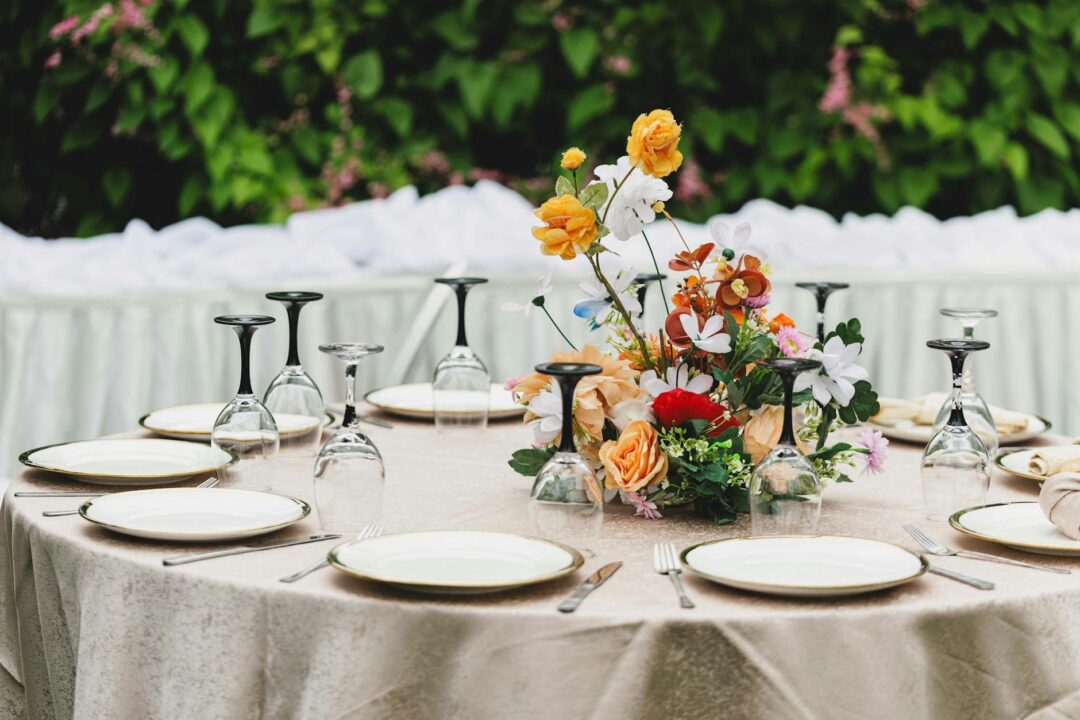
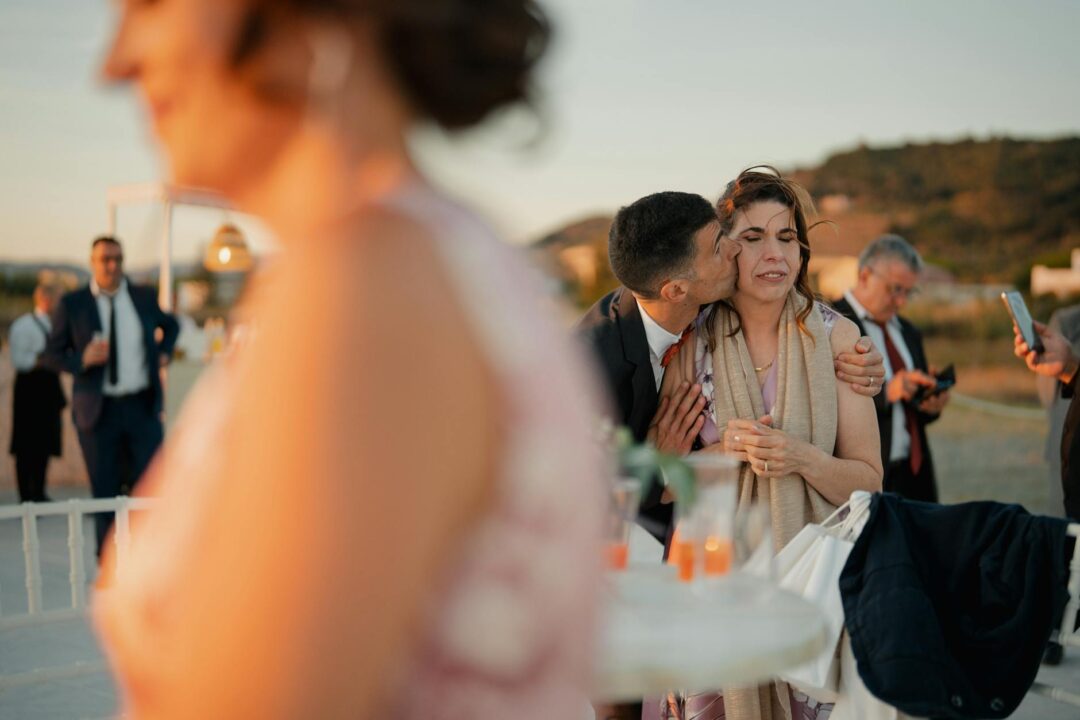

The cocktail hour is the hinge between your ceremony and reception: 45 to 60 minutes where guests settle in, you disappear for portraits, and everyone gets their first drink. Done well, it sets the entire energy for the night. Done poorly (thin passed apps, a single bartender, no entertainment), guests start checking their phones before you’ve even cut the cake.
This guide covers every layer of cocktail hour planning: a minute-by-minute structure, food and drink math, bar style comparisons, signature cocktail strategy, activities, music, specialty stations, and where the couple should actually be. Use the signage and menu cross-sell section to see how printed menu cards and welcome signs finish the look.
- Plan 4 to 6 passed app pieces per guest over a 45-minute cocktail hour; 6 to 8 pieces if the hour runs long or dinner is delayed.
- Budget 1.5 to 2 drinks per guest; staff at 1 bartender per 75 guests for beer/wine, 1 per 50 for a full cocktail bar.
- His-and-hers signature cocktails save 30% to 40% on bar costs versus a full open bar while still feeling curated and personal.
- Your cocktail hour menu card doubles as the first printed piece guests touch at the reception; choose a design that matches your invitation suite.
- Cocktail Hour Structure: A 45-60 Minute Timeline
- Food Math: How Many Appetizers Per Guest
- Drink Math: How Many Drinks Per Guest + Staffing Ratios
- Signature Cocktail Ideas (His + Hers, Couple’s History, Seasonal)
- Bar Styles Compared: Open vs Limited vs Cash vs Beer/Wine Only
- Cocktail Hour Activities (Yard Games, Photo Booth, Polaroids, Music)
- Specialty Drink Stations (Espresso Martini Cart, Cocktail Tower, Mocktails)
- Cocktail Hour Music: Live, DJ, or Curated Playlist
- Where the Couple Should Be During Cocktail Hour
- Cocktail Hour Signage and Menus
- Cocktail Hour Cost Breakdown
- Frequently Asked Questions
Cocktail Hour Structure: A 45-60 Minute Timeline
Most venues pencil in exactly one hour. In practice, the first 10 minutes are transit chaos as guests move from the ceremony space to the cocktail area. Here is a structure that works whether you run 45 minutes or the full 60.
| Time Mark | What Happens | Couple’s Location |
|---|---|---|
| 0:00 – 0:10 | Guests arrive; first round of drinks poured; ambient music starts | Portraits (ceremony site or grounds) |
| 0:10 – 0:15 | First passed-appetizer round hits the floor; bartenders at full pace | Portraits ongoing |
| 0:15 – 0:30 | Second appetizer round; signature cocktail prompt on bar menu card; activities open (lawn games, photo booth) | Extended portraits or transition to family formals |
| 0:30 – 0:45 | Third appetizer round; music transitions to slightly livelier tempo; coordinator gives guests a 15-minute heads-up | Optional: couple makes a brief appearance to mingle (5-10 min) |
| 0:45 – 1:00 | Wrap-up round of drinks; coordinator begins transition cues; guest book table busy | Couple lines up for grand entrance |
Buffer for late ceremonies
Build in a 10-to-15-minute buffer if your ceremony is running on a religious or cultural schedule that may slip. Brief your caterer in advance so they hold the first appetizer round until enough guests are present to warrant it.
What if cocktail hour runs longer than 60 minutes?
If the couple’s portraits take longer than planned, extend passed apps by one more round. A flat 45-minute app budget running to 75 minutes leaves guests genuinely hungry. Coordinate with your catering captain before the day starts: “If we hit 75 minutes, add one more round of the bruschetta.”
Food Math: How Many Appetizers Per Guest (and What to Pass)
The number everyone gets wrong is the per-guest piece count. Caterers typically plan 4 to 6 pieces per person per hour for a cocktail hour that precedes a full dinner. If dinner is delayed, the hour extends, or your crowd skews toward big eaters, scale to 6 to 8 pieces per person.
| App Type | Pieces/Guest (45 min) | Pieces/Guest (60+ min) | Notes |
|---|---|---|---|
| Passed apps (combined) | 4-6 | 6-8 | Mix 3 options for variety |
| Stationary display (charcuterie, cheese) | 3-4 | 4-6 | Counts toward total; self-serve |
| Warm passed bites (sliders, arancini) | 2 | 3 | Higher perceived value; needs warming equipment |
| Vegetarian/vegan options | Minimum 2 options total | Minimum 2-3 options total | Cover dietary restrictions without a separate station |
Staffing for passed apps
Use a 1-server-per-50-guests ratio for passed appetizers. For a full cocktail-reception-style event (where apps replace a seated dinner), tighten to 1 server per 25 guests. Each server typically carries one tray at a time, so three-option variety requires a minimum of three servers working the floor simultaneously.
What to pass vs. what to station
Passed trays create energy, keep guests moving, and feel curated. Stationary boards (charcuterie, crudites, cheese) anchor a corner and give guests a home base between conversations. A well-run cocktail hour has both: 2 to 3 passed options and 1 stationary display.
Drink Math: How Many Drinks Per Guest + Staffing Ratios
Budget 1.5 to 2 drinks per person for a 60-minute cocktail hour. For a crowd that skews older or more sober, 1 drink per person is safe. For a younger crowd at a summer outdoor wedding, 2 to 2.5 is more realistic.
Bartender ratios by bar type
| Bar Type | Bartenders per Guest | Why |
|---|---|---|
| Beer and wine only | 1 per 75 guests | Simple pours; fast throughput |
| Full cocktail bar | 1 per 50 guests | Mixed drinks take 30 to 90 seconds each |
| Signature cocktails + bar | 1 per 35-50 guests | Batch the sig cocktail to reduce per-pour time |
| Specialty station (espresso martini cart, etc.) | 1 dedicated barista/bartender | Station lines move independently of main bar |
The barback multiplier
For every 1 to 2 bartenders, add one barback. A barback restocks ice, glassware, and garnishes so your bartenders never leave their station. Skipping the barback role is the most common reason cocktail hour bars develop long queues after the 30-minute mark.
Signature Cocktail Ideas (His + Hers, Couple’s History, Seasonal)
A signature cocktail is a named, themed drink served exclusively at your wedding. It does not replace the bar, but it adds a personal story that a glass of house cabernet never can. About 42% of couples now include at least one signature cocktail at their wedding.
Strategy 1: His + hers
Two drinks, one per partner. The sweet spot is one lighter and refreshing (spritz, vodka lemonade, French 75) and one spirit-forward or darker (old fashioned, mezcal sour, whiskey ginger). This covers different palate preferences without overwhelming the bar.
Strategy 2: Couple’s-history themed
Name drinks after meaningful places or moments. Examples:
“The Portland Mule” – a Moscow mule with local craft ginger beer, named for the city where you got engaged.
Strategy 3: Seasonal pairings
| Season | Cocktail Name | Base Spirit | Flavor Notes |
|---|---|---|---|
| Spring | Garden French 75 | Gin + Champagne | Lavender, lemon, elderflower |
| Spring | Strawberry Basil Smash | Vodka | Fresh strawberry, basil, lime |
| Summer | Watermelon Margarita | Tequila | Fresh watermelon, lime, tajin rim |
| Summer | Lemon Verbena Spritz | Prosecco + Aperol | Citrus, herbal, light |
| Fall | Apple Cider Old Fashioned | Bourbon | Apple cider, cinnamon, bitters |
| Fall | Pear and Thyme Gimlet | Gin | Fresh pear, thyme, lemon |
| Winter | Cranberry Champagne Punch | Vodka + Champagne | Cranberry, pomegranate, rosemary |
| Winter | Spiced Mezcal Sour | Mezcal | Warming spice, citrus, egg white foam |
Batch your signature cocktail
For a 100-guest cocktail hour, pre-batching your signature drink in large pitchers or dispensers cuts the pour time from 90 seconds to 10 seconds. Instruct your caterer to keep the batch refrigerated and stir before each pour.
Bar Styles Compared: Open vs Limited vs Cash vs Beer/Wine Only
| Bar Style | What Guests Get | Typical Cost per Person | Best For |
|---|---|---|---|
| Open bar (full) | All spirits, beer, wine, mixers, signature drinks | $15 to $30 | Larger receptions; festive crowds |
| Limited bar | 2 to 3 spirits + beer + wine (no well liquor) | $10 to $20 | Couples who want variety without full cost |
| Beer and wine only | Draft or bottled beer + house wine selections | $6 to $12 | Budget-conscious; daytime weddings |
| Signature + beer/wine | 1 to 2 custom cocktails + beer + wine | $8 to $16 | Memorable without full bar price tag |
| Cash bar | Guests pay individually | $0 to couple (guests pay) | Strongly discouraged; impacts guest experience |
The signature cocktail plus beer and wine approach saves 30% to 40% compared to a full open bar. For a 100-guest wedding, that is a difference of roughly $700 to $1,400 for the cocktail hour alone.
Cocktail Hour Activities (Yard Games, Photo Booth, Polaroids, Music)
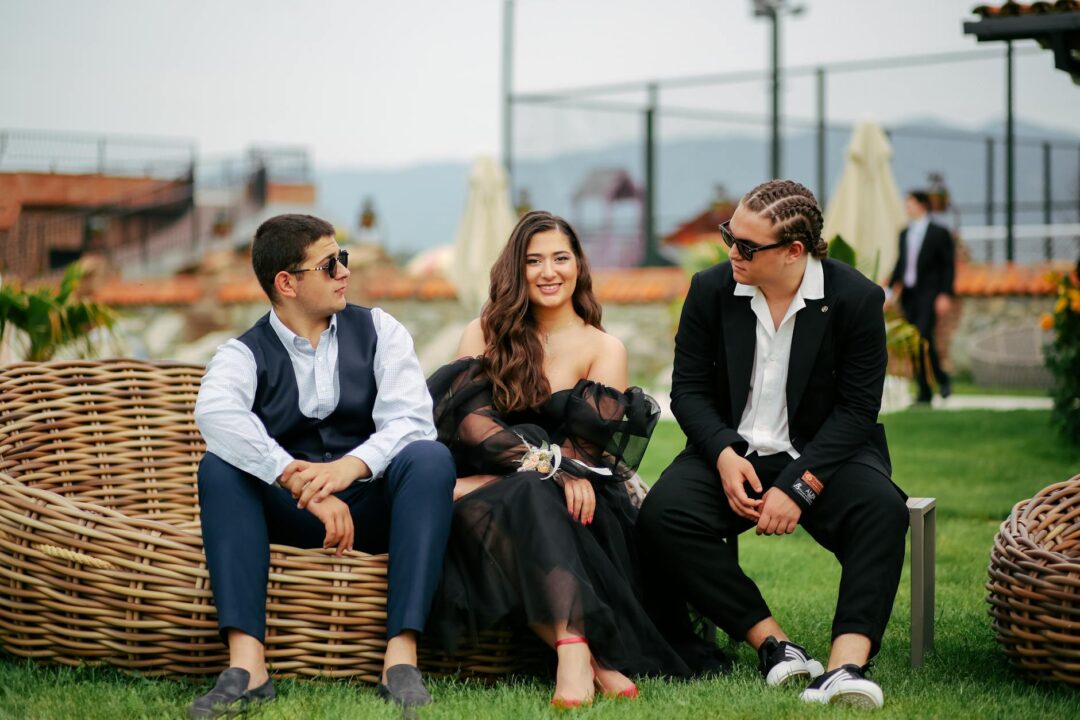
Activities prevent the awkward 20-minute gap where guests who do not know each other are standing in silence with a drink. Not every activity works for every venue or crowd. Here is an honest breakdown.
| Activity | Setup Cost (approx.) | Space Needed | Works Best For |
|---|---|---|---|
| Lawn games (cornhole, bocce, giant Jenga) | $0 to $150 rental | Open outdoor area | Outdoor venues; mixed ages |
| Photo booth (digital or film strip) | $600 to $1,200 | 10 ft x 10 ft minimum | Any venue; crowd-pleaser |
| Polaroid station (DIY guest book) | $150 to $300 (cameras + film) | Small table | Intimate weddings; creative couples |
| Live mini-portraits (caricature or watercolor) | $300 to $800 per artist | 2 chairs + easel | Couples with an art focus; conversation starters |
| Guest book signing table | $30 to $100 (book + pens) | Small table | Any wedding; traditional choice |
| Dessert preview / donut wall | $100 to $400 depending on scale | Counter space | Couples with a dessert-focused wedding |
One activity rule
More than two activities running simultaneously fragments your cocktail hour. Pick one primary (photo booth or lawn games) and one passive (guest book, dessert preview). Two active stations competing for attention produces a chaotic, unfocused feel.
Specialty Drink Stations (Espresso Martini Cart, Cocktail Tower, Mocktails)
Specialty stations are the upgrade layer above a standard bar. They draw a line, create a visual moment, and give guests something to talk about.
Espresso martini cart
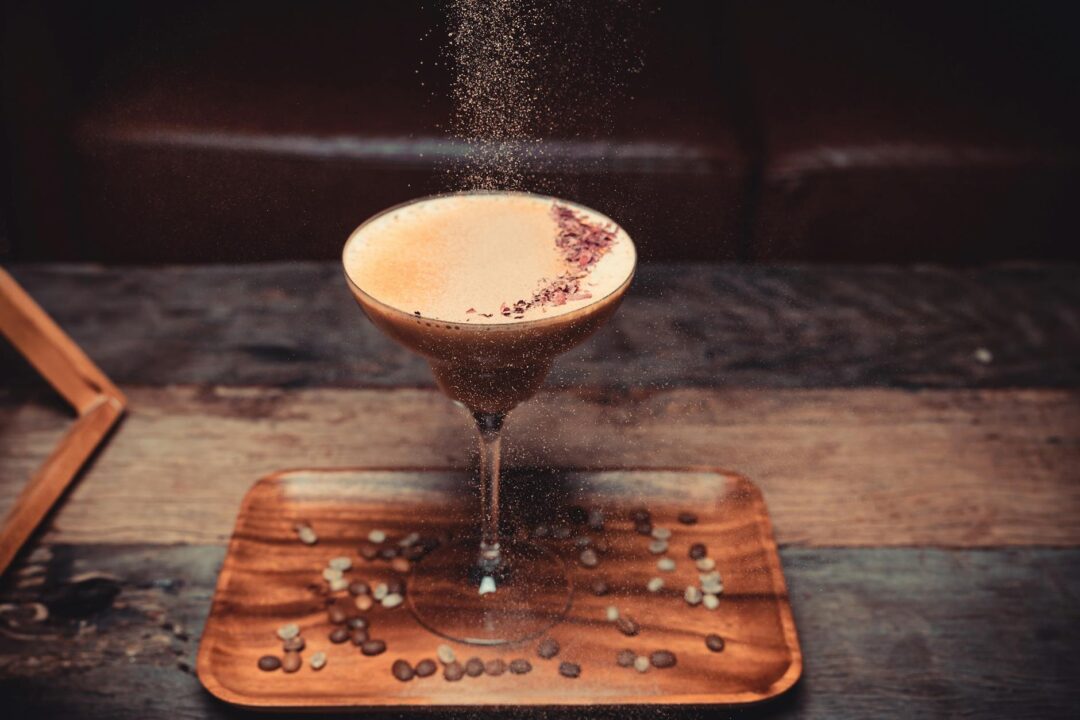
The espresso martini is one of the most-searched cocktail hour additions right now. A dedicated cart (a small espresso machine, a bartender, and a few garnish options) serves roughly 40 drinks an hour. Cost: $400 to $800 for the hour, depending on your market. Best deployed at the 20-to-30-minute mark when energy needs a boost.
Cocktail tower
A tiered punch-bowl tower or a stacked champagne tower lets guests self-serve from a visual centerpiece. Works best for a champagne toast moment at the start of cocktail hour. Cost to build: $50 to $150 DIY, or $200 to $400 through a caterer.
Mocktail station
A fully dedicated non-alcoholic station signals to your sober or pregnant guests that they are considered, not just accommodated. Offer at least 3 options with the same garnish effort as your alcoholic drinks. Sparkling water with fresh herbs, shrub-based sodas, and zero-proof negroni variations are all crowd-friendly options.
Whiskey or wine tasting station
A small tasting flight (3 pours, pre-measured) of bourbons or regional wines gives guests an activity and an education in one. Works best for a more intimate crowd of 80 guests or fewer, where the station does not back up.
Cocktail Hour Music: Live, DJ, or Curated Playlist
Music sets the social temperature. Too quiet and conversations feel exposed. Too loud and guests have to shout over each other. The target volume is “background conversation-friendly”: guests can talk without raising their voices, but the room never feels silent.
| Music Option | Typical Cost (1 hour) | Vibe | Logistics |
|---|---|---|---|
| Acoustic guitarist or solo performer | $200 to $600 | Warm, intimate | Book 3 to 6 months out |
| String trio or jazz duo | $500 to $1,200 | Elegant, classic | Require PA setup in large spaces |
| DJ (pre-reception set) | $150 to $400 add-on to reception package | Energetic; customizable | Usually included in DJ package; confirm hours |
| Curated Spotify/Apple Music playlist | $0 | Relaxed, personal | Requires Bluetooth speaker rental or venue AV |
Cocktail hour music genres that work
Jazz standards, acoustic covers of current pop songs, lo-fi indie, bossa nova, and neo-soul all hit the right conversational volume and vibe. Avoid anything with heavy bass or club tempo at the cocktail hour stage; save it for the reception.
If you use the same DJ for both cocktail hour and reception
Ask your DJ to provide you with a playlist preview. Many DJs default to the same set for cocktail hour; getting a list in advance ensures there is no bleed-through of first-dance songs or reception anthems before the right moment.
Where the Couple Should Be During Cocktail Hour (Portraits vs. Mingling)
The cocktail hour is primarily a portrait window, not a mingling window. Most couples spend 30 to 50 minutes of the cocktail hour with their photographer and rejoin guests for the final 10 to 15 minutes before the reception entrance.
First-look couples
If you did a first look before the ceremony, your family formals and couples portraits are mostly done. You may be able to join your cocktail hour for 20 to 30 minutes, which guests love. Talk to your photographer about the revised post-ceremony shot list before the day.
Non-first-look couples
Without a first look, post-ceremony portraits take longer. Expect to be with your photographer for 40 to 55 minutes of a 60-minute cocktail hour. This is normal. Your guests understand.
The partial appearance option
If your photographer confirms the timeline allows it, a 5-to-10-minute couple appearance at the 30-minute mark (quick hello, a few photos with family friends, grab a drink) takes the pressure off while giving guests a moment with you. Have your coordinator cue you when to return to portraits.
Cocktail Hour Signage and Menus
Printed cocktail hour menus and welcome signage are the detail that separates a styled wedding from a generic venue event. Your guests’ first impression of the reception aesthetic comes from what they see the moment they walk into the cocktail space.
What to print for your cocktail hour
A cocktail hour menu card lists your signature drinks, the bar options, and 2 to 3 featured food items. It works both as a practical guide (guests know what to ask the bartender for) and as a keepsake that reinforces your stationery suite.
Browse Paperlust wedding menu cards to find designs that coordinate directly with your invitation style. If your invitations use foil stamp or letterpress printing, matching your menu cards in the same technique ties the suite together without repeating the exact design.
Welcome signage for the cocktail space
A freestanding welcome sign at the cocktail hour entrance or bar directs guests and names the space as intentional rather than transitional. See Paperlust wedding signs for options across fabric, printed board, and vinyl foil finishes.
Your wedding reception decoration ideas and cocktail hour design should use the same color palette. A welcome sign, a menu card, and a coordinating place card for your escort display create a coherent visual story from the moment guests arrive.
Also see: Wedding Day Timeline for a full run-of-day schedule that places the cocktail hour in context.
Cocktail Hour Cost Breakdown
Costs vary significantly by market, guest count, and vendor relationships. These are US national averages for a 100-guest wedding.
| Item | Budget Range (100 guests) | Cost Driver |
|---|---|---|
| Passed appetizers (4-6 pieces/guest) | $800 to $2,000 | Ingredient cost + labor |
| Stationary display (charcuterie, cheese) | $300 to $700 | Product sourcing + display rentals |
| Bar service (beer + wine + 1 sig cocktail) | $1,000 to $2,000 | Alcohol + bartender labor + barback |
| Full open bar upgrade | $1,500 to $3,000 | Full spirits package + additional staff |
| Music (acoustic solo act) | $200 to $600 | Performer rate + PA if needed |
| Activity (photo booth or lawn games) | $150 to $1,200 | Rental vs. owned equipment |
| Specialty station (espresso martini cart) | $400 to $800 | Equipment rental + dedicated staff |
| Printed menu cards + welcome sign | $80 to $350 | Print method + quantity |
| Total (essentials: apps + bar + music) | $2,000 to $4,600 | |
| Total (fully styled: everything above) | $3,130 to $8,650 |
How to cut cocktail hour costs without cutting quality
The biggest lever is bar scope. Dropping a full open bar to a signature-plus-beer-and-wine package saves $700 to $1,400 on a 100-guest event. Swapping a live band for a curated playlist saves $400 to $800. Together, those two changes fund a quality passed-apps program or a specialty station.
More Wedding Food and Catering Guides
Planning beyond the cocktail hour? These guides cover the rest of the wedding meal:
- Wedding Food Ideas: reception meal formats, seasonal menus, and dietary accommodations
- Wedding Canape Ideas: a deeper look at canape variety and presentation
- Plated vs. Buffet Wedding: cost comparison and service style tradeoffs
- Brunch Wedding Reception: a full guide for morning or midday weddings
- Wedding Cake Trends 2026: flavor and design trends
- Wedding Dessert Table: setup, quantities, and display ideas
Complete Your Cocktail Hour Stationery
Menu cards that match your invitation suite, printed in your choice of foil stamp, letterpress, or digital. Designer proof within 1 to 2 business days.
Order a $5 sample pack first to feel the paper and print quality before committing.
Frequently Asked Questions
How long is a wedding cocktail hour?
A standard wedding cocktail hour runs 45 to 60 minutes. It can extend to 75 to 90 minutes if the couple needs additional portrait time after the ceremony or if the venue has a staggered setup between spaces. If it extends beyond 60 minutes, increase your passed-app count by one to two additional rounds.
How many drinks per guest at cocktail hour?
Budget 1.5 to 2 drinks per person for a standard 60-minute cocktail hour. For a more sober crowd or a morning/afternoon wedding, 1 drink per person is appropriate. For a summer outdoor wedding with a younger crowd, plan for 2 to 2.5 drinks.
Do you need food at cocktail hour?
Yes. Cocktail hour food is not optional. Guests who have been sitting through a ceremony on an empty stomach will be drinking on empty stomachs without it. The minimum is a stationary display (charcuterie, cheese, bread) plus at least 2 passed options. Skipping food creates a visible and uncomfortable energy shift within 20 minutes of the bar opening.
What is the difference between cocktail hour and reception?
The cocktail hour is the transitional social period between the ceremony and the seated reception. It is typically more casual, with guests standing and mingling. The reception is the main event, usually seated (at least partially), with dinner, speeches, and dancing. The cocktail hour ends when guests are called to their seats for the reception entrance.
Should the couple be at cocktail hour?
Most couples spend the majority of cocktail hour with their photographer for portraits. If you did a first look before the ceremony, you may have 20 to 30 free minutes to join guests. Without a first look, expect 40 to 55 minutes of portrait time. A brief 5-to-10-minute appearance at the midpoint is a nice guest experience touch if your timeline allows it.
What is a signature wedding cocktail?
A signature cocktail is a named, themed drink created specifically for your wedding. It is typically served alongside the standard bar offerings. Most couples create 1 to 2 signature cocktails that reflect their personalities, relationship history, or wedding season. They can be batched in advance to reduce bar congestion.
How many bartenders do I need for cocktail hour?
For a beer and wine bar: 1 bartender per 75 guests. For a full cocktail bar: 1 per 50 guests. For a signature cocktail bar: 1 per 35 to 50 guests (batch the signature drink to reduce per-pour time). Add 1 barback for every 1 to 2 bartenders to keep the bar stocked and running efficiently.
What should be on a cocktail hour menu card?
A cocktail hour menu card typically lists your 1 to 2 signature drinks (with their names and brief descriptions), the standard bar options (beer, wine, spirits available), and 2 to 3 featured appetizer items. Keep it to one side of a single card so guests can read it quickly. A design that matches your invitation suite ties the stationery moment together.