

Choosing between a plated dinner and a buffet is one of the most consequential decisions a couple makes during wedding planning, and it’s rarely just about the food. The format shapes your budget, your reception timeline, your staffing bill, and the overall mood your guests walk away with. If you’ve been Googling “plated vs buffet wedding” and finding the same surface-level pros-and-cons lists everywhere, this guide takes a different approach. We break down real 2026 cost-per-head data, walk through how each format reshapes your schedule, and cover every stationery requirement each format creates, from RSVP meal selection cards to buffet station signs. By the end, you’ll know exactly which format fits your wedding.
- Plated dinners run $75-$150 per head in 2026; buffets run $50-$100 per head for comparable menus at similar guest counts.
- Plated service takes 90-120 minutes from first course to dessert cleared; a well-run buffet takes 60-90 minutes.
- Family-style sits between the two: $65-$120 per head and approximately 75-105 minutes of service time.
- Your stationery needs change dramatically by format: plated requires individual menu cards, meal-coded place cards, and RSVP entree selection; buffets need station signs and dietary labels instead.
- Plated vs Buffet: Quick Comparison Table
- Plated Wedding Dinner: What It Is and When It Works
- Buffet Wedding Dinner: What It Is and When It Works
- Family-Style Dinner Service (A Third Option)
- Food Stations (A Fourth Option)
- Cost-Per-Head Breakdown by Format (2026 Ranges)
- Time Impact: How Each Format Reshapes Your Reception Timeline
- Guest Experience by Demographic
- Hybrid Options: Mix-and-Match Approaches
- Menu Cards, Place Cards, and Signage Requirements by Format
- Staffing Ratios for Each Service Style
- 6-Question Decision Framework
Plated vs Buffet: Quick Comparison Table
| Factor | Plated | Buffet | Family-Style | Food Stations |
|---|---|---|---|---|
| Cost per head (2026) | $75-$150 | $50-$100 | $65-$120 | $55-$110 |
| Service time | 90-120 min | 60-90 min | 75-105 min | 75-100 min |
| Staffing ratio | 1 per 8-10 guests | 1 per 40 guests | 1 per 12-15 guests | 1 per 50 guests |
| Formality | High | Casual-Semi-formal | Relaxed-Semi-formal | Casual-Party |
| Food waste | 5-10% | 25-30% | 10-18% | 20-25% |
| Best guest count | Under 100 | 150+ | 50-150 | 100-300 |
| Menu card required? | Yes, individual | Station signs | Per-table optional | Station signs |
Plated Wedding Dinner: What It Is and When It Works
A plated dinner means every guest receives a pre-portioned, fully composed plate delivered to their seat by a server. It is the most formal service style and the one most associated with traditional, sit-down reception dinners.
What makes plated work
- Every guest eats at roughly the same time, which makes toasts, first dances, and speeches easier to choreograph into the schedule.
- Portions are controlled, which keeps food waste low at 5-10%. For smaller guest counts (under 75), this can actually make plated more economical than a buffet once you factor in the food quantity a buffet requires.
- The visual impact of a composed plate landing in front of each guest is a meaningful hospitality signal. It says the couple invested in a particular kind of care for their guests.
- Guests with serious dietary restrictions appreciate that their plate is prepared specifically for them with their needs tracked in advance.
When plated is the right call
Plated service performs best when your guest count is under 100, your venue has adequate kitchen and service infrastructure, your catering team confirms they can execute it, and your wedding style skews formal or semi-formal. If you are planning a black-tie or white-tie wedding, plated dinner is the expected format.
The real downsides of plated
The labor requirement is high, typically one server per 8-10 guests, which is the primary reason plated costs more per head than other formats. Guests also eat only what is predetermined. If someone wasn’t paying attention on the RSVP card, or simply doesn’t like their chosen entree on the night, there is very little flexibility.
Buffet Wedding Dinner: What It Is and When It Works
A buffet means food is set out on one or more long serving tables and guests serve themselves. It is the most flexible format for guest choice and the most cost-effective for large guest counts.
What makes buffet work
- Guests control their own portions and combinations, which accommodates picky eaters and selective dieters without any advance planning.
- Staffing ratios are dramatically lower, roughly one attendant per 40 guests, versus one per 8-10 for plated. This is where the per-head cost savings come from.
- The relaxed, interactive quality of a buffet suits casual, barn, outdoor, or laid-back reception styles very well.
- For guest counts of 150 or more, the logistics of plating hundreds of meals simultaneously become genuinely difficult. Buffet handles large crowds more gracefully.
When buffet is the right call
Buffet works best for guest counts over 150, casual or semi-formal reception vibes, outdoor venues, and situations where dietary variety is a priority. It also suits couples who want their guests to stay social and mobile rather than seated for a formal service sequence.
The real downsides of buffet
Food waste runs at 25-30% because caterers must prepare 10-15% more food than strictly needed to ensure no dish runs out. Lines can form and drag out the schedule if the buffet is not set up with enough stations or if tables are not staggered for dismissal. A buffet that isn’t well-managed can add 30-45 minutes of unexpected dead time to the reception.
The per-head cost savings also narrow if you choose premium ingredients across the board. A buffet built around prime beef, multiple seafood options, and elaborate salads can actually match or exceed the cost of a simpler plated dinner.
Family-Style Dinner Service (A Third Option)
Family-style service puts large platters of food in the center of each table. Guests pass dishes around and serve themselves. It occupies the middle ground between plated and buffet in almost every dimension.
Cost range: $65-$120 per head
The per-head price sits between buffet and plated because the labor approaches plated levels (servers must deliver, manage, and clear multiple platters per table) but the food quantity needs are slightly higher than plated since platters must look abundant. Rental costs can also be higher due to the volume of serving pieces required.
Service time: 75-105 minutes
When platters arrive simultaneously, everyone begins eating at roughly the same time. This is closer to the plated experience than buffet in terms of schedule predictability. The passing dynamic adds some time, particularly with longer tables or guests who want to chat while serving themselves.
Who it suits
Family-style is an excellent choice for couples who want the warmth and variety of a buffet without the line problem. It creates a genuinely communal feeling and works beautifully for rustic, farm-to-table, Italian, Greek, or Mediterranean menus where abundance and sharing are part of the food culture. Best suited to guest counts of 50-150.
Watch out for
Tables need more space to accommodate platters and serving utensils alongside place settings, glassware, and centerpieces. Work with your venue and caterer early to confirm table size accommodates the setup. For very long banquet tables, getting platters to far ends can be slow.
Food Stations (A Fourth Option)
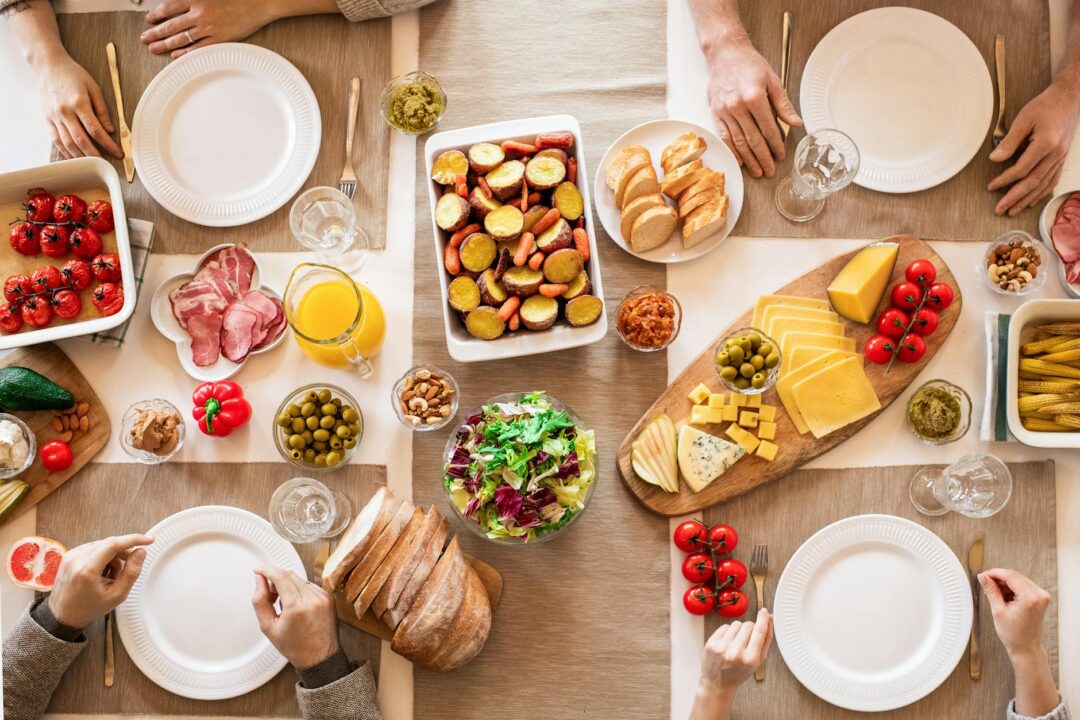
Food stations replace a single buffet or seated dinner with multiple themed stations spread around the venue. Think a carving station, a pasta bar, a taco station, a sushi station, or a dessert table.
Cost range: $55-$110 per head
The range is wide because it depends almost entirely on how many stations you run and what ingredients anchor each one. A two-station setup with pasta and salad skews low. A four-station setup with raw bar, carving station, taco bar, and dessert station can match or exceed plated pricing due to the staff needed to run each station.
Service time: 75-100 minutes of active grazing
Stations are designed for guests to move around and graze over an extended window rather than sit down for a formal meal. There is no defined start or end to the dinner service. This creates a party vibe but also makes it harder to gather guest attention for formal moments like toasts or parent dances.
Who it suits
Couples who want a high-energy, cocktail-party feel rather than a formal sit-down dinner. Also excellent for multicultural weddings where representing multiple food traditions is meaningful. Works best when the venue has adequate floor space for stations plus seating for guests who prefer to sit and eat rather than stand.
Watch out for
Older guests and guests with mobility limitations may find an all-stations format physically tiring. Build in adequate seating even if you don’t have a formal dining setup, and consider having at least one station where guests can take a plate to a table.
Cost-Per-Head Breakdown by Format (2026 Ranges)
The numbers below reflect US national ranges for 2026 based on caterer pricing data and real couple-reported costs across markets from budget-friendly to high-cost-of-living cities. These numbers include food and service but typically exclude bar costs, taxes, and gratuity, which can add 25-35% to the base food-and-service quote.
| Format | Budget Range | Mid Range | High Range | Primary Cost Driver |
|---|---|---|---|---|
| Plated | $75/head | $110/head | $150+/head | Labor: 1 server per 8-10 guests |
| Buffet | $50/head | $75/head | $100+/head | Food volume (25-30% overage needed) |
| Family-Style | $65/head | $90/head | $120/head | Labor + rentals (platters, serving pieces) |
| Food Stations | $55/head | $80/head | $110+/head | Number of stations x staffing per station |
The guest-count crossover point
A rule of thumb based on 2026 market data that surprises many couples: for guest counts under 75, plated dinner can actually cost less in total than a buffet once you account for food waste. Buffets require 10-15% more food per head to ensure nothing runs out. At 60 guests, that premium adds up. At 250 guests, the labor savings on buffet service overwhelm that math decisively. For more context on how service format fits into overall budget planning, see the wedding budget breakdown and the guide to average wedding costs in 2026.
The premium-menu trap
Buffets and stations can match or exceed plated pricing when couples choose premium ingredients across the entire spread. Before assuming buffet is the budget option, ask your caterer for a line-item quote on the actual food cost per person, not just the package price, and compare that directly against a plated quote on a comparable menu.
Time Impact: How Each Format Reshapes Your Reception Timeline
Your service format is one of the largest variables in your wedding day timeline. Here is what each format does to your schedule in practice.
Plated: 90-120 minutes total dinner service
Plated service is the most predictable format for timeline purposes. Once guests are seated, the sequence unfolds in clear stages: appetizers arrive, appetizers are cleared, mains arrive, mains are cleared, dessert arrives. Each stage takes roughly 20-30 minutes. This predictability is the format’s greatest scheduling advantage. Toasts, first dances, and parent dances can be slotted cleanly between courses without worrying about whether half the room is still in a serving line.
Buffet: 60-90 minutes, but with hidden schedule risk
The raw service time is shorter because guests move through a buffet faster than a full plated service sequence. However, the hidden risk is in line formation. If tables are not staggered for dismissal (calling up 2-3 tables at a time rather than opening the floor all at once), a 200-person buffet can create a 30-45 minute wait at the serving tables. Account for this in your timeline, and confirm with your catering team exactly how they plan to manage table dismissal.
Family-style: 75-105 minutes
Family-style mimics the predictability of plated because platters arrive to all tables simultaneously. The extra time over plated comes from the passing dynamic and the fact that guests often go back for seconds from remaining platters. Build in a 10-15 minute buffer if your menu includes multiple shared courses.
Food stations: 75-100 minutes of open grazing
Stations don’t have a clean dinner-start-dinner-end structure. They blur into cocktail hour and create a flowing evening rather than a scheduled sit-down experience. For couples planning formal moments like toasts, the approach is to build in defined pause points where you explicitly invite guests to take a seat and gather attention, then release them back to grazing.
Guest Experience by Demographic (Older Guests, Kids, Dietary Restrictions)
Older guests
Plated and family-style are consistently better for older guests. Older guests often have mobility considerations that make standing in buffet lines uncomfortable over an extended period, and all-stations formats that require significant walking can be genuinely difficult. Plated service in particular allows older guests to remain comfortably seated throughout dinner.
If you are doing a buffet or stations with a significant proportion of older guests, build in extra seating throughout the venue and assign a server or assistant to help older guests who might need it.
Young children
Buffet and stations actually work better for families with young children. Kids are often picky eaters, and a buffet gives parents the flexibility to pick simple, familiar items without needing to manage a predetermined plated entree. Stations can also work well since children tend to enjoy the novelty of interactive serving. Plated service can frustrate parents when their child won’t eat what arrives on the plate.
Guests with dietary restrictions
Plated dinner, managed correctly, offers the best experience for guests with serious food allergies or complex dietary needs. Their plate is prepared specifically for them, tracked from the RSVP through to kitchen execution. The risk is that errors happen when tracking multiple entree variations for a large guest count.
Buffets require strong, clear labeling at every dish. Without station signs identifying allergens (nuts, shellfish, gluten, dairy), guests with restrictions either skip most of the buffet or ask catering staff repeatedly. For large guest counts with significant dietary diversity, invest in thorough buffet signage.
Picky eaters
Buffets win here. Picky eaters can build their own plate from whatever they’re comfortable with, and no one around them knows they avoided the exotic mushroom risotto. Plated service locks in the menu months in advance on the RSVP, and guests who selected something they later regret have limited options.
Hybrid Options: Mix-and-Match Approaches
The format doesn’t have to be a binary choice. Many couples use hybrid approaches to get the advantages of multiple formats. For food ideas beyond the main dinner service, see the complete wedding food ideas guide and the wedding canape ideas guide.
Passed apps + buffet main
The most common hybrid. Cocktail hour features passed appetizers (which feel elevated and personal), followed by a buffet main. This creates a sense of hospitality and curation in the first hour while reducing the per-head cost of the sit-down meal. It also means guests arrive at the buffet table having already eaten something, which reduces the risk of line bottlenecks as not everyone rushes the buffet simultaneously.
Plated appetizer + buffet main
Guests are seated, servers bring a plated first course, and then the buffet opens for mains. This approach signals formal hospitality at the start of dinner service while giving guests freedom and flexibility for the main course. It works particularly well when you have a signature appetizer or soup you want every guest to experience exactly as intended.
Plated dinner + dessert station
Full plated service for all savory courses, then a dessert table or dessert station opens after mains are cleared. This is a smart pairing because dessert stations are inherently lower cost than a full buffet (no protein, no hot-holding equipment), and they create a natural, celebratory third act to the reception. Guests get up, move around, and the energy in the room lifts after what may have been a longer seated dinner.
Cocktail-style dinner + late-night buffet
No formal seated dinner at all. Guests graze through stations during the reception, and then a more substantial late-night buffet (sliders, pizza, fries) opens around 10 PM. This approach is gaining traction for evening-only receptions and more informal wedding styles. Budget accordingly: running two distinct food service moments increases catering complexity.
Menu Cards, Place Cards, and Signage Requirements by Format
Your food service format determines your entire stationery strategy for the dinner service. Here is what each format needs and why.
Plated dinner stationery requirements
Individual menu cards (essential)
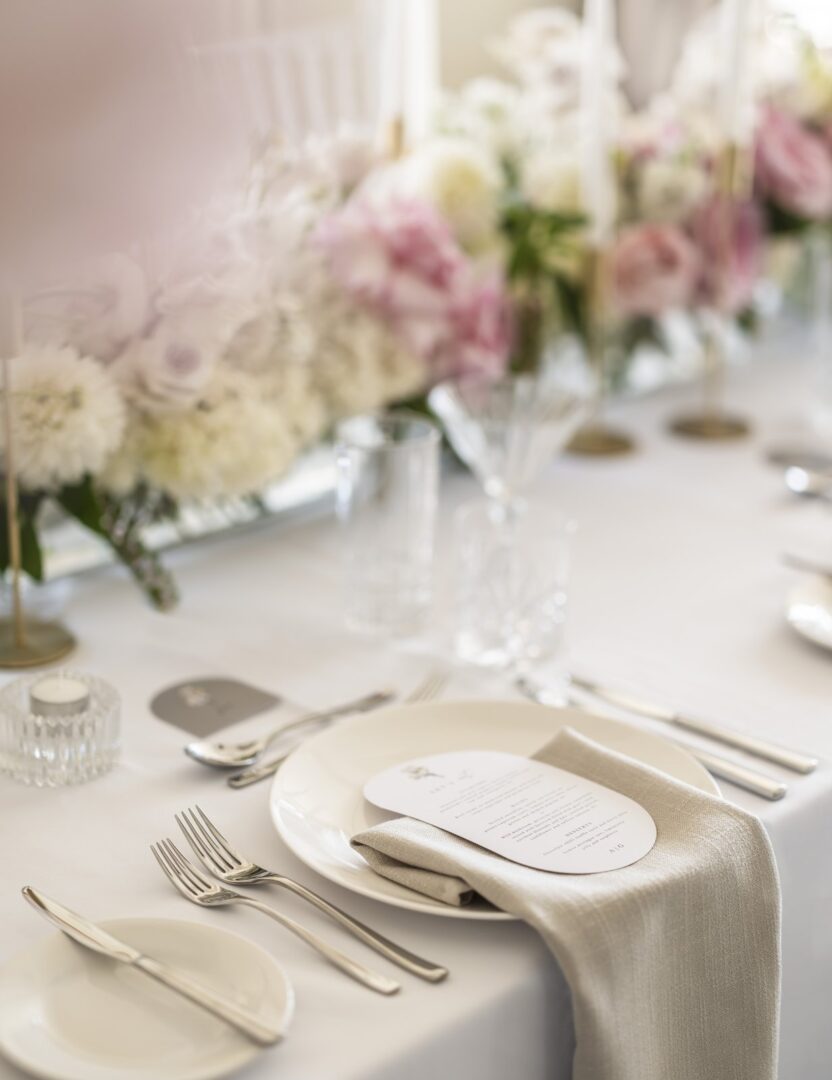
Every guest should have a menu card at their place setting. It serves two functions: it tells guests what is coming (especially useful for pre-selected entrees guests may have forgotten choosing months earlier) and it signals hospitality and attention to detail. Browse the full range at Paperlust menu cards, with designs from minimalist to foil-stamped formal that match your invitation suite.
Standard individual menu cards are 5 inches x 7 inches (127mm x 178mm). DL format (99mm x 210mm, or approximately 4 inches x 8.25 inches) works well for multi-course menus that need more vertical space.
Meal-coded place cards (essential for multi-entree menus)
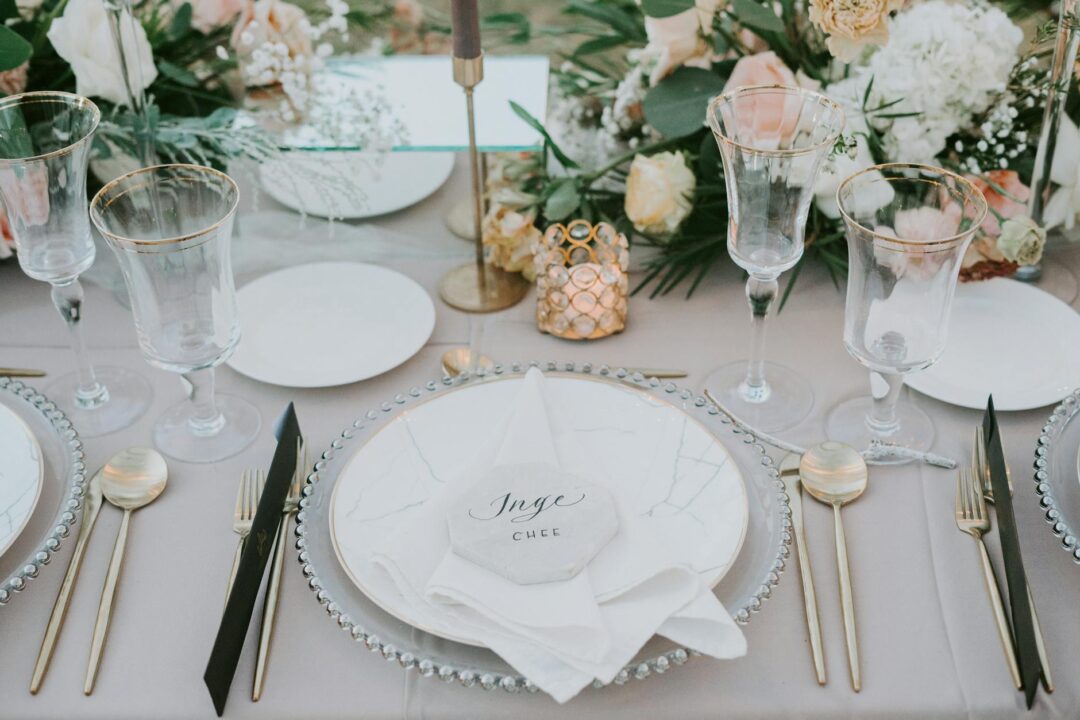
If guests pre-selected their entree on the RSVP, servers need to know who gets what without asking at the table. The standard system uses a subtle coding on the place card: a colored dot, symbol, or printed icon in the corner that corresponds to each entree option. This is how catering teams track chicken versus beef versus vegetarian without creating an uncomfortable “what did you order?” exchange at the table. Browse place card designs that can accommodate custom coding for your meal indicators.
RSVP meal selection card (essential before the wedding)
The meal selection has to be captured at RSVP time. Your RSVP card needs to list each entree option clearly with enough description that guests can make an informed choice months before the wedding. Include a field for dietary restrictions so your caterer can prepare accordingly.
Buffet stationery requirements
Station signs (essential)
Each dish needs a sign. Station signs identify the dish name, include a one-to-two line description, and flag dietary information (V for vegetarian, VG for vegan, GF for gluten-free, N for contains nuts, D for contains dairy). Without clear station signs, guests with dietary restrictions face the uncomfortable task of asking catering staff about every dish, and lines slow down while they wait for answers.
Station signs also carry the aesthetic of the reception. Personalized signage designed to match your invitation suite looks considered and intentional. Paperlust’s wedding signs include customizable buffet and food station signage to match your invitation suite.
Individual menu cards (optional but recommended)
Individual menu cards are optional for buffet receptions but still appreciated. They give guests an overview of everything on offer, which is particularly useful when some dishes are temporarily depleted and guests are deciding whether to wait. One menu card per table (rather than per guest) is a common cost-saving approach for buffets.
Family-style stationery requirements
Family-style sits between plated and buffet in its stationery needs. Individual menu cards per guest or per table are strongly recommended so guests know what is coming before the platters arrive. Station signs are not needed since food doesn’t pass through a self-serve point. Place cards do not need meal coding since there is no entree pre-selection.
Food stations stationery requirements
Stations need the same signage infrastructure as buffets: one sign per dish or per station, with dish names, descriptions, and dietary labels. For action stations (carving, pasta, taco bar), a larger station header sign that names the station clearly helps guests navigate the space. Consider a simplified menu overview card at each guest table, or post a full station menu near the entrance of the dining area.
Staffing Ratios for Each Service Style
Staffing is where most of the cost difference between plated and buffet actually lives. These ratios help you understand what your catering quote is paying for and why plated service commands a higher price per head.
| Format | Server Ratio | For 150 Guests | For 250 Guests | Staff Count Impact |
|---|---|---|---|---|
| Plated | 1 per 8-10 guests | 15-19 servers | 25-31 servers | Highest labor cost |
| Buffet | 1 per 40 guests | 4 attendants | 6-7 attendants | Lowest labor cost |
| Family-Style | 1 per 12-15 guests | 10-13 servers | 17-21 servers | Moderate, close to plated |
| Food Stations | 1 per 50 guests per station | 3 per station | 5 per station | Multiplies by station count |
The food station staffing math catches couples off guard. If you run four stations for 200 guests, you need approximately 4 attendants per station, totaling 16 staff for the stations alone. This is why elaborate station setups often cost more than a well-run buffet despite the lower per-station ratio. For more on how catering fits within total costs, see the wedding reception decoration ideas guide.
6-Question Decision Framework
Work through these questions in order. By the end, one format should emerge as the clear front-runner.
Question 1: What is your wedding style?
- Black-tie, formal ballroom, or traditional church reception: plated dinner is the expected and appropriate choice.
- Semi-formal, garden, or winery reception: family-style or a plated-plus-stations hybrid works well.
- Casual barn, outdoor, beach, or festival-style reception: buffet or food stations fit naturally.
Question 2: What is your guest count?
- Under 75 guests: consider plated first. Portion control makes it potentially the most economical option and the service logistics are manageable.
- 75-150 guests: buffet or family-style become more cost-effective, and both work logistically at this size.
- 150+ guests: buffet or stations are typically more practical and more economical at scale. Plating for 200+ guests simultaneously is operationally demanding.
Question 3: What is your per-head food budget?
- Under $65/head: buffet is likely your only realistic option for a full meal service at this price point.
- $65-$90/head: family-style and a mid-range buffet are both achievable.
- $90-$150+/head: all formats are viable; your choice can be driven by style and preference rather than budget constraint.
Question 4: How important is a tight, scripted reception timeline?
- Very important (you have multiple formal moments: toasts, dances, slideshow, cake cutting): plated dinner supports a scripted timeline best.
- Moderately important: family-style or a structured buffet with staggered dismissal can work.
- Not important (party vibe, low ceremony): stations or buffet gives guests the freedom to move and graze without a fixed schedule.
Question 5: What are your guests’ dietary needs?
- Several guests with serious allergies (peanuts, shellfish, celiac): plated dinner with advance tracking is the safest format. Buffets require meticulous station labeling and carry cross-contamination risk.
- General dietary diversity (vegetarians, vegans, gluten-free preferences): buffet handles this most flexibly since guests self-select.
- Families with young children who are picky eaters: buffet wins.
Question 6: Who makes up the majority of your guest list?
- Mostly older guests or guests with mobility considerations: plated or family-style; avoid requiring extended standing or walking for the main meal.
- Mixed ages with a significant contingent of families and children: buffet is most accommodating.
- Mostly young adults (20s-40s): any format works; base the decision on budget and style.
Complete Your Reception Stationery
Whatever format you choose, your table stationery sets the tone. Personalized menu cards, meal-coded place cards, and buffet station signs from Paperlust are designed to match your invitation suite so everything coheres from cocktail hour through to dessert.
Frequently Asked Questions
Which is cheaper: plated or buffet for a wedding?
Buffet is typically cheaper per head for guest counts over 100, primarily because the staffing ratio is dramatically lower (1 attendant per 40 guests versus 1 server per 8-10 for plated). However, at guest counts under 75, plated can actually cost less overall because portion control reduces food waste to 5-10%, versus 25-30% waste for a buffet that must over-prepare to ensure nothing runs out.
Do guests prefer plated or buffet at weddings?
Guest preferences vary by demographic. Older guests and guests with mobility limitations tend to prefer plated or family-style because it allows them to stay comfortably seated throughout dinner. Families with young children and guests with varied dietary preferences often prefer buffet for the flexibility it provides. For a mixed guest list, family-style tends to score well across age groups because it combines the seated experience with variety and choice.
Can you do a plated dinner without place cards?
If every guest receives the same meal, you don’t technically need place cards to manage meal service. However, the moment you offer more than one entree option, place cards with some form of meal coding (a colored dot, icon, or printed indicator in the corner) become essential. Without them, servers must ask every guest what they ordered, which slows service significantly and creates awkward interactions at the table.
How long does a plated dinner take compared to a buffet?
A plated dinner typically runs 90-120 minutes from first course arrival to dessert cleared. A well-managed buffet runs 60-90 minutes, but requires careful table dismissal management to prevent line congestion. If the buffet is opened all at once without staggering tables, you can add 30-45 minutes of unplanned wait time. Factor both formats’ actual expected service duration into your overall reception timeline.
Is family-style cheaper than plated at a wedding?
Family-style is usually priced similarly to plated or slightly below it. The labor requirement is comparable since servers still need to deliver, manage, and clear multiple platters per table. Food volume needs are slightly higher than plated since platters must look abundant. The per-head difference between family-style and plated is often smaller than couples expect; family-style’s main advantage is the communal atmosphere it creates rather than significant cost savings.
What about food stations: are they cheaper than a buffet?
Simple station setups (two or three stations) can price similarly to a mid-range buffet. However, as you add stations, the staffing costs multiply: each station typically needs one attendant per 50 guests. A four-station setup for 200 guests needs approximately 16 station attendants, which can push the total cost above a well-run buffet. Get itemized quotes for both formats before assuming stations are the more affordable option.
Do you need menu cards at a buffet wedding?
Individual menu cards per guest are optional at a buffet. What you do need are station signs next to each dish identifying the dish name, a brief description, and dietary labels (vegetarian, vegan, gluten-free, contains nuts, contains dairy). These signs serve guests with dietary restrictions and keep lines moving by helping guests make decisions before they reach the serving point.
Can you mix service styles at a wedding reception?
Hybrid formats are common and work well. Popular combinations include passed appetizers during cocktail hour followed by a buffet main, a plated first course followed by a buffet main, and plated dinner with a dessert station. Late-night station service added well after the main dinner has cleared is another popular option. Discuss the logistics and cost of hybrid formats specifically with your caterer since each requires separate setup, staffing, and timing planning.