
When choosing flowers for your wedding the sky’s the limit. There are white roses, pink peonies, elegant orchids, blue hydrangeas or an extravagant mix of all the finest. The list is endless.
The same can be said for your wedding stationery and of course the paper of all paper for the day – the wedding invitations. Paper has no bounds. With the rising trend of floral or botanical print stationery you can maintain the same theme through every step of the wedding.
Wedding invitations can establish your wedding style. From the first save the date invitations to the final thank you cards, your guests know what they are in for. It is ideal to start planning your wedding set six months to a year before so you can make sure every last detail ties in.
From gorgeous letterpress designs, subtle watercolour to traces of foil stamped leaves, the floral wedding stationery trend is timeless. So when you look back at your wedding mementos in ten years you can rest assured that you didn’t get swept away with a phase.
Unlike traditional floral stationery, floral designs are now inspiring a range of leading and emerging designers in Australia.
Most associate the floral planning with the bride, but that’s no longer the case with floral wedding invitations. Floral designs and continuously becoming more gender friendly with designs that aren’t too ‘girly’.
This can be achieved by choosing a black and white colour scheme.
You can include bold fancy lettering an intricate design at the bottom. Your wedding theme remains effortlessly elegant. This leaves room to incorporate floral arrangements of any colour or even simple creams and whites.
Blue invitations are currently trending with Prussian blue and cornflower blue signifying romance, emotion and musicality.
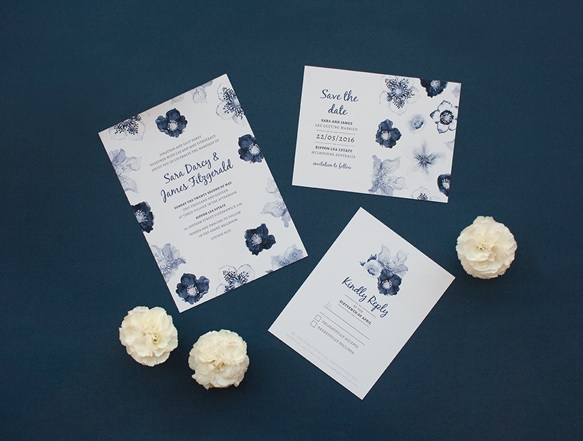
When you are open to colour you can’t go wrong. There are many rainbow designs to suit each and every wedding and means that you can have a wonderful bouquet with pinks, purple blue and of course healthy greenery.
With an array of diverse colours you can also have a little fun with the envelopes with a lush like green interior or a splash of burnt orange.


If you have been gifted with a little creative flair you may want to add your own floral pattern to your wedding invitations. This works well with the more rustic designs on recycled cardboard paper. This method ensures that every floral inspired invite that you mail out is personal and unique.
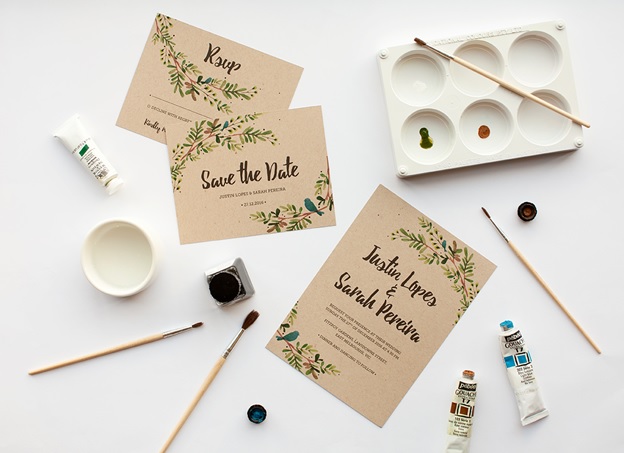
The vintage trend remains steady, this year vintage and floral are merging to create a new vintage floral genre which can be personalised to the couple.
Couples are now in search of the ‘dated look’ which can be achieved through watercolour or decreasing the saturation of pigment to get a faded design. The faded botanical design can emulate a 1920s cascading blooms.

This trend allows for a lot of flexibility as it stands out from the crowd and moves away from the popular Pantone colours. New digital technologies leave room for an endless supply of colours.
Types of Floral Wedding Invitation Designs
Floral stationery is not one aesthetic – it’s a whole family of visual directions. Here’s how to identify which floral style is right for your wedding.
Loose watercolor florals: Painterly, soft-edged, spontaneous. Peonies, ranunculus, anemones, and garden roses in overlapping washes of color. This is the style that photographs best in natural light and looks most like a couture designer created it just for you. Suits garden, winery, and outdoor weddings.
Botanical line art: Fine-line drawings of specific botanical specimens – eucalyptus, ferns, wildflowers, olive branches. More structured and scientific in feel than watercolor florals. Works for couples who want botanical beauty with a more modern, editorial aesthetic. Particularly effective when combined with letterpress printing on cotton paper.
Maximalist floral wreaths: Dense, abundant borders of layered illustrated flowers that frame the invitation text completely. Bold, celebratory, and absolutely appropriate for spring and summer weddings with large floral arrangements. The invitation looks like a garden in full bloom.
Foil-stamped botanical details: A single botanical motif – a sprig of leaves, a small floral cluster, a vine detail – rendered in gold or rose gold foil against a clean background. This approach uses restraint to create impact: one perfectly placed foil detail is more elegant than a full border of printed flowers.
Browse Paperlust’s full range of floral wedding invitations to find the design style that matches your wedding vision.

Coordinating Floral Stationery Across Your Suite
The stationery suite spans from save the dates to thank you cards – an 8 to 12 month period. Here’s how to keep the floral theme cohesive across every piece.
Start with your invitation: The invitation card is the anchor piece. Every other element in the suite should feel like it belongs to the same design family – using the same or complementary botanical motifs, the same color palette, and the same typography system.
Scale the motif: A full floral wreath on the invitation can become a single botanical sprig on the RSVP card, a corner detail on the details card, and a small leaf motif on the envelope liner. The same design language reads consistently across all formats and sizes.
Coordinate with your real florals: Share your invitation color palette with your florist early in the planning process. The more aligned your stationery and floral design, the more cohesive your whole wedding environment feels. This is particularly impactful in ceremony and reception photography – when the invitation, bouquet, and table arrangements share the same botanical vocabulary, the whole visual story hangs together.
A complete floral suite might include: save the dates from $1 per card, invitation and RSVP suite from $2.04 per card, plus printed table numbers, menus, and place cards. Custom floral stickers from Paperlust Print Shop add botanical detail to envelope seals and favor packaging.
Seasonal Floral Choices for Wedding Stationery
The flowers on your invitation don’t have to match the exact blooms at your wedding – but choosing seasonally appropriate florals creates a more cohesive, authentic feel.
Spring: Peonies, ranunculus, anemones, cherry blossom, sweet peas, tulips. Fresh, abundant, pastel-forward.
Summer: Roses, dahlias, sunflowers, wildflowers, lavender. Bold, saturated, full-bloomed.
Autumn: Dahlias, marigolds, chrysanthemums, dried pampas, seed pods. Warm tones, earthy textures.
Winter: Hellebores, white anemones, pine branches, berry sprigs, magnolia. Muted, elegant, architectural.
Frequently Asked Questions
What is floral wedding stationery?
Invitation suites featuring botanical illustration, watercolor florals, or foil-stamped floral motifs. One of the most enduringly popular wedding stationery styles – works across seasons, venues, and aesthetics.
What flowers are most popular?
Peonies, ranunculus, anemones, roses, eucalyptus, and wildflower mixes. Botanical line art often features olive branches, ferns, and seasonal botanical specimens.
How do I match invitation florals to my wedding flowers?
Share your invitation color palette with your florist early. You don’t need exact matches – just consistent color palette and similar botanical vocabulary for cohesive photography.
What print method suits floral invitations best?
Digital print for watercolor designs. Letterpress for botanical line art on cotton paper. Foil stamping for minimal metallic floral details. Request a $5 sample pack to compare in person.
Floral Stationery Timing and Planning
Start planning your floral stationery suite 6 to 9 months before your wedding. This gives you time to order save the dates, proof the invitation design, and coordinate with your florist on palette. For the invitation itself, order 4 to 5 months before your wedding date to allow for design approval, production, and a comfortable mailing window.
Request a physical sample before committing to a full run – the way a watercolor floral design prints on cotton paper versus smooth matte stock makes a significant difference to the final result. Paperlust’s $5 sample pack includes printed samples across paper types so you can compare quality in person. Wedding invitations start from $2.04 per card, with the full range of floral wedding invitation designs available to explore and customize.
Floral wedding stationery is the most timeless choice in the category – there’s a reason it has remained popular across decades of changing wedding trends. When done well, a beautifully illustrated botanical invitation doesn’t look like a trend; it looks like it was made specifically for your wedding. Explore Paperlust’s range of floral wedding invitation designs and request a swatch kit to feel the paper difference before you order.
Floral wedding stationery connects your paper suite to the most ancient tradition of using flowers to celebrate love. When a guest receives your invitation and the botanical illustration resonates with them, they’ve already started imagining your wedding before they’ve checked the date. That’s the power of a design choice that’s fully considered. Explore Paperlust’s floral wedding invitations and pair with coordinated save the dates for a fully botanical suite from announcement through to thank you card.
With 500+ exclusive designs, Paperlust offers floral options across every print method – digital print for maximum color richness in watercolor styles, letterpress for fine botanical line art on cotton paper, and flat foil for minimal metallic botanical accents. Request a $5 sample pack to compare paper stocks and print methods side by side before you commit.