
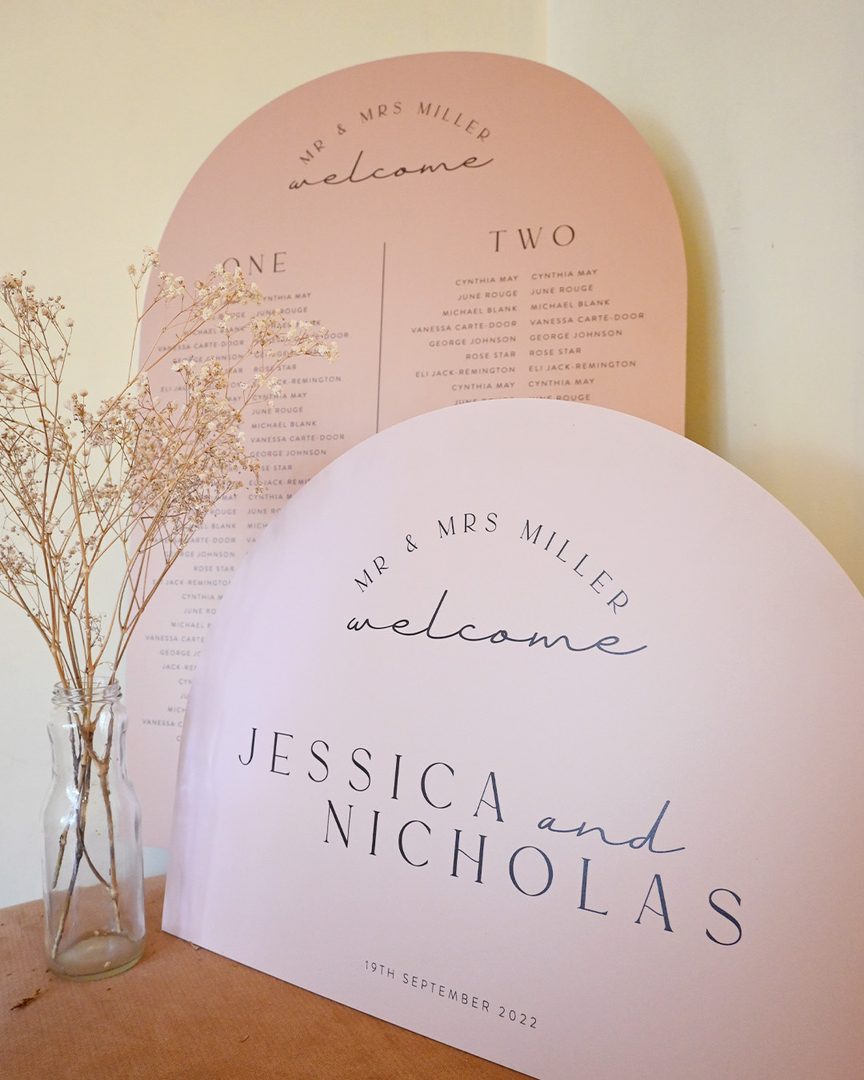
You have spent weeks building the perfect seating plan, and now it is time to turn that spreadsheet into something guests can actually read at the venue door. The display format you choose shapes the first impression your reception makes, and, more practically, it determines how your sign arrives, how it is hung or propped, and whether it survives a breezy outdoor ceremony.
This guide covers every physical format available for printed wedding seating charts: PVC board, fabric, and framed poster. For the full planning picture before you get to the printing stage, see Wedding Seating Charts: The Complete Guide.
| Format | Material | Best Display Method | Paperlust Option |
|---|---|---|---|
| Printed PVC Board | Rigid foam-core PVC substrate | Easel, frame, or leaned against a wall | Yes |
| Fabric | Soft fabric with grommets or rod pocket | Hanging from hooks, copper rod, or frame | Yes |
| Framed Poster | Paper print inside a purchased frame | Floor-standing frame or easel | DIY option (not a native Paperlust format) |
Quick-reference: lead time is 1-2 business days for your designer proof, then production time varies by method. Order at least 4 weeks out to be safe.
The Three Main Seating Chart Display Formats
A printed seating chart can take a few different physical forms, and each one has genuine trade-offs in rigidity, portability, display method, and look. Before you finalize your order, it is worth understanding what you are actually choosing between.
Paperlust also prints seating charts on acrylic and mirror acrylic, and the Paperlust formats this guide covers are the printed PVC board and the fabric seating chart. Both arrive print-ready and display-ready. The third format, the framed poster, is a general market option where couples order a large paper print (from a print shop or service bureau) and source a matching frame themselves. It is worth knowing how it works, but it is not something you order as a single product from Paperlust.
Each format suits a different venue style, handling situation, and aesthetic. The sections below cover all three in detail.
Printed PVC Board Seating Charts: Materials, Sizes, and Display
The PVC board is the most popular printed seating chart format. It is a rigid board made from a foam-core PVC substrate with a high-quality print surface. The result is a sign that is lightweight despite its rigidity, weather-tolerant enough for outdoor use, and stable on an easel without any additional support structure.
Size options
Paperlust offers two standard sizes for printed PVC board seating charts:
- 18x24in (457x610mm): suits guest lists of roughly 80-120 people, depending on font size and column layout. This is the more common choice for intimate weddings and courtyard venues.
- 24x36in (610x914mm): the oversized option, suited for guest lists of 120-200+ and larger venues where the sign needs to carry across a wide foyer or garden entrance. At this size you can run four to five columns comfortably while keeping text legible.
Display methods for PVC board
PVC boards work with three main display approaches:
- Easel: The most common choice. A wooden or metal A-frame easel holds the board upright without any attachment needed. Most florists and hire companies include easels, or you can buy a display easel for under $30.
- Leaned against a wall or prop surface: At cocktail-hour bars, stone walls, or staircase banisters, the board’s rigidity means it can lean stably without tipping.
- Framed inside a standing floor frame: A large clip frame or floating-glass floor frame turns the PVC board into a more formal installation. Note that PVC board does not require a frame for structural support. This is purely an aesthetic choice.
Pros of PVC board
- Arrives ready to display, no assembly or framing required
- Rigid surface holds its shape in outdoor or high-traffic areas
- Prints sharply, including fine calligraphy and detailed illustrations
- Lighter than a framed print of equivalent size
- Works in both indoor and outdoor venues
Fabric Seating Chart Displays: Drape, Portability, and Styling
The fabric seating chart is Paperlust’s second native format, and it is one that sets the brand apart from most print providers. Very few Australian or US competitors offer printed fabric seating charts as a standard product. For couples planning a boho, garden, soft-romantic, or sustainable aesthetic, it is often the more natural fit than a rigid board.
What fabric seating charts look and feel like
The print is applied directly to the fabric, giving the surface a soft, draped appearance rather than the crisp flat face of a PVC board. Edges are finished, and the sign typically comes with grommets or a rod pocket for hanging. The fabric does not wrinkle permanently, but it is not rigid, it needs a horizontal support (a rod, dowel, or wire) to hang straight, or it can be stretched across a frame.
Size options
Fabric seating charts are available in the same core sizes as the PVC board option:
- 18x24in (457x610mm), good for guest lists up to around 120 when printed in a readable font size at two to three columns
- 24x36in (610x914mm), the preferred size for larger weddings; the additional height gives you room to include decorative headers, guest names in a comfortable font, and still have white space so the sign does not feel crowded
Display methods for fabric
- Hanging from a copper or wooden rod: The most popular styling choice. A thin copper rod threaded through the top rod pocket, suspended from hooks or attached to a freestanding A-frame, gives a relaxed, gallery-style look that photographs beautifully.
- Stretched over a canvas frame: If you want the fabric to hang flat and taut with no drape movement, a canvas stretcher bar (available at art supply stores) provides the internal structure. The result looks closer to a framed canvas print.
- Pinned to a backdrop or greenery wall: Fabric’s lightweight and soft edges make it easy to attach directly to a flower wall, macrame backdrop, or fabric-draped arch without the bulk of a hard board.
Portability advantage
One underrated benefit of fabric is transport. A fabric seating chart folds or rolls without damage, making it far easier to handle if you are shipping it interstate or transporting it without a vehicle. PVC boards require careful flat storage and do not roll.
Pros of fabric
- Soft aesthetic that suits boho, garden, and romantic venue styles
- Lightweight and foldable for transport and storage
- No Australian competitor is currently pushing fabric seating charts as a primary product, it is a genuine visual differentiator at the venue
- Pairs naturally with copper rod, macrame, and greenery display setups
- Prints with the same sharpness and color fidelity as the PVC board

Framed Poster Seating Charts: The Classic Option
The framed poster approach is the format couples have used for years: order a large-format paper print, then mount it in a floor-standing poster frame. It is not something Paperlust sells as a single product, you would source a high-quality large-format paper print from a local printer, then pair it with a frame purchased from a homeware store or hire company.
When it works well
- Classic, formal, or black-tie venues where a hard-edged framed sign matches the decor
- When you already have or can borrow a matching frame from the florist or hire company
- Couples who want the look of a gallery-framed art piece at the entrance
Practical downsides to plan for
- Requires coordinating two separate orders: the print and the frame. A mismatch in exact dimensions means the print will not fit cleanly.
- Paper is more fragile than PVC in outdoor or high-humidity environments, condensation and morning dew can warp or cockle an unprotected paper print.
- The combined weight of glass and frame makes transport more awkward than a PVC board or fabric sign of the same finished size.
For most couples, the simplicity of a single-order PVC board or fabric seating chart from Paperlust is a better trade-off than coordinating a DIY framed poster. But if the look is exactly right for your venue, the framed poster is a valid choice. Once your digital template is ready to print, the display journey from template to venue is covered in this post. For building the template first, see Wedding Seating Chart Templates.
What Size Should Your Seating Chart Be? (Guest Count Guide)
The right size depends on two factors: the number of guests you need to list, and the viewing distance at your venue. A sign that is perfectly legible in a narrow villa corridor may be unreadable at the entrance to a 300-person ballroom.
| Guest Count | Recommended Size | Column Layout | Notes |
|---|---|---|---|
| Under 80 | 18x24in (457x610mm) | 2 columns | Comfortable spacing; decorative header has room |
| 80 to 120 | 18x24in (457x610mm) or 24x36in (610x914mm) | 2-3 columns | Go 24x36in if font is larger or you have a decorative border |
| 120 to 180 | 24x36in (610x914mm) | 3-4 columns | Standard choice for medium-large weddings |
| 180 to 250+ | 24x36in (610x914mm) | 4-5 columns | Reduce decorative elements to maximize guest list space |
Viewing distance rule of thumb
As a general guide, every foot of viewing distance requires approximately one point of font size for comfortable reading. At a 10-foot viewing distance (typical for a foyer or venue entrance), your smallest guest name text should be no smaller than 10pt at the print resolution. On a 24x36in board this is very achievable. On an 18x24in board at the same 10-foot distance, you may need to reduce your column count to keep text at a safe size.
Venue entrance positioning
Most venues place the seating chart at the ceremony-to-reception transition point: just inside the reception entrance, near the welcome table, or at the start of the cocktail-hour space. Guests typically walk past it in a moving line, which means the sign needs to communicate quickly. A clean two-column layout with table numbers as the primary sort (rather than alphabetical by name) can cut search time significantly for guests in a moving crowd.
Text Layout at Size: Font, Columns, and Readability
Printing at large format amplifies every design decision you made at screen size. Here is what to check before finalizing your file.
Font size minimums
- Decorative header (couple name, date, or title): 48-72pt depending on the style. This is what guests see first and it sets the tone.
- Table headings: 24-36pt. These need to stand out clearly from the name list beneath each table.
- Guest names: 10-14pt minimum for comfortable reading at 8-12 feet. Below 10pt, names become a strain to read without walking up to the sign.
Column count guidelines
Two columns is the most readable layout at both standard sizes. Three columns is a practical necessity for guest lists above 120 on an 18x24in board; on a 24x36in board three columns look natural and well-spaced. Four or five columns should only be used on the oversized board when guest count demands it; at five columns, names are narrow-width and the entire sign has a denser, more data-heavy feel.
Alphabetical vs. table-number sort
Sorting by table number (all guests at Table 1, then Table 2, etc.) works well when table names are intuitive. Sorting alphabetically by guest last name works better for large weddings where guests may not know their table number ahead of time. Many designers offer both; choose the sort that matches how your guests think about their seating.
White space and margins
Large-format prints need larger margins than you might expect. At 18x24in, plan for at least 0.5in (12mm) margins on all sides. At 24x36in, 0.75in (19mm) margins prevent the design from feeling cramped at the edges and ensure nothing is trimmed during production.
How to Display Your Seating Chart at the Venue
Having the sign is only half the job. Here is what to prepare ahead of time so setup is smooth on the day.
What to bring to the venue
- For PVC board: Confirm with your venue coordinator or florist whether an easel is included in the hire. If not, purchase or hire one. Most display easels for this purpose cost $25-$60 and are available from homeware stores.
- For fabric: Bring a copper or wooden dowel rod that matches or slightly exceeds the width of your sign. You will also need two hooks, nails, or a freestanding rod stand. Check venue rules about wall attachment, many venues prohibit nails but allow command strips or over-door hooks.
- For either format outdoors: Plan for wind. PVC boards on an easel can blow over in a moderate breeze. Sandbag the easel legs, or lean the sign against a heavier structure. Fabric signs can be tied off at the bottom corners with ribbon or twine to prevent billowing.
Lighting the sign
If the sign is placed in a foyer or dim corridor, it is worth asking your photographer or venue coordinator about a small spotlight. A well-lit seating chart photographs better and is more functional for guests arriving at dusk or after sunset. This is a detail that is often overlooked until setup day.
Location checklist
- Visible from the main entry path, not tucked around a corner
- At least 3-4 feet of clear standing space in front of it so guests can crowd around without blocking traffic flow
- Away from direct sunlight if the sign is near a window, prolonged UV exposure can fade prints and create harsh glare for readers
- Near the welcome table or escort card display if you are using both
Ordering and Lead Time: From Final Template to Printed Display
Once your template design is complete and all names are finalized, the ordering process with Paperlust follows a consistent flow.
Step 1: Finalize your guest list and design
The most common cause of delays is a seating chart that arrives at design with a guest list still in flux. Before placing your order, confirm that your RSVP deadline has passed and your final headcount is locked. The design file needs to be final before a designer proof is created.
For guidance on building and organizing the list before this stage, see Wedding Seating Charts: The Complete Guide.
Step 2: Choose your format and size
Select PVC board or fabric, then choose 18x24in (457x610mm) or 24x36in (610x914mm) based on your guest count and venue. Browse the full seating chart range and filter by format at /us/browse/seating-charts/.
Step 3: Receive and approve your designer proof
After your order is placed, a Paperlust designer is assigned to your order and delivers a proof within 1-2 business days. You have two rounds of included edits to adjust column layout, font size, guest name formatting, or design elements. Revisions are returned within 1-2 business days each.
Step 4: Production and dispatch
Production time varies by format. Digital-print seating charts are generally 8-10 business days from proof approval to dispatch. If you have added a flat foil detail (available on select designs), allow approximately 12-15 business days for production. Orders over $350 USD qualify for free DHL Express international shipping, which delivers in 2-4 business days in transit to the US once dispatched.
Planning your timeline
| Stage | Estimated Time |
|---|---|
| Designer proof delivery | 1-2 business days after order |
| Proof revisions (up to 2 rounds) | 1-2 business days per round |
| Production (digital print) | 8-10 business days |
| Production (flat foil designs) | 12-15 business days |
| DHL Express transit to US | 2-4 business days after dispatch |
| Recommended buffer before wedding day | At least 5 business days |
If your headcount changes after you have ordered, see How to Update Your Seating Chart Last-Minute for options at every stage of the process.
Frequently Asked Questions
What size should a wedding seating chart be?
For up to 80 guests, 18x24in (457x610mm) works well at two columns. For 80-200+ guests, 24x36in (610x914mm) gives you enough space to keep guest names legible at viewing distance. Choose the larger size when in doubt, a seating chart that is too small to read quickly causes bottlenecks at the venue entrance.
Is PVC or fabric better for a seating chart?
PVC board is better for outdoor venues, easel display, and when you need maximum rigidity for a long event day. Fabric is better for boho, garden, and hanging installations, it is lighter, foldable for transport, and creates a softer aesthetic that photographs well. Both formats produce the same print quality. The choice comes down to your venue style and how you plan to display it.
Which materials does a Paperlust seating chart come in?
Paperlust seating charts come in printed PVC board, fabric, acrylic, and mirror acrylic.
How do I display a fabric seating chart at the venue?
The most common approach is a copper or wooden dowel rod threaded through a top rod pocket, suspended from hooks on a wall or freestanding rod stand. Fabric can also be stretched over a canvas frame for a taut, gallery look, or pinned directly to a flower wall or greenery backdrop. Check venue policies on wall attachments before committing to a wall-hung setup.
How far in advance should I order a wedding seating chart?
Order at least 4-6 weeks before your wedding date. This gives you time for the designer proof (1-2 business days), any revision rounds, production (8-15 business days depending on format), DHL Express transit (2-4 business days), and a buffer for last-minute guest list adjustments. Do not finalize the order until your RSVP deadline has passed.
Can I add flat foil to a seating chart?
Yes, flat foil is available on select Paperlust seating chart designs. It adds a mirror-bright metallic detail, popular for couple name headers and decorative borders. Flat foil production takes approximately 12-15 business days, so factor this into your timeline. Flat foil is applied without a custom die or debossed impression, it sits on the surface of the print.
What font size should I use on a seating chart?
Guest names should be no smaller than 10-14pt for comfortable reading at 8-12 feet. Table headers should be 24-36pt, and your decorative title (couple name or header) typically 48-72pt. Your Paperlust designer will optimize the layout during the proof stage, but it helps to brief them on your preferred font size range and column count upfront.
Do I need an easel for a PVC board seating chart?
An easel is the most straightforward display method and the one most venues accommodate. A standard display easel costs $25-$60 from homeware stores, or many florists and venue hire companies include them. Alternatively, a PVC board can lean against a wall or prop surface, or sit inside a floor-standing clip frame for a more formal look.
What happens if my guest list changes after I order?
If your list changes before proof approval, the revision process handles it within the included two rounds of edits. If changes come after the proof is approved or after production begins, contact Paperlust’s customer service team immediately via live chat. See How to Update Your Seating Chart Last-Minute for a full breakdown of options at each stage.
Is free shipping available on seating charts?
International orders over $350 USD qualify for free DHL Express shipping, which delivers in 2-4 business days in transit to the US once dispatched. Orders under $350 USD incur standard international shipping charges. Australian orders ship free via overnight Startrack on all orders.
Ready to print your seating chart?
Browse PVC board and fabric seating charts, filter by size and style, and start your order today.