
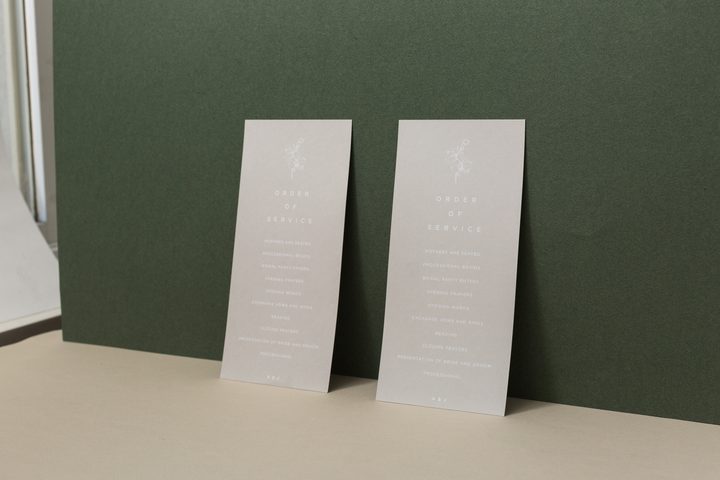
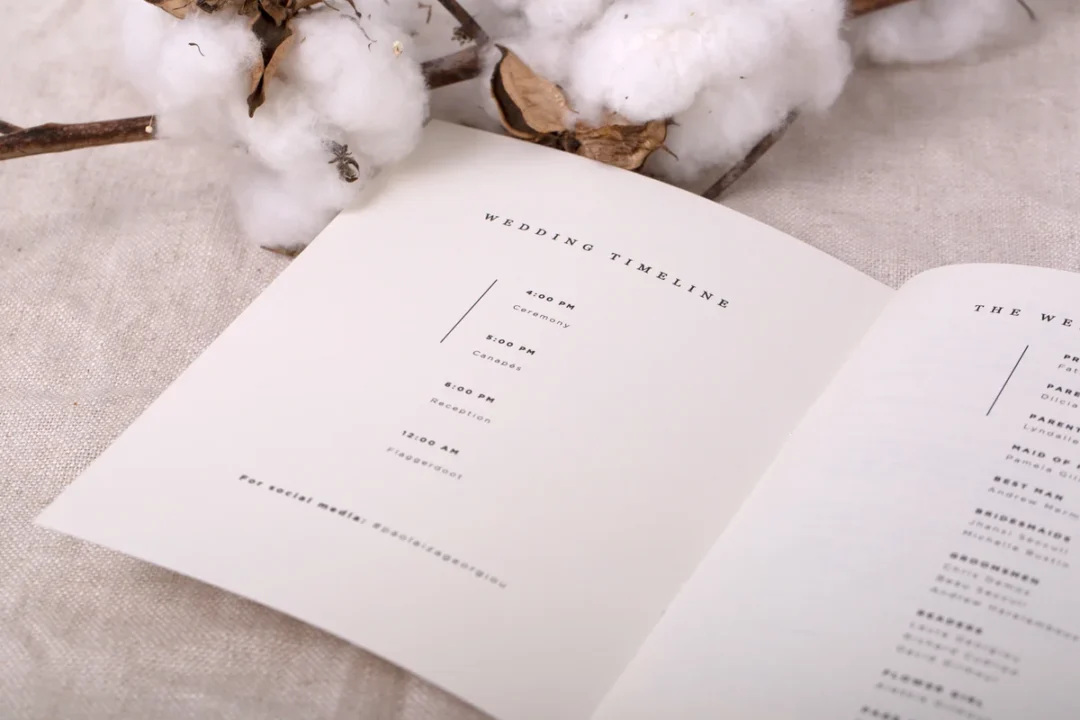

Your ceremony is the heart of your wedding day. A well-designed program gives every guest a guide to follow along, introduces the people who matter most to you, and becomes a keepsake long after the flowers have faded. Whether you are planning a simple folded card or a full booklet, this guide covers everything you need to know about wedding ceremony programs – what to include, how to design them, when to order, and how to match them to your stationery suite.
Wedding Ceremony Programs: At a Glance
- Do you need one? Not required, but guests love them – especially for religious or multicultural ceremonies with unfamiliar rituals.
- Most popular format: Bi-fold card (5.5 x 8.5 inches [140 x 216 mm]), followed by single-sheet and fan programs.
- What to include: Order of service, wedding party list, readings and music, and a personal thank-you note.
- Print methods: Digital, flat foil, letterpress, metallic, and white ink – available at Paperlust.
- Order timeline: Finalize wording 4-6 weeks before the wedding; allow 2 weeks for proofing and production.
- Pro tip: Order 10-15% more than your guest count – late RSVPs and keepsakes add up.
What Is a Wedding Program and Do You Need One?
A wedding ceremony program is a printed guide that outlines the structure and key participants of your ceremony. It tells guests who is in the wedding party, what will happen and in what order, what readings or songs will be shared, and how to participate (for example, when to stand or join in a response). Programs range from a simple single-sided card to a multi-page booklet, depending on the complexity of the ceremony and the couple’s style preferences.
Do you need one? There is no rule that requires a ceremony program. Plenty of couples skip them, especially for short civil ceremonies or very intimate gatherings. That said, programs tend to be well-received by guests for a few reasons:
- They help guests follow along during religious, multicultural, or bilingual ceremonies that include unfamiliar customs or prayers.
- They introduce the wedding party – many guests may not know every bridesmaid, groomsman, or officiant by sight.
- They provide context for readings, songs, and musical selections that guests may not recognize.
- They serve as a tangible memento of the day, especially when printed on a beautiful stock like cotton or heavyweight matte.
If your ceremony runs 30 minutes or less with no structured readings, you can reasonably skip the program. If you have a ceremony that follows a liturgy, includes multiple speakers or performers, or draws guests who are unfamiliar with your traditions, a program is a genuinely helpful touch.
What to Include on a Wedding Program
The exact contents of a wedding program depend on your ceremony style, but most programs share the same core sections.
Essential sections
- Cover: Your names, wedding date, ceremony venue, and an optional quote, monogram, or artwork.
- Order of service: A numbered or sequential list of everything that will happen – prelude music, processional, opening remarks, readings, vows, ring exchange, pronouncement, recessional. Include the names of songs and hymns where relevant.
- Wedding party list: Names and roles for your officiant, wedding party members, parents walking in the processional, and any special performers or readers.
- Readings: The title, author, or scripture reference for any readings being shared during the ceremony. You can include the full text if space allows.
Optional additions
- A personal note: A short message from the couple thanking guests for being there.
- Memorial tribute: A brief acknowledgment of loved ones who have passed.
- Glossary or traditions guide: Helpful for multicultural ceremonies or rituals guests may not recognize.
- Music list: The full prelude and recessional playlist, especially if you have a live musician.
- Venue map or logistics note: Directions to the reception, parking notes, or a “phones away” request.
For a full checklist of every section to consider, see What to Include on a Wedding Program: The Complete Checklist.
Wedding Program Sizes, Shapes, and Formats
The format you choose affects both how much information you can fit and how the program feels in guests’ hands. Here are the most common options.
| Format | Typical Size | Best For | Notes |
|---|---|---|---|
| Single-sheet flat | 4 x 9 inches [102 x 229 mm] | Short civil ceremonies with minimal content | Front and back; most economical |
| Bi-fold card | 5.5 x 8.5 inches [140 x 216 mm] folded | Most ceremonies; 4 interior panels | Most popular format; easy to hold |
| Tri-fold card | 3.5 x 8.5 inches [89 x 216 mm] per panel | Longer ceremonies with lots of content | 6 panels total; elegant when folded |
| Fan program | Varies; paddle shape common | Outdoor summer ceremonies | Doubles as a hand fan; novelty appeal |
| Booklet | 5.5 x 8.5 inches [140 x 216 mm] finished | Long or complex ceremonies; formal weddings | Saddle-stitched; highest perceived value |
Choosing your format: The bi-fold is the workhorse option. It gives you four panels to work with (cover, two inner pages, back cover) and holds up well in guests’ hands. If your ceremony runs long or includes a full program with music lyrics and bilingual text, a booklet is worth the step up. Fan programs are charming at outdoor summer weddings in warm climates where they serve a practical purpose, not just an aesthetic one.
Design Principles: Fonts, Layout, and Paper Choice
Good ceremony program design is about hierarchy and readability. Guests are typically reading in a dim church or squinting in afternoon sun – this is not the place to push decorative fonts beyond comfort.
Typography
- Heading font: A single serif or script font for your names and ceremony date on the cover. Keep scripts at large enough sizes that they remain legible (18pt minimum for scripts).
- Body font: A clean serif like Garamond or Caslon, or a simple sans-serif like Optima. Body text should sit at 10-12pt for comfortable reading.
- Avoid: More than two font families per design, all-caps body text in scripts, and colored text on dark backgrounds unless contrast is very high.
Layout
- Lead with your names and the date prominently on the cover.
- Use clear visual separation between sections (white space or a simple dividing rule works well).
- Keep margins generous – 0.5 inches [13 mm] minimum on all sides for printed programs.
- Align reading names and performer credits consistently (flush left is easier to scan than centered body text).
Paper and print method
Paper choice does more for the feel of a ceremony program than almost any design decision. The options Paperlust offers for programs include:
- Matte 300gsm: Clean, modern, and suitable for digital printing with fine photographic details or illustrations. A reliable choice for most wedding styles.
- Wild Cotton (300gsm or 600gsm): The premium choice for letterpress programs. The soft, fibrous surface takes a deep debossed impression and gives programs a handcrafted, heirloom quality that guests frequently comment on.
- 380gsm Premium: The right weight for flat foil programs – substantial without being stiff, with a smooth surface that catches foil detail beautifully.
- Kraft (290gsm): Earthy and textural, well-suited for boho or garden weddings using white ink or digital printing.
Matching print method to style: For formal or traditional ceremonies, letterpress on Wild Cotton or flat foil on Premium stock signal luxury without overwhelming the design. For modern minimal weddings, clean digital printing on 300gsm Matte is refined and cost-effective. For garden or boho aesthetics, digital or white ink on Kraft creates a warm, organic feel.
Professional Printing vs DIY: How to Choose
The choice between professional printing and doing it yourself comes down to three factors: your time investment, your access to quality equipment, and how much the finished result matters to you.
When professional printing makes sense
- You want access to specialty print methods (flat foil, letterpress, metallic, white ink) that are not achievable on a home or office printer.
- You need more than 50 copies and want consistent color and registration across all of them.
- Your programs are part of a coordinated stationery suite and you need the paper stock, weight, and color to match exactly.
- You are working with a premium paper stock like Wild Cotton or heavyweight Premium that is not sold in craft stores.
When DIY is a reasonable option
- Your ceremony is simple and you are happy with a clean digital print on standard cardstock.
- You have access to a laser printer that handles cardstock well (most home inkjet printers do not produce professional-quality output on thick stock).
- You have the time to fold, cut, and assemble programs for your full guest count.
Planning to print at home? See DIY Wedding Programs: How to Design and Print at Home for a step-by-step guide covering design software, printer settings, and folding techniques.
Digital Wedding Programs: QR Codes and App Alternatives
A growing number of couples are replacing or supplementing printed programs with a digital option accessed via a QR code. Guests scan a small printed card or a sign at the ceremony entrance and are taken to a hosted web page, PDF, or app with the full program content.
Advantages of going digital:
- No printing or folding required, which can significantly reduce cost and labor.
- Program content can be updated right up to the day if an order of events changes or a name is spelled incorrectly.
- Guests who prefer reading on their phone may find it easier to follow along.
Limitations to consider:
- Guests without smartphones – or with low battery – are left without a program entirely.
- Phone screens in a dim ceremony venue can be distracting or even disrespectful in settings where devices are discouraged.
- QR cards still need to be printed, so you are not eliminating printing entirely.
- Digital programs do not serve as the same kind of keepsake that a beautifully printed card can.
Many couples combine both: a small QR card (a simple business-card-size print) for guests who prefer digital, alongside a shorter printed program for those who want a physical copy or a keepsake. This hybrid approach keeps costs lower than full-count printed booklets while still giving every guest something tangible.
Going digital? See Digital Wedding Programs and QR Code Ceremony Cards for a full breakdown of tools, hosting options, and design tips.
Ordering Timeline for Wedding Programs
Programs are often ordered later than invitations, but they still require a realistic runway – especially if you are choosing a specialty print method.
Recommended timeline
6-8 weeks before the wedding
- Confirm your ceremony structure and order of events with your officiant.
- Draft the full wording and collect all names and roles from your wedding party.
- Choose your format, paper, and print method.
4-6 weeks before the wedding
- Finalize all content and submit your order to allow time for proofing.
- Your designer proof arrives within 1-2 business days at Paperlust.
- Two rounds of edits are included at no extra cost.
Production and shipping
- Digital print: Approximately 8-10 business days production.
- Flat foil or metallic: Slightly longer; plan 10-15 business days for production.
- Letterpress: Approximately 20 business days production due to handcrafted setup.
- US shipping: 2-4 business days transit via DHL Express after dispatch. Orders over $350 USD ship free via DHL Express.
- Rush print: A 24-hour rush option is available for an additional fee.
Order buffer: Always order 10-15% more programs than your confirmed guest count. Late RSVPs, parents who want extras as keepsakes, and the occasional coffee ring mean you will almost always need more than your headcount.
How to Match Your Program to the Rest of Your Suite
A well-designed wedding suite is coherent: every piece from invitation to program feels like it belongs to the same visual world. Matching your program to your suite does not require a pixel-perfect replica of your invitation design – it requires alignment on three things.
1. Typography consistency
Use the same heading font from your invitation on your program cover. If your invitation features a calligraphy script for your names, carry that same script typeface onto the program. Body text can shift to a more readable serif or sans-serif without breaking the visual link.
2. Color palette alignment
Carry the two or three colors from your invitation into your program design. If your invitation uses dusty rose and sage green, your program cover florals or border should echo those tones. If your invitation is predominantly black on white with a single gold accent, keep the program restrained in the same way.
3. Print method and paper coordination
This is the most impactful layer. If your invitations were printed in flat foil on 380gsm Premium stock, ordering your programs in digital print on 300gsm Matte will feel noticeably different in guests’ hands. Matching the paper weight and print method across your suite creates a cohesive sensory experience that elevates the overall impression.
Paperlust designs are built as collections, which means the invitation, program, envelope liner, menu, and place card in the same design family share the same artwork. If you ordered your invitations through Paperlust, your program design match is already available in the same collection.
Browse our full range of wedding programs and filter by print method to find the exact finish you need. For more inspiration on coordinating your full suite, explore the matching wedding invitations collections.
Go Deeper: Explore the Full Wedding Programs Guide
This hub covers the full picture. For each topic in detail, explore the dedicated guides in this series:
- Everything to put on your program: What to Include on a Wedding Program: The Complete Checklist – a section-by-section breakdown with example wording for every element.
- Printing at home: DIY Wedding Programs: How to Design and Print at Home – software options, paper buying guide, printer settings, and folding instructions.
- Going paperless: Digital Wedding Programs and QR Code Ceremony Cards – tools for building a hosted digital program, QR card design tips, and the hybrid approach.
For wording inspiration and real-world examples, you may also find these useful:
Frequently Asked Questions
How many wedding programs should I order?
Order one per couple or household attending, plus 10-15% extra for late RSVPs, keepsakes for immediate family, and your own records. For a 100-person wedding, 110-115 programs is a reasonable target.
When should I order wedding programs?
Finalize your wording 4-6 weeks before the wedding to allow time for proofing and production. Digital print programs take approximately 8-10 business days in production; letterpress programs need around 20 business days. Add US shipping transit of 2-4 business days via DHL Express to your timeline.
What size are most wedding programs?
The bi-fold format is the most popular: 5.5 x 8.5 inches [140 x 216 mm] folded. It gives you four panels to work with and sits comfortably in guests’ hands during the ceremony. Single-sheet programs run around 4 x 9 inches [102 x 229 mm] and are a good choice for short ceremonies with minimal content.
Do I need a professional designer to make a wedding program?
No – Paperlust assigns a professional designer to every order who builds your program from your submitted text and any design customizations. You receive a proof within 1-2 business days, with two rounds of edits included at no extra cost. If you prefer to design your own, a DIY route using Canva or Adobe InDesign and printing at home is also an option for simple digital-print programs.
What paper is best for wedding programs?
Wild Cotton (300gsm or 600gsm) is the top choice for letterpress programs – the soft fibrous texture holds a deep debossed impression. For flat foil programs, 380gsm Premium stock gives the right weight and smooth surface. For clean digital print programs, 300gsm Matte is versatile and pairs well with most design styles.
Can I get wedding programs in the same design as my invitations?
Yes. Paperlust designs are sold as full collections, so the program, invitation, menu, place card, and envelope liner are all available in the same artwork. Simply select the matching design when you order your programs and specify the same print method for a fully coordinated suite.
How much do wedding programs cost?
Cost varies by print method, paper stock, and quantity. Digital print programs are the most affordable option. Flat foil and metallic programs cost more due to specialty materials. Letterpress programs sit at the premium tier. Paperlust pricing is shown per card on the product page; ordering in higher quantities reduces the per-unit cost. Orders over $350 USD receive free DHL Express shipping to the US.
Are digital QR code programs a good alternative to printed ones?
They work well as a supplement, but most couples who use them still order a smaller quantity of printed programs for guests who prefer something physical – elderly relatives, guests without smartphones, and those who want a keepsake. A hybrid approach (QR cards at the door plus a limited print run of 30-40 booklets) balances cost and guest experience well.
Can wedding programs include memorial tributes?
Yes, and many couples include a brief memorial line on the back cover or inside. A common format is a short line such as “We carry with us the memory of [Name], whose presence is felt today.” Some couples include a small candle or empty seat as part of the ceremony and reference it in the program. There is no standard format – keep it sincere and brief.
What is the difference between flat foil and letterpress for wedding programs?
Flat foil uses a metallic foil film applied under heat and pressure to create a bright, mirror-finish metallic surface. There is no deboss or custom die, which keeps production faster and minimum orders lower (from 10 programs). Letterpress presses the design into the paper itself, creating a tactile, debossed impression with handcrafted character. Letterpress uses Wild Cotton stock and requires approximately 20 business days of production. Many couples combine both techniques: letterpress for the main typographic elements and flat foil accents for the date or monogram.
Ready to Design Your Wedding Programs?
Browse hundreds of designs across digital, flat foil, letterpress, metallic, and white ink – all matched to full stationery collections so your entire suite stays cohesive.