

Planning a formal celebration means every detail counts, and nothing sets the tone earlier than your invitation. Whether you are navigating the difference between “black tie” and “black tie optional,” choosing between letterpress on Wild Cotton and flat foil on heavyweight stock, or figuring out how to phrase a reception card, this guide covers every etiquette rule and design decision you need.
- “Black tie” means formal evening dress; place the dress code line at the bottom right or on an insert card, never centered in the main text block.
- Traditional black tie wording uses third-person phrasing, spelled-out dates and times, and full names throughout.
- Letterpress on 600gsm Wild Cotton is the most tactile, heritage-appropriate finish for formal invitations; flat foil adds mirror-bright metallic accents on heavyweight stock.
- Dress code tiers run casual, semi-formal, black tie optional, black tie, and white tie, each with distinct wording conventions.
- A complete black tie suite includes the invitation, reception card, RSVP card, details card, and addressed envelopes, with all pieces in the same design family.
- Order at least 8-10 weeks before the wedding to allow for letterpress production (roughly 20 business days after proof approval).
What Is a Black Tie Wedding Invitation?
A black tie wedding invitation is a formal stationery piece that signals an elegant, dressy evening celebration. Beyond aesthetics, the phrase “black tie” carries a specific social meaning: men are expected to wear tuxedos and women floor-length gowns, though exact expectations vary by region and couple.
The invitation itself communicates that formality before a single guest opens the envelope. Traditional etiquette calls for heavier card stock, classic typography, formal third-person wording, and a print finish that feels substantial in hand. Rushed digital print on thin card sends a mixed signal. A deep-pressed letterpress card on 600gsm Wild Cotton cotton paper, or a crisp flat foil treatment on heavyweight stock, tells guests immediately that the event matches the dress code on the card.
That said, “black tie” on an invitation does not require a rigid Victorian format. Modern formal invitations balance etiquette with personality, and a clean, contemporary typographic layout with a gold foil accent can read just as formally as a traditional engraved script if the paper weight and print quality support it.
Black tie wedding invitations →
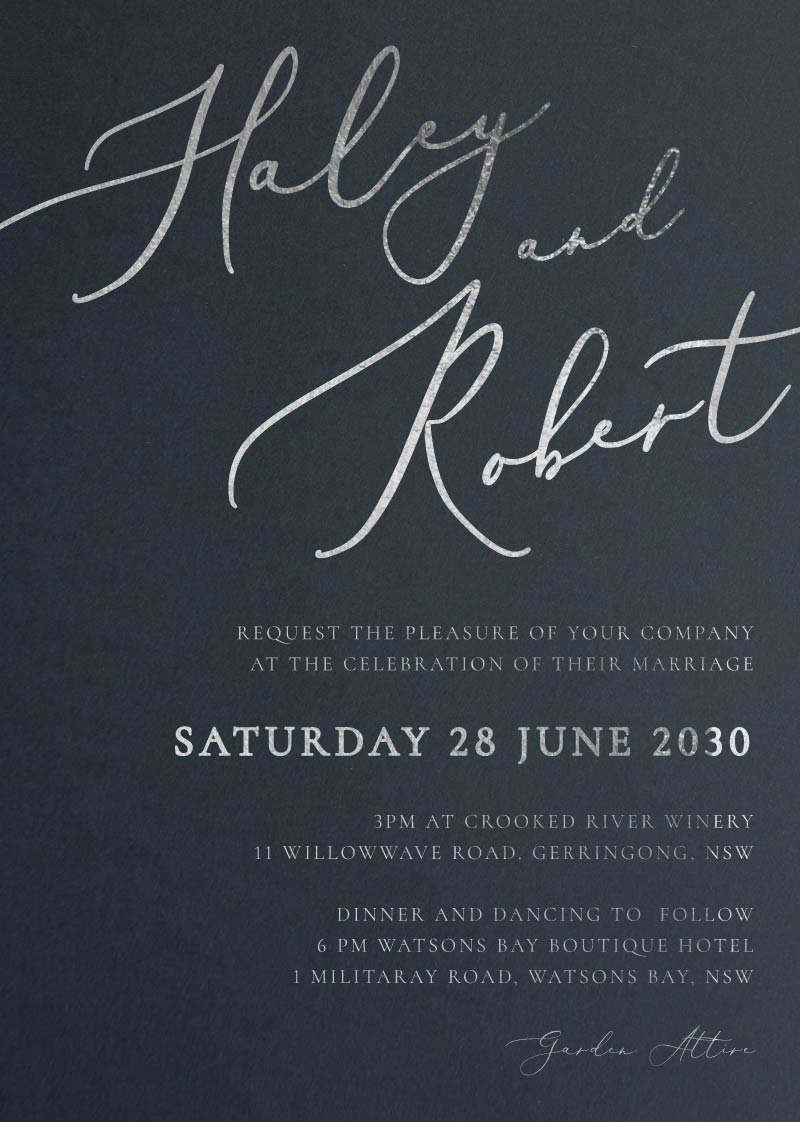
Rose Et GrisColour Stock + Foil
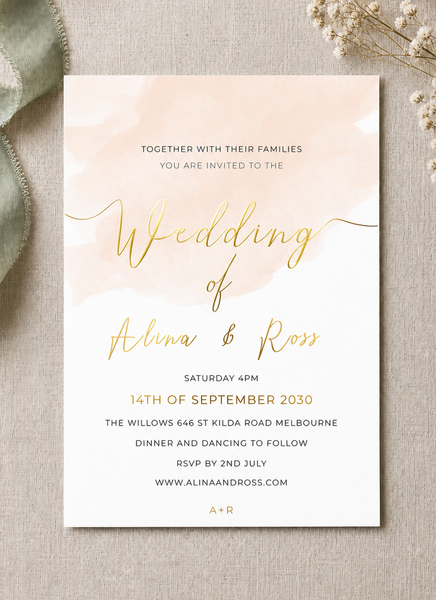
RoseyFlat foil
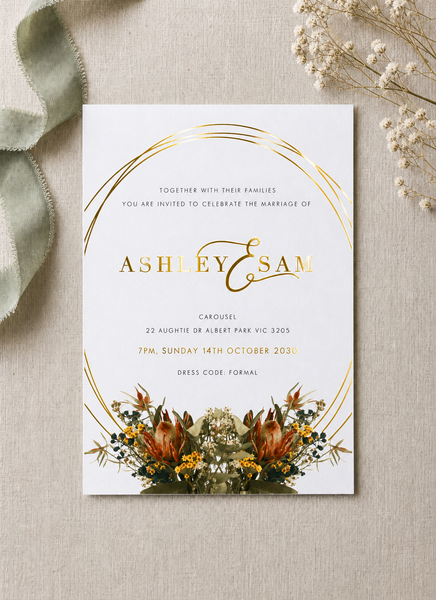
A Native CircleFlat foil

Ink and NibColour Stock + Foil
“Black Tie” vs. “Black Tie Optional” vs. “White Tie”: Wording It Right
The dress code phrase is usually placed at the bottom right corner of the invitation, or on a separate details card. It is one of the few lines where clarity matters more than tradition. Below is how each tier differs in meaning and how to word it on paper.
Black tie
Full black tie means tuxedos for men and floor-length formal gowns for women. The phrase on the invitation is simply:
It is written with initial capitals, placed without a colon or full sentence, and sits discretely at the lower right of the main card or on a details insert.
Black tie optional
Black tie optional signals that formal dress is welcomed but not required. Men may wear tuxedos or dark suits; women may wear floor-length gowns, formal midi dresses, or elegant pantsuits. The phrase on the invitation:
Some couples add a clarifying line on the details card, such as “Formal attire encouraged.” That is entirely appropriate and avoids guests feeling uncertain about the suit-versus-tuxedo question.
White tie
White tie is the most formal civilian dress code in the United States and internationally. Men wear tailcoats, white waistcoats, and white bow ties; women wear floor-length ballgowns. White tie weddings are rare outside of diplomatic, military, or very traditional formal society contexts. The phrase:
The invitation itself should match this level of formality. Engraving on crisp smooth stock was the traditional standard; today, letterpress on heavyweight cotton paper or flat foil on 380gsm premium stock achieves a comparably formal feel at a more accessible price point.
Variations to know
A handful of other phrases appear on formal invitations, each with a slightly different expectation:
- Formal attire: equivalent to black tie optional for most US guests; clear and unambiguous
- Creative black tie: tuxedos encouraged but guests may interpret creatively with color or accessories; suits fine
- Cocktail attire: not black tie, but still elevated; suits, cocktail dresses, midi length acceptable
Formal Third-Person Wording Examples
Traditional black tie invitation wording follows a precise structure. The most common format in the United States uses third-person phrasing throughout, with dates and times spelled out in full rather than printed as numerals. Here are the key building blocks and how they fit together.
Host line
The host line names whoever is issuing the invitation. Traditional etiquette places parents here; modern couples often host themselves.
request the honour of your presence
Use “honour of your presence” for religious ceremonies and “pleasure of your company” for secular venues. Both are correct; the distinction is a matter of etiquette tradition rather than strict rule.
Couple’s names
If parents are hosting and the bride’s surname is implied, the bride’s first and middle names appear alone. The groom’s full name follows.
Caroline Elizabeth
to
Mr. Thomas Harrington Alcott
Date and time
Spell out the day, date, year, and time in full for a black tie invitation. Numerals are reserved for details cards and RSVP cards.
two thousand twenty-six
at half past six in the evening
Venue line
Include the venue name and city on separate lines. A street address is optional for well-known venues; include it for private estates or less-familiar locations.
New York, New York
Full formal wording example
request the honour of your presence
at the marriage of their daughter
Caroline Elizabeth
to
Mr. Thomas Harrington Alcott
on Saturday, the twelfth of September
two thousand twenty-six
at half past six in the evening
The Grand Ballroom at Hotel Vanderbilt
New York, New York
Reception to follow
Black Tie
Modern formal wording (couple-hosted)
Caroline Elizabeth Whitmore
and
Thomas Harrington Alcott
request the pleasure of your company
to celebrate their marriage
Saturday, the twelfth of September, two thousand twenty-six
at half past six in the evening
The Grand Ballroom at Hotel Vanderbilt
New York, New York
Dinner and dancing to follow
Black Tie Optional
Design Standards for Formal Wedding Invitations
Etiquette governs wording; design governs feel. For a black tie event, the visual language of the invitation should reinforce the formality of the occasion through typography, layout, color palette, and finish.
Typography
Classic formal invitations favor serif typefaces: elegant scripts for names and headings, refined Roman or engraved-style serifs for body text. Mixed typography is common and effective when the pairing is intentional. A calligraphic script for the couple’s names paired with a clean small-caps serif for the date and venue creates a formal hierarchy without rigidity.
Avoid heavy sans-serif fonts, overly casual handwritten scripts, or display fonts that read as playful. Restraint in typeface choice signals formality more reliably than any single font category.
Color palette
Black, ivory, and gold are the safest formal palette for black tie. Navy and charcoal read as formal when paired with gold or silver accents. Blush, sage, and muted neutrals work well at a slightly less formal register, appropriate for black tie optional events but softer than strict black tie traditions call for.
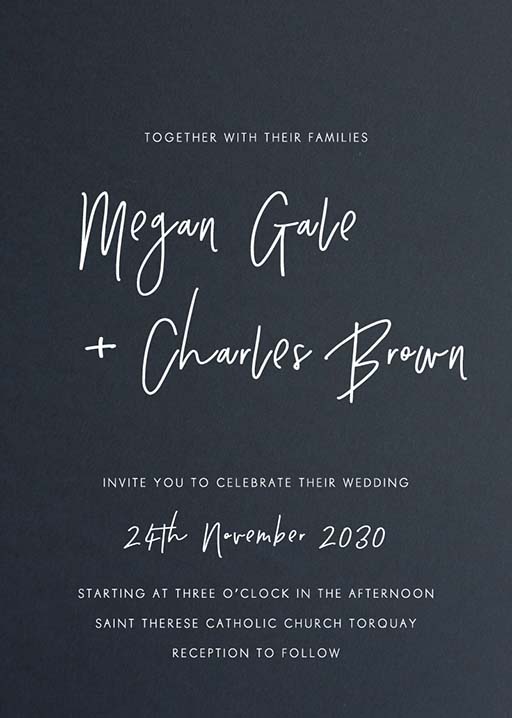
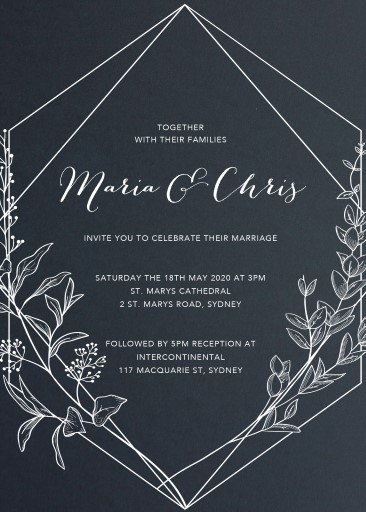
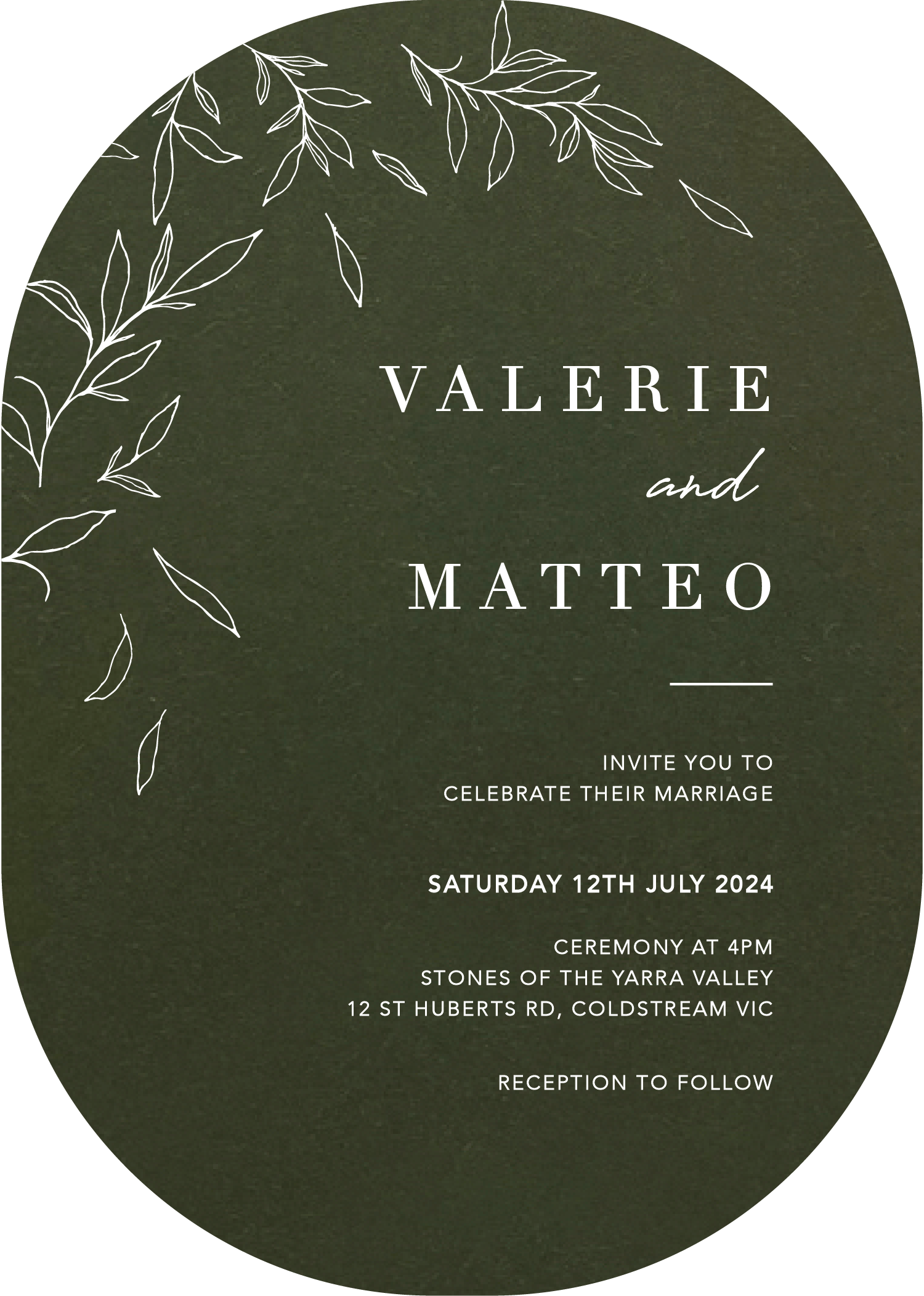
White ink on black card stock is a compelling modern choice for formal invitations: high contrast, dramatic, and unmistakably intentional.
Layout
Traditional black tie layouts are centered, with generous white space between lines. Left-aligned layouts read as modern and editorial rather than traditional; they are appropriate for black tie optional or creative black tie contexts.
Borders and rules (thin printed lines framing the card) add formality to an otherwise simple design. Monograms, crests, and custom illustrated motifs all belong in the formal register when executed with restraint.
Paper, Print, and Finish Options for Black Tie Invitations
The finish you choose will be felt before it is read. Paperlust offers several print methods suited to formal events; the best choice depends on budget, aesthetic, and the specific level of formality you are signaling.
Letterpress on Wild Cotton
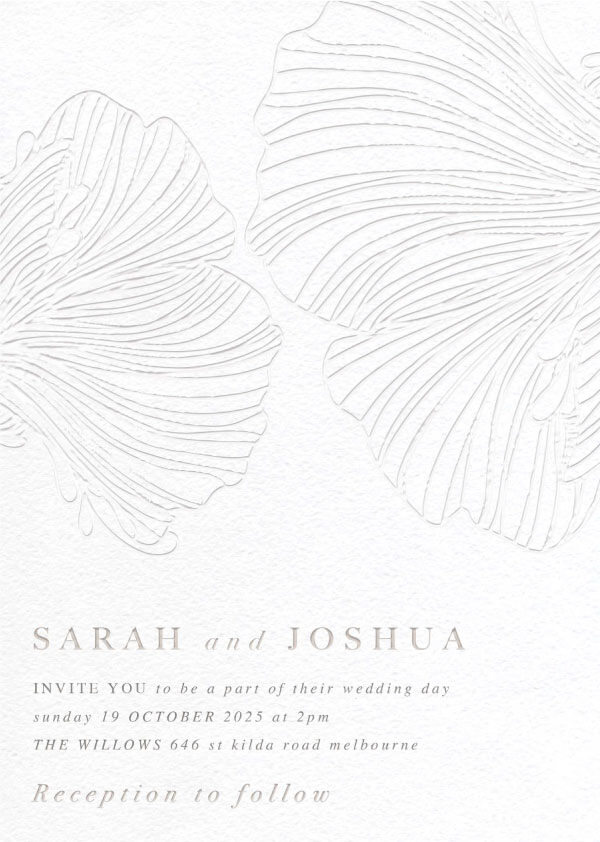
Letterpress is the most tactile, heritage-appropriate finish for a black tie wedding invitation. A custom plate presses the design into the surface of the paper, creating a visible debossed impression that guests can feel with their fingertips.
Paperlust uses 300gsm and 600gsm Wild Cotton for letterpress. Wild Cotton is a genuine cotton-fiber paper that holds a deep impression and has a soft, pillow-like texture unlike any coated or wood-pulp stock. The 600gsm double-thick option is as substantial a card as you will find in stationery and is the natural choice when formality and material quality are priorities.
Letterpress production takes approximately 20 business days after proof approval. A designer proof is delivered within 1-2 business days of placing your order, with two rounds of edits included at no additional cost. Custom samples are available for most print methods, but the $15 custom sample is not available for letterpress; a $5 sample pack includes a letterpress sample so you can feel the stock and impression before committing.
Letterpress wedding invitations →
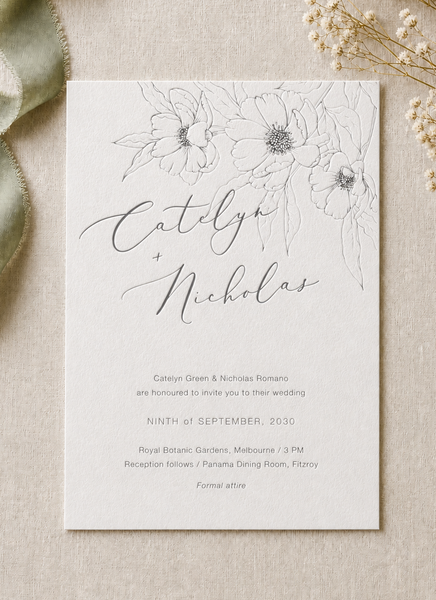
Graphite BloomsLetterpress

Sweet and SaltyLetterpress
Botanic PressLetterpress

Tropical OasisLetterpress
Flat foil
Flat foil lays mirror-bright metallic foil onto the card surface without a custom die or deboss impression. It has no minimum order requirement beyond 10 cards (or 30 for 350gsm heavyweight stock), and produces a vivid, reflective metallic finish in gold, silver, rose gold, copper, and a range of other colors including holographic and celestial blue.
For formal invitations, flat foil on 380gsm premium stock or 350gsm heavyweight stock delivers an unmistakably luxe result. The foil catches light, names appear to glow, and the card feels appropriately weighted for a formal event.
White ink
White ink on black or dark navy card stock is a bold, contemporary formal choice. The contrast is striking, and when paired with a heavyweight black card, the result reads as intentionally dramatic rather than casual. Paperlust offers white ink on colour stock (270-300gsm) and kraft, making it viable for dark-palette formal suites.

Digital print
Digital print on 380gsm premium or 300gsm matte card is the most accessible option. It allows full-color design, fast production, and very low minimum orders. For formal events it works best when the design itself does the heavy lifting, a beautifully typeset black-and-white invitation on premium digital stock reads as formal when the layout and typography are strong.
| Print method | Formality fit | Key feature | Paper | Min order |
|---|---|---|---|---|
| Letterpress | Black tie / White tie | Debossed tactile impression | 300gsm or 600gsm Wild Cotton | 10 |
| Flat foil | Black tie optional / Black tie | Mirror-bright metallic, no die | 380gsm Premium, 350gsm Heavyweight | 10 (30 for heavyweight) |
| White ink | Black tie (dark palette) | White on dark stock, high contrast | Colour stock 270-300gsm, Kraft | 10 |
| Digital print | Semi-formal / Black tie optional | Full color, fast, accessible | Matte, Premium, Linen | 10 |
Formality Tiers: From Casual to White Tie
Choosing where your wedding sits on the formality spectrum helps guests know exactly what to expect. The table below maps each tier to its typical dress code, wording style, and stationery finish.
| Formality tier | Guest dress code | Wording style | Invitation phrase | Ideal print finish |
|---|---|---|---|---|
| Casual | Smart casual | First person, relaxed | No dress code line needed | Digital, flat foil accents |
| Semi-formal | Suit or cocktail dress | First or third person | Cocktail Attire | Digital, flat foil, metallic |
| Black tie optional | Tuxedo or dark suit | Third person, some numerals acceptable | Black Tie Optional | Flat foil, letterpress |
| Black tie | Tuxedo required, gown | Formal third person, dates spelled out | Black Tie | Letterpress, flat foil on heavyweight |
| White tie | Tailcoat + white waistcoat, ballgown | Strict traditional, all details spelled out | White Tie | Letterpress on 600gsm Wild Cotton, flat foil on premium stock |
What to Include in a Black Tie Wedding Suite
A black tie wedding suite is the full collection of stationery pieces sent to guests. All pieces should share the same design system, font, color palette, paper, and print method, so the suite feels intentionally coordinated rather than assembled from mismatched templates.
Core pieces
- Main invitation card: the formal anchor of the suite; carries the ceremony details, wording, and dress code line
- Inner envelope (optional): traditionally used to address the invitation to specific guests within a household; less common in modern suites but appropriate for very formal events
- Outer envelope: hand-addressed in the same calligraphic or typographic style as the invitation; Paperlust offers printed envelope addressing at approximately $0.20 per address
- Free white envelopes: included with every Paperlust order; colored or textured envelope upgrades are available
Supporting pieces
- RSVP card and return envelope: a must for formal events; include the reply-by date, meal preference (if applicable), and a line for guest name and number attending
- Details or information card: carries reception venue, accommodation, wedding website, and any additional logistics; keeps the main invitation clean and uncluttered
- Reception card: traditionally separate from the invitation in very formal suites; lists the reception venue and time when these differ from the ceremony
- Accommodations card: hotel block information and room booking code; appropriate for destination or multi-day events
- Map or directions card: less common now that guests use navigation apps, but still appropriate for estates or venues in rural areas
Envelope enclosure order
Traditional etiquette places the invitation face-up at the front, with enclosures tucked behind it in order of size, largest first. RSVP cards are tucked under the flap of their pre-addressed return envelope. The full set then goes into the inner envelope, which goes face-forward into the outer envelope.
Modern practice is more relaxed: tuck enclosures behind the invitation in the order guests will use them, and skip the inner envelope unless formality requires it. The Paperlust wedding invitation collection includes designs suited to full formal suites across all print methods.
Frequently Asked Formal Invitation Etiquette Questions
Where exactly should the dress code appear on a black tie invitation?
The dress code line belongs at the lower right corner of the invitation card, or on the details insert card. It should not appear centered in the main text block alongside the ceremony details. Some couples place it on the invitation itself; others prefer the details card so the main invitation remains clean. Both approaches are correct.
Should I use “honour” or “honor” on a formal US invitation?
Both are acceptable in the United States. “Honour” with the British spelling is traditional in formal US wedding stationery and is widely used; “honor” with American spelling is equally correct. Choose one spelling and use it consistently across your suite.
Do I need to spell out dates and times on a black tie invitation?
Spelling out dates and times is the traditional approach for formal black tie invitations and signals the highest level of care and formality. It is not strictly required, and some modern formal invitations use a mix of spelled-out and numeral formats. For white tie events, spelling everything out is the expected standard.
Is letterpress appropriate for a black tie wedding invitation?
Yes. Letterpress on heavyweight Wild Cotton paper is one of the most appropriate finishes for a black tie or white tie invitation. The debossed impression, cotton-fiber texture, and substantial weight of the card communicate formality through touch before the guest reads a word. Paperlust letterpress starts at 300gsm and goes up to the 600gsm double-thick Wild Cotton option, which is the heaviest card in the range.
Can I use flat foil on a formal invitation instead of letterpress?
Yes. Flat foil on 380gsm premium or 350gsm heavyweight stock is an excellent choice for formal invitations. It delivers mirror-bright metallic text or design elements without the longer production timeline of letterpress, and the minimum order of 10 cards makes it accessible for smaller guest lists. For a white tie event, the combination of flat foil and a very clean, restrained design on heavyweight stock is entirely appropriate.
What is the difference between flat foil and foil stamp?
Flat foil applies metallic foil film to the card surface without a custom die, leaving no debossed impression. It is the foil technique Paperlust offers: fast turnaround, a 10-card minimum (30 for 350gsm heavyweight), and a wide color range including gold, silver, rose gold, copper, and holographic. Foil stamping is a separate industry technique that uses a heated metal die to press foil into the paper, creating a tactile embossed impression. Paperlust does not offer foil stamping; the premium tactile alternative is letterpress on Wild Cotton, which presses the design into the cotton-fiber paper for a comparable debossed effect without metallic foil.
How far in advance should I order black tie invitations?
Order at least 8-10 weeks before the wedding for letterpress invitations. Letterpress production takes approximately 20 business days after proof approval, and proofs are delivered within 1-2 business days of placing your order. Add time for envelope addressing, assembly, and postage; formal invitations are typically mailed 6-8 weeks before the wedding date. Flat foil has a shorter production window and is a good option if your timeline is tighter.
Does Paperlust offer envelope addressing for formal invitations?
Yes. Paperlust prints guest addresses on envelopes at approximately $0.20 per address, using a typographic style matched to your invitation design. Free white envelopes are included with every order, and colored or textured envelope upgrades are available. For a very formal suite, hand-calligraphy addressing from an independent calligrapher is also an option, though it is not a Paperlust service.
Paperlust offers 500+ exclusive designs across letterpress, flat foil, white ink, and digital print, all made in our Melbourne studio.