
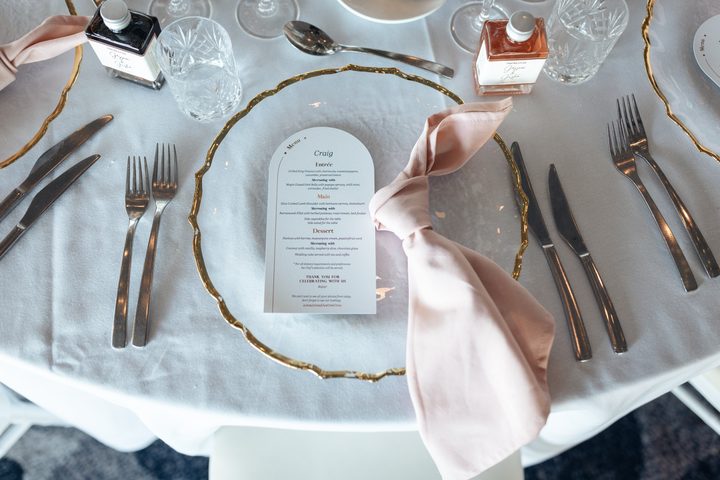
Your reception tables are one of the first things guests notice when they walk into the room, and a well-designed table number does more than point people to their seats. It reinforces your wedding aesthetic, ties your stationery suite together, and creates a small but memorable detail that photographs beautifully. Whether you’re drawn to sleek printed cards, non-number naming systems, or something more personal like photo displays, this guide covers every style, format, and display option worth considering.
If you’re also working through place cards and seating arrangements, our complete wedding place cards guide walks through formats, wording, and pairing options to help you build a cohesive table setting.
| Type | Best For | Min. Order | Finish Options |
|---|---|---|---|
| Printed flat card | Any style; pairs with invitation suite | 10+ | Digital, flat foil, metallic, letterpress |
| Tented card | No stands needed; casual to formal | 10+ | Digital, metallic |
| Framed card | Elegant; reusable frame as guest gift | 10+ | Any print method |
| Non-number system | Personal touch; conversation starter | 10+ | Digital, flat foil |
| Photo table number | Storytelling; guests find them instantly | 10+ | Digital print |
Printed Table Number Card Styles: Flat, Tented, and Framed
Printed cards are the most versatile option because they can match any theme, any color palette, and any print finish. The three main formats are flat cards, tented cards, and insert-ready cards sized for frames or acrylic holders.
Flat Cards
Flat cards are printed on a single panel of card stock and require a holder or stand to remain upright on the table. They work with the full range of print finishes and paper weights available at Paperlust:
- Digital print – the most affordable and flexible option; supports full color artwork, photos, and custom typography
- Flat foil – mirror-bright metallic finish (gold, silver, rose gold, copper, and more) applied directly to the card; no custom die required, no deboss impression; minimum order 10 cards
- Metallic print – a dry-toner metallic pigment that adds subtle shimmer without the full mirror-brightness of foil; great for couples who want a hint of metallic without committing to a bold foil look
- Letterpress – deboss impression pressed into 300gsm or 600gsm Wild Cotton paper; the most tactile and luxurious option; pairs beautifully with a matching letterpress invitation suite
Tented Cards
Tented (or tent fold) cards are scored and folded in half so they stand on their own without a holder. They’re ideal for couples who want to minimize rental costs or keep the table surface clean. The fold also creates a natural second panel that can carry a menu, a love note to guests, or a list of table activities.
Framed Cards
A flat card sized to fit a small frame turns a practical item into a displayable piece. After the wedding, frames can be gifted to guests or repurposed as keepsakes. Standard sizes that fit readily available frames include 4 x 6 inches (102 x 152mm) and 5 x 7 inches (127 x 178mm). If you’re ordering matching invitation suites, choosing a table number in the same dimensions as your place card keeps the whole table setting visually unified.

Acrylic and Lucite Table Number Ideas
Acrylic and Lucite table numbers are a popular choice on Pinterest and in venue styling photos, but they’re typically sourced from specialty prop suppliers rather than stationery printers. If your venue coordinator or florist is already renting acrylic charger plates or geometric centerpiece frames, adding matching acrylic table numbers through the same vendor keeps the look consistent.
That said, there’s a compelling middle-ground approach: order a small printed card with your table number and place it inside a clear acrylic holder or floating frame that you source separately. This gives you the translucent modern aesthetic of acrylic while keeping your custom typography, font, and color palette consistent with the rest of your Paperlust suite. Many couples order a set of clear acrylic number holders (widely available from wedding hire companies and online retailers for $1-3 per holder) and then insert a printed card from their stationery order.
Styling Tips for Acrylic Holders
- Choose a card with minimal ink coverage so the clear background of the holder remains visible
- Flat foil or metallic print on white card stock looks especially striking inside a clear acrylic frame because the reflective metallic surfaces catch the light from both sides
- Arch-shaped cards add visual interest when placed in a rectangular holder, creating a shaped silhouette rather than a box-inside-a-box look
- For a completely seamless look, print on vellum stock so the card itself appears semi-transparent inside the holder
Non-Number Table Naming Systems: Songs, Destinations, and More
Replacing table numbers with a themed naming system is one of the most effective ways to create talking points at your reception. When guests spend 30 seconds figuring out where “Table Santorini” is on the seating chart, they’ve already started a conversation. Here are the most popular non-number systems and how to execute each one well.
Travel Destinations
Travel tables work for couples who love to explore or who have a meaningful list of places to draw from: where you met, your first trip together, cities where family members live, or places on your bucket list. The seating chart becomes a visual map of your relationship. Use a world map as the backdrop for your seating display and mark each destination with a pin or flag.
Songs or Albums
Name each table after a song from your wedding playlist or a record that’s meaningful to your relationship. This works especially well for music lovers and creates an immediate conversation between table guests as they try to identify the song or remember where they’ve heard it. Print the table name in large script type and include a small note at the bottom with the artist name or a lyric.
Wildflowers, Trees, or Botanicals
Botanical naming is a natural fit for garden weddings, rustic venues, or any couple who loves nature. Each table gets a plant name, with a small illustration or pressed flower motif on the card. Coordinate the table card illustration with the florals in your centerpieces for a layered, cohesive look.
Books, Films, or Artworks
For literary couples, each table becomes a book title or author. For film lovers, directors, films, or iconic quotes. Frame the table card to look like a book cover or a film poster using custom typography. This is an easy way to signal shared interests to guests and make the seating chart feel personal rather than administrative.
Practical Consideration for Non-Number Systems
If you use a non-number system, your seating chart display needs to be easy to navigate. An alphabetical list by guest name with the corresponding table name beside it is cleaner than a visual layout when guests don’t have number intuition to orient them. See our wedding seating chart guide for full display options and how to structure the layout when using named rather than numbered tables.
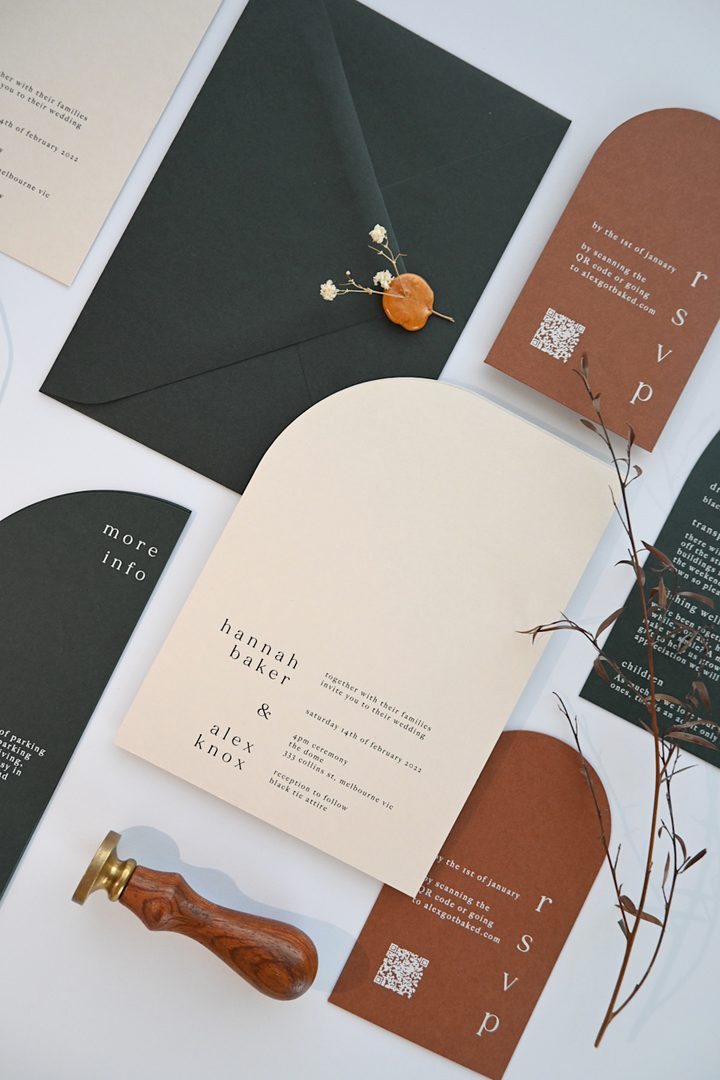
Photo Table Numbers: Using Guest Photos or Relationship Milestones
Photo table numbers embed an image directly into the card design, turning a functional item into a small storytelling piece. There are two main approaches.
Guest Photos per Table
Each table card features a photo of the couple with the guests seated at that table. This takes planning: you need a suitable photo for every table and the lead time to source them before your order is placed. But the impact is significant. Guests feel personally acknowledged, not just assigned. It works best for smaller receptions (up to around 12-15 tables) where managing individual photos per table is feasible.
Relationship Milestone Photos
Each table card features a photo from a specific moment in the couple’s relationship: your first trip together at table 2, an engagement photo at table 3, a childhood photo at table 4. Guests naturally move between tables to look at each card, and it gives your whole reception a narrative through-line. You can supplement with a small caption below each photo naming the moment or location.
Production Notes for Photo Table Numbers
- Use digital print for photo-heavy designs; it handles color gradients and skin tones with the most accuracy
- Supply high-resolution images (at least 300 DPI at print size) to your designer; your Paperlust designer can adjust brightness, contrast, and color balance as part of the proof process
- Allow an extra 2-3 business days beyond the standard 1-2 business day proof window when submitting multiple photo files across different table numbers
- Consider ordering a backup set for the most sentimental photos in case any card is misplaced during setup
How to Display Wedding Table Numbers: Holders, Frames, and Stands
Even the most beautifully printed table number card needs a good home on the table. The right holder keeps it upright, visible, and stable through a full evening of service, chair movement, and accidental bumps from guests reaching across centerpieces.
Wire or Metal Stands
Simple clip-style wire stands are inexpensive, widely available, and nearly invisible, letting the card itself do all the visual work. Gold-finish wire stands pair well with flat foil table numbers; matte black wire suits modern minimalist or moody themes; copper wire suits warm autumnal or bohemian aesthetics.
Wood Slice Holders
A slit cut into a small rustic wood slice is the natural-finish choice for garden, barn, and woodland receptions. Wood slice holders bring organic texture and warmth and don’t require any drilling or hardware. They work best with taller cards (at least 5 inches / 127mm tall) so the number is visible above floral centerpieces.
Easels
Small tabletop easels in gold, bronze, or antique brass hold flat or framed cards at an angled display. They’re especially useful for larger format table numbers (6 x 8 inches / 152 x 203mm or bigger) because the easel back provides stable support that clip-style stands can’t manage at that weight.
Candleholder or Floral Integration
Some couples tuck the table number card behind a candle pillar or lean it against the vase at the front of the centerpiece. This works well when the card is at least 5 x 7 inches (127 x 178mm) so it’s visible from a seated position without obscuring the florals. Place the card at the front of the centerpiece closest to the room entrance, since that’s the direction most guests approach from.
Hanging Systems
For outdoor receptions with pergola or arbor structures, cards can hang from twine or ribbon attached to the top of the centerpiece branch or a small overhead hook. Hanging table numbers work best in combination with non-standard formats like wooden discs or double-layered card with a punched hole at the top.
For large receptions where guests need to navigate a complex seating arrangement, pair your table number display approach with a well-designed seating chart at the room entrance. Browse our wedding seating charts to find a format that matches your table number design.
Matching Table Numbers to Your Invitation Suite
A cohesive stationery suite creates a through-line from the moment guests receive your invitation to the moment they sit down at their table. Matching your table numbers to your invitations is easier than it sounds, and it doesn’t require ordering everything in one go.
Font and Typography Match
The quickest way to create visual cohesion is to carry the same headline font from your invitation to your table number. If your invitations use a flowing script for your names, that same script on the table number immediately signals “same suite” even if the card format is different.
Color Palette Consistency
Use the same ink colors or foil colors across your invitation, place card, and table number. If your invitations feature gold flat foil, gold flat foil on the table number creates an immediate visual link. If your invitations are white ink on a dark color stock, a white ink table number on the same colored card continues that palette to the table.
Paper Stock
Ordering your table numbers on the same paper stock as your invitations strengthens the suite feel. Wild Cotton letterpress stock on both the invitation and the table number gives guests a tactile consistency they may not consciously register but will notice if it’s absent. Your Paperlust designer can advise on which papers are available across different formats in your order.
Design Element Repetition
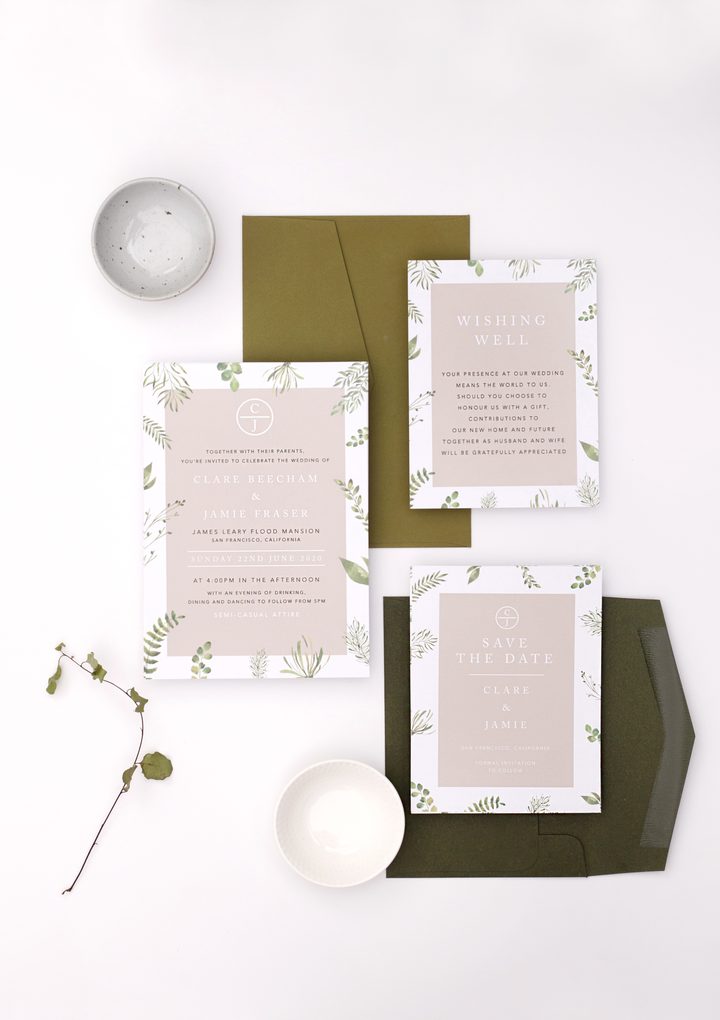
If your invitation features a botanical border, a geometric frame, or an arch motif, echo that element on the table number. It doesn’t need to be identical, just recognizable. A corner motif on the invitation can appear as a centered header illustration on the table number. This is one of the things Paperlust’s in-house designers handle during the proof process, and it’s worth noting explicitly in your design brief so the designer knows to carry the element across.
If you haven’t settled on your place card design yet, the matching table number decision is easier to make once you’ve locked in the place card format. Our guide to wedding place cards covers all the format options and wording conventions in detail.
Table Number Size and Visibility Guide for Large Receptions
Visibility is a practical concern that gets overlooked in the design phase. A beautifully printed 3 x 4 inch table number is nearly impossible to spot at a 200-person reception when guests are navigating between rounds of tightly packed tables under low lighting. Use the guide below to choose a format that’s readable from a standing approach.
| Reception Size | Recommended Card Height | Number Font Size (min) | Notes |
|---|---|---|---|
| Under 80 guests (up to 10 tables) | 4 in (102mm) | 48pt | Standard flat card or tented card sufficient |
| 80-150 guests (10-18 tables) | 5-6 in (127-152mm) | 60pt | Use a stand to elevate above centerpieces |
| 150-250 guests (18-30 tables) | 6-8 in (152-203mm) | 72pt+ | Easel or tall stand; place at front of centerpiece |
| 250+ guests (30+ tables) | 8 in+ (203mm+) | 96pt+ | Consider a secondary floor-level sign at the table entrance point |
Contrast and Legibility
High contrast between the number and the card background is the single biggest visibility factor. A mid-gray number on an off-white card looks refined in photos but reads poorly across a room. For large receptions, prioritize:
- Black or deep navy ink on white or cream stock
- White ink on a dark color stock (cobalt, black, forest green, burgundy)
- Gold flat foil on a white, cream, or black card (the metallic reflectivity catches venue lighting from across the room)
Placement Height
A table number card sitting flat on the table between plates is nearly invisible to an approaching guest. The number needs to be above the rim of the centerpiece vase or floral arrangement to be spotted at a distance. Aim for the base of the number to sit at least 8-10 inches (200-250mm) above the table surface when using a holder or stand. For candle-lit receptions, double-check that the card is positioned where the candlelight illuminates it rather than casting it in shadow.
—Frequently Asked Questions
What size should wedding table numbers be?
For receptions under 80 guests, a 4 x 6 inch (102 x 152mm) card works well. For larger receptions of 80-150 guests, 5 x 7 inches (127 x 178mm) is more visible. For 150+ guests, use at least a 6 x 8 inch (152 x 203mm) card and place it in a raised stand so it’s visible above centerpiece height.
Do table numbers need to match the wedding invitations?
They don’t need to be identical, but carrying the same font, color palette, and print finish from your invitation suite to your table numbers creates a cohesive look that photographs beautifully and feels intentional. Paperlust’s designers will match your suite elements across all stationery items in your order.
What are some creative alternatives to numbered tables?
Popular non-number systems include travel destinations meaningful to the couple, song titles from the wedding playlist, botanical names (flowers, trees, herbs), book titles, film names, and national parks. The key is making the seating chart easy to navigate with a clear alphabetical guest list rather than a visual table layout.
What’s the difference between flat foil and other metallic finishes for table numbers?
Flat foil applies a mirror-bright metallic layer (gold, silver, rose gold, copper, and other colors) directly to the card with no deboss impression. It’s available at minimum orders of 10 and works on matte, premium, heavyweight, and color stock. Metallic print is a more affordable alternative that uses a dry-toner pigment for a subtle, soft shimmer. Letterpress creates a debossed impression in the paper with no foil, just inked text pressed into the stock.
Can I order table numbers without ordering the full invitation suite?
Yes. Table numbers, place cards, and menus can all be ordered as standalone items through Paperlust. If you want them to match a suite you’ve already ordered, share your previous order details when briefing your designer so they can match the fonts, colors, and paper stock.
What holder should I use for printed table number cards?
Wire clip stands are the most versatile and least expensive option. Wood slice holders suit rustic and garden themes. Tabletop easels work well for larger format cards (6 x 8 inches / 152 x 203mm and above). If you’re working with a venue stylist or florist, they typically have a stock of card holders available for hire.
How far in advance should I order table numbers?
Order at the same time as your place cards and menus, typically 4-6 weeks before the wedding. Digital print table numbers have the shortest production window. Flat foil and letterpress take longer; allow at least 3 weeks of lead time for these finishes. Your designer proof is delivered within 1-2 business days of placing the order.
Can I use photo table numbers from Paperlust?
Yes. Paperlust’s digital print range supports full-color photo reproduction on table number cards. Upload your images during checkout or share them with your designer during the proof stage. Designers can adjust brightness, contrast, and color balance on request.
How many table numbers do I need to order?
Order one card per table plus 2-3 extras as backups in case of damage during setup. If you have 18 tables, ordering 20-22 cards is sensible. Minimum order at Paperlust is 10 cards per print method and format combination.
Picked your style? Browse our table number designs, or order a $5 sample pack to see the paper and print quality in person first.
Browse Table NumbersOrder $5 Sample PackDesign Your Wedding Table Numbers
500+ exclusive designs. Flat foil, letterpress, digital print, and more. Designer proof in 1-2 business days.
Browse Table NumbersView Seating Charts