
There is something undeniably romantic about a wedding where the sea plays a role, whether you are exchanging vows at a waterfront estate, a yacht club, or a cliffside with the ocean stretching out behind you. Nautical wedding invitations set the tone from the first moment your guests open the envelope, signaling a day that is equal parts elegant and adventurous. This guide walks you through every design detail, wording choice, and paper decision so your stationery arrives as a keepsake, not just a card.
- Best palette: Navy + white + gold (formal) or coral + aqua + cream (casual).
- Top motifs: Anchors, compass roses, rope borders, ship wheels, and navigation charts.
- Paperlust differentiator: White ink on navy colour stock, and flat foil in gold or silver.
- Paper picks: 270gsm navy Colour Stock (white ink) or 380gsm Premium (flat foil).
- Wording styles: Formal yacht-club wording and relaxed seaside ceremony versions, both covered below.
- Suite tip: Pair with coastal save the dates for a cohesive stationery story from the start.
Nautical vs. Coastal: What Is the Difference?
Couples planning a waterfront wedding often use “nautical” and “coastal” interchangeably, but the two aesthetics diverge in meaningful ways when it comes to stationery design.
Coastal is broadly inspired by the shoreline. Think driftwood textures, sea glass tones, sandy beige, soft watercolor waves, and organic botanical motifs like salt grass or sea lavender. The mood is relaxed, organic, and nature-led. A coastal invitation might feature a watercolor beach scene in muted aqua and blush rather than a formal anchor.
Nautical reaches further out to sea. It draws from maritime heritage: the Navy’s midnight blue, the crisp geometry of rope knots and anchor chains, the bold red-and-white of signal flags, the precision of a compass rose or a navigator’s chart. Nautical invitations tend to run more structured and graphic, with cleaner lines and stronger contrast.
In practice, many couples blend the two, using a nautical motif (compass rose, rope border) on a coastal palette (seafoam, sandy ivory). Knowing which aesthetic anchors your overall wedding vision helps your designer deliver something that feels intentional rather than generic.
Where Each Aesthetic Works Best
| Aesthetic | Venue Fit | Palette | Formality |
|---|---|---|---|
| Nautical | Yacht club, naval estate, lighthouse, tall ship | Navy, white, red, gold, silver | Semi-formal to black tie |
| Coastal | Beach ceremony, seaside barn, bluff overlook | Aqua, blush, sand, seafoam, sage | Casual to semi-formal |
| Nautical-Coastal blend | Coastal resort, marina, waterfront garden | Navy + coral, slate blue + cream, aqua + gold | Casual to semi-formal |
Design Elements for Nautical Wedding Invitations
The most recognizable nautical motifs carry centuries of maritime meaning. Knowing what each one signals helps you choose details that feel purposeful.
Anchors
The anchor is the signature motif of nautical stationery. Traditionally a symbol of steadfastness and hope, it works across formality levels, from a bold centered illustration on a navy card to a small stamped detail in the corner of an envelope liner. Choose a clean, geometric anchor for a modern look or a rope-wrapped anchor for a heritage feel.
Compass Roses
A compass rose introduced as a subtle watermark or letterhead-style graphic communicates direction, intention, and adventure. It reads as slightly more sophisticated than an anchor and suits couples who want nautical references without leaning into the cliche.
Rope and Knot Borders
A rope border printed around the perimeter of an invitation adds texture without imagery. Pair with a classic serif font and minimal color for a look that reads as quietly nautical rather than thematic. Rope knots, particularly the sailor’s knot, also work well as corner accents or as an envelope-back design.
Ship Wheels and Navigation Charts
Helm wheels and vintage navigation charts suit couples who want a distinctly maritime feel. A chart of your wedding venue’s waterway, printed in a muted navy or sepia tone, makes for an unforgettable custom illustration that doubles as a keepsake.
Typography Choices
Script fonts work well against nautical motifs, softening the geometry. All-caps serif fonts (think: classic naval stencil lettering) create a bolder, more graphic statement. A combination of a condensed serif for names and a classic serif body font gives the card both formality and personality.

Color Palettes: Navy, White, Gold, and Red
Color is where nautical invitations either sing or slip into kitsch. The traditional palette is unbeatable for a reason, but there is plenty of room to make it your own.
Navy + White + Gold (Classic Formal)
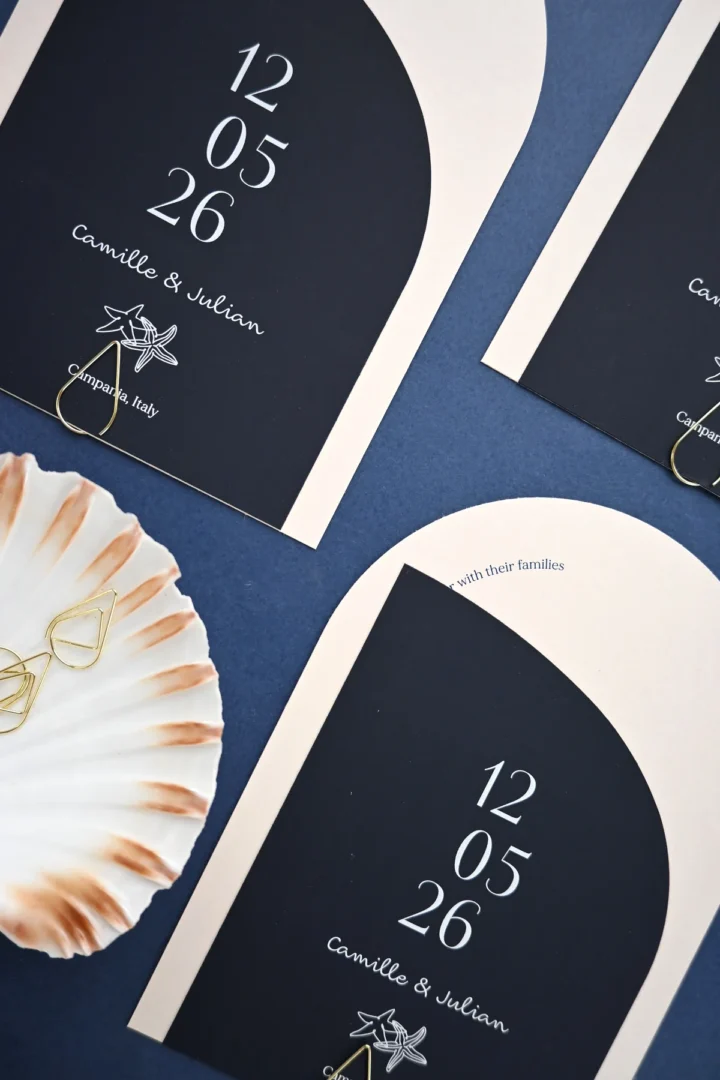
This is the foundational nautical palette. Navy reads as authoritative and rich; white creates clean contrast; gold adds the warmth and luxury that lift it above serviceable into elegant. On Paperlust, this combination works beautifully with white ink printed on navy colour stock (270gsm or 500gsm), with flat foil in gold used for names or an anchor illustration.
Navy + White + Silver (Modern Formal)
Swap gold for silver and the palette shifts cooler, sharper, and more contemporary. Flat foil in silver on white 380gsm Premium stock is a clean choice for this direction.
Navy + Red + White (Heritage Nautical)
The tri-color of maritime signal flags. This palette is less common for weddings but works well for a yacht club or America’s Cup-inspired celebration. Keep red as an accent, a wax seal, the envelope liner, or a ribbon, rather than a primary color on the card face.
Aqua + Navy + Coral (Relaxed Coastal-Nautical)
This palette softens the formality considerably. It suits an outdoor ceremony where the vibe is more celebration than ceremony. Watercolor illustrations and a lighter digital print on matte or linen stock suit this direction.
Navy + Blush + Cream (Romantic Maritime)
For couples who want the depth of navy without sharp contrast, blush and cream as secondary colors create a softer, more romantic reading. This palette works on both colour stock and on cream-toned papers with navy type.
Wording for Nautical and Yacht Club Weddings
Wedding invitation wording follows conventions that vary by formality. Nautical weddings span the full range, from a formal yacht club wedding that follows black-tie protocol to a barefoot beach ceremony. Here are frameworks for both ends.
Formal Yacht Club Wording
Formal nautical weddings typically hosted at a yacht club, naval officer’s club, or waterfront estate follow traditional third-person wording.
request the honor of your presence
at the marriage of their daughter
Charlotte Anne Harrington
to
Oliver James Weston
son of Mr. and Mrs. Richard Weston
Saturday, the fourteenth of June
two thousand and twenty-six
at half after five o’clock in the evening
The Newport Yacht Club
Newport, Rhode Island
Reception to follow on the Terrace
Key choices for formal nautical wording: spell out numbers and times in full, use “the honor of your presence” for a religious ceremony or “the pleasure of your company” for a civil ceremony, and identify the venue fully.
Casual Seaside Wording
A relaxed ceremony by the water invites a warmer, first-person tone.
Emma & Jack
June 14, 2026 | 5:30 PM
Harborview Beach Club | Malibu, CA
Cocktails, dinner, and dancing to follow
Dress code: Smart coastal
The “smart coastal” dress code hint helps guests know whether to reach for navy linen or a black-tie suit.
Nautical Wording Phrases to Consider
Use these on envelope liners, detail cards, or as a single line on the invitation face rather than cramming multiple phrases onto the main card.
“Join us as we chart a new course”
“Where sea meets celebration”
“Anchor’s aweigh – [your date] – [your venue]”
“All hands on deck for our wedding day”
Formal vs. Casual Nautical Invitation Styles
Understanding where your invitation sits on the formal-to-casual spectrum affects every decision: the stock you choose, whether to use foil, the typography, and what format the card takes.
Formal Nautical
Design: Classic serif typography, anchor or compass rose motif, minimal illustration, strong contrast palette (navy on cream or white on navy), gold or silver flat foil accents.
Stock: 380gsm Premium (flat foil) or 270gsm navy Colour Stock (white ink). Both feel substantial in the hand, which signals quality before a word is read.
Format: Standard 5″x7″ (approximately 127mm x 178mm) portrait or DL (4.33″x8.66″ / 110mm x 220mm) landscape for a sleeker, more contemporary version of formal.
Print method: Flat foil in gold or silver for the anchor illustration or couple’s initials gives a formal nautical invitation a mirror-bright finish that catches light the way the ocean does. Because Paperlust’s flat foil does not require a custom die, minimum orders are just 10 cards, which makes it accessible for smaller guest lists too.
Casual Nautical
Design: Watercolor illustrations, softer typefaces, coral or aqua accents, rope border as the sole nautical element.
Stock: 300gsm Matte or 300gsm Linen. The subtle texture of linen stock has a quiet nod to sailcloth without being on-the-nose.
Print method: Digital print, or metallic ink for a subtle gold shimmer without the full mirror finish of foil. Metallic print is available on Matte, Linen, and 380gsm Premium stocks.
A Note on White Ink
White ink on dark card stock is one of Paperlust’s most distinctive offerings for nautical stationery. Navy colour stock, cobalt, and dark blue are all available as a base. White ink prints opaque, making it ideal for anchor illustrations, rope border details, or full text on a dark card. Your Paperlust designer handles the file setup, and the result looks striking and contemporary against a deep navy background.
Nautical Invitation Formats
The format of your invitation, its dimensions, how it opens, and whether it is a single card or a set, is a design decision as much as it is a logistical one.
Flat Single-Card (Standard)
The most common format. A single card, typically 5″x7″ (127mm x 178mm), carries all the key details: who, when, and where. Clean and cost-effective, it suits both formal and casual styles.
DL Format (Long Card)
A tall, narrow card at approximately 4.33″x8.66″ (110mm x 220mm) that fits a standard DL envelope. The proportion feels more editorial and contemporary. It is well-suited to a bold vertical compass rose illustration or a long script name treatment.
Folded Card
A gatefold or single-fold card opens dramatically, giving you a full spread interior for a venue map, a sea chart illustration, or a full wording block. The cover can carry just the anchor motif and your names, keeping things clean and impactful.
Boxed Suite (Keepsake Box)
For formal yacht club weddings or couples who want a true luxury experience, a boxed invitation suite houses the main invitation, information card, RSVP, and envelope liner together in a rigid presentation box. Paperlust offers boxed presentation for larger suites on request.
All-in-One (Seal and Send)
Paperlust’s all-in-one trifold invitation includes a perforated RSVP card and can be mailed without an envelope. This suits casual nautical weddings where you want to reduce postage complexity. The three-panel layout also gives room for a map, a quote, or a timeline of the day.
Building a Nautical Wedding Stationery Suite
The invitation is the anchor of a broader suite. Building out complementary pieces in the same aesthetic creates a cohesive experience that guests notice from the first card to the last place setting.
Save the Dates
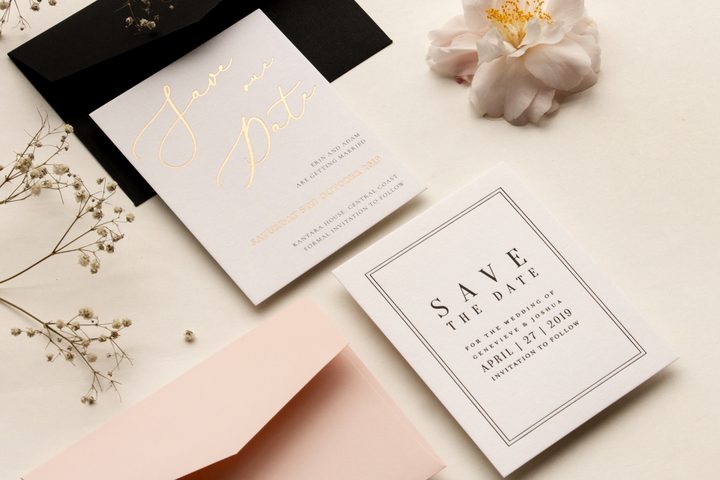
Your save the date is the first piece of stationery your guests receive, and for nautical weddings, it sets the maritime tone months before the invitation arrives. A simple compass or anchor motif on a navy or cream card, printed digitally or with flat foil, signals the theme without giving away every design detail.
For deeper guidance on coastal-themed save the dates, see our dedicated guide to coastal save the dates, which covers beach, cove, and lakeside themes alongside the formal maritime aesthetic.
RSVP Cards
Match the base color and motif of your invitation. For white-ink-on-navy invitations, a smaller RSVP in the same navy stock with white ink type looks deliberately matched. For flat foil invitations on cream stock, a matching RSVP with a gold foil anchor or border keeps the suite cohesive.
Information Cards
Information cards carry venue directions, accommodation, and registry or website links. In a nautical suite, an information card can double as a miniature venue map or a stylized chart of the local waterway. Paperlust information cards start from approximately $25 USD.
Menu Cards and Place Cards
A nautical table setting with navy linen and shell-shaped ceramics is completed by matching menu cards and place cards. Paperlust shell die-cut place cards bring the coastal motif to the table without repeating the anchor illustration everywhere.
Envelope Liners
Envelope liners are the hidden reveal of a great stationery suite. A white-and-navy stripe, a vintage sea chart pattern, or a watercolor wave interior transforms a standard envelope into a keepsake detail that guests notice even before they read the card.
For the full range of wedding invitation designs, including coastal and navy styles, explore Paperlust wedding invitations.
Ready to Design Your Nautical Wedding Invitations?
Explore 500+ exclusive designs. Proofs delivered within 1-2 business days. Free DHL Express on orders over $350 USD.
What is the difference between nautical and coastal wedding invitations?
Nautical invitations draw from maritime heritage: navy palettes, anchors, compass roses, rope motifs, and formal yacht-club aesthetics. Coastal invitations are more broadly beach-inspired, using softer palettes (aqua, sand, blush), organic textures, and nature-led motifs like seashells and driftwood. Many couples blend both styles, using a nautical motif on a coastal color palette.
What paper stock works best for nautical wedding invitations?
For formal navy-on-cream invitations, Paperlust’s 380gsm Premium stock is a strong choice for flat foil printing. For the distinctive white-on-navy look, navy Colour Stock (270gsm or 500gsm) printed with white ink gives you a bold, opaque result that reads as contemporary and luxurious.
Can I get flat foil on a navy card stock?
Yes. Paperlust offers Colour Stock + Foil as a combined option, applying gold, silver, rose gold, or other foil colors to 270gsm or 500gsm European coloured card, including navy. This gives you a dark base with a metallic motif or text rather than white ink.
What wording style suits a yacht club wedding?
Yacht club weddings typically use formal third-person wording, spelling out times and dates in full and naming both families. “Request the honor of your presence” is traditional for religious ceremonies; “pleasure of your company” is used for civil ceremonies. Full wording examples are in the guide above.
How many pieces are in a nautical wedding stationery suite?
A full suite typically includes an invitation, RSVP card, information card, and envelopes. Optional additions include envelope liners, belly bands, wax seals, menu cards, and place cards. Paperlust designers help you build a cohesive suite across all pieces, with 15% off when you order three or more card types in the same order.
Does Paperlust offer samples of nautical invitation designs?
Yes. The $5 sample pack includes seven designs across different print methods so you can feel the paper stocks and see print quality before ordering. A $15 custom sample of your chosen design is also available for most print methods (not available for letterpress).
How quickly are proofs delivered for nautical wedding invitations?
A designer proof is delivered within 1-2 business days of placing your order. Two rounds of edits are included at no extra cost. If your timeline is tight, a 24-hour rush print option is available for an additional fee.