

Shop Mexican wedding invitations: United States | Australia | United Kingdom | Canada | New Zealand
Planning a Mexican or Hispanic wedding in the US means navigating two cultures, two languages, and a set of traditions that most stationery guides simply ignore. From listing the padrinos and madrinas correctly to formatting bilingual wording that reads naturally in both Spanish and English, there is a lot to get right – and the details genuinely matter to your guests and families. This guide gives you everything you need: culturally accurate wording templates, formal title conventions, design inspiration across three distinct aesthetic styles, and practical tips for ordering and addressing your invitations.
Mexican Wedding Invitations: At a Glance
- Primary layout formats: side-by-side bilingual (Spanish left, English right), stacked bilingual, or two separate cards per language
- Padrinos and madrinas: listed in a separate section, typically to the right or below the couple’s names
- Formal host line: parents named first – both families, maternal and paternal
- Key phrase: “participan el enlace matrimonial de” (announce the marriage of) for formal Catholic ceremonies
- Design styles: Talavera tile, tropical floral, and modern Latin minimalist
- Print options at Paperlust: digital, flat foil (gold, rose gold, copper), letterpress, metallic, white ink
- Timeline tip: send 10-12 weeks before the wedding date for out-of-town guests; include a travel information card for family traveling from Mexico
- Free DHL Express shipping on orders over $350 USD; US delivery 2-4 business days after dispatch
Mexican Wedding Traditions That Affect Your Invitations
Mexican weddings are rich with ceremony-specific elements that shape how your invitation suite is designed and worded. Understanding which traditions apply to your celebration determines what information belongs on the card – and in what order.
The Catholic Ceremony and Its Language
The majority of Mexican weddings are Catholic, and the formal Spanish wording reflects this. Phrases like “participan el enlace matrimonial” (announce the matrimonial union) and “tienen el honor de invitarle” (have the honor of inviting you) are rooted in religious formality. If your ceremony is civil, you can use “unión civil” or the more neutral “celebran su matrimonio” without the religious undertone.
El Lazo
The lazo is a floral or rosary cord that drapes around the couple during the ceremony, symbolizing their union. If you include a lazo at your ceremony, note the padrinos de lazo (sponsors of the lazo) in your invitation’s sponsor section. This is a meaningful acknowledgment that your guests will recognize and appreciate.
Las Arras Matrimoniales
The 13 gold coins (arras) gifted by the padrino to the couple represent the groom’s pledge to provide for the household. Listing the “padrinos de arras” on your invitation signals to families that this tradition will be observed – an important cultural signal for older relatives.
Timing and Lead Times
Mexican wedding guest lists are often large, and many guests travel from Mexico or other states. Send your invitations 10-12 weeks out (rather than the standard 6-8 weeks) to give international guests time to arrange travel and visas. A separate travel information card with hotel block details is strongly recommended and should be included in your invitation suite.
The Padrino and Madrina System – How to Include Sponsors on Invitations
The padrino and madrina system is the single most distinctive feature of Mexican wedding stationery. It has no true equivalent in Anglo-American wedding tradition, and most generic wording guides skip it entirely. Here is a complete breakdown.
What Padrinos and Madrinas Are
Padrinos and madrinas are sponsors – typically close family friends, godparents, or respected community members – who “sponsor” a specific element of the wedding. Common sponsorships include:
- Flowers (padrinos de flores)
- Wedding cake (padrinos de pastel)
- Rings (padrinos de argollas)
- Lazo (padrinos de lazo)
- Arras (padrinos de arras)
- Music or DJ (padrinos de musica)
- Photography (padrinos de fotografia)
- Wedding dress (padrinos de vestido)
Where They Appear on the Invitation
Padrinos and madrinas are listed in a dedicated section, separate from the couple’s and parents’ names. Placement is typically on the lower right portion of the card or on a separate inserts card included in the suite. The section is usually headed “Padrinos y Madrinas” and each sponsorship is listed on its own line:
Flores: Sr. y Sra. Miguel Reyes
Lazo: Sr. y Sra. Eduardo Torres
Arras: Sr. y Sra. Roberto Mendez
Pastel: Sra. Carmen Gutierrez
Do You Need an English Translation for Padrino Listings?
In bilingual invitations, most couples choose to leave the padrino section in Spanish only. Because there is no direct English translation that captures the cultural meaning, writing “Sponsors: Mr. and Mrs. Miguel Reyes (Flowers)” is technically accurate but loses cultural resonance. For mixed-language guest lists, a brief explanatory line in English – “We gratefully recognize our padrinos and madrinas” – followed by the Spanish listing works well.
How Many Padrinos to List
Small, intimate ceremonies may list just the lazo and arras padrinos. Large traditional weddings can have 20 or more. For space and readability on the invitation, consider listing only the ceremony-role padrinos (lazo, arras, rings) on the card itself and reserving the full list for a separate sponsors insert card.
Bilingual Mexican Wedding Invitation Wording Examples (Spanish and English)
The examples below move from most formal (traditional Catholic) to more relaxed modern wording. Each shows both the Spanish and English versions; in practice these would appear side by side or on facing panels of a folded card. Swap in your family names, venue, and date.
Format 1: Traditional Catholic – Both Families Named
Con la gracia de Dios,
Sr. Eduardo Ramirez y Sra. Patricia Castillo de Ramirez
y
Sr. Jorge Mendoza y Sra. Ana Torres de Mendoza
participan el enlace matrimonial de sus hijos
Sofia Lucia Ramirez
y
Carlos Alberto Mendoza
el sabado veintiseis de julio del ano dos mil veintiseis
a las dos de la tarde
Iglesia Santa Maria de los Remedios
Los Angeles, California
With God’s blessing,
Mr. Eduardo Ramirez and Mrs. Patricia Castillo de Ramirez
and
Mr. Jorge Mendoza and Mrs. Ana Torres de Mendoza
announce the marriage of their children
Sofia Lucia Ramirez
and
Carlos Alberto Mendoza
Saturday, July 26, 2026
at two o’clock in the afternoon
Santa Maria de los Remedios Church
Los Angeles, California
Format 2: Civil Ceremony – Modern and Bilingual
Junto a nuestras familias,
Isabella Vargas y Marco Antonio Flores
celebran su matrimonio
Sabado, 15 de agosto de 2026
6:00 de la tarde
Rancho Vista Grande
San Antonio, Texas
Cena y baile a seguir
Together with our families,
Isabella Vargas and Marco Antonio Flores
celebrate their marriage
Saturday, August 15, 2026
6:00 in the evening
Rancho Vista Grande
San Antonio, Texas
Dinner and dancing to follow
Format 3: Intimate Wedding – Couple-Hosted
Tenemos el placer de invitarlos a celebrar nuestra boda
Lucia Maria Santos
y
David Emmanuel Cruz
Sabado, 10 de octubre de 2026, a las cinco de la tarde
The Botanic House
Chicago, Illinois
We are delighted to invite you to celebrate our wedding
Lucia Maria Santos
and
David Emmanuel Cruz
Saturday, October 10, 2026, at five o’clock in the evening
The Botanic House
Chicago, Illinois
Format 4: Mixed Families – One Mexican, One American
Sr. y Sra. Ramon Ortega
junto con
Mr. and Mrs. James and Sandra Miller
celebran la union de
Valentina Ortega y Tyler Miller
Viernes, 20 de noviembre de 2026
Mr. and Mrs. Ramon and Lucia Ortega
together with
Mr. and Mrs. James and Sandra Miller
celebrate the union of
Valentina Ortega and Tyler Miller
Friday, November 20, 2026
Formal Title and Family Naming Conventions in Mexican Wedding Invitations
Mexican invitation etiquette uses specific conventions for names and titles that differ from standard American phrasing. Getting these right signals cultural respect to your guests.
Maternal Surnames and Compound Names
In Mexican tradition, individuals carry two surnames: the paternal surname first, followed by the maternal surname. On a formal invitation, the bride is typically listed as her full given name and paternal surname. For even greater formality, both surnames appear:
- Standard formal: Sofia Ramirez Castillo (paternal + maternal)
- American simplified: Sofia Ramirez (paternal only)
Choose based on your family’s preference and how your names fit the design layout. With flat foil lettering, longer compound names look stunning – the metallic script carries double-barreled surnames beautifully.
Parent Host Lines
In traditional Mexican invitations, both sets of parents are named – and named formally. The correct format uses “Sr. y Sra.” (Senor and Senora) followed by the father’s given name and shared paternal surname:
- Correct: Sr. y Sra. Eduardo Ramirez
- Incorrect (too Anglo): Mr. and Mrs. Eduardo Ramirez (used only on the English side)
Widowed parents are listed as “Sr. Eduardo Ramirez” (no “y Sra.”) or “Sra. Patricia Castillo de Ramirez” (keeping the married surname with “de”).
The “De” Convention for Married Women
In traditional Mexican naming, a married woman adds “de” followed by her husband’s paternal surname: Ana Torres de Mendoza. This appears on the most formal invitations. Younger or more modern couples often omit it, particularly on the English side of a bilingual invitation.
Title Abbreviations Quick Reference
| Spanish | Full Form | English Equivalent | Use On |
|---|---|---|---|
| Sr. y Sra. | Senor y Senora | Mr. and Mrs. | Married parents, formal |
| Sr. | Senor | Mr. | Father’s name alone |
| Sra. | Senora | Mrs. | Mother’s name, widowed parent |
| Srta. | Senorita | Miss | Unmarried woman (rare in modern use) |
| Lic. | Licenciado/a | Esq. / professional title | Guests with university degree – very formal |
| Dr. / Dra. | Doctor / Doctora | Dr. | Medical doctors, PhDs – formal only |
Mexican Wedding Invitation Design Styles – Talavera, Floral, Modern Latin
Three design movements dominate Mexican wedding stationery right now. Each works beautifully with Paperlust’s print methods, and each creates a different emotional tone for your celebration.
Talavera-Inspired Designs
Talavera pottery – the iconic blue-and-white (and sometimes multi-colored) ceramic tradition from Puebla – has become a standout aesthetic for Mexican weddings. Talavera-inspired invitations use symmetrical tile patterns as borders, geometric florals, and deep cobalt or terracotta color palettes on warm ivory or cream card stock. The result is instantly recognizable as Mexican heritage while remaining elegant enough for a formal celebration.
For Talavera designs, digital print on 300gsm premium matte stock delivers the sharpest detail for the intricate tile motifs. If you want to elevate the design, flat foil in gold or copper applied over a digital base adds a luminous accent to key elements like the couple’s names or the central floral motif.
Tropical Floral
Lush hand-painted florals – bougainvillea, dahlias, hibiscus, tropical leaves – evoke the warmth and beauty of Mexican garden weddings. This style is the most versatile: it works for destination weddings in Mexico, US garden venues, and hacienda-style celebrations. Color palettes range from bold magenta and marigold to softer blush and terracotta.
Paperlust’s botanical and floral invitation designs on 380gsm premium stock have the weight and richness these designs deserve. Flat foil in gold or rose gold on floral designs creates stunning contrast between the metallic lettering and the illustrated botanicals.
Modern Latin Minimalist
A newer aesthetic that has grown significantly with second-generation Mexican-American couples: clean typography, restrained color palettes (cream, ivory, warm terracotta), and a sophisticated nod to cultural identity through small design details rather than maximalist folk art. Think a single bougainvillea bloom, a subtle Talavera tile border, or elegant bilingual script in a refined serif font.
Letterpress printing is the standout choice for modern Latin minimalist invitations. The deep impression on 600gsm Wild Cotton card gives the restrained design maximum tactile impact. The debossed lettering reads as both contemporary and luxurious – a natural fit for couples who want cultural elegance without folkloric exuberance.
Design Elements That Work Across All Three Styles
| Design Element | Talavera | Tropical Floral | Modern Minimalist |
|---|---|---|---|
| Foil color | Gold, copper | Rose gold, gold | Gold, pale gold |
| Card stock | 300gsm matte, linen | 380gsm premium | 600gsm Wild Cotton |
| Print method | Digital + flat foil | Digital + flat foil | Letterpress |
| Envelope | Cobalt, terracotta | Sage, blush, kraft | Ivory, cream |
| Typography | Display serif + tile motif | Script + botanical | Clean serif or script |
Save the Date in Spanish – Wording Examples for Mexican Weddings
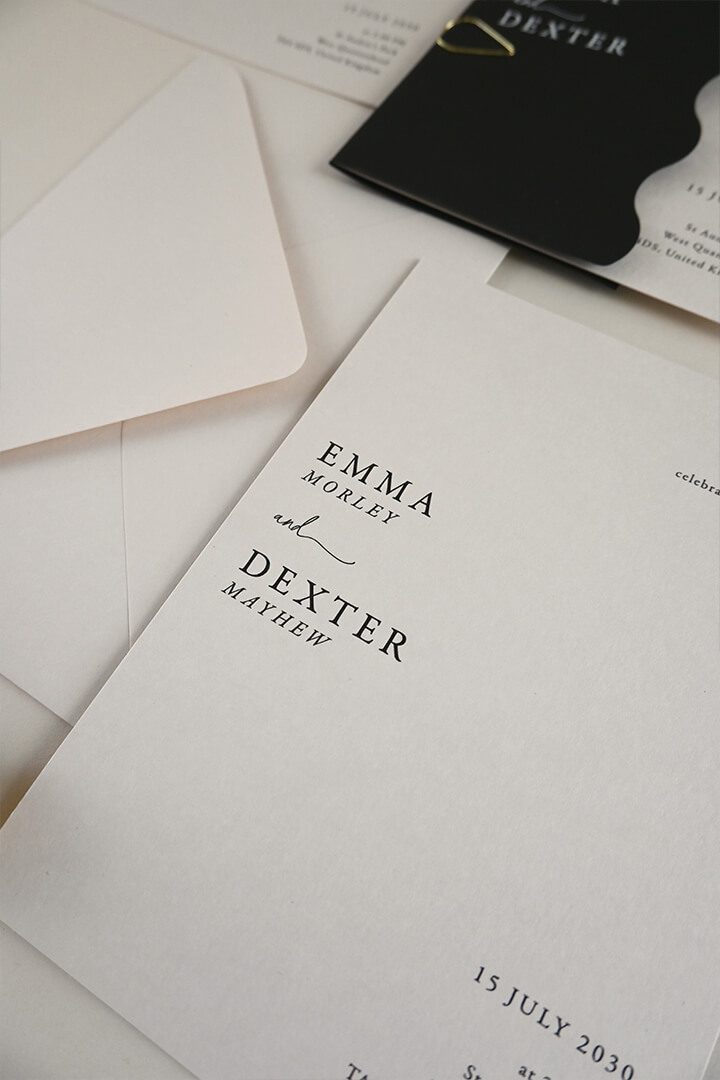
A bilingual save the date sets the tone for your entire invitation suite. It signals to Spanish-speaking family members that your wedding will honor both cultures – and it gives US-based guests an elegant preview of the bilingual celebration to come.
For a complete deep-dive on Spanish save the date wording and format options, see our full guide at Save the Date in Spanish: Wording, Formats, and Examples.
Basic Bilingual Save the Date Wording
12 de julio de 2026 – Los Angeles, California
La invitacion formal esta por llegar.
English: Save the Date – Sofia and Carlos are getting married
July 12, 2026 – Los Angeles, California
Formal invitation to follow.
Formal Save the Date with Parent Names
Sofia Lucia Ramirez y Carlos Alberto Mendoza
Sabado, 26 de julio de 2026 – Los Angeles, California
English: The Ramirez and Mendoza families joyfully announce the upcoming wedding of
Sofia Lucia Ramirez and Carlos Alberto Mendoza
Saturday, July 26, 2026 – Los Angeles, California
Casual and Modern
15 agosto 2026 – San Antonio, Texas
English: Save the Date – Isabella + Marco Antonio
August 15, 2026 – San Antonio, Texas
Save the Date Formats for Mexican Weddings
| Format | Best For | Size Guide |
|---|---|---|
| Standard rectangle card | Formal bilingual, parent-hosted | 5 x 7 in (127 x 178 mm) |
| Postcard format | Modern Latin minimalist | 4 x 6 in (102 x 152 mm) |
| Magnet | Destination weddings in Mexico | 5.5 x 4.2 in (140 x 107 mm) |
| Arch or die-cut | Tropical floral aesthetic | Varies by design |
Envelope Addressing for Mexican Weddings in the US
Addressing envelopes for a US-based Mexican wedding requires navigating two address format conventions and, often, two different countries. Here is how to handle both confidently.
US Addresses for Guests in the United States
Use standard US USPS format for all domestic guests:
2847 Elm Street
San Antonio, TX 78201
Use “Sr. y Sra.” (not “Mr. and Mrs.”) for Spanish-speaking households if you know that is their preference. For guests you are less certain about, “Mr. and Mrs.” on the outer envelope and the Spanish title only on the inner envelope (if you are using a traditional two-envelope suite) is a gracious middle ground.
Addressing Guests in Mexico
Mexico’s postal addressing format differs from the US system. The correct order is:
Calle Hidalgo 224
Col. Centro
Guadalajara, Jalisco 44100
Mexico
Key differences from US format: the street name and number are reversed (“Calle Hidalgo 224” not “224 Hidalgo Street”), the colonia (neighborhood) is listed as “Col.” before the city, and the five-digit postal code precedes the state name. If you are mailing to Mexico from the US, add “Mexico” as the final line and use USPS International First Class mail.
Paperlust Address Manager
Paperlust’s Address Manager tool lets you import your guest list from an Excel spreadsheet, which is particularly helpful for large Mexican wedding guest lists with bilingual address fields. You can keep the Spanish-format addresses for Mexico guests and US-format for domestic guests in separate columns, making the printing process straightforward.
Mexican Wedding Invitation Paper and Printing Options
The right print method and paper stock do more than look beautiful – they communicate the tone of your wedding before guests read a single word. Here is a practical guide to Paperlust’s options matched to the main Mexican wedding aesthetics.
Digital Print on Premium Stocks
Digital print is the most versatile and fastest option. Paperlust’s 380gsm premium matte stock is ideal for Talavera and tropical floral designs – it has the weight to feel luxurious while delivering razor-sharp color reproduction for intricate botanical illustration and tile pattern detail. Starting from $2.04 per card for wedding invitations, it is also the most budget-friendly route for large guest lists (100 or more cards, which is common for Mexican weddings).
Flat Foil
Flat foil adds a mirror-bright metallic accent to your card without the custom die or debossing of traditional artisan foil techniques. At Paperlust, flat foil is applied flush with the card surface, giving names and key design elements a luminous finish. Gold flat foil on cream card is a classic for formal Mexican invitations; copper and rose gold work beautifully with tropical florals; silver flat foil suits a modern Latin aesthetic paired with navy or deep charcoal stock.
Minimum order for flat foil is 10 cards (or 30 for 350gsm Heavyweight stock). Production time is approximately 12-15 business days after proof approval, with your designer proof delivered within 1-2 business days of ordering.
Letterpress
For modern Latin minimalist designs, letterpress on 600gsm Wild Cotton is the standout choice. The deep press impression creates a tactile invitation that guests immediately register as exceptional. Wild Cotton’s natural texture is particularly beautiful for clean typography – the slightly rough surface gives each letter a handcrafted quality. Minimum order is 50 cards; production runs approximately 20 business days.
Note: the $15 custom sample is not available for letterpress orders – order the $5 sample pack to feel the Wild Cotton stock before committing to a letterpress invitation order.
Metallic Ink
Metallic print uses a dry-toner gold pigment applied at a dedicated imaging station alongside standard CMYK inks. The result is a subtle gold shimmer – less mirror-bright than flat foil, but more understated and sophisticated. It works well for body text on formal bilingual invitations where you want a warm gold tone throughout without the full reflective impact of foil lettering.
White Ink on Color Stock
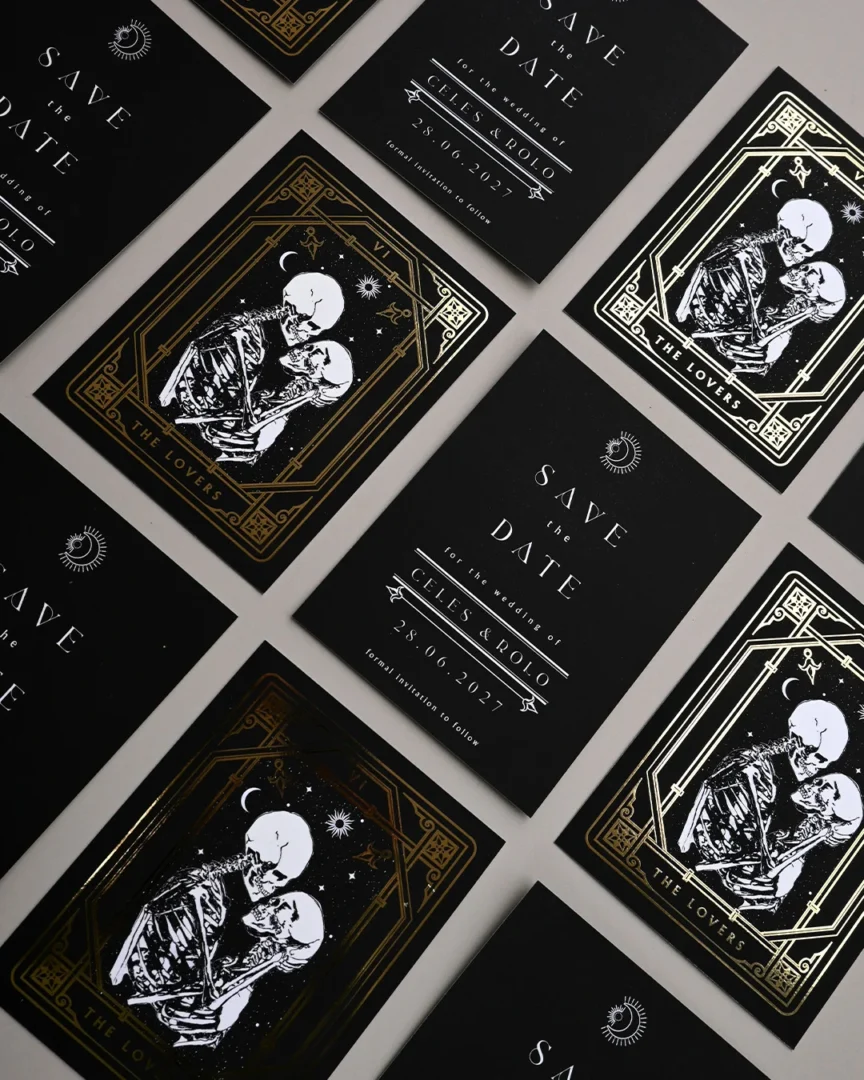
White ink on deep navy, cobalt, or black card stock creates a striking contrast that works for couples leaning into a dark, moody aesthetic or a nighttime fiesta reception. Cobalt color stock in particular has a natural resonance with Talavera’s blue palette. White ink is printed as a fifth color alongside standard CMYK inks.
Mexican Wedding Invitation FAQs
How do I list the padrinos and madrinas on a bilingual wedding invitation?
List them in a dedicated “Padrinos y Madrinas” section, separate from the couple’s and parents’ names. Each sponsorship appears on its own line with the title (e.g., “Flores: Sr. y Sra. Miguel Reyes”). For bilingual invitations, most couples leave the padrino section in Spanish only – there is no single English equivalent for the term, and leaving it in Spanish preserves the cultural meaning.
What is the correct Spanish phrase for “honor of your presence” on a Catholic wedding invitation?
“Tienen el honor de invitarle a la celebracion de su matrimonio” is the most formal phrasing. For a Catholic ceremony, leading with “Con la gracia de Dios” (With God’s grace) adds the religious context that traditional Catholic families expect.
How do I write a bilingual wedding invitation – Spanish first or English first?
In Mexican tradition, Spanish typically appears first. Side-by-side layouts place Spanish on the left and English on the right. Stacked layouts put Spanish at the top. For families where the primary-language split is reversed (more English speakers than Spanish), reversing the order is perfectly acceptable – follow your guest list, not a hard rule.
How many words can fit on a bilingual invitation without it looking crowded?
Bilingual invitations carry roughly twice the text of a single-language card. To manage density: use a 5 x 7 in (127 x 178 mm) format (maximum readable space), keep each language to 60-90 words, and use a clean sans-serif or restrained script font at 9-10pt for body text. Paperlust’s designers will adjust spacing and sizing during the proof process to ensure both languages read clearly.
Do I need to send separate Spanish-only and English-only invitations to different guests?
You can, but it is not required. Many couples choose a single bilingual invitation for all guests – it elegantly communicates the bicultural nature of the wedding and avoids the logistics of managing two different print runs. The exception is if your padrino listing is very long: in that case, a single-language invitation with a bilingual insert card may be cleaner.
What is the difference between “participan el enlace matrimonial” and “celebran su matrimonio”?
“Participan el enlace matrimonial de” (announce the matrimonial union of) is the traditional Catholic-ceremony phrasing, usually used when parents are the hosts and the ceremony is in a church. “Celebran su matrimonio” (celebrate their marriage) is more neutral and modern, better suited to civil ceremonies, secular venues, or couple-hosted weddings. Both are grammatically correct; the choice is a matter of religious tone.
How far in advance should I send Mexican wedding invitations?
Send 10-12 weeks before the wedding date if you have guests traveling from Mexico or other countries. Standard US weddings typically send 6-8 weeks out, but with international travel logistics, visa requirements, and large family gatherings, the extra lead time is important. Send your save the dates 8-12 months out for a destination wedding in Mexico.
Can I order a custom sample of a Mexican-style invitation before committing to the full order?
Yes – a $15 custom sample is available for most Paperlust print methods, including digital and flat foil. This lets you see your exact design, text, and color on the actual card stock before printing your full order. Note that the custom sample is not available for letterpress orders; order the $5 sample pack to experience the Wild Cotton stock instead.
Ready to Design Your Mexican Wedding Invitations?
Browse our full collection of Mexican and Hispanic wedding invitation designs – available in digital, flat foil, letterpress, metallic, and white ink print methods.
Browse Mexican Wedding InvitationsAll Wedding Invitations
Not sure on paper and print method? Order a $5 sample pack first.
Shop Wedding Invitations at Paperlust
Hundreds of wedding invitation designs you can customize online, with an online proof before you print.