
Browsing designs? Shop wedding invitations in the US | Australia | UK | Canada | New Zealand
Planning a wedding means making hundreds of decisions, and most of the important ones happen well before you ever order a single envelope. This guide walks you through every task, in the right order, so your stationery goes out on time, with the right names, to the right number of people.
Pre-Invitation Planning: At a Glance
- 12+ months out: Set date, lock venue, set budget, rough guest list
- 9-12 months out: Book key vendors, finalize guest count, take engagement photos
- 6-9 months out: Order save the dates, start invitation design
- 4-6 months out: Lock wording, finalize addresses, order invitations
- Pre-send: Proofread, address envelopes, weigh and stamp, assemble, mail
- Proofs in 1-2 business days after placing your order at Paperlust
- Free DHL Express on orders over $350 USD
Here at Paperlust we have a board of articles we want to write about. At the top of the list: ‘Themed Weddings From the Invitation Out’. But where do we start? There are so many decisions to make before we even get to the invitation. Maybe we got ahead of ourselves.
We’ve gone back a little bit to the very start of a wedding planning checklist. This isn’t gospel: you’re going to have to fill in the details but it’s a good place to start. We’ve also left off the detailed checklist for the day because, really, you know how you want to wake up the morning you’re getting married and it’s up to your family to tell you they told you so when you’re still chasing little things an hour before the ceremony. Follow the checklist and you should be alright.
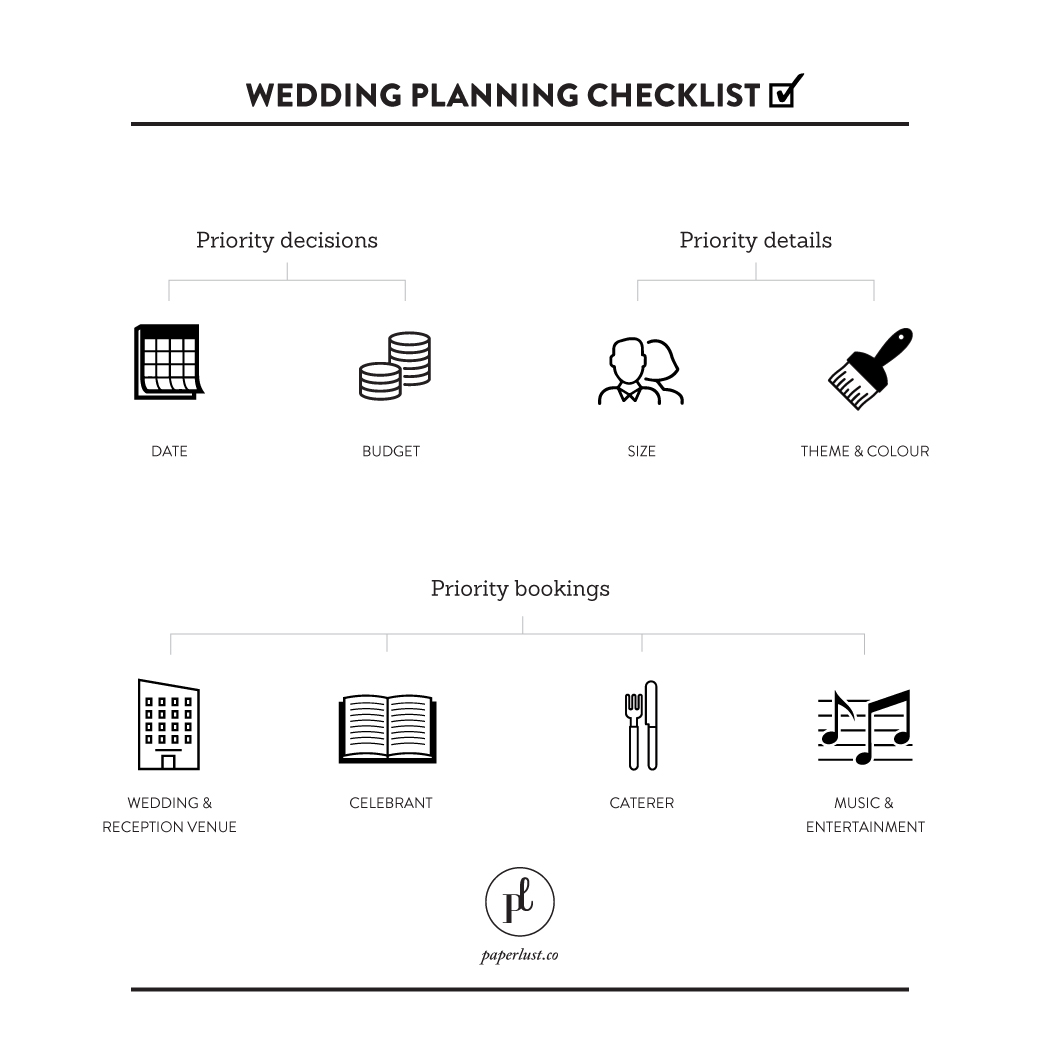
PRIORITY DECISIONS
THE DATE
This speaks for itself: you can’t arrange anything without the date. It will also mean that you can break down your checklist into a timeline for when things need to get done.
THE BUDGET
It’s hard to decide about things like the budget without being sure about your other wedding details. If you set your limits before making the other decisions, you’re less likely to go over budget. Or if you do, you can say you started out with the very best intentions.
PRIORITY DETAILS
THE SIZE
The size of your wedding is the next big decision because it will impact the decisions that follow (venue, invitations, menu, EVERYTHING!)
So start asking yourself, how large do you want your bridal party to be? (You’ve probably gone too far when you’ve started adding second and third cousins to the list). How many guests do you want to invite? Are you going to invite everyone to both the ceremony and the reception? Or is it an intimate ceremony with friends and a huge party with friends afterwards more what you had in mind?
Start your list and don’t forget to double check with your mum and the soon-to-be in laws that no one has been left off. (Or decide now that this is your wedding and bear the consequences of complaints and questions in your ear until the next big event takes people’s minds off things).
THE THEME AND COLOUR
To make sure there is consistency from start to finish (the invitation to the day itself) and so you don’t have to go back and change things, choose your theme now. If you’ve got a little time, you might take a month or two to find some inspiration, like Spanish wedding ideas, beach wedding ideas, beach wedding invitations, or fun festive colour wedding ideas.
Or if you’re on a shorter time frame, start with a colour and work outwards from there. Colour or theme choices can easily spiral out of control, so take a deep breath, and consider two things: what do my fiance and I want? What have we both always liked? Maybe he says he wants to be wearing a tuxedo, every inch of his body dripping luxury and expense. You say you’ve always imagined getting married outside, maybe in a garden under a flower arbour. Neither of you have thought much beyond that. Here is where all your conflict resolution and the hours of practicing compromise comes into play. You’re going to meet in the middle of casual and formal but there’s still room to move. Narrow it down with a colour or two.
Once you’ve chosen that perfect theme think about what’s appropriate for your venue, does your parent’s back yard really suit the casual chic reception you’ve both agreed to? So it’s an outdoor ceremony and a sit down, formal wedding reception. You might be dropping pins back and forth when you find places you like but it’s going to come down to the pointy end: details, details, details.
PRIORITY BOOKINGS
Okay, while making your decisions, keep in mind three things:
- What time of year you’re getting married
October-November is the most popular time of the year to get married. This means that prices will be quite high and some companies won’t be available. If you’re planning well ahead of time, you’ll probably scrape through. It also means that seasonal things might not be available (so that’s food or flowers).
- Your budget
There are too many horror stories of weddings blown out of control not to mention the budget again. You’ve got to remember your limitations while you’re making these decisions.
- You’re not going to be able to please everybody
Maybe that’s something to keep in mind for every part life but it especially applies to your wedding day when your parents have been invested so much in you, your family has supported you through the growth of this relationship and your friends have been there every step of the way. In a lot of ways, a wedding is as much for them as it is for you.
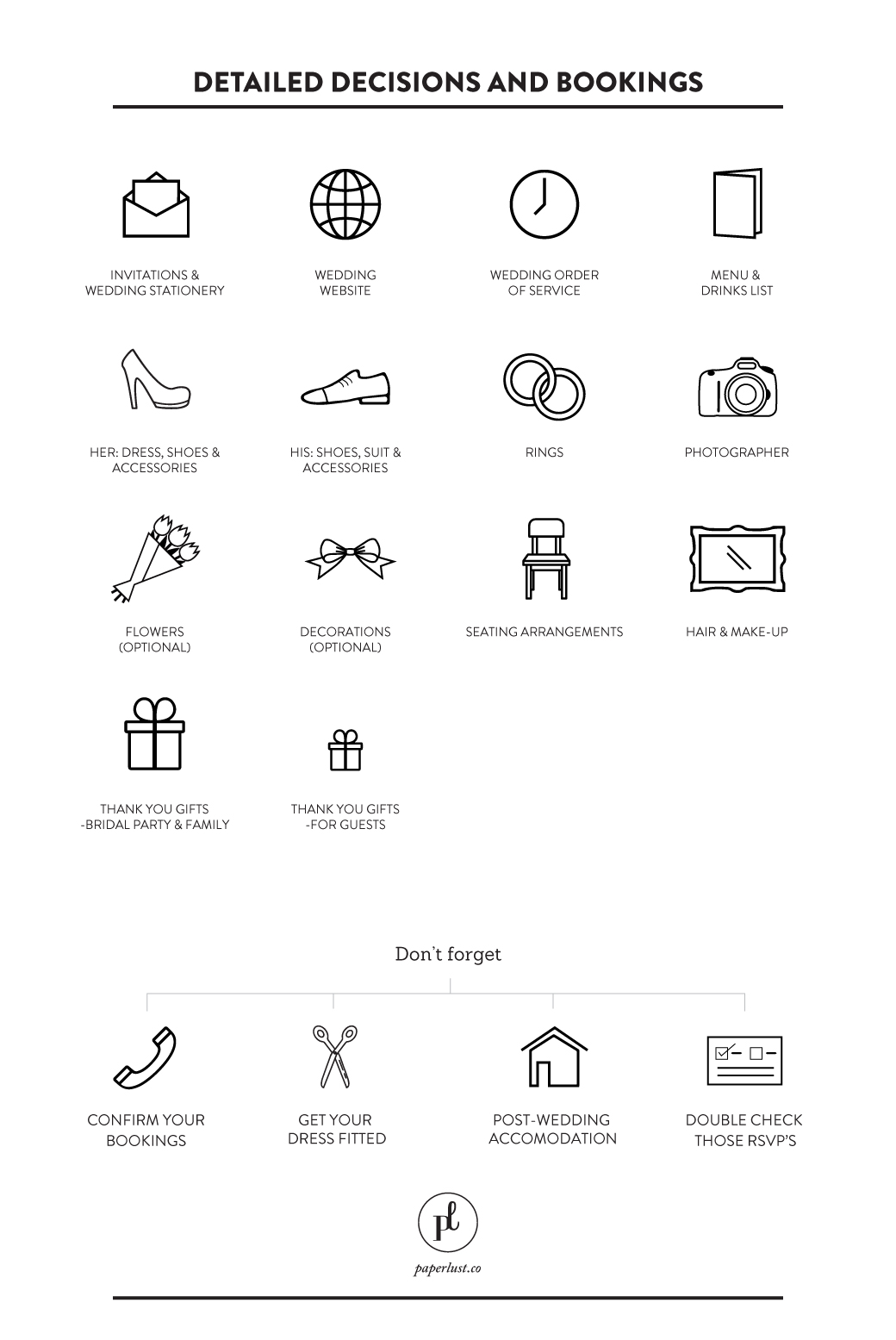
So the priority bookings are
The wedding and reception venues
You’ve decided on the size, your budget and your theme. Now you have to find somewhere for both the ceremony and the reception.
The celebrant
Whether you’re having a religious or a secular wedding, you need someone to marry you. We can’t all have family friends who are priests or celebrants to officiate, in the lead up to the big day you’re probably going to get to know your celebrant pretty well though. Organise your celebrant early so the wedding itself can go ahead. Even if the venue gets burnt down on the day, you’ll have the essential part: someone to perform the wedding rites.
The caterer
Sometimes your venue will supply a menu, sometimes it won’t. There will be limitations to what and who is available, depending on the time of the year that you’re getting married, so keep that in mind. If your reception is somewhere regional, remember to check that caterers are available to come to that area or book local. Also check that they’re able to supply crockery and cutlery, and if they have other table settings that are available (might save you some worry down the road).
The music and entertainment
There are no fixed rules to music and entertainment these days. If you’re having an intimate reception with only a few people, a playlist is a pretty easy way of providing music. You can even have some fun by taking song requests from guests when they RSVP (maybe try three songs in case there’s some doubling up). Or maybe your best friend is a musician and she wants to perform for you. Easy.
However, if you’re having something a bit bigger than that, you’re faced with the decision of band or DJ. Keep in mind outsourcing is a great way to avoid constant song choices because the people on the dance floor don’t like what’s on. Book well in advance to make sure you get the artists you want.
THE DETAILED DECISIONS AND BOOKINGS
Okay, so the big things are out of the way now. From here, with your size and theme in mind, you get to add the colour and detail.
The invitations and wedding stationery
The invitations and wedding stationery are essential if you want people to be there with you to celebrate. Breaking it down, the three essential pieces in the wedding stationery is the invitation suite (your engagement invites, invitation, information and RSVP cards), place cards or table plan and thank you cards.
Save the date, wedding programs and menu cards tend to be optional. If you’re getting your invitations custom designed, a lot of services will allow you to pick and choose the cards that you need, with a similar design to tie all the cards together. What’s important is that you decide on what kind of invitation you want at the beginning of your wedding planning, formal or casual wedding invitations, elegant wedding invitations. Really, whatever you think is the best wedding invitation for you!
If you’re planning well in advance, a save the date card will be essential to give guests time and notice, and if you are throwing an engagement party, the engagement invitation is vital to arrange travel plans. On the other hand, if you’ve only got a few months to get things together, you can avoid the save the date card by simply sending out the invitation.
It’s essential that you receive the RSVP cards within four to six weeks before the date so that you can fill in the finer details. If you haven’t decided on your menu at this point and can’t give your guests specific choices, at least give them space here to let you know about dietary requirements.
HOT TIP: Don’t forget to proof read your invitation and wedding stationery (mistakes are much easier to fix before they’ve come back from the printer!).
The wedding website (optional)
The wedding website is a recent trend that groups together all the things that tend to come up during the planning of a wedding. Its primary use is to receive digital RSVPs but it’s also a great way to provide extra information or updates for guests. Post wedding, it’s a good way to share pictures of the day and other information that people probably want to be keeping their eye on.
It shouldn’t be the sole way of communicating with guests though. Paper invitations aren’t simply tradition: a hard copy invite is both a wonderful paper object and provides the initial information that will lead people to the website.
Not technology savvy? Don’t worry too much, your website doesn’t have to be complicated. As long as it fulfils the basic requirements of allowing people to RSVP, ask questions and navigate to the must have information. Consider hiring someone so you don’t have to worry about yourself, or pop on a free host website like WordPress, squarespace or Tumblr (depending how brave you’re feeling with those limited tech skills).
The wedding order of service
The printed order of service is always optional, but it’s essential to plan your day in advance so that you don’t leave anything out. Depending on the kind of planner you are, this might be listed from when to wake up to when your hair needs to be done to how long you want to wait before the ceremony. Or it might just be a list of the key parts of the day and when you hope to be there.
The order of service itself is what the guests will see. Do you need one? It depends if you’re asking for participation in the ceremony or there is a lot of movement from one place to another that you don’t want to be communicated in your uncles booming voice. They’re often a nice keepsake of the ceremony and provide a space for additional information about you as a couple. Here is the perfect place for those photographs and keepsakes of your relationship that you’ve been wanting to share with people.
The menu and drinks list
Your venue may provide a menu and available drinks. There will still be decisions you need to make about the menu though: buffet, sit down, fixed menu or various options. For drinks: open bar? Spirits? Or a selection of a few of the well-known favourites. A wine list might not be appropriate for your beachside barbecue, but it will be exactly what you need if you’ve chosen a formal sit down dinner. Drinks are important to consider if you want to add something special to supplement the bar, or even just to make sure your budget doesn’t blow out too far.
The important thing is to consider what’s available given the time of year and venue, and how much you’re going to need with the amount of guests that are coming. You’ve sent out the invitations so you have a rough estimate and you’ll be able to confirm later to the date when you’re sure.
The decision for food and drinks is important if you’re sending out menu cards or getting menus printed with your invitation stationery set. Read the menu card wording if you’re not sure about the wording.
The cake
While you’re looking at the menu, it’s probably a good idea to start considering your desserts and finding a bakery that supplies wedding cakes. Maybe you’re not really a cake person or there’s too much risk of allergies with your guests, so you’ll have to consider other kinds of sweets. There should still be something to sink a knife into though (where’s the fun if you can’t kiss the nearest boy if the knife comes out dirty?).
Organise the desserts and then you can cross it off the list.
Her dresses, shoes and accessories
Maybe on your personal to do list, this is a lot higher than we’ve got it here. We’ve found that timing the wedding dress can be difficult, too early and there’s the risk of growing out of it, too late and there isn’t enough time to make necessary changes. Start by looking around. Don’t be rushed into anything. Be certain of your decision. Then your decision for your other accessories will just follow.
The bridal party dresses should be organised at the same time. Let’s be honest, getting together with the girls and making a day of it will probably make it more fun than stretching it out over group messages and worrying about how stressful all these decisions are. Once this is done, you can start looking at other things.
His suit, shoes and accessories
The amount of planning this needs (for colour, suit, shirt, tie, belt, cufflinks, socks, shoes, etc.) all depends on the groom. A new suit is going to need alterations so give enough time for the changes and possible changes to those changes: a few weeks ahead of time and there won’t be any niggling doubts. Maybe he already has a belt, cufflinks, socks and shoes, but these are fun details that are less exciting if they’ve been worn a hundred times before. Unless he’s training to go up a weight size, you should be able to get things organised early.
Of course, the same rules also apply for the groomsmen’s formal wear.
The rings
We’re not saying that the rings are likely to be forgotten given everything else on your mind, it’s just that they’re better to have on the list so you can be sure. While a lot of women might be conflicted about the engagement ring (I don’t see a ring on his finger?!), the wedding ring is a shared symbol of commitment. They aren’t temporary trappings of the day either, so start talking to a jeweller as soon as you possibly can, especially if you’re getting them custom made.
The photographer
Even in this age of high quality camera phones, you want professional photographs to mark your big day. This is another booking you should probably make early to avoid missing out on who you want (especially if you’re getting married during a high wedding season).
If not, there are always alternatives (in fact, the very early noughties trend of disposable cameras on every table is making a comeback), but keep in mind an overexposed Instagram filter isn’t going to look the same as professional photos ten years from now.
The flowers (optional)
This is one of our favourite parts: flowers! While the traditional role of the bouquet might be a little outdated for you, flowers add colour and interest as decorations.
DID YOU KNOW? The carrying of a bouquet by the bride is meant to represent her fertility, while the throwing of the bouquet evolved from an old English tradition of female guests tearing the dress and bouquet to borrow good luck, the bride would only escape the crowd once she’d thrown the bouquet.
If you consult a florist they’re going to warn you about seasonal limitations and give you great advice on what flowers go well together. Plan your order ahead but you’re not going to be able to receive them more than a day or two ahead, otherwise they’ll wilt.
Maybe you’re opposed to cut flowers. Consider decorative potted plants around the venue or even as a thank you keepsake for guests (succulents are very much in vogue at the moment, try a cactus for your black thumbed friends and if they’re able to keep them alive, they’ve got something to remind them of you for a long time to come).
The decorations (optional)
Whether its table decorations, bunting, garlands, wall features, lighting or whatever you’ve found on the deepest and darkest boards of Pinterest to add colour and interest to your venues, organise them ahead of time to avoid running around on the day for last minute extras. Make sure they’re appropriate to the theme and avoid the kind of things that don’t really have any use on the day (decorative bunting is very different to an overabundance of silver, sparkly streamers on every table).
The seating arrangements
Putting off the most tedious details until last always works well. If you’ve chosen to have an informal wedding outside with unrestricted seating, then you’ve done well. Otherwise, you’re going to have to organise seating arrangements for all your guests to ensure that you have a place for them at the reception. (Try crossing this off the list early to save some tension, or put it on the list of things to delegate early on).
The hair and makeup (optional)
Ask friends if you’re not sure about who to go to for hair and makeup, you’ll definitely find someone who knows a good hair and makeup professional. Look into it well ahead of time in case your first choice is unavailable and so that you can try a test run to confirm that they’re able to do what you would like.
The thank you gifts for your bridal party and family
How to say thank you to the friends and family that have supported you in the lead up to your big day (and probably for a long time before that)? Consider this well ahead of time and you can give personalised thank you gifts to everyone that had helped out. Left to the last minute and you might cut off your options.
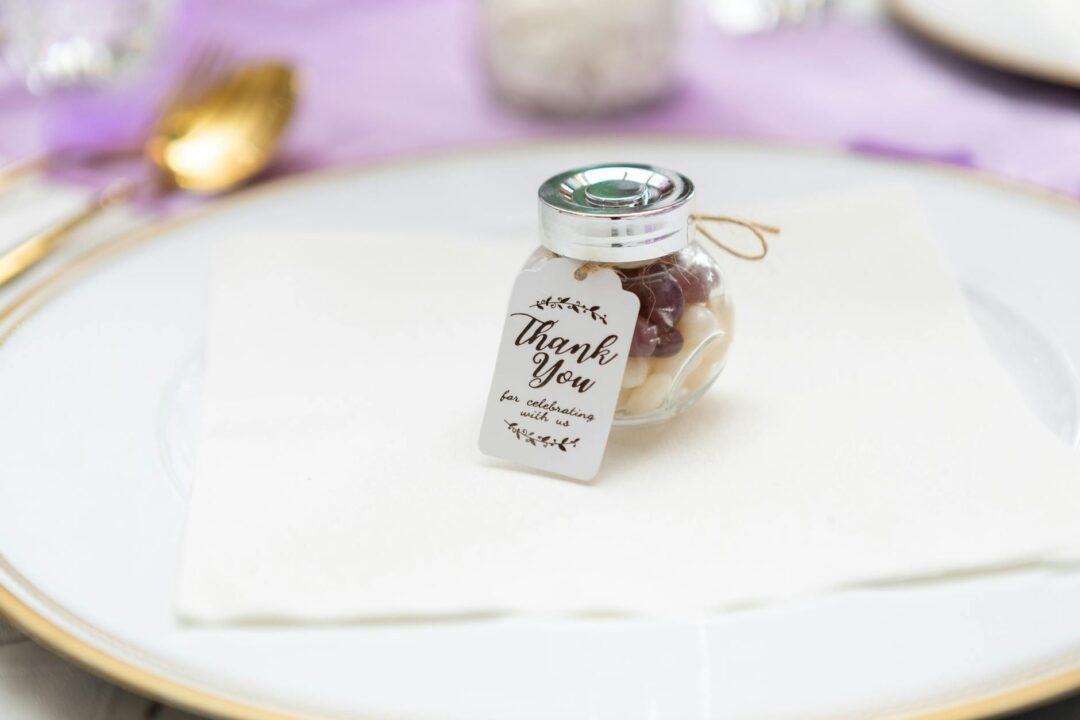
The thank you gifts for guests
While you might not want to do anything too extravagant for the guests that came to the ceremony and reception, they still need to be thanked for joining you on the day. Maybe this isn’t going to be as personalised as the gifts you gave to the bridal party, you can still make it something fun at each plate on the tables. We mentioned before potted plant party favours; there’s always a tasty treat for the ride home; or a hangover cure for the morning after. Whatever you decide, it’s better to decide a few weeks out from the day in case you need to be packing hundreds of party bags. Sending a thank you card is essential for all guests to thank them for coming.
DON’T FORGET
- To confirm your bookings a few months ahead of time and then a few weeks out from the wedding
Unexpected things may come up so make sure that you’ve done everything you can to avoid major problems. Double checking the details can be a good way of doing that.
- To get your dress fitted within the fortnight of the big day
We didn’t want to focus on the dress but it’s one of the things you need to double check and confirm closer to the date so we can’t really leave it off.
- To organise and make bookings for post-wedding accommodation
Once upon a time this would have been called a honeymoon. Maybe you don’t have the extended period of time to celebrate your new life with the person you love (or you’ve been living together for a while now so there’s nothing especially exciting about being stranded somewhere in a bed together), but you’re taking a couple of days to mark the occasion. There are details for that too so don’t forget to organise that as well.
- To double check those RSVPs
You’ve made the place cards. Now double check that everyone who has returned the RSVP card has a place. You don’t have to chase down people who haven’t responded. It might be good to
- To pick up the rings
Okay, so there are too many romantic comedies where the rings get waylaid and disaster ensues. This seems to be related to trusting them to brother-in-laws or younger siblings. Best way to avoid disaster? Do it yourself. Some things are low-risk to delegate. Others are best kept in the safest possible hands. Yours.
This checklist is a good place to start with planning a wedding. Print off the checklist and make notes as you go so that you don’t leave anything out (there’s even space to add the things we might have forgotten). Happy wedding planning!

The Complete Pre-Invitation Wedding Planning Timeline (12+ Months)
Modern weddings take longer to plan than ever before. Popular venues now book 12 to 18 months in advance for peak-season dates, and with so many vendors to coordinate, couples who start early arrive at their invitation order with everything confirmed. The timeline below maps every key task to the right window, with stationery milestones clearly marked.
12+ Months Before the Wedding
This is the foundation phase. Every decision you make here shapes everything that follows, including how many invitations you order.
- Set the date. Your date determines season, availability, and lead times for every vendor and every card you print.
- Establish your total budget. Allocate a stationery budget early (typically 2-3% of total spend) so it doesn’t get squeezed when venue and catering costs rise.
- Start your guest list. A rough count now, even a range like “80-120 people”, helps you book the right venue and get accurate stationery quotes later.
- Book your venue. Venue availability is the single biggest driver of your wedding date in peak season. Lock it before confirming anything else.
- Book your photographer. Great photographers book out 12-18 months in advance. Engagement photos taken 6-9 months out can be used on save the dates.
- Book your officiant/celebrant. Religious officiants, sought-after civil celebrants, and destination wedding officiants all fill up fast.
9-12 Months Before the Wedding
With the venue and key vendors locked, this window is where your guest list sharpens and your stationery design direction begins.
- Finalize your core vendor list. Caterer, florist, band or DJ, hair and makeup, vendors in this tier typically book 9-12 months out for popular dates.
- Lock your guest count. You don’t need the final name-by-name list yet, but you need a firm number. This count drives your invitation quantity, your save the date order, and your venue deposit confirmation.
- Take your engagement photos. Book these 6-9 months before the wedding so you have polished, edited images ready to use on photo save the dates.
- Choose your stationery style. Browse print methods and design directions. This is a good time to order a $5 Paperlust sample packit includes seven designs across different print methods so you can feel the difference between digital, letterpress, and flat foil before committing to an order.
- Order save the dates. Most couples send save the dates 8-12 months before the wedding. For destination weddings or holidays that require travel, aim for 12 months. For local weddings, 6-8 months is acceptable. See our full guide on save the date etiquette for timing by wedding type.
6-9 Months Before the Wedding
This is your design window. Most couples spend 4-8 weeks in the invitation design phase, so starting at 6 months out leaves comfortable buffer before your mail date.
- Start your invitation suite design. Browse designs, shortlist your favorites, and begin customizing wording. At Paperlust, a designer proof arrives within 1-2 business days of placing your order.
- Confirm wording with both families. Names, titles, and ceremony wording are the most common sources of last-minute changes. Lock these before final approval.
- Set up your wedding website. Your invitations can include a QR code or short URL linking to your site for accommodation details, RSVP instructions, and your registry.
- Finalize your guest list with full addresses. Begin collecting physical mailing addresses now. Digital tools like Paperlust’s Address Manager let you import lists from Excel or share a link to collect them directly from guests.
- Consider your full stationery suite. If you want menus, programs, place cards, and signage to match your invitation design, brief all pieces at the same time so they’re designed cohesively. A full stationery suite overview is in our wedding stationery suite guide.
4-6 Months Before the Wedding
Your invitation order window. Most couples send invitations 6-8 weeks before the wedding (10-12 weeks for destination weddings). Working back from your mail date with production time factored in puts the order deadline in this range.
- Lock your invitation design and approve your proof. The proof includes all text, layout, and colors. Read it aloud at least twice. Have someone outside the planning process read it too.
- Place your invitation order. Orders over $350 USD ship free via DHL Express (2-4 business days US transit after dispatch).
- Order any matching pieces. RSVP cards, information cards, and envelope liners should be ordered at the same time as invitations so they arrive together.
- Confirm your RSVP deadline. Set your RSVP date 3-4 weeks before the wedding. This gives you time to chase non-responders and confirm final numbers with your caterer.
- Pre-address envelopes. Hand-addressed or calligraphy-addressed envelopes take longer than you expect. If you’re doing it yourself, allow at least a week for 100+ envelopes.

Building Your Guest List Before You Order: Why the Count Matters
Most couples underestimate how tightly their guest count is tied to their stationery order. Getting this wrong in either direction costs money.
Why ordering too few invitations is expensive
Printing is structured around quantity tiers. A second small run of 20 invitations often costs nearly as much as the original order of 100 because setup costs are fixed. Order 10-20% more than your confirmed guest count to cover last-minute additions, keepsakes for family, and your own copy for the wedding album.
Why ordering too many invitations wastes your budget
On the other side, ordering 200 when you’re inviting 80 households ties up real dollars in paper you’ll never use. A household count is different from a guest headcount, one couple, one invitation. Work with household counts when placing stationery orders.
How to finalize your guest count before ordering
- Draft your list in three tiers: must-invite, hope-to-invite, and if-space-allows
- Confirm with both families that no one obvious has been left off the must-invite tier
- Convert headcount to household count (couples = 1 invitation, families with children = 1 invitation)
- Add 10-15% buffer to your household count for the reasons above
- Lock this number before you open a design tool
| Guest Headcount | Estimated Households | Suggested Order Quantity (with buffer) |
|---|---|---|
| 50 guests | 30-35 households | 45-50 invitations |
| 100 guests | 55-65 households | 80-90 invitations |
| 150 guests | 80-95 households | 110-120 invitations |
| 200 guests | 110-130 households | 145-160 invitations |
When to Order Save the Dates vs Invitations: The Decision Guide
The most common stationery question we receive: “Do I need save the dates, and when should I order them?” The honest answer depends on your wedding type, your guest profile, and your planning timeline.
When you should definitely send save the dates
- Destination or travel-required wedding. Guests booking flights and accommodation need as much lead time as possible. Send save the dates 10-12 months out.
- Wedding on or near a major holiday. Long weekends, peak summer travel dates, and school holiday periods mean guests have competing commitments. Send early.
- Large guest list with many out-of-towners. If more than 30% of your guests need to travel, save the dates help them plan before your formal invitations arrive.
- Short engagement (under 9 months). When your timeline is compressed, a quick save the date buys guests time while you finalize invitation details.
When you can skip save the dates
- Small local wedding (under 50 guests, all within driving distance)
- Ceremony and reception on the same day in the same city as most guests
- Elopement or micro-wedding where you’re managing RSVPs personally
- Wedding more than 15 months away (send the invitation itself closer to the date)
The timing comparison table
| Wedding Type | Send Save the Date | Send Invitations |
|---|---|---|
| Local (guests mostly in same city) | 6-8 months out (optional) | 6-8 weeks out |
| Interstate or regional | 8-10 months out | 8-10 weeks out |
| Destination or international | 10-12 months out | 3-4 months out |
| Holiday or peak-season date | 10-12 months out | 8-10 weeks out |
For a complete guide on invitation mail dates, including a month-by-month calendar for 2026 and 2027 weddings, see our wedding invitation timeline guide.
Design tip: coordinate your save the date and invitation suite
Save the dates and invitations don’t have to be identical, but they should feel like they belong together. Consistent typography, color palette, or print method (for example, both using flat foil in rose gold on the same paper stock) creates a cohesive impression when guests open each piece. Browse coordinated save the dates and wedding invitations to find matching styles.
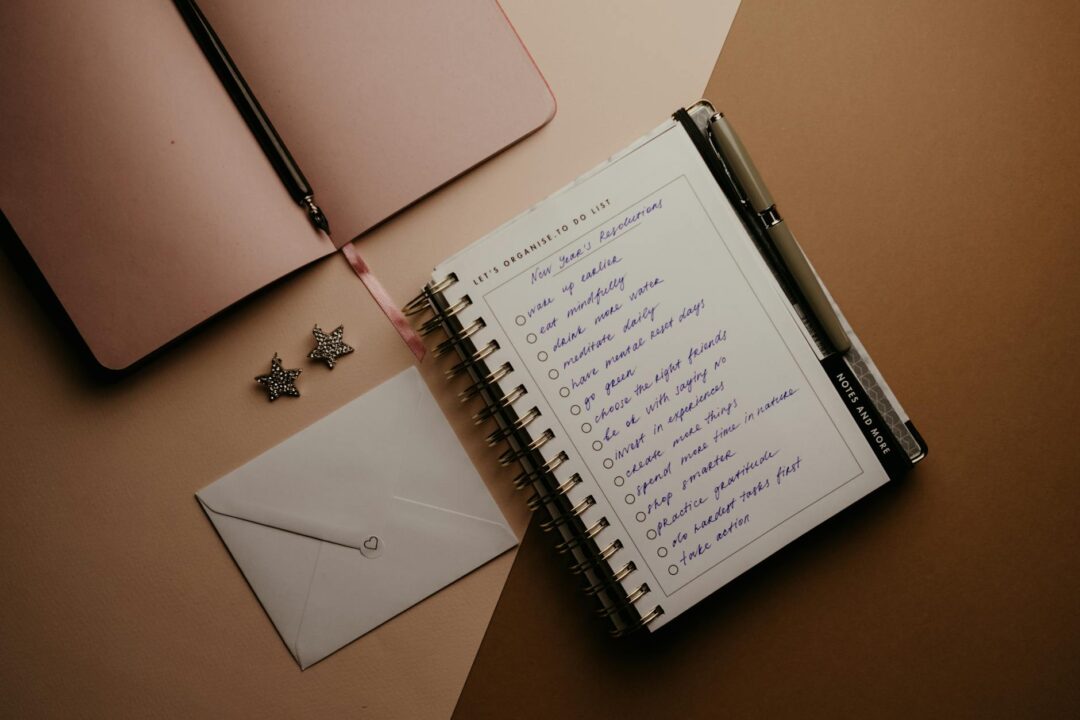
The Pre-Send Invitation Checklist: Before They Leave Your Hands
You’ve approved your proof, received your order, and assembled your invitations. Before anything goes in a mailbox, run through this checklist. These are the errors that couples discover after mailing, and every one of them is preventable.
Proofreading
- Read the invitation text aloud, slowly. Your brain autocorrects errors when reading silently.
- Check the date for day-date alignment (for example, “Saturday, October 11, 2026”, October 11, 2026 is a Sunday, not a Saturday).
- Verify the venue name is spelled correctly. Check against the venue’s own website.
- Confirm the address is complete (street number, suburb/city, state/zip).
- Verify ceremony and reception times are accurate and in the correct order.
- Check that RSVP details are complete: email, website URL, or card included.
- Confirm the RSVP deadline date.
- Have someone not involved in the planning read everything as a fresh set of eyes.
Addressing and envelopes
- Verify every guest name is spelled correctly, this is especially important for names from different cultural backgrounds.
- Use formal names on outer envelopes (full names, titles where appropriate).
- Confirm plus-one invitations are addressed correctly (“and guest” or the partner’s name).
- Double-check that each envelope contains the correct invitation (particularly important for invitations with different inserts for different guest groups).
- Verify every address is current. Collect updated addresses rather than relying on a contact list that might be 2-3 years old.
Postage and assembly
- Weigh a fully assembled invitation before buying stamps in bulk. Multi-insert suites with wax seals, envelope liners, and thick stock can exceed standard letter weight.
- Take one assembled invitation to your local post office to confirm the correct postage rate.
- If using wax seals on outer envelopes, check with your post office whether hand-canceling is required to avoid machine damage.
- RSVP cards go inside with a pre-addressed, stamped return envelope (etiquette standard for formal invitations).
- Assemble a test set before doing the full run, tuck order, envelope closure, and insert orientation all deserve a dry run.
Mailing logistics
- Mail in person at a staffed post office counter rather than dropping in a box. This reduces handling damage and ensures correct postage.
- Keep a copy of your guest list with mail dates noted. Follow up with guests who haven’t responded within 2 weeks of the RSVP deadline.
- For international guests, mail 2-3 weeks earlier than domestic invitations to account for transit time.
Ready to Order Your Invitations?
500+ exclusive designs. Proofs in 1-2 business days. Free DHL Express on orders over $350 USD.
Wedding Planning FAQs
How far in advance should I start planning my wedding?
Most couples benefit from at least 12 months. This gives you enough time to book a venue before peak dates fill up, allow engagement photos to be taken and edited before save the dates are ordered, and complete the invitation design and approval process without rushing. If you have less than 12 months, focus on venue, photographer, and officiant first, then compress the stationery timeline accordingly.
What is the first thing to book when planning a wedding?
Your venue. Venue availability sets your date and controls what other vendors are available in your area on that day. Photographers, caterers, and live music acts follow, all book from a limited roster of available dates, and popular vendors fill up 9-12 months in advance for peak-season Saturdays.
When should I order wedding invitations?
Order invitations 4-5 months before the wedding date. This gives you time to receive the order, address envelopes, and mail with 6-8 weeks lead time for guests (10-12 weeks for destination weddings). At Paperlust, proofs are delivered within 1-2 business days, and orders over $350 USD ship free via DHL Express with 2-4 business days US transit.
Do I need save the dates if I’m sending invitations?
Not always. Save the dates are most important for destination weddings, travel-required guests, peak holiday dates, and large weddings with many out-of-towners. For a local wedding where most guests live in the same city, invitations alone sent 8 weeks out are standard. If in doubt, save the dates are relatively affordable and the cost of sending them is far less than guests who can’t attend because they didn’t have enough notice.
How many wedding invitations should I order?
Order by household, not headcount. One couple = one invitation, one family = one invitation. Take your household count and add 10-15% buffer for last-minute adds, keepsakes, and your own record. Ordering a small second run is often nearly as expensive as the original order due to fixed setup costs, so it’s better to over-order slightly up front.
What do I need to finalize before ordering invitations?
Lock in: your full names and how they should appear, your venue name and complete address, the ceremony date and time, the reception time and address (if different), your RSVP deadline, your RSVP method (card, email, or website URL), and whether any guests need accommodations or travel information included as an insert. Having all of this confirmed before starting the design process avoids proof revision rounds that add time to your timeline.
What is the correct wording for a formal wedding invitation?
Traditional formal wording follows a specific structure: the hosts’ names (parents of the couple, or the couple themselves) followed by the request line (“request the honor of your presence” for religious ceremonies, “request the pleasure of your company” for civil ceremonies), the full names of the couple, the date written out in full, the ceremony time, and the venue name and address. For more complete wording examples across every style from formal to casual, see our full wedding invitation wording guide.
What should I include in my wedding invitation suite?
The core pieces are: the invitation itself, an RSVP card with return envelope, and an information or details card with accommodation, transport, and any other event information. Optional pieces include an envelope liner, a belly band to hold the suite together, wax seals, and for formal or multi-venue weddings, a separate ceremony and reception card. Save the dates, menus, programs, place cards, and thank you cards round out the full stationery timeline. Browse the full Paperlust invitation suite for design options across every style.
Can I include a wedding website on my invitations?
Yes, and it’s now standard practice. Include the URL on a separate details card or at the bottom of the information card, not on the invitation itself, which should remain clean and focused. A QR code printed on the details card is a clean way to make the link easy to access. Include your wedding website URL on your save the date as well, since accommodation booking and RSVP collection can start early.
How long does it take to address wedding envelopes?
Longer than you expect. Hand-addressing 100 envelopes with return address calligraphy and inner envelopes takes 6-12 hours depending on your pace. Give yourself at least a week for large guest lists. Alternatives include digital address printing, which is faster and consistent, or ordering pre-addressed envelopes through your stationery printer. If you want calligraphy, book a calligrapher 4-6 months out, good ones fill up quickly.
What is the difference between flat foil and letterpress for wedding invitations?
These are two distinct print methods with very different looks and tactile qualities. Flat foil uses metallic foil applied directly to paper, it creates a mirror-bright metallic finish with no impression in the paper. It’s available in gold, rose gold, silver, copper, and specialty finishes like holographic. Letterpress presses inked type and designs into thick cotton paper, creating a visible debossed impression. It’s known for its handcrafted, tactile feel. Both are available at Paperlust across a range of paper stocks. For most couples, the choice comes down to whether they want shine (flat foil) or tactile depth (letterpress). See our stationery guide to explore both.
What’s the latest I can order invitations and still mail on time?
Working backward from a 6-week guest lead time for a local wedding: order invitations 10-11 weeks before the wedding. This allows 1-2 business days for proof delivery, 1-2 rounds of proof revisions if needed, production time (8-10 business days for digital, up to 20 business days for letterpress), shipping transit (2-4 business days DHL Express for US orders over $350 USD), and 1-2 weeks for envelope addressing and assembly. If you’re cutting it close, digital print is the fastest method. Letterpress and other specialty methods require more lead time.
Start Your Invitation Design
500+ exclusive designs from independent artists. Letterpress, flat foil, digital, and more. Proofs in 1-2 business days.