
block per BLOG_STYLE_STANDARD.md after WP draft push.,>
Choosing between a save the date postcard and a save the date card is one of those decisions that feels minor until you realize it sets the tone for everything that follows. Both formats do the same job – reserving your date on every guest’s calendar – but they signal different things about your wedding’s formality, budget, and vibe. Here is what you need to know to pick the right one.
- Postcards win on: postage cost, no-envelope assembly, destination and casual wedding tone, photo-forward design
- Cards win on: formality, keepsake envelope appeal, invitation suite matching, privacy during mailing
- The deciding factor: your wedding style – relaxed and modern, or traditional and ceremonial
The 30-second version
See our Australia, United States, United Kingdom, Canada, or New Zealand collection to see locale-specific designs and shipping.
Not sure which way to lean? Run through this comparison – eleven decision points covering everything from postage to etiquette signaling – and the right format usually becomes clear within a few rows.
| Decision factor | Save the date postcard | Save the date card |
|---|---|---|
| Postage rate | Lower – qualifies for the USPS postcard rate | Higher – standard first-class letter rate |
| Envelope required | No – mails as-is | Yes – free white envelopes included with every Paperlust order |
| Privacy | Visible to all mail handlers | Private – sealed inside envelope |
| Photo display | Large front panel – ideal for full-bleed photo layouts | Front and back – more total design real estate |
| Wording space | Back panel for all text | Back panel plus envelope liner options |
| Formality signal | Casual to modern | Formal to traditional |
| Design versatility | Best for minimalist, destination, travel-theme, photo-led | Best for formal, traditional, suite-matched designs |
| Assembly time | Faster – address and stamp, no inserting or sealing | Slightly longer – insert, seal, address, stamp |
| USPS eligibility | Must meet USPS postcard dimension minimums and maximums | Standard envelope sizes automatically qualify |
| Keepsake potential | Good – flat and easy to pin or display | High – envelope and card together feel like a keepsake package |
| Best for | Destination, elopement, casual, backyard, modern couples | Black-tie, traditional, formal, second wedding (privacy) |
When postcards are the right call
A save the date postcard is not a budget compromise – it is a deliberate format choice that suits specific couples very well.
Destination weddings
When guests need to book flights and hotels up to a year out, a postcard previewing the location does double duty. A beach scene, mountain lodge, or European backdrop communicates the vibe instantly. The open format also signals early that this is a celebration guests travel to, not just attend. Browse save the date postcards to see destination-friendly designs.

Casual, backyard, or outdoor weddings
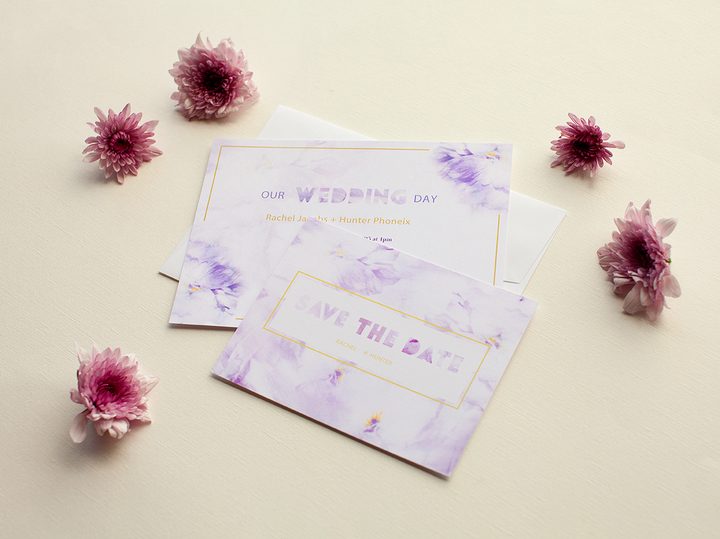
If your wedding is in a garden, on a farm, or at a brewery, a postcard matches the register. Guests receive a confident, casual announcement rather than a formal summons – consistent with the wedding you are actually throwing.
Modern or minimalist couples
Couples who gravitate toward clean lines and photography-first design often find postcards give them more creative control. A full-bleed image on the front, spare text on the back, and no envelope fussing around it – the format gets out of the way of the design.
Budget-conscious planning
Postcards qualify for the USPS postcard rate rather than the standard first-class letter rate. That difference multiplied across 100 to 200 guests adds up to real money – money that goes toward florals, catering, or upgrading your invitation suite. You also skip envelope assembly entirely, which saves meaningful time at scale.
Photo-led announcements
If you had an engagement shoot and want the image to lead, a postcard’s large front panel gives your favorite frame room to breathe – functioning almost like a mini-print that guests stick on their refrigerator without being asked.
- Your wedding is destination, outdoor, backyard, or relaxed in tone
- You have engagement photos you want displayed large and front-and-center
- You want to save on postage across a sizeable guest list
- Your aesthetic is modern, minimalist, or travel-themed
- Fast, simple addressing and mailing matters to you
When cards are the right call
For a significant share of couples, a carded save the date in an envelope is clearly the better choice – not just for formality’s sake, but for several practical reasons too.
Black-tie or formal weddings
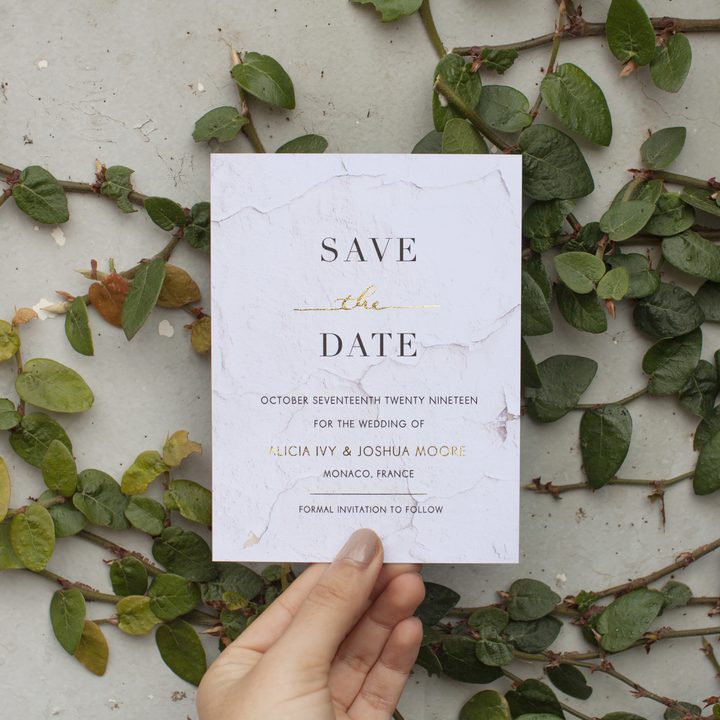
An envelope sets a tone before guests even open it. For formal weddings, a carded save the date signals what is coming: a considered, ceremonial event. If your invitation suite will feature cotton paper, foil-stamped type, or letterpress printing, a carded format reinforces that register from the very first mailing.
Keepsake value
Guests who keep wedding correspondence in scrapbooks hold on to carded save the dates more reliably than postcards. The act of opening an envelope creates a small moment of occasion. If you want your save the date to end up in a memory box rather than a recycling bin, an envelope and card has the stronger track record.
Sharing additional information early
If you want to include a small accommodation card or hotel block note, a carded format mailed in an envelope gives you that flexibility. A postcard cannot carry inserts – so if you need to communicate more than the basics before the formal invitation, the card is the right vehicle.
Privacy matters
For a second wedding or a guest list you are being selective about, an envelope provides a meaningful layer of discretion. Your date and venue stay private until your guest opens the mailbox themselves, rather than being visible to every mail handler en route.
Matching a formal invitation suite
Consistency across your stationery suite matters more than most couples expect. If your invitations will be formal and layered, a postcard save the date can feel jarring in retrospect. A carded format gives you a natural foundation to carry through in paper stock, print method, and design language.
- Your wedding has a formal, black-tie, or traditional dress code
- You want a keepsake guests are likely to store and display for years
- You plan to include additional inserts like hotel or accommodation info
- Privacy about your event details matters
- You want seamless visual consistency with a formal invitation suite
Browse all save the date formats at Paperlust – 500+ exclusive designs across every print method.
The cost comparison: postage and production
Budget is rarely the only factor, but it is almost always a factor. Here is where the numbers actually differ.
Postage
USPS offers a dedicated postcard rate – lower than the standard first-class letter rate used for carded save the dates in envelopes. For postcards to qualify, they must meet USPS size requirements (minimum 3.5″ x 5″, maximum 4.25″ x 6″), which standard save the date postcard sizes comfortably meet. Across a guest list of 100 to 200, that per-piece saving becomes a real budget line item.
One practical tip: for premium-printed postcards with flat foil or metallic, ask the post office for hand-canceling rather than machine processing. This significantly reduces the risk of bending or ink smearing during transit.
Production costs
At Paperlust, both postcards and cards start from $1 per card. The per-piece production cost is similar across formats – the financial advantage of postcards comes almost entirely from the postage side. Free white envelopes are included with every card order, so you are not paying extra for enclosures when you choose the carded format.
Premium print and where postcards help
For couples upgrading to flat foil, foil stamp, or metallic ink, postage savings from the postcard format can meaningfully offset the premium print cost – making a foil postcard more accessible in total spend than a foil card at first-class rates. Budget-conscious couples doing high-volume digital print mailings typically find the postcard format delivers the best cost-per-piece once postage is factored in.
The design and tone comparison
Beyond logistics, the two formats send different signals before a guest reads a single word.
Postcards read as an experience announcement. They arrive open and immediate, the way a travel postcard does. There is no ritual of opening an envelope – the information is right there, bold and confident. This works beautifully for couples with a strong visual identity or a destination element that a photo can communicate in under a second.
Cards read as a ceremonial preview. The sealed envelope creates a small moment of anticipation. Guests pick it up, notice the calligraphed address, and feel that something intentional is inside. That ritual suits weddings built on ceremony and tradition.
Both formats support the same Paperlust print methods – digital print, flat foil, foil stamp, metallic, and white ink on dark stock. The format difference is less about what you can print and more about what the physical object communicates before design is even considered.
Hybrid strategies: when to use both
The postcard-or-card framing is a useful shortcut, but some couples find the right answer is a deliberate combination.
Postcard save the date, formal invitation suite
A growing number of couples send a casual postcard save the date early – 10 to 12 months out for destination events, 6 to 8 for local – then follow up with a fully formal carded invitation suite closer to the date. The postcard handles the urgent calendar task efficiently. The formal suite delivers the ceremony guests expect. The contrast can even work in your favor: guests understand the planning is practical, but the event will be special.
Different formats for different guests
There is no rule requiring everyone to receive the same format. Some couples send photo postcards to friends and peers, and carded save the dates to family members who are more traditional. Keep the design language consistent across both – same color palette and designer – so the campaign feels cohesive even when the physical format differs.
If you are weighing a third format, save the date magnets sit between postcard and card in terms of casualness – any Paperlust design becomes a magnet at checkout, with guaranteed refrigerator longevity.
What wedding etiquette says
Classic etiquette has historically favored envelopes for all pre-wedding correspondence, on the basis that an enclosure signals importance and protects the card in transit. This position holds most weight for formal or black-tie weddings where stationery is expected to carry ceremonial weight.
Contemporary etiquette has relaxed considerably. The current consensus is that postcards are entirely appropriate for most weddings, with two exceptions: very formal events (black-tie or white-tie) and situations where privacy matters. For destination weddings especially, the postcard format is not just accepted – it is often considered the more fitting choice, because it communicates the travel-and-experience nature of the event the moment it lands in the mailbox.
Both traditional and modern sources agree on one point regardless of format: send save the dates only to confirmed guests. A save the date creates an expectation – do not send one to someone who might not make the final guest list.
For timing, what to include, plus-one etiquette, and more, see the full save the date etiquette guide.
How to coordinate with your invitation suite either way
Whichever format you choose, visual consistency between your save the date and your invitation suite makes the whole package feel considered.
If you chose a postcard: Select a design from the same Paperlust designer or design family as your intended invitation. Match your color palette, typography style, and print method. A minimalist flat-foil postcard pairs naturally with a letterpress invitation suite – guests receive a coherent experience from first announcement to ceremony day.
If you chose a card: Use the save the date as a test run. Order a paper stock sample to confirm weight and finish look right in hand before committing to a larger invitation order. Lock in your print method and color scheme at the save the date stage and carry those choices through to the full suite.
In both cases, your wedding website bridges the two. Include your URL on the save the date so guests can access venue details, registry, and accommodation options as soon as they receive it – then follow up with your full wedding invitation suite six to eight weeks before the date.
Save the date postcard vs. card: FAQs
Are save the date postcards cheaper than cards?
Yes – primarily on postage. Postcards qualify for the USPS postcard rate, which is lower than the first-class letter rate used for carded save the dates. At Paperlust, production pricing starts at $1 per card for both formats, so the main saving is in postage. Across 100 to 200 guests, that difference adds up to a real number.
Do save the date postcards look less formal than cards?
Generally yes – and for many couples, that is the point. A postcard communicates a casual, modern, or destination vibe by its nature. For relaxed or outdoor weddings, that informality is a feature. For black-tie or traditional events, a carded format better suits the occasion. Print method – foil stamp or flat foil can elevate either format, but the format itself sets the formality register.
Can you have a photo on a save the date postcard?
Yes – and postcards are often the better photo format. The front panel gives your engagement shot a large, uninterrupted canvas with full-bleed printing that runs edge to edge. Cards can also feature photos, but the postcard format typically gives the image more visual weight and makes a stronger first impression.
Which is more popular – postcards or cards for save the dates?
Both are widely used. Carded save the dates remain the default for formal weddings. Postcards have grown significantly in popularity alongside destination weddings, elopement-style celebrations, and modern minimalist couples. For casual and destination events, postcards are now as common as carded formats.
Is it tacky to send save the date postcards?
Not at all – provided the format matches the wedding. A beautifully printed postcard for a destination, casual, or modern wedding is a thoughtful, appropriate choice. It can feel mismatched at a very formal or black-tie event where guests expect stationery to signal ceremony. Match format to wedding style and the question of tacky does not arise.
Do save the date postcards need an envelope?
No – that is a defining feature of the format. Postcards mail as-is and qualify for the lower USPS postcard rate as a result. If you put a postcard in an envelope for protection, you pay first-class rates and lose the postage saving. For premium-printed postcards, hand-canceling at the post office provides protection without needing an envelope.
Can you send save the date postcards for a black-tie wedding?
Technically yes, but it is generally not recommended. Black-tie weddings carry a formality expectation that extends to the stationery. A carded save the date in an envelope – on premium stock with foil or letterpress – sets the right tone from the first mailing. A postcard can feel like a mismatch at a formal event even when the design is beautiful.
Which format works best for destination weddings?
Postcards are the preferred format for most destination weddings. They communicate the travel-and-experience nature of the event instantly – especially when the front features location-inspired photography. They are also practical and cost-effective. Send them 10 to 12 months ahead so guests have maximum time to arrange flights and accommodations.
Do save the date postcards still allow for a wedding website link?
Yes – the back panel has room for your names, date, city, a “formal invitation to follow” line, and a wedding website URL or QR code. Keep wording concise and let your site handle detailed information like venue directions, registry, and accommodation options.
Will save the date postcards match my formal invitation suite?
They can with intentional design choices – same color palette, print method, and design family as your invitation. Some couples use the format contrast intentionally: a relaxed postcard followed by a formal invitation suite signals the planning is practical but the event will be special. For seamless suite matching without any contrast, a carded format is the safer choice.
How much do you save in postage with postcards over cards?
The USPS postcard rate is lower than the standard first-class letter rate used for carded save the dates. The exact difference depends on current USPS rates – check USPS.com for the latest figures before finalizing your order. The per-piece saving is consistent enough that across a guest list of 100 to 200 it becomes a meaningful budget difference, not just a rounding error.
Can you send postcards to some guests and cards to others?
Yes – there is no etiquette rule requiring uniformity. Some couples send photo postcards to friends and peers, and carded save the dates to family members who are more traditional. The tradeoff is a small increase in coordination – two orders, two addressing rounds. Keep design language consistent across both formats so the overall campaign feels cohesive.
Ready to send a save the date that feels finished from the first glance?
Browse Paperlust save the date postcards across digital print, flat foil, foil stamp, metallic ink, and white ink on premium paper stocks. Order a sample pack first to compare paper, print, and finish in person.