

Planning a Jewish wedding is one of the most meaningful experiences a family can share, and the invitation is the first glimpse guests have of the celebration ahead. Whether you are navigating bilingual Hebrew-English layouts, listing both sets of parents as hosts, working out what to write when your ceremony starts after Shabbat, or choosing between a hamsa motif and botanical vines, there is a lot to get right. This guide covers everything you need to know about Jewish wedding invitation wording, traditions, and design, with specific examples you can adapt for any denomination and family dynamic.
- Hebrew date: Always include alongside the civil date, use Hebcal to convert accurately
- Both parents listed: Jewish tradition emphasizes family unity; list both sets of parents as hosts
- Ceremony term: Say “under the chuppah” rather than just “at our ceremony”
- Multiple times: Traditional weddings list smorgasbord/kabbalat panim + chuppah times separately
- Shabbat timing: If chuppah begins after Shabbat ends, state the exact Shabbat end time in a note
- Hebrew typography: Work with Paperlust designers for custom Hebrew lettering on your invitation
- Layout options: Side-by-side bilingual, double-sided, folded card, or English-primary with Hebrew elements
- Paper recommendation: 380gsm Premium (flat foil) or 600gsm Wild Cotton (letterpress) for a luxury feel
- Order early: Allow 20+ business days for foil methods; proofs delivered in 1-2 business days
Jewish Wedding Invitation Traditions
Jewish weddings carry centuries of tradition, and the invitation is where those traditions start to take shape on paper. At its core, a Jewish wedding invitation communicates the same information as any other (who is getting married, where, when), but the framing, language, and structure reflect values that are specific to Jewish culture and, in many cases, to the particular denomination and family background of the couple.
The Emphasis on Family and Community
Jewish wedding invitations traditionally place the family front and center. Rather than the couple issuing the invitation themselves, it is the parents, and often both sets of parents together, who extend the invitation to guests. This reflects the Jewish understanding of marriage as a union of two families, not just two individuals.
The tone of Jewish invitations also tends to be warmer and more joyful than the formal English “request the honor of your presence” phrasing common in Christian weddings. Phrases like “invite you to share in our joy,” “invite you with b’simcha” (b’simcha meaning “with joy”), or “join us as we celebrate” are all appropriate and widely used. The word “simcha” itself, which means a joyful occasion, often appears in Jewish wedding invitations as a way of framing the event.
Hebrew as a Living Language on Your Invitation
Including Hebrew on a wedding invitation is a meaningful gesture that connects the couple to Jewish history, text, and community. The extent of Hebrew used varies widely. Some couples include a full parallel Hebrew-language invitation alongside the English. Others add just the Hebrew date, the couple’s Hebrew names, and perhaps a short phrase or biblical verse. Still others use English throughout but add a few Hebrew words or a traditional abbreviation.
At the top of traditionally printed Hebrew invitations, you will often see a small abbreviation:
- Beit Heh (B”H), short for “B’ezrat Hashem” (“with God’s help”), common in Ashkenazi communities
- Bet Samech Dalet (B”SD), short for “B’siyata D’Shmaya” (“with the help of Heaven”), more common in Sephardi and Mizrahi communities
These abbreviations appear in the upper right corner of the Hebrew panel (since Hebrew reads right to left) and signal the couple’s religious orientation. Couples who are secular or non-observant often omit them entirely, and that is equally acceptable.
What “Under the Chuppah” Means (and Why It Belongs on Your Invitation)
The chuppah (marriage canopy) is the physical and symbolic heart of a Jewish wedding ceremony. The couple stands under it to exchange vows, and its four open sides traditionally symbolize the new home the couple is creating, open to family and community on all sides. Referring to the chuppah on your invitation signals to guests that a Jewish ceremony is taking place and helps set expectations about the format of the day.
For couples who are having a specifically Jewish ceremony, writing “under the chuppah” rather than simply “at our ceremony” is a small but meaningful distinction that many Jewish guests will notice and appreciate.
Standard Wording for Jewish Wedding Invitations
Jewish wedding invitation wording follows a general structure, but there is more flexibility within that structure than many couples expect. Below are the core components and how to handle each.
The Host Line
The host line names the people issuing the invitation. In traditional Jewish wording, this is the parents of both the bride and groom, listed together, not separately by side. The most common formats:
Both families listed by name:
Mr. and Mrs. David Cohen
and
Mr. and Mrs. Michael Levy
Simplified family line:
Couple-hosted with family acknowledgment:
together with their families
invite you to share in their joy
One set of parents hosting (e.g., the bride’s parents):
request the pleasure of your company
as their daughter
When divorced parents are involved, each parent is listed on a separate line. Remarried parents may include their spouse. Step-parents can be included or omitted based on the couple’s preference, there is no fixed Jewish rule here; general wedding etiquette applies.
The Request Line
This is where Jewish invitations often diverge most visibly from traditional English wording. Options range from formal to warm:
- “request the honor of your presence” (formal, traditional English)
- “request the pleasure of your company” (slightly less formal)
- “invite you to share in their joy” (warm, modern Jewish)
- “invite you with b’simcha to celebrate” (Hebrew-inflected, joyful)
- “joyfully invite you to celebrate” (casual, contemporary)
The phrase “honor of your presence” is technically reserved for ceremonies held in a house of worship in traditional English etiquette. If your ceremony is held in a hotel ballroom or outdoor venue, “pleasure of your company” is the more accurate formal choice, though many couples use either interchangeably.
The Couple’s Names
Jewish invitations traditionally list the bride’s name first. This is a departure from some older secular traditions where the groom was listed first. In more egalitarian or same-sex couples, names can appear in any order the couple chooses.
A formatting note: Jewish invitations often connect the two names with “and” rather than “to,” which is common in Christian ceremony wording (“the marriage of Rachel to Daniel” vs. “the marriage of Rachel and Daniel”). The “and” framing reflects the partnership model rather than the older patriarchal “giving away” model.
The Ceremony Details
Include:
- Day of the week, written out
- Civil date (in formal spelled-out form: “the fifteenth of June, two thousand and twenty-six”)
- Hebrew date (see section below on dating)
- For traditional weddings: kabbalat panim/smorgasbord time AND chuppah time listed separately
- Venue name and full address
- Dress code if applicable
Example:
corresponding to the nineteenth of Sivan, 5786
>
Chuppah, 6:30 in the evening
Dinner and dancing to follow
>
123 Main Street, New York, New York
Bilingual Hebrew and English Invitation Options
For couples who want Hebrew text on their invitation, there are four main layout approaches. The right one depends on how much Hebrew text you want to include, whether all your guests can read Hebrew, and your overall design vision.
Layout Option 1: Side-by-Side Bilingual Card
The English text appears on the left panel and the Hebrew text on the right. Both languages are printed on the same side of the same card, in parallel columns. This is the most common format for Jewish wedding invitations in the US and works well for standard invitation card sizes.
The challenge: Hebrew reads right to left, so the Hebrew panel begins at the top right and moves down and to the left. On a side-by-side layout, the two panels essentially “start” at opposite outer edges and work inward, which can feel elegant if done well or cluttered if the card is too small.
Layout Option 2: Double-Sided Card
One side of the card is entirely in English; the other side is entirely in Hebrew. This gives each language room to breathe and is a clean, formal option. Guests who do not read Hebrew can simply turn the card over and not feel confused by unfamiliar text.
Layout Option 3: Folded Card
A folded card (similar to a greeting card format) can carry the English wording on the inside left panel and the Hebrew wording on the inside right panel, with the design or a meaningful quote on the cover. This is a traditional and elegant approach that works particularly well for formal Jewish weddings.
Layout Option 4: English-Primary with Hebrew Accents
Many modern Jewish couples, especially those from Reform, Conservative, or non-observant backgrounds, prefer a primarily English invitation with selected Hebrew elements: the Hebrew date, the couple’s Hebrew names, a single verse, or just the abbreviated abbreviation (B”H or B”SD) at the top. This is a genuinely flexible approach that honors Jewish tradition without requiring fluent Hebrew readers to appreciate the design.
A Note on Hebrew Typography at Paperlust
Paperlust’s design team can work with you on custom Hebrew lettering for your invitation. For any invitation that includes Hebrew text, whether a full bilingual layout or a single Hebrew phrase, we strongly recommend requesting a custom design consultation rather than attempting to type Hebrew characters directly into a standard design template. Hebrew typography requires right-to-left text direction, specific font selection, and careful proofing by someone fluent in the language. Paperlust’s designers are available to handle this as a custom request.
Visit our wedding invitations collection to start with a base design, then reach out to our design team about adding Hebrew text.
Who “Hosts” a Jewish Wedding Invitation? Parent Wording
The host line on a Jewish wedding invitation is worth spending real time on, because Jewish tradition places particular emphasis on the role of both families. Getting this right matters, not just for etiquette reasons, but because it sets the tone for how guests understand the wedding.
The Traditional Both-Families Format
In Ashkenazi tradition, both sets of parents are named as hosts, listed one after the other with “and” between them. The bride’s parents are typically listed first. This reflects the idea that the wedding is a joining of two families, and that both families are equally involved in hosting.
Mr. and Mrs. David Cohen
and
Mr. and Mrs. Michael Levy
When Parents Are Divorced or Remarried
Divorced parents are listed on separate lines. If one or both parents have remarried, the step-parent can be included alongside them:
and
Dr. Howard Cohen
and
Mr. and Mrs. Michael Levy
This can get long quickly. A clean alternative that many couples choose:
That three-word phrase does a lot of work. It honors everyone without requiring a complex multi-line host section, and it avoids the awkward question of who is listed first, second, third.
When the Couple Is Hosting
More and more Jewish couples today are paying for their own weddings, which changes the hosting dynamic. The couple can still acknowledge family involvement:
together with their families
joyfully invite you to celebrate their wedding
Or, for a completely couple-hosted invitation:
invite you to share in their joy
Same-Sex Couples and Non-Binary Partners
Jewish tradition is adapting to reflect the full spectrum of Jewish families. For same-sex couples, the same wording options apply. Name order is typically chosen by the couple. The Reform, Conservative, and Reconstructionist movements all perform same-sex Jewish weddings, and wording can reflect this directly:
invite you to share in their simcha
For non-binary partners, names appear without gendered titles. “Together with their families” is a clean and gracious host line that sidesteps any title complications.
Shabbat and Holiday Timing: What to Note on the Invitation
Scheduling a Jewish wedding involves navigating the Jewish calendar in ways that have no equivalent in most other wedding planning guides. If you are having a traditional Jewish wedding, or if a significant portion of your guests are Shabbat-observant, the timing on your invitation needs to be handled with care.
Why Shabbat Matters for Weddings
Shabbat (the Jewish Sabbath) begins at sundown on Friday and ends when three stars appear in the sky on Saturday night, typically 40-50 minutes after sunset, depending on location. Jewish law prohibits writing, traveling, handling money, and many other activities during Shabbat. An observant guest cannot travel to a wedding venue during Shabbat, which means a Saturday afternoon wedding is simply not accessible to Shabbat-observant guests without them being within walking distance of the venue.
Many traditional Jewish weddings are therefore scheduled for Saturday evening after Shabbat ends (a “Motzei Shabbat” wedding), or on Sunday, or on a weekday evening. If your Saturday evening wedding begins after Shabbat ends, called after tzet hakochavim (“the going out of the stars”), your invitation should make this clear.
What to Write on the Invitation
If your chuppah is scheduled for after Shabbat ends:
(Following the conclusion of Shabbat)
Or, for a more specific note, include the actual Shabbat end time for your venue’s location:
Chuppah at 8:30 p.m.
This is not just polite, it is practical. Observant guests need to know exactly when they can begin traveling. Giving them the Shabbat end time removes the need to look it up and signals that you have considered their needs in planning.
You can find the Shabbat end time for any location and date at Hebcal.com or MyZmanim.com.
Jewish Holidays to Avoid
Certain periods on the Jewish calendar are traditionally considered inappropriate times for Jewish weddings:
- The Omer counting period (between Passover and Shavuot), many traditional families avoid weddings during most of this period, with specific permitted days varying by family custom (Sephardi vs. Ashkenazi, etc.)
- The Three Weeks (from the 17th of Tammuz to Tisha B’Av), a period of mourning
- Rosh Hashanah and Yom Kippur (High Holy Days), always avoided
- Shabbat itself, observant couples do not marry on Shabbat
- Passover and Shavuot, marriages are not performed on major holidays
If your wedding date falls near any of these periods, it is worth checking with your rabbi and noting the date clearly on your invitation so guests can plan accordingly.
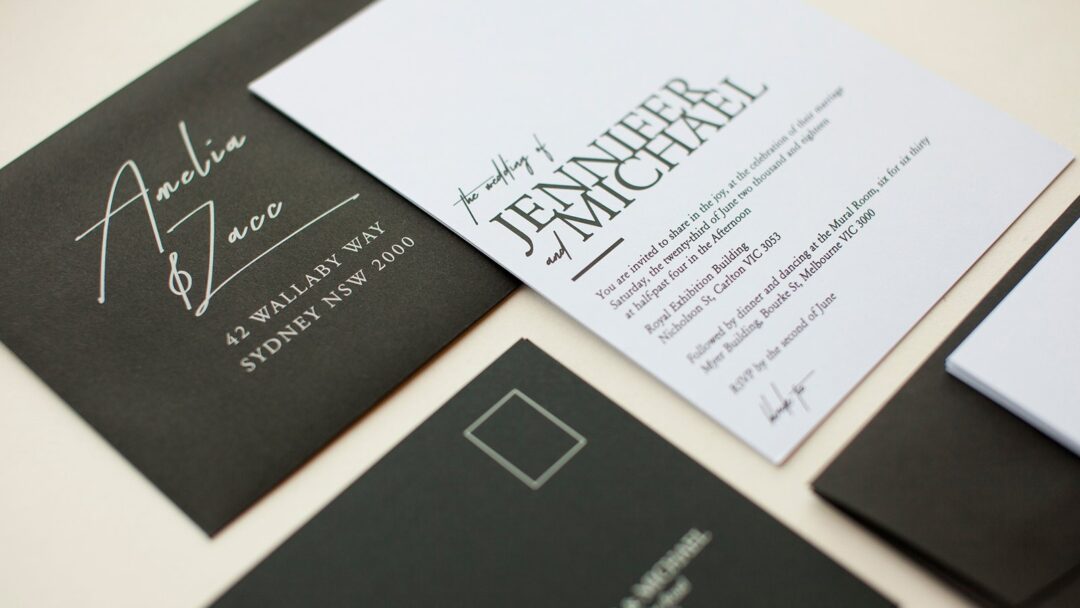
Design Elements: Hamsa, Star of David, and Botanical Motifs
Jewish wedding invitations sit at the intersection of religious symbolism, cultural tradition, and contemporary design. The visual language of a Jewish wedding invitation can draw on a rich set of symbols, or it can be completely abstract, letting the wording carry the cultural meaning.
Traditional Jewish Symbols
The Star of David (Magen David): The six-pointed star is the most universally recognized symbol of Jewish identity. On wedding invitations, it can appear as a subtle watermark, a central motif, a border element, or a flat foil accent. It works across every denomination and level of observance and is widely understood by non-Jewish guests as well.
The Hamsa (Hand of Miriam): A palm-shaped amulet that appears across both Jewish and Arab cultures, the hamsa is a symbol of protection and good luck. It has particular resonance in Sephardi and Mizrahi Jewish tradition. On wedding invitations, a hamsa often appears as a central illustration, particularly on Moroccan-style or Middle Eastern-influenced designs.
The Tree of Life (Etz Chaim): A symbol from Kabbalistic tradition representing the structure of the universe, the Tree of Life appears on some Jewish wedding invitations as an intricate illustration. It is particularly popular in artistic or nature-forward designs.
Biblical verses: Quotes from Song of Songs (Shir HaShirim) are the most common scriptural additions to Jewish wedding invitations. “Ani l’dodi v’dodi li” (“I am my beloved’s and my beloved is mine,” Song of Songs 6:3) is perhaps the most frequently used. These verses can appear in Hebrew, English, or both.
Botanical and Nature-Inspired Motifs
Many Jewish couples today choose invitations that draw more from contemporary design trends than from explicitly religious imagery. Botanical designs, featuring olive branches, fig leaves, pomegranates, and other plants that appear in the Torah and in the landscape of Israel, bridge Jewish cultural references and modern aesthetics beautifully.
The pomegranate is particularly resonant. Tradition holds that a pomegranate has 613 seeds, one for each commandment in the Torah. A pomegranate motif on a Jewish wedding invitation carries this symbolism lightly, appealing to couples who want cultural depth without overtly religious imagery.
Botanical wedding invitations →

Floral Circle Invitation SetDigital printing

Garden EstateFlat foil

Good SpringDigital printing

Garden windowDigital printing
Print Method Considerations for Jewish Wedding Invitations
The formality and symbolism of Jewish wedding invitations make luxury print methods a particularly good match.
Flat foil (from $3.96/card, minimum 10): Mirror-bright metallic foil in gold or silver, printed directly onto the card. Gold flat foil on cream cotton paper is the classic Jewish wedding invitation combination, the gold echoes the warmth of candlelight and the richness of Jewish ceremonial objects. Turnaround is 7-10 business days after proof approval.
Letterpress (from $5.04/card): A debossed impression pressed into 300gsm or 600gsm Wild Cotton paper. For couples who want a tactile, artisanal feel with inked type rather than foil, letterpress on Wild Cotton is exceptional. It works particularly well for Hebrew typography, where the letterforms benefit from the weight and depth of the pressed impression.
Digital print (from $2.52/card): For couples prioritizing a large guest list or a faster turnaround, digital print delivers full-color designs, including illustrated motifs like hamsas, botanical vines, and Star of David borders, cleanly and affordably.
For any invitation that includes a Hebrew panel, we recommend requesting a custom proof review before approving, Hebrew characters are easy to misconfigure in standard design tools, and a careful proof step protects you from errors that would be difficult to explain to your guests.
Jewish Wedding Stationery Suite Checklist
A Jewish wedding often requires more pieces of stationery than a secular wedding, because of the multiple components of the day. Here is a complete checklist of what you may need.
Core Invitation Suite
| Piece | Purpose | Jewish-Specific Note |
|---|---|---|
| Main Invitation | The primary invitation card | Include Hebrew date + “under the chuppah” language |
| RSVP Card + Envelope | Guest response card | May need meal choice (kosher options, if applicable) |
| Details / Information Card | Venue info, accommodations, website | Good place to explain kabbalat panim, smorgasbord, or Shabbat timing for non-Jewish guests |
| Outer Envelope | Mailing envelope | Free white envelopes included with Paperlust orders |
| Inner Envelope (optional) | Formal inner envelope naming guests | Traditional for formal Orthodox weddings |
Day-Of Stationery
| Piece | Purpose | Jewish-Specific Note |
|---|---|---|
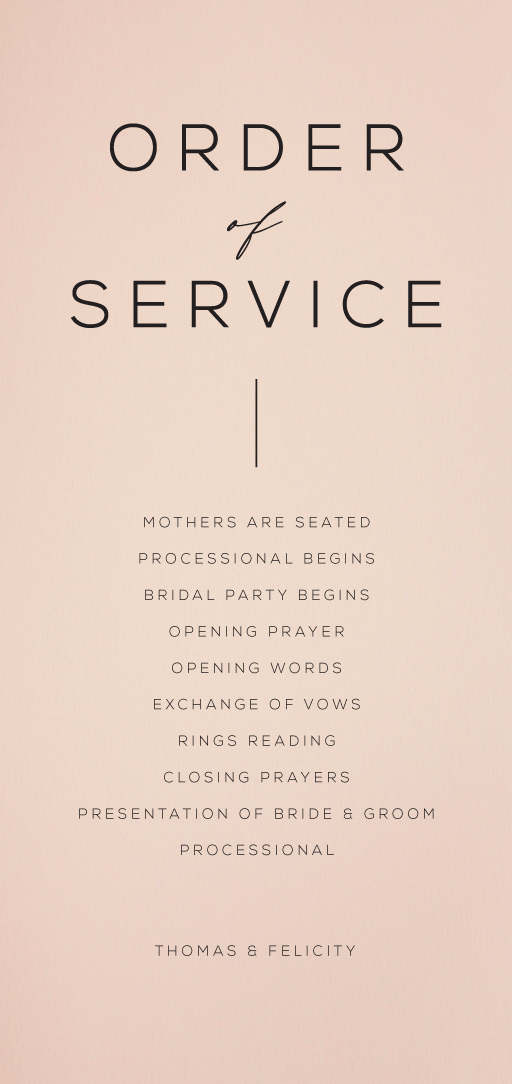
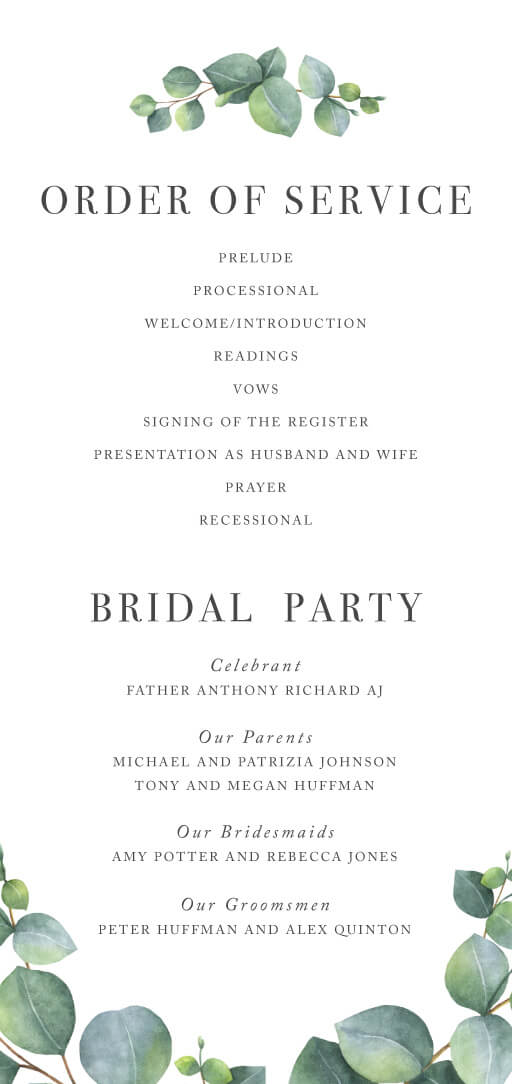
| Ceremony Program | Guide guests through the ceremony | Explains Hebrew terms (bedeken, kiddushin, sheva brachot) for non-Jewish guests |
| Menu Cards | Reception meal details | Can note kosher certification or caterer |
| Place Cards | Assigned seating | Couples sometimes include Hebrew name alongside English |
| Table Numbers / Names | Table identification | Some couples name tables after Israeli cities or Jewish holidays |
| Ketubah | Jewish marriage contract | Typically a separate artistic piece, not part of the stationery suite |
| Welcome Sign | Entrance or ceremony directional | Can include Hebrew greeting (Baruchim Haba’im, Welcome) |
| Seating Chart | Guest seating directory | For large weddings, essential for directing guests at the reception entrance |


Ordering Timeline for Jewish Wedding Stationery
For flat foil or letterpress invitations, allow a minimum of 20 business days for production after your proof is approved. Proofs are delivered within 1-2 business days of placing your order, with two rounds of revisions included.
For digital print invitations, production is faster, typically 8-10 business days after proof approval. For large or complex suites, we recommend ordering 4-6 weeks before your send date.
Free DHL express shipping is included on all orders over $350 USD, with delivery to all 50 states in 2-4 business days after dispatch.
You can save 15% when ordering three or more card types together, so ordering your invitation, RSVP card, and details card as a suite saves meaningful money and ensures design consistency across every piece.
Browse the full Paperlust wedding invitations collection to find a design that works as the foundation of your Jewish wedding suite.

Find Your Perfect Jewish Wedding Invitation
500+ exclusive designs. Flat foil, letterpress, metallic, and digital print options. Free DHL express shipping on orders over $350 USD.
Frequently Asked Questions About Jewish Wedding Invitations
Do I need to include Hebrew text on a Jewish wedding invitation?
No, it is entirely your choice. Many Jewish couples, especially from Reform or non-observant backgrounds, use an English-only invitation and include just the Hebrew date or the couple’s Hebrew names as a nod to tradition. A full bilingual Hebrew-English layout is more common in Orthodox and Conservative communities. The most important thing is that your invitation reflects your family’s relationship to Jewish tradition, not a checklist of required elements.
How do I find the Hebrew date for my wedding?
The most reliable tool is Hebcal.com, which converts any civil date to the Hebrew calendar date. When listing the Hebrew date on your invitation, include the day of the Hebrew month (spelled out or as a number), the Hebrew month name, and the Hebrew year. For example: “the 19th of Sivan, 5786.” Always double-check the conversion with a second source, as errors on printed invitations are difficult and expensive to correct.
Can I have Hebrew text printed on a Paperlust invitation?
Yes, Paperlust’s design team can work with you on custom Hebrew typography for your invitation. Because Hebrew requires right-to-left text direction and specific font considerations, we recommend reaching out to the design team directly rather than attempting to add Hebrew characters through the standard customization tool. A custom design request ensures your Hebrew text is correctly laid out, properly typeset, and proofed by someone familiar with the language.
What is the difference between kabbalat panim and the chuppah on a Jewish wedding invitation?
Kabbalat panim (literally “receiving of the faces”) is the pre-ceremony reception, often called a smorgasbord, where guests mingle, eat, and greet the families before the ceremony begins. The chuppah is the ceremony itself, held under the wedding canopy. Traditional Jewish weddings list both times on the invitation separately, for example, “Kabbalat Panim 5:30 p.m.” and “Chuppah 6:30 p.m.”, so guests know when to arrive for each segment.
What should I write on the invitation if my ceremony is after Shabbat?
If your ceremony starts after Shabbat ends on Saturday night, include a note on your invitation stating the time Shabbat concludes and when the chuppah begins. For example: “Shabbat concludes at 8:14 p.m. / Chuppah at 8:30 p.m.” This helps observant guests plan their travel and signals that you have considered their needs. The Shabbat end time varies by location and date, use Hebcal.com or MyZmanim.com to find the exact time for your venue.
Which print method is best for a Jewish wedding invitation?
Flat foil on 380gsm Premium card delivers a mirror-bright gold or silver metallic finish and is the go-to choice for Jewish weddings that want the classic gold-on-cream look, at a faster turnaround (7-10 business days after proof approval). Letterpress on 600gsm Wild Cotton is the premium tactile option, pressing the design into the paper for an heirloom-quality feel that suits heritage-inspired typography, including Hebrew lettering. Digital print is ideal for full-color illustrated designs or larger guest lists on a tighter budget.
Should both sets of parents be listed as hosts on a Jewish wedding invitation?
Jewish tradition strongly favors listing both sets of parents as hosts, reflecting the view of marriage as a joining of two families. The standard format lists the bride’s parents first, followed by “and,” then the groom’s parents. If the wording becomes complicated due to divorce, remarriage, or multiple family situations, “together with their families” is a widely accepted and gracious alternative that honors everyone without requiring a lengthy host section.
What Jewish symbols work well on wedding invitations?
The Star of David, hamsa, Tree of Life, and pomegranate are all widely used Jewish symbols on wedding invitations. Biblical verses from Song of Songs, especially “Ani l’dodi v’dodi li” (“I am my beloved’s and my beloved is mine”), are also popular additions. Many modern Jewish couples prefer botanical motifs with Jewish cultural resonance, such as olive branches, fig leaves, or pomegranates, which reference the Land of Israel without using overtly religious iconography. The right choice depends on your aesthetic and your relationship to Jewish tradition.