
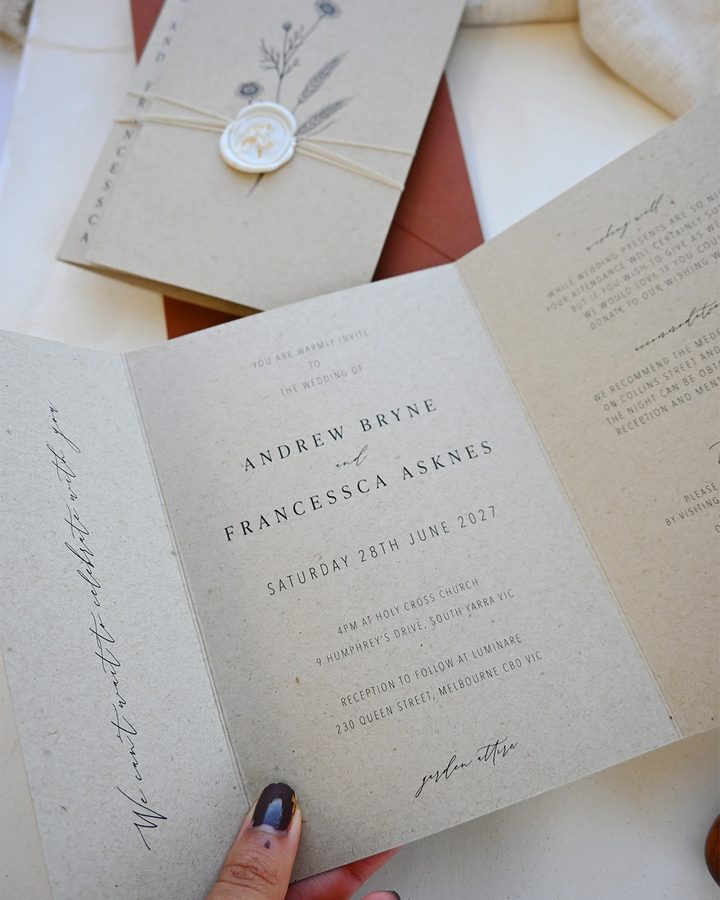
Ordering too few wedding invitations is a more common and more painful mistake than most couples expect. Reordering a small batch later almost always costs significantly more per unit than getting the right number upfront – and if your design uses a custom die for foil or letterpress, the die charge applies again. Getting your count right before you place the order saves money and stress.
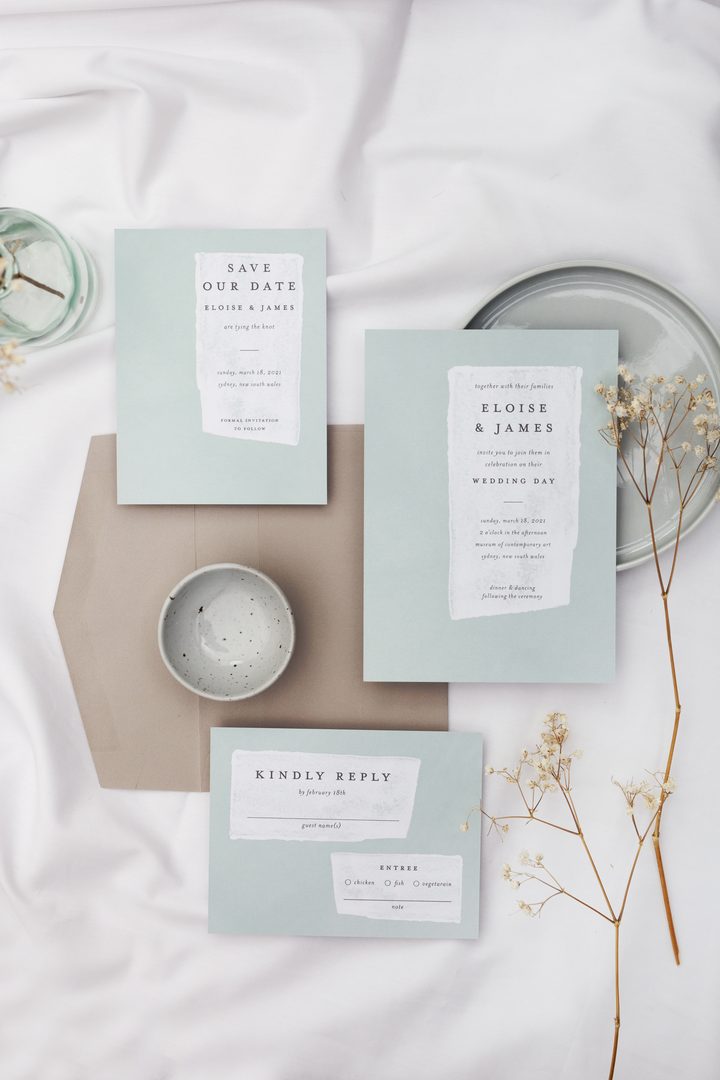

This guide walks you through the exact method for calculating your invitation quantity, handles every tricky edge case, and covers the extras you’ll need beyond invitations alone.
- Rule 1: Count by household, not by person
- Rule 2: Add 10-15% buffer to your final household count
- Rule 3: Keep 3-5 spares after mailing (for postal mishaps and keepsakes)
- Rule 4: Count your extras: programs, menus, place cards, table numbers
- Typical ratio: 150-person wedding = 75-90 invitations needed
The Core Rule: Count by Household, Not by Person
This is the single most important principle. One invitation per household – not one per person.
A married couple living together gets one invitation. A family of four gets one invitation. Two roommates who are both invited get one invitation (unless they’re not close friends – in which case, consider separate invitations to avoid awkwardness about whether each roommate was individually intended as a guest).
This one principle typically cuts your invitation count nearly in half compared to your total guest count. A 150-person wedding doesn’t need 150 invitations – it typically needs 70-80.
Quick household calculation
| Guest Scenario | Invitations Needed |
|---|---|
| Married or partnered couple living together | 1 |
| Family with children (all invited) | 1 |
| Single adult living alone | 1 |
| Single adult with a plus-one | 1 (address to both names) |
| Adult child living at parents’ home | 1 (shared with parents, or separate if very close) |
| Two roommates, both invited | 1 or 2 (judgment call – see notes below) |
| Engaged couple living separately | 1 (send to one address, address to both) |
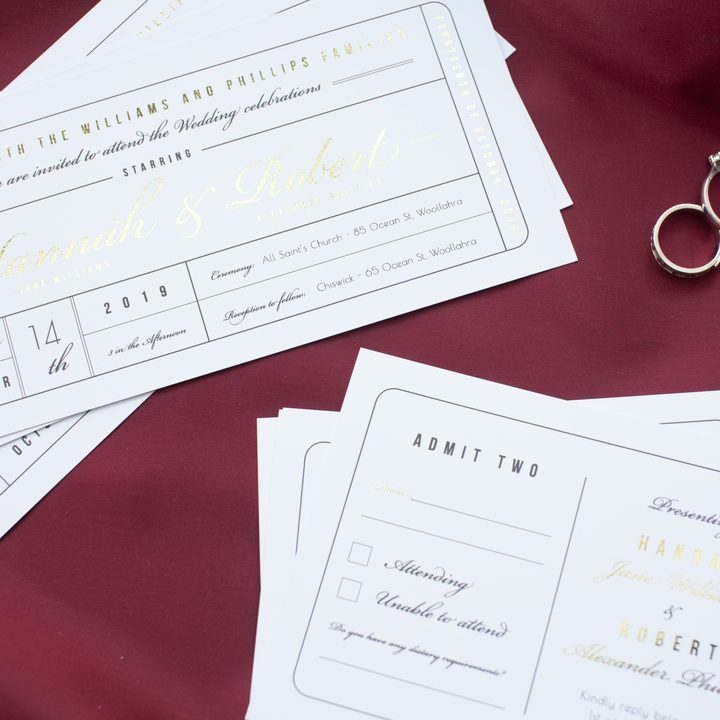
The Buffer Rule: Always Order 10-15% More
Once you have your household count, add 10-15% on top. This buffer covers:
- Postal mishaps (invitations that get lost or damaged in transit)
- Last-minute guest additions after you thought the list was final
- Keepsake copies for the couple and parents
- Addressing errors that result in a damaged envelope
- Photographer extras for flat-lay shots at the wedding
It is always cheaper to print extras in your original run than to reorder later. Most print-on-demand services charge a setup fee or minimum order for a reprint – you may end up paying as much for 10 extra invitations as you did for 50 in the original order.
Example calculation
| Wedding Size | Guest Count | Estimated Households | With 15% Buffer | Order Quantity |
|---|---|---|---|---|
| Micro | 20-30 | 12-18 | 14-21 | 20-25 |
| Small | 50-75 | 30-45 | 35-52 | 40-55 |
| Medium | 100-150 | 60-90 | 69-104 | 75-110 |
| Large | 200-250 | 120-150 | 138-173 | 150-180 |
Special Cases That Affect Your Count
Children
Children under 18 living with their parents share that household’s invitation. Children 18 or older who live away from home (at college, in their own apartment) should receive their own invitation – they’re adults with their own address. Children 18+ still living at home can share the family invitation if they’re named on the outer envelope, or get a separate one if you want to acknowledge their adult status specifically.
Single guests with plus-ones
A single guest who’s been given a plus-one gets one invitation. Address it to “Your Guest’s Name and Guest” or, if you know the partner’s name, “Your Guest’s Name and Partner’s Name.” Never address an invitation with “and Guest” on the outer envelope – that language belongs on the inner envelope or RSVP card.
Roommates
Two friends who are roommates and both invited is a judgment call. If they’re equally close to you, separate invitations feel more personal and make each feel individually invited. If one is a close friend and the other is more of a casual inclusion, one invitation addressed to both is fine. If the roommates don’t know each other well and might not know they’re both on the list, definitely send separate invitations.
Adult children living at home
An adult child still living with their parents can share the family invitation if you name them on the envelope: “Mr. and Mrs. Johnson and Emily.” For a particularly close friend who happens to still live at home, a separate invitation addressed to them personally is a thoughtful gesture.
Divorced or separated parents
If both parents are invited and they live separately, send separate invitations to each address. Do not send one invitation to a shared family home if the parents no longer live together.
Beyond the Main Invitation: What Else to Count
Your invitation order is a good time to order all your day-of stationery at once – you’ll likely qualify for the 15% discount on 3+ card types, and your designer can match the aesthetic across every piece.
| Item | Quantity Basis | Notes |
|---|---|---|
| RSVP cards | Match invitation count | One per invitation suite |
| Ceremony programs | Guest count + 10% | One per person, not per couple |
| Menus | Guest count or per table | One per seat, or 1-2 per table for shared menus |
| Place cards | Guest count + 5% | One per seat; buffer for late additions |
| Table numbers | Number of tables | One per table; order 1-2 extras |
| Thank you cards | Household count + 20% | One per household; order generously for gifts |
Paperlust offers 15% off when you order 3 or more card types, and a 10% welcome discount on your first order. Ordering your full suite together – invitations, RSVP cards, menus, place cards, programs, and thank you cards – makes both financial and design sense.
Common Mistakes That Lead to Running Short
The most common reason couples reorder invitations at a much higher per-unit cost:
- Counting heads instead of households: The single most common miscalculation. A 120-person wedding typically needs 60-70 invitations, not 120.
- Forgetting vendor invitations: Some couples like to send formal invitations to their wedding photographer, officiant, and planner as a keepsake gesture. If that’s you, add them to your list.
- Skipping the buffer: “We’ll be fine with the exact count” is the sentence that leads to reordering. Always add 10-15%.
- Envelope addressing errors: Hand-addressing envelopes leads to some that need to be discarded. Have spares.
- The late additions: Someone’s name almost always gets added after the “final” list is submitted. Build the buffer in.
Paperlust has helped thousands of couples order exactly the right number of wedding invitations since 2014. This calculation method is based on real order data and customer feedback from weddings of every size and scale.
Frequently Asked Questions
How many extra wedding invitations should I order?
Order 10-15% more than your calculated household count. On a typical medium wedding (100-150 guests), that means keeping 8-15 spare invitations after mailing. Extras are far cheaper to include in your initial print run than to reorder as a small batch later.
Do I need to send invitations to vendors like the photographer or DJ?
It’s not expected, but it’s a lovely gesture some couples choose to make. If you want to send your photographer, videographer, or officiant a formal invitation as a keepsake (especially if they’re personal friends), add them to your list and order accordingly.
Should I send a separate invitation to adult children still living at home?
If the adult child is a close friend or if you want to specifically acknowledge them as an individual invitee, yes – send a separate invitation to them personally. If they’re simply included as part of the family household, include their name on the family envelope and one invitation serves all.
What’s the minimum order quantity for wedding invitations?
At Paperlust, flat foil invitations start at a minimum of 10. Foil stamp invitations have a minimum of 50 due to the custom die requirement. Digital print has the most flexible minimum quantities. Check your chosen design for specific minimums.
How do I count invitations for roommates?
If both roommates are equally close to you and equally invited, consider sending separate invitations so each person feels individually welcomed. If one is a direct friend and the other is a plus-one or casual acquaintance, one shared invitation is fine.
Can I order more invitations later if I run out?
Yes, but it’s expensive. A small reorder typically costs more per invitation than your original run – and if your design uses a foil stamp, the custom die charge may apply again. Always order with a buffer upfront.