
Shopping from outside the US? Australia | United Kingdom | Canada | New Zealand
Choosing eco-friendly wedding invitations used to mean settling for plain recycled card that looked exactly like what it was: a compromise. That is no longer the case. Today’s sustainable stationery can be indistinguishable from a conventional luxury suite, and in some cases, it is genuinely more beautiful. This guide covers every option available in 2026, what the environmental claims actually mean, and how to order invitations that look extraordinary while sitting lightly on the planet.
At a Glance: Eco-Friendly Invitation Options
- Recycled paper, Post-consumer waste stock; most widely available
- FSC-certified paper, Third-party certified responsible forestry; broad range of finishes
- Seed paper, Plantable after the wedding; embedded with wildflower seeds
- Digital invitations, Zero paper; lower carbon, but real trade-offs in formality
- Sustainable inks, Vegetable-based and UV-cured inks reduce VOC emissions
- Carbon-offset printing, Emissions calculated and offset at point of production
- Paperlust plants a tree with every order, built-in reforestation with no extra cost or action required
What Makes a Wedding Invitation “Eco-Friendly”?
The phrase “eco-friendly” covers a wide spectrum in the stationery world, and not all claims carry equal weight. At one end, a brand might describe itself as eco-friendly simply because it prints on paper rather than plastic. At the other end are companies with certified supply chains, verified carbon offsets, and documented end-of-life programs for their products.
Before you start comparing designs, it helps to know which environmental levers matter most, in rough order of impact:
The biggest impact factors
Paper sourcing (highest impact)
Where the fiber comes from and how it was processed accounts for the majority of a stationery suite’s environmental footprint. Post-consumer recycled paper avoids new tree felling entirely. FSC-certified paper comes from forests managed to specific biodiversity and replanting standards. Neither is perfect, but both are vastly better than uncertified virgin pulp.
Production energy and inks
Conventional offset printing uses petroleum-based inks that release volatile organic compounds (VOCs) during drying. Vegetable-based and UV-curable inks substantially reduce that output. Some print studios also run on renewable energy, though this is less common and harder to verify.
Shipping distance
A beautifully recycled invitation printed in your own country has a fraction of the shipping emissions of a conventional card shipped from overseas. Sourcing locally carries genuine environmental benefit beyond the paper itself.
End of life
Most paper invitations end up in the bin within days. Seed paper changes that equation entirely: guests plant the card and it grows into wildflowers. That is a genuinely different product category, not just marketing.
What to watch out for
Greenwashing is common in stationery. Watch for phrases like “responsibly sourced” (no standard definition), “eco-conscious” (ditto), or “printed with eco-friendly inks” without specifying what that means. Third-party certifications (FSC, SFI, EU Ecolabel) are the most reliable signal because they involve external audit. A brand’s own claims are not a substitute.
Recycled and FSC-Certified Paper Options
These are the most accessible sustainable choices and the ones most likely to deliver a high-end result that is visually identical to conventional stationery.
Recycled paper
Post-consumer waste (PCW) recycled paper is made from paper that has already been used, collected, processed, and remade into new stock. The key number to look for is the PCW percentage: 30% recycW means 30% of the fiber came from post-consumer waste, with the rest potentially being virgin pulp. 100% PCW is the gold standard.
Modern recycled papers are available in a wide range of weights, finishes, and colors. A 350gsm recycled matte card can feel just as substantial as any premium stock. The texture tends to have a slightly more organic surface, which many couples actively prefer for botanical, rustic, or minimalist designs.
FSC-certified paper

The Forest Stewardship Council (FSC) certifies that timber and pulp products come from forests managed to maintain biodiversity, protect indigenous rights, and prohibit illegal logging. When you see the FSC logo on stationery, it means the supply chain from forest to print shop has been independently audited.
FSC certification does not require recycled content. An FSC-certified card could be 100% virgin fiber that nonetheless comes from a responsibly managed plantation. For maximum impact, look for products that are both FSC-certified AND contain recycled content, though these are less common.
Paperlust’s paper range includes FSC-certified options across multiple finishes. This gives couples access to premium textures like smooth matte, linen, and premium 380gsm stock without compromising on supply-chain transparency.
Cotton paper
Cotton rag paper (such as Paperlust’s Wild Cotton range, available at 300gsm and 600gsm) is made from textile offcuts rather than wood pulp. The cotton fiber is a byproduct of garment manufacturing that would otherwise go to waste, which gives it a genuinely different environmental profile than either recycled wood pulp or virgin FSC timber. Cotton paper is also naturally archival and completely free of the acid that degrades standard paper over time.
Seed Paper and Plantable Wedding Invitations
Seed paper is the most genuinely circular option in wedding stationery. Made from post-consumer recycled paper pulp embedded with real wildflower, herb, or vegetable seeds, the invitation itself becomes a planting medium after the wedding.
How seed paper works
The seeds are mixed into the paper pulp during manufacturing and distributed evenly throughout the sheet. After your guests read the invitation, they can tear it into pieces, press it into soil, water it, and watch it germinate. Most seed papers are seeded with a mix of wildflowers chosen for broad climate compatibility, typically including varieties like forget-me-nots, chamomile, and sweet alyssum.
The paper itself is made without wood pulp (the fibers would interfere with germination) and is entirely biodegradable. There are no synthetic coatings, laminates, or foils that would prevent decomposition.
Design considerations for seed paper
Because seed paper cannot be coated or laminated, the range of print methods available is narrower than for conventional stocks. Digital printing works well on seed paper. Letterpress and flat foil can also be applied, but the technique and outcome differ slightly from smooth matte stock because of the fibrous, slightly textured surface of most seed papers.
Paperlust offers seed paper (plantable) as one of its paper stock options. This means couples can choose from Paperlust’s 500+ exclusive designs and simply select seed paper at the stock stage rather than needing to source a specialist supplier.
Typographic designs, minimal linework, and watercolor-style artwork tend to translate best to seed paper’s organic texture. Heavily detailed photography or fine halftone printing will lose definition on the fibrous surface.
What to tell your guests
Including a small note card explaining the seed paper and how to plant it dramatically increases the chance guests actually use it. A brief instruction such as “Tear into small pieces, press into soil, water gently, and watch wildflowers grow” is all that is needed. The note can be printed on the same seed paper or on a small recycled card included with the suite.
Digital vs. Printed: The Environmental Trade-Off
The conventional wisdom is that digital invitations are always the greener option. That is mostly true, but the trade-offs are worth understanding before you make the decision.
The case for digital
A digital invitation sent via email, a dedicated wedding website, or an app like Paperlust’s digital save the date service generates no paper waste, no production emissions, and no shipping footprint. For couples who genuinely do not want printed stationery, digital is the lowest-impact choice by a wide margin.
Paperlust offers digital save the dates through its customer service team for $35 flat. Customers receive JPEG or PDF files of their chosen design to send themselves via email or messaging. This is not a self-serve checkout option but can be arranged directly.
The limitations of digital
The environmental calculation for digital is not as simple as zero. Server energy use, device energy for reading, and the full supply chain of the devices themselves all carry real (if smaller) footprints. More practically, digital invitations have real limitations in formality, deliverability (spam filters, incorrect email addresses), and the meaningful experience of receiving something physical in the mail.
A growing body of research suggests that physical invitations receive higher engagement, better response rates, and are more likely to be kept as keepsakes. For a wedding, that is not a trivial consideration.
A hybrid approach
Many couples use digital save the dates (lower stakes, earlier in the planning cycle) and then print their formal invitations on sustainable stock. This reduces paper volume while retaining the experience and formality of a printed suite for the main invitation.
Eco-Friendly Inks and Printing Processes
The paper itself is the biggest environmental lever, but the printing process also matters, particularly for couples who want to make genuinely informed decisions.
Vegetable-based and soy inks
Standard offset printing uses petroleum-based inks. Vegetable-based inks (including soy inks) use plant oils as the carrier instead of petroleum. They produce lower VOC emissions during drying, are generally easier to de-ink during recycling, and come from renewable feedstocks.
The catch: “vegetable-based ink” can describe inks that are only partially plant-based. The relevant standard is whether the VOC content is meaningfully lower, not just the carrier composition. A reputable printer will be able to specify the VOC content of its inks.
Digital printing and toner
Most short-run wedding invitation printing uses digital presses rather than conventional offset. Digital presses use toner (dry powder fused to paper with heat) rather than wet ink, which eliminates the VOC emission issue entirely. Digital presses also print exactly the number of sheets ordered, eliminating the substantial paper waste that comes from offset press makeready.
Paperlust uses digital printing for its standard, metallic, and white ink methods. For eco-conscious couples ordering standard designs, digital printing is actually the cleaner process by default.
Letterpress and flat foil
Letterpress printing uses water-based inks on its standard cotton stocks, which is a relatively clean process. The thick cotton paper used (300gsm or 600gsm Wild Cotton) contains no synthetic coatings and is fully biodegradable.
Flat foil applies a metallic film to paper using heat and pressure. The foil itself is typically a polyester carrier film with a metallic coating, which is not biodegradable. For couples prioritizing sustainability, this is worth knowing. The foil application is very thin and confined to the printed area, so the overall foil volume per invitation is small, but it does prevent the paper from being composted.
Design Ideas That Are Both Sustainable and Beautiful
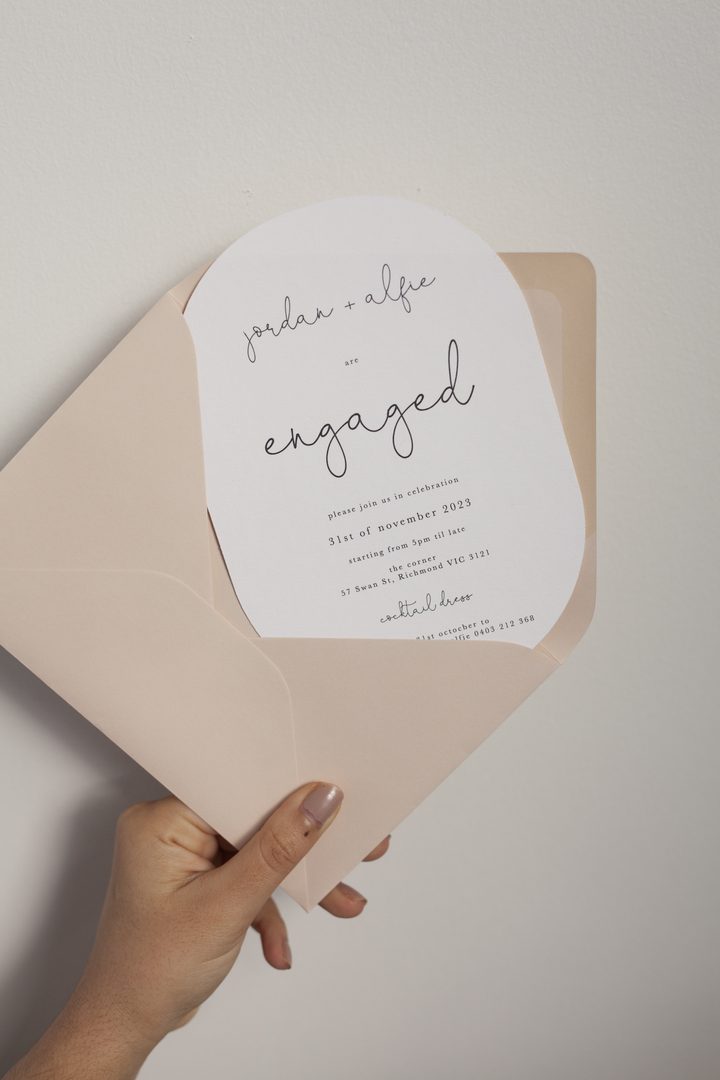
Sustainable materials have developed genuine design strengths of their own, rather than simply being eco-friendly versions of conventional stationery.
Botanical and pressed flower designs
The organic texture of recycled and cotton papers is naturally complementary to botanical illustration, pressed flower motifs, and watercolor-style artwork. Many of Paperlust’s most popular invitation designs in this category feature trailing greenery, delicate wildflowers, or minimalist leaf prints that feel inherently suited to natural papers.
For couples who want a visual language that signals sustainability without saying so explicitly, earthy color palettes (sage, dusty rose, terracotta, warm cream) on natural-textured stocks read as intentional rather than thrifty.
Minimalist and typographic designs
Seed paper and recycled stocks work particularly well with high-contrast typographic layouts where the design is carried by the letterforms rather than photographic detail. A strong serif typeface in deep charcoal or forest green on a natural stock can look more luxurious than an overcrowded illustrated design on bright white.
Color stock options
Paperlust’s color stock range includes cotton-fiber papers in cobalt, navy, sage, kraft, and other earthy tones that complement a sustainability-focused suite. White ink printing on dark kraft card is a particularly striking combination that carries genuine environmental credentials: kraft paper is one of the most recyclable papers available.
Keeping the whole suite consistent
One practical consideration: if you choose seed paper for invitations, check whether the same paper is available for RSVP cards, information cards, and envelopes. Paperlust’s seed paper option is available as a stock choice across invitation and save the date formats, allowing couples to build a cohesive suite. Envelopes in recycled or kraft stock can complete the look without requiring specialty seed paper for every element.
What to Look for When Ordering Eco-Friendly Invitations
Checklist before you order
| What to check | Why it matters | What to look for |
|---|---|---|
| Paper certification | Verifies responsible sourcing claims | FSC, SFI, or EU Ecolabel logo |
| Recycled content percentage | More post-consumer content = less new fiber | 30% PCW minimum; 100% PCW ideal |
| Ink type | VOC emissions; recyclability of finished card | Vegetable-based, soy, or digital toner |
| Foil finish | Foil prevents composting/recycling of paper | Decide whether foil is a priority vs. compostability |
| Seed paper availability | End-of-life option; guests can plant the card | Confirm which designs/formats are available in seed paper |
| Packaging | Outer packaging contributes to waste | Recycled or kraft outer wrap; no plastic |
| Shipping origin | Shipping emissions | Local or regional print production; consolidated dispatch |
| Tree planting or offset program | Additional reforestation/carbon mitigation | Verifiable program with audit trail (not just a claim) |
Paperlust’s sustainability credentials
Paperlust plants a tree with every order through a verified reforestation program. This requires no action from the customer; it is built into every purchase. Paperlust also offers seed paper (plantable) as a paper stock option across its invitation range, FSC-certified paper options, and cotton rag paper (Wild Cotton) made from textile offcuts.
Paperlust’s production is based in Melbourne, Australia, with DHL Express international delivery available. Orders over $350 USD qualify for free DHL Express shipping. For US couples, transit time after dispatch is 2-4 business days.
Once you order, a professional designer is assigned to your suite and delivers a proof within 1-2 business days. Unlimited ordinary proof edits are included at no extra charge.
Questions to ask any stationery company
If you are ordering from a supplier whose sustainability claims you want to verify, these questions will quickly separate genuine credentials from marketing language:
A company with genuine sustainability credentials will answer all of these specifically. Vague responses are a reliable signal that the claims are marketing-led rather than process-led.
Ready to explore eco-friendly invitation designs?
Paperlust plants a tree with every order. Seed paper and FSC-certified stocks available across 500+ exclusive designs.
Frequently Asked Questions
Are eco-friendly wedding invitations more expensive?
Not necessarily. Recycled paper and FSC-certified stocks are comparably priced to standard matte or premium papers at most print studios. Seed paper does carry a small premium because of the manufacturing complexity of embedding seeds in the pulp. Digital invitations are the lowest-cost option. For most sustainable choices, the price difference is minor relative to the total stationery budget.
Can eco-friendly invitations look as luxurious as conventional stationery?
Yes, in most cases. FSC-certified and cotton papers are available in weights and finishes that match or exceed conventional luxury stocks. Letterpress on 600gsm Wild Cotton cotton paper is among the most premium stationery products available, and cotton rag is one of the most environmentally sound paper choices. The limitation is primarily with seed paper, which has a more organic surface texture not suited to fine photographic print detail.
What is the most eco-friendly invitation option?
Digital invitations generate the least paper and production waste. For physical invitations, seed paper made from 100% post-consumer recycled content with vegetable-based inks and no synthetic coatings is the strongest choice. FSC-certified cotton rag paper is a close second and offers a wider range of design possibilities. The full picture also includes shipping distance, packaging, and whether the printer participates in a verified reforestation or offset program.
Do seed paper invitations look cheap?
They do not have to. Seed paper has a naturally textured, organic surface that works beautifully with the right design. Typographic designs, botanical illustrations, and minimal layouts translate particularly well. Heavily detailed photography or fine halftone artwork will lose resolution. Choosing the right design for the medium is the key variable.
Can I mix seed paper with conventional stocks in my suite?
Yes. A common approach is seed paper for the main invitation card, with recycled or kraft card for the RSVP and information inserts, and recycled envelopes. This keeps costs manageable while giving guests a plantable keepsake with the primary piece. Check with your printer which formats are available in each stock option.
What does FSC certification actually guarantee?
FSC (Forest Stewardship Council) certification means the timber or pulp used in a product was sourced from forests independently audited against FSC’s standards. Those standards cover biodiversity protection, prohibition of illegal logging, protection of indigenous land rights, and replanting requirements. It does not guarantee recycled content or any specific carbon footprint, but it does provide meaningful third-party verification that the fiber did not come from unsustainable or illegal logging operations.
Does Paperlust offer FSC-certified paper?
Yes. Paperlust offers FSC-certified paper options, seed paper (plantable) as a stock choice, and cotton rag paper (Wild Cotton at 300gsm and 600gsm) made from textile offcuts. Paperlust also plants a tree with every order through a verified reforestation program, at no extra cost or action required from the customer. For more on available paper types, visit the wedding invitations browse page and filter by paper stock.
How do I tell guests what to do with a seed paper invitation?
Include a brief planting instruction on the invitation itself or on a small note card enclosed with the suite. Something like: “This invitation is made from seed paper. Tear into small pieces, press into a shallow container of soil, keep moist, and watch wildflowers grow.” Most guests find this genuinely delightful and are far more likely to keep a seed invitation than a conventional card. See our guide to seed paper and plantable wedding invitations for more detail on varieties, germination timelines, and design tips.