
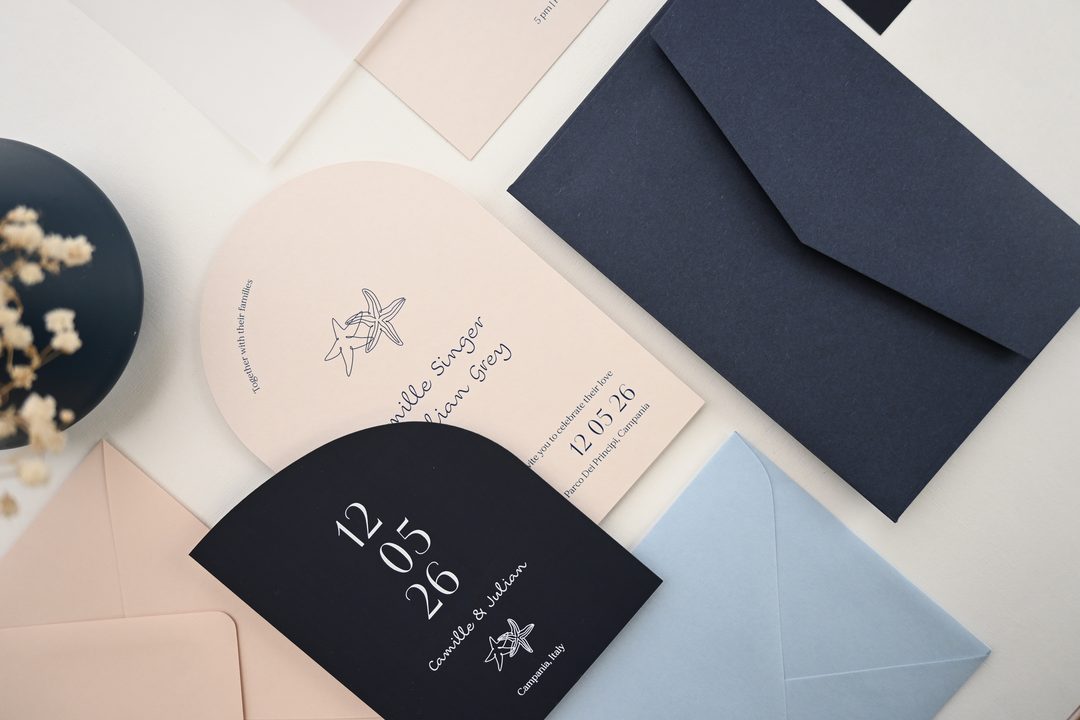
When couples sit down to write their invitations, the host line is often the first place they hit a wall. Who exactly is “hosting” this wedding? What happens when both families are pitching in? What if the couple is paying for everything themselves? The phrase “together with their families” has become one of the most popular solutions to this puzzle, and for good reason: it’s gracious, modern, and flexible enough to cover a lot of ground.
This guide walks you through every version of couple-hosting wording, from the simplest two-line template all the way to blended family situations and fully custom approaches. You’ll find complete, copy-ready examples for each scenario, plus plain-English explanations of the etiquette behind each choice.
- Couple hosting alone: Start with the couple’s names or use “Together with their families” as an umbrella line, no parents listed
- “Together with their families”: Best when families contribute but you don’t want to name individuals
- Both sets of parents named: Bride’s parents first, then groom’s (or by couple’s preference for same-sex)
- One set of parents + couple: List the contributing family first; couple follows
- Third person vs. first person: Traditional etiquette prefers “their” (third person); casual modern invitations often use “our”
- Formal request line: “request the honor of your presence” (for religious ceremonies); “request the pleasure of your company” (for non-religious venues)
- Proof in 1-2 business days after placing your Paperlust order
How the Host Line Has Evolved
Historically, the host line on a wedding invitation was straightforward: whoever paid for the wedding had their name at the top. For most of the 20th century, that meant the bride’s parents. The classic phrasing “Mr. and Mrs. Robert Hartley request the honor of your presence…” told guests exactly who was in charge and who had footed the bill.
By the 1990s and 2000s, the reality of wedding finances had shifted considerably. Both sets of parents commonly contribute. Couples in their late 20s and 30s often fund their own celebrations. Blended families complicate the parent line considerably. Same-sex couples navigating whose family comes first have every reason to find a different approach.
“Together with their families” emerged as the natural answer. It acknowledges family involvement without ranking anyone or requiring a formal financial accounting. It reads warmly rather than bureaucratically. And it opens the door for the couple’s names to take center stage, which reflects what the day is actually about.

Wording Examples for Every Scenario
Couple Hosting Alone
When the couple is funding the wedding themselves and wants the invitation to reflect that, there are two good approaches. The first is to simply lead with the couple’s names, skipping the host line entirely. The second is to open with a warm invitation phrase that includes just the two of them.
invite you to celebrate their marriage
Saturday, the fourteenth of June, two thousand and twenty-six
at four o’clock in the afternoon
Rosewood Garden Estate, Napa, California
Dinner and dancing to follow
Olivia Rose Bennett
and
James William Cooper
Saturday, June 14, 2026 | 4:00 PM
Rosewood Garden Estate, Napa, California
Note that “Please join us” shifts to first person (“us”), which is increasingly common for casual and modern invitations even when tradition favors third person. If your wedding has a relaxed tone, this reads naturally. For a black-tie event, stick to third person.
“Together with Their Families” Wording
This is the most versatile phrasing for any situation where family is involved but you don’t want to list individual names.
Olivia Rose Bennett
and
James William Cooper
request the honor of your presence at their marriage
Saturday, the fourteenth of June, two thousand and twenty-six
at four o’clock in the afternoon
Saint Michael’s Cathedral, Boston, Massachusetts
Reception to follow
Olivia and James
joyfully invite you to celebrate their wedding day
Saturday, June 14, 2026 at 4 PM
Rosewood Garden Estate, Napa Valley
The second version uses first names only, which suits casual or intimate weddings where guests know the couple well.
Couple and Both Sets of Parents Named
When you want to honor all four parents by name, the traditional format lists the bride’s parents first, then the groom’s, followed by the couple. For same-sex couples, choose the order that flows best with your design or that feels most natural to you both.
together with
Mr. and Mrs. David Henry Cooper
request the pleasure of your company
at the marriage of their children
Olivia Rose Bennett
and
James William Cooper
Saturday, the fourteenth of June, two thousand and twenty-six
at four o’clock in the afternoon
Rosewood Garden Estate, Napa, California
For a more contemporary approach, first names for all parents work well:
and
David and Margaret Cooper
invite you to celebrate the marriage of
Olivia and James
June 14, 2026 | Rosewood Garden Estate, Napa
One Set of Parents and the Couple
This situation arises when one family is contributing significantly (financially or logistically) and the couple wants to acknowledge that without listing the other set of parents. It is perfectly acceptable to name only one family.
and their daughter Olivia
together with James William Cooper
invite you to their wedding celebration
Saturday, June 14, 2026 at 4 PM
Rosewood Garden Estate, Napa, California
If you’re concerned about how the other family will feel, a softer option is to use “together with their families” (plural, but general) even if only one side is actively contributing. This sidesteps any implication of imbalance.
Blended and Divorced Family Situations
Blended families require some finesse. The guiding principle is: include the people who are actively present and supportive in the couple’s lives, and use “and” rather than “together with” to keep the tone warm rather than corporate.
When parents are divorced and both contributing:
and
David and Margaret Cooper
invite you to celebrate the marriage of their children
Olivia Rose and James William
Saturday, June 14, 2026 | Napa Valley
Listing divorced parents separately (rather than “Mr. and Mrs.”) is standard practice. Each parent’s name appears on its own line or joined with their current partner if they have remarried and that partner is included.
When a stepparent is part of the picture:
Thomas Bennett
and
David and Margaret Cooper
joyfully invite you to the marriage of
Olivia Rose Bennett
and
James William Cooper
June 14, 2026 | Rosewood Garden Estate
Casual and Modern Phrasing
For couples who want to ditch formal wording entirely, a first-person, conversational approach has become mainstream. These examples skip titles and last names and read more like a personal note than a formal summons.
Join Olivia and James
for their wedding
June 14, 2026 at 4 in the afternoon
Rosewood Garden Estate, Napa Valley
Dinner, dancing, and a lot of love to follow.
Olivia and James would love for you to be there.
June 14, 2026 | 4 PM | Rosewood Garden Estate, Napa
Food, drinks, and dancing until late.
The second example is best suited to very casual celebrations: backyard weddings, destination elopements with a party afterward, or couples who simply have that kind of friendship with all their guests.
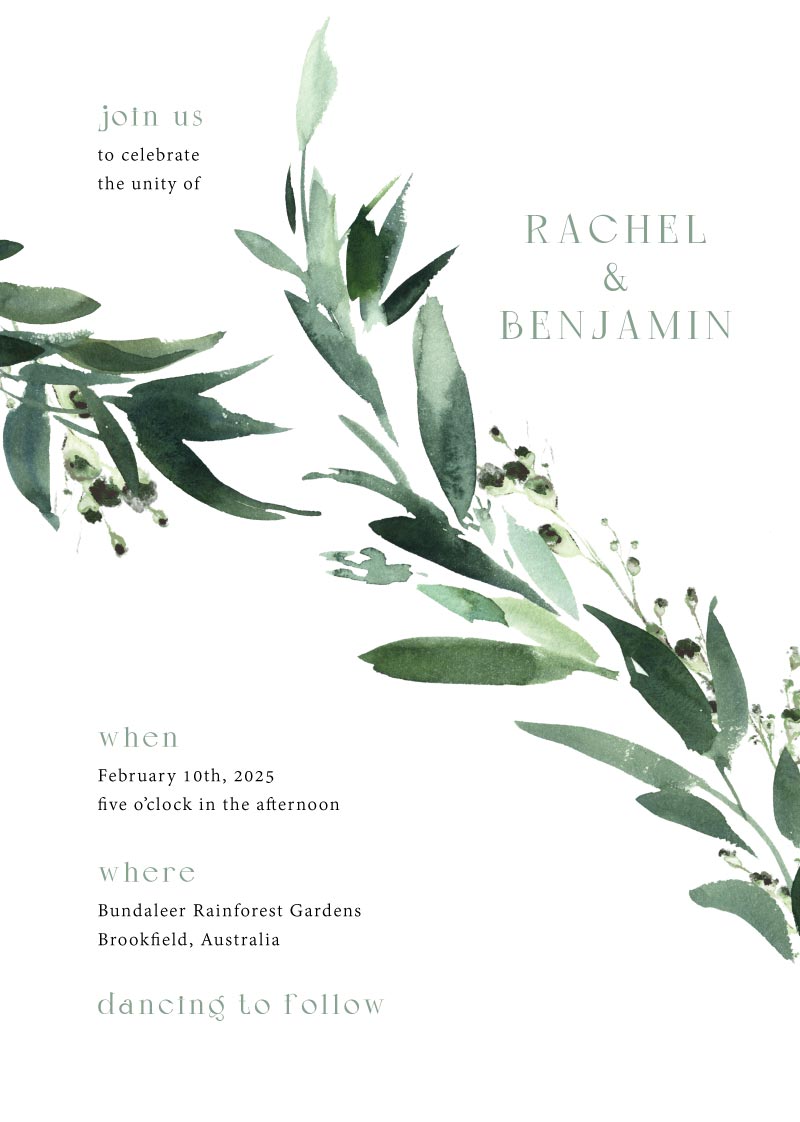
Love and LeavesDigital printing

Terracotta ArchDigital printing
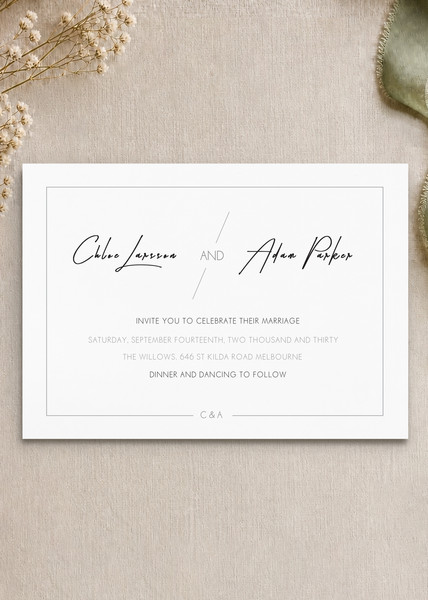
Modern ModeDigital printing
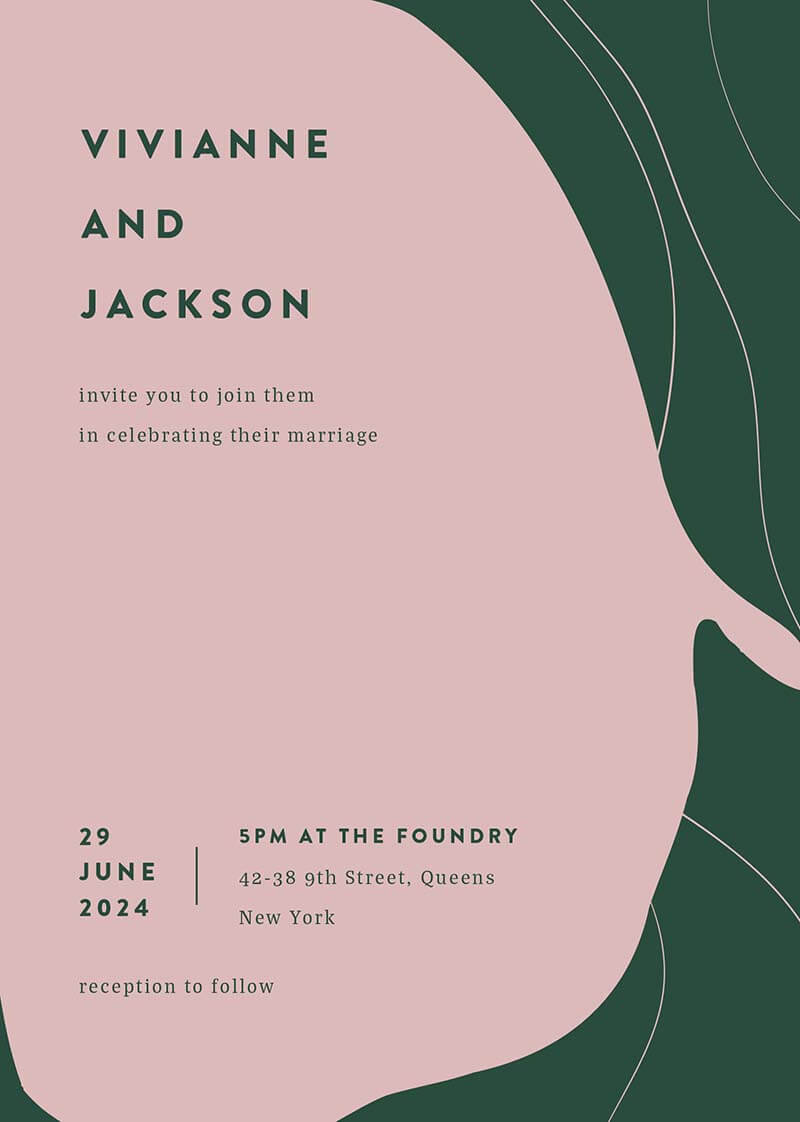
Abstract CodeDigital printing
Etiquette Do’s and Don’ts
| Do | Don’t |
|---|---|
| Use “request the honor of your presence” for a ceremony held in a house of worship | Use “honor of your presence” for a secular venue (it implies a religious setting) |
| Spell out all numbers in formal invitations (times, dates, years) | Use numerals for times or dates on formal invitations unless space is very tight |
| List the bride’s family first if naming parents individually (traditional convention) | Feel obligated to name parents if the couple is entirely self-funded |
| Use “together with our families” (first person) for casual or modern invitations | Mix third person (“their families”) with first person (“we invite you”) in the same line |
| Include deceased parents with a brief note if meaningful to the couple | Omit a deceased parent if the couple wishes to honor them – the invitation can accommodate it |
| Match wording formality to the overall tone of your event | Use highly formal wording for a casual outdoor barbecue-style reception |
A Note on “The Honor of Your Presence”
This phrase dates back to when most weddings took place in churches and the invitation implied you were being welcomed onto holy ground. Today, etiquette authorities largely agree that “request the honor of your presence” is fine for any ceremony with religious elements (a church, synagogue, or mosque), while “request the pleasure of your company” is the correct equivalent for secular venues. Many modern couples skip the formal request line entirely and simply say “invite you to celebrate” or “would love for you to join them.”
How to Adapt the Wording to Your Design
The physical layout of your invitation affects how wording reads. A few practical tips:
Keep the host line short. “Together with their families” is five words and centers beautifully on almost any invitation format. If you name all four parents, that block of text takes up significant space and may require a smaller type size or a longer card format.
Consider a pocket-fold suite if you need room for a full parent list. The outer envelope carries the formal names; additional details go inside. This lets you be thorough without crowding the primary card.
For letterpress and foil stamp invitations, shorter text blocks tend to look most striking. Long parent lists can work, but consult your designer at proof stage to see how it sits on the card. With Paperlust, you receive your designer proof within 1-2 business days and can request adjustments before anything goes to print.
For digital print invitations, you have the most flexibility on copy length. This is also the most affordable starting point at $2.04 per card, which makes it ideal if you are still workshopping the exact wording and may want to revise.
Browse the full collection of wedding invitations to find a design that suits your wording length and formality level. If you are considering a suite of matching pieces, check out the save the date collection for designs that carry the same host-line conventions.
International orders over $350 USD ship free via DHL Express. For US couples ordering from Paperlust’s Melbourne studio, that covers most full invitation suites, making international printing a practical option.
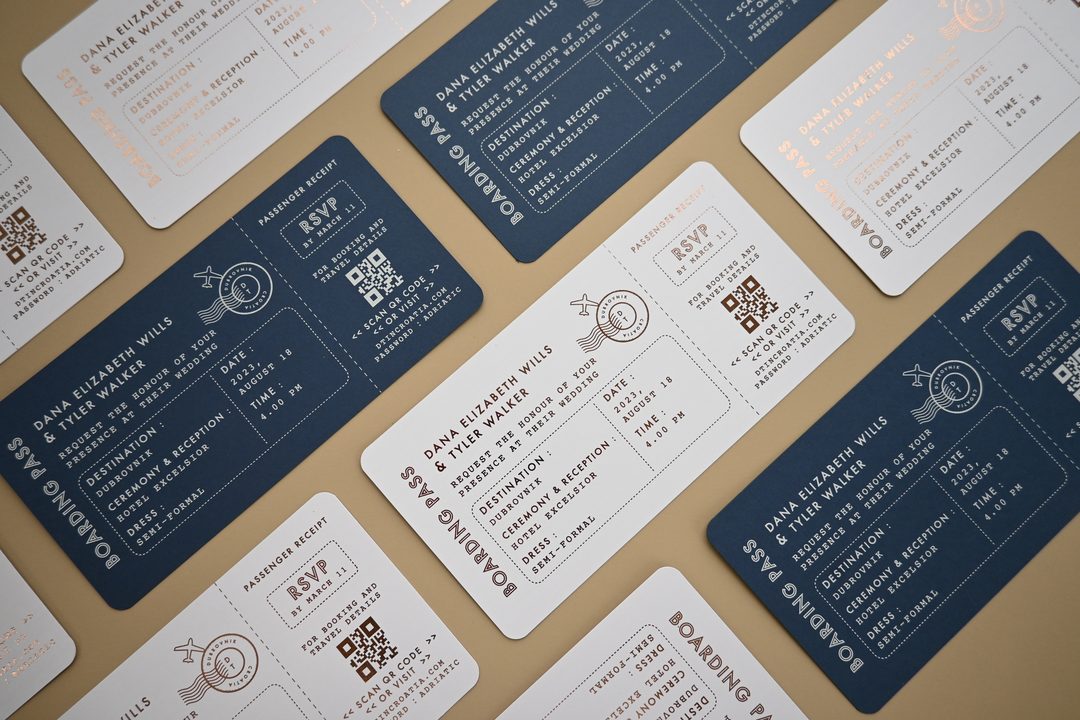
Before you order, a $5 sample pack puts the paper weight and each print method in your hands, making the final choice an easy one.

Rose et GrisFlat foil

Good SpringDigital printing
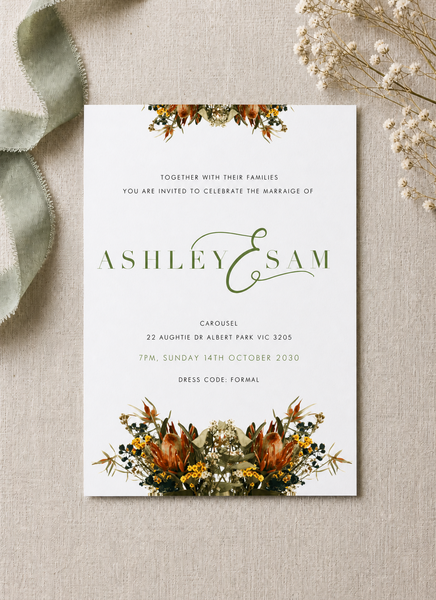
A Native CircleDigital printing

Moira Hughes CoutureColour Stock + Foil
Frequently Asked Questions
Who should be listed as the host on a wedding invitation?
The host line traditionally names whoever is financially and logistically hosting the wedding. In practice, this has evolved: many couples use “together with their families” even when contributions from each family vary, because it is the most gracious and inclusive option. You are not required to list only the person paying 100% of the costs.
Do I have to name parents on my wedding invitation?
No. Many couples, particularly those who are self-funding or whose parents prefer not to appear on the invitation, simply lead with the couple’s names or use a general phrase like “together with their families.” This is entirely proper etiquette and is increasingly the norm for couples in their late 20s and 30s.
Is “together with our families” correct, or should it be “their families”?
Traditional etiquette prefers third person (“together with their families”), because the invitation is formally addressed from the hosts to the guests. First person (“together with our families”) is grammatically natural in speech but historically wasn’t used in printed invitations. That said, modern couples use first-person phrasing all the time, especially for casual events. If your wedding is formal, stick with third person. For anything relaxed, “our families” reads warmly and is widely accepted.
How do we handle the invitation wording when parents are divorced?
List each parent separately on their own line rather than using “Mr. and Mrs.” List them in whatever order feels right to the couple, or put the bride’s parents first by convention. If a parent has remarried and the stepparent will be included, their name goes on the same line as the parent. There is no obligation to include a stepparent; include the people who are genuinely part of the couple’s life.
How do we word the invitation if one family is contributing much more than the other?
“Together with their families” is the cleanest solution here. It acknowledges all family involvement without signaling proportions. If one family specifically asks to be named and the other does not, it is perfectly acceptable to name one family in the host line and use a general phrase for the other (“and the family of James William Cooper”).
Do both sets of parents need to approve the invitation wording before it is printed?
There is no etiquette rule requiring parental approval, but it is considerate to share a proof or at least a draft of the wording with parents who are named on the invitation. A quick text or email with the wording saves potential hurt feelings later. With Paperlust’s 1-2 business day proof timeline, sharing the proof with parents before final approval is very practical.
Can we include a deceased parent on the invitation?
Yes, and many couples find it meaningful to do so. A common approach is: “Olivia Rose Bennett, daughter of Thomas and the late Patricia Bennett.” The phrase “the late” is the standard way to indicate a parent who has passed. This is an entirely optional personal decision, not an etiquette requirement.
Related Wording Guides
- Browse All Wedding Invitations at Paperlust
- Catholic Wedding Invitation Wording and Mass Program Guide
- Wedding Announcement Cards: For Guests Not Invited to the Day
Shop Wedding Invitations at Paperlust
Hundreds of wedding invitation designs you can customize online, with an online proof before you print.