
Catholic weddings carry centuries of liturgical tradition into a single day. Whether your ceremony includes a full Nuptial Mass or a Rite of Marriage without Mass, knowing how to reflect that on your invitation and program makes the difference between a beautiful piece of paper and a genuinely meaningful one. This guide covers everything you need to write, design, and print: from the correct wording on your invitation to a complete, print-ready order of service for your wedding program.
Planning stationery for a Jewish, Indian, or Muslim ceremony instead? We have guides for each of those traditions in the series as well.
Quick Reference
Catholic Wedding Stationery at a Glance
- Use “request the honor of your presence” (not “pleasure of your company”) for a church ceremony
- Name the ceremony type: “Nuptial Mass” or “Sacrament of Holy Matrimony” on the invitation
- Include the full church name and city/state (street address is optional)
- A Nuptial Mass runs 60-90 minutes; a ceremony-only Rite of Marriage runs 30-45 minutes
- Wedding programs cover 5 sections: Introductory Rites, Liturgy of the Word, Rite of Marriage, Liturgy of the Eucharist, and Concluding Rites
- Print readings by citation and reader name (you do not need to print the full scripture text)
- Non-Catholic guests appreciate a short note in the program explaining Communion etiquette
- Programs typically run 4-8 pages for a Nuptial Mass; 2-4 pages for a ceremony-only service
Browsing from outside the US?
Australia | United States | United Kingdom | Canada | New Zealand
What Makes a Catholic Wedding Invitation Different
A Catholic wedding invitation is not just a logistical notice. It is a formal announcement of a sacrament. The language used signals the sacred character of the ceremony in ways that a generic wedding invitation does not.
Three things set Catholic invitations apart.
The request line. When a ceremony takes place in a church, the traditional phrase is “request the honor of your presence” rather than “request the pleasure of your company.” The word “honor” has been the convention for church ceremonies for generations because it reflects reverence for the sacred space.
Naming the ceremony. The invitation should identify whether the ceremony is a Nuptial Mass (a full Mass with Communion, the most common Catholic wedding format) or simply a Rite of Marriage (a shorter ceremony without Mass, sometimes called a ceremony-only service). This also helps guests who are not Catholic understand what they are attending and approximately how long it will last.
The church name. Unlike secular venues, a church carries its own significance. Include the full name of the parish (not just “St. Mary’s” but “Saint Mary Catholic Church”), along with the city and state. A street address is optional but useful if there are several parishes with similar names in the area.

Catholic Wedding Invitation Wording Examples
The following examples use American spelling conventions (“honor” rather than “honour”) and follow standard Catholic etiquette. Each can be adapted to your family structure and preferred level of formality.
Full Nuptial Mass, Couple Hosting
The honor of your presence
is requested at the Nuptial Mass uniting
Margaret Anne Sullivan
and
Thomas Joseph Reilly
in the Sacrament of Holy Matrimony
on Saturday, the eighteenth of October
two thousand and twenty-six
at three o’clock in the afternoon
Saint Patrick Catholic Church
Chicago, Illinois
Reception immediately following
The Dalton Hotel Ballroom
Full Nuptial Mass, Parents Hosting
Mr. and Mrs. Robert Sullivan
request the honor of your presence
at the Nuptial Mass uniting their daughter
Margaret Anne
to
Thomas Joseph Reilly
son of Mr. and Mrs. William Reilly
in the Sacrament of Holy Matrimony
Saturday, October 18, 2026 at 3:00 p.m.
Saint Patrick Catholic Church
Chicago, Illinois
Dinner and dancing to follow
Together with Their Families, Semi-Formal
Together with their families
Margaret Sullivan
and
Thomas Reilly
request the honor of your presence
at their Sacrament of Holy Matrimony
celebrated within a Nuptial Mass
October 18, 2026 at 3:00 p.m.
Saint Patrick Catholic Church
Chicago, Illinois
Reception to follow
Ceremony-Only (Rite of Marriage, No Mass)
Margaret Anne Sullivan
and
Thomas Joseph Reilly
together with their families
request the honor of your presence
at the celebration of their Rite of Marriage
Saturday, October 18, 2026 at 3:00 p.m.
Saint Patrick Catholic Church
Chicago, Illinois
Reception to follow at The Dalton Hotel Ballroom
The Separate Reception Card
When the reception is at a different venue, include a separate enclosure card rather than placing reception details on the invitation itself. Standard wording:
Reception
immediately following the ceremony
The Dalton Hotel Ballroom
333 North Michigan Avenue
Chicago, Illinois
Kindly reply by September 20

Good SpringDigital printing

Fifth AvenueDigital printing
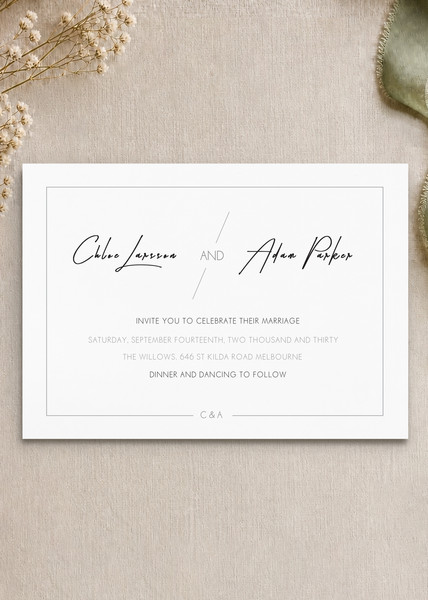
Modern ModeDigital printing
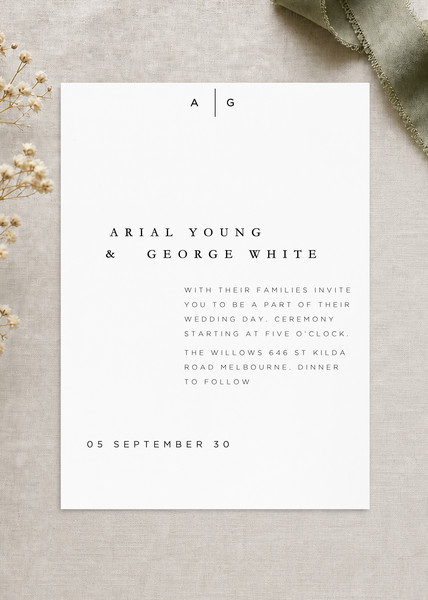
NouveauDigital printing
Additional Wording Considerations
Honorifics for Clergy
If you mention the officiant on your invitation, the correct title for a priest is “Reverend” (abbreviated Rev.) and for a deacon, “Deacon” followed by the full name. A monsignor is addressed as “Very Reverend Monsignor” or simply “Monsignor.” A bishop is “Most Reverend Bishop.” Most Catholic invitations do not name the officiant on the invitation itself. That information typically appears on the wedding program instead.
When the Guest List Is Mixed
If you have many non-Catholic guests, consider adding a brief line on the invitation or on a separate note card: “A full Nuptial Mass will be celebrated. The ceremony is approximately 75 minutes.” Non-Catholic guests appreciate being prepared for a longer service and for knowing that they are welcome to remain seated during Communion.
Spelling Out Dates and Times
Very formal Catholic invitations traditionally spell out the full date and time (“the eighteenth of October, two thousand and twenty-six, at three o’clock in the afternoon”). Semi-formal invitations use numerals (“October 18, 2026 at 3:00 p.m.”). Either is correct, choose the level of formality that matches your overall stationery design.
The Catholic Wedding Program: A Complete Order of Service
The wedding program is where the practical information lives. It helps guests follow the ceremony, tells them who is reading each scripture passage, lists the music, and gives non-Catholic guests enough context to participate comfortably.
A Nuptial Mass program typically runs 4-8 printed pages. A ceremony-only program is usually 2-4 pages.
Front Cover
The front cover needs only a few elements:
- The title: “The Nuptial Mass of” or “The Marriage of”
- Both names
- The church name
- The date and city
Many couples add a meaningful scripture verse or a simple cross or floral graphic on the cover.
Inside Left: Wedding Party and Ministers
List the celebrant (priest), any deacon, the lectors, cantor, musicians, and the wedding party. A common heading is “Those Celebrating with Us.” This gives guests a reference point for the names mentioned during the ceremony.
Inside Right: Order of Service
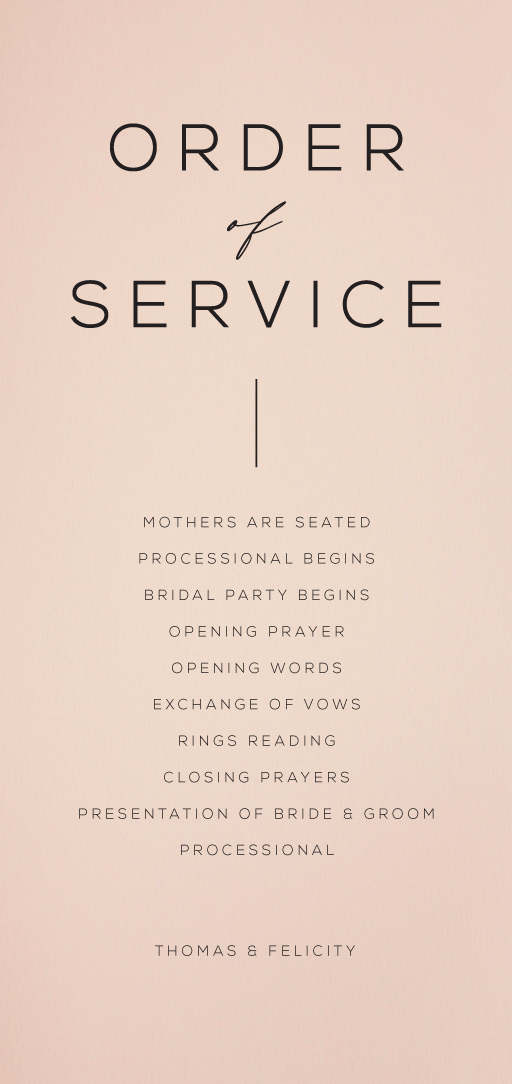
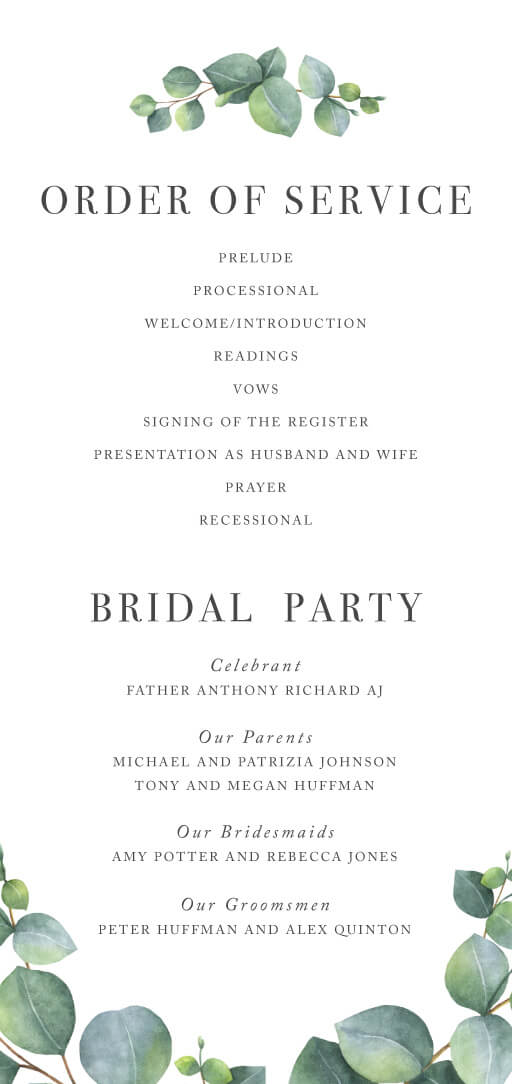
This is the core of the program. Print the section headings clearly and list each element with the music title (if applicable) and reader name where relevant. You do not need to print the full text of prayers or readings, citations and reader names are standard.
Introductory Rites
Prelude
Procession
Greeting and Opening Prayer
Liturgy of the Word
First Reading, Genesis 2:18-24
Read by Martha Chapman, grandmother of the bride
Responsorial Psalm, “The Lord is kind and merciful” (Psalm 103)
Sung by the cantor
Second Reading, 1 Corinthians 13:4-13
Read by John Reilly, uncle of the groom
Gospel Acclamation
Gospel, John 15:9-12
Proclaimed by Rev. Michael O’Brien
Homily
Rite of Marriage
Address to the Couple
Questions of Intent
Exchange of Consent (Vows)
Blessing and Exchange of Rings
Lighting of the Unity Candle
“Ave Maria”, sung by the cantor
Prayers of the Faithful
Read by Catherine Sullivan, sister of the bride
Liturgy of the Eucharist
Presentation of the Gifts
Offertory: “Panis Angelicus”
Eucharistic Prayer
The Lord’s Prayer
Nuptial Blessing
Sign of Peace
Lamb of God
Holy Communion
Communion Hymn: “On Eagle’s Wings”
Presentation of Flowers to Our Lady
Concluding Rites
Solemn Blessing and Dismissal
Recessional
“Ode to Joy”, organ
A Note about Communion
Many Catholic couples include a short, hospitable paragraph in the program about Communion. A commonly used version reads:
Holy Communion is the central act of Catholic worship and is reserved for baptized Catholics who are in good standing with the Church. If you are not Catholic, or if you are Catholic and not currently receiving Communion, we warmly invite you to come forward during Communion with your arms crossed over your chest to receive a blessing from the priest. We are grateful you are celebrating this day with us.
This small gesture goes a long way toward helping non-Catholic family members feel welcomed rather than excluded.
Back Page Options
Common back-page additions include:
- A thank-you note from the couple
- An in memoriam line for family members who have passed
- A short scripture verse or prayer that is meaningful to the couple
- Names of the wedding party parents and grandparents
VerdeDigital printing

White GardenDigital printing
EucalyptusDigital printing
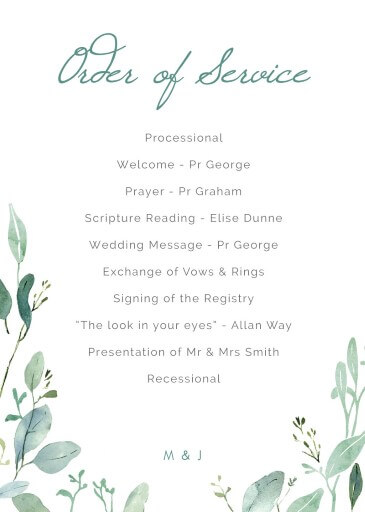
Botanical GeoDigital printing
Popular Scripture Readings for Catholic Weddings
Choosing your readings is one of the most personal parts of planning a Catholic wedding. Your priest or deacon will give you a list of approved options from the Catholic Lectionary. These are some of the most commonly chosen:
| Reading | Reference | Common Theme |
|---|---|---|
| The Creation of Woman | Genesis 2:18-24 | Partnership and companionship |
| Set me as a seal on your heart | Song of Songs 2:8-10, 14, 16; 8:6-7 | Love’s strength and permanence |
| Love is patient, love is kind | 1 Corinthians 13:4-13 | The qualities of lasting love |
| Love one another as I love you | John 15:9-12 | Christ’s model of selfless love |
| Bear one another’s burdens | Galatians 6:2 | Shared responsibility in marriage |
| Wives and husbands, be subordinate | Ephesians 5:2, 21-33 | Mutual respect (note: many couples skip this one) |
Your deacon or priest can confirm which readings from the lectionary are approved for your specific date. Lent and Advent have restrictions on certain music and solemnity levels that can affect which readings are available.
How Paperlust Designs Catholic Wedding Invitations and Programs
Paperlust produces the full suite: invitations, reception cards, RSVP cards, information cards, and matching wedding programs. Browse the complete range of wedding invitations and wedding programs to see current designs.
For Catholic weddings, several design choices work particularly well.
Print method. Letterpress on 600gsm Wild Cotton creates an heirloom-quality invitation with a tactile, pressed impression that suits formal Catholic aesthetics. Flat Foil in gold or pale gold adds a metallic warmth to traditional designs without the heavier price point of foil stamp. Digital print is the most affordable and still produces beautifully sharp results on premium card stock.
Design elements. Crosses, floral wreaths, and classic serif typography are the most common choices for Catholic wedding stationery. Many couples incorporate a scripture reference or a single meaningful line from the Mass, typically in italic text beneath the couple’s names. Cream, ivory, white, and soft gold are the most popular color palettes.
The suite. A typical Catholic wedding stationery suite includes the invitation, a separate reception card, an RSVP card, and the wedding program. Some couples add an information card for out-of-town guests with hotel and travel details. Paperlust designs all of these as a cohesive set so the fonts, paper, and finish match across every piece.
Matching programs. Wedding programs at Paperlust are printed on the same paper stocks as your invitations, so the whole suite reads as unified. A folded 4-page program on 300gsm cotton stock is the most popular format for a Nuptial Mass. The program can be designed to match or complement your invitation suite.
A designer is assigned to every order, proof is delivered within 1-2 business days, and two rounds of edits are included at no additional cost. Orders over $350 USD ship free via DHL Express.
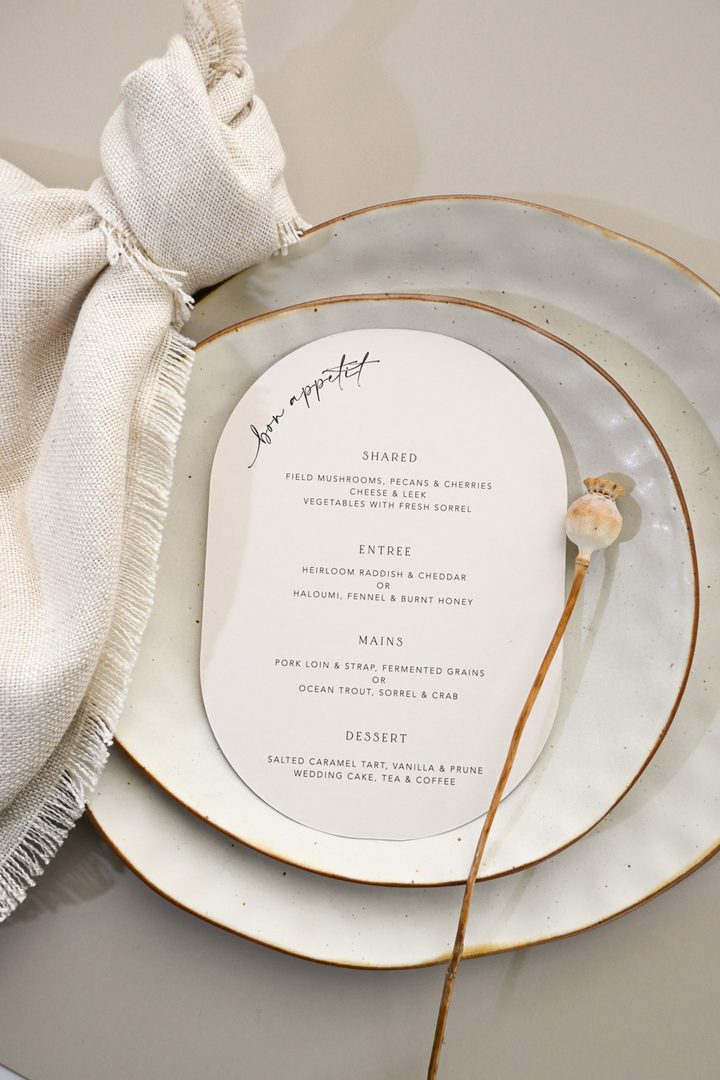
If you are weighing finishes, the $5 sample pack sets digital, letterpress, flat foil, and foil stamp side by side so the decision is simple.
Frequently Asked Questions
Does a Catholic wedding invitation have to mention the Mass?
Only if the ceremony includes one. If you are having a full Nuptial Mass, the words “Nuptial Mass” or “Sacrament of Holy Matrimony celebrated within a Nuptial Mass” should appear on the invitation so guests know what to expect. If you are having a ceremony-only Rite of Marriage, you can write “Rite of Marriage” or simply “Catholic ceremony.” The invitation should accurately reflect the type of service being celebrated.
What is the correct honorific for the priest on the invitation?
The standard title for a priest on a formal Catholic invitation or program is “Reverend” (Rev.) followed by the full name. A deacon is listed as “Deacon [Full Name].” A monsignor is “Very Reverend Monsignor [Full Name]” or simply “Monsignor [Last Name].” For the invitation itself, most couples do not list the officiant, that information appears on the program instead.
How long is a Catholic Nuptial Mass?
A Nuptial Mass typically runs 60-90 minutes. A ceremony-only Rite of Marriage (without Communion) is usually 30-45 minutes. The length depends on the length of the homily, the number of musicians, and whether additional optional elements like a unity candle, Marian devotion, or special cultural customs (such as the lazo or arras) are included.
How many pages should a Catholic wedding program be?
A Nuptial Mass program typically runs 4-8 pages when printed as a folded booklet. If you include the full text of the readings and the full text of prayers, it can run longer, up to 12 pages for a very detailed program. A ceremony-only program is usually 2-4 pages. At Paperlust, the most popular format for a Nuptial Mass is a 4-page folded program on 300gsm cotton card.
What should non-Catholic guests know before attending a Nuptial Mass?
Three things are most helpful to communicate: the approximate length of the ceremony (60-90 minutes), that Communion is reserved for Catholics in good standing with the Church, and that non-Catholics are warmly invited to come forward during Communion with arms crossed over the chest to receive a blessing. Including a short paragraph in the program covering these points is the most considerate approach.
Can we include cultural customs like a unity candle or lazo in a Catholic Mass?
Many Catholic parishes permit optional customs including the lighting of a unity candle, the lazo (a floral or rosary rope looped around the couple’s shoulders), the arras (13 coins), and the presentation of flowers to the Virgin Mary. These are cultural additions, not required parts of the Rite, and need to be confirmed with your priest in advance. If you include them, note each one with its music or prayer in the program so guests can follow along.
Do we need to print the full scripture text in the program?
No. Standard practice is to print the reading by citation (book, chapter, and verse) followed by the reader’s name. Printing the full text is optional, some couples prefer it for a longer, more immersive program; others keep the program lean. If your ceremony includes many non-Catholic guests who may not have access to a Catholic Bible, printing a short excerpt or summary of each reading can be a thoughtful touch.
Related Cultural Wedding Guides
This article is part of the Paperlust cultural wedding series. If you are planning a wedding that blends multiple traditions, or if you are a guest trying to understand a new ceremony, these guides cover the same depth for other faith traditions:
- Jewish Wedding Traditions: 2026 Guide to Customs, Ceremonies, and Modern Celebrations
- Indian Wedding Traditions 2026: Customs, Ceremonies and Modern Guide
- Chinese Wedding Traditions 2026: Customs, Ceremonies and Modern Guide
Shop Wedding Invitations at Paperlust
Hundreds of wedding invitation designs you can customize online, with an online proof before you print.