
Planning an autumn wedding in Australia means choosing one of the three months, March, April, or May, when the weather finally eases, the light turns genuinely beautiful, and almost every other couple with a ring on their finger is competing for the same Saturday.
That last point is the one worth starting with. According to the Easy Weddings 2026 Australian Wedding Industry Report, spring and autumn together account for more than two-thirds of all Australian weddings in 2026. March alone accounts for 13 percent of the year’s total, the most popular autumn month and the second most popular month overall after October. Venue availability tightens faster than couples expect, the light shifts substantially across the three months, and two fixed public holidays shape the calendar in ways unique to Australian autumn.
Australian autumn at a glance
- Season: March 1 to May 31. A June wedding is winter.
- Booking lead time: Plan 12 to 18 months ahead. March Saturdays at popular venues are often gone within weeks of becoming available.
- Most popular autumn month: March (13% of 2026 weddings, per the Easy Weddings 2026 Australian Wedding Industry Report).
- Light: Sunset moves from around 8:00 pm (AEDT) in early March to around 5:15 pm (AEST) in late May, close to a three-hour shift across the season. Daylight saving ends on the first Sunday of April in most states, causing an abrupt one-hour shift. Verify the exact time for your date and city at geodesyapps.ga.gov.au/sunrise.
- Key dates: Easter (late March or April, varies by year) and Anzac Day (25 April, fixed annually).
- Rain risk: March and April are generally dry. May is meaningfully wetter in Melbourne, Sydney, and Perth.
- Regional character: Melbourne and regional Victoria get classic deciduous foliage. Queensland autumn is warm and clear, with no leaf color.
Autumn dates go early, and a save the date stops your guests committing to something else first.
Why autumn venues book faster than couples expect
The Easy Weddings 2026 Australian Wedding Industry Report found that couples book their venue an average of 11 months before the wedding date. For autumn Saturdays at sought-after wineries, garden estates, and outdoor ceremony venues, that average understates the reality. It is common for first-choice venues to be fully booked when couples call 14 or 16 months out for a March date.
What this does to pricing: venues that fill without effort do not negotiate. The Easy Weddings 2026 report puts the national average venue cost at $17,518 AUD (up 9.5 percent on the prior year). Autumn Saturdays at premium garden and winery properties regularly land above that figure, and public holiday surcharges in the Easter window are common and non-negotiable.
Set your date before you fall in love with a specific venue, bring two or three alternate Saturdays to every inquiry, and ask directly at the first call whether your preferred date is already taken.


How the light changes and what it means for your run sheet
This is the planning detail that surprises couples most. Over the 92 days of autumn, the usable natural light window for outdoor photography shrinks by close to three hours, as the sun moves north through the season and daylight saving time ends.
Most Australian states, including New South Wales, Victoria, South Australia, ACT, and Tasmania, set clocks back one hour on the first Sunday of April. Queensland and Western Australia do not observe daylight saving.
- A late-March wedding in Melbourne operates on AEDT (UTC+11). Sunset arrives around 7:30 pm. Golden-hour portraits run from roughly 7:00 to 7:20 pm.
- The same venue in late May operates on AEST (UTC+10). Sunset arrives around 5:15 pm. Your golden-hour window closes by 5:00 pm. If your ceremony runs from 3:00 to 3:30 pm, you have roughly 90 minutes to move guests, photograph portraits, and finish before the light fails.
For Queensland couples the effect is smaller, with no clock change. Sunset in Brisbane moves from around 6:20 pm in early March to around 5:05 pm by late May, and it moves gradually rather than in a step.
The later in the season you marry, the earlier your ceremony must begin. A 4:00 pm start that works comfortably in March becomes a race against darkness in May. Give your photographer your specific date and city, check the actual sunset time for that date at geodesyapps.ga.gov.au/sunrise, and ask them to review your proposed run sheet before you commit to a ceremony time.
Easter and Anzac Day: what each one means for your planning
Easter falls somewhere between late March and late April each year. The long weekend spans Good Friday through Easter Monday across most states, and interstate guests often welcome the extra travel time. Venues typically apply a public holiday surcharge to any event falling on those days. Some florists, hire companies, and other suppliers treat the long weekend as a break and either charge a premium or are simply unavailable. Interstate guest travel costs spike during the Easter school holiday period. If your preferred date falls anywhere in the Easter window, ask every supplier at the first inquiry whether they apply a public holiday loading and what that figure is.
Anzac Day is 25 April, fixed annually. Depending on which day of the week it falls on, it may extend into a long weekend, and in some states, venue licensing conditions apply to events held on the day. Ask your venue’s event manager directly: does Anzac Day affect our booking in terms of licensing, staffing, or costs? The answer varies by venue and state, and is not something to discover after a contract is signed.
If May suits your budget better than March, the quieter Saturdays in mid-to-late May after the Easter and Anzac cluster tend to have broader venue availability and less pricing pressure than the peak March window.
Travel, accommodation and what the weather will actually do belong on a details card, not in the invitation.
Melbourne versus Queensland: the same season, different weddings
Australian autumn is not one climate, and advice written for one region does not straightforwardly transfer to another.
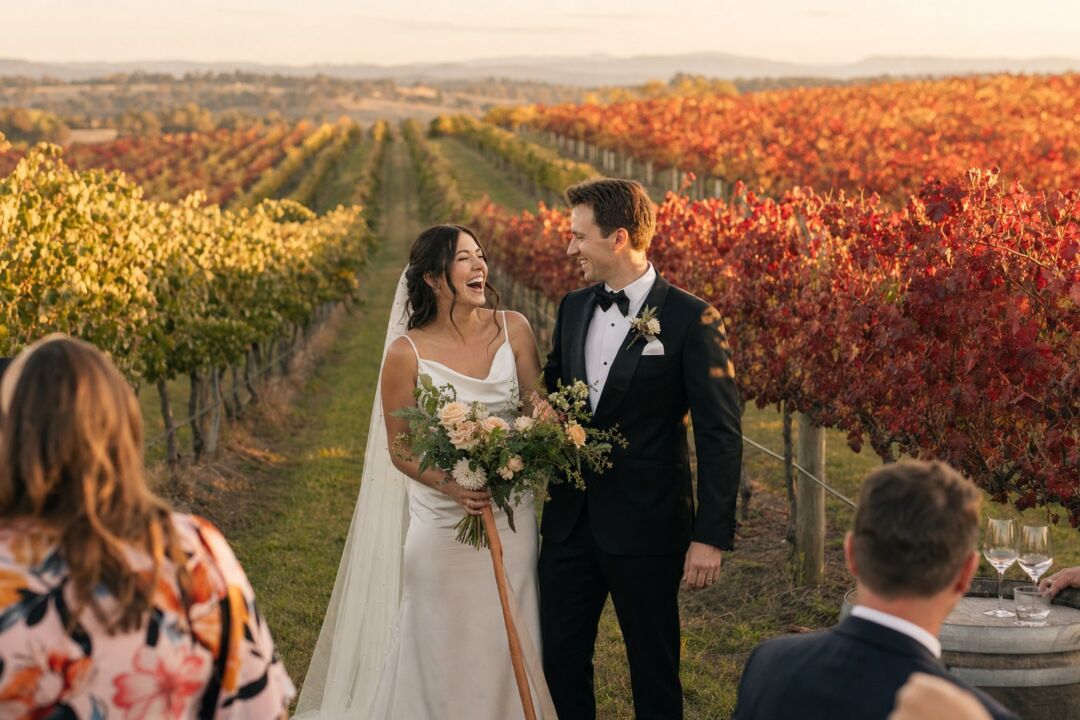
Victoria and its regional wine country (the Yarra Valley, Macedon Ranges, Mornington Peninsula) deliver the classic autumn visual: deciduous European trees in full color, vineyard rows turning red and gold. March can still reach summer temperatures. April is pleasant by day but cool after sunset. A May wedding in the Macedon Ranges needs a heater plan for the reception and layer guidance for guests. Foliage peaks in mid-to-late April in most Victorian wine regions.
Queensland does not have European deciduous foliage. Its subtropical and tropical climate means March through May is actually the most comfortable time of year, with humidity falling after the wet season and daytime temperatures in Brisbane settling into the low-to-mid 20s Celsius. A Queensland couple planning an autumn wedding is planning for clear skies and mild warmth, not copper leaves.
New South Wales and Western Australia sit between these two. The Hunter Valley and Blue Mountains offer some foliage and vineyard color; Perth has a dry Mediterranean autumn with moderate temperatures and low rainfall. March Saturdays at Melbourne-region wineries and Hunter Valley properties are among the tightest bookings in the country.
A wet weather plan that is actually needed
For March and April weddings in most Australian capitals, the wet weather conversation is largely a formality.
May is different. The Bureau of Meteorology publishes long-term monthly rainfall averages for each capital city at bom.gov.au/climate. For Melbourne, May is noticeably wetter than March or April, with a meaningful probability of rain on any given day. Conditions in Sydney and Perth in May follow a similar pattern.
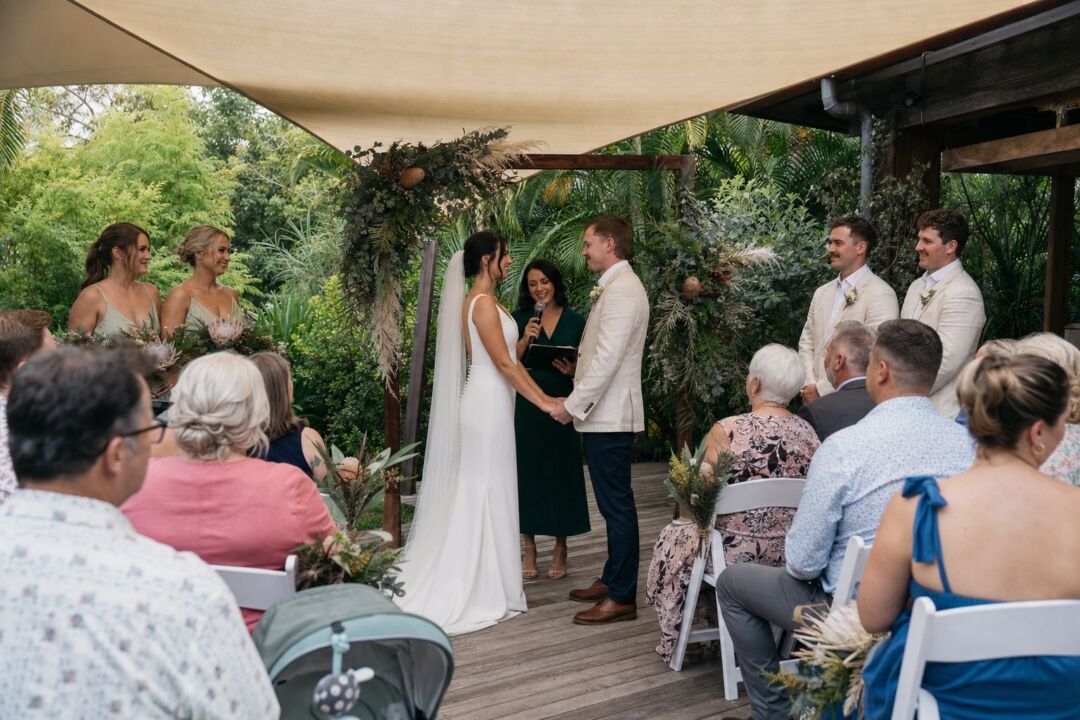
A genuine wet weather plan includes three elements: a fully enclosed indoor ceremony space (not just a covered deck or a sail shade), a decision protocol agreed in advance with your venue and celebrant (who calls the move indoors, at what time, based on what forecast), and a guest communication chain so that if the ceremony location changes, guests learn about it before they arrive at the original spot.
Marquees are an option for venues without indoor ceremony spaces, but a marquee in a May Melbourne setting needs heating, and heating is a cost to budget for explicitly before you sign a contract.
One detail worth emphasizing: it is rarely the ceremony that rain affects. It is the portrait session. Ask your photographer before booking how they handle outdoor portraits in rain and how it changes the run sheet.
Guest attire for an autumn wedding
March calls for what you would wear to a late-summer event, with a layer available for the evening. April is a genuine transition month and a jacket is sensible by the end of the night. May is region-dependent: Brisbane requires no cold-weather planning, while Melbourne and the Macedon Ranges will be noticeably cool by 8:00 pm. If your venue will be cold in the evening, note it on your wedding website or information card, particularly if any guests are traveling from a warmer state.
Stationery timing in a peak booking season
When autumn dates are secured 12 to 18 months in advance, save-the-dates need to go out earlier than couples in quieter seasons typically expect. The general guide is save-the-dates four to six months before the wedding and invitations six to eight weeks before. For autumn weddings with interstate guests, push both deadlines slightly earlier: March dates compete directly with Easter travel planning, and April dates may fall inside the Easter window itself.
Browse invitation designs suited to the autumn aesthetic at Paperlust’s wedding invitations collection. Autumn weddings cluster around vineyards for good reason, and winery wedding invitations pick up that setting without leaning on falling leaves.
Invitation designs that suit an autumn palette, personalized online. The $5 sample pack puts seven designs and an envelope in your hands, including real foil and letterpress, so you judge paper and finish off a screen.
Frequently asked questions
Is autumn a popular time to get married in Australia?
Yes. According to the Easy Weddings 2026 Australian Wedding Industry Report, spring and autumn together account for more than two-thirds of all Australian weddings in 2026. March alone accounts for 13 percent of the year’s total, the most popular autumn month and the second most popular month overall after October. Venue and supplier competition is as intense as at any other time of year.
How far in advance should I book a venue for an autumn wedding in Australia?
The Easy Weddings 2026 Australian Wedding Industry Report found that couples book their venue an average of 11 months before the wedding. For popular March Saturdays at winery and garden estate venues, that lead time frequently runs to 14 to 18 months. Treat your venue as the first booking you make, before any other supplier, and bring two or three alternate dates to every inquiry.
Does Easter affect autumn wedding planning?
Yes. Easter falls somewhere between late March and late April each year. Venues routinely apply a public holiday surcharge to events on Good Friday, Easter Saturday, or Easter Monday. Some suppliers are unavailable or more expensive over the long weekend. Interstate guest travel costs rise during the Easter school holiday window. Ask every supplier at first inquiry whether they apply a public holiday loading.
What are the biggest weather risks for autumn weddings in Australia?
March and April are generally dry in most Australian capitals and the outdoor event risk is low. May introduces meaningful rain risk, particularly in Melbourne, Sydney, and Perth. The Bureau of Meteorology publishes long-term monthly rainfall averages by city at bom.gov.au/climate; in Melbourne, May is noticeably wetter than the earlier autumn months. A May wedding should include a fully enclosed indoor ceremony option and a pre-agreed decision protocol for moving indoors, not merely a covered outdoor space.
How do I plan ceremony timing given the earlier autumn sunsets?
Work backward from the sunset time on your specific date using the Geoscience Australia sunrise and sunset calculator at geodesyapps.ga.gov.au/sunrise. The most usable golden-hour portraits happen in the 30 to 40 minutes before sunset. For a late-May Melbourne wedding, a 3:00 pm ceremony start is common. Ask your photographer to review your proposed run sheet against the actual sunset time on your date before you finalize it.
Is a Queensland autumn wedding different from a Melbourne autumn wedding?
Yes, substantially. Queensland does not observe daylight saving time and does not have the European deciduous foliage that defines Victoria’s wine regions. A Queensland autumn wedding in March through May is typically warm, sunny, and free of the wet-season humidity. Melbourne-region autumn weddings offer genuine foliage, cooler temperatures, and an abrupt light change caused by the AEST/AEDT clock shift in early April. Styling choices, guest attire guidance, and run sheet planning differ enough between the two regions that advice written for one does not directly apply to the other.