
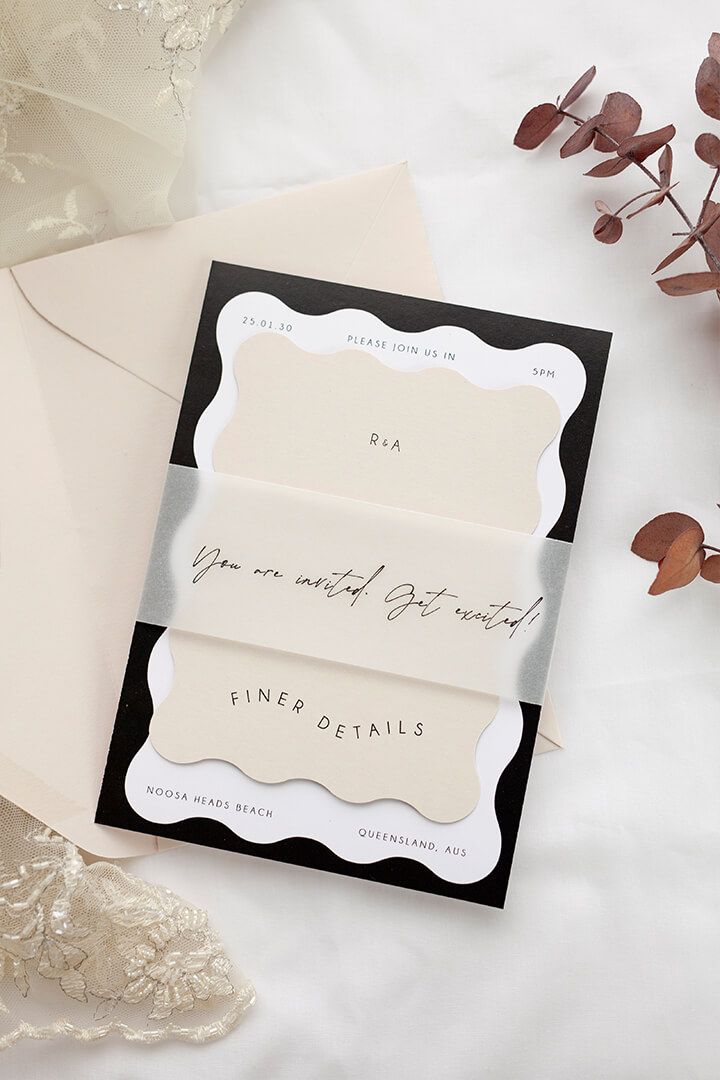

- The dominant 2026 color direction is warm and earthy, Pantone Mocha Mousse (17-1230) is anchoring palettes across invitations, florals, and decor.
- Micro weddings are surging: under-50-guest celebrations are up 23% YoY (WeddingWire), driven by intimacy, budget reallocation, and multi-day formats.
- Format innovation is accelerating, arched cards, scalloped edges, vellum wraps, and wax-seal closures are the top stationery requests for 2026.
- 72% of couples now use QR codes on wedding stationery or signage to direct guests to a wedding website (WeddingWire 2025).
- Sustainability is non-negotiable for a growing share of couples, “sustainable wedding” searches are up 45% YoY on Pinterest.
- Day-of stationery (signs, menus, programs) is becoming a high-investment category as couples lean into the full tactile guest experience.
Wedding planning for 2026 looks meaningfully different from just two years ago. Couples are blending cultural traditions, choosing intimacy over scale, investing in tactile details their guests will actually remember, and making deliberate choices about sustainability and personalization at every step. Whether you are in the early stages of planning or finalizing your stationery suite, this guide covers every major trend shaping weddings this year so you can decide which ones belong at your celebration.
The 2026 Wedding Landscape
As of 2026, the numbers paint a clear picture. According to The Knot Real Weddings Study, the average US wedding budget sits at approximately $35,000, with an average guest count of 131. But those averages mask a much more interesting story: a growing split between couples who are scaling down dramatically (the micro wedding movement) and couples who are investing heavily in elevated experiences for a similar or smaller headcount.
WeddingWire data shows micro weddings, defined as celebrations with fewer than 50 guests, growing 23% year-over-year. Pinterest’s 2026 Wedding Predicts report shows “micro wedding” searches up 33% and “sustainable wedding” searches up 45% compared to the prior year. Vogue Bridal has documented a parallel surge in maximalist aesthetics: bold jewel tones, lush tablescapes, and opulent floral installations making a definitive comeback after years of pared-back minimalism.
For couples planning 2026 weddings, the environment is one of genuine creative freedom. There is no single dominant aesthetic, instead, there is a permission structure to do exactly what feels right for you. The trends below are the clearest signals from across the industry, organized so you can see how they connect and where they might intersect with your own wedding vision.
Trend 1: Color Palette Forecast
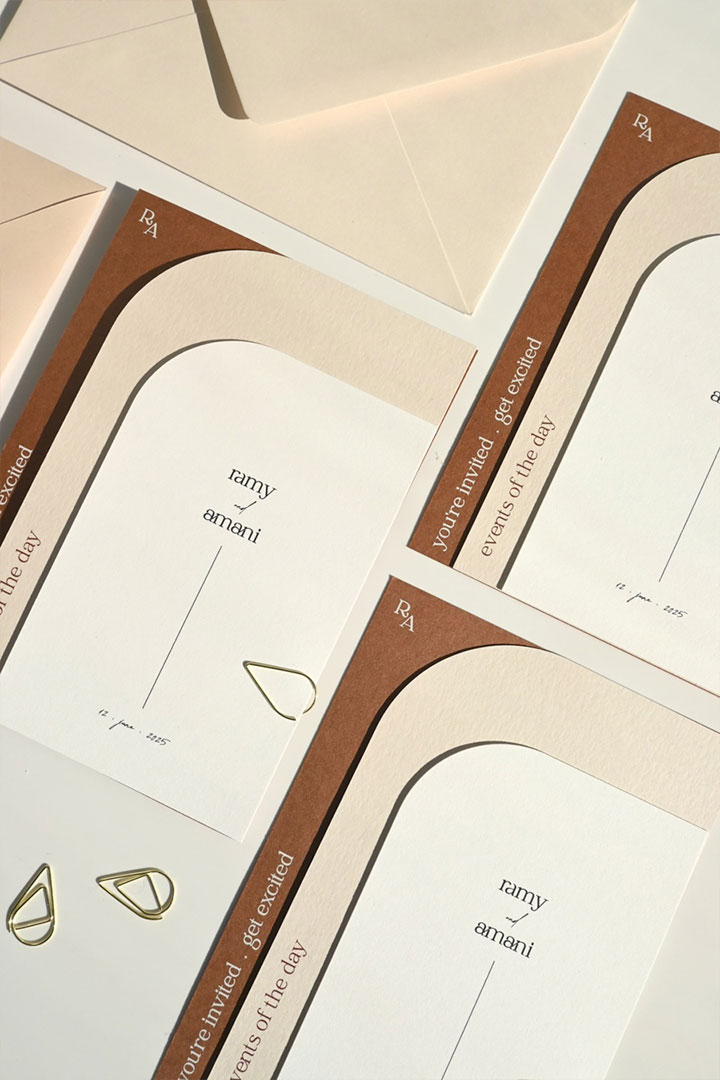
Pantone named Mocha Mousse (17-1230) its 2025 Color of the Year, and its influence is feeding directly into 2026 wedding palettes. Pinterest searches for “mocha mousse wedding” have risen sharply, and the broader direction (warm taupes, burnished terracottas, dusty clay, and deep caramel) is showing up across invitations, florals, bridesmaid attire, and tablescapes.
Alongside the warm neutrals, rich jewel tones are making a strong comeback per Vogue Bridal’s 2026 coverage: deep plum, forest green, sapphire, and oxblood are appearing in bold contrast pairings. Soft sage and dusty rose remain evergreen but are being layered with metallic accents, particularly gold and copper, for added dimension.
For stationery, these palette shifts translate directly into print method choices. Warm earthy tones pair beautifully with flat foil in gold or copper on a cream or kraft stock. Jewel-toned backgrounds call for white ink or a colour stock plus foil combination. Letterpress on Wild Cotton 600gsm delivers the depth and texture that moody, rich palettes deserve.
For a deep dive into specific palette combinations and how to translate them into your invitation suite, see our full guide to 2026 wedding color palettes.
Trend 2: Stationery + Invitation Trends
Wedding stationery in 2026 is being treated as an experience, not just a logistics document. Couples are investing in their invitation suite as the first physical piece of their wedding that guests will touch, and they want it to set a tone that reflects the whole day.
The clearest shifts in 2026 stationery:
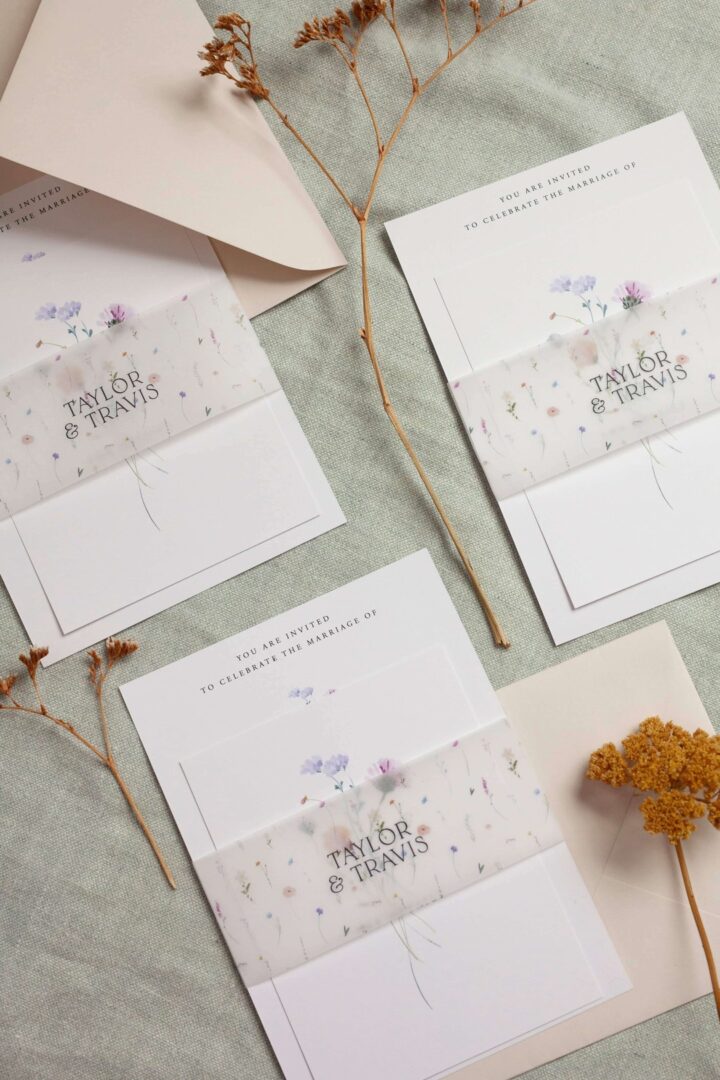
- Vellum overlays and wraps: translucent vellum layered over printed cards creates an ethereal, layered effect that photographs beautifully and feels unexpected in the hand.
- Wax seal closures: custom wax seals on envelopes are the most-requested finishing detail, particularly in warm metallic tones (gold, antique bronze, terracotta).
- Letterpress on heavyweight cotton: the tactile, pressed impression of letterpress on 600gsm Wild Cotton remains the benchmark for luxury, and demand continues to grow.
- Foil stamp and flat foil: mirror-bright metallic type on cream or colored stock is a perennial choice, but 2026 is seeing more adventurous foil color pairings: copper on blush, rose gold on navy, holographic on ivory.
- Metallic print: for couples who want a gold-toned finish at a more accessible price point, metallic print (a dry-toner pigment process) delivers subtle shimmer without the full foil cost.
Paperlust wedding invitations start from $2.04 per card for digital print, with letterpress and foil options scaling from there. Every order includes a designer proof within 1-2 business days and two rounds of edits at no extra charge. Browse the full collection at Paperlust wedding invitations.
For the complete breakdown of 2026 invitation design directions (including typography, layout, and envelope trends) see our dedicated guide to 2026 wedding invitation trends.
Shop the 2026 collection
Trend-led wedding invitations
Curved frames, textural printing, vellum overlays, and 2026 color stories across the Paperlust collection.
Trend 3: Micro + Intimate Wedding Rise
The micro wedding is no longer a pandemic workaround, it is a deliberate choice. WeddingWire’s 2025 data shows micro weddings (under 50 guests) growing 23% year-over-year, and Pinterest 2026 data puts micro wedding searches up 33%. Couples are choosing smaller guest lists not because they have to but because they want the kind of intimacy, spontaneity, and personalization that simply is not possible at a 130-person reception.
What this means practically: more couples are reallocating budget. The savings from a smaller catering bill often flow into elevated stationery, bespoke florals, a better venue, or a longer honeymoon. A micro wedding with 30 guests and letterpress invitations on Wild Cotton 600gsm costs a fraction of what 130 digital-print invitations would cost at a traditional wedding, and the per-piece quality is unmatched.
Micro weddings also tend to run across multiple formats: a ceremony-only dinner, an elopement followed by a celebration party for the broader community, or a destination weekend with a tight circle. Each of these formats has specific stationery implications, from minimalist elopement announcements to multi-piece destination wedding suites with itinerary cards and welcome notes.
For couples planning intimate celebrations in 2026, our full guide to micro wedding trends 2026 covers venues, formats, invitation timing, and stationery considerations in detail.
Trend 4: Sustainability + Eco Choices
Sustainability has moved from a niche preference to a mainstream expectation. Pinterest’s 2026 Wedding Predicts data shows “sustainable wedding” searches up 45% year-over-year, the fastest-growing search category in the wedding space. As of 2026, couples are making active choices about every vendor and material, and stationery is no exception.
The key sustainability decisions in wedding stationery for 2026:
- Paper sourcing: FSC-certified and recycled-content stocks are the baseline. Cotton paper (like Paperlust’s Wild Cotton range) is a premium option that uses no trees and is fully biodegradable.
- Seed paper: plantable seed paper invitations are a growing niche for eco-conscious couples who want their stationery to literally grow into something after the wedding.
- Digital RSVPs: pairing printed invitations with a QR code linking to an online RSVP form eliminates the need for reply cards and return envelopes, reducing paper waste significantly.
- Minimalist suites: fewer inserts, more information consolidated onto single-panel designs or all-in-one formats that can be mailed without an envelope.
Paperlust plants a tree with every order placed, a direct sustainability commitment embedded in the product rather than just a brand claim. Free white envelopes are included with all orders, with colored and textured options available for couples who want a full unboxing moment.
For a complete framework on building an eco-conscious wedding stationery suite, see our guide to sustainable wedding trends 2026.
Trend 5: Tech Integration (QR Codes, AR Invitations, Livestream)
Technology is woven into the 2026 wedding in ways that feel natural rather than forced. WeddingWire reports that 72% of couples now use QR codes on their stationery or wedding signage to direct guests to a wedding website, a figure that has risen steadily over the past three years and shows no sign of plateauing.
QR codes on stationery
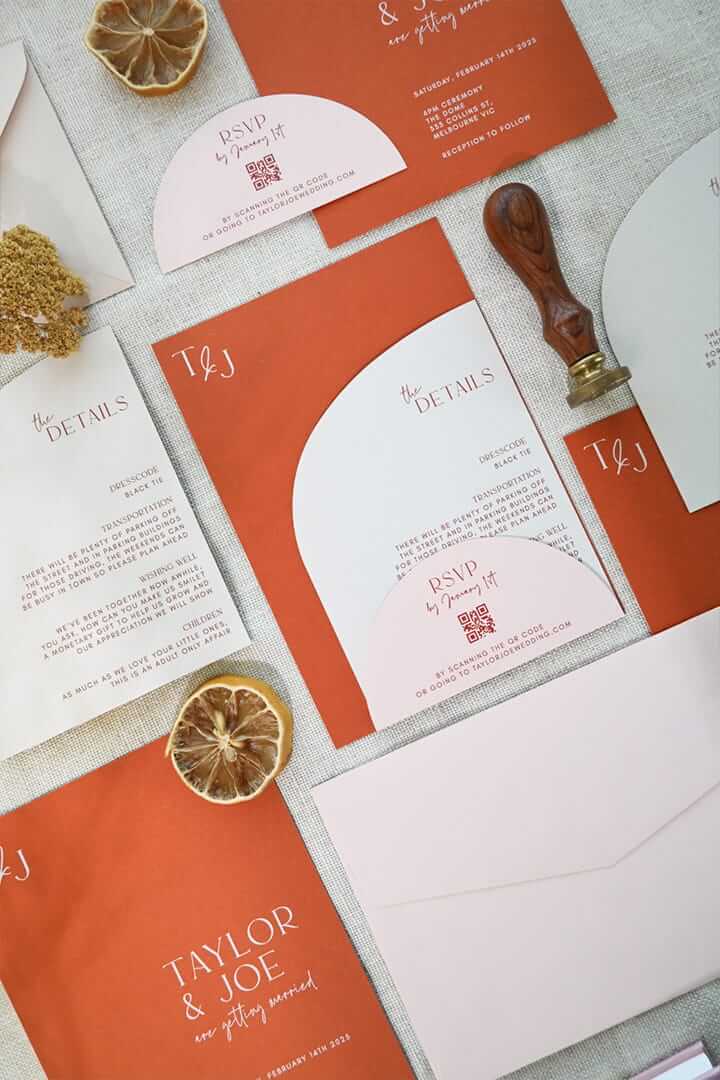
A QR code on an invitation card can link to the wedding website, an online RSVP form, a registry, or a video message from the couple. Design-wise, QR codes have become more integrated, printed in gold foil, embedded within the invitation’s design layout, or placed on a coordinating detail card rather than the main invitation face. The functional and the beautiful are no longer in conflict.
Augmented reality invitations
A small but growing segment of couples in 2026 is experimenting with AR-linked invitations, physical cards that, when scanned with a phone camera, trigger an animated video, a personal message from the couple, or a preview of the venue. This is still an emerging niche, but Paperlust’s design team can incorporate custom QR codes into any invitation design as part of the standard personalization process.
Livestream logistics
For couples with guests who cannot attend in person, particularly relevant for destination weddings or couples with international family, a livestream link has become standard stationery information alongside the venue address and parking details. A well-designed information card that includes the livestream URL (or a QR code linking to it) ensures remote guests feel fully included and informed.
Trend 6: Format Innovation (Arched, Scalloped, Vellum, Wax Seal)
Rectangle is no longer the default. In 2026, invitation format is itself a design decision, and non-standard shapes are moving from bold statement to near-mainstream. The formats seeing the most growth:
Arched top invitations
The arch is the dominant non-rectangular format of the 2026 stationery season. Its gentle curve softens the overall suite aesthetic and pairs naturally with botanical illustration styles, romantic calligraphy, and the warm earthy palette direction leading this year.
Scalloped edges
Scalloped or petal-edged cards add tactile texture and visual interest without departing dramatically from a traditional format. They work well for garden, floral, and vintage-inspired wedding aesthetics.
Vellum layers
Vellum, a translucent 180gsm stock available through Paperlust, is being used as an overlay on the main invitation card, as an envelope liner, or as a standalone detail card for ceremony programs or menus. Its semi-transparent quality creates a layered, delicate effect that photographs beautifully.
Wax seal closures
Custom wax seals on invitation envelopes are the finishing detail getting the most attention on social platforms in 2026. For couples who want to incorporate them, the seal color should coordinate with the primary stationery palette, warm gold, antique bronze, deep plum, or terracotta are the leading choices this year.
Trend 7: Maximalist Decor Comeback
After several years of minimalist white-and-greenery aesthetics dominating wedding decor, 2026 is seeing a pronounced swing toward maximalism. Vogue Bridal’s 2026 coverage documents the shift explicitly: bold jewel tones, opulent floral installations, layered tablescapes, and an overall ethos of more-is-more for couples who want their wedding to feel genuinely celebratory rather than restrained.
For couples planning 2026 weddings, maximalist decor creates a strong brief for stationery. A lush, heavily floral wedding deserves an invitation that matches the visual ambition of the day, rich colored stock, foil detailing, elaborate botanical illustrations, and heavyweight paper that communicates quality before a single word is read.
Specific maximalist stationery directions gaining traction in 2026:
- Deep-colored envelopes (navy, forest green, bordeaux) paired with white ink addressing
- Illustrated invitations with detailed botanical or romantic motifs, printed on letterpress or digital with metallic accents
- Multi-piece suites with coordinated belly bands, ribbon ties, or layered envelope liners
- Bold serif typography scaled large against minimal negative space, letting the type do the visual work
Trend 8: Cultural Fusion + Personalization
For couples planning 2026 weddings, cultural expression in stationery has moved beyond a single motif or a token design element. Couples are building full invitation suites that genuinely reflect the intersection of two cultural traditions, dual-language printing, motifs drawn from specific heritage aesthetics, and design choices that communicate meaning to guests who share that cultural context.
The most common fusion approaches in stationery:
Dual-language invitations
Printing the same invitation in two languages (English and Spanish, English and Mandarin, English and Arabic) on a single card or as a two-card pairing is one of the most requested personalization options for multicultural couples in 2026. Paperlust’s design team can accommodate this within the standard proof process.
Heritage motifs
Geometric patterns from South Asian, Middle Eastern, and African design traditions are appearing as border treatments, envelope liners, and background textures on otherwise modern invitation layouts. The result is stationery that feels both contemporary and deeply personal.
Ceremony-specific inserts
Multi-event weddings (common for South Asian, Jewish, and Nigerian ceremonies) need coordinated stationery across multiple events (mehndi, rehearsal dinner, sangeet, civil ceremony). Building a unified visual system across all event stationery is a significant design brief that Paperlust’s team handles regularly.
Trend 9: Destination + Multi-Day Celebrations
Destination weddings and multi-day celebration formats are both growing in 2026. The Knot data shows that couples who opt for destination weddings typically have smaller overall guest lists but higher per-guest investment, exactly the conditions that support elevated stationery.
Multi-day celebrations (where a wedding weekend includes a welcome dinner Friday, ceremony Saturday, and brunch Sunday) require a more comprehensive stationery system than a single-day event. A well-organized destination wedding stationery suite might include:
- Save the dates sent 9-12 months in advance (especially important for international travel)
- Main invitation with a detailed information card covering flights, accommodation blocks, and local recommendations
- Welcome bag cards or notes for guests arriving at the hotel
- Day-of programs for the ceremony
- Menus and escort cards for the reception dinner
- Brunch or farewell event details
For destination wedding save the dates, early send timing is critical, Paperlust’s save the date collection includes formats designed specifically for travel-forward aesthetics, from map-illustrated designs to minimal typographic styles that feel intentionally modern.
Trend 10: Day-of Stationery Investment
For couples planning 2026 weddings, day-of stationery has become one of the highest-ROI categories in the overall stationery budget. The reasoning is straightforward: every guest experiences your ceremony program, your dinner menu, your escort cards, and your venue signage in real time during the celebration. These pieces are seen, touched, and photographed more than the invitation, which arrives weeks earlier and may not travel to the event.
Wedding signs
Welcome signs, seating charts, bar menus, table numbers, and directional signs are all part of the day-of stationery ecosystem. Paperlust’s wedding signs are available in fabric and printed PVC board formats, fabric signs are a genuine differentiator, offering a soft, draped aesthetic that no print-on-demand competitor currently matches in terms of material quality.
Ceremony programs
Program design in 2026 is more intentional than it has been in previous years, single-sided vellum programs with minimal typography, folded booklet programs with illustration, or fan programs for outdoor summer ceremonies are all trending. The program is often the piece guests hold throughout the entire ceremony, so its weight, texture, and design quality are noticed.
Dinner menus and place cards
Coordinated menu and place card design creates a polished table experience. In 2026, couples are increasingly choosing letterpress menus on heavyweight Wild Cotton stock, or flat foil menus in gold or copper, treating the dinner table as an extension of the overall design narrative of the wedding.
Escort cards and seating charts
Escort cards have become a creative opportunity in 2026: mini envelopes, folded cards, cards tied to small favors, and digital displays with QR code check-in are all being used. For larger guest counts, a printed seating chart on fabric or PVC board is the cleaner logistical solution.
Trend 11: AI + DIY Tool Integration
As of 2026, AI-powered design tools have entered the wedding planning workflow in a meaningful way. Couples are using AI tools to generate mood boards, explore color combinations, draft invitation wording, and even prototype layout ideas before engaging a stationery supplier.
The practical implication for couples working with Paperlust: AI-assisted mood boarding can help you arrive at the design brief stage with much more clarity than in previous years. You know your palette, your typographic direction, your format preference, which means the human designer working on your proof can execute faster and more accurately to your vision.
Where AI tools have clear limits in the stationery context: they cannot replicate the tactile qualities of letterpress on 600gsm Wild Cotton, the mirror-bright finish of flat foil, or the precise calibration of white ink on a dark colored stock. Those craft decisions still require a human designer with real materials and a press. AI generates directions; Paperlust’s team executes them.
Paperlust’s online design tool allows for real-time customization of any of the 500+ available designs (changing colors, fonts, wording, and layout) before requesting a designer proof. This combination of self-service digital design and professional production is exactly what the AI-assisted planning era calls for.
Trend 12: Mood-Driven Design
The final, and perhaps most durable, trend for 2026 weddings is the move away from style labels toward mood-driven briefs. Couples are increasingly describing what they want their wedding to feel like rather than what aesthetic category it belongs to. “Warm and celebratory,” “quiet and intimate,” “romantic but not fussy,” “rich and ceremonial” are the kinds of briefs that Paperlust designers work with daily.
This shift has practical implications for stationery selection. A mood-driven brief translates more directly into print method, paper weight, color, and typography choices than a style label like “boho” or “garden party.” When a couple says they want their invitation to feel “substantial, a little formal, and very warm,” that brief points clearly toward letterpress on Wild Cotton, a cream or dusty blush stock, and a serif typeface in a deep warm tone.
The trend toward mood-driven design is also connected to the broader movement away from Pinterest-replicated aesthetics. As of 2026, couples who have been planning their wedding since 2024 have spent two or more years consuming curated wedding content, and many of them are actively trying to move away from recreating something they saw and toward expressing something genuinely personal. That orientation benefits from a design partner who can translate a feeling into a physical object.
What This Means for Your Wedding Stationery
Across all twelve trends above, a few consistent stationery implications emerge for couples planning 2026 weddings:
- Invest in print quality. Whether you choose digital print, letterpress, flat foil, or foil stamp, the tactile quality of your invitation communicates something real to guests before they read a word. For 2026’s mood-driven, experience-oriented wedding culture, that tactile signal matters.
- Think in suites, not pieces. A coordinated invitation, save the date, and day-of stationery system creates a coherent guest experience across the entire timeline of the wedding, from the first save the date in the mail through the ceremony program in hand.
- Format is content. The shape, weight, and finish of your invitation is part of what it communicates. An arched card says something different from a rectangle. Vellum says something different from matte cardstock. In 2026, couples are using format as an intentional design tool.
- Build in lead time. Letterpress and foil orders require production time. Designer proofs are delivered within 1-2 business days, with two rounds of edits included, but complex multi-piece suites benefit from a 6-8 week runway before mailing date.
Browse the full Paperlust collection at wedding invitations500+ exclusive designs from independent artists, with every print method from digital through letterpress available from a single supplier.
- Made in Melbourne since 2014, 500+ exclusive designs from independent artists
- Named Westpac Business of Tomorrow 2017
- 100% happiness guarantee: free reprint or full refund
- Designer proof in 1-2 business days; two rounds of edits included
- Free DHL express shipping on orders over $350 USD
- Plant a tree with every order
Set the date early
Save-the-dates + magnets
Lock in your guest list for a 2026 wedding with custom save-the-date cards or magnets in foil, letterpress, and digital print.
Frequently Asked Questions: Wedding Trends 2026
What is the most popular wedding color for 2026?
Warm earthy tones are leading 2026 wedding palettes, anchored by Pantone Mocha Mousse (17-1230) as the 2025 Color of the Year carrying its influence into 2026. Dusty clay, burnished terracotta, warm taupe, and caramel are the most-requested palette directions. Alongside the earth tones, rich jewel tones (deep plum, forest green, sapphire) are making a significant comeback per Vogue Bridal’s 2026 coverage.
Are micro weddings still trending in 2026?
Yes, and the data is unambiguous. WeddingWire reports micro weddings (under 50 guests) growing 23% year-over-year, and Pinterest shows “micro wedding” searches up 33% for 2026. Micro weddings are no longer a cost-cutting measure; they are an intentional choice for couples who prioritize intimacy, flexibility, and elevated quality over scale.
What stationery formats are most popular in 2026?
Arched top invitations are the dominant non-rectangular format for 2026. Scalloped edges, vellum overlays, and wax seal closures are the leading finishing details. For print method, letterpress on heavyweight Wild Cotton and flat foil on cream or colored stock are the most-requested premium options.
How much should I budget for wedding invitations in 2026?
Paperlust wedding invitations start from $2.04 per card for digital print. Letterpress and foil options are priced higher and vary by paper stock and order quantity. A typical suite for 100 guests including save the dates, invitations, and detail cards will range widely depending on print method, digital print keeps costs accessible while letterpress or foil deliver a luxury experience at a higher per-piece price. Every order includes a designer proof within 1-2 business days and two rounds of free edits.
What is the biggest stationery trend for 2026 specifically?
Format innovation is the clearest macro-trend in 2026 stationery: arched cards, vellum wraps, wax seals, and non-standard shapes are moving from bold statement to near-mainstream. Alongside format, QR code integration for wedding website links and online RSVPs is the dominant functional trend, 72% of couples now use QR codes in their stationery or signage (WeddingWire).
Are sustainable wedding invitations a real option?
Yes, and demand is growing fast. “Sustainable wedding” searches on Pinterest are up 45% year-over-year for 2026. Paperlust offers several eco-conscious options: FSC-certified stocks, cotton paper (no trees, fully biodegradable), seed paper (plantable after the wedding), and digital RSVP integration via QR code to reduce total paper usage. Every Paperlust order includes a tree planted on your behalf.
How far in advance should I order wedding invitations for a 2026 wedding?
For most print methods, a 6-8 week lead time before your intended mailing date is a safe target. Letterpress and foil orders should allow the longer end of that window. Your designer proof arrives within 1-2 business days, and you have two rounds of edits included. Invitations are typically mailed 6-8 weeks before the wedding date, meaning your order should be placed 10-14 weeks before the wedding for most couples.
What is the difference between flat foil and foil stamp?
Flat foil applies a mirror-bright metallic finish without a custom die and without any deboss, it is faster and more affordable, with a minimum order of 10 cards for most stocks. Foil stamp requires a custom die and leaves a pressed, tactile impression (deboss) in addition to the metallic finish, it has a minimum order of 50 cards and takes longer to produce, but delivers a more pronounced luxury feel. Both are available through Paperlust across a wide range of metallic colors including gold, rose gold, copper, silver, and holographic.
Can I use QR codes on my Paperlust invitations?
Yes. A QR code can be incorporated into any Paperlust invitation design as part of the personalization process. Your designer will place it during the proof stage. The QR code can link to your wedding website, online RSVP form, registry, or any other URL. As of 2026, QR codes are used by 72% of couples in their wedding stationery or signage.
What is a mood-driven wedding design brief?
A mood-driven brief describes how you want your wedding to feel rather than naming an aesthetic style. For example: “warm, a little formal, and intimate” or “joyful and bold without being loud.” This approach is trending in 2026 as couples move away from replicating Pinterest aesthetics and toward expressing something genuinely personal. Paperlust designers work from mood briefs daily and can translate a feeling into specific paper stock, print method, color, and typography recommendations.
What day-of stationery should I budget for?
At minimum: ceremony programs and escort cards or a seating chart. For a fuller guest experience: dinner menus, table numbers, welcome signs, and a bar menu sign. Paperlust offers coordinated day-of stationery in the same design styles as the invitation suite, so your programs, menus, and signs can all share a visual language with the invitation that arrived months earlier. Wedding signs are available in fabric and printed PVC board formats.
Are destination wedding invitations different from regular invitations?
The design format can be identical, but the information architecture is more complex. Destination wedding invitations typically need to work alongside a detailed information card covering travel, accommodation blocks, and a multi-day event schedule. Save the dates for destination weddings should be sent 9-12 months in advance, earlier than the standard 6-8 months, to give guests time to book travel. Paperlust’s save the date collection includes formats designed for destination wedding aesthetics, including map-illustrated and travel-themed designs.
What printing options are available for vellum invitations?
Paperlust’s 180gsm vellum stock is compatible with white ink and is also available as a colour stock plus foil option. Vellum is most commonly used as an overlay over a printed card (for a layered, translucent effect) or as a standalone detail card for programs or menus. Because vellum is semi-transparent, it works best with bold typography or minimal design rather than full-color imagery.