
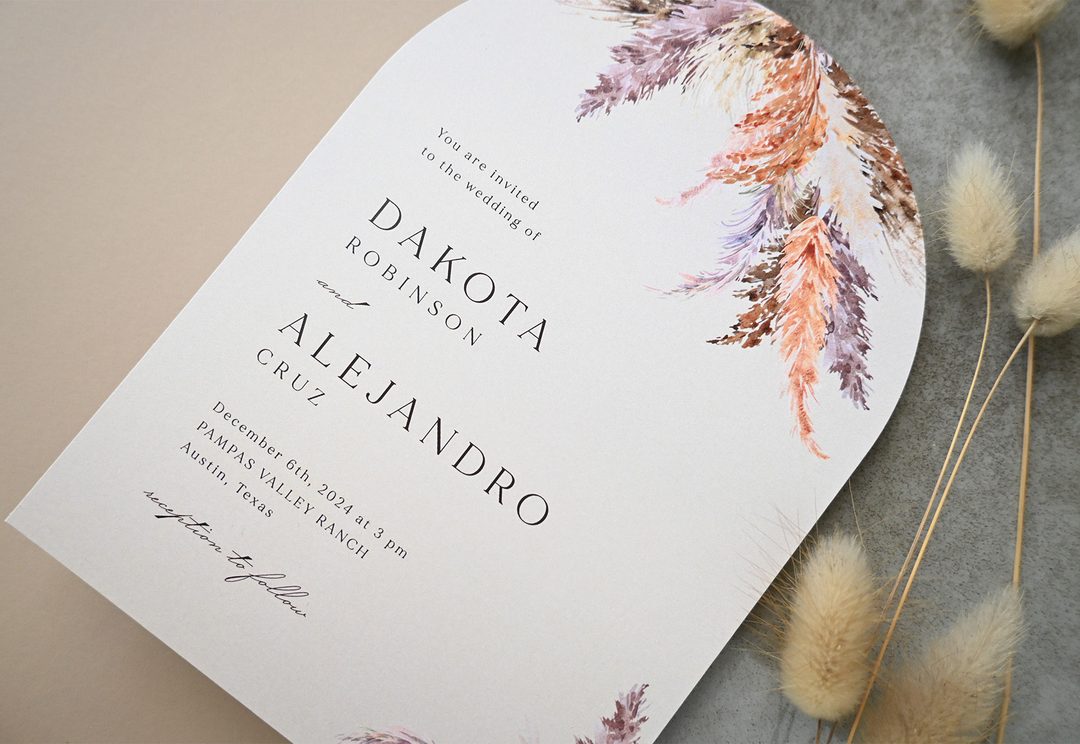
Planning a wedding that honors two faiths at once is one of the most meaningful things a couple can do. It says, simply and clearly, that both families matter and both traditions belong here. Your invitation is the first place that message lands. This guide covers how to word your interfaith wedding invitations, how to handle the ceremony and program side of things, and how to choose a design that represents both of you without tilting toward one tradition.
Whether you are navigating a Jewish-Christian wedding, a Hindu-Christian ceremony, a Muslim-Catholic union, or any other combination, the principles here apply across the board.
Quick Reference
Interfaith Wedding Stationery at a Glance
- Neutral wording (“join together in marriage”) works for any faith combination and offends no one
- Dual-tradition wording names both ceremonies or both sets of customs on the same invitation
- Whose tradition goes first on the invitation: traditionally the bride’s family line appears first
- Co-officiants (one from each tradition) can be named on the ceremony program, not on the invitation itself
- The wedding program is where you explain rituals, readings, and the order of blended elements
- Design symbols work best when used sparingly and in balance (one from each tradition, same visual weight)
- If the ceremony venue is a religious space, use “request the honor of your presence”
- If the venue is secular, “request the pleasure of your company” or “joyfully invite you” both work
Browsing from outside the US?
Australia | United States | United Kingdom | Canada | New Zealand
What Makes an Interfaith Wedding Invitation Different
A standard wedding invitation carries one set of assumptions: a single tradition, a single venue type, a single set of conventions. An interfaith invitation has to do something harder. It has to signal belonging to two families whose backgrounds may be very different, without suggesting that one tradition is an afterthought.
Three things set interfaith invitations apart from any other kind.
The request line. For a ceremony at a religious venue (a church, synagogue, temple, or mosque), the traditional phrase “request the honor of your presence” signals a sacred space. For a secular venue or a civil ceremony that incorporates religious elements, “request the pleasure of your company” or “joyfully invite you” are both neutral and welcoming. If you have co-officiants from two traditions but a secular venue, lean toward the neutral phrasing.
Naming the ceremony or blending the language. Some couples choose to name both traditions explicitly (“in a ceremony blending Jewish and Christian traditions”). Others prefer completely neutral language that belongs to neither tradition and therefore belongs to both. Either approach is valid. What does not work is defaulting to one tradition’s full formal language and adding a small nod to the other as a footnote.
The role of the program. Interfaith couples often worry about cramming too much explanation onto the invitation itself. The invitation is not the place for that. Keep it clean and welcoming. The ceremony program is where you explain the order of service, the meaning of specific rituals, and any guidance guests may need (such as when to sit, stand, or participate).
Interfaith Wedding Invitation Wording Examples
The following wording examples cover the most common interfaith scenarios. Each can be adapted to your exact faith combination, family structure, and level of formality. Wording appears in italic callout boxes exactly as it would read on the invitation.
Faith-Neutral Wording (Any Combination)
Faith-neutral wording works for any pairing of traditions. It avoids all religious references on the invitation itself, which is particularly useful when guests from both sides span a wide range of observance levels.
Together with their families
Amara Singh
and
Benjamin Cole
joyfully invite you to celebrate their marriage
Saturday, the fourteenth of June, two thousand and twenty-six
at four o’clock in the afternoon
Rosewood Gardens, Napa, California
Reception to follow
With open hearts and the blessings of both families
Sophie Goldberg
and
James O’Connell
invite you to join them as they begin their life together
Sunday, the twenty-second of March, two thousand and twenty-six
Ceremony at two o’clock
The Botanical Garden, Chicago, Illinois
Dinner and dancing to follow
Dual-Tradition Wording (Naming Both)
When you want the invitation itself to acknowledge both faiths, name them directly in the body of the invitation. This approach works especially well when both families are closely involved in hosting.
In a ceremony uniting Hindu and Christian traditions
Mr. and Mrs. Raj Patel
together with
Mr. and Mrs. David Williams
joyfully invite you to the marriage of
Priya Patel
and
Michael Williams
Friday, the tenth of October, two thousand and twenty-six
at five o’clock in the evening
The Grand Hall at The Jefferson, Washington, D.C.
With joy and gratitude to God and Ha-Shem
The honor of your presence is requested
at the marriage of
Rebecca Levin
and
Christopher Monroe
as they celebrate their union in the Jewish and Christian traditions
Saturday, the eighteenth of July, two thousand and twenty-six
at six o’clock in the evening
Hillside Estate, Sonoma, California
Modern Mixed-Faith Wording (Informal Register)
For couples who want warmth over formality and are happy to set a relaxed, welcoming tone from the first line:
Two families. Two faiths. One big celebration.
Leila Rahimi and Daniel Carter
are getting married, and they would love for you to be there.
June 6th, 2026
Ceremony at 4:00 PM | Reception to follow
The Heritage House, Austin, Texas
Our ceremony will blend Persian and Christian traditions. Come ready to celebrate both.

The Ceremony and Program Side
The wedding program is where the real work of an interfaith ceremony lives. Your invitation sets the tone; the program explains the moment-by-moment.
Co-Officiants and How to List Them
Many interfaith couples choose to have two officiants: one from each tradition. This works beautifully in the program but rarely belongs on the invitation itself, which is already doing a lot of informational work. In the program, list both officiants in the order they will speak or lead, and give each a simple title that is accurate to their tradition (Rabbi, Reverend, Pandit, Deacon, Cantor, or simply “Officiant” if they are a civil celebrant who specializes in interfaith ceremonies).
What to Print in the Program
An interfaith program needs to do something a single-tradition program does not: it has to briefly orient guests from both sides who may be unfamiliar with the elements from the other tradition.
| Program Section | What to Include | Estimated Time |
|---|---|---|
| Welcome and Processional | Names of officiant(s), brief acknowledgment of both traditions | 5 minutes |
| Readings | Reader names, text source (scripture, poem, or wisdom literature) | 5-10 minutes |
| Ritual Explanations | 1-2 sentence description of each tradition-specific element | As needed |
| Vows | Either printed in full or indicated as “personal vows” | 5-10 minutes |
| Ring Exchange | Any specific language or blessing used | 3-5 minutes |
| Unity Ritual (if used) | Name and 1-sentence explanation (candle lighting, handfasting, garland exchange, etc.) | 3-5 minutes |
| Pronouncement and Recessional | Any concluding blessing or ritual (glass breaking, bindu application, etc.) | 5 minutes |
Explaining Each Tradition Without Turning It Into a Lecture
The best programs explain without over-explaining. A single sentence for each ritual is enough. For example:
The Breaking of the Glass
In Jewish tradition, breaking a glass at the end of the ceremony is a reminder that even in moments of great joy, we hold space for all of human experience. We invite you to shout “Mazel Tov!” as the glass is broken.
The Garland Exchange (Jai Mala)
In the Hindu tradition, the exchange of garlands signifies the couple’s acceptance of one another and their new families. This is our way of saying yes before we say “I do.”
Blending Rituals: What Works and What to Watch
The most successful interfaith ceremonies do not try to include every ritual from both traditions. They pick two or three elements from each, chosen because they are meaningful to the couple, accessible to guests across both families, and visually or ceremonially compatible.
Rituals That Blend Well
- Unity candle + fire ceremony: The unity candle (common in Christian ceremonies) can sit alongside or instead of an Agni fire element without feeling forced.
- Seven blessings + seven steps: A Jewish Sheva Brachot and a Hindu Saptapadi (seven steps around the fire) both use the number seven and can be acknowledged together even if only one is performed.
- Handfasting + tying the knot: Celtic or non-denominational handfasting pairs naturally with Hindu hast milap (tying of hands) since both are tactile symbols of binding.
- Shared readings: Passages from Rumi, Pablo Neruda, the Song of Solomon, or the Upanishads are beautiful in almost any combination and are not exclusive to one tradition.
The Question of Which Tradition Goes First
In the ceremony as in the invitation, there is no universal rule about which tradition goes first. Common approaches:
- Alternating: Open with Tradition A’s elements, transition to Tradition B’s, close with A’s (or the reverse).
- Chronological: Follow the structural sequence that makes logistical sense for your officiant and venue.
- Framing elements from the host tradition: If one family is providing the venue or the community connection, their tradition’s opening and closing can bookend the other.
The most important thing is that both traditions appear in a place of ceremony and significance, not tucked into a corner of the program.
Design Choices for a Dual-Faith Invitation
Symbols and Motifs
Using religious symbols on an interfaith invitation is a meaningful choice, but it requires balance. If you include a cross and a Star of David, both should carry the same visual weight (same size, same color treatment, same placement). If you include an Om symbol alongside a Christian cross, neither should dominate.
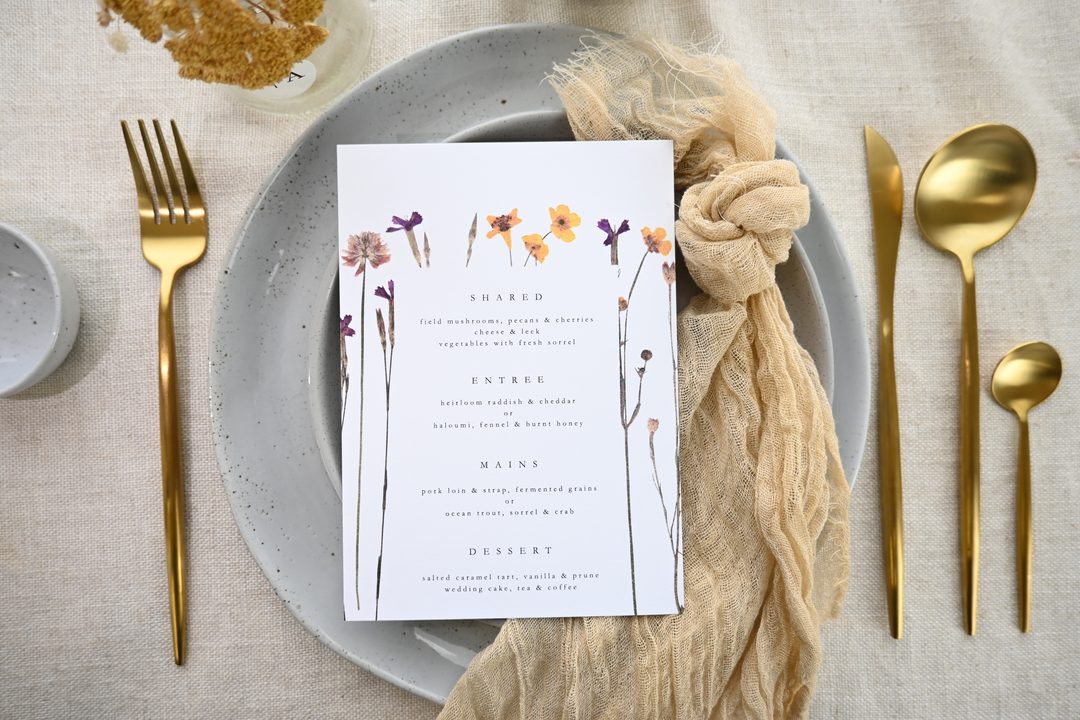
A safer approach for many couples is to choose a design with no explicitly religious symbols and instead use motifs that have shared resonance: botanicals, geometric patterns, celestial elements, or abstract linework. These feel meaningful without being doctrine-specific.
Color and Palette
Both families’ traditional wedding colors can often be woven into the suite without signaling one tradition’s hierarchy over the other. A palette of cream, gold, and a single accent color (deep green, dusty rose, burgundy) works across almost every tradition. Gold in particular reads as celebratory in Jewish, Hindu, Christian, and many other contexts.
The Suite as a Whole
An interfaith couple often benefits more than most from printing a complete suite: the invitation, a separate information card (useful for explaining the venue or any dress code notes), an RSVP card, and a program. When guests receive a full suite, the program can carry the explanatory weight so the invitation stays elegant and uncluttered.
Browse Paperlust’s wedding invitation designs, including styles that work beautifully for interfaith and mixed-faith ceremonies. With 500+ designs across digital print, flat foil, foil stamp, and letterpress, you can mix elements to create a suite that genuinely represents both of you.
For the program side of your ceremony, explore Paperlust’s wedding programs: bi-fold, flat card, and fan program formats, all customizable.
Working With a Designer
Every Paperlust order includes a professional designer who handles the typesetting and layout. If you have specific requests (combining two motifs, matching two card styles from different design collections, or adjusting a design to feel more culturally balanced), add a note when you place the order. The design team works with interfaith couples regularly and can advise on how to achieve balance across the suite.
Proofs are delivered within 1-2 business days, with two rounds of edits included at no extra charge. Orders over $350 USD ship free via DHL Express, with US delivery in 2-4 business days after dispatch.
Paperlust’s $5 sample pack lets you compare paper stocks and print finishes in person, so you can commit to a full order with confidence.
FAQ
Whose tradition goes first on the invitation?
Traditionally the bride’s family line appears first in the host line. For a dual-tradition invitation, this convention still applies: the family whose name leads the host line typically appears first. That said, many modern interfaith couples simply list the couple’s names with “together with their families” and skip the debate entirely.
How do I word a dual-faith ceremony on the invitation?
The cleanest approach is to add a single line after the couple’s names: “in a ceremony celebrating [Faith A] and [Faith B] traditions.” For example: “in a ceremony celebrating Jewish and Christian traditions.” This is brief, clear, and respectful. Alternatively, use entirely neutral language that does not name either tradition (“joyfully invite you to celebrate their marriage”).
Do I need to name the officiants on the invitation?
No. Officiant names belong in the ceremony program, not on the invitation. The invitation covers the essentials: who, when, where, and the hosting line.
What if our families disagree about how to word things?
This is extremely common. One practical approach is to have two versions of the invitation: one phrased to lean toward your family’s preferences and one toward your partner’s, with the shared details identical. This rarely causes issues in practice since the two groups are likely not comparing notes. Discuss it with your partner first and decide together what the priority is.
Can we use religious symbols from both faiths on the same invitation?
Yes, if both are given equal visual weight. If one symbol is large and central and the other is small and corner-placed, the invitation reads as belonging to one tradition more than the other. The cleanest approach is either equal placement and sizing of both symbols, or no explicitly religious symbols and a neutral design motif instead.
Is it appropriate to explain the traditions in the invitation?
Briefly, yes. A single line naming the ceremony type (or the two traditions being honored) is appropriate. A full paragraph of explanation belongs in the program, not on the invitation. The invitation’s role is to welcome and inform, not to educate.
What size and format works best for an interfaith program?
A bi-fold card is the most practical for interfaith ceremonies because the extra real estate lets you lay out both traditions’ elements clearly. A single flat card can work if your ceremony is streamlined. Fan programs are popular for outdoor ceremonies and add a practical function in warm weather. Paperlust prints all three formats.