
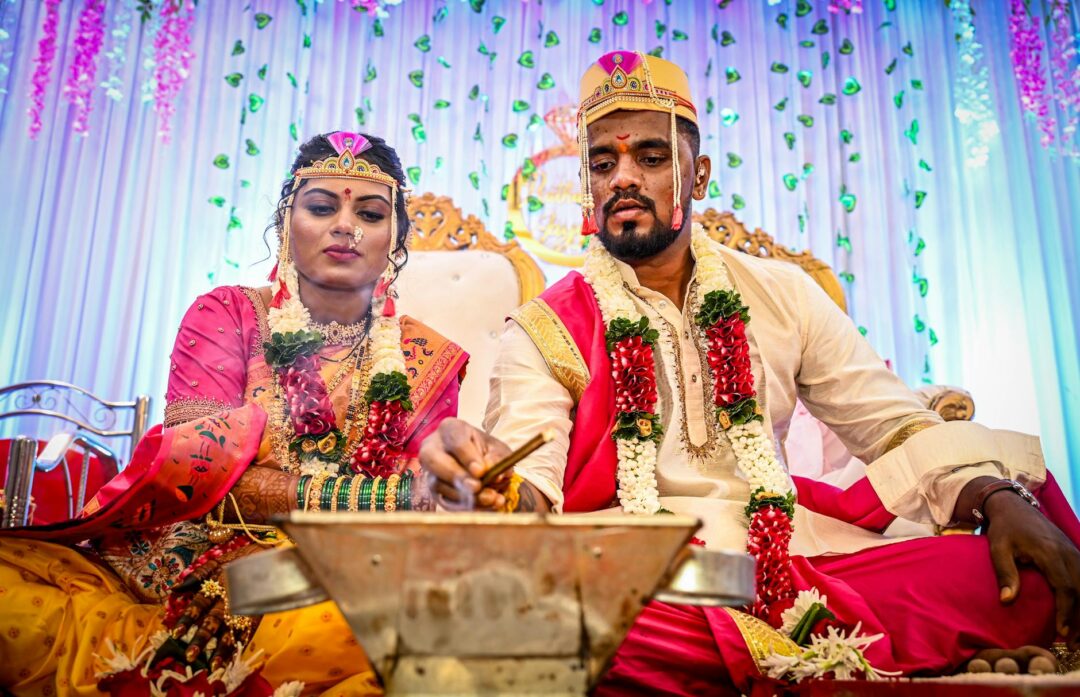
An Indian wedding is rarely a single afternoon. It is a three to seven-day arc of music, color, and ritual that brings two families into one. For US and Australian diaspora couples planning a celebration far from a hometown temple or gurdwara, the question is rarely what traditions to include. It is which to keep, which to adapt, and how to communicate the schedule to a guest list that may not know what a sangeet looks like or why the groom arrives on a horse.
This guide walks through the major ceremonies in chronological order, calls out where North Indian Hindu, South Indian, Sikh, and Punjabi customs differ, and explains the stationery you actually need across the multi-day timeline.
- A traditional Indian wedding spans 3 to 7 days, with mehndi, sangeet, haldi, the wedding day (baraat, varmala, mandap rituals, saat phere, vidaai), and reception as the core events.
- Regional differences are real: Sikh weddings center on the Anand Karaj at the gurdwara; South Indian Hindu weddings emphasize the kanyadaan and mangalsutra; North Indian Hindu weddings build around the seven phere around the sacred fire.
- Most couples send one main invitation suite plus separate insert cards for mehndi, sangeet, and reception, not a different suite per event.
- Color palettes vary regionally: Punjabi reds and golds, South Indian gold and emerald, Bengali whites and reds, all best served by foil and metallic finishes.
- Modern fusion weddings now make up an estimated 30 to 40 percent of US diaspora celebrations in 2026, with bilingual stationery becoming standard.
How long is an Indian wedding?
Most modern Indian weddings in the US and Australia condense the traditional week into three or four days. Couples with larger families may extend to five or seven. The structure below reflects what most diaspora couples are planning in 2026.
| Day | Event | Stationery needed |
|---|---|---|
| Day 1 (afternoon) | Mehndi | Mehndi insert |
| Day 1 (evening) | Sangeet | Sangeet insert with dress code |
| Day 2 (morning) | Haldi | Often skipped or by text |
| Day 3 | Wedding day (baraat, varmala, ceremony) | Main invitation, RSVP, ceremony program |
| Day 4 | Reception | Reception insert |
Mehndi: the henna ceremony
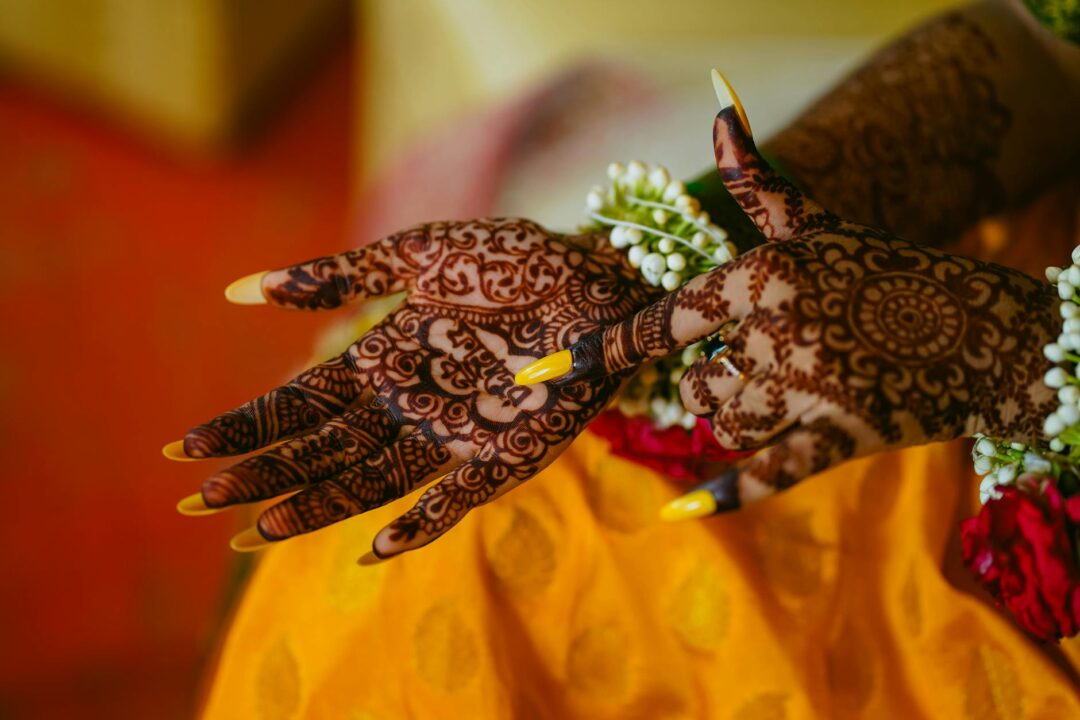
The mehndi is held the day or two before the wedding. A henna artist applies intricate designs to the bride’s hands and feet, and often to the hands of female family members. The ritual is rooted in Hindu and Muslim traditions across South Asia and is believed to bring good luck and deepen love between the couple.
Modern mehndi events are part beauty appointment, part party. Expect bright yellows, pinks, and oranges in decor, low seating with cushions, and a buffet of finger food. Most couples include a single mehndi insert in the main invitation suite stating date, time, venue, and dress code (typically yellows, oranges, or pastels).

Sangeet: the music and dance night
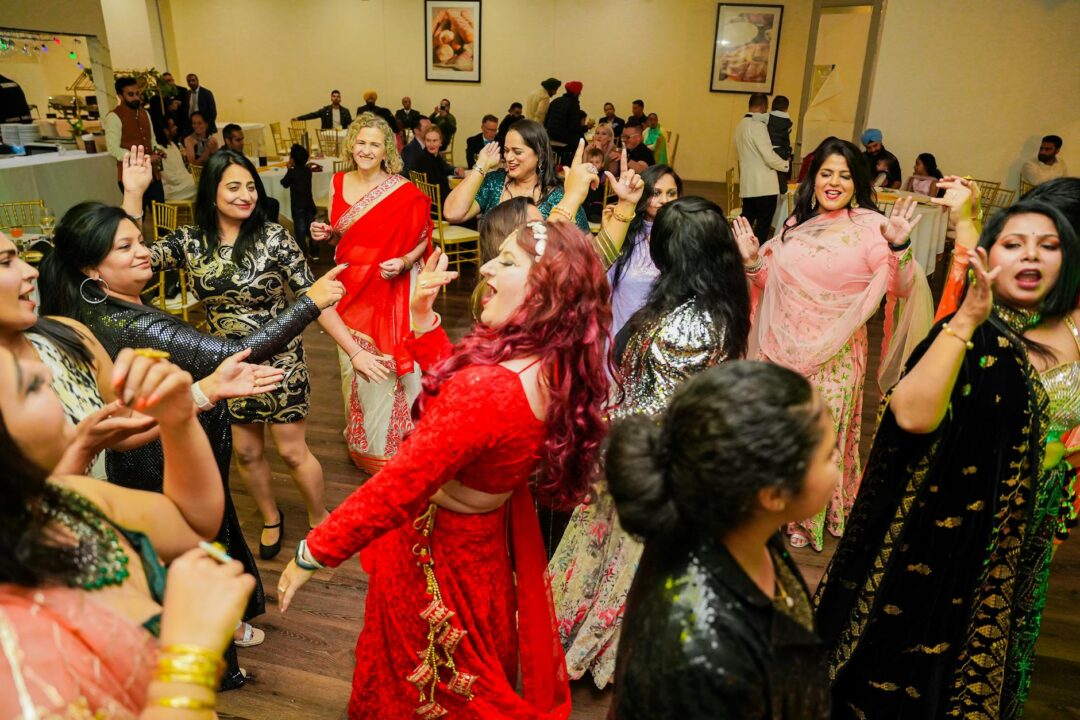
The sangeet (literally “sung together”) is the celebration night. Both families gather, choreographed dances are performed, speeches are made, and the dance floor stays open late. In Punjabi families the sangeet is often the largest event of the week. In South Indian weddings it is sometimes folded into smaller pre-wedding gatherings.
For US and AU couples, a 150 to 300 guest sangeet is typical. Plan for a stage, professional sound, dance floor space for at least 60 percent of guests at once, and a buffet. The dress code is colorful and formal: lehengas, sherwanis, sarees, and Indo-Western fusion in jewel tones, metallics, and pastels. Communicate this clearly on the sangeet insert so non-Indian guests do not arrive in cocktail black.
Haldi: the turmeric ceremony
The haldi is the most intimate pre-wedding ritual. Family members apply a paste of turmeric, sandalwood, rosewater, and oil to the bride and groom (separately, usually at their respective family homes). The paste is believed to brighten the skin, ward off evil, and bless the couple before the wedding day.
It is messy and joyful. Yellow stains everything. Most couples wear simple cotton clothes they do not mind ruining. The haldi often does not need a printed invitation: many families send the details by text or family WhatsApp group.
The wedding day: baraat, varmala, and the mandap
The wedding day itself is built around three movements: the groom’s procession (baraat), the meeting of the couple (varmala or jaimala), and the ceremony under the mandap (or at the gurdwara for Sikh weddings).
Baraat: the groom’s procession
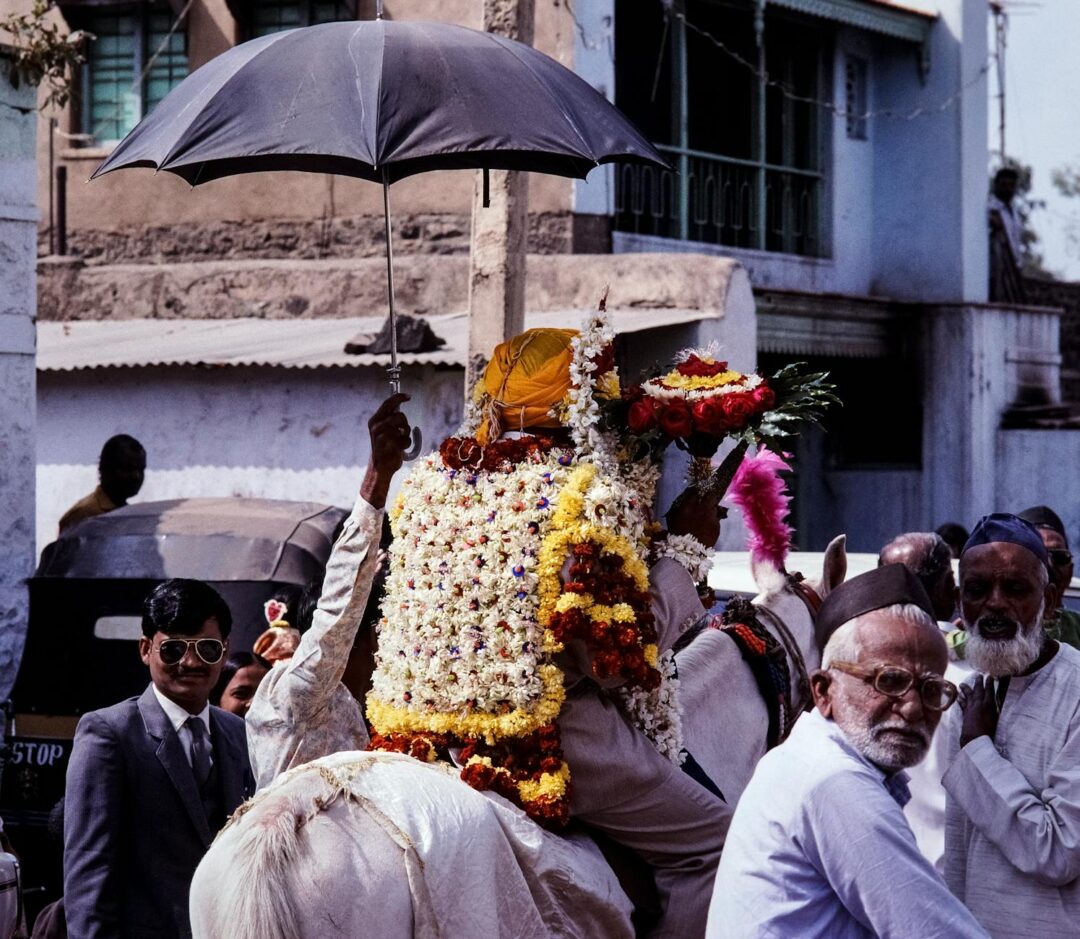
The baraat is the groom’s arrival at the wedding venue, traditionally on a white horse, accompanied by his family and friends dancing to a dhol drummer. In modern US and AU weddings, the horse is sometimes replaced by a vintage car, a decorated golf cart, or simply a procession on foot from the parking lot.
Venues need to know about the baraat in advance. The procession needs at least 30 to 50 meters (100 to 165 feet) of clear processional space (a parking lot, lawn, or closed driveway), permission for live drumming if outdoors, and ideally a covered welcome area where the bride’s family greets the groom with garlands and aarti.
Varmala or jaimala: the garland exchange
Once the groom reaches the mandap entrance, the bride enters and the couple exchanges garlands of fresh flowers (usually marigold, rose, or jasmine). This is the first moment they “meet” as a couple in front of the families. In many regional traditions, the groom’s friends try to lift him so the bride cannot reach to place the garland: a playful game that always ends well. Build in 10 to 15 minutes for it.
Mandap rituals and saat phere
The mandap is the four-pillared canopy under which the Hindu wedding ceremony is performed. Inside the mandap, a sacred fire (agni) is lit, and the priest (pandit) leads the couple through the central rituals. The most universal elements are:
- Kanyadaan: The bride’s father formally gives her hand to the groom.
- Hasta Milap: The hands of the bride and groom are tied together with a sacred thread.
- Mangal Phera (saat phere): The couple walks around the sacred fire, traditionally seven times, with each circle representing a vow (nourishment, strength, prosperity, family, offspring, longevity, friendship).
- Sindoor and Mangalsutra: The groom applies vermilion to the bride’s hair parting and ties the sacred necklace around her neck. These are the most visible markers of marriage in Hindu tradition.
A printed ceremony program is one of the highest-impact pieces of stationery a couple can include. Non-Indian guests follow along with what is happening, why it matters, and what each ritual means. A two-panel folded program with the ritual sequence on one side and a glossary on the other is ideal.
Vidaai: the bride’s farewell
After the ceremony, the bride formally departs her family home (or the venue) with the groom’s family. She throws rice or coins back over her head as a gesture of repaying her parents for their care. It is one of the most emotionally raw moments of the day. Plan 15 to 20 minutes for goodbyes and family photos before guests transition to the reception.
Regional and religious variations
“Indian wedding” is not a single tradition. Within India, customs vary dramatically by region, religion, and language. Below are the most common variations US and AU couples plan around.
North Indian Hindu (Punjabi, Marwari, Gujarati)
The most familiar template in Western media. Multi-day, music-heavy, mandap-based ceremony with the saat phere and sindoor moments. Punjabi weddings layer in additional rituals (chooda ceremony, kalire) and lean into reds, deep pinks, and golds. Gujarati weddings include the garba, a high-energy folk dance evening before the wedding.
South Indian Hindu (Tamil, Telugu, Malayali, Kannada)
Generally shorter (often 2 to 3 days), held in the morning, and lower-key in volume but rich in ritual. The mangalsutra tying is the central marriage moment, often performed at an auspicious time (muhurtham) calculated by the family priest. The aesthetic is gold and emerald green, with the bride traditionally wearing a Kanjeevaram silk saree. Music is classical (nadaswaram) rather than dance-driven.
Sikh (Anand Karaj)
The Anand Karaj is the Sikh wedding ceremony, performed at a gurdwara in front of the Guru Granth Sahib (the Sikh holy scripture). The couple walks around the Guru Granth Sahib four times (laavan) while four hymns are sung, each representing a stage of love and union with the divine. There is no fire, no mandap, and no priest in the Hindu sense. Sikh weddings are followed by langar (community meal) at the gurdwara and a separate evening reception.
Bengali Hindu and Muslim (Nikah)
Bengali weddings include the shubho drishti (bride and groom see each other through a betel-leaf veil for the first time) and the saat paak (the bride is carried in by her brothers and circles the groom seven times). The traditional palette is white and red. Indian Muslim weddings center on the Nikah (Islamic marriage contract), performed by an imam, and often include a Mehendi, a Manjha (haldi-equivalent), and a Walima reception hosted by the groom’s family.
For more on this topic, see our Chinese wedding traditions guide.
Stationery planning across the multi-day timeline
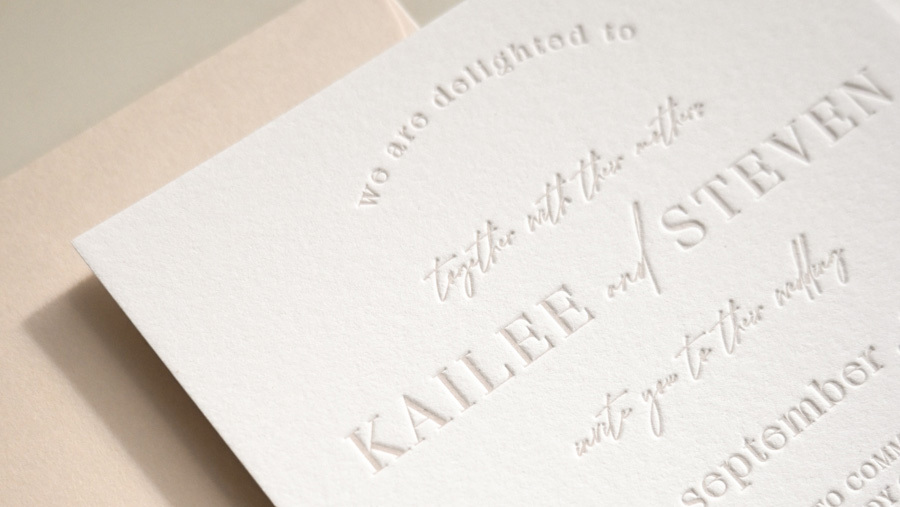
Most Indian couples in the US and AU send one cohesive invitation suite covering the full schedule, rather than a different invite per event. The suite typically includes:
- Main invitation with wedding day details
- RSVP card with meal preferences if relevant
- Information card for accommodations, travel, and dress code
- Mehndi insert with date, venue, dress code
- Sangeet insert with date, venue, dress code, and any performance signups
- Reception insert if separate from the wedding day
- Ceremony program distributed at the venue, explaining each ritual for guests
For a 200-guest wedding, expect to order 120 to 150 suites (most households share, especially for older relatives). Add 10 to 15 percent for keepsakes, photographers, and last-minute additions.
You can browse our full wedding invitation collection for design starting points. The foil invitation collection is the natural fit for the metallic accents most Indian wedding suites lean into. For early notice (recommended for any guest traveling internationally), our save the date collection covers the same design styles in a smaller, mailable format.
Color palettes by tradition
| Tradition | Core palette | Best print methods |
|---|---|---|
| Punjabi (Hindu and Sikh) | Crimson, gold, deep pink, ivory | Foil stamp, flat foil |
| South Indian Hindu | Gold, emerald green, ivory, mustard | Flat foil, metallic print |
| Bengali Hindu | Red, white, gold accents | Foil stamp, letterpress on Wild Cotton |
| Gujarati and Marwari | Saffron, fuchsia, gold, royal blue | Flat foil, digital on color stock |
| Muslim (Nikah) | Emerald green, gold, ivory, navy | Foil stamp, metallic print |
| Modern fusion | Burgundy, blush, gold, sage | Flat foil, letterpress, digital with metallic |
Venue logistics for US and AU couples
Western venues vary widely in their familiarity with Indian wedding requirements. Before signing a contract, confirm:
- Baraat space: Is there a parking lot, lawn, or driveway long enough for a procession of 50 to 200 people, ideally with a horse or vehicle entry? Is amplified or live drumming allowed?
- Mandap setup: Can the venue accommodate a four-pillared structure with floral installations, often 3.7 by 3.7 meters (12 by 12 feet) or larger? Is a sacred fire permitted indoors, or do you need an outdoor space?
- Catering: Can you bring an outside Indian caterer? Many venues have exclusive caterers who do not handle authentic regional Indian food well. Negotiate this in writing before booking.
- Multi-day hold: Is the venue available across two or three consecutive days, or do you need separate venues for sangeet, ceremony, and reception?
Build a 6 to 9 month booking timeline for venues, and 4 to 5 months for printed stationery. Paperlust returns designer proofs in 1 to 2 business days and includes two free rounds of edits per order.
Fusion trends to watch in 2026
- Bilingual stationery with English alongside Hindi, Punjabi, Gujarati, or Tamil script
- Dual ceremony programs explaining both Hindu and Western rituals for mixed-faith guest lists
- Sustainable mandaps built from rented or rehomed structures rather than single-use floral installations
- Daytime ceremonies followed by evening receptions rather than the traditional all-day format
- QR codes on the invitation suite linking to a wedding website, schedule, dress code visuals, and ritual explanations
Frequently asked questions
How many days does an Indian wedding actually take?
Most modern Indian weddings in the US and AU run 3 to 4 days: mehndi and sangeet on day one, haldi on day two morning, the wedding ceremony on day three, and the reception on day three evening or day four. Larger or more traditional families may extend to 5 or 7 days with additional rituals.
Do you need separate invitations for each ceremony?
No. Most couples send one cohesive invitation suite with insert cards for each event. This is more cost-effective than printing separate suites and gives the whole celebration a unified visual identity. Family-only events like a private haldi often do not need a printed invite at all.
What does saat phere mean?
Saat phere literally means “seven circles” in Hindi. It refers to the seven circumambulations the bride and groom take around the sacred fire during the Hindu wedding ceremony. Each circle represents a marital vow: nourishment, strength, prosperity, family, offspring, longevity, and friendship. After the seventh phera, the couple is considered formally married.
Are Sikh weddings the same as Hindu weddings?
No. Sikh weddings (Anand Karaj) are performed at a gurdwara in front of the Guru Granth Sahib, the Sikh holy scripture. There is no sacred fire, no mandap, and no priest in the Hindu sense. The couple walks around the Guru Granth Sahib four times (laavan) while four hymns are sung. Pre and post-wedding events are often shared in style with Punjabi Hindu weddings, but the religious ceremony itself is distinct.
How early should you send Indian wedding invitations?
Send save the dates 6 to 9 months ahead, especially if guests are traveling internationally. Send the main invitation suite 8 to 12 weeks before the wedding (closer to 12 for destination weddings). Order printed stationery 4 to 5 months out to allow for design rounds, family input, and shipping.
For more on this topic, see our Jewish wedding traditions guide.
Browse 500+ exclusive designs from independent artists, with foil, metallic, and letterpress finishes that suit every regional tradition. Designer proofs in 1 to 2 business days, two free rounds of edits, and free DHL Express shipping on US orders over $350 USD.
About Paperlust
Paperlust is a Melbourne-founded wedding stationery studio working with 500+ independent designers from Australia and around the world. Since 2014 we have helped couples across Australia, the US, and the UK plan stationery suites for every kind of wedding, including the multi-day, multi-tradition Indian celebrations that demand both visual richness and clear logistical communication. Every order is assigned a professional designer, comes with two free rounds of edits, and ships free via DHL Express on international orders over $350 USD. Designer proofs are returned in 1 to 2 business days. We were named a Westpac Business of Tomorrow in 2017 and plant a tree with every order.
A valuable guide to Indian wedding traditions, regional customs, and multi-day celebrations. MissMomo appreciates how the article also highlights the importance of choosing the right outfits for every wedding function.