
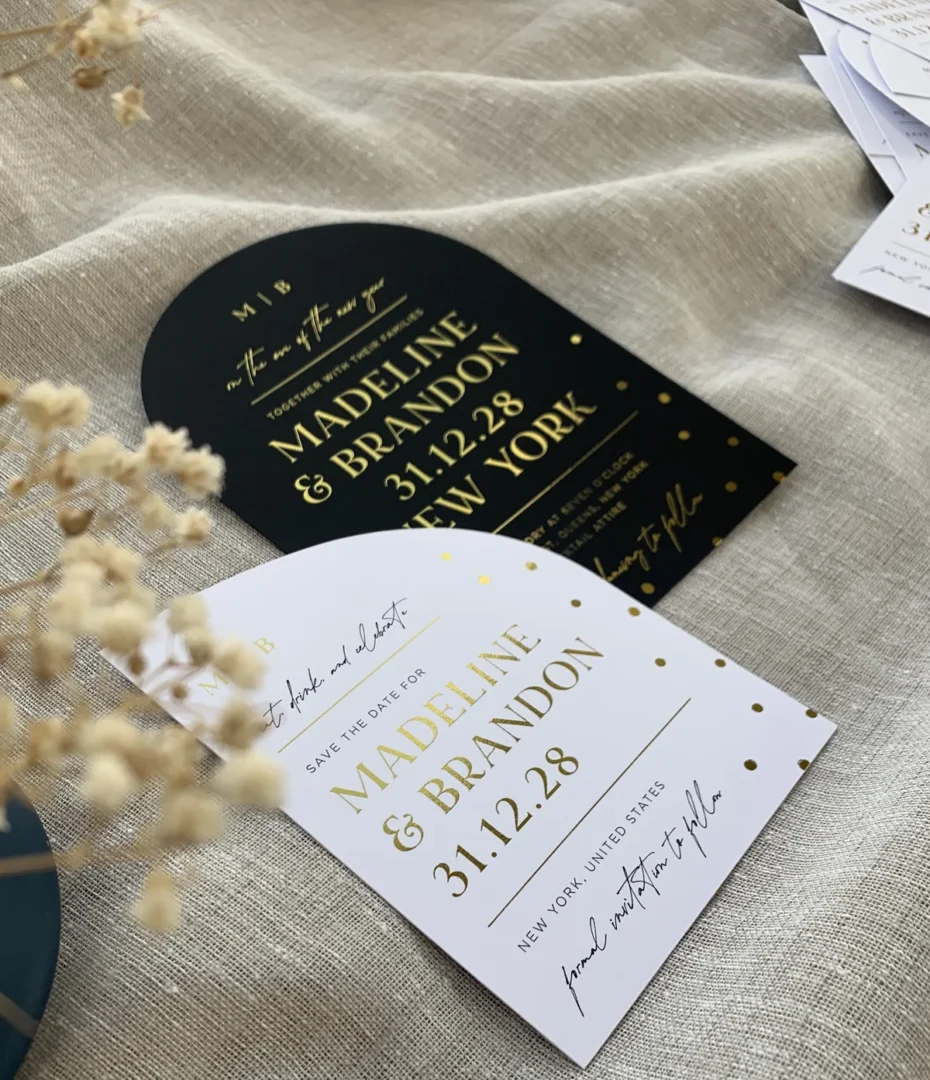
Wedding invitations set the tone for your entire day, but finding ones that look expensive without costing a fortune can feel overwhelming. The good news: the gap between “budget” and “luxury” invitations has never been smaller. With the right print method, paper choice, and ordering strategy, you can send beautifully designed invitations at prices that leave room for the rest of your wedding budget.
- Digital print invitations start at $2.04 per card, the most affordable way to get designer stationery printed professionally.
- Foil looks are achievable on a budget with flat foil on digital print stock, no custom die required, minimum order of 10.
- Ordering your full suite together (invitation + RSVP + details card) saves 15% compared to ordering pieces separately.
- Avoid rush fees by placing your order 10-12 weeks before the wedding date.
- The biggest cost drivers are paper weight, print method, and quantity, not designer quality.
- A 10% off first-order discount and a $5 sample pack let you test before you commit.
How Much Should Wedding Invitations Cost? A Realistic Budget Breakdown
Most couples spend between $150 and $600 on wedding invitations in the US, including envelopes. Where you land in that range depends mainly on your print method and guest count, not necessarily the design you choose. Understanding the price tiers before you start shopping saves a lot of frustration.
The three main price tiers
| Budget range (100 guests) | What you get | Best for |
|---|---|---|
| Under $200 | Digital print, standard weight paper, basic envelopes | Minimalist styles, modern typography, simple layouts |
| $200 – $400 | Digital print on premium card stock OR flat foil on matte; white envelopes included | Most couples; full suite possible at this range |
| $400 – $600 | Flat foil, metallic, or letterpress on specialty papers; full suite | Couples wanting tactile finishes or bold color stock |
| $600+ | Letterpress, bespoke paper combinations, large guest counts | Heritage-feel weddings; heirloom quality a priority |
The single biggest lever you have is print method. Switching from digital print to letterpress can triple the per-card cost on the same design. That does not mean letterpress is not worth it for some couples, it means knowing the trade-off before you fall in love with a design.
Per-card vs per-suite pricing
Invitation printing prices are quoted per card, but you will need multiple pieces per guest. A typical suite includes the invitation, an RSVP card, and a details card. Budget for 2-3 cards per guest, not one. At $2.04 per card for digital print, 100 guests means roughly $600-$900 for a full suite at full price, but bundle discounts and first-order savings bring that down substantially.
What Drives Wedding Invitation Prices (Paper, Printing, Quantity)
Three variables account for nearly all the price variation you see between invitation companies. Once you understand them, you can make deliberate trade-offs instead of guessing why one suite costs three times another.
Print method
This is the biggest cost driver. Digital print is the most affordable option, full color, fast production, works on a wide range of papers. Flat foil adds a metallic shine at an accessible price point because it uses pre-made foil film applied via roller heat, no custom metal die required. Letterpress is the most labor-intensive method: hand-mixed inks, specialty cotton paper, and a pressed impression that you can feel with your fingertips. Metallic print sits between digital and flat foil on price, using gold pigment at a fifth imaging station for a warm shimmer at a lower per-card cost than foil.
Paper weight and type
Heavier paper costs more. Digital print works on stocks from standard card weight up to 380gsm premium. Letterpress requires 300gsm Wild Cotton as a minimum, the paper is thick enough to take the impression without tearing. Specialty papers like kraft, vellum, and color stock add a small premium but are often more affordable than upgrading your print method.
Quantity and minimum orders
Most print-at-home and digital-print services have low or no minimums. Flat foil at Paperlust starts at a minimum of 10 cards, making it accessible even for intimate guest lists. Letterpress requires a higher minimum of 50 cards given the production setup involved. The practical upside: digital print per-card prices drop as quantity rises, so ordering 120 for 100 guests is often smarter than ordering exactly 100 and running short.

Cheapest Wedding Invitation Options Compared – Digital, Print-at-Home, Printed
Budget couples typically weigh three formats: downloading a digital design and printing at home, ordering through a local print shop, or ordering from an online stationery printer. Each has real trade-offs that rarely get spelled out honestly.
Print-at-home
The cheapest upfront option. You purchase or download a template, edit it yourself, and run it through a home or office printer. True cost is rarely zero, consumer ink is expensive, home printers do not handle card stock well, and cutting by hand takes time. The result rarely looks as polished as a professionally printed card, and paper stock is limited to what your local store carries.
Best for: Very small guest counts (under 30), casual backyard weddings, couples with design experience and a quality printer.
Local print shop
Local printers can produce clean digital-print invitations, but setup fees and minimum orders push costs up for smaller quantities. Design help is inconsistent, you may get a skilled operator or someone who just runs your PDF. Proofing turnaround varies and rush jobs are expensive.
Best for: Couples who want local control and can supply a press-ready PDF.
Online stationery printer
The sweet spot for most couples. Online specialist printers offer lower per-card pricing through scale, professional design review included, and a much broader range of print methods and paper stocks. Paperlust includes a professional designer on every order who reviews your file and sends a proof within 1-2 business days. You get two rounds of edits included at no extra cost.
Best for: Most couples, any guest count, all print method options.
Cost comparison at 100 invitations
| Option | Estimated cost (invitations only) | Design help included? |
|---|---|---|
| Print-at-home | $40-$120 (paper + ink) | No |
| Local print shop | $150-$350 | Varies |
| Online printer (digital) | $204+ (from $2.04/card) | Yes (designer + proof) |
How to Get Foil and Premium Looks on a Budget
Foil invitations used to mean high minimums, long lead times, and prices that required a dedicated line item in the wedding budget. Flat foil has changed that. Here is how to get the mirror-bright metallic look at a price point most couples can work with.
Flat foil vs letterpress: the two upgrades couples ask about most
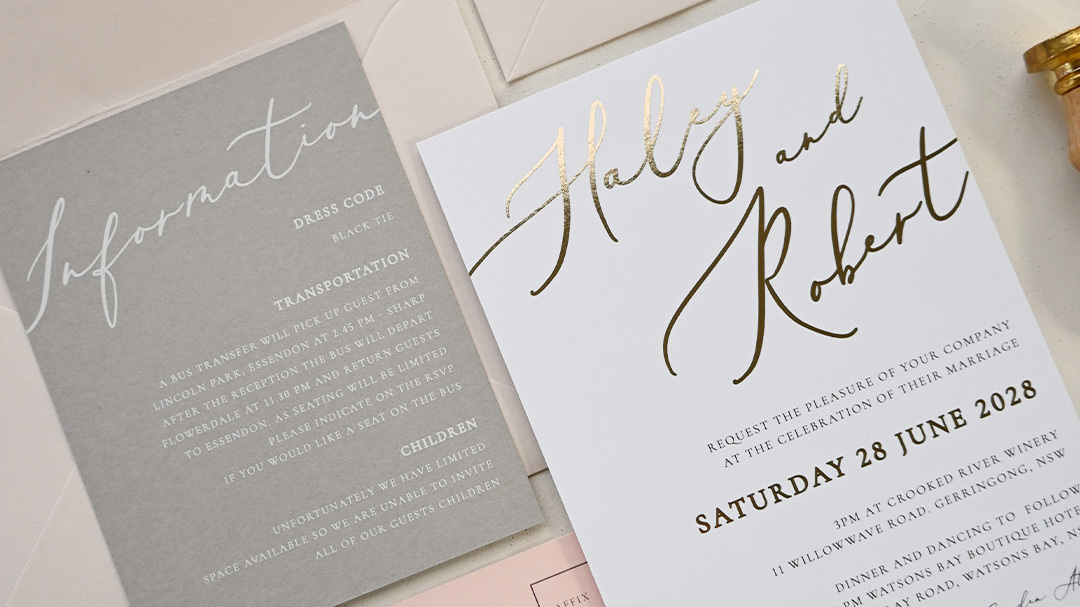
Flat foil applies pre-made metallic film directly to the card without a custom die. There is no debossed impression, the foil sits flush on the surface, giving you a clean, mirror-bright metallic finish. Because no custom die is needed, minimum orders are low and production is faster. At Paperlust, flat foil starts at a minimum of just 10 cards, practical even for intimate weddings.
Letterpress uses hand-mixed inks pressed into 600gsm Wild Cotton paper, leaving a tactile impression you can feel when you run your finger across the text. The result is more physical and is widely regarded as the luxury standard for wedding stationery. Letterpress requires a minimum of 50 cards given the setup involved, and production runs about 20 business days.
For most couples shopping on a budget, flat foil delivers strong visual impact at a fraction of the letterpress cost. If tactile feel is the priority and budget allows, letterpress is the upgrade to consider.
Foil colors available
Flat foil is available in gold, pale gold, rose gold, silver, copper, red, green, blue, hot pink, celestial blue, and holographic finishes. Gold remains the top seller for wedding stationery, but silver and rose gold are strong runners-up for modern and minimalist palettes.
Metallic print: the most affordable metallic option
If flat foil is still outside your budget, metallic print is worth considering. It uses a gold pigment applied at a fifth imaging station during digital printing, the result is a subtle, warm shimmer rather than a mirror-bright finish. It costs significantly less than foil and works on matte, linen, and premium paper stocks. For couples who want a hint of gold without the full foil commitment, metallic print is the most affordable metallic option.
Save Money With Bundles – Invitation Suites vs Separate Pieces
One of the most reliable ways to reduce your total stationery spend is ordering your full suite in a single transaction. Most couples need three card types at minimum: the invitation itself, an RSVP card, and a details or information card.
The 15% bundle discount
Paperlust offers 15% off when you order three or more card types together. On a full suite order of $300, that is $45 back in your pocket, roughly the cost of your RSVP cards covered by the discount alone. The discount applies automatically at checkout when three or more card types are in your cart.
What to include in your suite
- Invitation card, the anchor of the suite; sets the visual tone.
- RSVP card and envelope, required for headcount tracking; keep the design matching.
- Details or information card, venue directions, accommodation blocks, dress code, website URL.
- Optional additions: wishing well insert, rehearsal dinner invitation, welcome dinner note.
Matching designs across card types
Suites look most polished when all card types share the same design family. Paperlust’s 500+ exclusive designs are built as full suites, so if you love an invitation, the RSVP and details card in the matching style are already available. You are not piecing together mismatched cards from different collections.
Timing Your Order to Avoid Rush Fees
Rush fees are one of the most avoidable invitation costs, and they hit couples who wait. Standard wedding invitation timelines are well established: guests need your invitation 6-8 weeks before the wedding. That means your invitations need to be in-hand at least 8 weeks out, which means ordering at least 10-12 weeks before the date to allow for proofing, production, and shipping.
The production timeline by print method
| Print method | Typical production time | International transit (DHL Express) |
|---|---|---|
| Digital print | ~8-10 business days | 2-4 business days |
| Flat foil / metallic | ~12-15 business days | 2-4 business days |
| Letterpress / flat foil on cotton | ~20 business days | 2-4 business days |
Rush print option
If your timeline is tighter than expected, Paperlust offers a 24-hour rush print on digital print orders for an additional fee. This covers production only, transit time is separate. Rush is not available for letterpress, where the production process cannot be compressed. Plan ahead for that method.
Proofing: where timelines slip
Your designer sends a proof within 1-2 business days of your order. From there, you have two rounds of edits included. Most couples approve in one or two days. The proofing stage is where timelines most often slip, long approval delays from busy couples are the main culprit, not the printer. Build 3-5 days of buffer into your schedule for the back-and-forth.
The Best Affordable Wedding Invitation Styles for 2026
Certain design directions are holding strongly in 2026 for couples shopping at budget-conscious price points, partly because they look elegant in digital print without needing foil or specialty paper to succeed.
Modern minimalist
Clean lines, generous white space, and bold typography-led layouts are among the most affordable styles to print beautifully. Minimalist designs do not rely on intricate illustrations or metallic accents to make an impact, a single well-chosen typeface on quality card stock reads as luxury at digital-print prices.
Classic script and calligraphy
Script-heavy designs have strong visual presence in digital print. A calligraphy-style header on matte 300gsm stock looks polished without any foil. These designs also translate well to flat foil if you later decide to upgrade the typography to metallic.
Botanical and floral line art
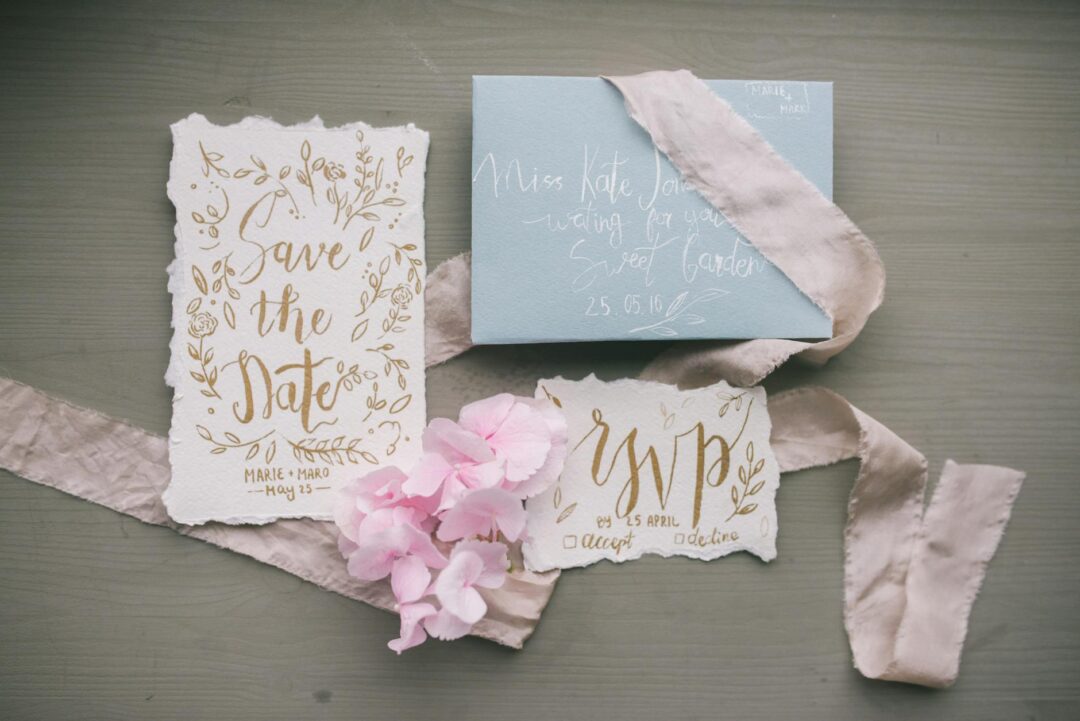
Detailed botanical illustrations are a perennial favorite and print crisply in digital. The fine line work that makes these designs feel hand-drawn reproduces well at standard digital print resolution, no specialty method needed.
Dark and moody
Deep green, navy, charcoal, and terracotta color palettes are popular in 2026. Many of these designs work on standard digital print using full-color CMYK, you do not need color-stock paper to achieve the look. Adding white ink on kraft or a dark color stock is one upgrade that stays affordable.
Arch and die-cut formats
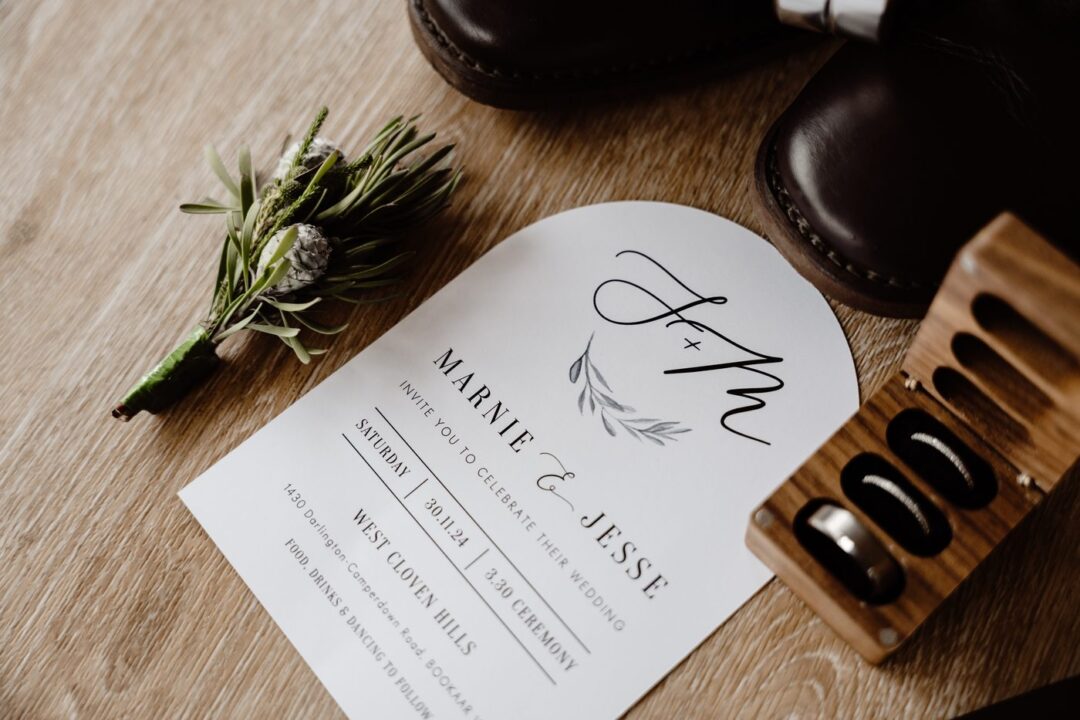
Arch-shaped invitations have moved from a niche format to mainstream. The arch shape is available across digital, flat foil, and metallic print methods. The die-cut cost is included in the per-card price at Paperlust, it is not a separate line item.
Cheap vs Inexpensive – What Quality to Expect at Each Price Point
The word “cheap” in wedding planning can mean two very different things: a low price that reflects low quality, or a low price that reflects smart buying. The distinction matters when you are deciding where to spend and where to save.
What you can rely on at the affordable end
- Designer quality: Every Paperlust design is created by an independent Australian or international artist. At $2.04/card in digital print, you are buying that design, not a compromise version of it.
- Professional proofing: A designer reviews your file and sends a proof within 1-2 business days. Mistakes are caught before printing.
- Paper quality: Digital print runs on 300gsm matte, 300gsm linen, and 380gsm premium stocks, these are heavy, quality papers. The cheapest invitation option is not thin or flimsy.
- Envelopes included: White envelopes are included with every order. Colored or textured envelopes are available as an add-on.
Where spending more makes a real difference
- Tactile impression: Letterpress leaves a physical impression that you feel when you run your finger across it. Digital print and flat foil are visually rich but flat to the touch.
- Paper weight perception: 600gsm Wild Cotton (letterpress) feels noticeably heavier in hand than 300gsm digital stock. Weight signals luxury in a way that is immediately felt when guests open their envelopes.
- Specialty papers: Vellum overlays, kraft, and color stock papers have distinct textures and visual character that standard stocks do not replicate.
The “cheap” trap to avoid
The cheapest option by per-card price often has hidden costs: no designer review, no proofing included, limited paper options, and no recourse if there is a print defect. A happiness guarantee, Paperlust’s commitment to a free reprint or refund if you are not satisfied, is a real differentiator at the affordable end of the market. Check for it before you commit to a low-price offer that has no quality backstop.
How to Cut Guest List Costs Without Cutting Corners
Your guest count is the most direct multiplier on invitation cost. Cutting 20 guests from your list saves more per dollar than switching from flat foil to digital print. But guest-list decisions are rarely pure math. Here are smarter levers to pull before you compromise on print method or paper.
Order strategically, not exactly
Order 10-15% more than your confirmed guest count. Couples who order exactly 100 for 100 guests almost always need reprints for last-minute additions, errors, or keepsakes, and reprints from a new production run cost significantly more per card than ordering extras upfront. The marginal cost of extra cards at the time of your main order is low.
Use the Address Manager tool
Addressing mistakes are a common source of reprints. Paperlust’s Address Manager tool lets you import guest addresses via Excel or direct entry. Getting addresses right on the first print run is one of the most practical ways to avoid costly re-orders.
Send save the dates only to travel guests
Save the dates are typically sent to all guests, but you can keep costs down by sending them only to guests who need travel planning, out-of-towners, interstate guests, or international guests. Local guests who are close family or close friends will understand a direct call or text. Your invitation is the formal record; your save the date is the logistics tool.
Digital save the dates as a hybrid option
Paperlust offers digital save the dates at $35 flat via customer service, you receive a JPEG or PDF of your design to send yourself via email or text. This is not available as a self-serve checkout option, but it is worth asking about if you want design consistency with your printed suite at a much lower upfront cost. Note: Paperlust does not send them on your behalf.
Affordable Wedding Invitation FAQs
What is the cheapest way to do wedding invitations?
Digital print is the most affordable professionally printed option, starting at $2.04 per card at Paperlust. Print-at-home templates are cheaper upfront but cost more in time and often produce lower-quality results. For most couples, digital print with a professional designer included is the better value.
How much should I budget for 100 wedding invitations?
For 100 digital-print invitations (card only, not a full suite), budget $200-$350. A full suite, invitation, RSVP, and details card, for 100 guests typically runs $400-$700 in digital print before discounts. The 15% bundle discount and a 10% first-order discount both apply and reduce that range meaningfully.
Can I get foil invitations on a budget?
Yes. Flat foil at Paperlust starts at a minimum of 10 cards and delivers mirror-bright metallic shine without a custom die, keeping cost and lead time low. Metallic print (gold pigment) is the most affordable metallic option if flat foil is still outside your budget.
How far in advance should I order wedding invitations?
Order 10-12 weeks before your wedding date for standard print methods. Letterpress needs 12+ weeks to allow for 20 business days of production plus transit plus proofing time. Digital print can be ordered as close as 6-8 weeks before, or even faster with the 24-hour rush print add-on.
Are cheap wedding invitations lower quality?
Not necessarily. Paperlust’s digital print invitations start at $2.04 per card on 300gsm+ card stock with a professional designer review included. The paper is heavy and the color quality is high. What changes at higher price points is the print method (foil, letterpress) and paper feel, not the design quality or production standard.
Is free shipping available on wedding invitations?
International DHL Express shipping is free on orders over $350 USD. Orders under that threshold are charged at DHL rates. Australian orders receive free overnight Startrack shipping on all orders regardless of size.
Can I order a sample before committing?
Yes. A $5 sample pack includes 7 designs across different print methods so you can feel the paper and see the print quality in person before placing your full order. A $15 custom sample lets you order a sample of your specific design, available for most print methods but not letterpress. A $20 full swatch kit includes all available paper stocks.
What is included in the price of wedding invitations at Paperlust?
The per-card price includes professional design review, up to two rounds of edits, printing, and white envelopes. A professional designer is assigned to every order. The 100% happiness guarantee covers a free reprint or refund if the result is not right.
Ready to find your invitations?
Browse 500+ exclusive designs from $2.04 per card. Designer review and proof included on every order.