
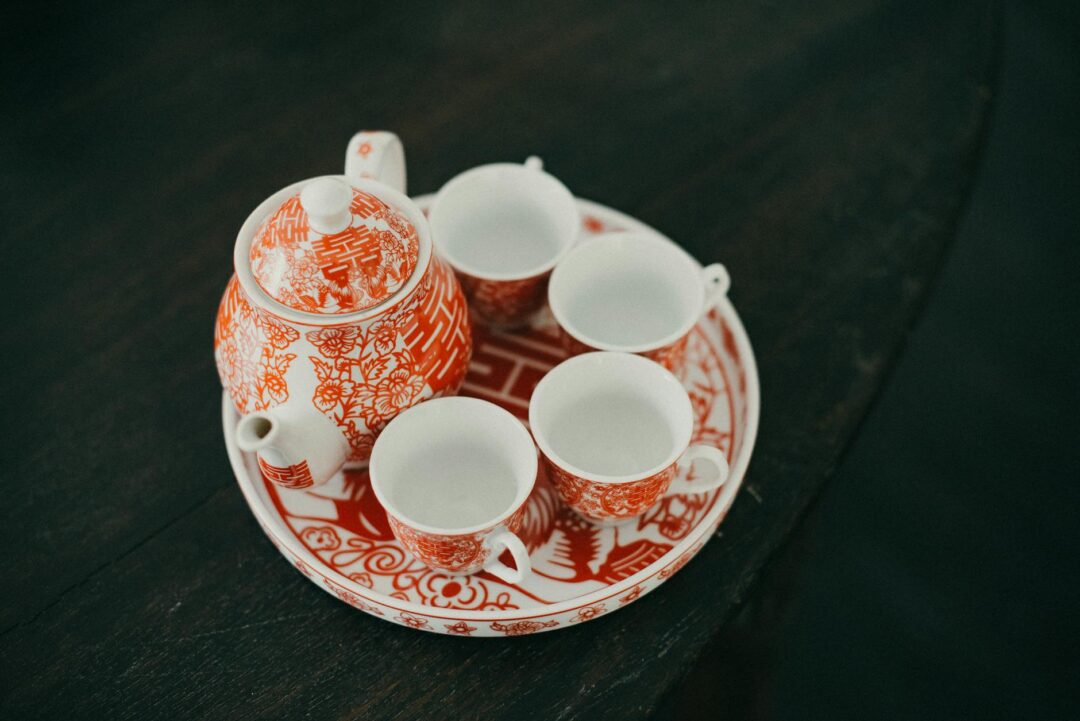
A Chinese wedding is rarely just one event. It is a carefully sequenced day (often spread across two) of family rituals, symbolic foods, and color-coded gestures that have carried meaning for centuries. For couples planning a wedding in Australia or the United States, the question is almost never whether to honor these traditions, but how to weave them into a celebration that also reflects a modern, often bicultural life. This guide covers the rituals you’ll see at a Chinese wedding today, the etiquette behind each one, the practical details most articles skip (red envelope amounts, tea ceremony seating, stationery design), and how to translate the symbolism into invitations and signage that feel intentional rather than themed.
- The tea ceremony is the most important traditional ritual; the bride and groom serve tea to elders in a strict seniority order and receive red envelopes (lai see) or jewelry in return.
- The hair-combing ritual happens the night before, performed by a “good-fortune woman” with four symbolic strokes and four blessings.
- Door games ask the groom and groomsmen to pay a symbolic toll of red envelopes; in Australia and the US in 2026, common amounts run $88, $108, $168, $188, $288 AUD or USD per envelope, anchored on the lucky number 8.
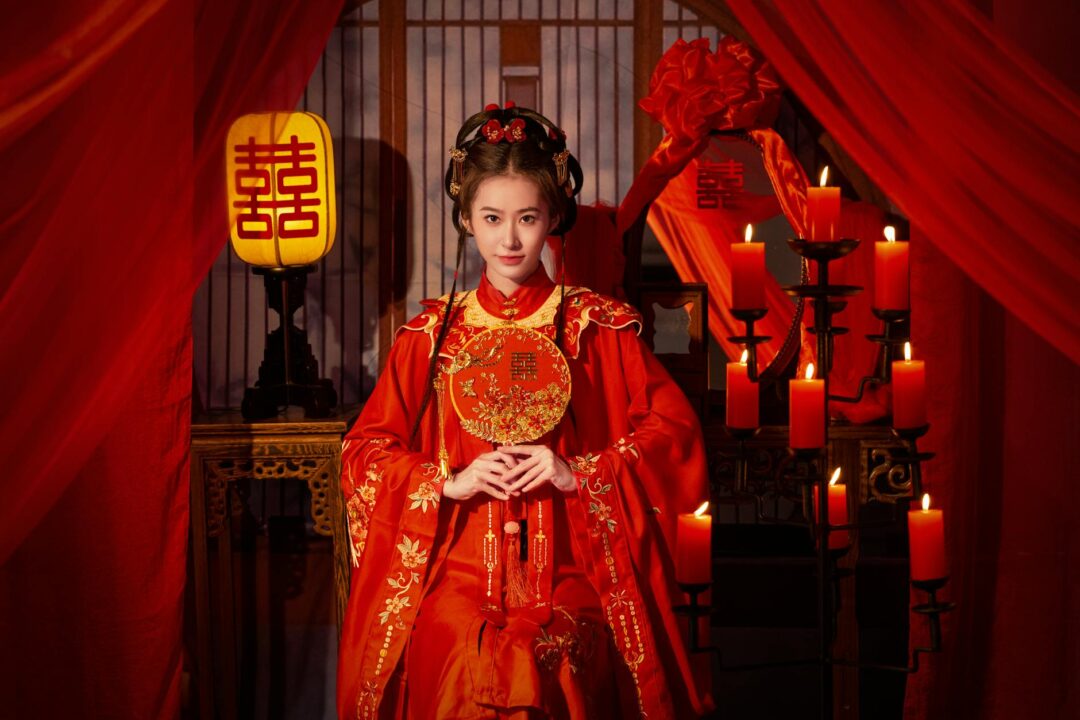
- The bride traditionally wears the qun kwa (Cantonese) or qipao (Mandarin) in red and gold for ceremonial moments, often changing into a Western gown for the banquet and a third look mid-reception.
- For invitations, the dominant palette is red and gold with the double happiness 囍 motif; foil printing reads as the most authentic premium choice.
The shape of a modern Chinese wedding day
Most Chinese weddings in Australia and the US today compress the historical multi-day timeline into 18 to 24 hours, often split between the bride’s family home, a tea-ceremony venue, and an evening banquet at a Chinese restaurant or hotel ballroom.
The order of events on a typical fusion day: hair combing the night before; door games at sunrise; tea ceremony for the bride’s family mid-morning; church or civil ceremony around noon; portrait session and a second tea ceremony for the groom’s family in the afternoon; banquet from early evening with multiple outfit changes and toasts. What rarely gets dropped is the tea ceremony, the door games, and the banquet itself, and these are the moments that most need to be communicated clearly on stationery.

The tea ceremony: order, etiquette, and what the stationery should say
The tea ceremony (jing cha or 敬茶) is the formal moment when the couple is introduced to one another’s families and recognized as husband and wife within the family hierarchy. It typically happens twice on the wedding day: once at the bride’s home in the morning before she leaves, and once at the groom’s home or venue after the bride has been collected.
The couple kneels or stands depending on family preference, and serves a sweet tea with red dates, lotus seeds, and longan (symbolizing fertility, harmony, and a sweet union) to elders in strict order of seniority. After accepting the tea, each elder offers a blessing and presents a lai see (red envelope) or a piece of gold jewelry, often both.
Order of service
The seniority order is fixed and you should not improvise. From most senior to most junior: paternal grandparents, maternal grandparents, parents (groom’s first if the ceremony is at his family home, bride’s first if at hers), aunts and uncles (older to younger, paternal side first), older siblings and their spouses, older cousins. Younger relatives do not receive tea; they participate by helping pour, holding the tray, or by bowing afterward.
Tea ceremony seating chart: the detail most articles skip
If the tea ceremony has more than 12 elders being served, a printed order card (jing cha order) avoids the awkwardness of pausing mid-ceremony to confirm who is next, and it gives the photographer a cue sheet. A working order card includes the full name of each elder in service order, their relationship to the couple in both English and (where appropriate) the Chinese kinship term, the side of the family marked clearly, and a service number. A small 5×7 inch (127 x 178 mm) printed card in matching red and gold reads as both functional and ceremonial. Custom seating charts can be designed to mirror the invitation suite.
Sample wording for the family announcement card
Saturday, the Fourteenth of June
The Family Home of Mr. and Mrs. Lee
1. Yeh Yeh and Mah Mah Lee
2. Gung Gung and Po Po Wong
3. Mr. and Mrs. David Lee
4. Mr. and Mrs. Henry Wong
5. Uncle Peter and Auntie Susan Lee
6. Cousin Michelle Wong
Hair combing the night before
The hair-combing ritual (Shang Tou or 上頭) happens the night before the wedding, traditionally at a midnight hour chosen by a Chinese almanac. Both the bride and the groom undergo it separately at their own family homes, performed by a “good-fortune woman” (a relative or family friend who is married, has children, and whose own marriage is considered happy).
She combs the hair four times, each stroke accompanied by a spoken blessing: from beginning to end (a marriage that lasts a lifetime); from harmony to old age (love and respect through old age); for a house full of children and grandchildren (fertility and family); for longevity and prosperity. After the combing, the bride or groom eats a small bowl of glutinous rice balls (tang yuan) for sweetness and unity. If you are inviting a small circle of women to attend, a coordinating insert card in the invitation suite is a thoughtful touch.
Door games and red envelope amounts in 2026
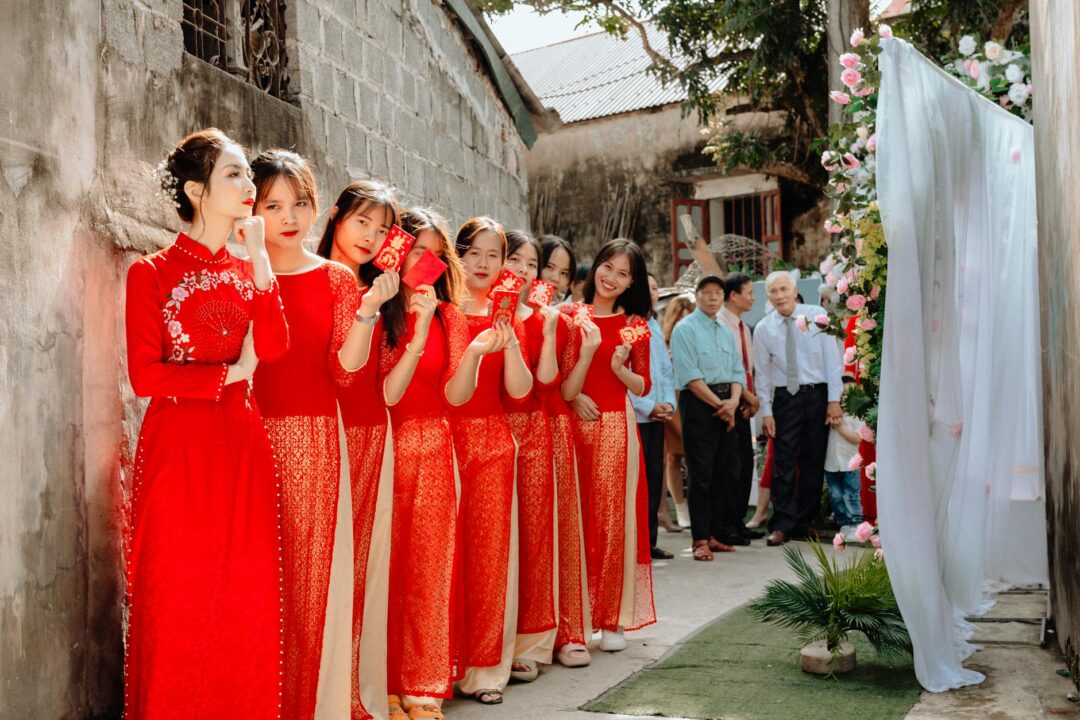
Door games (chuangmen or 闯门) happen when the groom arrives at the bride’s family home to collect her. The bridesmaids stand at the door and refuse to let him in until he has completed a series of challenges and paid a toll in red envelopes. Common challenges include eating bitter, sour, sweet, and spicy foods (representing the four flavors of marriage), answering trivia about the bride, singing a love song, and doing pushups while declaring love. The bridesmaids set the difficulty.
How much should red envelopes contain?
This is the question competitor articles consistently dodge, so here are the practical 2026 amounts used by Chinese-Australian and Chinese-American couples. Amounts are anchored on the lucky number 8 (the Mandarin word for eight, ba, sounds like the word for prosperity, fa) and avoid the unlucky number 4 (which sounds like the word for death).
| Recipient | Per envelope (AUD/USD) | How many |
|---|---|---|
| Lead bridesmaid (sister of the bride or maid of honor) | $288 to $688 | 1 |
| Bridesmaids (each) | $88 to $188 | 1 per bridesmaid |
| Group challenge envelopes (handed out during games) | $8.80, $18.80, $28.80 | 4 to 8 small envelopes |
| Tea ceremony elder gift envelope (from couple to elder) | Symbolic only, often empty or with a small token, since the elders are giving | N/A |
| Banquet guest gift envelope (from guests to couple) | $168 to $388 per single guest, $288 to $688 per couple | Per guest household |
The lead bridesmaid envelope is intentionally generous, since she usually distributes portions to the rest of the bridal party. Challenge envelopes are kept small in value but plentiful in count, since the energy comes from the back-and-forth, not the dollar figure. Avoid round numbers like $100 or $200, which read as flat; the doubled-eight ($88, $188, $288) reads as both generous and culturally fluent. Plan to order roughly 30 to 40 small envelopes, 8 to 12 medium, and 1 large. Custom envelopes that match your invitation suite (gold foil monogram or 囍 motif) need 4 to 6 weeks lead time.
What the bride and groom wear
The traditional Cantonese bridal garment is the qun kwa (裙褂), a two-piece red and gold embroidered jacket and skirt. The Mandarin equivalent is the qipao (旗袍), a single-piece fitted red dress with a high collar and frog closures. Both are heavy with gold embroidery, often featuring dragons (groom, strength) and phoenixes (bride, grace).
In a modern wedding, most brides wear the qun kwa or qipao for the tea ceremony and door games, change into a Western white gown for the church or civil ceremony, and return to a third look (often a red or gold cocktail dress) for the banquet entrance and toasts. Some add a fourth change before the cake cutting. Grooms either wear a cheongsam (changshan, a long dark-blue or black robe) or a Western tuxedo with a red-and-gold pocket square as a nod.
The banquet: courses, toasts, and the menu card
The banquet is the social and gastronomic centerpiece of a Chinese wedding. A traditional Cantonese wedding banquet runs 8 or 9 courses (8 for prosperity, 9 for longevity, never 4); a northern Chinese banquet may extend to 10 or 12. Each course is symbolic.
| Course | Typical dish | Symbolism |
|---|---|---|
| 1 | Cold platter (jellyfish, roast duck, suckling pig) | Joy, abundance, virginity (suckling pig) |
| 2 | Shark fin soup (or a sustainable substitute) | Wealth, status |
| 3 | Lobster or prawns | Happiness, laughter (the red color) |
| 4 | Roast suckling pig or barbecued pork | Wholeness, family completeness |
| 5 | Abalone with sea cucumber | Prosperity |
| 6 | Steamed whole fish | Surplus and abundance for the year ahead (yu sounds like surplus) |
| 7 | Fried rice or noodles | Long life (uncut noodles), abundance |
| 8 | Sweet red bean or lotus seed soup | Sweetness in marriage, fertility |
| 9 | Wedding cake or sweet pastries | Celebration, Western fusion gesture |
Menu cards are not just decorative: many Western guests will not recognize the dishes, and a printed menu in English with the Chinese name and the symbolic meaning underneath turns the meal into cultural storytelling. Wedding menu cards in red and gold to match the invitation suite are one of the highest-leverage pieces at a Chinese banquet. Toasts (yam seng or 飲勝, literally “drink to victory”) happen multiple times during the meal, with the host calling “yam seng” three times in increasingly drawn-out cheers as everyone stands.
Color, motifs, and stationery design
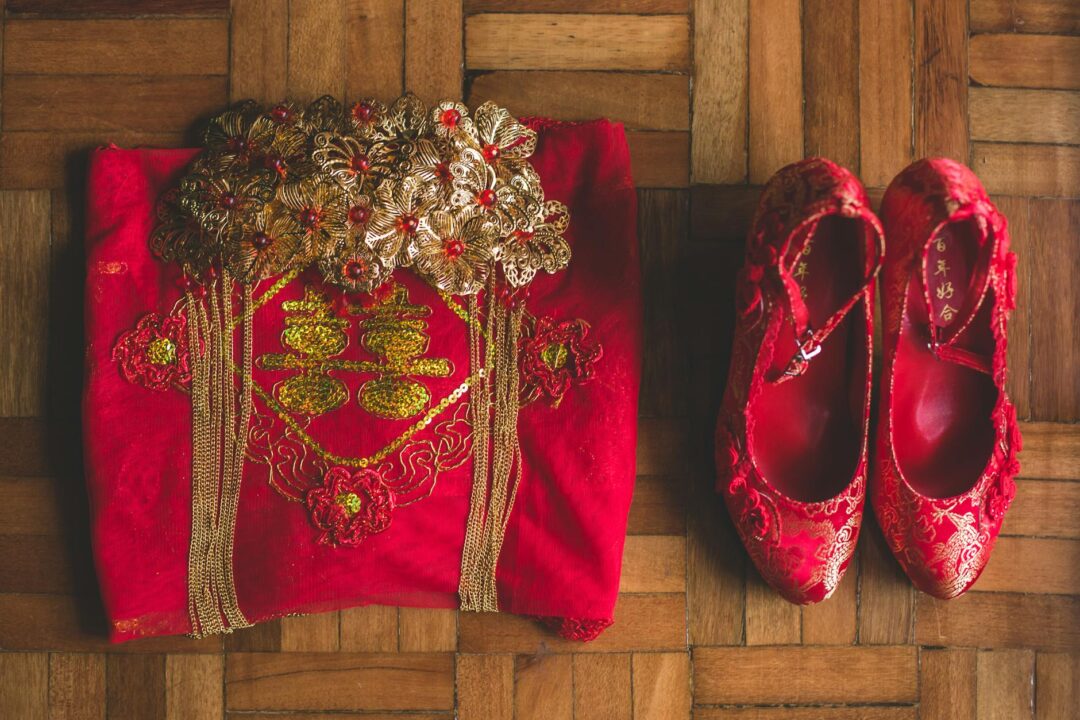
Red is the dominant color (joy, luck, protection from evil), gold the secondary color (wealth, high status). White is traditionally avoided in stationery because it is the color of mourning, though a modern fusion bride will often wear a Western white gown for the church ceremony. Motifs that read as authentic on stationery: double happiness (囍), the most universally recognized wedding character; dragons and phoenixes (groom and bride in balance); mandarin ducks (lifelong fidelity); peonies (prosperity); pomegranates (fertility); and jianzhi paper-cut borders as a frame around the invitation text.
Print methods that suit a red-and-gold palette
Three print methods carry this aesthetic best. Foil stamp uses a custom die to press real gold foil into the paper with a tactile debossed impression, the closest contemporary equivalent to traditional gold-leaf Chinese wedding cards; pairs beautifully with deep red 380gsm Premium stock. Flat foil applies foil without a die at a lower 10-card minimum, faster lead time. Letterpress creates a debossed impression on 600gsm Wild Cotton (the heaviest paper available) and works for a minimalist modern design with 囍 as the only ornament. Digital print starts at $2.04 per card and can reproduce a full paper-cut design photographically, but lacks the tactile feel of foil.
Sample wording: bilingual Chinese wedding invitation
and
Mr. and Mrs. Henry Wong
request the honor of your presence
at the marriage of their children
Michelle Lee & Andrew Wong
李美玲 & 黃安祖
Saturday, the Fourteenth of June
Two Thousand and Twenty Six
at four o’clock in the afternoon
Tea Ceremony to follow
Banquet at six o’clock
Crown Casino, Southbank, Melbourne
Save the dates and the stationery timeline
For a Chinese wedding with a banquet and multiple ceremonies, save the dates should go out earlier than for a Western-only wedding. Elderly relatives often need to travel internationally, and the tea ceremony cannot proceed without the senior generation present.
| Stationery piece | When to send |
|---|---|
| Save the date (international guests) | 10 to 12 months before |
| Save the date (local guests) | 8 months before |
| Formal invitation | 3 to 4 months before |
| Tea ceremony invitation (close family only) | 2 months before |
| RSVP deadline | 6 weeks before |
| Banquet seating chart finalized | 2 weeks before |
For Paperlust customers in the US and Australia, save the dates are most often ordered as a digital printed card or a postcard format. International guests benefit from a card with the venue, the closest international airport, and a personal note about whether traditional dress is expected at any of the ceremonies.
Banquet seating and the politics of family hierarchy
At the banquet, table 1 is reserved for the most senior members of both families: paternal grandparents, parents, and honored elders. Table 2 is the second tier: maternal grandparents and the couple’s siblings. The bridal party often sits together at table 3 or at a head table near the stage. Banquet seating at a Chinese wedding is more politically sensitive than at a Western reception. Mistakes (seating a maternal grandparent at table 3 instead of table 1, or seating divorced parents at the same table without checking) cause real tension. Confirm seating with a parent or aunt before printing.
Consider printing two seating displays: one in English for younger guests and Western friends, and one in traditional Chinese characters for older relatives. A bilingual seating chart in red and gold signals respect to the senior generation.
About Paperlust
Paperlust is a wedding stationery studio founded in Melbourne in 2014. We work with more than 500 independent designers across Australia, the US, and internationally to produce invitations, save the dates, menus, place cards, and signage in digital, foil stamp, flat foil, letterpress, metallic, and white ink finishes. Every order receives a designer proof within 1 to 2 business days, unlimited ordinary proof edits at no extra charge, and free StarTrack Premium delivery in Australia; next business day is usual for metro areas, regional/rural needs extra time. International orders over $350 USD ship free via DHL Express. For Chinese fusion weddings we design bilingual cards in English and traditional or simplified Chinese characters as standard.
For more on this topic, see our Indian wedding traditions guide.
For more on this topic, see our Jewish wedding traditions guide.
Browse 500+ designs in red, gold, and bilingual layouts. Customize wording in English and Chinese, choose foil stamp or letterpress, and have your designer proof back in 1 to 2 business days.
Frequently asked questions
What is the most important Chinese wedding tradition?
The tea ceremony is widely considered the most important. It is the moment when the couple is formally introduced to one another’s families and the marriage is recognized within the family hierarchy. Even couples who skip every other tradition usually keep the tea ceremony.
How much money should I put in a red envelope as a wedding guest in 2026?
For a single guest attending a hotel banquet in Sydney, Melbourne, San Francisco, or New York, $168 to $288 AUD or USD is the standard range in 2026. Couples typically give $288 to $588. Close family and business connections give $688 or more. Use even amounts that include the number 8, and avoid the number 4. Cash in clean new bills is preferred.
Do I need to wear traditional Chinese dress to a Chinese wedding?
No. Western-style dresses and suits are appropriate for guests. Avoid white and black as primary colors and choose red, pink, gold, or warm jewel tones. The bride and groom and their immediate family will wear traditional dress for the tea ceremony.
Can a Chinese wedding invitation be printed in English only?
Yes, but a bilingual invitation in English and Chinese is the more thoughtful choice if the couple has older relatives who read primarily in Chinese characters. The Chinese version is usually printed on the reverse or as a second card in the suite.
What does the double happiness symbol 囍 mean?
The double happiness character 囍 is two of the character for happiness (喜) joined together. It represents joy doubled by marriage and is the most universally recognized motif on Chinese wedding stationery, decor, and gifts. It is almost always printed in red or gold.
Do Chinese weddings have bridesmaids and groomsmen?
Yes. Modern Chinese weddings in Australia and the US almost always have a bridal party. The bridesmaids play a particularly active role on the day, leading the door games and collecting red envelopes from the groom and his groomsmen.