
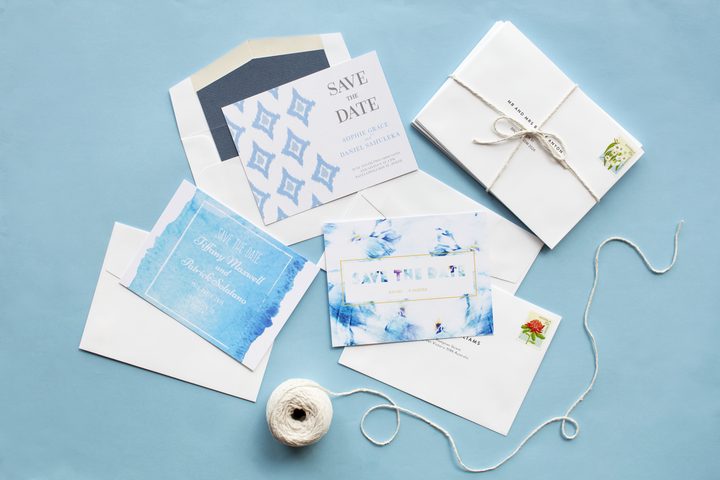
- Postcard save the dates are addressed directly on the card – no envelope required or used.
- To qualify for the USPS postcard rate, your card must measure 3.5-4.25″ tall x 5-6″ wide (89-108mm x 127-152mm) and be 0.007-0.016″ thick.
- The right half of the address side is reserved for the guest address, postage, and endorsements – never place message content there.
- A return address is optional (unlike an envelope), but strongly recommended so undeliverable cards come back to you.
- Oversized postcards lose the postcard rate and are charged at the First-Class letter rate instead.
See our Australia, United States, United Kingdom, Canada, or New Zealand collection to see locale-specific designs and shipping.
Save the date postcards are one of the most practical choices couples make – they skip the envelope entirely, mail at a lower postage rate, and arrive looking polished and intentional. But because the address lives directly on the card itself, the rules for layout, addressing etiquette, and USPS compliance work differently than they do for a traditional card-in-envelope. This guide walks you through everything: official size requirements, how to divide the back panel, how to address each guest scenario, and the mistakes that can bump your postcard out of the cheaper postage tier.
- Size: 3.5-4.25″ tall x 5-6″ wide (89-108mm x 127-152mm)
- Thickness: 0.007″-0.016″
- Address zone: Right half of the address side only
- Message zone: Left half of the address side + entire front
- No envelope needed – address goes directly on the card stock
- Rate: Currently around $0.61 per card (rates adjust annually – always confirm at USPS.com)
USPS postcard size requirements for save the dates
To mail at the USPS postcard rate, your save the date must fall within a specific size window – not just under the maximum, but also over the minimum. Cards that are too small don’t qualify either. Here are the official dimensions from the USPS Domestic Mail Manual (DMM):
| Dimension | Minimum | Maximum |
|---|---|---|
| Height (short edge) | 3.5″ (89mm) | 4.25″ (108mm) |
| Length (long edge) | 5″ (127mm) | 6″ (152mm) |
| Thickness | 0.007″ | 0.016″ |
The most popular save the date postcard size is 4″ x 6″ (102mm x 152mm) – well within the window and the same format as a standard photo print, which keeps printing costs low. A 4.25″ x 6″ card sits right at the maximum height and length, which is fine as long as the thickness stays within range.
What happens if your card exceeds those dimensions? It’s automatically reclassified as a First-Class letter flat or large envelope and charged at a higher rate. If you’re mailing 100+ postcards, that difference adds up fast. Always confirm your card’s print dimensions before ordering in bulk – Paperlust’s save the date postcards are designed to qualify for the postcard rate.
How postcard addressing differs from envelope addressing
When you mail a save the date in an envelope, the envelope does the addressing work. The card inside stays private, protected, and completely separate from the mailing logistics. Postcard addressing turns that relationship inside out – the card IS the mailpiece.
That means three things work differently:
- The address is written directly on the card stock. There’s no envelope to open, which is part of the appeal – but it also means your addressing decisions are visible to anyone who handles the piece, including postal workers, a neighbor who grabs it from the mailbox, or a curious college roommate at a shared address.
- No return address is required. USPS mandates a return address on First-Class letters and envelopes, but postcards are exempt. You can still include one (and you should – more on that below), but it’s your choice where to put it and whether to put it at all.
- The stamp goes on the card itself. The postage area is fixed in the top-right corner of the address side. The address occupies the right half of the same side. Your wedding message, design preview, or URL goes on the left half of the address side and the entire front face of the card.
This layout is governed by USPS rules, not convention. If guest address content strays into the left half or message content bleeds into the right half, your card may fail automated sorting – which can slow delivery or trigger a surcharge.
How to lay out the back of a save the date postcard
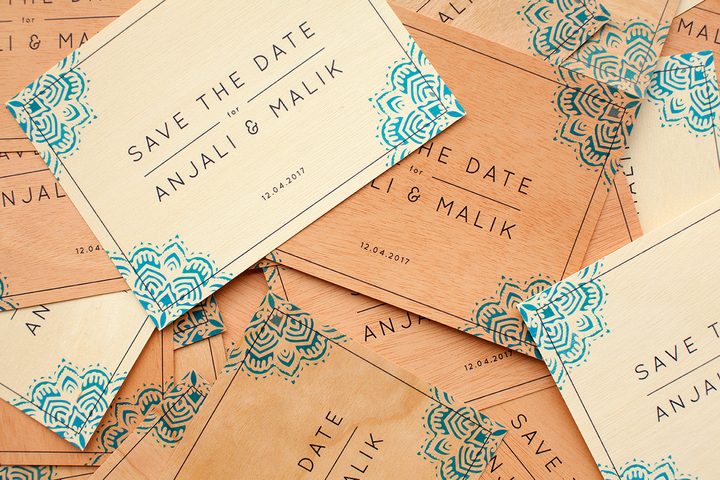

The back of your postcard – the address side – has a specific structure. Think of it as two columns:
Right half: address zone
Reserve the entire right half of the address side (at least 2.13″ wide from the right edge) for:
- Guest address block – recipient name, street address, city, state, and ZIP+4. Three to four lines is typical.
- Postage stamp or pre-printed indicia – top-right corner. USPS requires a clear zone of at least 5/8″ from the bottom of the stamp area to the top of the address.
- Return address (optional) – top-left of the right half, or use the top-left corner of the entire card.
Left half: message zone
The left half of the address side is yours to use for:
- A short message (“Save the date! Join us as we celebrate…”) or your names and wedding date
- Your wedding website URL
- A note about invitations to follow
- Decorative design elements
Front face
The front is entirely your design space – your photo, illustration, or typographic layout. No USPS restrictions apply here beyond the card’s physical dimensions.
Most professional save the date postcard designs like those at Paperlust’s postcard collection have the address zone pre-ruled into the template, so the layout is handled for you. If you’re working with a custom or DIY design, confirm with your printer that the address zone is clearly delineated before going to press.
Address etiquette by guest type
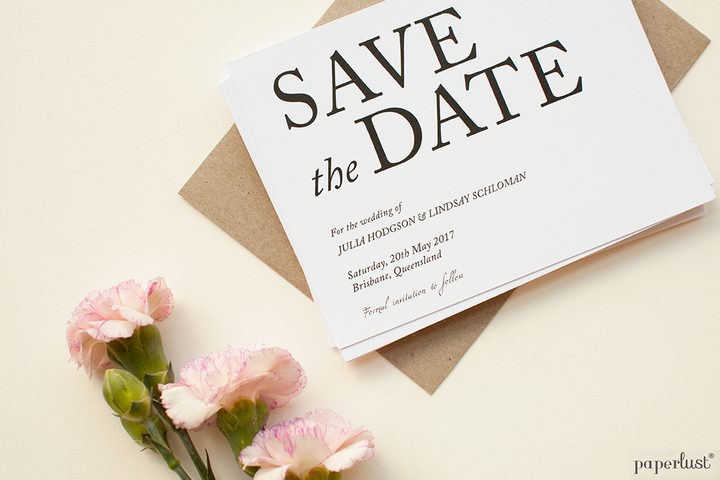
Postcard addressing follows the same etiquette conventions as envelope addressing – with one key adjustment. Because your card is open to anyone who handles it, consider what level of formality matches your wedding and how comfortable you are with guests seeing names displayed on a piece of mail.
Use this reference table for every guest scenario you’ll encounter:
| Guest scenario | Address line 1 | Address line 2 |
|---|---|---|
| Married couple, shared last name | Mr. and Mrs. John Smith | Street address |
| Married couple, different last names | Ms. Jane Doe | Mr. John Smith (separate line, then address) |
| Same-sex couple | Mr. James Lee and Mr. David Park | Street address (alphabetical or as preferred) |
| Unmarried couple living together | Ms. Jane Doe | Mr. John Smith (separate line, then address) |
| Single guest with a named plus-one | Ms. Jane Doe and Mr. Chris Lane | Street address |
| Single guest, open plus-one | Ms. Jane Doe and Guest | Street address |
| Single guest, no plus-one | Ms. Jane Doe | Street address |
| Family with young children | The Smith Family | Street address |
| Family – listing children’s names | Mr. and Mrs. John Smith | Emma, Liam, and Olivia (then address) |
| Divorced parent – separate postcard | Ms. Jane Smith | Street address (send to each separately) |
For professional title holders, always lead with the title: Dr. Sarah Lee and Mr. James Lee. When both partners hold the same title, use: Drs. Sarah and James Lee. Military titles follow rank order.
Formal vs casual address conventions
There’s no single right answer for how formal your postcard addressing needs to be. The general rule: match the tone of your wedding.
For a black-tie or formal wedding, use full honorifics (Mr., Mrs., Ms., Dr.) and spell out every word – no abbreviations for street types (Avenue, not Ave) and no ZIP-only lines. For a casual beach wedding or backyard celebration, first names alone are perfectly acceptable – “Sarah and Mike Thomas” reads warmly and is still entirely correct for USPS delivery.
One detail that catches couples off guard: “Ms.” is the default honorific for any adult woman whose marital status you don’t know or who hasn’t specified a preference. “Miss” is for young girls under 18. When in doubt, use “Ms.” or drop the honorific entirely for casual weddings.
For more addressing conventions that apply to both postcards and traditional envelopes, see our companion guide on how to address save the dates. For the broader rules around timing, wording, and what information to include, save the date etiquette 101 is a useful companion.
Common addressing mistakes that break the USPS postcard rate qualifier
Most postcard rate rejections come from a handful of preventable errors. Here’s what to watch for:
- Address written on the wrong side. The address must go on the address side (the back) – specifically the right half. Placing the address on the front face or spanning both halves can cause missorting.
- Message content in the right-half address zone. Decorative text, your wedding website URL, or hashtags in the right half can confuse OCR readers and cause rejection. Keep the right half clear for address and postage only.
- Exceeding the 4.25″ x 6″ maximum. A card that’s even slightly oversized (say, a 5″ x 7″ postcard) is reclassified as a First-Class flat and charged at a higher rate. Always confirm your finished trim size before ordering.
- Wrong stamp class. A Forever Stamp is valid for First-Class letters – but the postcard rate is lower and requires a postcard stamp (or Forever stamp, which covers it since it covers the First-Class single-piece rate). Where couples go wrong: using insufficient postage on oversized cards they assumed were postcard-rate eligible.
- Low-contrast address text. USPS automated sorters use optical character recognition (OCR). Light gray text on a cream card may not scan cleanly. Use dark, high-contrast ink – black on white or near-white is ideal.
- Glossy-over-address area. Some card finishes create glare that OCR readers struggle with. If you’re using a glossy card, print the address in a matte-ink strip or use a label – and confirm with your card provider that the stock is USPS-compatible.
If you’re concerned about compliance, USPS offers a free mailpiece design consultation for bulk mailers at business mail entry units (BMEUs). For smaller quantities, your local post office can review a sample card before you commit to a full run.
Should you include a return address?
Unlike a standard First-Class letter, postcards don’t legally require a return address. But there are strong practical reasons to include one.
The case for including a return address: Postcards sent to outdated addresses don’t vanish – they’re returned to sender if there’s a return address. For a 100-guest mailing, even a 5% undeliverable rate is five postcards that otherwise disappear permanently. A return address also adds a finished, professional look and reassures guests they’re receiving mail from a real source, not a mailer.
Where to place it: Top-left corner of the address side is the convention. Some couples use a pre-printed return address stamp on the front of the card instead – both are fine with USPS. Printed address labels in the return address position are also acceptable and useful when ordering return address stickers in bulk.
The case against: Minimal. If you’re absolutely certain your guest list addresses are current and confirmed, skipping the return address keeps the address side cleaner. But for most couples, the extra security is worth the small amount of space it takes.
How to handle bulk mailing
Addressing 80 or 150 or 300 postcards is a different project from addressing 15. Here are the three main approaches and when each makes sense:
Hand-addressing
The most personal option and widely considered the most elegant for formal weddings. A calligrapher can address 100 postcards in a couple of hours; expect rates of $1.50-$4+ per envelope depending on the artist. Because postcards are smaller and have no inner envelope, the per-piece cost is often lower than envelope calligraphy. Book early – popular calligraphers fill up months in advance.
Printed labels
The fastest option for large guest lists. Use white matte labels with a legible sans-serif font at a minimum 10-point size. Labels are USPS-acceptable and scan reliably. Position them in the address zone (right half). Avoid glossy labels on postcard stock that’s already glossy.
Direct print on the card
The cleanest option aesthetically – addresses are printed directly onto the card during production. Some printers (including Paperlust via the Address Manager tool) can handle this during the print run by importing your guest list from Excel or a spreadsheet. Each card ships addressed and ready to stamp. This eliminates the addressing step entirely and ensures every address is positioned correctly in the USPS-compliant zone.
For any bulk mailing over 200 pieces, consider USPS Every Door Direct Mail (EDDM) or a Standard Mail permit if you qualify – both offer significant postage savings but require more lead time and presort preparation. For most wedding guest lists, First-Class postcard stamps are the simpler and more reliable choice.
Frequently asked questions
What size does a save the date postcard need to be for the USPS postcard rate?
To qualify for the USPS postcard rate, your save the date must be at least 3.5″ tall x 5″ long (89mm x 127mm) and no larger than 4.25″ tall x 6″ long (108mm x 152mm). Thickness must fall between 0.007″ and 0.016″. Cards that exceed these dimensions are treated as First-Class flats and charged a higher postage rate. The most common save the date postcard size, 4″ x 6″, falls well within the qualifying window.
Where do you put the address on a save the date postcard?
The guest’s delivery address goes on the right half of the address side (the back of the card). USPS requires the address to sit in the right portion – at least 2.13″ wide from the right edge – along with the postage stamp in the top-right corner. The left half of the address side is your message zone. Never place address content on the front of the card, and never let message content stray into the right-half address zone.
Do save the date postcards need a return address?
No – USPS does not require a return address on postcards the way it does on First-Class letters. However, including one is strongly recommended. If a card is undeliverable (outdated address, relocated guest), USPS will return it to you only if there’s a return address. Place yours in the top-left corner of the address side or use a pre-printed return address stamp on the front of the card.
How do you address a save the date postcard to a married couple?
For a married couple sharing a last name, use “Mr. and Mrs. John Smith” on the first address line, followed by the street address. If the couple uses different last names, list them on separate lines: “Ms. Jane Doe” on line one, “Mr. John Smith” on line two, then the street address on line three. For casual weddings, first names work well: “Sarah and John Smith.”
How do you address a save the date postcard to an unmarried couple?
List both names on separate lines rather than combining them with “and” on a single line – this is the traditional convention for unmarried couples, regardless of whether they live together. Format: “Ms. Jane Doe” on line one, “Mr. John Smith” on line two, then the street address. For casual tone, “Jane Doe and John Smith” on a single line is also widely accepted.
Do you include children’s names on save the date postcards?
It depends on whether children are invited and how you want to communicate that. “The Smith Family” implies the whole household is welcome, including kids. If you’re inviting a family with children, listing the children by first name (below the parents’ names) makes the invitation explicit. If children are not invited, address the postcard to the parents only – “Mr. and Mrs. John Smith” – and communicate the adults-only policy separately or through your wedding website.
What stamp do you use for save the date postcards?
Use a USPS postcard stamp, which covers the current postcard rate (currently around $0.61 – confirm at USPS.com as rates adjust annually). A First-Class Forever Stamp also works on qualifying-size postcards since its value meets or exceeds the postcard rate, though you’re slightly overpaying. Never use a domestic letter stamp on a postcard and assume it covers the cost – the rate tiers are different. If you’re unsure, a Forever Stamp is always safe for First-Class domestic postcard mailing.
Can you use return address labels on save the date postcards?
Yes. White matte return address labels are fully acceptable on postcards. Place them in the top-left corner of the address side. Avoid glossy labels if your card stock is already high-gloss, as stacked gloss surfaces can cause OCR scanning issues. Pre-printed return address labels ordered in bulk are cost-effective for large mailings and keep the back of the card looking clean and consistent.
What is the proper etiquette for addressing same-sex couples on a postcard?
Use the same honorific conventions you would for any couple. For two men: “Mr. James Lee and Mr. David Park.” For two women: “Ms. Sarah Kim and Ms. Amy Chen.” If both share a last name: “Mr. James and Mr. David Lee.” When you don’t know a guest’s preferred honorific or title, use their full name without any honorific – this is always a respectful default. Alphabetical order is the convention when no other preference is known.
Should you address save the date postcards by hand or use printed labels?
Both are acceptable. Hand-addressing is the traditional choice for formal weddings and adds a personal, elegant touch – especially in calligraphy. Printed labels or direct-to-card printing are practical for large guest lists (150+ guests) and ensure every address is legible for USPS OCR scanning. A middle ground many couples use: hire a calligrapher for a smaller inner circle of VIP guests and use printed labels for the rest. Whatever method you choose, use dark ink with high contrast against the card’s address zone background.
What if your save the date postcard exceeds USPS postcard size?
Any card larger than 4.25″ tall or 6″ long (108mm x 152mm) – such as a 5″ x 7″ postcard – no longer qualifies for the postcard rate. It will be charged at the First-Class letter or flat rate, which is higher. If your cards are already printed oversized, you have two options: mail them at the higher rate (budget for the difference) or insert them in an envelope and mail as a standard First-Class letter. For future orders, confirm your trim dimensions with the printer before going to press.
How do you address a save the date postcard for a single guest with a plus-one?
If the plus-one has a name you know and want to include: “Ms. Jane Doe and Mr. Chris Lane” on the first address line, followed by the street address. If the plus-one is unnamed or open: “Ms. Jane Doe and Guest” – always capitalize “Guest” to make clear it’s an intended invitation, not a casual reference. Do not add a guest designation to a single person’s name unless they’ve actually been given a plus-one, as this communicates the invitation clearly and avoids awkward conversations later.
Ready to send a save the date that feels finished from the first glance?
Browse Paperlust save the date postcards across digital print, flat foil, foil stamp, metallic ink, and white ink on premium paper stocks. Order a sample pack first to compare paper, print, and finish in person.