

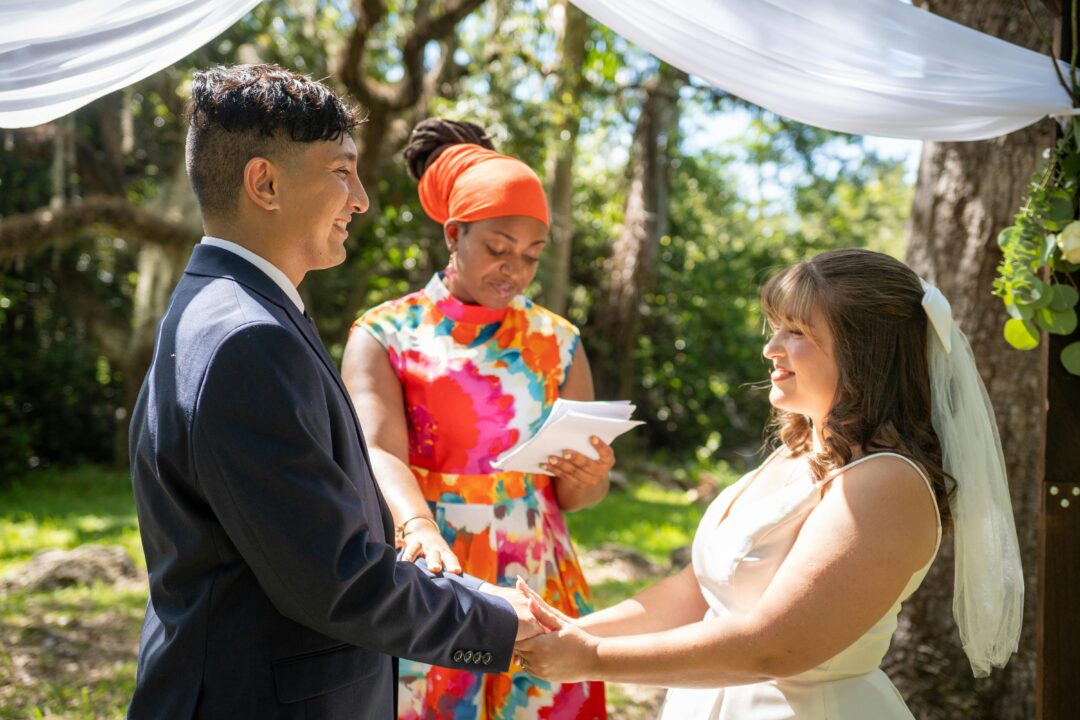

- Secular vows contain no religious references – they draw on humanist values, shared commitment, and the deliberate, ongoing choice to build a life together.
- They suit civil ceremonies, non-religious celebrations, and interfaith couples who want ceremony language that belongs to everyone in the room.
- Some states require legally declaratory words (“I do” or “I take you”) in civil ceremonies – these are brief and sit alongside, not instead of, your personal vows.
- Humanist ceremonies often favor “I choose” over “I vow” – emphasizing that commitment is an active, renewed decision rather than a one-time oath.
- This guide includes 20 complete secular vow examples organized by tone – minimalist, heartfelt, humanist, partnership-focused, and nature-inspired.
- For the full picture across all vow styles, see our complete wedding vows guide.
Secular wedding vows give couples complete freedom to put exactly what they mean into words – no liturgy, no prescribed language, no framework inherited from a tradition that isn’t yours. They are some of the most honest, most personal, and most emotionally direct vows written today. This guide covers everything you need: what “secular” actually means in a ceremony context, 20 complete vow examples across five tones, how a secular ceremony is structured, and how to choose the language that fits the commitment you’re making.
What Are Secular Wedding Vows?
“Secular” simply means non-religious. Secular wedding vows contain no references to God, scripture, faith traditions, or spiritual covenant. They are grounded in the human relationship itself – the two people standing together, the life they’re choosing to build, and the specific promises they are making to each other.
The term covers a few overlapping ceremony types:
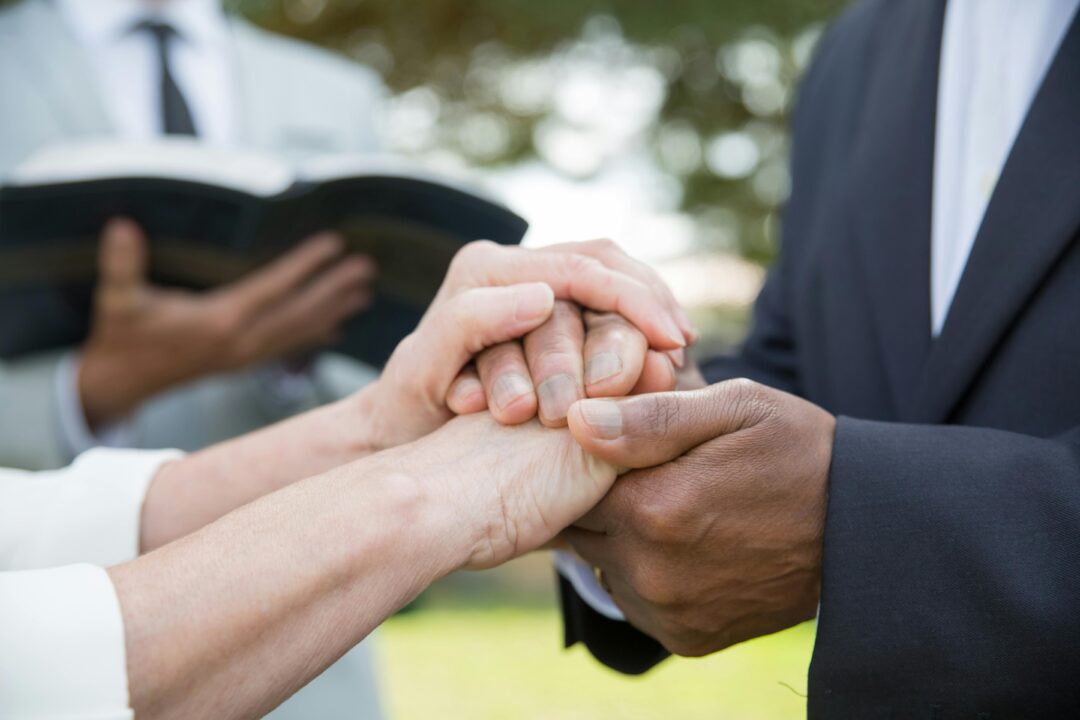
- Civil ceremonies – officiated by a judge, justice of the peace, or civil celebrant. These are legally binding by definition and can be entirely non-religious. Some states require specific declaratory words (such as “I do” or “I take you as my lawful spouse”) as part of the legal marriage. These required phrases are usually brief and can sit naturally within a full personal vow without disrupting the tone.
- Humanist ceremonies – performed by a humanist celebrant and centered explicitly on human values: reason, compassion, shared growth. Humanist ceremonies have a distinct philosophy – they treat the ceremony itself as meaningful because the people in the room make it so, not because it invokes a higher power. They are not legally binding in most US states on their own, so couples typically register separately with a civil officiant or have a judge co-sign.
- Non-denominational ceremonies – a broad category where the officiant (often ordained online) does not represent a specific faith. These may be religious in tone or entirely secular depending on the couple’s wishes.
What distinguishes secular vows from religious vows is not what they exclude – it’s what they put at the center. Where religious vows locate the marriage within a covenant before God or within a community of faith, secular vows locate it in the two people: their history, their choices, and the specific quality of attention they intend to bring to a shared life.
For interfaith couples, secular vows often represent a genuinely neutral ground – language that honors both partners without favoring either tradition. For non-religious couples, they are simply the honest choice. For couples who do have a faith but are marrying in a civil setting, secular vows can coexist with personal spiritual meaning without making that meaning the ceremony’s subject.
The freedom secular vows offer is real – and can also feel daunting. Our complete wedding vows guide covers every style from traditional to humorous if you want to compare before you commit to secular language.
A ceremony that sounds like you should look like you too
Wedding invitation designs across foil, letterpress and minimalist styles, customized by a designer before print.
20 Secular Wedding Vow Examples
The examples below are organized by tone. Read through all five categories before deciding which direction fits your ceremony – the best secular vows feel like a natural extension of how you actually talk and what you actually value, not a borrowed template. Use these as starting points, not finished scripts.
Minimalist Vows
Clean, precise, and emotionally direct. These work well for couples who want something short enough to memorize word-for-word and confident enough to stand on its own without ornament.
Heartfelt and Personal Vows
Warm, specific, and emotionally open. These work well when you want vows that feel genuinely personal – like they could only have been written by one person for one person.
Humanist-Inspired Vows
These draw on humanist values – the idea that meaning comes from people, choices, and connection rather than from external authority. They suit couples who want vows with a clear philosophical underpinning.
Shop ceremony programs
Guests who do not know the format need it printed. Order of service designs that match your invitations.
Partnership-Focused Vows
These center on the practical and emotional architecture of a shared life – teamwork, mutual respect, and the day-to-day reality of a working partnership. They suit couples who want vows that are as much about how you live as about how you feel.
Nature-Inspired Vows
These draw on natural imagery – seasons, roots, tides, and the rhythms of the living world. They work well for outdoor ceremonies, garden weddings, and couples who want vows with a grounded, unhurried quality.
Secular Ceremony Structure
One of the most common questions couples ask when planning a secular ceremony is: without a religious structure to follow, how does it actually hold together? The answer is that secular ceremonies have their own well-developed structure – and in many ways, they give couples more flexibility to design a ceremony that genuinely reflects who they are.
A typical secular ceremony follows this sequence:
Welcome and Opening
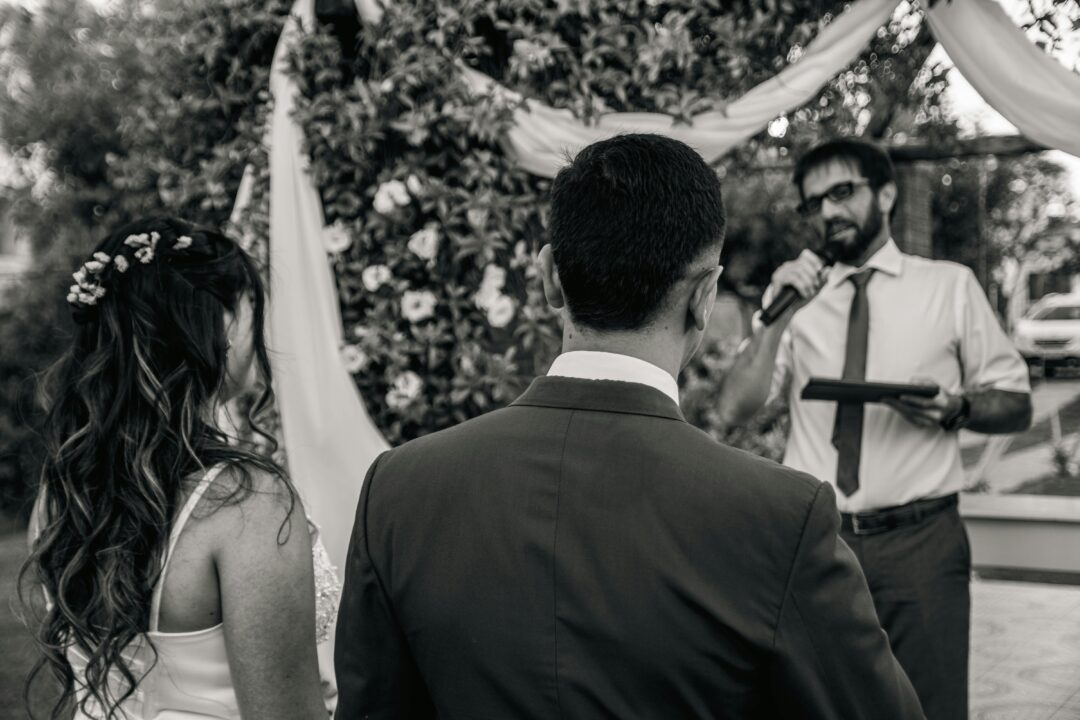
The officiant opens the ceremony by welcoming guests and acknowledging the significance of the occasion. In religious ceremonies, this often invokes the presence of God. In a secular ceremony, the opening instead centers the people – naming the couple, acknowledging the family and friends gathered, and framing the ceremony as a collective act of witness. A well-written secular opening can be just as moving as any religious invocation – it simply draws its weight from the community present rather than from faith.
Readings and Music
Secular ceremonies often include one or two readings delivered by guests – poetry, prose, or passages from literature that speak to the couple’s values. Popular choices include Pablo Neruda, Mary Oliver, Rainer Maria Rilke, and excerpts from novels or films that mean something to the couple. Music may accompany the processional, fill a pause between sections, or close the ceremony. There are no restrictions on secular content – the only criterion is that it feels true to the couple.
Vow Exchange
This is the ceremony’s core. The officiant typically invites the couple to face each other, then either reads the vows aloud for them to repeat, or steps back while each partner speaks their own written vows. In civil ceremonies, any legally required declaratory language is incorporated here – usually as a brief question (“Do you take this person to be your lawful spouse?”) before or after the personal vows. The legal component takes thirty seconds; it does not define the tone of the exchange.
Ring Exchange
Rings are exchanged with a short spoken promise – either a traditional ring vow (“With this ring, I thee wed”) or a secular equivalent the couple has written. Simple options: “Wear this as a symbol of my love and my commitment to you” or “This ring has no beginning and no end – like the love behind it.”
Pronouncement
The officiant declares the couple married. In secular ceremonies, the language can be personal and warm – “By the power invested in me, and by the love of everyone in this room, I now pronounce you married” – rather than the formulaic civil phrasing.
Finding a Non-Religious Officiant
For couples planning a secular ceremony, finding the right officiant matters. Options include:
- Civil officiants – judges, justices of the peace, court clerks, and (in many states) county clerks. These are legal by default. They range from entirely perfunctory to genuinely skilled ceremony leaders.
- Humanist celebrants – trained through organizations like the American Humanist Association. They specialize in secular and humanist ceremonies and bring professional ceremony-writing skills. Note that in most US states, a humanist ceremony is not a legal marriage on its own – couples typically file separately with a civil authority.
- Online-ordained officiants – friends or family ordained through organizations like the Universal Life Church. This is legal in most US states when the ordination is registered with the county. Check your state’s specific requirements well in advance.
Vow Language vs Commitment Language
One of the most interesting choices in writing secular vows is the verb at the center of each promise. The word you choose carries meaning – about the nature of the commitment, the relationship’s underlying philosophy, and the emotional register you’re aiming for. Here are the four most common options and what each one signals.
“I vow”
“I vow” is the most ceremonially weighted option. It comes from a Latin root meaning a solemn promise, and its associations are primarily religious and formal. In secular vows, using “I vow” can feel deliberately ceremonial – a way of signaling that this is not just a promise but a considered, witnessed oath. It works well when you want the vows to feel historic and substantial. The potential downside: for some couples, “I vow” carries religious echoes they want to avoid. If that’s a concern, one of the alternatives below may feel more natural.
“I promise”
“I promise” is the most versatile option – warm, direct, and universally understood. It has no religious associations, feels conversational without being casual, and scales comfortably from minimalist to heartfelt vow styles. Most secular vow examples default to “I promise” for exactly these reasons. It puts the emphasis on the person making the commitment rather than on the ceremonial act itself – which tends to feel honest and grounded in a secular context.
“I commit”
“I commit” has a more deliberate, intentional quality than “I promise.” It emphasizes sustained effort – the idea that a marriage is something you actively work at rather than something that simply is. It suits partnership-focused vows particularly well and works for couples who want their ceremony language to acknowledge, honestly, that love is a practice rather than a state. It can feel slightly more formal than “I promise,” which works well in writing but is worth testing aloud to make sure it feels natural in your own voice.
“I choose”
“I choose” is the language most closely associated with humanist ceremonies, and for good reason: it places the entire weight of the commitment in the will of the person speaking. It rejects the idea of destiny, fate, or external compulsion, and replaces it with a fully conscious, voluntary act. “I choose you today – and I will choose you again tomorrow” carries a specific emotional force that the other options don’t quite replicate. Humanist celebrants often favor this phrasing because it captures the core humanist idea: that what makes a commitment meaningful is not who witnesses it or what law enforces it, but the genuine, renewable intention of the people making it.
Many couples use a combination. “I choose you” as the opening statement, followed by “I promise” for individual commitments, is a structure that works well across all five vow styles above. The most important thing is that the language feels like yours – read your draft aloud three or four times and notice which words sit naturally in your mouth and which ones don’t.
Want to see the paper before you print?
Order a $5 sample pack and compare stocks and finishes at home.
Writing Your Own Secular Vows
The examples above are starting points. The vows that will move the room are the ones that only you could have written. Here’s a practical process for getting there.
Step 1: Reflect before you draft
Set aside thirty minutes – no phone, no laptop – and write longhand answers to these questions: What did you notice about this person before you knew you were in love with them? What specific moment made you think “this is it”? What do they do, habitually and without fanfare, that you love most? What kind of partner do you want to be? What are you genuinely committing to, not just on a good day but on a hard one? The draft doesn’t come from inspiration – it comes from honest answers to honest questions. Do the reflection first.
Step 2: Write long, then cut
Your first draft should be longer than the finished vow. Write everything you want to say – don’t edit as you go. Then read it back and cut anything that is generic enough to apply to any couple, anything that is more about how you sound than what you mean, and anything that would embarrass your partner. What’s left is the real draft. Aim for 200-300 words finished – long enough to land, short enough to keep the room with you.
Step 3: Speak it aloud before you finalize
Written vows and spoken vows are different. A sentence that reads beautifully can be a tongue-twister at pace, and the emotional weight of a line often shifts when you hear it in your own voice. Read your draft aloud at least twice – ideally to someone you trust. Notice where you rush, where you stumble, and where you genuinely feel something. Adjust accordingly.
Step 4: Coordinate with your partner on length and tone
You don’t need to share the exact content of your vows in advance – that’s part of what makes the exchange moving. But you should agree on approximate length and general tone. If one partner delivers three minutes of heartfelt prose and the other delivers forty seconds, it creates an imbalance that neither person enjoys. A quick coordination call – “mine’s about two minutes, fairly personal” – is all you need.
What to include vs what to avoid
| Include | Avoid |
|---|---|
| Specific observations about your partner | Inside jokes guests won’t understand |
| Concrete promises, not vague sentiments | Generic phrases (“my best friend,” “my rock” without context) |
| At least one specific memory or detail | Anything that requires explanation to land |
| Something that makes your partner smile | Humor that only works if perfectly timed |
| A clear, simple closing line | Trailing off or ending mid-thought |
Once you have final vows, print them on a card – not a phone. A card you can hold, glance at, and set back in a pocket. Your hands will shake, and that’s fine. The card keeps you anchored. If you’re looking for beautifully designed vow cards that match your invitation suite, browse Paperlust’s wedding stationery collection – every order includes a professional designer and a proof within 1-2 business days. You can also take inspiration from the language in your wedding invitation wording to carry a consistent tone from first contact through ceremony.
Frequently Asked Questions
What makes a vow “secular”?
A secular vow contains no references to God, religion, scripture, or spiritual covenant. It locates the commitment entirely in the relationship between the two people – their choices, their promises, and the life they are building together. Secular vows can be deeply meaningful and emotionally moving; the absence of religious language does not reduce their significance.
Are secular wedding vows legally valid?
Yes – what makes a marriage legally valid is the officiating authority and the required declaratory language, not the content of personal vows. In civil ceremonies, a judge or licensed officiant legally marries you regardless of whether your personal vows are religious or secular. The personal vows you exchange are a ceremony element; the legal marriage comes from the license, the officiant’s authority, and any required verbal declarations under your state’s law.
Do civil ceremonies require specific vow language?
It depends on the state. Some US states require a declaratory statement – something like “I do take you to be my lawful spouse” or a simple “I do” in response to the officiant’s question. Others have no prescribed wording at all. Check your state’s marriage law, or ask your officiant – they will know exactly what is required. Any legally required language is typically brief (a single sentence or question-and-answer) and can be woven naturally into a fuller personal vow exchange without disrupting the ceremony’s tone.
What is a humanist wedding ceremony?
A humanist ceremony is a secular ceremony officiated by a trained humanist celebrant. It is explicitly grounded in humanist values – the idea that meaning and ethics come from human experience and reason, not from religious authority. Humanist ceremonies are highly personalized, often deeply moving, and give couples extensive freedom in structure and language. In most US states, a humanist ceremony is not a legally binding marriage on its own; couples typically register their marriage separately with a civil authority and hold the humanist ceremony as the meaningful celebration.
Can we have a secular ceremony if one of us is religious?
Yes – and many couples do. A secular ceremony uses language that belongs to everyone in the room and doesn’t require either partner to set aside their personal beliefs. It simply doesn’t make those beliefs the ceremony’s subject. Some couples with one religious partner choose to include a reading, a blessing, or a moment of silence that allows space for personal spirituality without making the ceremony denominationally specific. Talk this through with your officiant – a skilled celebrant can help you find language that feels honest for both partners.
How long should secular wedding vows be?
The sweet spot is 200-300 words, which translates to roughly 1-2 minutes spoken at a calm, deliberate pace. Long enough to land with weight; short enough to hold the room’s full attention from start to finish. Under 150 words can feel abrupt; over 400 words risks losing the audience’s focus regardless of how beautifully written the vows are. Coordinate with your partner so both sets of vows are roughly similar in length – a significant imbalance can feel awkward in the ceremony.
Should we write our own secular vows or use a template?
Both are valid. The examples in this guide are designed to be used as starting points – you can use one of them nearly verbatim if it genuinely fits, or you can use them as structural inspiration while filling in your own specific language. The most moving vows tend to include at least one element that is particular to your relationship: a specific memory, a quality you admire in concrete terms, or a promise that is specific enough that only you could have made it. Generic templates, used without personalization, tend to feel generic in the ceremony. Start with a template, then make it yours.
What is the difference between “I vow,” “I promise,” and “I choose”?
Each carries a different shade of meaning. “I vow” is the most formally ceremonial – it has deep historical roots and signals a solemn, witnessed oath. “I promise” is warmer and more conversational, with no religious associations, and is the most versatile option for secular vows. “I commit” emphasizes sustained, active effort – love as a practice rather than a feeling. “I choose” is favored in humanist ceremonies for its explicit emphasis on voluntary, renewable decision-making. Many couples mix these: “I choose you” as the opening, then “I promise” for each specific commitment.
Can secular vows be used in a courthouse wedding?
Yes – courthouse and civil registry ceremonies are inherently secular by definition. The officiant (typically a judge or court clerk) will conduct the legal ceremony, which may include a required declaratory exchange. Beyond any required language, many civil officiants welcome couples who want to add personal vows. Ask your specific officiant in advance whether there is time for personal vows in the ceremony and whether there are any restrictions on content.
What are good secular readings for a non-religious ceremony?
Classic secular ceremony readings include poems by Pablo Neruda (“Sonnet XVII”), Mary Oliver (“When Death Comes,” “Wild Geese”), Rainer Maria Rilke (Letters to a Young Poet, passages on love), and ee cummings (“i carry your heart with me”). Prose options include passages from novels, personal essays, or letters. The best secular readings are ones that connect to something real in the couple’s relationship – a shared author, a book they read together, a poem that captures how one partner sees the other. Avoid anything that requires long contextual explanation to land in a ceremony.
How far in advance should we write our secular vows?
Start at least four to six weeks before the wedding. This gives you time to write a first draft, live with it for a week, revise, read aloud, and refine again before finalizing. Vows written in the final week tend to feel rushed and often lack the specificity that makes them memorable. Starting early also gives you time to coordinate with your partner on length and tone without the pressure of an imminent deadline. If you’re writing genuinely personalized vows, five weeks is a comfortable timeline; anything under two weeks is a real risk.
Should we keep our secular vows secret from each other before the wedding?
Most couples do – hearing your partner’s vows for the first time at the altar is one of the most genuinely moving parts of the ceremony. But keeping the content secret doesn’t mean keeping everything secret. You should coordinate on approximate length, general tone (serious, heartfelt, lightly humorous), and whether you’re referencing any shared experiences the other should know might come up. A quick check-in – “mine are personal and about two minutes” – is enough. The specific words can stay yours until the moment you speak them.
What should we print our vows on for the ceremony?
A small card – not a phone, and not a full sheet of paper. A card (roughly 5” x 3” or similar) is easy to hold, easy to glance at, and fits in a pocket or jacket. Many couples have their vows printed on a card that matches their invitation suite, which ties the stationery together beautifully. Paperlust can design and print custom vow cards as part of your wedding stationery order – the same designer who works on your invitations can ensure everything is consistent. Print at least two copies: one for each partner to hold, and a spare.
Your day, your wording
Civil + humanist wedding invitations
Designs without religious iconography, with full control over your wording. Modern minimalist, botanical, and editorial collections.
About Paperlust
Paperlust has been designing and printing wedding stationery from Melbourne since 2014. With 500+ exclusive designs from independent artists and a team of dedicated designers, every order includes a professional proof within 1-2 business days, two free rounds of edits, and a 100% happiness guarantee – free reprint or full refund if anything isn’t right.
Paperlust was named a Westpac Business of Tomorrow in 2017 and has been featured in leading wedding and lifestyle publications. We ship internationally via DHL Express on orders over $350 USD, with US delivery typically arriving within 2 to 4 business days after production.
Have questions about your vow card design or invitation suite? Our team is available on live chat – and every order includes a designer who works with you to get every detail exactly right.
Ready to design your wedding stationery?
Browse 500+ exclusive invitation designs – from classic letterpress to modern digital print. Every order includes a professional designer, a proof within 1-2 business days, and a happiness guarantee.
Image credits