
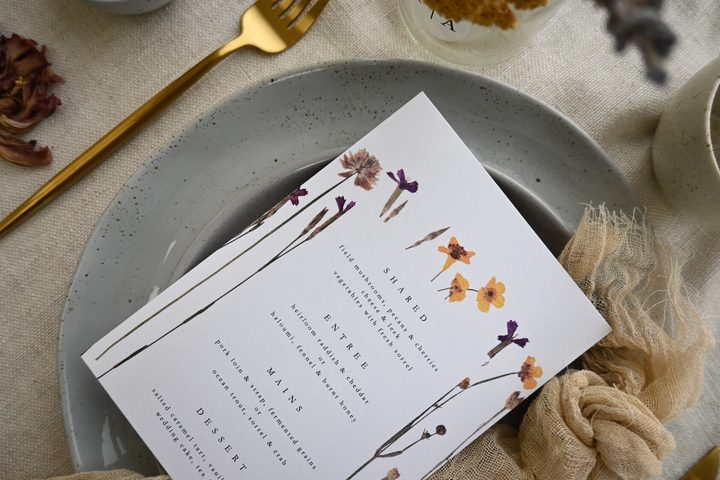
Browse wedding menu cards in your region: United States | Australia | United Kingdom | Canada | New Zealand
Wedding menu cards do two things at once: they tell guests what they’re eating, and they make your reception table look completely intentional. Once your caterer confirms the final menu, you’re ready to order. This guide covers everything from format and size to wording, dietary callouts, print methods, and ordering timelines, so your menu cards are ready before the first course arrives.
Wedding Menu Card Quick-Reference
- Most common formats: Flat single-sheet, bi-fold (folded), tent card
- Standard sizes: 5 x 7 inches [127x178mm] flat; bi-fold opens to 5.5 x 8.5 inches [140x216mm]; tent card 3.5 x 5 inches [89x127mm]
- Print methods available: Digital, flat foil, letterpress, metallic, white ink
- Individual vs. shared: Individual cards per place setting are most common; shared table menus suit buffets or minimalist tablescapes
- Ordering window: Order 4-6 weeks before the wedding; have the finalized caterer menu in hand first
- Design tip: Match your invitation suite for a cohesive look, coordinate paper stock, font, and color palette
- Format decision guide: Flat sheet = best for short menus or minimalist styling; bi-fold = best for multi-course meals with more content; tent card = best for standout centerpiece look with shorter content
What Is a Wedding Menu Card and Do You Need One?
A wedding menu card is a printed piece placed at each guest’s seat (or shared between guests at each table) that lists the courses, dishes, and sometimes the beverages being served at the reception. Think of it as a small, elegant program for the meal.
Do you need one? Not technically, but most couples with a plated or multi-course meal choose them for three solid reasons. First, they set expectations: guests with dietary restrictions can quickly confirm their options are covered, which reduces table-side questions during service. Second, they add polish: a well-designed menu card ties the table decor together and photographs beautifully in reception shots. Third, they work as a keepsake: many couples find that guests pocket the menu card alongside the invitation.
If you’re running a buffet or food-station reception, shared table menus or small standing tent cards near each station are common alternatives to individual place-setting cards.
The short answer: if you have more than two courses, or if your table styling includes place cards and centerpieces, a menu card is worth adding. Your menu wording and names can be added before printing, and there are more than 200 printed wedding menu designs to consider.
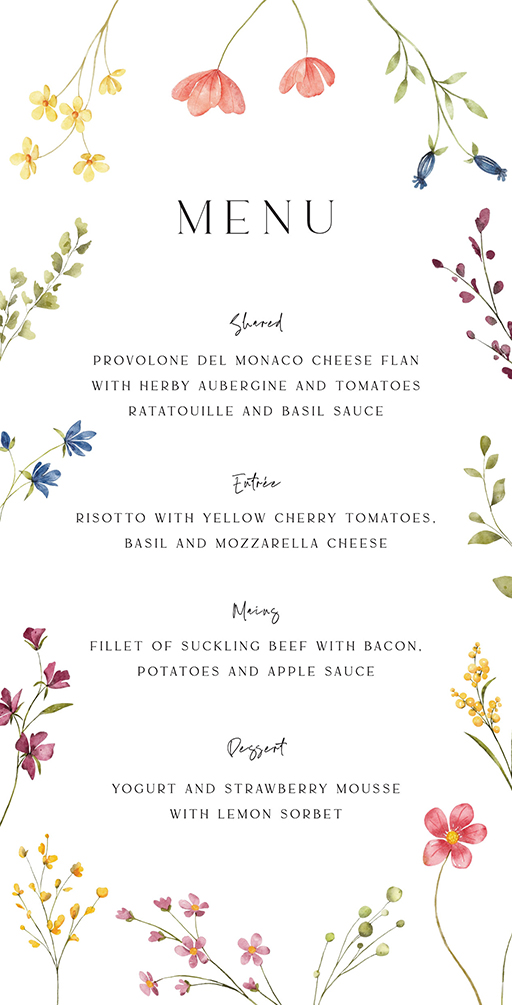

Wild MeadowDigital printing
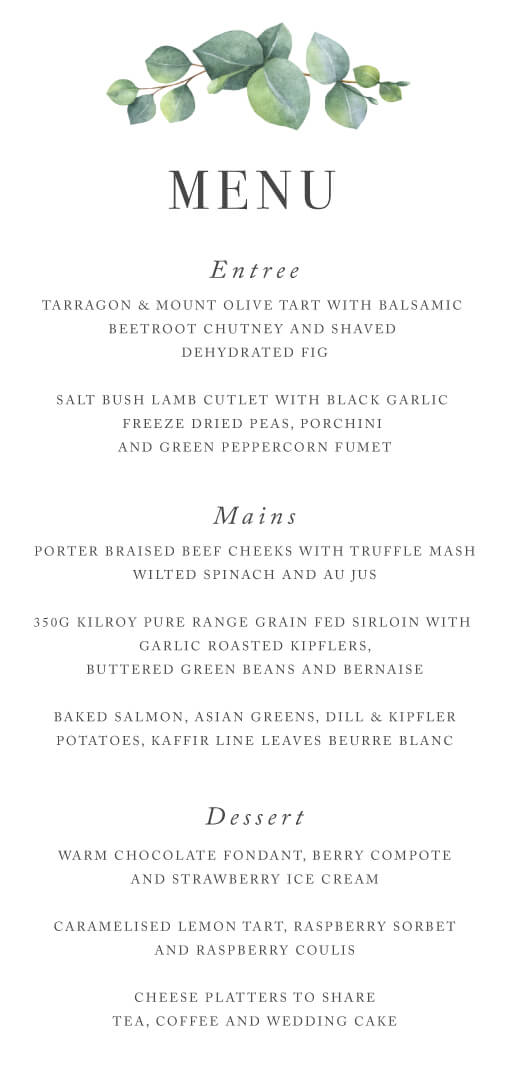
EucalyptusDigital printing

LinearDigital printing
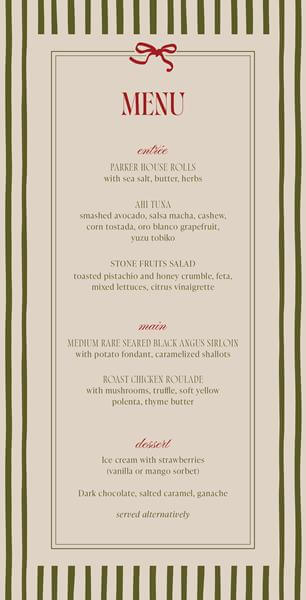
Bow StripesDigital printing
Wedding Menu Card Sizes and Formats: Folded, Flat, and Tent Cards
The format you choose should match both the length of your menu and your overall table aesthetic.
Flat Single-Sheet Menu Cards
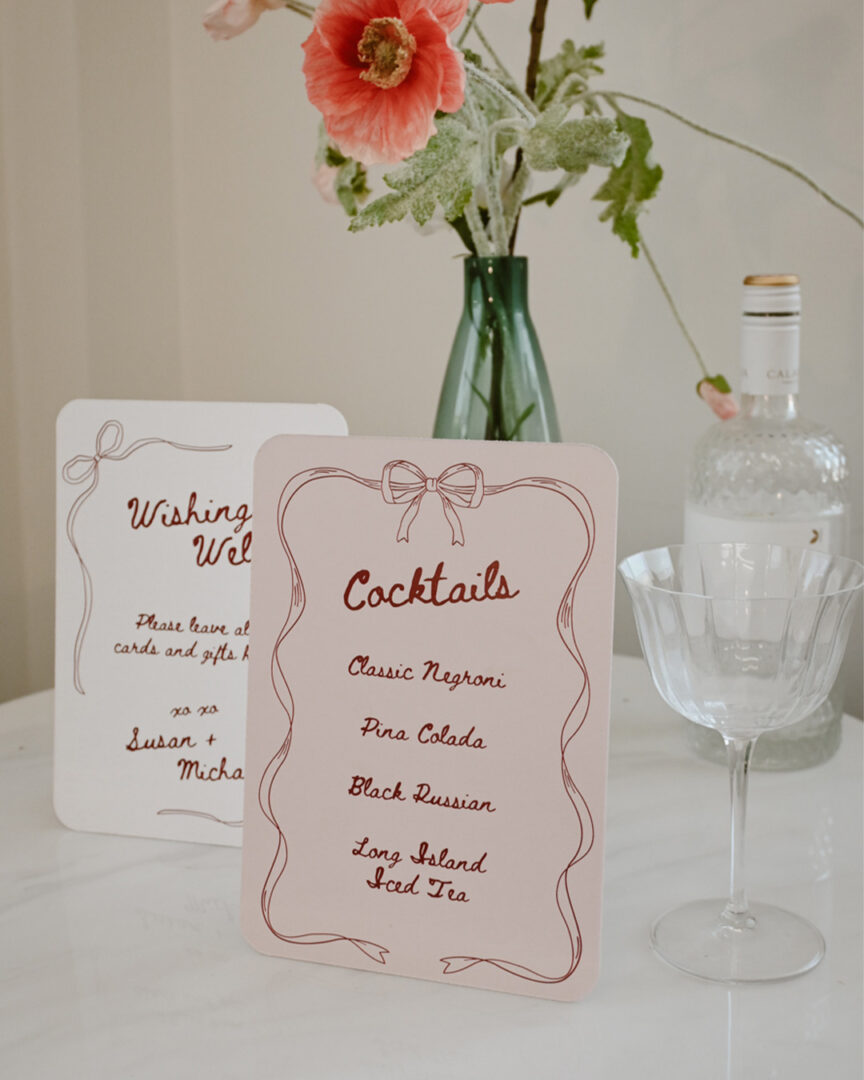
A flat card is the simplest option. It prints front and back, lies flat in front of the place setting or props against a glass. A standard 5 x 7 inches [127x178mm] flat card comfortably fits a three-course menu plus drinks on the front, with a short message or thank-you on the back.
Best for: minimalist tables, short menus (two to three courses), couples who want the cleanest look.
Bi-Fold Menu Cards
A bi-fold (folded card) opens like a small booklet. When closed it typically measures around 4.25 x 5.5 inches [108x140mm] or 5.5 x 4.25 inches [140x108mm] landscape; when open, the full spread is 5.5 x 8.5 inches [140x216mm]. The extra real estate is useful for long menus (five or more courses), wine pairings listed per course, or multilingual menus.
Best for: multi-course dinners, winery and farm-to-table weddings, couples who want a slightly more substantial printed piece.
Tent Cards
A tent card (also called a fold-over card or place-name tent) stands upright on the table. Common sizes are 3.5 x 5 inches [89x127mm] or 4 x 6 inches [102x152mm] folded. The standing position makes them easy to read from across the table and creates a slight decorative moment on the setting. They work best with shorter menus since the print area per panel is smaller.
Best for: cocktail-style receptions, shorter menus with two to three courses, rustic barn and outdoor weddings.
Comparison at a Glance
| Format | Size (closed) | Best for |
|---|---|---|
| Flat sheet | 5 x 7 in [127x178mm] | Short menus, minimalist tables |
| Bi-fold | 4.25 x 5.5 in [108x140mm] | Multi-course dinners, longer content |
| Tent card | 3.5 x 5 in [89x127mm] | Upright display, shorter menus |
How to Word a Wedding Menu Card: Wording Examples for Every Course
For a full wording deep-dive with templates for three-course, five-course, and buffet menus, see our guide to wedding menu card wording. Below are the essential principles and sample formats to get you started.
Basic Structure
Most printed menus follow this order from top to bottom:
- Header, the couple’s names or a simple title like “Dinner Menu” or “This Evening’s Menu”
- Courses in order, from appetizer or amuse-bouche through to dessert; list each course as a heading, then the dish and a short description below it
- Beverages (optional), wine pairings or drinks listed under the relevant course or as a separate section at the end
- Closing line (optional), a short thank-you or date and venue note at the bottom
Wording Example: Three-Course Plated Wedding Menu
12 September 2026
To Begin
Burrata with heirloom tomato, basil oil, and sea salt
Main Course
Grass-fed beef tenderloin with roasted fingerlings, wild mushroom jus, and broccolini
Vegetarian option: Butternut squash risotto with sage brown butter and toasted pepitas
Dessert
Individual lemon tart with chantilly cream and fresh berries
Please speak with your server regarding any dietary requirements
Wording Example: Five-Course Formal Dinner
Amuse-Bouche
Cucumber gazpacho shot with dill cream
First Course
Seared scallop with cauliflower puree, crispy capers, and chive oil
Second Course
Arugula salad, shaved fennel, blood orange, candied walnuts, champagne vinaigrette
Main Course
Herb-crusted rack of lamb with Lyonnaise potatoes and rosemary lamb jus
Vegetarian alternative: Wild mushroom Wellington with truffle cream
Dessert
Dark chocolate mousse with salted caramel and hazelnut praline
September 2026 | The Grand Estate, Napa Valley
Wording Tips
- Keep dish descriptions to one line where possible, guests scan, not read
- Use a consistent heading style for each course (all caps, small caps, or bold, not a mix)
- If you have a vegetarian or vegan option for any course, list it directly beneath the main option for that course rather than in a separate section
- Avoid abbreviations (use “and” not “&” in dish descriptions, the ampersand can look crowded at small point sizes)
Handling Dietary Options and Alternatives on Printed Menus
Dietary accommodations are one of the most common points of confusion for menu card design. Here are the approaches that work best.
Option 1: List Alternatives Inline Per Course
List the standard dish first, then the alternative (vegetarian, vegan, gluten-free) in a slightly smaller type or italics directly below it. This keeps the visual flow clean and makes it easy for guests with restrictions to find their option without scanning a separate section.
Option 2: Single Footer Note
For receptions where dietary options were collected via RSVP and the catering team will serve the correct plate automatically, a simple footer is enough:
Option 3: Dual-Sided Card
If you have extensive dietary variants (multiple allergens, multiple protein options), a flat 5 x 7 inches [127x178mm] card with the standard menu on the front and alternate menus on the back is the cleanest solution. This avoids cluttering the front with long lists of alternatives.
What to Skip
Do not list every allergen in brackets after every dish, this creates visual clutter and is almost impossible to typeset cleanly at menu-card scale. Instead, brief your caterer to have servers handle allergen questions at the table, and use a short footer note to prompt guests to ask.
Wedding Menu Card Design: Matching Your Invitation Suite
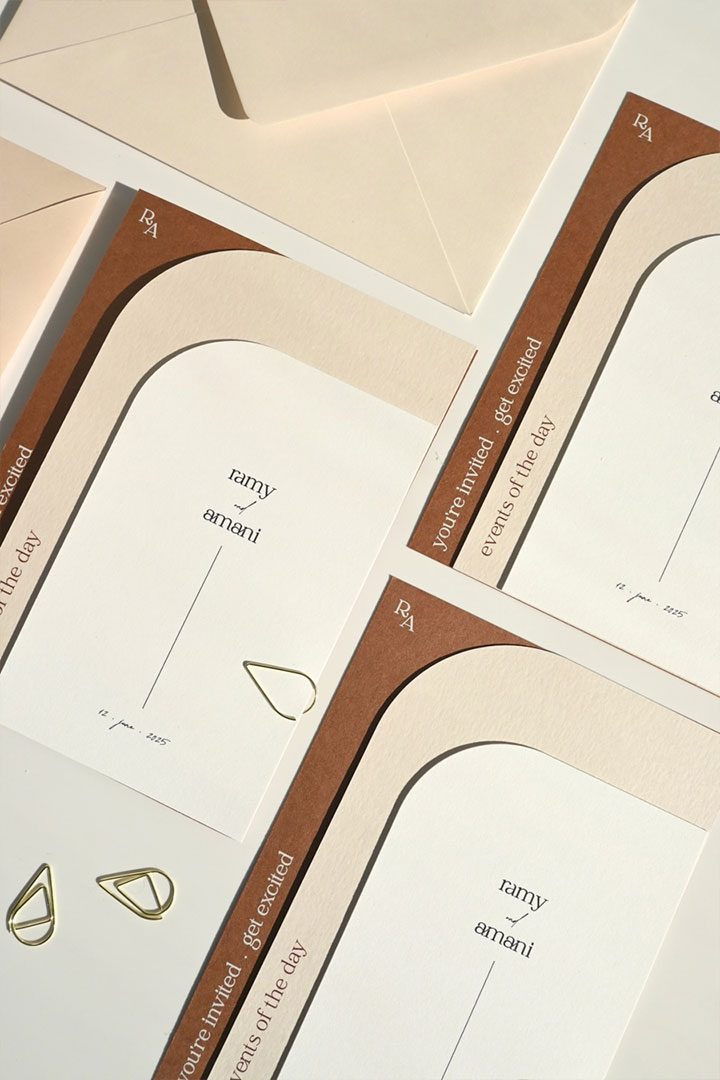
The most polished reception tables use menu cards that feel like a natural extension of the invitation suite, same fonts, same color palette, same print method where possible.
How to Match Your Suite
- Fonts first, if your invitation used a script font for names and a serif for body text, apply the same pairing to your menu headings and dish descriptions
- Color palette, pull your accent color (say, dusty rose or sage green) for course headings or a fine-line border element
- Paper stock, wherever possible, order your menu cards on the same paper stock as your invitations. A letterpress menu on 600gsm Wild Cotton cotton pairs perfectly with a letterpress invitation suite; a digital menu on 300gsm matte matches a digital invitation
- Print technique, if your invitations featured a flat foil monogram, a flat foil header or border on the menu card creates a visual echo that feels deliberate and expensive
Popular Design Directions
| Style | Design elements | Print method |
|---|---|---|
| Modern minimalist | Clean sans-serif, white space, thin rule lines | Digital, metallic |
| Romantic botanical | Watercolor florals, script font, earthy palette | Digital, flat foil accent |
| Luxe formal | Gold foil header, serif body, cotton card | Flat foil, letterpress |
| Rustic farmhouse | Kraft stock, white ink, handwritten script | White ink, digital |
| Moody garden | Dark card, white or metallic typography | White ink, metallic |
Browse the full range of custom wedding menu cards to filter by style, color, and print method.
Print Methods for Wedding Menu Cards: Digital, Flat Foil, and Letterpress
Paperlust offers five print methods for wedding menu cards. Here is how to choose between them.
Digital Print
Digital printing uses high-resolution inkjet or laser printing directly onto the card stock. It supports full-color designs including photos, watercolor artwork, and gradient backgrounds. It is the fastest and most affordable option, which makes it ideal for larger guest lists or couples who want a design-forward menu without a significant per-card premium.
- Paper options: matte, linen, metallic, kraft, blush, premium
- Minimum order: no minimum
- Best for: full-color artwork, modern designs, large guest counts
Flat Foil
Flat foil applies a mirror-bright metallic film directly to the surface of the card, no custom die, no debossing. The foil sits flush with the paper, catching the light without adding texture. Available in gold, pale gold, rose gold, silver, copper, and several other metallic shades. Flat foil is Paperlust’s foil technique for wedding stationery. Unlike the embossed metal-die method used by traditional artisan printers, flat foil leaves no impression in the paper, it is entirely surface-applied. This means a lower minimum order quantity and a shorter production lead time than die-based techniques. Flat foil gives you the luxe metallic look your suite deserves.
- Paper options: matte stock, 380gsm premium, 350gsm heavyweight, colour stock + foil (270gsm and 500gsm)
- Minimum order: 10 cards (except 350gsm heavyweight: minimum 30)
- Best for: gold or silver header text, monogram accents, elegant formal weddings
Letterpress
Letterpress presses ink and paper together under heavy pressure, leaving a visible deboss impression in the card. It is the most tactile and craft-intensive print method, producing a result that guests can feel as well as see. Paperlust uses 300gsm or 600gsm Wild Cotton cotton stock for all letterpress orders.
- Paper options: 300gsm Wild Cotton, 600gsm Wild Cotton (double-thick)
- Minimum order: 50 cards
- Best for: heritage, classic, or garden-party weddings; couples who want a truly handcrafted feel
- Note: custom samples are not available for letterpress. The $5 sample pack includes a letterpress example so you can feel the stock before ordering.
Metallic Print
Metallic print uses a dry toner gold or silver pigment at a fifth imaging station, giving the design a subtle metallic shimmer without the mirror-bright finish of foil. It is the most affordable way to add a metallic accent to a digitally printed card.
- Paper options: 300gsm matte, 300gsm linen, 380gsm premium
- Best for: couples who want a hint of shimmer without the cost of foil
White Ink
White ink is printed as a fifth color, making it possible to print on dark or deeply colored card stocks. It can be applied on its own or used as an underlay beneath CMYK color. Pairs beautifully with kraft, black, navy, and other dark card options.
- Paper options: 290gsm kraft, 180gsm vellum, 270-300gsm colour stock
- Best for: moody or dark-themed weddings, rustic kraft aesthetics
Individual Menu Cards vs Shared Table Menus
The choice between individual menu cards and shared table menus is partly a budget decision and partly a styling one.
Individual Menu Cards (Per Place Setting)
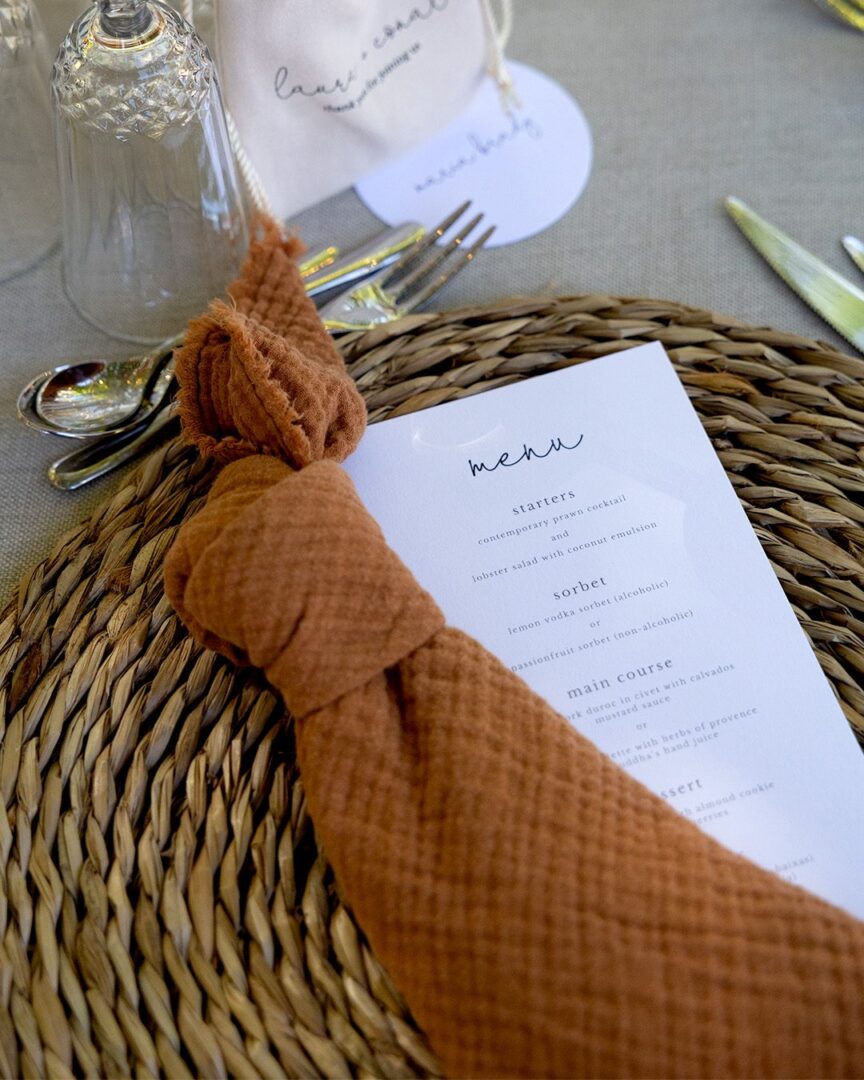
An individual card sits at each guest’s place, either tucked inside a folded napkin, propped against a water glass, or placed flat beneath the cutlery. This is the most common approach for plated receptions.
Advantages:
- Guests can refer to it throughout the meal without leaning across the table
- Works as a keepsake, many guests take theirs home
- Consistent styling across every place setting
- Pairs naturally with custom wedding place cards for a fully coordinated table
Considerations:
- Higher unit count means higher printing cost for large guest lists
- Requires accurate RSVP count before ordering (order 10-15% extra as buffer)
Shared Table Menus
A shared menu card, typically a larger format such as 5 x 7 inches [127x178mm] or A4, is placed once per table (usually two to four cards per table of eight to ten guests). This works well for buffet, family-style, or food-station receptions where each guest is not receiving a specific plated course.
Advantages:
- Lower total quantity, reduces cost for large guest lists
- Works well in minimalist tablescapes where individual cards might feel cluttered
Considerations:
- Less useful for plated multi-course dinners where guests have individual selections
- Doesn’t function as a personal keepsake
Hybrid Approach
Some couples order individual tent cards for each place setting (smaller format, shorter content) plus one framed or mounted table menu (larger format, full courses) as a decorative element near the centerpiece. This gives guests a personal item while also creating a table design moment.
Ordering Timeline: When to Finalize and Order Your Menu Cards
The most common mistake couples make with menu cards is ordering before the caterer has confirmed the final menu. Here is the timeline that keeps things on track.
Step 1: Wait for Caterer Confirmation
Do not place your menu card order, or even finalize the design wording, until your caterer has confirmed the final dishes. Caterers typically lock the menu 4-8 weeks before the wedding date. Some allow small wording adjustments right up until 2-3 weeks out; ask your caterer for their cut-off date.
Step 2: Design and Proof (allow 1-2 weeks)
Once you have the confirmed menu text, upload it to your chosen design and submit your order. Your Paperlust designer will deliver a proof within 1-2 business days. You have two rounds of edits included at no extra cost. Budget 1-2 weeks total for design back-and-forth to be safe.
Step 3: Production Window
Production time varies by print method:
- Digital print: approximately 8-10 business days in production
- Flat foil: approximately 10-14 business days in production
- Letterpress: approximately 20 business days in production
Step 4: Shipping and Delivery
Paperlust ships internationally via DHL Express. US delivery is typically 2-4 business days transit after dispatch. Orders over $350 USD qualify for free DHL express shipping.
Recommended Order Window: 4-6 Weeks Before the Wedding
| Print method | Order by (before wedding) |
|---|---|
| Digital print | 4 weeks before |
| Flat foil | 5 weeks before |
| Letterpress | 6-7 weeks before |
If your wedding date is approaching faster than the standard timeline allows, ask about 24-hour rush production (available for an additional fee on select digital print orders).
Wedding Menu Card FAQs
How many wedding menu cards do I need to order?
Order one card per guest for individual place-setting menus. For shared table menus, plan for one to two cards per table of eight to ten guests. Always add 10-15% extra to cover last-minute RSVPs or setup adjustments.
What size should a wedding menu card be?
The most common size for a flat card is 5 x 7 inches [127x178mm]. Bi-fold cards typically close to 4.25 x 5.5 inches [108x140mm] and open to 5.5 x 8.5 inches [140x216mm]. Tent cards fold to approximately 3.5 x 5 inches [89x127mm].
What print methods are available for wedding menu cards at Paperlust?
Digital print, flat foil, letterpress, metallic print, and white ink. Digital is the fastest and most affordable. Flat foil adds a mirror-bright metallic accent. Letterpress creates a tactile deboss impression on cotton paper.
When should I order my wedding menu cards?
Order 4-6 weeks before your wedding, but only after your caterer has confirmed the final menu. Digital print needs at least 4 weeks. Flat foil needs 5 weeks. Letterpress needs 6-7 weeks.
Should I match my menu cards to my wedding invitations?
Matching your menu cards to your invitation suite, same fonts, colors, and paper stock, creates the most cohesive table look. It is not required, but it photographs beautifully and feels intentional.
How do I list dietary options on a printed menu?
The cleanest approach is to list the dietary alternative directly below the standard dish for each course in smaller type or italics. For events where dietary needs were collected at RSVP, a short footer note is enough.
Can I get a sample menu card before ordering?
Yes. The $5 sample pack includes seven designs across different print methods, including a letterpress sample. A $15 custom sample is available for most print methods, but not for letterpress.
How much do wedding menu cards cost?
Pricing varies by print method and quantity. Digital print is the most affordable per card. Ordering three or more card types (menus, place cards, programs) at once saves 15% on the combined order.
What is the difference between individual cards and shared table menus?
Individual cards sit at each place setting, one per guest, they suit plated dinners and double as keepsakes. Shared table menus are placed one to two per table and work well for buffets or minimalist tablescapes.
Does Paperlust ship to the US?
Yes. US delivery is 2-4 business days transit via DHL Express after dispatch. Orders over $350 USD qualify for free DHL express shipping.
Ready to design your wedding menu cards?
Browse 500+ designs from independent artists and filter by print method, style, and color.