
Planning your ceremony order is one of the most practical and meaningful things you can do in the lead-up to your wedding. When you know exactly how each moment will unfold, from the first guest being seated to the final burst of confetti in the recessional, everything else falls into place. For the complete programs guide covering format, wording, and design choices, see Wedding Programs: The Complete Guide.
This article focuses on the ceremony itself: the standard order of events, who walks when, how to structure the vow exchange and rings, what optional rituals fit where, and how to handle variations for religious, civil, and non-denominational ceremonies. By the end, you will know exactly what to print on your order of service program.
- A typical wedding ceremony runs 20-30 minutes for a civil ceremony and 45-60 minutes for a religious one.
- The processional order runs: musicians/pre-ceremony music, seating of grandparents, seating of parents, wedding party (groomsmen then bridesmaids, or pairs), flower girl and ring bearer, then the couple or the person getting married.
- Core ceremony sections are: welcome/opening, readings (1-3), vow exchange, ring exchange, pronouncement and first kiss, then the recessional.
- Unity ceremonies (candle, sand, handfasting) are optional and sit between the vows and ring exchange, or immediately after.
- Civil and non-religious ceremonies follow the same basic structure but swap religious readings for poetry and remove faith-based rituals.
- Your printed order of service mirrors this sequence section by section, giving guests a roadmap for every moment.
The Standard Wedding Ceremony Order (Step by Step)
Every wedding ceremony, regardless of style or setting, follows a recognizable arc. Knowing this sequence helps you plan your timeline, brief your vendors, and ultimately structure the printed program your guests will hold.
Below is the standard order for a Western-style wedding ceremony. Scroll down for religious, civil, and non-denominational variations.
| Stage | What Happens | Typical Duration |
|---|---|---|
| Pre-ceremony | Guests arrive, ushers seat them, background music plays | 15-30 min |
| Processional | Wedding party and couple walk to the altar | 3-8 min |
| Welcome and opening | Officiant greets guests, sets tone of ceremony | 2-4 min |
| Readings | 1-3 readings by chosen guests or officiant | 3-8 min |
| Vow exchange | Couple recites personal or traditional vows | 3-6 min |
| Ring exchange | Rings placed, words spoken | 2-4 min |
| Unity ceremony (optional) | Candle, sand, handfasting, or other ritual | 3-7 min |
| Pronouncement and first kiss | Official declaration; couple kissed as married | 1-2 min |
| Signing (where required) | Legal documents signed by couple and witnesses | 3-5 min |
| Recessional | Couple and wedding party exit | 2-5 min |
Pre-ceremony: seating and music
- Guests typically arrive 15-30 minutes before the ceremony start time.
- Ushers greet guests at the entrance and escort them to seats, either by side (bride’s side / groom’s side, though many modern couples skip this distinction) or simply by filling from the front.
- Background music plays throughout seating. Strings, acoustic guitar, a pianist, or a curated playlist all work. Choose music that signals the mood you want.
- VIP seating (immediate family and anyone you want front-row access for) is typically completed before the processional begins.
The Processional Order: Who Walks First?
The processional is the formal entrance of the wedding party and the couple. Order conventions vary by religion, regional tradition, and personal preference, but the most common Western sequence is:
Traditional Western processional order
- Officiant – Takes their position at the altar first, often before any formal processional music begins.
- Grandparents of the couple – Typically escorted to their seats by an usher or younger family member before the official processional music starts.
- Parents of the partner not walking down the aisle – Escorted to their front-row seats.
- Groomsmen / honor attendants – Walk from the front or enter from the side, depending on venue layout. Some walk with bridesmaids in pairs; others enter separately.
- Bridesmaids – Walk in single file or in pairs with groomsmen. Chief bridesmaid (maid of honor) typically walks last in the bridesmaid group.
- Flower girl(s) – Scatter petals down the aisle. Typically adorable and slow.
- Ring bearer – Carries the ring pillow (with fake rings; real rings stay with the best person).
- The couple getting married – Walks last. Traditionally, the bride enters on the right arm of their escort (often a parent). Couples may walk together; same-sex couples each choose their own escort or walk solo.
Who walks the person getting married down the aisle?
There is no single rule here in 2026. Options include:
- One parent (traditionally the father of the bride, but both parents is increasingly common)
- Both parents together
- A sibling, grandparent, or close friend
- Walking alone as a statement of independence
- Both partners walking each other in simultaneously from opposite sides
- Both partners entering together if there is no traditional “bride walks to the groom” structure
Processional music choices
- The main processional typically begins when the wedding party starts walking and shifts to a different, often more dramatic, piece when the couple enters.
- Common choices: live strings, a singer, acoustic guitar, piano, or a carefully curated playlist.
- Tempo matters: most processionals work best at a moderate walking pace, roughly 70-80 beats per minute.
The Ceremony Itself: Welcome, Readings, Vows, and Ring Exchange
Once everyone is in place, the ceremony proper begins. Here is how each section typically runs.
Welcome and opening remarks
The officiant opens by welcoming guests, introducing themselves if necessary, and framing the significance of the occasion. This section usually runs 2-4 minutes. It might include:
- A formal welcome (“We are gathered here today…”)
- A brief reflection on marriage or the couple’s relationship
- Any practical instructions (photography policies, phone requests, when to be seated)
- An acknowledgment of absent loved ones, if the couple wishes
Readings
Most ceremonies include one to three readings. Common choices:
- Literary: Poetry or prose from authors the couple loves (Rilke, Pablo Neruda, Mary Oliver, e.e. cummings)
- Religious: Scripture passages (1 Corinthians 13, Song of Solomon, Ruth 1:16-17)
- Personal: Something written by a family member or the couple themselves
Readers are usually seated guests who are given the text in advance. Keep each reading to 1-3 minutes. Three readings is typically the maximum before attention wanders.
Vow exchange
The vow exchange is the emotional heart of the ceremony. Options:
- Traditional vows: Set text (“to have and to hold, from this day forward…”) repeated after the officiant
- Personal vows: Written by each partner, spoken from memory or read from a card
- Hybrid: Officiant’s traditional framework with personal additions
Personal vows typically run 1-3 minutes each when spoken at a normal pace. If you are writing them yourself, aim for 200-350 words per person.
Ring exchange
The ring exchange follows the vows. The ring bearer (if you have one) presents the rings, or the best person retrieves them from a pocket. The officiant prompts each partner to place the ring and speak the ring-exchange words (“with this ring, I thee wed” or a personalized version). The whole section runs 2-4 minutes.
Unity Ceremonies: Candle, Sand, Handfasting, and More
Unity ceremonies are optional rituals that symbolize the joining of two lives or two families. They typically follow the ring exchange, though some officiants place them between the vows and ring exchange. If you include one, budget 3-7 additional minutes.
Popular unity ceremony options
- Unity candle: Each partner holds a lit taper; together they light a central pillar candle. A classic, especially in church settings. Note: outdoor ceremonies can be tricky with wind.
- Sand ceremony: Two (or more) vessels of different-colored sand are poured into a shared container, creating a layered, unforgettable design. A popular alternative when candles are not practical.
- Handfasting: The couple’s hands are bound together with ribbon, cord, or cloth, symbolizing the literal “tying the knot.” Originally Celtic in origin, now popular across secular and spiritual ceremonies.
- Wine ceremony: A shared glass of wine is passed between partners, sometimes blended from two separate bottles. Can be adapted for other beverages.
- Tree planting: Each partner adds soil (or water) to a shared pot or garden bed. Particularly meaningful for eco-minded couples.
- Family unity: Children from previous relationships or siblings are invited to participate, often pouring sand into the family container or holding candles together.
If you include a unity ceremony, list it clearly in your printed program so guests understand what they are watching.
The Recessional: Who Exits First?
The recessional is the celebratory exit after the pronouncement. The order is essentially the reverse of the processional.
Standard recessional order
- The couple – Walk together, hand in hand, first.
- Flower girl and ring bearer – Usually follow immediately behind, or exit with the couple if very young.
- Best person and maid of honor (chief attendants) – Walk together as a pair.
- Remaining wedding party – Bridesmaids and groomsmen follow, typically in pairs.
- Parents of the couple – Exit next, escorted by ushers if necessary.
- Grandparents – Exit after parents, again escorted if needed.
- Guests – Row by row from front to back, usually guided by ushers.
Recessional music
- Recessional music should feel upbeat and celebratory. The couple is now married. This is not the moment for a slow ballad.
- Popular choices: Mendelssohn’s “Wedding March,” a triumphant classical piece, a joyful pop song, or something deeply personal to the couple.
- Music typically continues until most guests have filed out.

Order of Service for Non-Religious and Civil Ceremonies
If your ceremony is civil, non-denominational, or humanist, the core structure remains the same. The differences are in language and content rather than sequence.
Key differences in a civil or non-religious ceremony
- No religious readings: Substitute poetry, literary prose, song lyrics, or personal letters. Popular choices include Mary Oliver’s “When Death Comes,” Pablo Neruda’s love sonnets, or e.e. cummings’s “i carry your heart.”
- No faith-based language in vows: Phrases like “before God” or “in the eyes of God” are removed or replaced with secular equivalents (“before family and friends,” “in this community”).
- No unity candle as a religious symbol: Sand ceremonies, handfasting, or other non-religious rituals are common substitutes. The candle itself is not inherently religious; many civil couples still choose it.
- Legal declarations may differ: In some jurisdictions, civil ceremonies require specific legal wording from the officiant. Confirm with your officiant in advance.
- More flexibility overall: Civil ceremonies tend to be shorter (20-30 minutes) and can include almost anything the couple wants: a friend’s performance, a comedy reading, a moment of silence, or a group participation element.
Sample non-religious ceremony order
- Pre-ceremony music and seating
- Processional
- Welcome and opening (secular framing)
- Reading 1 (poetry or personal)
- Address to the couple (officiant’s reflection)
- Reading 2 (optional)
- Exchange of vows (personal or civil standard)
- Ring exchange
- Unity ritual (optional)
- Pronouncement
- First kiss
- Signing (if applicable)
- Recessional
For real examples of how non-religious and religious programs are designed and laid out visually, see Wedding Program Examples by Ceremony Style.
How to Translate Your Order of Service Into a Printed Program
Your ceremony order maps almost directly onto your printed wedding program. Here is how the two align, and what to include on each.
Program structure mirrors ceremony structure
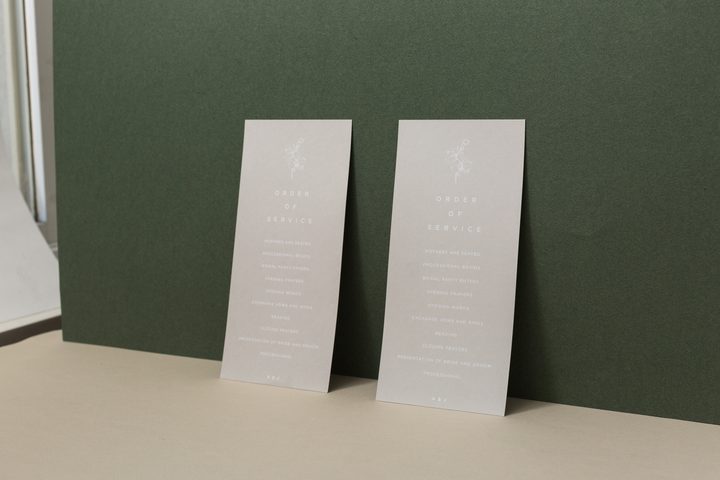
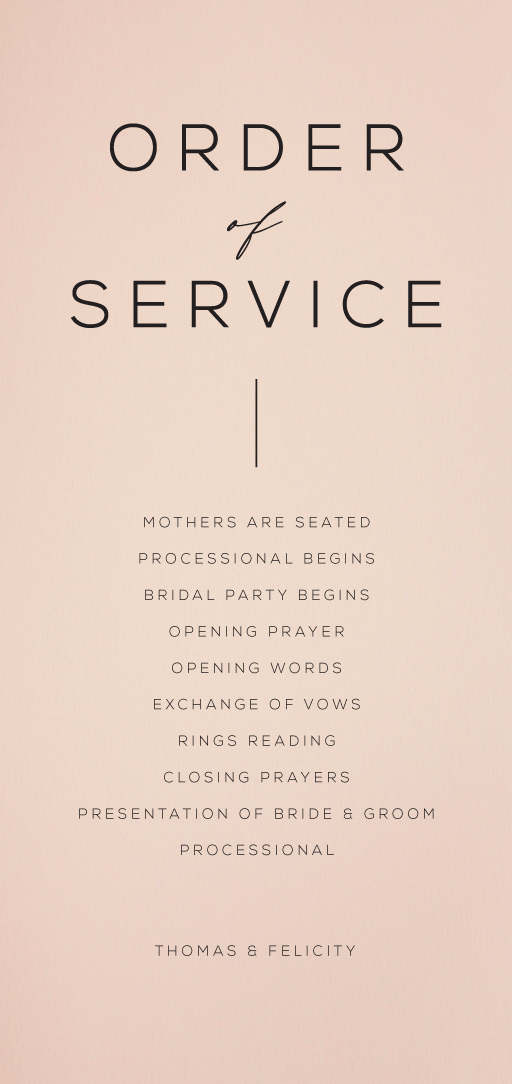
Every section of your ceremony gets a corresponding line or heading in the program. Guests follow along in real time, so the program needs to be clear and in order.
Welcome
Processional
Opening Words
First Reading: “The Art of Marriage” – read by Emma Torres
Address
Second Reading: 1 Corinthians 13:4-8 – read by David Chen
Exchange of Vows
Exchange of Rings
Lighting of the Unity Candle
Pronouncement of Marriage
First Kiss
Recessional
What else to include beyond the ceremony order
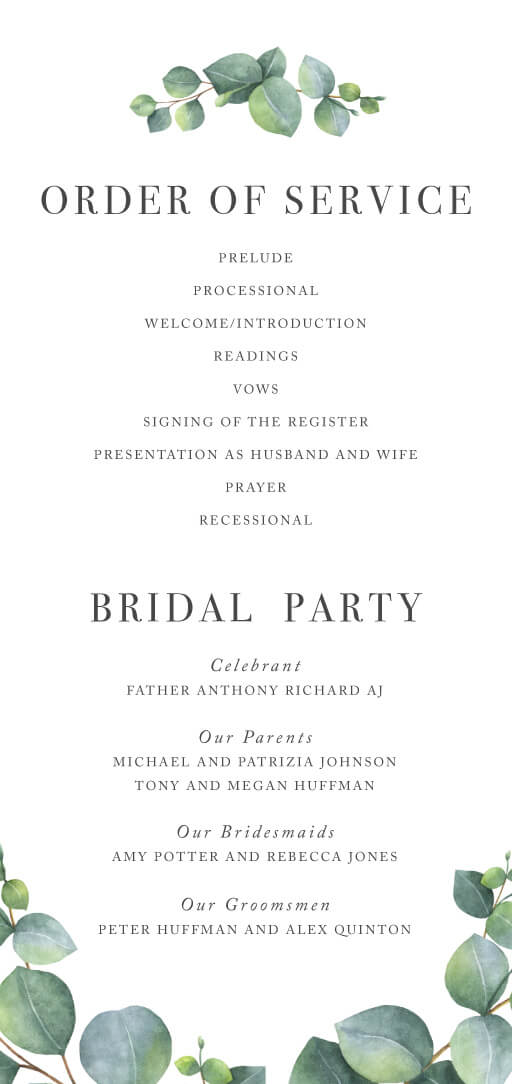
- Names of the wedding party: Listed with roles (maid of honor, best man, flower girl, officiant)
- Readings in full: Optional but appreciated, especially for longer or lesser-known texts
- Song titles and musicians: Useful for guests who want to Shazam a piece they love
- A thank-you note: Short and warm, from the couple to their guests
- A memorial: “In loving memory of…” acknowledgment for lost family members
- Reception details: Location and timing if not on the invitation suite
Format options for printed programs
Wedding programs come in several formats. The right choice depends on ceremony length, how much text you have, and your design aesthetic.
| Format | Best For | Typical Size |
|---|---|---|
| Single-sided flat card | Short civil or elopement ceremony | 4×6 in [102x152mm] or 5×7 in [127x178mm] |
| Folded booklet | Full religious or long ceremony with many sections | A5 [148x210mm] folded |
| Scroll or fan | Outdoor summer ceremonies (fan is functional) | Varies |
| Bi-fold card | Medium-length ceremonies with moderate content | 4×9 in [102x229mm] or DL |
For wording help, see our guide to order of service wording for example text across every section. For even more complete wording examples, see Wedding Program Wording Examples.
For design choices, print methods, and layout tips once you know your content, see Wedding Program Design Tips.
Browse the full range of Paperlust ceremony programs, available in digital print, letterpress, flat foil, metallic, and white ink on premium paper stocks, at wedding programs.


Order of Service FAQs
What is the order of a wedding ceremony?
A typical wedding ceremony follows this sequence: pre-ceremony seating, processional, welcome and opening remarks, readings, vow exchange, ring exchange, optional unity ceremony, pronouncement and first kiss, optional signing, and recessional. The total duration depends on ceremony type, running 20-30 minutes for a civil ceremony and 45-60 minutes for a full religious service.
Who walks down the aisle first in a wedding?
In a traditional Western processional, grandparents are seated first, followed by parents of the partner not walking down the aisle. The wedding party (groomsmen, then bridesmaids, or in pairs) walks next. The flower girl and ring bearer come just before the main event. The person or couple getting married walks last, usually to a different, more dramatic piece of processional music.
How long does a wedding ceremony take?
A civil or non-religious ceremony typically runs 20-30 minutes. A standard church ceremony runs 45-60 minutes. A full Catholic Mass with wedding rites can run 60-90 minutes or longer. These estimates do not include the pre-ceremony seating period, which typically adds another 15-30 minutes.
What is the difference between an order of service and a wedding program?
They are the same thing. “Order of service” is the British and Australian term; “wedding program” is more common in the United States. Both refer to the printed document guests receive listing the ceremony sequence, wedding party names, readings, and any other relevant details.
What goes on a wedding order of service?
A complete order of service typically includes: the names of the couple and the date, a list of every ceremony section in order, the names of the wedding party and officiant, reader names and reading titles, song titles and performers, and a thank-you note. Optional additions include readings printed in full, memorial acknowledgments, and reception details.
When should guests be seated before a wedding ceremony?
Guests should be seated at least 15-20 minutes before the ceremony start time. Send invitations with a start time 15 minutes earlier than you actually intend to begin (sometimes called “doors open” time) to account for late arrivals and seating delays. For larger weddings with 150+ guests, build in 30 minutes of seating time.
What is the order for a non-religious wedding ceremony?
A civil or non-religious ceremony follows the same general arc: processional, welcome, readings (literary or personal instead of scripture), address from the officiant, personal vow exchange, ring exchange, optional unity ritual, pronouncement, first kiss, and recessional. The language is secular and the couple has much more flexibility to personalize every element.
Can you skip sections of the ceremony order?
Yes. Readings, unity ceremonies, and the signing are all optional. Some couples shorten their ceremony to 15 minutes intentionally. The only required elements for a legal marriage are the formal declaration of intent (the vows, in a form that meets your local legal requirements) and the pronouncement by a licensed officiant. Everything else is yours to include, remove, or adapt.
What order does the wedding party walk in during the recessional?
The recessional reverses the processional. The couple exits first, followed by the flower girl and ring bearer (if present), then the chief attendants (maid of honor with best man), then the remaining wedding party in pairs, then parents, then grandparents, and finally the general guests row by row from front to back.
How many readings should a wedding ceremony have?
Most ceremonies include one to three readings. One reading keeps the ceremony brisk; two readings allow you to honor more guests; three readings is usually the maximum before attention starts to drift. Each reading should run no longer than 2-3 minutes when spoken aloud at a comfortable pace, which corresponds to roughly 300-450 words of text.
Ready to print your order of service?
Browse 500+ ceremony program designs in digital print, letterpress, flat foil, metallic, and white ink.