
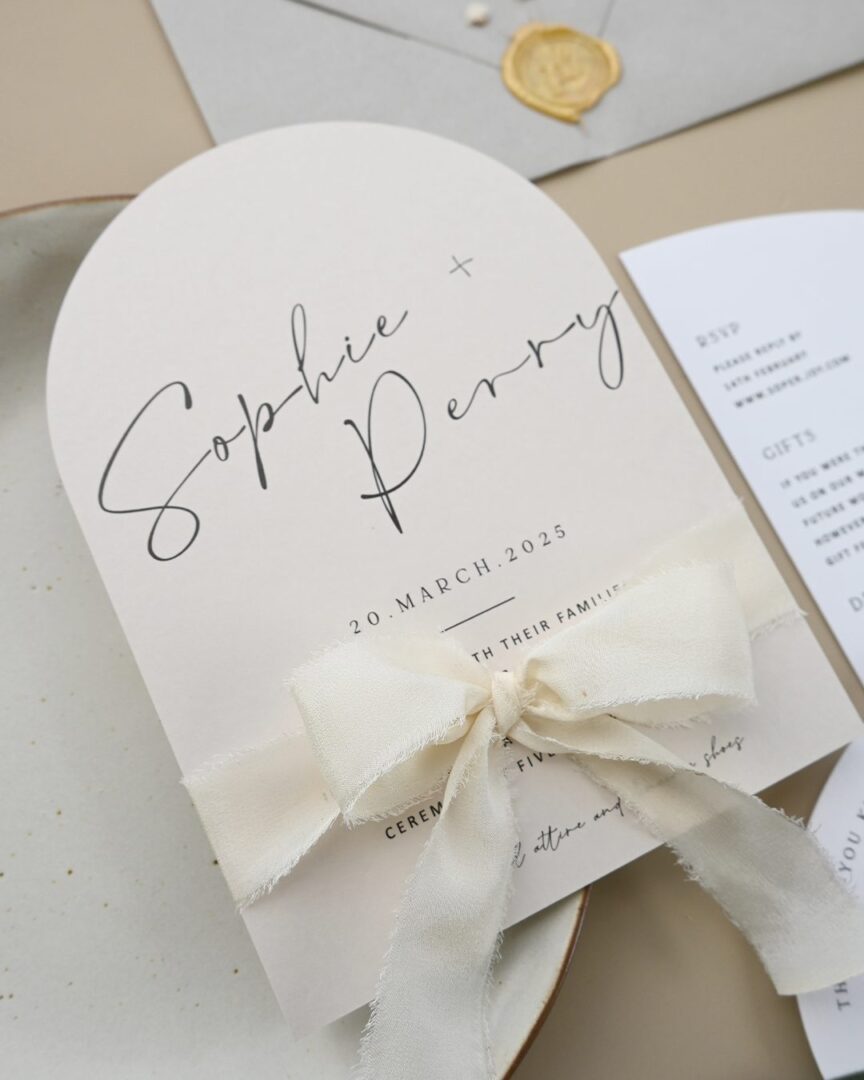
Your guest list is finalized, your seating arrangement is locked in, and now you need the one piece of stationery that ties the entire reception table together. Wedding place cards seem simple, but there are more decisions involved than most couples expect: format, wording style, whether to include meal selections, when to order, and how to make sure they actually match the rest of your suite. This guide covers every decision in order, so you can get to checkout with confidence.
- Place card vs escort card: escort cards go at the entrance and direct guests to a table; place cards sit at each seat and assign the exact chair.
- Standard size: 3.5″ x 2″ (89mm x 51mm) tented, or 3.5″ x 3.5″ (89mm x 89mm) flat/die-cut, both are easy to read from a standing position.
- Wording minimum: guest name only is always enough; add table number or meal symbol only if your venue requires it.
- Meal choice: use a small symbol or color-coded dot on the card, never write the full entree name on a visible card.
- Order timeline: place your order 2-3 weeks before the wedding, after your final RSVP count is confirmed.
- Free DHL express shipping on orders over $350 USD; proofs delivered within 1-2 business days.
Place Cards vs Escort Cards: What Is the Difference?
The two terms get used interchangeably at weddings, but they describe two different tools that solve the same seating problem in different ways. Understanding the distinction helps you decide which one your reception actually needs, or whether you want both.
An escort card is displayed near the entrance to the reception, usually arranged alphabetically on a table or display. Each guest picks up their own card, which tells them which table they are sitting at. Escort cards typically list the guest’s name and table number or table name. They do not assign a specific chair.
A place card sits at the individual place setting, on or above the plate. It assigns one specific seat to one specific person. Every chair at every table has one. Place cards are used when you want full control over who sits next to whom, common at formal weddings, family-heavy receptions, or any event where a caterer needs to match an entree to a seat.
Which do you need?
| Scenario | Best option |
|---|---|
| You want guests seated at a specific table but not a specific chair | Escort card only |
| You want each guest at a specific assigned chair | Place card only (or both) |
| You have a pre-selected meal and need caterer coordination | Place card (with meal symbol) |
| You have a large guest list and want a beautiful entrance display | Escort card display + place cards at table |
| Small, intimate wedding (under 40 guests) | Place cards alone, no escort card needed |
For a deeper look at how each option works in practice, see our full breakdown: Escort Cards vs Place Cards: Which Does Your Reception Need?
Place Card Sizes and Formats: Tented, Flat, and Folded
Place cards come in a handful of standard formats, and the format you choose affects both how the card looks on the table and how guests interact with it.

Browsing place cards? Shop by region: United States | Australia | United Kingdom | Canada | New Zealand
Tented (folded tent) place cards
The tent card is the most common format. The card is scored down the middle and folded in half so it stands on its own. Standard finished size is 3.5″ wide x 2″ tall (89mm x 70mm) when standing. No holder required. Because the card is self-supporting, it works on any table surface.
Flat place cards
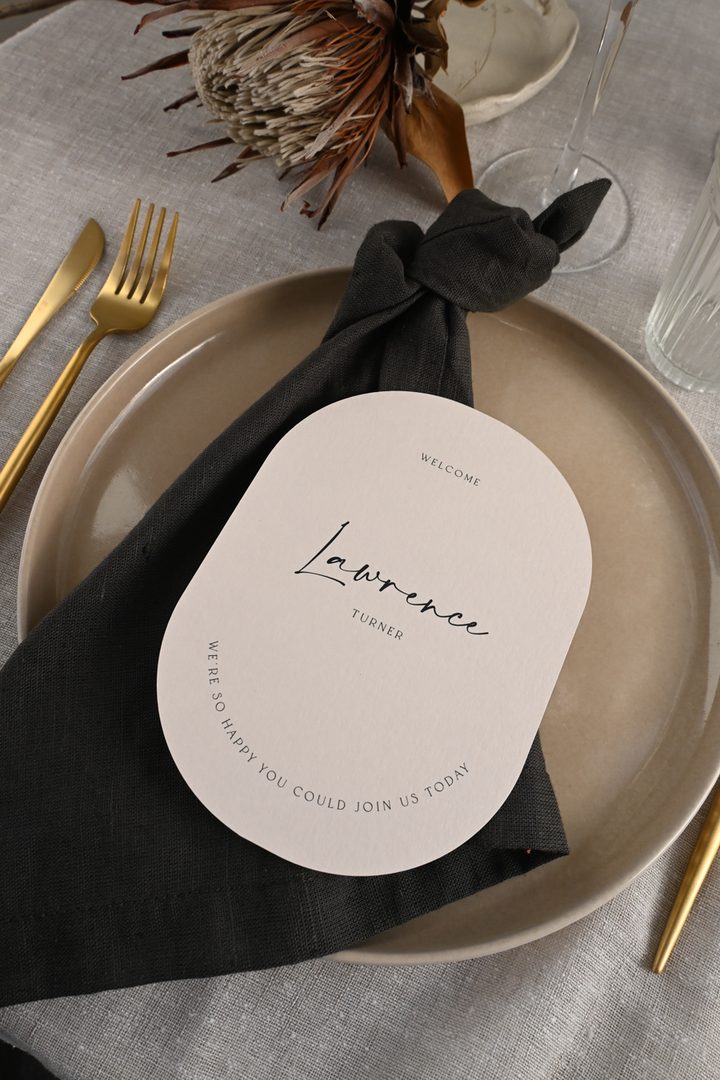
A flat place card does not fold. It lies flat on the plate or napkin, or sits in a dedicated card holder (wire frame, acrylic slot, or decorative clip). Flat cards give more room for die-cut shapes and printing detail because there is no fold to engineer around. Sizes vary: 3.5″ x 2″ (89mm x 51mm) is standard, but half-arch, scallop, oval, and round shapes are all popular at Paperlust.
Folded (double-panel) place cards
A folded card is similar to a tent card but uses a larger unfolded sheet, giving two full panels for design. Some couples print the guest’s name on the outside panel and a personal note or the menu selection inside. Less common but well-suited to formal weddings.
Die-cut and shaped cards
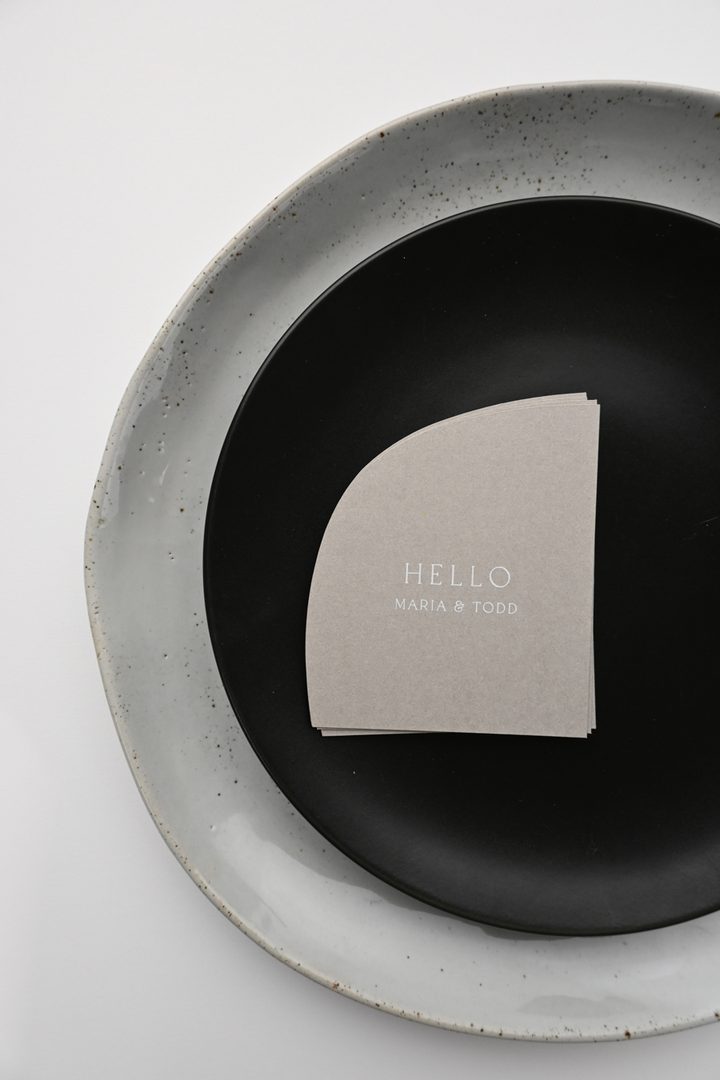
Shapes are increasingly popular and a strong way to carry a design theme through the table. Half-arch, scallop, oval, wave-edge, and quarter-circle shapes are all available in the Paperlust range. Shaped cards work best as flat cards with a dedicated holder or as part of a menu-place card combo.
Size reference table
| Format | Common size (inches) | Common size (mm) | Holder needed? |
|---|---|---|---|
| Tent card | 3.5″ x 2″ standing | 89mm x 51mm | No |
| Flat standard | 3.5″ x 2″ | 89mm x 51mm | Optional |
| Half-arch / die-cut | 3″ x 3.5″ approx. | 76mm x 89mm approx. | Recommended |
| Round | 3″ diameter | 76mm diameter | Recommended |
What to Write on a Wedding Place Card: Wording Guide
The single most important rule for place card wording: be consistent across every card. Choose one format and apply it to all guests without exception.
Name-only (simplest and most common)
Name only is entirely appropriate at any wedding, formal or casual. It directs guests to the right seat without adding visual noise to the table.
Name + table number
Use this format when you are using place cards at an unassigned table (i.e., guests choose their own chair once they know their table) or when you have not provided a separate escort card display.
Table 7
Formal titles (Dr., Rev., the Honourable)
At formal weddings, use full honorifics on place cards. Apply consistently, if you use “Dr.” for one guest, use applicable titles for all guests who hold them.
First name only (casual weddings)
For informal or relaxed celebrations, first-name-only works well and gives the table a warm, personal feel.
Couples sharing a card (rare but used at very small weddings)
Note: a shared card only works if both people are seated side by side. For separated couples or standard assigned seating, always use individual cards.
Meal Choice Place Cards: How to Include Dietary Selections
If your venue is serving a pre-selected entree, your caterer will need a way to match each plate to each guest. Place cards are the standard mechanism for this, but the method matters.
Why you should not write the entree name on the card
Writing “Chicken” or “Vegetarian” in large text on a place card feels clinical and can cause social awkwardness (guests can see what others ordered). Instead, use a symbol or color system that is readable to caterers but subtle to guests.
Symbol method
Print or stamp a small symbol in a corner of the card. Agree on the code with your caterer in advance. Common conventions:
| Symbol | Typical meaning |
|---|---|
| Circle (filled or hollow) | Chicken / poultry |
| Square | Beef / red meat |
| Triangle | Fish / seafood |
| Leaf or diamond | Vegetarian / vegan |
| Star | Children’s menu |
Color-coded dot method
A small colored sticker dot placed on the back or bottom edge of the card is the most discreet option. Red, blue, and green stickers from any office supply store work well. Coordinate the color key with your venue coordinator at the final walkthrough.
Abbreviated text (subtle corner notation)
If you prefer text, use a small abbreviated notation printed in a light ink in the lower corner of the card. This is readable to caterers presenting plates but not immediately visible to seated guests.
VG
Confirm the abbreviations with your caterer before finalizing the print order. They may have a preferred system already in use.
Design Tips: How to Match Place Cards to Your Suite
Place cards that look pulled from a different wedding are a visual distraction at the reception table. The goal is for your cards to feel like a natural extension of your invitation suite, not a last-minute addition.
Match the font family
The most impactful single design decision is font consistency. If your invitations use a script font for names and a serif for body text, carry that same combination to your place cards. Your Paperlust designer has access to your original design files and can apply the same font treatment directly.
Carry the color palette
Pull at least one color from your invitation suite into your place card design. If your invitations are ivory with sage green botanical accents, a sage place card with ivory text maintains visual cohesion. If your suite uses gold flat foil, match with gold flat foil on the place cards.
Match the print method
This is where budget decisions become visible. If your invitations are printed with digital print, digital place cards will match perfectly. If your invitations use flat foil, placing flat foil place cards beside them creates a unified premium feel. Mixing digital and foil prints at the same table setting can create an unintentional contrast.
Consider the shape
Die-cut shapes are a powerful way to reinforce a theme. Scallop and shell shapes suit coastal and beach weddings. Arch and half-arch shapes are a strong fit for romantic, garden, and modern minimalist aesthetics. Classic rectangular or tent cards suit traditional formal weddings.
Use the same paper stock where possible
If your invitation suite uses 380gsm Premium paper, selecting the same stock for place cards creates a tactile consistency that guests will notice even without being able to name why. Paperlust’s 500+ designs are grouped by suite, so selecting coordinating pieces within the same suite keeps design, paper, and print method aligned automatically.
Print Method Options for Place Cards: Digital, Flat Foil, and More
Paperlust offers several print methods for place cards. Here is how each one compares so you can choose the right level of finish for your budget and aesthetic.
Digital print
Digital is the most affordable option and the fastest to produce. Full-color print with sharp detail on your choice of matte, linen, premium, metallic, or cotton paper. The right choice for most weddings, especially when you need high quantity or have a full-color design with photography or watercolor elements.
Flat foil
Flat foil applies a mirror-bright metallic finish to selected design elements (typically the guest’s name or a decorative accent). No custom die is required, which keeps minimum order quantities lower and production faster than die-based foil techniques. Available in gold, pale gold, rose gold, silver, copper, holographic, and several color foils. The right choice if your invitation suite already uses flat foil and you want a consistent premium finish at the table.
Metallic print
Metallic print uses a gold or silver pigment applied at a fifth imaging station, giving a subtle sheen that reads as metallic in person without the full mirror-bright contrast of foil. More affordable than flat foil, and a strong choice when you want a hint of warmth without committing to full foil treatment.
White ink
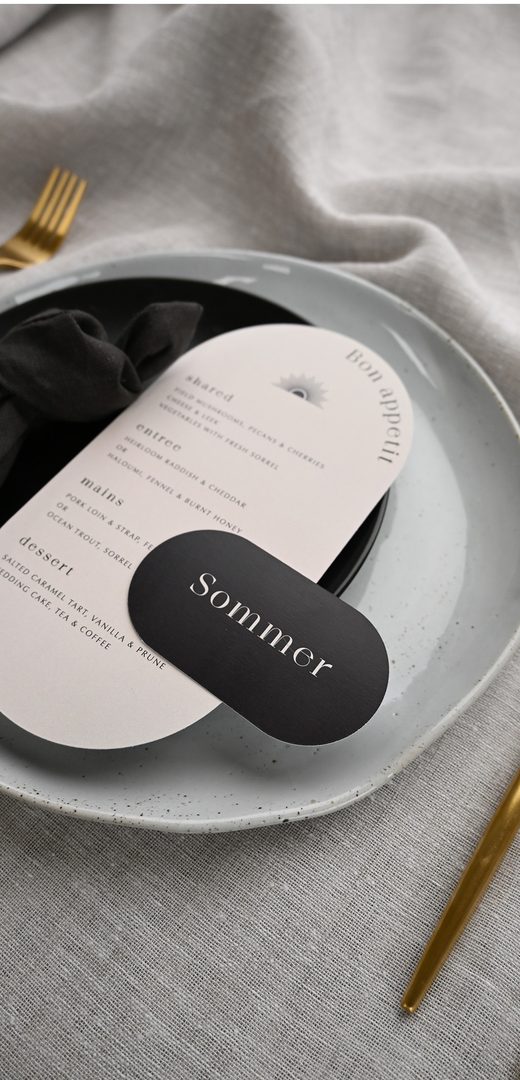
White ink prints on dark or colored paper stocks, allowing for elegant reversed-out designs. White on navy, white on black, white on forest green, all achieve a high-contrast look that reads as formal and intentional. A good match for moody, modern, or maximalist table aesthetics.
Letterpress
Letterpress presses each card individually into 300gsm or 600gsm Wild Cotton paper, leaving a tactile debossed impression. The most premium and most costly option. Production time is approximately 20 business days. Suited to couples whose invitations are also letterpress and who want a fully luxury finish across every stationery touchpoint.
| Method | Price tier | Production time (approx.) | Best for |
|---|---|---|---|
| Digital | $ | 8-10 business days | Most weddings; full color designs |
| Flat foil | $$ | 10-14 business days | Matching foil suite; metallic name treatment |
| Metallic print | $$ | 8-10 business days | Subtle gold sheen on a budget |
| White ink | $$ | 8-10 business days | Dark stock; formal reversed-out designs |
| Letterpress | $$$ | ~20 business days | Full luxury finish; matching letterpress suite |
Quantity Guide and Ordering Timeline
How many place cards do you need?
Order one place card per guest, not per household. If a couple is seated at the same table but in assigned chairs, each person needs their own card.
Add a buffer of 5-10% on top of your confirmed RSVP count. Cards are occasionally lost in transit, dropped, or damaged during setup. Reorders take additional production time and are rarely cost-effective as a separate small run.
| Guest count | Recommended order quantity |
|---|---|
| Under 50 | RSVP count + 5 |
| 50-100 | RSVP count + 8-10 |
| 100-200 | RSVP count + 10-15 |
| 200+ | RSVP count + 15-20 |
When to place your order
Your place card order depends on two upstream events: your RSVP deadline and your finalized seating arrangement. You cannot finalize place card names until both are done.
Ordering timeline (working backwards from your wedding date)
- 8-10 weeks out: RSVP deadline passes; you have a confirmed guest count.
- 6-8 weeks out: Finalize your seating arrangement. Use a seating chart to map tables and confirm all names. Browse Paperlust seating charts if you still need a printed chart for the venue entrance.
- 4-6 weeks out: Place your place card order. Upload your guest name list to your designer at this point.
- 1-2 business days after ordering: Receive your digital proof. Review all names carefully, spelling errors are the most common issue.
- After proof approval: Production begins. Allow 8-10 business days for digital print; approximately 20 business days for letterpress.
- 2 weeks out (minimum): Cards should arrive. This gives you buffer time for any issues before the rehearsal week.
DIY vs Professional Place Cards: Honest Comparison
DIY place cards are a common impulse for budget-conscious couples. The real cost is not just materials, it is time, consistency, and the professional finish you give up. Here is an honest side-by-side.
What DIY actually costs
- Cardstock: 100-sheet packs of suitable 80-100lb cardstock run $15-30 USD. For 150 cards with a buffer, expect at least two packs.
- Printing: Home inkjet printers struggle with heavy cardstock and produce variable color output. A print shop (FedEx Office, Staples) charges $0.10-0.25 per page for laser prints.
- Cutting: Straight-edge cutting requires a paper trimmer and produces minor variations in cut size. Die-cut shapes are not achievable at home without a specialist cutter.
- Time: For 150 guests, allow 4-6 hours minimum: layout, proofing, printing, cutting, sorting. More if any names are misspelled and need reprinting.
What you give up with DIY
- Die-cut shapes (arch, wave, scallop, half-circle) are not achievable on home equipment
- Foil treatment of any kind is not available for home printing
- Consistent color matching to your printed invitation suite is difficult without a calibrated press
- Paper stock quality and weight will likely differ from your invitation suite
Where DIY makes sense
- Very small guest count (under 30) where the time investment is manageable
- Casual outdoor or bohemian wedding where a hand-crafted look is intentional and desirable
- Name-only flat cards with simple typography printed at a local print shop (not at home)
For a complete step-by-step approach if you do decide to go the DIY route, see How to Make Wedding Place Cards.
Where professional printing wins clearly
- You want die-cut shapes, foil, letterpress, or metallic print
- You need 75+ cards with consistent color and cut across the entire set
- Your invitation suite is professionally printed and you want a matching finish at the table
- You do not have 4-6 hours to spare in the final weeks before your wedding
The honest comparison: for most couples planning a wedding with a professionally printed suite, the time cost of DIY alone exceeds the price difference. Professional place cards from Paperlust start from just over $1 per card for a simple digital print run, with proofs delivered within 1-2 business days.
Wedding Place Card FAQs
What is the standard size for wedding place cards?
The most common size is 3.5″ x 2″ (89mm x 51mm) for flat cards. Tented cards fold from a sheet scored at the center, typically finishing at 3.5″ wide by 2″ tall when standing. Die-cut shapes vary, but most fall within a 3″-4″ (76mm-102mm) range so they are visible on a dinner plate without covering the rim.
Do I need place cards at my wedding?
Not every wedding requires place cards. If you have fewer than 50 guests and are comfortable with open seating, you may not need them. If your venue is catering a pre-selected meal, your caterer will almost certainly require them. If you have more than 80 guests, some form of seating direction (escort cards, place cards, or a seating chart) makes the reception run more smoothly for guests and venue staff.
What is the difference between a place card and an escort card?
An escort card is displayed at the entrance to the reception and directs guests to their table. A place card sits at the individual seat and assigns the exact chair. Some couples use escort cards at the entrance display (for the guest arrival experience) and place cards at the table (for caterer coordination). Others use only one or the other. See our full guide: Escort Cards vs Place Cards.
Should I include table numbers on place cards?
Include a table number on your place card only if you are not providing a separate seating chart or escort card display. If guests already know their table number from an escort card, repeating it on the place card is redundant. For assigned-seat receptions, name-only place cards are standard when the table number was communicated at the entrance.
How do I indicate meal choices on place cards without it being obvious?
The most common methods are a small symbol printed in a corner of the card (circle, square, triangle, or leaf for different entrees), an abbreviated notation in small type (such as “CH” or “VG”), or a color-coded adhesive dot placed on the back. Coordinate the system with your caterer before placing your order so the code is agreed in advance.
When should I order wedding place cards?
Order 4-6 weeks before your wedding, after your RSVP deadline has passed and you have finalized your seating arrangement. This gives you time to proof names carefully (1-2 business days for proof delivery), approve, and receive finished cards before the rehearsal week. Allow extra lead time if you are ordering letterpress (approximately 20 business days production).
Can I order a custom sample before placing my full place card order?
Yes, a custom printed sample is available for most print methods for $15 USD, allowing you to check the paper quality, color, and finish in person before committing to a full print run. Note that the $15 custom sample is not available for letterpress, for letterpress evaluation, the $5 sample pack (which includes a letterpress sample) is the best way to check the paper and print quality before ordering.
Does Paperlust offer free shipping on place cards?
International orders over $350 USD ship free via DHL Express, with transit typically 2-4 business days after dispatch. Orders under the $350 threshold are charged at standard DHL Express rates. All Australian orders ship free via overnight Startrack.
Can I order place cards that match my invitation suite?
Yes. Paperlust’s designs are grouped into coordinated suites, and you can order place cards in the same design family as your invitations to maintain visual consistency across your entire stationery collection. Browse the full range at Paperlust wedding place cards.
What if I have a last-minute RSVP or a name change after I have already ordered?
If you discover a name error or late RSVP shortly after placing your order, contact Paperlust customer support via live chat as quickly as possible. Changes before proof approval are free. After proof approval and production has begun, additional cards may be ordered as a separate short run, though the per-card cost will be higher than the original order.
Ready to order your wedding place cards?
Browse 500+ designer place card styles. Proofs in 1-2 business days. Free DHL Express on orders over $350 USD.